Chapter 03 – The Manager’s Changing Work Environment & Ethical Responsibilities: Doing the Right Thing
3-21
d. Organizations may have two important value systems that can
conflict:
(1) the value system stressing financial performance versus
(Correct answer is C)
C. Four Approaches to Deciding Ethical Dilemmas.
1. The utilitarian approach: for the greatest good
a. Ethical behavior in the utilitarian approach is guided by what will
result in the greatest good for the greatest number of people.
Chapter 03 – The Manager’s Changing Work Environment & Ethical Responsibilities: Doing the Right Thing
3-22
2. The individual approach: for your greatest self-interest long term which will
help others.
a. Ethical behavior in the individual approach is guided by what will
result in the individual’s best long-term interests, which ultimately is
considered in everyone’s self–interest.
3. The moral-rights approach: respecting fundamental rights shared by
everyone.
4. The justice approach: respecting impartial standards of fairness.
a. Ethical behavior in the justice approach is guided by respect for
impartial standards of fairness and equity.
Group Exercise: Solving an Ethical Dilemma
There is a group exercise available at the end of this manual that applies the four
approaches to studying ethical dilemmas.
Exercise Objective
Chapter 03 – The Manager’s Changing Work Environment & Ethical Responsibilities: Doing the Right Thing
3-23
(Correct answer is D)
C. White-Collar Crime, SarbOx, and Ethical Training
1. At the beginning of the 21st century, U.S. business was rocked by an array
of scandals like Enron and WorldCom.
2. Next were cases of insider trading, the illegal trading of a company’s
stock by people using confidential company information.
Chapter 03 – The Manager’s Changing Work Environment & Ethical Responsibilities: Doing the Right Thing
3-24
5. How do people learn ethics? Psychologist Laurence Kohlberg has
proposed three levels of personal moral development.
a. Level 1, preconventional—people at this level tend to follow rules and
to obey authority; managers tend to expect obedience for
obedience’s sake.
D. How Organizations Can Promote Ethics
1. Creating a strong ethical climate
2. Screening prospective employees
3. Instituting ethics codes and training programs
a. A code of ethics consists of a formal written set of ethical standards
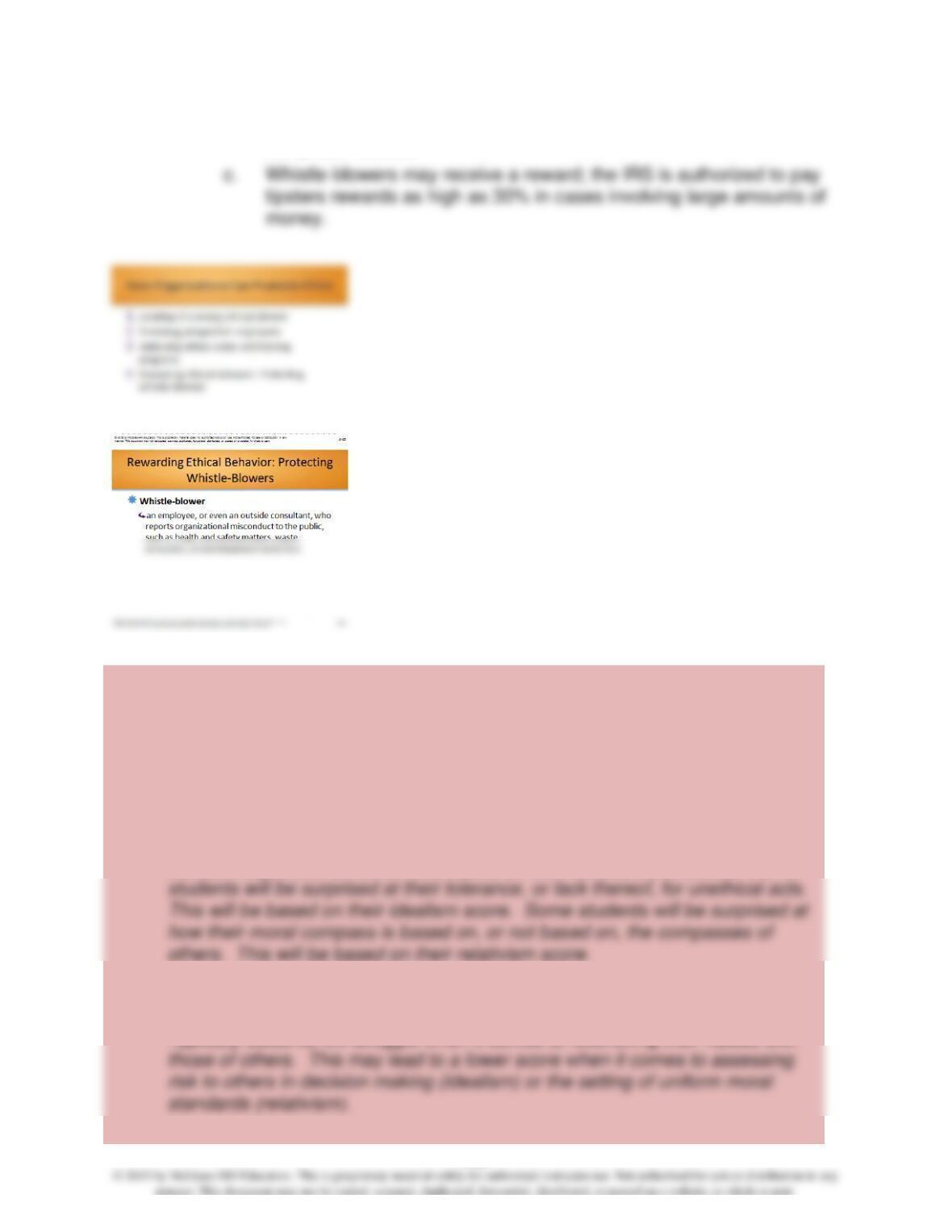
4. Rewarding ethical behavior: protecting whistle-blowers
Chapter 03 – The Manager’s Changing Work Environment & Ethical Responsibilities: Doing the Right Thing
3-25
b. Federal law prohibits employers from firing employees who report
workplace hazards.
SELF-ASSESSMENT 3.1 (p. 87)
Assessing Your Ethical Ideology
Go to connect.mheducation.com and take Self-Assessment 3.1.
Student Questions:
1. Where do you stand in terms of idealism and relativism? Are you surprised by
the results?
Student responses will differ here based on their assessment results. Some
2. Based on your two lowest-scored items for idealism and relativism, what
beliefs are getting in the way of increasing your ethical ideology?
Typically students will struggle when it comes to reconciling their values with
3. How might a low ethical ideology impact your career? How about a high
Chapter 03 – The Manager’s Changing Work Environment & Ethical Responsibilities: Doing the Right Thing
3-26
ethical ideology?
A low ethical ideology can lead to poor decision making that can cause the
Additional Activities:
You can also consult the Connect Instructors Manual for the post-assessment activity
and corresponding PowerPoint slides used for this Self-Assessment in Connect. In
Section 3.5 discusses corporate social responsibility, including economic, legal, ethical
and philanthropic responsibilities. Social responsibility also includes climate change,
sustainability, and natural capital.
One way that you could begin your coverage of these topics is to have the students
read the Harvard Business Review article “The Truth about CSR.” This article provides
Possible Topics for Discussion:
• Summarize the benefits to firms of displaying ethical behavior and high social
responsibility.
3.5 The Social Responsibilities Required of You as a
Manager (pp. 88–92)
Is being socially responsible really necessary?
Chapter 03 – The Manager’s Changing Work Environment & Ethical Responsibilities: Doing the Right Thing
3-27
• Assume you want to learn more about a firm’s corporate social responsibility
Major Idea Outline:
A. Social responsibility is a manager’s duty to take actions that will benefit the
interests of society as well as of the organization.
C. Is Social Responsibility Worthwhile? Opposing and Supporting Viewpoints.
1. Against social responsibility: Economist Milton Friedman says that the only
social responsibility of business is to maximize profits.
2. For social responsibility:
D. Corporate Social Responsibility: The Top of the Pyramid
Chapter 03 – The Manager’s Changing Work Environment & Ethical Responsibilities: Doing the Right Thing
3-28
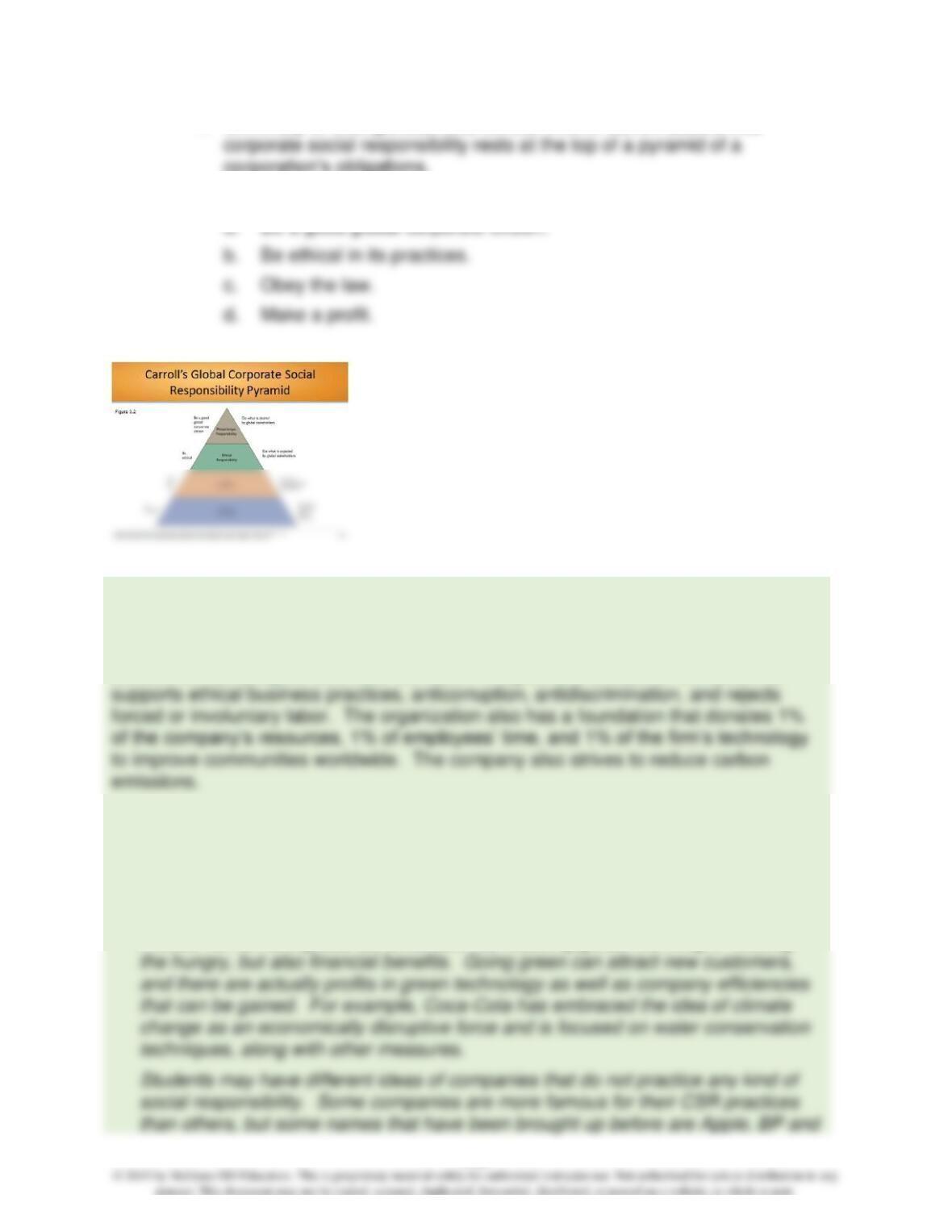
1. University of Georgia business scholar Archie Carroll asserts that
corporation’s obligations.
2. He suggests the priorities of the organization should be:
Interactive Classroom Material:
EXAMPLE: Corporate Social Responsibility: Salesforce.com Wants to Change
the Way the World Works (p. 90)
Salesforce has adopted Business Conduct Principles and a Code of Conduct that
YOUR CALL
Do you believe corporate social responsibility really has benefits? Can you
think of any highly profitable and legal businesses that do not practice any kind
of social responsibility?
Corporate social responsibility surely has benefits. These benefits do not only
include human and global benefits, such as reducing global warming or feeding
Chapter 03 – The Manager’s Changing Work Environment & Ethical Responsibilities: Doing the Right Thing
3-29
JP Morgan Chase.
Additional Activities:
One way to build on this Example is to have the students watch the CNN Money
segment “The Business of Business is not Business.” In this 4-minute video,
Salesforce.com CEO Marc Benioff discusses why focusing solely on shareholder
returns today is not the role of a CEO. Consider using the following discussion
questions:
Do you agree with Marc Benioff that CEOs today should not focus exclusively on
shareholder wealth? Defend your point of view.
E. One Type of Social Responsibility: Climate Change, Sustainability, & Natural
Capital
2. Global warming refers to the rise in global average temperature near the
3. Sustainability is economic development that meets the needs of the
4. The benefits of being green
a. Today going green has entered the business mainstream, where
5. The value of earth’s resources: natural capital
a. Natural capital is the value of natural resources, such as topsoil, air,
water, and genetic diversity, which humans depend on.
Chapter 03 – The Manager’s Changing Work Environment & Ethical Responsibilities: Doing the Right Thing
F. Another Type of Social Responsibility: Philanthropy, “Not Dying Rich.”
1. Philanthropy is making charitable donations to benefit humankind.
a. Bill Gates of Microsoft is an example. His foundation is spending
G. How Does Being Good Pay Off?
1. Effect on customers – According to one survey, 88% of respondents are
apt to buy from customers that are socially responsible than from
companies that are not.
5. Effect on company efficiency – In one study, employees who rarely saw
honesty applied in their firms observed more misconduct than did
employees who saw honesty applied occasionally or frequently.
6. Effect on company revenues – Employee fraud costs U.S. organizations
Chapter 03 – The Manager’s Changing Work Environment & Ethical Responsibilities: Doing the Right Thing
3-31
8. Effect on profits – Studies suggest that profitability is enhanced by a
reputation for honesty and corporate citizenship.
SELF-ASSESSMENT 3.2 (p. 92)
Assessing Your Attitudes toward Corporate Responsibility
Go to connect.mheducation.com and take Self-Assessment 3.2.
Student Questions:
1. Where do you stand on corporate social responsibility?
2. What life events have influenced your attitudes toward corporate social
responsibility? Discuss.
Student upbringing, values and morals may have a significant influence on
3. Based on the three lowest-rated items in the survey, how might you foster a
more positive attitude toward social responsibility? Explain.
Responses will differ here based on what the lowest-rated items were. In
Additional Activities:
You can also consult the Connect Instructors Manual for the post-assessment activity
and corresponding PowerPoint slides used for this Self-Assessment in Connect. In
Chapter 03 – The Manager’s Changing Work Environment & Ethical Responsibilities: Doing the Right Thing
3-32
Section 3.6 discusses corporate governance. Corporate governance is the system of
governing a company so that the interests of corporate owners and other stakeholders
are protected. Company directors should be clearly separated in their authority from the
CEO by insisting on strong financial reporting systems and more accountability.
Possible Topics for Discussion:
• Discuss reasons why corporate governance systems often fail.
Major Idea Outline:
A. Corporate governance is the system of governing a company so that the
interests of corporate owners and other stakeholders are protected.
B. One of the biggest areas of concern is the independence of directors.
1. Inside directors may be members of the firm; outside directors are supposed
3.6 Corporate Governance (pp. 93-94)
How can I trust a company is doing the right thing?
Chapter 03 – The Manager’s Changing Work Environment & Ethical Responsibilities: Doing the Right Thing
3-33
C. Employees, customers and other stakeholders must have trust in the company.
Trust is demonstrated through:
1. How likely the people you’re dealing with are to serve your interests
2. How much they have demonstrated concern for others
Interactive Classroom Material:
EXAMPLE: Corporate Governance: Chesapeake Energy’s CEO Gets Some
Unusual Breaks from His Board of Directors (p. 93–94)
Chesapeake Energy’s CEO, who was once one of the wealthiest men the world, hit
hard times due to a loss of stock value. His handpicked board of directors gave him a
YOUR CALL
If McClendon had stayed on as Chesapeake Energy’s CEO, what kinds of
corporate reforms would you, as a shareholder, have insisted on so that you
could trust what the company told you?
Students should identify reforms that would make sure that the board of directors

Chapter 03 – The Manager’s Changing Work Environment & Ethical Responsibilities: Doing the Right Thing
3-34
compensation is tied to performance.
Additional Activities:
One way to build on this Example is to have the students watch the video
“Chesapeake Suing Former CEO Aubrey McClendon’s Company, Alleging He Stole
Data, Maps.” This 3-minute video from a local news channel summarizes a legal
battle between Chesapeake Energy and Aubrey McClendon over some of Aubrey’s
actions between the time he resigned as CEO and when he finally left the company
more than two months later. Consider using the following discussion questions:
What actions should the board of directors at Chesapeake Energy have taken to
Chapter 03 – The Manager’s Changing Work Environment & Ethical Responsibilities: Doing the Right Thing
3.1 Is profit the only important goal of a business? What are others?
Profit is not the only important goal of a business. “People” is an important goal of
business as well. This includes an organization’s responsibility to its employees
3.2 Stockholders are only one group of stakeholders. Who are the stakeholders
important to me inside the organization?
Other than stockholders, other important stakeholders in the organization’s internal
3.3 Who are stakeholders important to me outside the organization?
Stakeholders outside the organization include customers, competitors, suppliers,
3.4 What does the successful manager need to know about ethics and values?
A successful manager needs to know what constitutes ethics and values. In other
3.5 Is being socially responsible really necessary?
There are two viewpoints on corporate social responsibility. Some believe that a
company’s social responsibility is to make profit for its shareholders, others believe
CHALLENGE: MAJOR QUESTIONS
Chapter 03 – The Manager’s Changing Work Environment & Ethical Responsibilities: Doing the Right Thing
3-36
3.6 How can I trust a company is doing the right thing?
It is important for a company’s board of directors to be independent of its day–to–
day operating executives, such as the CEO. There should be a strong insistence