
Chapter 03 – The Manager’s Changing Work Environment & Ethical Responsibilities: Doing the Right Thing
3-1
3
Chapter
The Manager’s Changing Work
Environment & Ethical
Responsibilities:
Doing the Right Thing
Major Questions the Student Should Be Able to Answer 2
Mapping the Class: Chapter Outline 3
Overview of the Chapter 4
Classroom Outline 5
CHAPTER CONTENTS
Chapter 03 – The Manager’s Changing Work Environment & Ethical Responsibilities: Doing the Right Thing
3-2
3.1 The Triple Bottom Line: People, Planet, & Profit
MAJOR QUESTION: Is profit the only important goal of a business? What are others?
3.4 The Ethical Responsibilities Required of You as a Manager
MAJOR QUESTION: What does the successful manager need to know about ethics and
values?
3.5 The Social Responsibilities Required of You as a Manager
MAJOR QUESTION: Is being socially responsible really necessary?
MAJOR QUESTIONS THE STUDENT SHOULD BE ABLE TO ANSWER
Chapter 03 – The Manager’s Changing Work Environment & Ethical Responsibilities: Doing the Right Thing
3-3
3.1 The Triple Bottom Line: People, Planet, & Profit
3.2 The Community of Stakeholders Inside the Organization
• To Whom Should a Company Be Responsible?
3.3 The Community of Stakeholders Outside the Organization
3.4 The Ethical Responsibilities Required of You as a Manager
• Defining Ethics & Values
3.5 The Social Responsibilities Required of You as a Manager
• Corporate Social Responsibility: The Top of the Pyramid
• Is Social Responsibility Worthwhile? Opposing & Supporting Viewpoints
3.6 Corporate Governance
MAPPING THE CLASS: CHAPTER OUTLINE
Chapter 03 – The Manager’s Changing Work Environment & Ethical Responsibilities: Doing the Right Thing
3-4
3.1 The Triple Bottom Line: People, Planet, & Profit
3.2 The Community of Stakeholders Inside the Organization
Managers operate in two organizational environments—internal and external—
3.3 The Community of Stakeholders Outside the Organization
The external environment of stakeholders consists of the task environment and
3.4 The Ethical Responsibilities Required of You as a Manager
Managers need to be aware of what constitutes ethics and values, and how to
3.5 The Social Responsibilities Required of You as a Manager
Managers need to be aware of the viewpoints supporting and opposing social
3.6 Corporate Governance
Corporate governance is the system of governing a company so that the interests
OVERVIEW OF THE CHAPTER
Chapter 03 – The Manager’s Changing Work Environment & Ethical Responsibilities: Doing the Right Thing
3-5
The Manager’s Toolbox: Mind-sets: How Do People Excuse Lying & Cheating?
Two psychological mechanisms that can contribute to why people cheat are described
in this toolbox. The first is a “holier-than-thou” effect that causes people to be overly
optimistic of their moral judgment. The second is motivated blindness, which is the
Possible Topics for Discussion:
• How would you justify cheating and plagiarism? Is it simply required behavior in
order to get through college? (“I’m not going to be a chump.”) What do you say
to the fact that, as the research shows, students who cheat and thus don’t
actually do the assigned work are more likely to fail anyway? Do you think you
can stop the lying and deception once you’re out in the work world?
Section 3.1 describes the triple bottom line, consisting of People, Planet and Profit.
Success in these areas can be measured through a social audit.
CLASSROOM OUTLINE
3.1 The Triple Bottom Line: People, Planet, & Profit (p. 72)
Is profit the only important goal of a business? What are others?
Chapter 03 – The Manager’s Changing Work Environment & Ethical Responsibilities: Doing the Right Thing
3-6
Possible Topics for Discussion:
• Evaluate the extent to which your company (or a previous one) performs on each
of the dimensions of the triple bottom line. What recommendations for
improvement would you provide to the firm?
Major Idea Outline:
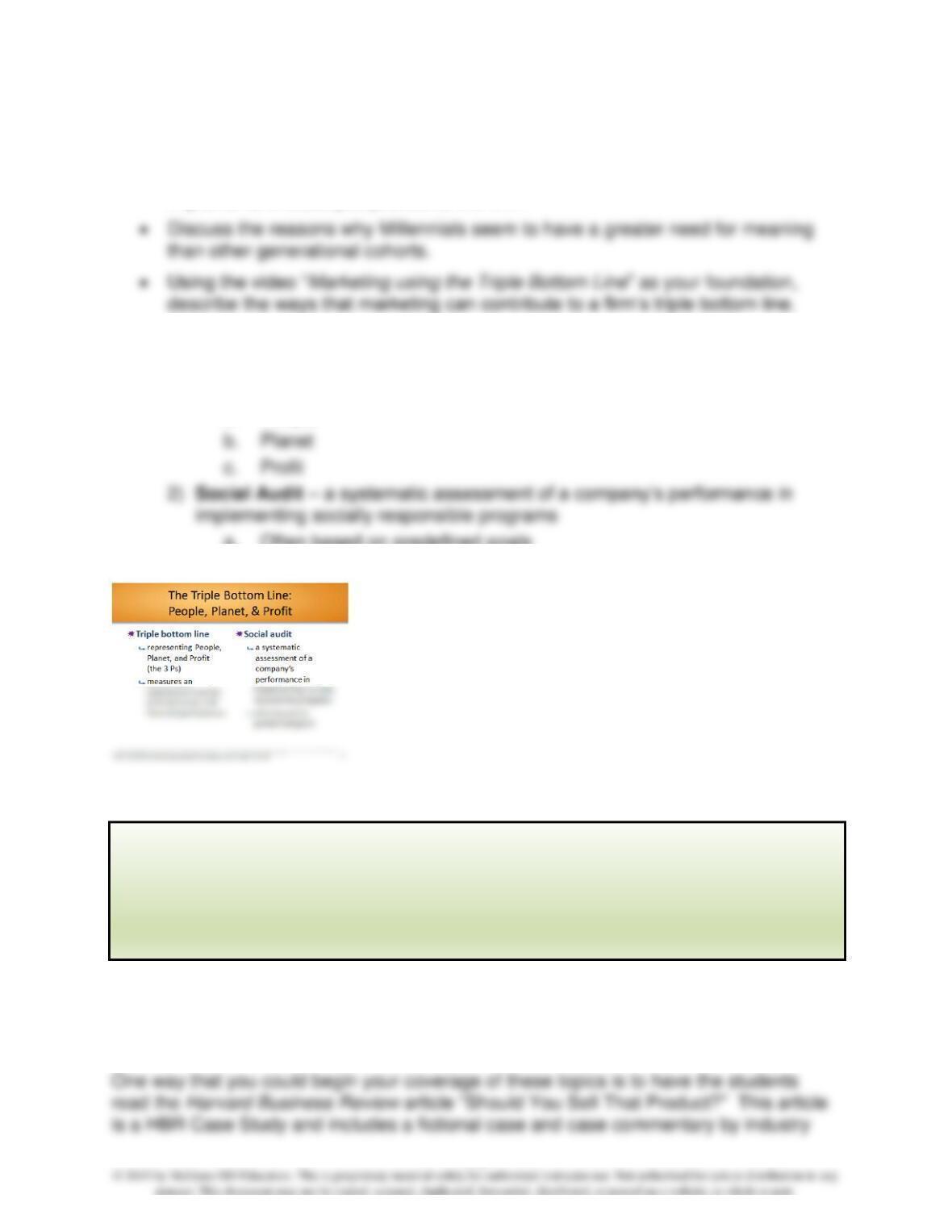
1) The Triple Bottom Line – measures an organization’s social environmental
and financial performance
a. People
a. Often based on predefined goals
Section 3.2 discusses one of the two organizational environments that managers
operate in—internal. The internal environment consists of the following stakeholders:
employees, owners and the board of directors.
3.2 The Community of Stakeholders Inside the Organization
(pp. 73-75)
Stockholders are only one group of stakeholders. Who are stakeholders
important to me inside the organization?
Chapter 03 – The Manager’s Changing Work Environment & Ethical Responsibilities: Doing the Right Thing
experts. This case looks at whether a company should go ahead with its intended
launch of a new product, a book series based on a character that some members of the
community find disrespectful. Using this case study would be an excellent way to
explore the various stakeholders that can be impacted by a firm’s actions and the
Possible Topics for Discussion:
• Describe the internal stakeholders of organizations and identify possible sources
of conflict between these stakeholders.
Major Idea Outline:
A. To Whom Should a Company Be Responsible?
1. In September 2010, a buried Pacific Gas & Electric natural-gas pipeline in
San Bruno, CA blew up, killing 7 people and destroying 38 homes.
2. PG&E had relied on surveys to determine which transmission pipelines
were safe, but the company’s incentive program awarded bonuses to
B. Internal and External Stakeholders
1. Stakeholders are the people whose interests are affected by an
organization’s activities.
Chapter 03 – The Manager’s Changing Work Environment & Ethical Responsibilities: Doing the Right Thing
3-8
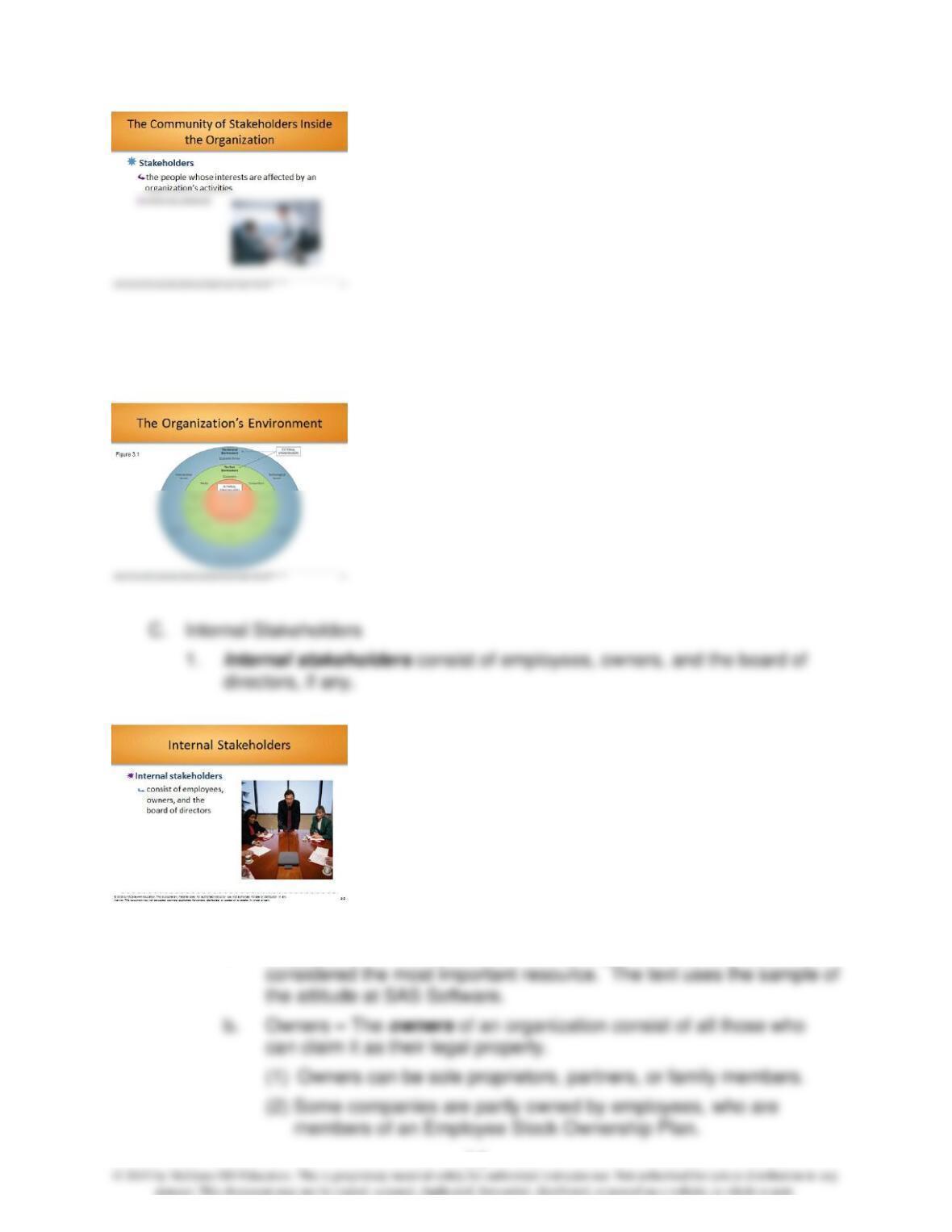
2. Managers operate in two organizational environments made up of various
stakeholders: internal stakeholders and external stakeholders.
a. Employees – In many forward-looking organizations, employees are
Chapter 03 – The Manager’s Changing Work Environment & Ethical Responsibilities: Doing the Right Thing
3-9
(3) In all these examples, the goal of the owners is to make a profit.
c. Board of directors – In a corporation, the board of directors, whose
members are elected by the stockholders, hires the chief executive.
Section 3.3 describes the external environment, which consists of the task and general
environments. The task environment consists of customers, competitors, suppliers,
distributors, strategic allies, employee associations, local communities, financial
institutions, government regulators, special-interest groups, and the mass media. The
general environment consists of economic, technological, sociocultural, demographic,
political-legal, and international forces.
Possible Topics for Discussion:
• Discuss the elements of the task environment that are most likely to impact your
academic institution over the next 5 to 10 years. How could your school best
deal with those challenges?
3.3 The Community of Stakeholders Outside the
Organization (pp. 76-82)
Who are stakeholders important to me outside the organization?
Chapter 03 – The Manager’s Changing Work Environment & Ethical Responsibilities: Doing the Right Thing
3-10
Major Idea Outline:
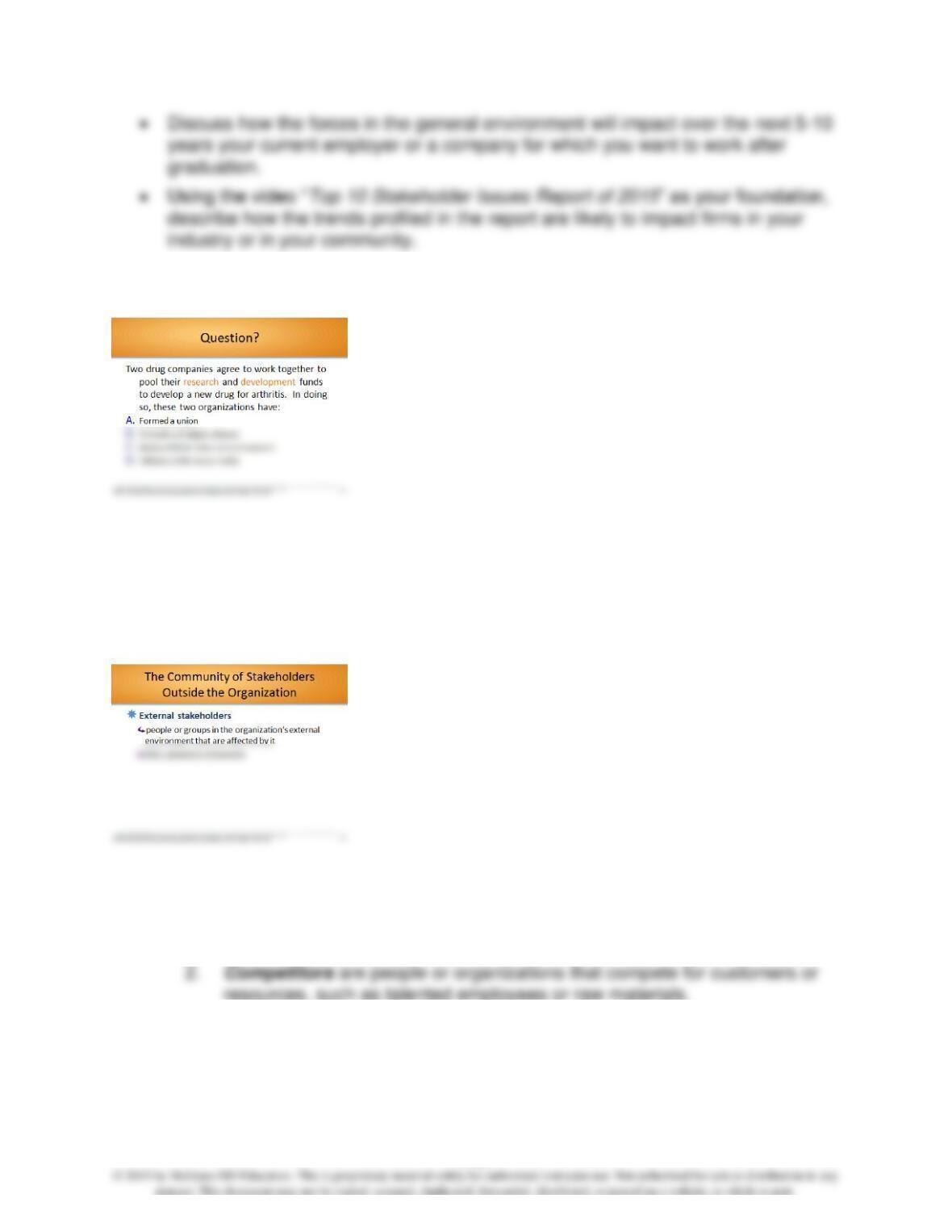
(Correct answer is B)
A. The external stakeholders are people or groups in the organization’s external
environment that are affected by it.
B. This environment consists of the task environment and the general
environment.
C. The task environment consists of eleven groups that present you with daily
tasks to handle.
1. Customers are those who pay to use an organization’s goods or services.
Chapter 03 – The Manager’s Changing Work Environment & Ethical Responsibilities: Doing the Right Thing
3-11
3. A supplier is a person or organization that provides supplies—raw
materials, services, equipment, labor, or energy—to other organizations.
a. Suppliers in turn have their own suppliers.
Interactive Classroom Material:
EXAMPLE: Taking Care of Customers: Amazon’s Jeff Bezos Obsesses about
“the Customer Experience” (p. 76)
Amazon’s CEO believes that customers should have a vast selection of products, low
prices and the ability to receive their orders fast. Amazon tries to have a simple
YOUR CALL
Does it matter to you how harshly a company treats other stakeholders so long
as it handles its customer relations well? To what extent are Amazon’s policies
consistent with the triple bottom line?
This Example demonstrates how Amazon is focusing on one particular
stakeholder – the customer, at the possible expense of other stakeholders.
Chapter 03 – The Manager’s Changing Work Environment & Ethical Responsibilities: Doing the Right Thing
Amazon’s policies seem to be inconsistent with the “People” portion of triple
be short term profits, but long term harm, when other stakeholders are forgotten.
Additional Activities:
One way to build on this Example is to have the students watch the 60 Minutes
segment “Amazon’s Jeff Bezos Looks to the Future.” This 13-minute video profiles
the plan of Amazon to pursue drone delivery of its packages. Consider using the
following discussion questions:
4. A distributor is a person or organization that helps another organization
sell its goods and services to customers.
3-13
5. The term strategic allies describe the relationship of two organizations
that join forces to achieve advantages neither can perform as well alone.
6. Employee organizations such as unions and associations represent still
another external stakeholder.
7. Local communities are important stakeholders.
a. Schools, municipal governments, families, and merchants rely on the
Chapter 03 – The Manager’s Changing Work Environment & Ethical Responsibilities: Doing the Right Thing
3-14
Interactive Classroom Material:
EXAMPLE: Local Communities as Stakeholders: Are Financial Incentives to
Business Really Necessary? (p. 78)
States have introduced tax incentives to poach movie production business from
California in order to reap the economic benefits that come with film companies. This,
YOUR CALL
How would you advise local public officials to handle the whole matter of tax
incentives for business—especially if they are across the negotiating table from
a conglomerate like Royal Dutch Shell or heavy-equipment maker Caterpillar?
What obligations should a community expect of the companies located there?
Local public officials who are negotiating across the table from conglomerates
Additional Activities:
One way to build on this Example is to have the students watch the CBS Sunday
Morning segment “Hollywood Goes on the Road.” This 7-minute video discusses how
government incentives are playing a key role in where a movie gets made. Consider
using the following discussion questions:
Assume you are a resident of one of the 40 states that offer incentives to movie
8. Financial institutions
Chapter 03 – The Manager’s Changing Work Environment & Ethical Responsibilities: Doing the Right Thing
3-15
a. Although normally reluctant to make loans to start-ups, financial
9. Government regulators are regulatory agencies that establish ground
rules under which organizations may operate.
a. Many agencies, boards, and commissions have the legal authority to
10. Special-interest groups are groups whose members try to influence
specific issues.
11. Mass media is an important stakeholder because it has tremendous power
Chapter 03 – The Manager’s Changing Work Environment & Ethical Responsibilities: Doing the Right Thing
3-16
Interactive Classroom Material:
EXAMPLE: EXAMPLE: Managing the Media: What’s the Best Practice for
Handling Product Recalls? (p. 80)
There have recently been many product recalls and one of the biggest was the
General Motors automobile recall. The company’s CEO, Mary Barra, was forced to
YOUR CALL
Do you agree with how Mary Bara has been handling the recall? What else
should she have done?
How convincing Barra has been is up for interpretation, but there may not be a
clear answer here. She has followed many of the J&J gold standard principles,
Additional Activities:
One way to build on this Example is to have the students watch the video “Testing
Shows GM Ignition Recall Vehicles Safe to Drive.” This is a 2-minute video produced
by General Motors that seeks to reassure drivers that GM cars affected by the ignition
switch recall are safe to drive if drivers only use a single key on the key ring and the
Chapter 03 – The Manager’s Changing Work Environment & Ethical Responsibilities: Doing the Right Thing
3-17
(Correct answer is B)
D. The General Environment
1. The general environment, or macroenvironment, includes six forces:
economic, technological, sociocultural, demographic, political-legal, and
2. Economic forces consist of general economic conditions and trends –
unemployment, inflation, interest rates, and economic growth – that may
affect an organization’s performance.
Chapter 03 – The Manager’s Changing Work Environment & Ethical Responsibilities: Doing the Right Thing
3-18
4. Sociocultural forces are influences and trends originating in a country’s,
a society’s, or culture’s human relationships and values which may affect
5. Demographic forces are influences on an organization arising from
changes in the characteristics of a population, such as age, gender, ethnic
origin, sexual orientation, occupation, income family size and the like.
c. By 2042, minorities are expected to reach 50% of the population, and
6. Political-legal forces are changes in the way politics shape laws and how
those laws affect organizations.
Chapter 03 – The Manager’s Changing Work Environment & Ethical Responsibilities: Doing the Right Thing
3-19
a. The current political climate affects issues such as antitrust cases.
7. International forces are changes in the economic, political, legal, and
technological global system that may affect an organization.
Section 3.4 discusses what constitutes ethics and values. There are four approaches to
deciding ethical dilemmas: the utilitarian approach, the individual approach, the moral–
rights approach and the justice approach.
3.4 The Ethical Responsibilities Required of You as a
Manager (pp. 83–87)
What does the successful manager need to know about ethics and values?
Chapter 03 – The Manager’s Changing Work Environment & Ethical Responsibilities: Doing the Right Thing
Possible Topics for Discussion:
• Describe the three most significant ethical dilemmas you face at your company
(or faced at a previous employer).
Major Idea Outline:
A. An ethical dilemma is a situation in which you have to decide whether to
pursue a course of action that may benefit you or your organization but that is
unethical or even illegal.
B. Defining Ethics and Values
1. Ethics are the standards of right and wrong that influence behavior.
2. Values
a. Ethical dilemmas often take place because of an organization’s value