3-1
Chapter 3
Job Costing, Process Costing, and Operations Costing
Concept Questions
1. (LO1—The uses of product costs)
Product cost information is used to help managers make pricing decisions but,
2. (LO1—Job and process costing)
Job order costing is a system that tracks costs for each job produced by a
3. (LO2—Job costing)
The two components are direct labor and direct materials.
4. (LO2—Job cost sheet)
A job cost sheet is highly customizable, but generally includes the following basic
5. (LO3, 4—Overhead in a traditional manufacturing environment)
Overhead is difficult to track primarily because it is indirect in nature. Generally,
6. (LO4, 5—Cost driver)
Solutions Manual
7. (LO4—Predetermined overhead rate)
8. (LO5—Treatment of overapplied overhead)
The manager has two options: to adjust cost of goods sold or to adjust work in
9. (LO6—Equivalent units of production)
10. (LO7—FIFO method)
The FIFO method is conceptually superior to the weighted-average method;
Brief Exercises
1. (LO1—Product costing systems)
a. Process costing
Chapter 3: Job Costing, Process Costing, and Operations Costing
3-3
2. (LO2—Basics of job costing)
a. False
3. (LO3—Overhead rates)
Rent on factory building $15,000
Wages paid to supervisors 3,500
4. (LO4—Predetermined overhead rate and applied overhead)
5. (LO5—Overapplied overhead)
Manufacturing Overhead 190,000
6. (LO6, 7—Process costing: Equivalent units with FIFO)
Number of Gallons
Beginning work in process (70% complete) 50,000
Solutions Manual
3-4
Equivalent units of beginning WIP
completed this quarter
50,000 × 30% =
15,000
Calculation of work started and completed:
Beginning WIP 50,000
7. (LO6, 7—Process costing: Equivalent units with weighted average)
Equivalent units started and
Chapter 3: Job Costing, Process Costing, and Operations Costing
3-5
8. (LO8—Service department allocation using the direct method)
Service A Service B Production A Production B
Department costs $48,000 $75,000 $210,000 $180,000
Costs are allocated as follows:
Service A Service B Production A Production B
Department costs
Exercises
9. (LO1—Job versus process costing)
a. job order
10. (LO2—Job costing)
In the absence of either beginning or ending WIP, the cost of goods
11. (LO2, 3—Direct labor versus indirect labor)
This question requires students to distinguish between production-related
Solutions Manual
3-6
12. (LO3—Job costing)
Total manufacturing costs are the sum of direct materials used, direct labor, and
manufacturing overhead. Direct materials used are equal to $20,000, as follows:
13. (LO4—Identification of cost drivers)
a. Square footage designed, number of change orders, design complexity
b. Complexity of the party (e.g., birthday versus wedding), number and types of
14. (LO3, 4—Overhead costs, cost pools, cost drivers)
a. false
15. (LO4—Predetermined overhead rate and applied overhead)
A. $41.73 per pen
Chapter 3: Job Costing, Process Costing, and Operations Costing
16. (LO4, 5—Predetermined overhead rate and applied overhead)
A. Predetermined overhead rate × Actual hours = Overhead applied
17. (LO4, 5—Predetermined overhead rate and applied overhead)
A. Predetermined overhead rate × Actual hours = Overhead applied
Actual overhead – Applied overhead = Under (Over) applied
So,
18. (LO4, 5—Applied overhead and predetermined overhead rate)
Solutions Manual
3-8
19. (LO6, 7—Process costing: FIFO method)
A. Calculation of units completed:
Beginning units 3,000 bags
20. (LO6, 7—Process costing: Weighted-average method)
A. The number of units completed would still be
18,000 bags of chips. However, under the
B. All units completed are considered to have
been started this period.
Chapter 3: Job Costing, Process Costing, and Operations Costing
3-9
21. (LO6—Process costing: Equivalent units using FIFO method)
A. Step 1: Calculation of units started and completed (FIFO)
Beginning units 3,000
+ Units started 20,000
B. Step 3: Calculation of cost per equivalent unit
22. (LO6, 7—Process costing: Equivalent units using weighted-average method)
A. Step 1: Calculation of units started and completed (weighted average)
Beginning units 0
+ units started 23,000
– ending units (5,000
Solutions Manual
3-10
23. (LO6, 7—Process costing: Equivalent units using weighted-average)
Step 1: Calculation of units started and completed (weighted average)
24. (LO6, 7—Process costing: Cost per equivalent unit using weighted average)
A. Step 1: Calculation of units started and completed (weighted
average)
Beginning units 4,000
+ Units started 13,000
Chapter 3: Job Costing, Process Costing, and Operations Costing
3-11
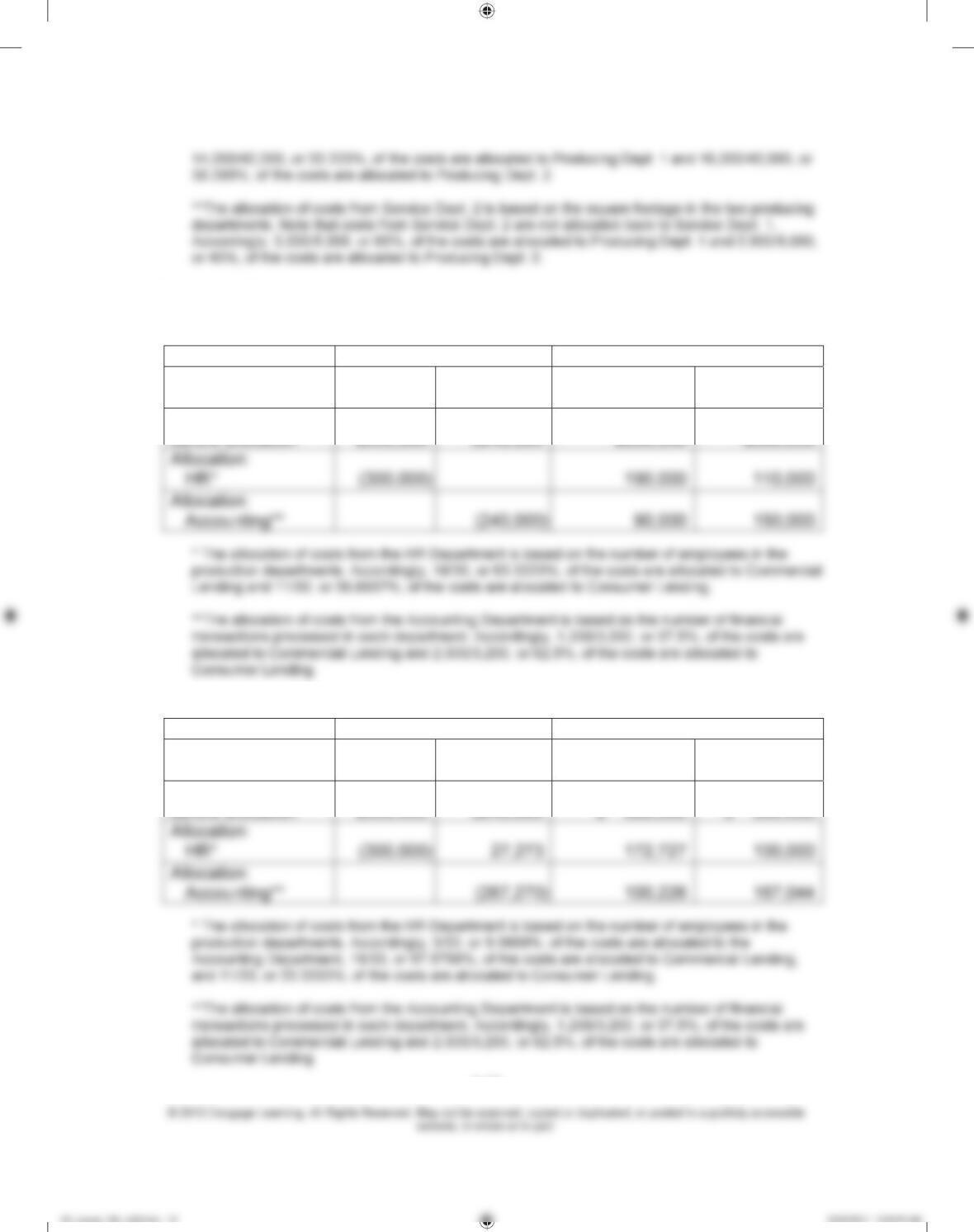
25. (LO8—Service department cost allocation)
A.
Service Departments Producing Departments
Service
Dept. 1
Service
Dept. 2
Producing 1
Producing 2
Departmental costs
B.
Service Departments Producing Departments
Service
Dept. 1
Service
Dept. 2
Producing 1
Producing 2
Departmental costs
before allocation $ 63,000 $ 42,000
$200,000 $100,000
B. Step 3: Calculation of cost per equivalent unit
Solutions Manual
3-12
26. (LO8—Service department cost allocation)
A.
Service Departments Production Departments
HR
Accounting
Commercial
Lending
Consumer
Lending
Departmental costs
before allocation $300,000 $240,000
$800,000 $600,000
B.
Service Departments Production Departments
HR
Accounting
Commercial
Lending
Consumer
Lending
Departmental costs
before allocation $300,000 $240,000
$ 800,000 $ 600,000
Chapter 3: Job Costing, Process Costing, and Operations Costing
3-13
Problems
27. (LO1, 2, and 3—Job costing)
A.
Estimated overhead fo
r
the cost pool
Estrimated units of the cost drive
r
=Predetermined overhead rate
B.
C.
Parkas Shirts Pants Shoes
Direct materials $16,000 $12,000 $ 9,500 $11,500
D. Haberman could also use operations costing. The company may choose to
continue using job costing because of its familiarity with the approach and
the investment in the costing system.
28. (LO2, 3, and 4—Job costing: Supply the missing data)
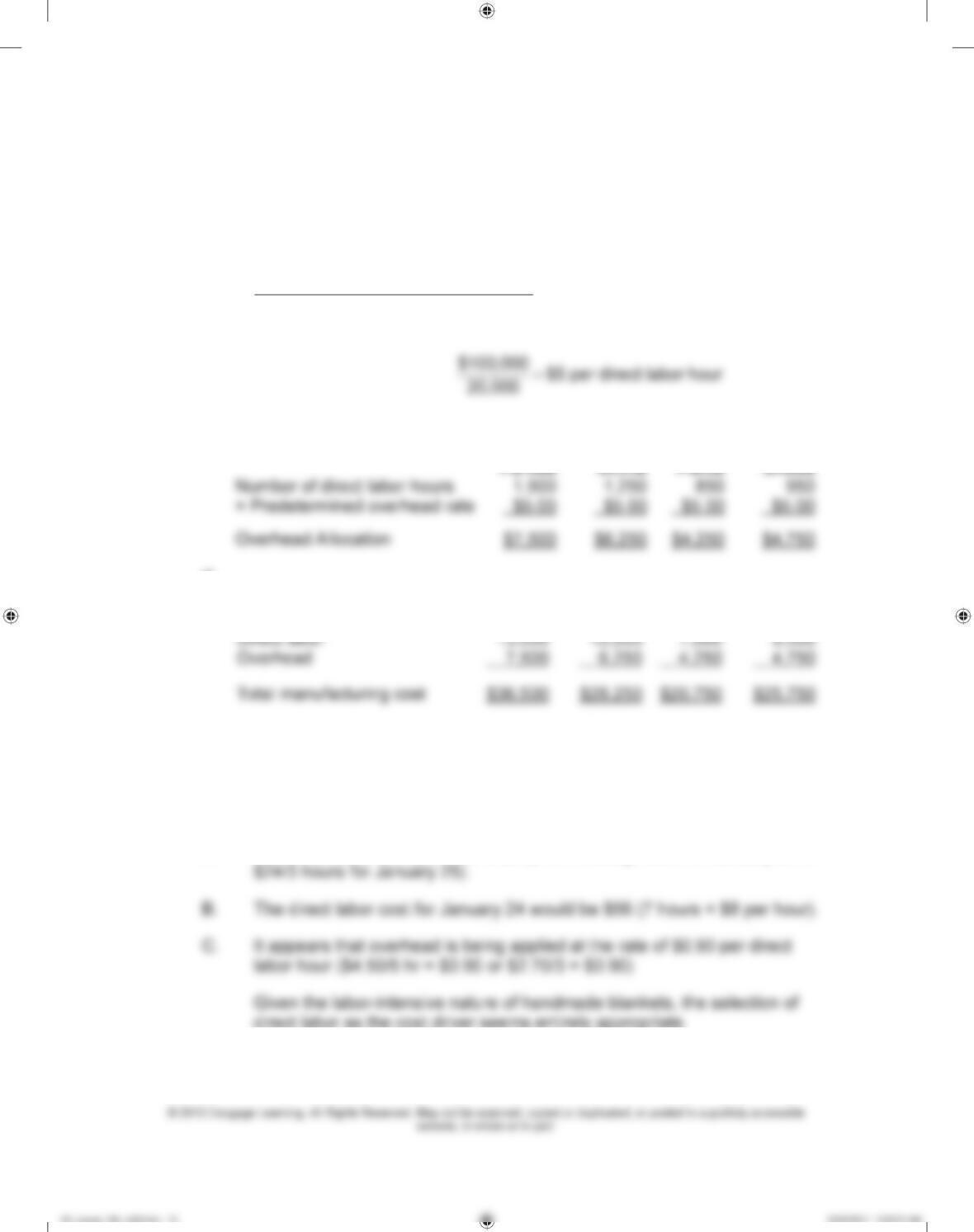
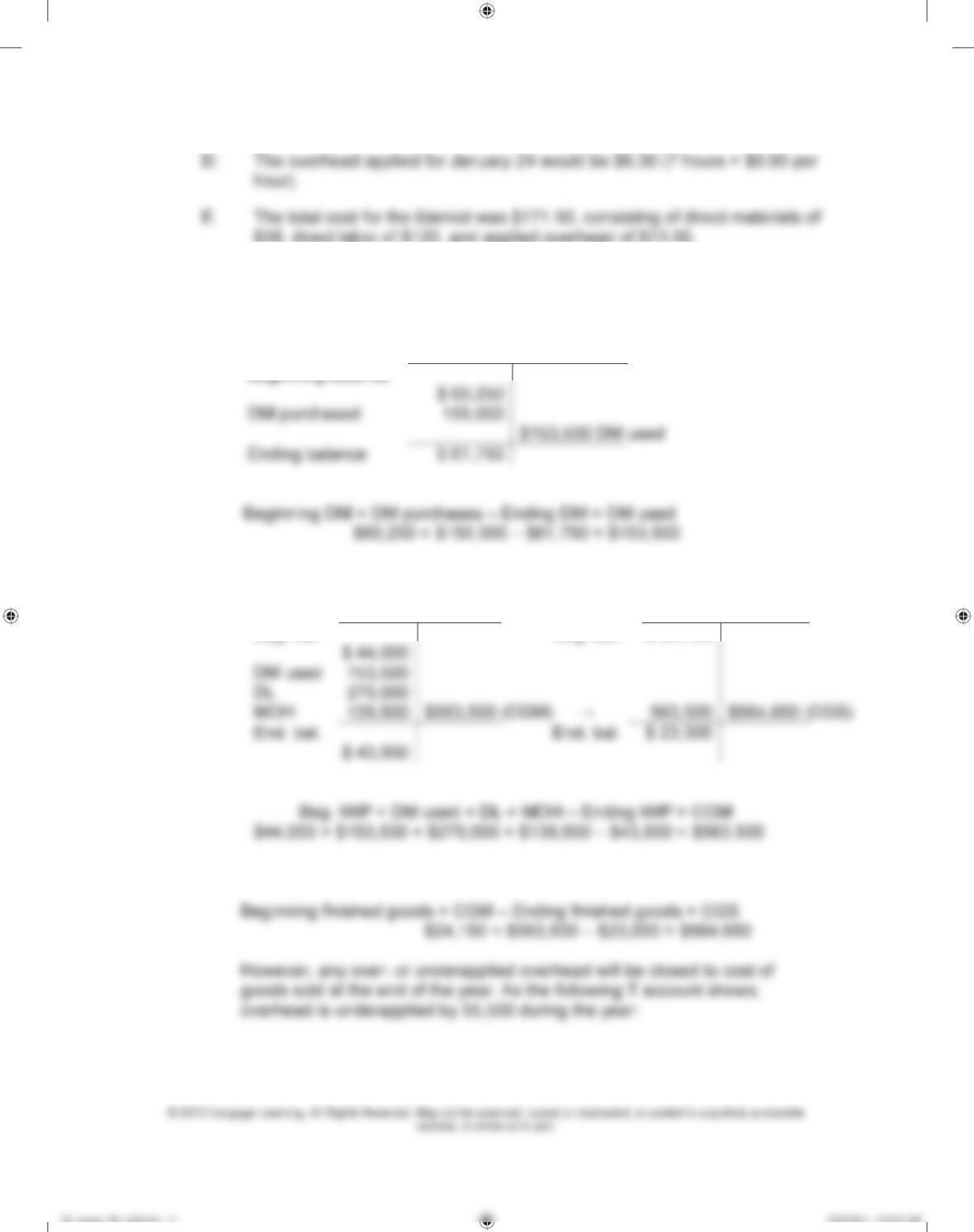
A. The direct labor cost per hour is $8 ($40/5 knitting hours for January 23 or
Solutions Manual
3-14
29. (LO2, 3, 4, and 5—Comprehensive job costing)
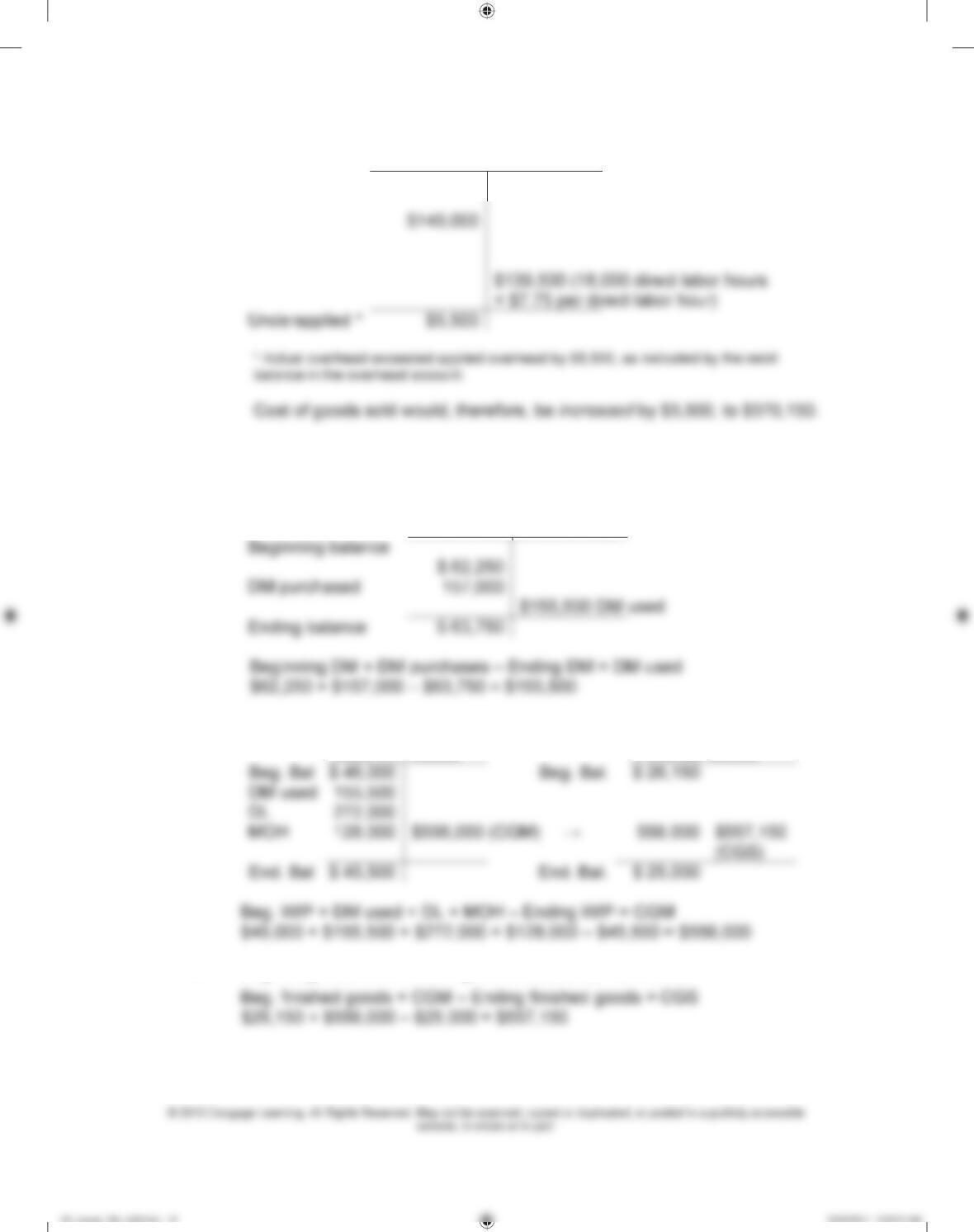
A. Direct materials used = $153,500
Direct Materials Inventory
B. Cost of goods manufactured (CGM) = $563,500
Work in Process Finished Goods
Beg. bal.
Beg. bal. $ 24,150
C. The initial balance in cost of goods sold (CGS) = $564,650 (see part B)
Chapter 3: Job Costing, Process Costing, and Operations Costing
3-15
Manufacturing Overhead
Actual Applied
30. (LO2, 3, 4, and 5—Comprehensive job costing)
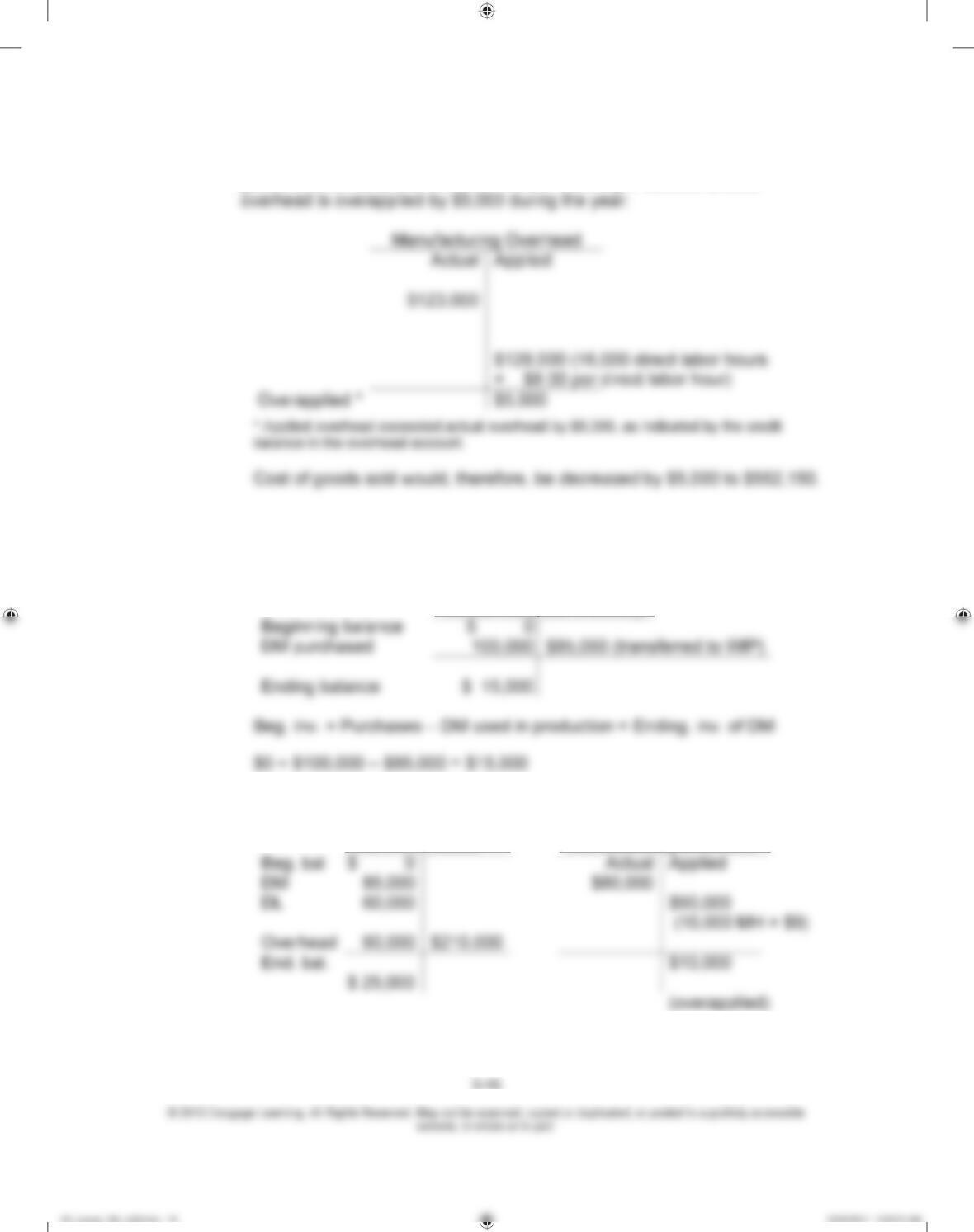
A. Direct materials used = $155,500
Direct Materials Inventory
B. Cost of goods manufactured (CGM) = $565,500
Work in Process Finished Goods
C. Beginning balance in cost of goods sold (CGS) = $557,150
Solutions Manual
However, any over- or underapplied overhead will be closed to cost of
goods sold at the end of the year. As the following T account shows,
31. (LO2, 4, and 5—Comprehensive job costing)
A. Calculation of ending direct materials inventory:
Direct Materials Inventory
B. Calculation of the ending work in process inventory:
Work in Process Manufacturing Overhead