Chapter 3: The Internal Organization
Highlights from Table 3.5 are:
• Resources and capabilities that are neither valuable, rare, costly to imitate, nor
nonsubstitutable mean that the firm will be at a competitive disadvantage and will earn
below-average returns.
Teaching Note
Given the criteria for the sustainability of a competitive advantage, ask students if The
Gap’s Old Navy concept (or another case with which they are likely to be personally
familiar) represents a source of competitive advantage that can be sustained over time.
6
Explain how firms analyze their value chain to determine
where they are able to create value when using their
resources, capabilities, and core competencies.
3-3b Value Chain Analysis
A framework that firms can use to identify and evaluate the ways in which their resources
3.3.
Chapter 3: The Internal Organization
Figure Note
Students should refer to Figure 3.3 and Tables 3.6 and 3.7 during your explanation of
FIGURE 3.3
A Model of the Value Chain
Figure 3.3 illustrates how the value-creating activities performed by the firm can be
separated into value chain activities and support functions.
FIGURE 3.4
Creating Value through Value Chain Activities
Figure 3.4 illustrates the link between the value chain activities and customer value. All
areas of the value chain can help firms deliver value to customers.
Supply-chain management consists of activities including sourcing, procurement,
Distribution consists of activities related to getting the final product to the customer.
Efficiently handling customers’ orders, choosing the optimal delivery channel, and
working with the finance support function to arrange for customers’ payments for
delivered goods are examples of these activities.
Chapter 3: The Internal Organization
Marketing (including sales) consists of activities taken for the purpose of segmenting
target customers on the basis of their unique needs, satisfying customers’ needs, retaining
FIGURE 3.5
Creating Value through Support Functions
Figure 3.5 illustrates the link between the support functions a company performs and
customer value. All support functions can help firms deliver value to customers.
Finance consists of activities associated with effectively acquiring and managing financial
resources. Securing adequate financial capital, investing in organizational functions in
Management information systems consist of activities taken to obtain and manage
information and knowledge throughout the firm. Identifying and utilizing sophisticated
technologies, determining optimal ways to collect and distribute knowledge, and linking
relevant information and knowledge to organizational functions are activities associated
with this support function.
Using the value chain framework enables managers to study the firm’s resources and
capabilities in relationship to the primary and support activities performed to design,
Chapter 3: The Internal Organization
This implies that, given that individual firms comprise unique or heterogeneous bundles of
activities, reconfiguring the value chain—or rebundling resources and capabilities—may
enable a firm to develop unique value-creating activities.
Firms can use outsourcing as an alternative to identify primary or support activities for
which its resources and capabilities are not core competencies and do not enable the firm
to add superior value and achieve competitive advantage.
7
Define outsourcing and discuss the reasons for its use.
3-4 OUTSOURCING
• Outsourcing describes a firm’s decision to purchase a value-creating activity from an
external supplier. Outsourcing has become important, and may become more important in
the future, for two reasons:
Firms engaging in outsourcing can increase their flexibility, mitigate risks, and reduce
their capital investment.
Teaching Note
When outsourcing, a firm seeks the greatest value. In other words, a company wants to
outsource only to firms possessing a core competence in terms of performing the
primary or support activity that is being outsourced.
Chapter 3: The Internal Organization
To ensure that the appropriate primary and support activities are outsourced, four skills are
essential for managers involved in outsourcing programs:
• Strategic thinking—understanding whether/how outsourcing creates competitive
advantage within the company
Teaching Note
Outsourcing can take several forms, depending on a firm’s strategic objectives.
Examples of outsourcing strategies that, while different, enable outsourcing firms to
achieve their strategic objectives while changing the face of college campuses include:
• Universities and colleges outsourcing the management of college bookstores to Follett
8, 9
Discuss the importance of identifying internal strengths and
weaknesses; Describe the importance of avoiding core rigidities.
3-5 COMPETENCIES, STRENGTHS, WEAKNESSES, AND
STRATEGIC DECISIONS
Tools such as outsourcing help the firm focus on its core competencies as the source of its
competitive advantages. However, evidence shows that the value-creating ability of core
competencies should never be taken for granted. Moreover, the ability of a core
Chapter 3: The Internal Organization
Events occurring in the firm’s external environment create conditions through which core
competencies can become core rigidities, generate inertia, and stifle innovation. According
to one observer, “Often the flip side, the dark side, of core capabilities is revealed due to
external events when new competitors figure out a better way to serve the firm’s
customers, when new technologies emerge, or when political or social events shift the
ground underneath.”
STRATEGIC FOCUS
The Extreme Specialization of Outsourcing: Who Is Doing It and Who Is Not
While call centers may be the most familiar example of outsourcing, many functions are
being outsourced in a wide range of industries. Companies around the globe are providing
very specialized outsourcing services, and this Strategic Focus lists several examples, such
as drug testing, financial transaction processing, and computer programming.
Teaching Note
Lead students in a debate or analysis of outsourcing. Students should be able to
Chapter 3: The Internal Organization
ANSWERS TO REVIEW QUESTIONS
1. Why is it important for a firm to study and understand its internal organization?
As they analyze their internal environment, a manager should think of the firm as a
bundle of heterogeneous resources and capabilities that can be used to create an exclusive
2. What is value? Why is it critical for the firm to create value? How does it do so?
Value is represented by the bundle of performance characteristics and attributes that a
3. What are the differences between tangible and intangible resources? Why is it
important for decision makers to understand these differences? Are tangible
resources more valuable for creating capabilities than are intangible resources, or is
the reverse true? Why?
Tangible resources are represented by assets that can be seen and quantified. They are not
Chapter 3: The Internal Organization
4. What are capabilities? How do firms create capabilities?
Capabilities represent the firm’s capacity or ability to successfully integrate sets of firm
resources and deploy these resources to achieve some desired end. Capabilities evolve or
5. What four criteria must capabilities satisfy for them to become core competencies?
Why is it important for firms to use these criteria to evaluate their capabilities’
value-creating potential?
Capabilities are a firm’s core competencies when they satisfy the four criteria of
sustainable competitive advantage: they must be valuable, rare, costly to imitate, and
Chapter 3: The Internal Organization
6. What is value chain analysis? What does the firm gain by successfully using this
tool?
The value chain is a template that the firm uses to understand its cost position and to
identify the multiple means that might be used to facilitate the implementation of its
7. What is outsourcing? Why do firms outsource?
Outsourcing is the purchase of a value-creating activity from an outside supplier that can
provide the greatest value. A firm is likely to engage in outsourcing when it identifies
Chapter 3: The Internal Organization
8. How do firms identify internal strengths and weaknesses? Why is it vital that
managers have a clear understanding of their firm’s strengths and weaknesses?
By completing the internal analysis, firms can (must) identify their strengths and
weaknesses in resources, capabilities, and core competencies. For example, if they have
9. What are core rigidities? What does it mean to say that each core competence could
become a core rigidity?
Core rigidities can be viewed as yesterday’s sources of competitive advantage. These are
Chapter 3: The Internal Organization
MINI CASE
Is Strengthening the Superdry Brand a Foundation to Strategic Success?
Note: To prepare students for class discussion and to introduce them to the
British-based SuperGroup is the owner of Superdry and its carefully branded product
lines. The Superdry brand is at the heart of the business. The brand is targeted to
discerning customers in their teens and 20s who seek to purchase “stylish clothing that is
Teaching Note
Ask students to discuss how changes in management style affect changes in the
decision-making process. Ask students to discuss the changes that were made to the
Superdry brand, including marketing approaches and additional product lines.
Answers to Case Discussion Questions
1. What influences from the external environment over the next several years do you think
might affect Superdry’s ability to compete?
Perhaps the most significant factor in Superdry’s external environment would be its
2. Does Superdry have one or more capabilities that are valuable, rare, costly to imitate, and
nonsubstitutable? If so, what are they? If not, on which criteria do they fall short?
Superdry’s branded clothing has a unique look, style, and feel that consumers find
Chapter 3: The Internal Organization
3. Will the actions that Superdry is taking solve its problems? Why or why not?
Comments from analysts suggest that the new executive team is already stabilizing the
4. What value does Superdry create for its customers?
5. What actions would you recommend the management of Superdry take to resolve its
problems and turn around the performance of the firm?
In addition to paying close attention to shifts in the firm’s external environment
ADDITIONAL QUESTIONS AND EXERCISES
The following questions and exercises can be presented for in-class discussion or assigned as
homework.
Application Discussion Questions
1. Several companies use their brand as a competitive advantage. Ask the class, given their
knowledge about the global economy, which brands they believe have the strongest
2. Students should visit the manager of a local store to obtain the following information.
Using the definition presented in the chapter, define value for the manager. Ask the
manager if the definition is consistent with how her or his firm thinks of value. If there is
a difference, ask the manager to assess why the difference exists.
Chapter 3: The Internal Organization
32
list to another member of the group. Does that person agree with your assessment of the
group’s resources? If not, what might account for the differences? If differences do exist
between you and your colleague, what is the meaning of such differences in terms of
trying to form the group’s capabilities?
4. Refer to the third question. Ask students if it was easier to list the tangible or the
Ethics Questions
1. Can efforts to develop sustainable competitive advantages result in employees using
unethical practices? If so, what unethical practices might be used to compare a firm’s
core competencies with those held by rivals? How do the Internet’s capabilities affect
actions taken to form competitive advantages that will help the firm in its efforts to
outperform its rivals?
2. Do ethical practices affect a firm’s ability to develop brand as a source of competitive
4. Are there any ethical dilemmas associated with outsourcing? If so, what are they? How
would you deal with outsourcing ethical dilemmas you believe exist?
Chapter 3: The Internal Organization
33
6. Through the Internet, firms sometimes make a vast array of data, information, and
knowledge available to competitors as well as to customers and suppliers. What ethical
issues, if any, are involved when the firm finds competitively relevant information on a
INSTRUCTOR’S NOTES FOR MINDTAP
Cengage offers additional online activities, assessments and resources inside MindTap,
our online learning platform. Here is a comprehensive listing of the activities available
within each chapter of MindTap for Hitt, Ireland Hoskisson’s Strategic Management:
Competitiveness and Globalization, 13th edition:
Course Level Resource: Cornerstone to Capstone Diagnostic- features short quizzes in
Chapter Level Resources:
• What Would You Do Video
• MindTap Reader (eBook)
• Assignments:
o Multiple Choice Quiz
Course Level Case Resources:
• Text Cases (Readings)
Chapter 3: The Internal Organization
34
ADDITIONAL INFORMATION FOR SELECT MINDTAP RESOURCES:
WHAT WOULD YOU DO? TOYOTA
This exercise introduces students to strategic decisions as they are made in the real world.
Students should come to class prepared to discuss this exercise, and why they chose the
answer they did. All answers are graded as correct – the point of the exercise is to engage
your student’s interest.
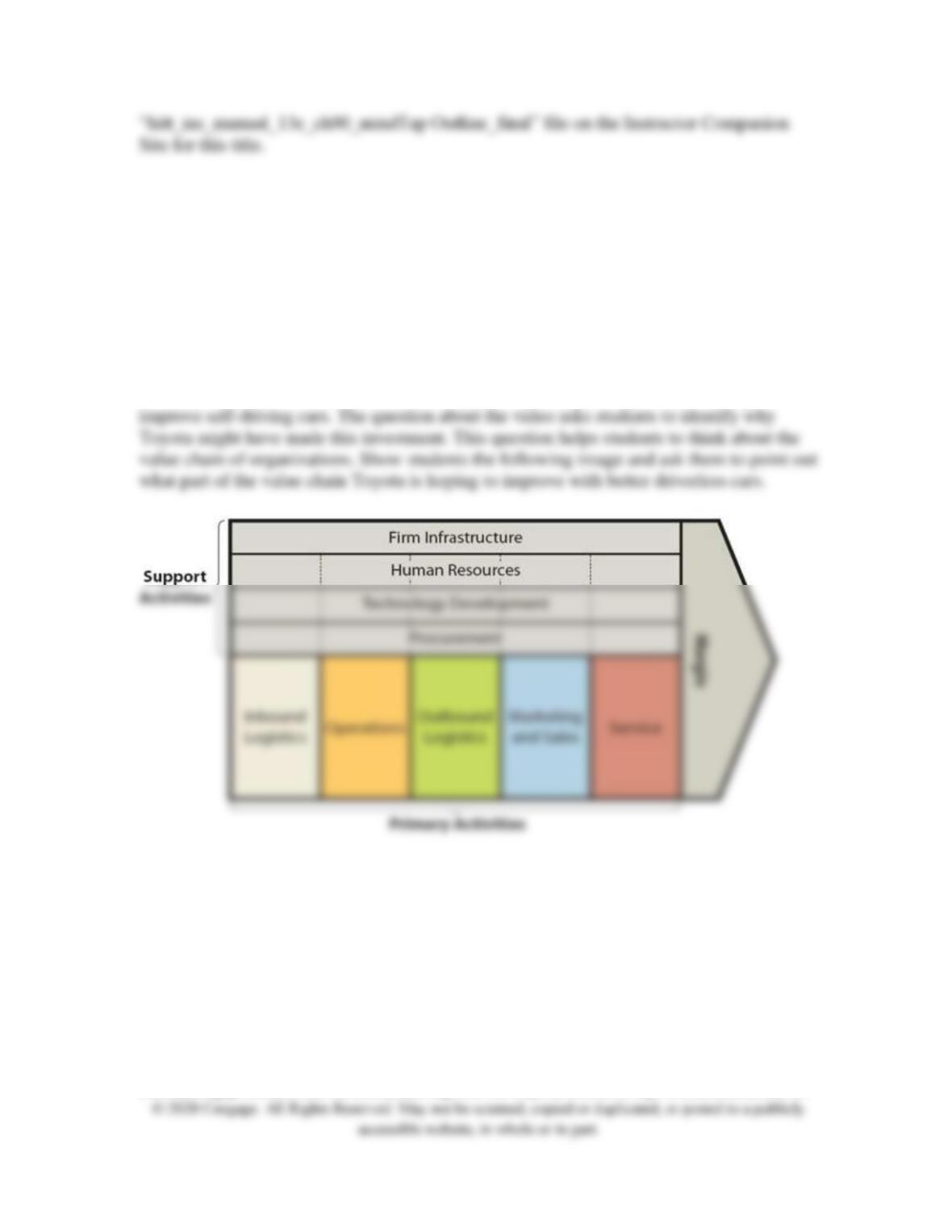
Students watch a brief video about how Toyota is investing money in Uber to help
VIDEO QUIZ: TOYOTA
The media quiz offers additional opportunities for students to apply the concepts in the
chapter to a real-world scenario as it is described in news reports.
Title: Toyota
RT: 2:28
Topic Key: Competitive Advantage, Core Competencies, Value Chain Analysis
Bloomberg journalist Kevin Buckland reports on Toyota Motor Corp.’s announcement to

Chapter 3: The Internal Organization
expand its alliance with Uber Technologies, Inc. The Japanese automaker is making a
$500M investment in Uber as part of a plan to get self-driving cars on the road.
Suggested Discussion Questions and Answers
• Toyota has long held a competitive advantage as a respected auto manufacturer. Why is it
now investing $500 million in the transportation services industry?
In today’s rapidly changing global competitive landscape, Toyota recognizes that it
Chapter 3: The Internal Organization
• How does an alliance with Uber Technologies help Toyota create a sustainable core
competence? Use the four-part criteria to evaluate this strategic move.
Several organizations have begun developing self-driving vehicles in recent years,
• Where does Toyota’s investment in Uber fit in terms of the firm’s value chain?
Historically, Toyota’s value chain ended with the sale of its vehicles to
GUIDED CASE: SUPERDRY
This auto-graded activity asks students to read the short end-of-chapter case on Superdry,
and answer questions in the areas of Analysis, Strategy, and Implementation &
Performance.
Founded in 1985, British-based SuperGroup is the owner of Superdry and its carefully
branded product lines. The Superdry brand is at the heart of the business. The brand is
Chapter 3: The Internal Organization
Students will review these concepts:
GROUP PROJECT: BUILD A BETTER MOUSETRAP:
CREATING A COMPETITIVE ADVANTAGE
The focus of this chapter is on understanding how a firm’s resources and capabilities serve
as the cornerstone for competencies and, ultimately, are a source of competitive
advantage.
The goal of this exercise is to learn about how companies use strategies, like outsourcing,
Ask each student team to present their findings to the class. To obtain a variety of in the
presentation, ask several questions during the presentation. For instance: