Chapter 03 – Managing Ethics and Diversity
3-17
Marc Cenedella, Ladders founder and president says, “executives clearly see the public images of the
companies they work for as a reflection of their own credibility in the marketplace. In companies like
Enron, where there is systemic misbehavior across all levels of the company, folks don’t want to be in that
environment.”
Executives are “drawing subtle distinctions between what’s an acceptable corporate misstep and what’s an
As an example, Cenedella cites the case of Martha Stewart Living Omnimedia. Respondents were split
almost evenly: 51 percent wouldn’t want to work there, 49 percent would. “In that case,” Cenedella says,
“Martha’s crime had nothing to do with her business, so that’s a mitigating factor.” However, “the brand is
so tightly wrapped up in her personal behavior and her lifestyle that the brand has been tarnished,” he
says. “That’s why people are right in the middle on this.”
Would you work for these companies? Below are additional results from TheLadder.com’s survey:
Company Name Responding No
Enron 72%
World com 65%
Tyco 38%
Symbol Technologies 37%
Lecture Enhancer 3.3
CATALYST KEEPS TRACK OF FEMALE PROGRESS IN CORPORATE AMERICA
Catalyst is an independent, not-for-profit organization research and advisory organization that works with
businesses and the professions to build inclusive work environments and expand opportunities for women
at work. It is also conducts research on all aspects of women’s career advancement. Some of its research
findings concerning women in workplace are summarized below:
Chapter 03 – Managing Ethics and Diversity
3-18
Female Executives Aspire to the CEO Job: Women and men report equal aspirations to reach the corner
office, and women who have children living with them are just as likely to aspire to the CEO job as those
who do not. Catalyst found that women and men employ very similar advancement strategies, which
African American Women: African American women are not advancing as far in corporate America as
their white, Asian, and Latina counterparts. The biggest barriers they face are negative, race-based
stereotypes, more frequent questioning of their credibility and authority, and a lack of institutional
support. Even though African American women represent an important and growing source of talent, they
currently represent only 1.1% of corporate officers in Fortune 500 companies. Experiencing a double
challenge the way things are done in their workplace and less likely to report that diversity efforts have
created a supportive environment. These women told Catalyst that Asian cultural values are frequently at
odds with their ability to successfully navigate the corporate landscape. Specifically, the discomfort some
Asian women have with self-promotion makes advancement problematic, and their strong work ethic
appears to limit networking opportunities. Also, they report difficulty in finding mentors and few report
having positive relationships with their superiors.
Excerpts from press releases found on http://www.catalyst.org/
Notes for Topics for Discussion and Action
DISCUSSION
1. W1. When are ethics and ethical standards especially important in organizations?
MANAGEMENT IN ACTION
Chapter 03 – Managing Ethics and Diversity
3-19
It may be difficult for managers to determine how to apportion harms or benefits among various
stakeholder groups. In such cases, ethical standards and guidelines are very important. For example, when
2. Why might managers do things that conflict with their own ethical values?
3. How can managers ensure that they create ethical organizational cultures?
4. Why are gay and lesbian workers and workers who test positive for HIV sometimes discriminated
against?
5. Why might some employees resent workplace accommodations that are dictated by the Americans with
Disabilities Act?
Chapter 03 – Managing Ethics and Diversity
3-20
ACTION
6. Choose a Fortune 500 company not mentioned in the chapter. Conduct research to determine what
steps this organization has taken to effectively manage diversity and eliminate sexual harassment.
(Note to Instructors: Obtaining the information to answer this question is more difficult than it appears.
You might consider eliminating the Fortune 500 requirement or have students identify an exemplary
company in the area of diversity/multiculturalism. Companies are less likely to disclose anything to do
with sexual harassment. Information on reported incidences of sexual harassment is easier to find. Two
different versions of this question are answered below).
Sample A:
In response to allegations of discrimination and other inequitable practices, Texaco has devised the
following plans to create a more diverse environment for their company. These plans include:
(2) Implementing a scholarship and internship program to expand college recruiting.
(4) Increase purchasing from women- and minority-owned businesses.
(5) Plans to encourage women and minorities to become wholesalers and retailers with targeted financing
programs.
Sample B:
13.9% to 16% over a three-year period. Bullock partnered with the company’s training department to
make diversity training a part of the core curriculum for all major leadership development training
programs in the U.S. and Paris. Diversity is now included as a management objective in annual
performance reviews on a worldwide basis.
AACSB: Diversity
BUILDING MANAGEMENT SKILLS
Chapter 03 – Managing Ethics and Diversity
3-21
Notes for Building Management Skills:
Solving Diversity-Related Problems
(Note to Instructor: Student answers will vary. Below is some general information to help guide class
discussion.)
Questions:
1. Why do you think that the decision maker acted unfairly in this situation?
2. In what ways, if any, were biases, stereotypes, or overt discrimination involved in this situation?
3. Was the decision maker aware that he or she was acting unfairly?
4. What could you or the person who was treated unfairly have done to improve matters and rectify the
injustice on the spot?
5. Was any sexual harassment involved in this situation? If so, what kind was it?
6. If you had authority over the decision maker (for example, you were his or her manager or supervisor),
what steps would you take to ensure that the decision maker no longer treated diverse individuals
unfairly?
Chapter 03 – Managing Ethics and Diversity
Some companies require that their employees work long hours and travel extensively, whether or not they
have children at home or fill some other caregiver role. Employees question whether or not it’s ethical for
managers to expect so much from them in the workplace, and not consider their other caregiving
obligations.
Questions:
1. Either individually or in a group, think about the ethical implications of requiring long hours and
extensive amounts of travel for some jobs.
2. What obligations do you think managers and companies have to enable employees to have a balanced
life and meet non-work needs and demands?
AACSB: Ethics
Questions:
1. Discuss why the patterns of communication that you observed might be occurring in your
restaurants.
2. Discuss whether your observation reflects an underlying problem. If so, why? If not, why not?
MANAGING ETHICALLY
SMALL GROUP BREAKOUT EXERCISE
3-23
3. Discuss whether you should address this issue with your staff and in your restaurants. If so,
how and why? If not, why not?
AACSB: Communication Skills
AACSB: Diversity
Notes for Be the Manager
(Note to instructor: Below are some suggestions. Student responses will vary.)
1. What are you going to do to address this issue?
experiencing.
AACSB: Reflective Thinking
Case Synopsis: Men Enlist in Fight for Gender Equality
More big businesses are enlisting men in their push to attain gender equality and diversity at the top.
Companies long viewed women’s advancement as the women’s problem. But despite years of women–
only corporate events, women have progressed slowly into the executive suite or stalled altogether,
diversity experts say.
BE THE MANAGER
THE WALL STREET JOURNAL CASE IN THE NEWS
Chapter 03 – Managing Ethics and Diversity
3-24
men’s privileged status, and “unconscious bias”—everyone’s implicit preference for certain groups.
Unconscious bias often influences important workplace decisions.
• Let’s Break a 4th Quarter Deal
SUPPLEMENTAL FEATURES
MANAGER’S HOT SEAT (MHS)
Chapter 03 – Managing Ethics and Diversity
3-25
These Instructor’s PowerPoint slides can be used to supplement the lecture material.
INSTRUCTOR’S POWERPOINT
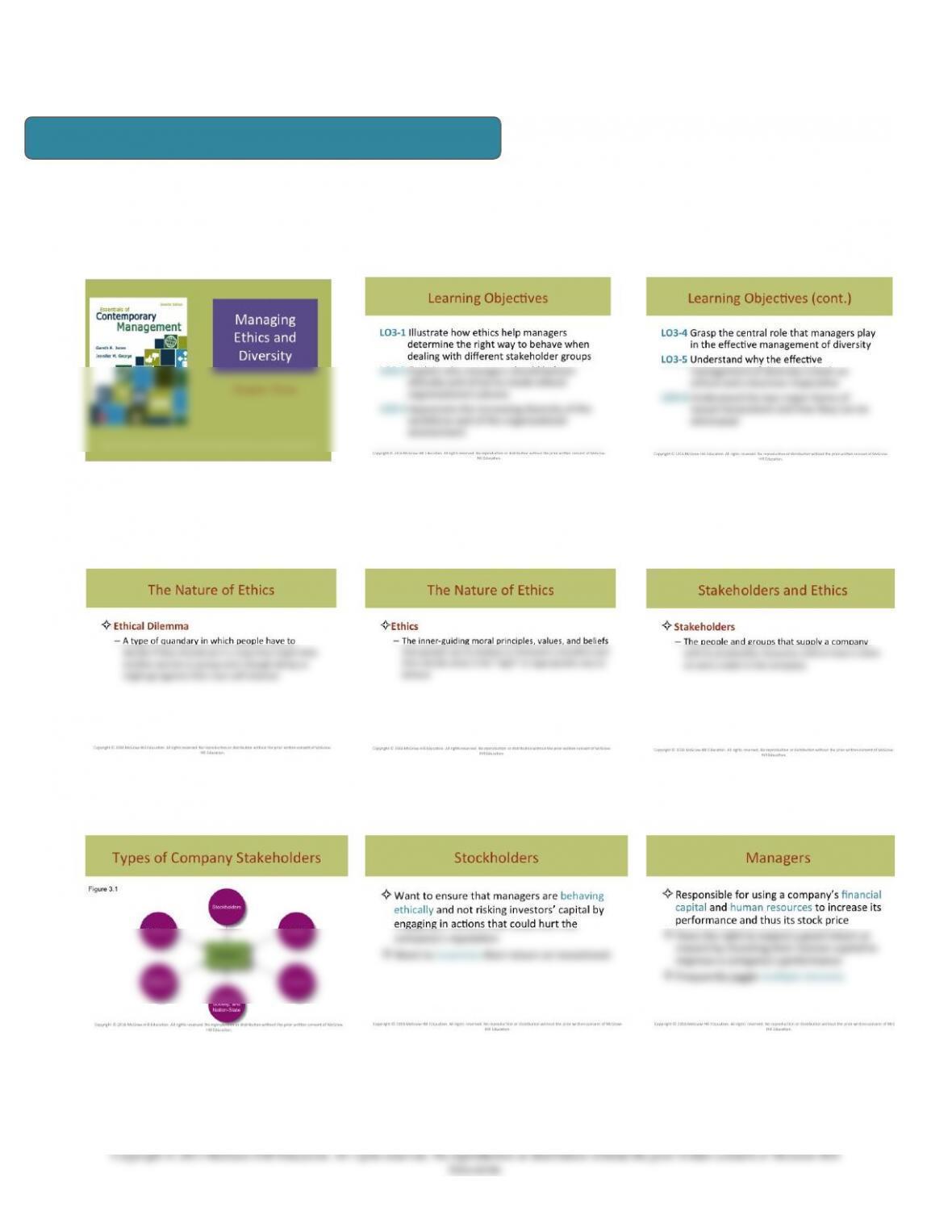
SLIDE 1
Chapter Title
INSTRUCTOR’S POWERPOINT
SLIDE 2
Learning Objectives: LO 3-1 –
LO 3-3
INSTRUCTOR’S POWERPOINT
SLIDE 3
Learning Objectives: LO 3-4 –
LO 3-6
INSTRUCTOR’S POWERPOINT
SLIDE 4
The Nature of Ethics
INSTRUCTOR’S POWERPOINT
SLIDE 5
The Nature of Ethics
INSTRUCTOR’S POWERPOINT
SLIDE 6
Stakeholders and Ethics
INSTRUCTOR’S POWERPOINT
SLIDE 7
Figure 3.1 – Types of Company
Stakeholders
INSTRUCTOR’S POWERPOINT
SLIDE 8
Stockholders
INSTRUCTOR’S POWERPOINT
SLIDE 9
Managers
INSTRUCTOR’S POWERPOINT SLIDES
Chapter 03 – Managing Ethics and Diversity
3-26
INSTRUCTOR’S POWERPOINT
SLIDE 10
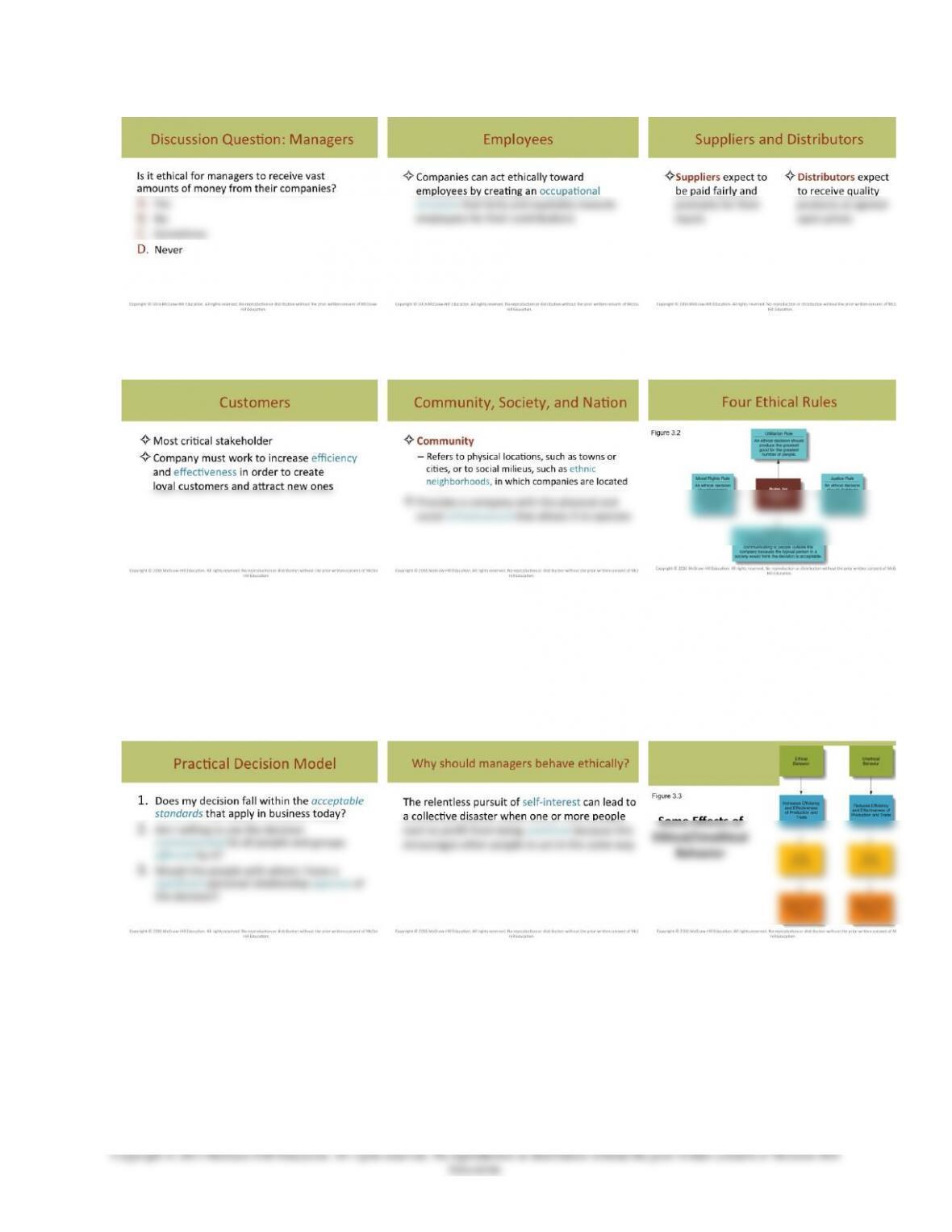
Discussion Question: Managers
INSTRUCTOR’S POWERPOINT
SLIDE 11
Employees
INSTRUCTOR’S POWERPOINT
SLIDE 12
Suppliers and Distributors
INSTRUCTOR’S POWERPOINT
SLIDE 13
Customers
INSTRUCTOR’S POWERPOINT
SLIDE 14
Community, Society, and Nation
INSTRUCTOR’S POWERPOINT
SLIDE 15
Figure 3.2 – Four Ethical Rules
INSTRUCTOR’S POWERPOINT
SLIDE 16
Practical Decision Model
INSTRUCTOR’S POWERPOINT
SLIDE 17
Why Should Managers Behave
Ethically?
INSTRUCTOR’S POWERPOINT
SLIDE 18
Figure 3.3 – Some Effects of Ethical
and Unethical Behavior
Chapter 03 – Managing Ethics and Diversity
3-27
INSTRUCTOR’S POWERPOINT
SLIDE 19
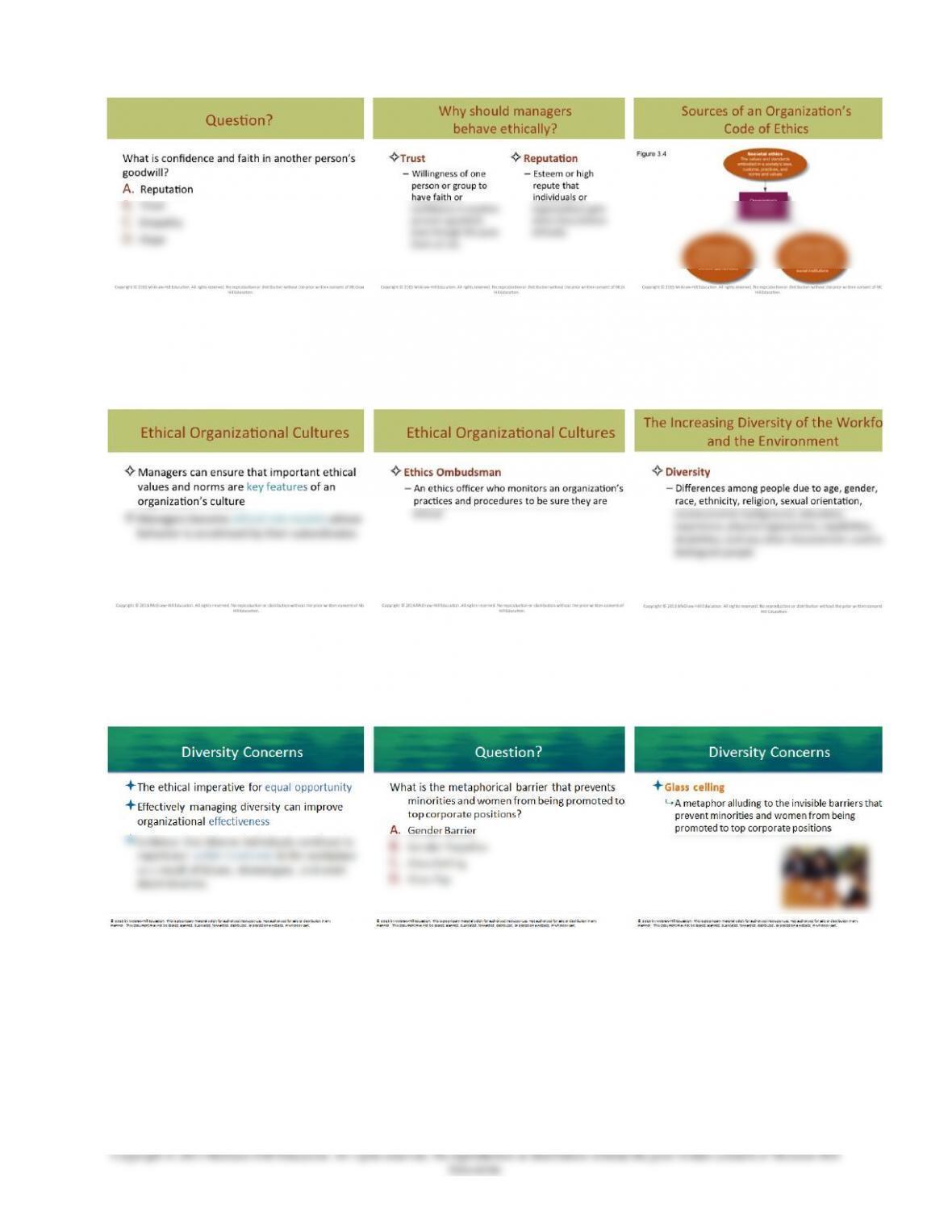
Question?
INSTRUCTOR’S POWERPOINT
SLIDE 20
Why Should Managers Behave
Ethically?
INSTRUCTOR’S POWERPOINT
SLIDE 21
Figure 3.4 – Sources of an
Organization’s Code of Ethics
INSTRUCTOR’S POWERPOINT
SLIDE 22
Ethical Organizational Cultures
INSTRUCTOR’S POWERPOINT
SLIDE 23
Ethical Ombudsman
INSTRUCTOR’S POWERPOINT
SLIDE 24
The Increasing Diversity of the
Workforce and the Environment
INSTRUCTOR’S POWERPOINT
SLIDE 25
Diversity Concerns
INSTRUCTOR’S POWERPOINT
SLIDE 26
Question?
INSTRUCTOR’S POWERPOINT
SLIDE 27
Glass Ceiling
Chapter 03 – Managing Ethics and Diversity
3-28
INSTRUCTOR’S POWERPOINT
SLIDE 25
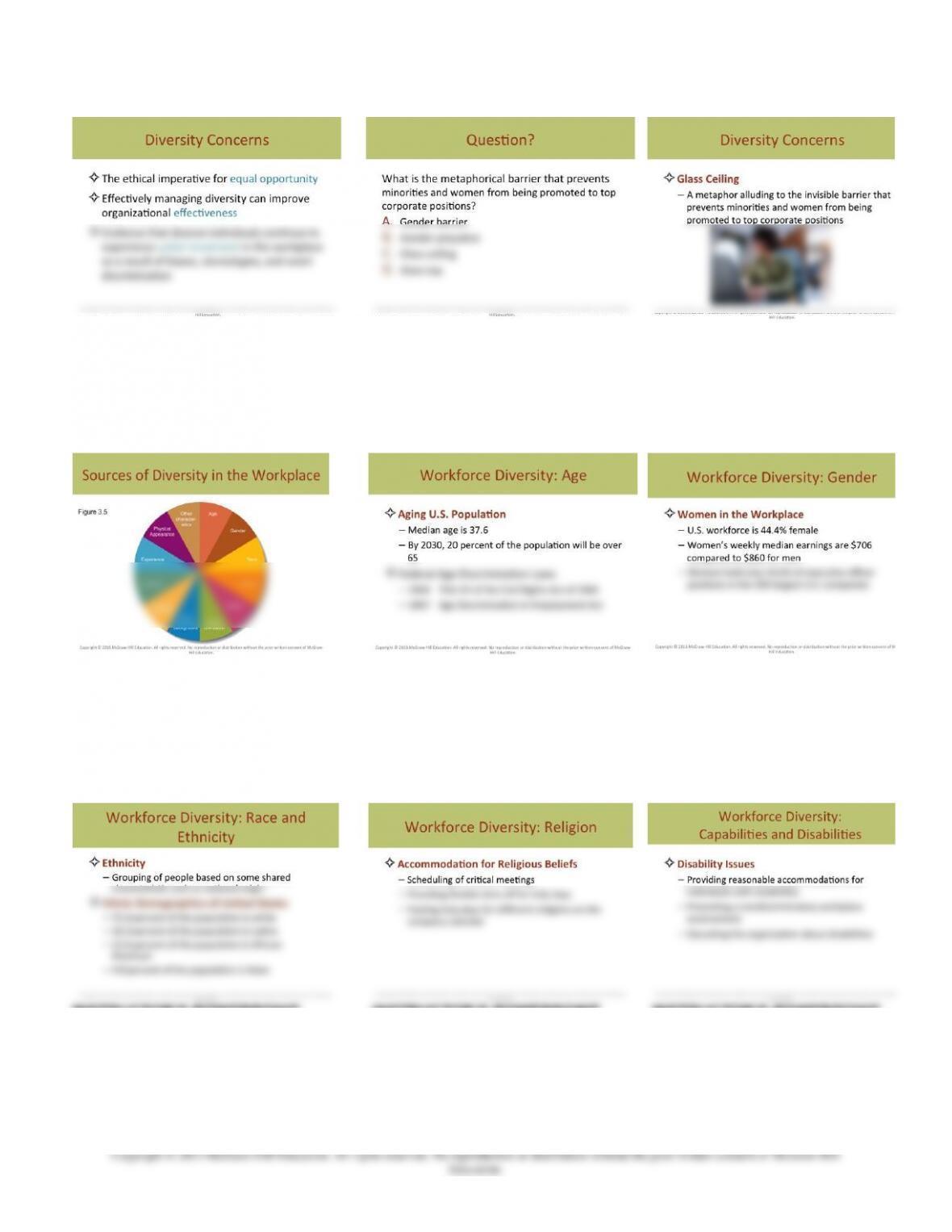
Diversity Concerns
INSTRUCTOR’S POWERPOINT
SLIDE 26
Question?
INSTRUCTOR’S POWERPOINT
SLIDE 27
Glass Ceiling
INSTRUCTOR’S POWERPOINT
SLIDE 28
Figure 3.5 – Sources of Diversity in the
Workplace
INSTRUCTOR’S POWERPOINT
SLIDE 29
Workforce Diversity: Age
INSTRUCTOR’S POWERPOINT
SLIDE 30
Workforce Diversity: Gender
INSTRUCTOR’S POWERPOINT
SLIDE 31
Workforce Diversity: Race and Ethnicity
INSTRUCTOR’S POWERPOINT
SLIDE 32
Workforce Diversity: Religion
INSTRUCTOR’S POWERPOINT
SLIDE 33
Workforce Diversity: Capabilities
and Disabilities
Chapter 03 – Managing Ethics and Diversity
3-29
INSTRUCTOR’S POWERPOINT
SLIDE 34
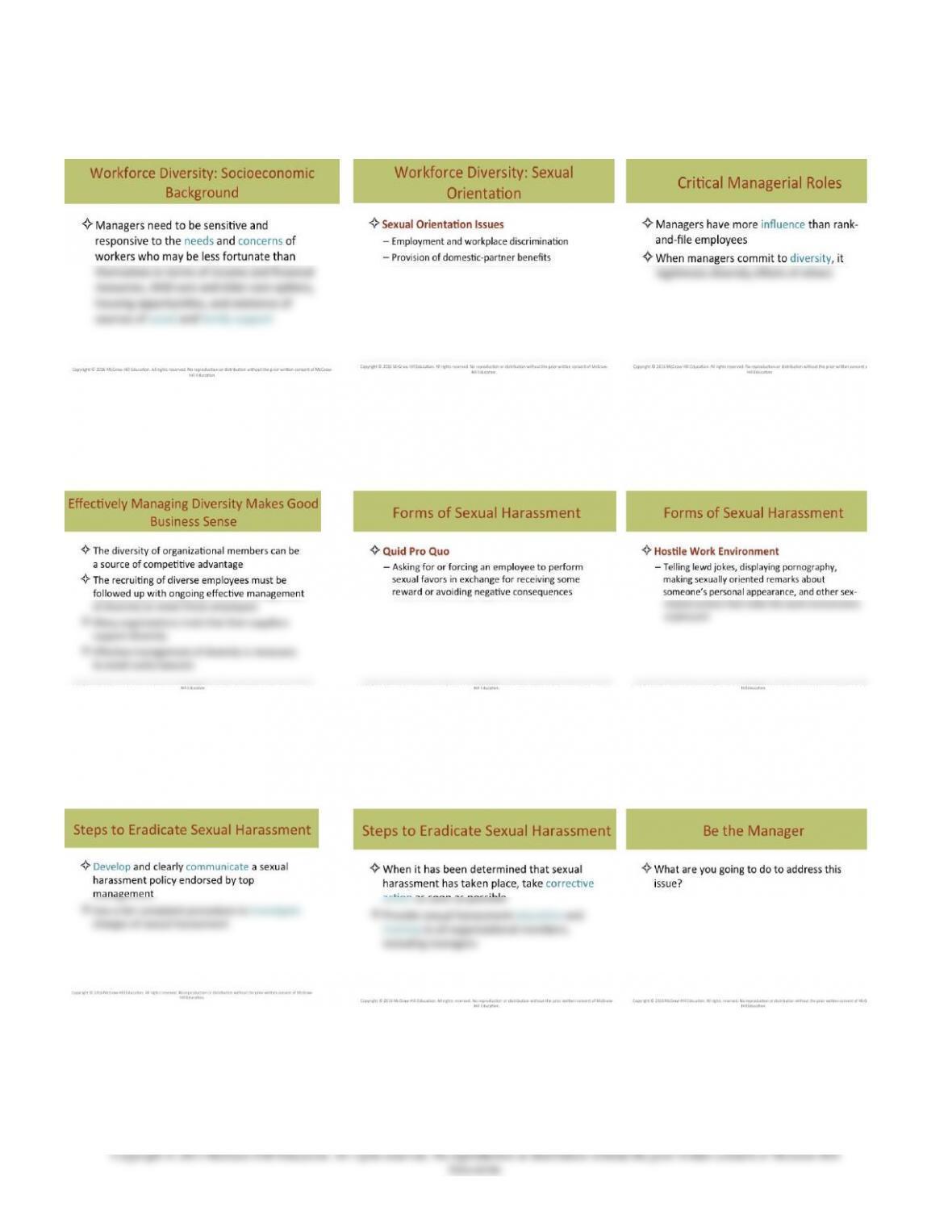
Workforce Diversity: Socioeconomic
Background
INSTRUCTOR’S POWERPOINT
SLIDE 35
Workforce Diversity: Sexual
Orientation
INSTRUCTOR’S POWERPOINT
SLIDE 36
Critical Managerial Roles
INSTRUCTOR’S POWERPOINT
SLIDE 37
Effectively Managing Diversity Makes
Good Business Sense
INSTRUCTOR’S POWERPOINT
SLIDE 38
Forms of Sexual Harassment
INSTRUCTOR’S POWERPOINT
SLIDE 39
Hostile work environment
INSTRUCTOR’S POWERPOINT
SLIDE 40
Steps to Eradicate Sexual Harassment
INSTRUCTOR’S POWERPOINT
SLIDE 41
Steps to Eradicate Sexual Harassment
INSTRUCTOR’S POWERPOINT
SLIDE 42
Be the Manager
Chapter 03 – Managing Ethics and Diversity
3-30
INSTRUCTOR’S POWERPOINT
SLIDE 43
Topics for Discussion
INSTRUCTOR’S POWERPOINT
SLIDE 44
Topics for Discussion
INSTRUCTOR’S POWERPOINT
SLIDE 45
Topics for Discussion
INSTRUCTOR’S POWERPOINT
SLIDE 46
Topics for Discussion
INSTRUCTOR’S POWERPOINT
SLIDE 47
Topics for Discussion

Chapter 03 – Managing Ethics and Diversity