
3-14
4. Isn’t the sharing of information, such as the location of a DUI checkpoint, protected
freedom of speech by the Constitution? Can the government really create laws to prohibit
this? On the other hand, is it ethical for drivers to share this type of information so that a
drunk driver can avoid being caught?
Chapter 03 – Databases and Data Warehouses: Supporting the Analytics-Driven Organization
3-15
CLOSING CASE STUDY TWO (p. 90)
WHEN MAKING A DATABASE OF PRIVATE AND COMPANY-STRATEGIC INFORMATION
AVAILABLE TO THE PUBLIC CAN BE GOOD
The two closing case studies in this chapter set in diametric opposition to each other.
This one covers when making publicly available information can be good.
QUESTIONS
1. What is your first reaction to Glaxo’s approach to finding a cure for malaria? Is it a
legitimate initiative or simply a smoke-and-mirrors marketing ploy to get the public to
believe that it cares about so-called neglected diseases in third-world countries?
2. What role could a social media tool like Facebook play in supporting this initiative? What
information could Glaxo and the volunteer researchers share on Facebook to speed up the
process of finding a cure for malaria?
3. Search the Web and find at least two sites at which you can participate in “saving the
world” through some sort of crowdsourcing initiative. What sites did you find? Who
sponsors the site? What is the “save the world” focus?
4. What role can analytics play in facilitating this type of research? What “intelligence”
would be important to capture and share with everyone? What sort of information
regarding the 13,500 available compounds could be displayed in a digital dashboard?
Chapter 03 – Databases and Data Warehouses: Supporting the Analytics-Driven Organization
3-16
Back to Jump List
SHORT-ANSWER QUESTIONS (p. 92)
1. What is business intelligence? Why it is more than just information?
2. What is online transaction processing (OLTP)?
3. What is online analytical processing (OLAP)?
4. What is the most popular database model?
5. How are primary and foreign keys different?
6. What are the five software components of a database management system?
7. How are QBE tools and SQL similar? How are they different?
8. What is a data warehouse? How does it differ from a database?

Chapter 03 – Databases and Data Warehouses: Supporting the Analytics-Driven Organization
3-17
9. What are the five major types of data-mining tools?
10. What is a data mart? How is it similar to a data warehouse?
Chapter 03 – Databases and Data Warehouses: Supporting the Analytics-Driven Organization
3-18
ASSIGNMENTS & EXERCISES (p. 92)
1. Finding “Hacked” Databases. The Happy Hacker (www.happyhacker.org/news/newsfeed.shtml)
is a Web site devoted to “hacking” – breaking into computer systems. When people hack into a
system, they often go after information in databases. There, they can find credit card information
and other private and sensitive information. Sometimes, they can even find designs of yet–to–be–
released products and other strategic information about a company. Connect to The Happy
Hacker Web site and find an article that discusses a database that was hacked. Prepare a short
report for your class detailing the incident.
DISCUSSION
2. Defining Queries for a Video Rental Store. Consider your local video rental store. It
certainly has an operational database to support its online transaction processing (OLTP).
The operational database supports such things as the adding of new customers, the
renting of videos (obviously), the ordering of videos, and a host of other activities. Now,
assume that the video rental store also uses that same database for online analytical
processing (OLAP) in the form of creating queries to extract meaningful information. If
you were the manager of the video rental store, what kinds of queries would you build?
What answers are you hoping to find?
DISCUSSION
3. Creating a Query. On the Web site that supports this text (www.mhhe.com/haag, choose
Chapter 3 and then Inventory database), we’ve provided the database (in Microsoft
Access) we illustrated in this chapter. Connect to the text’s Web site and download that
database. Now, create three queries using the QBE tool. The first one should extract
information from only one file (your choice). The second one should extract information
found in at least two files. The third should include some sort of selection criteria. How
easy or difficult was it to perform these three queries? Would you say that a DBMS is just
as easy to use as something like word processing or spreadsheet software? Why or why
Chapter 03 – Databases and Data Warehouses: Supporting the Analytics-Driven Organization
3-19
not? By the way, Extended Learning Module J takes you through the step-by-step process
of creating a query in Access.
DISCUSSION
4. Career Opportunities in Your Major. Knowledge workers throughout the business world
are building their own desktop databases (often called end-user databases or knowledge
worker databases). To do so, they must understand both how to design a database and
how to use a desktop DBMS such as Microsoft Access or FileMaker (made by FileMaker).
The ability to design a database and use a desktop DBMS offers you a great career
advantage. Research your chosen major by looking at job postings (the Web is the best
place to start). How many of those jobs want you to have some database knowledge? Do
they list a specific DBMS package? What’s your take – should you expand your education
and learn more about databases and DBMSs? Why or why not?
5. Salaries for Database Administrators. Database administrators (DBAs) are among the
highest paid professionals in the information technology field. Many people work for 10
to 20 years to get a promotion to DBA. Connect to Monster.com (www.monster.com) or
another job database of your choice and search for DBA job openings. As you do, select all
locations and job categories and then use “dba” as the keyword search criteria. How
many DBA job postings did you find? In what industries were some of the DBA job
openings? Read through a couple of the job postings. What was the listed salary range (if
any)? What sort of qualifications were listed?
DISCUSSION
• At the time we wrote this text, Monster listed over 1050 job openings for DBAs.
6. HOW UP-TO-DATE SHOULD DATA WAREHOUSE INFORMATION BE? Information timeliness
is a must in a data warehouse – old and obsolete information leads to poor decision making.
Below is a list of decision-making processes that people go through for different business
Chapter 03 – Databases and Data Warehouses: Supporting the Analytics-Driven Organization
3-20
environments. For each, specify whether the information in the data warehouse should be
updated monthly, weekly, daily, or by the minute. Be prepared to justify your decision.
a. To adjust classes sizes in a university registration environment
b. To alert people to changes in weather conditions
c. To predict scores of professional football games
d. To adjust radio advertisements in light of demographic changes
e. To monitor the success of a new product line in the clothing retail industry
f. To adjust production levels of food in a cafeteria
g. To switch jobs to various printers in a network
h. To adjust CD rates in a bank
i. To adjust forecasted demands of tires in an auto parts store
DISCUSSION
• Answers here will vary according to arguments made. Our answers are as follows.
Chapter 03 – Databases and Data Warehouses: Supporting the Analytics-Driven Organization
DISCUSSION QUESTIONS (p. 93)
1. Databases and data warehouses clearly make it easier for people to access all kinds of
information. This will lead to great debates in the area of privacy. Should organizations
be left to police themselves with respect to providing access to information or should the
government impose privacy legislation? Answer this question with respect to (1)
customer information shared by organizations; (2) employee information shared within a
specific organization; and (3) business information available to customers.
DISCUSSION
2. Business intelligence sounds like a fancy term with a lot of competitive advantage
potentially rolled into it. What sort of business intelligence does your school need?
Specifically, what business intelligence would it need to predict enrollments in the coming
years? What business intelligence would it need to determine what curriculums to offer?
Do you think your school gathers and uses this kind of business intelligence? Why or why
not?
DISCUSSION
• Business intelligence for schools is vast.
3. Consider your school’s registration database that enforces the following integrity
constraint: to enroll in a given class, the student must have completed or currently be
enrolled in the listed prerequisite (if any). Your school, in fact, probably does have that
integrity constraint in place. How can you get around that integrity constraint and enroll
in a class for which you are not taking nor have completed the prerequisite? Is this an
instance of when you should be able to override an integrity constraint? What are the
downsides to being able to do so?
DISCUSSION
3-22
4. In this chapter, we listed the five important software components of a DBMS: the DBMS
engine, the data definition, data manipulation, application generation, and data
administration subsystems. Which of those are most and least important to users of a
database? Which of those are most and least important to technology specialists who
develop data applications? Which of those are most and least important to the chief
information officer (CIO)? For each of your responses, provide justification.
DISCUSSION
• The most important DBMS component to users would include primarily the data
5. Some people used to believe that data warehouses would quickly replace databases for
both online transaction processing (OLTP) and online analytical processing (OLAP). Of
course, they were wrong. Why can data warehouses not replace databases and become
“operational data warehouses”? How radically would data warehouses (and their data–
mining tools) have to change to become a viable replacement for databases? Would they
then essentially become databases that simply supported OLAP? Why or why not?
DISCUSSION
• Data warehouses cannot replace databases for OLTP because they only contain
6. Consider that you work in the human resources management department of a local
business and that many of your friends work there. Although you don’t personally
generate payroll checks, you still have the ability to look up anyone’s pay. Would you
check on your friends to see if they’re earning more money than you? For that matter,
would you look up their pay just out of simple curiosity, knowing that you would never do
anything with the information or share it with anyone else? Why or why not? People
working at the Internal Revenue Service (IRS) were caught just curiously looking up the
reported incomes of movie stars and other high-profile public figures. Is this acceptable?
Why or why not?

Chapter 03 – Databases and Data Warehouses: Supporting the Analytics-Driven Organization
3-23
7. In spite of the need for “clean” information, many organizations have databases with
duplicate records for you. You’ve probably experienced the consequences of this by
receiving two identical pieces of junk mail from the same company. One record in the
database may have your middle initial while the other doesn’t, or there is some other type
of discrepancy. Why would some organizations intentionally not go through a process of
cleaning their database information?
DISCUSSION
Chapter 03 – Databases and Data Warehouses: Supporting the Analytics-Driven Organization
3-24
INDUSTRY & GLOBAL PERSPECTIVES
GLOBAL PERSPECTIVE – The Value of Analytics? More Efficient SCM and More Effective CRM
(p. 69)
• This global perspective builds on the major business initiatives of SCM and CRM, which were
discussed in Chapter 2.
• Amway China uses analytics to tighten its supply chain management system (efficiency)
• It also uses analytics to create a better customer relationship management system
(effectiveness)
INDUSTRY PERSPECTIVE – Credit Scoring with SAS at Canada’s Laurentian Bank (p. 82)
• SAS is the most well-known provider of statistical analysis software, in general and
specifically for the data warehouse environment.
INDUSTRY PERSPECTIVE – Dr Pepper Snapple Group Relies on Information and Analytics To Be
Competitive (p. 87)
• Dr Pepper Snapple Group, like many beverage providers, is huge in terms of its operations
all over the world.
Chapter 03 – Databases and Data Warehouses: Supporting the Analytics-Driven Organization
3-25
ADDITIONAL ASSIGNMENTS AND EXERCISES
PRIMARY KEYS, FOREIGN KEYS, AND INTEGRITY CONSTRAINTS
Note: Use this in the relational database model section
Let’s consider the information that your school tracks for a class. In this instance, a class is a
scheduled course. For example, your school may have FINA 2100— Introduction to
International Financial Markets as a course. If the school offers it in the fall, then it becomes a
class. Below, we’ve provided many pieces of information that your school probably tracks about
the class. First, which is the primary key (place an X in the second column)? Second, for each
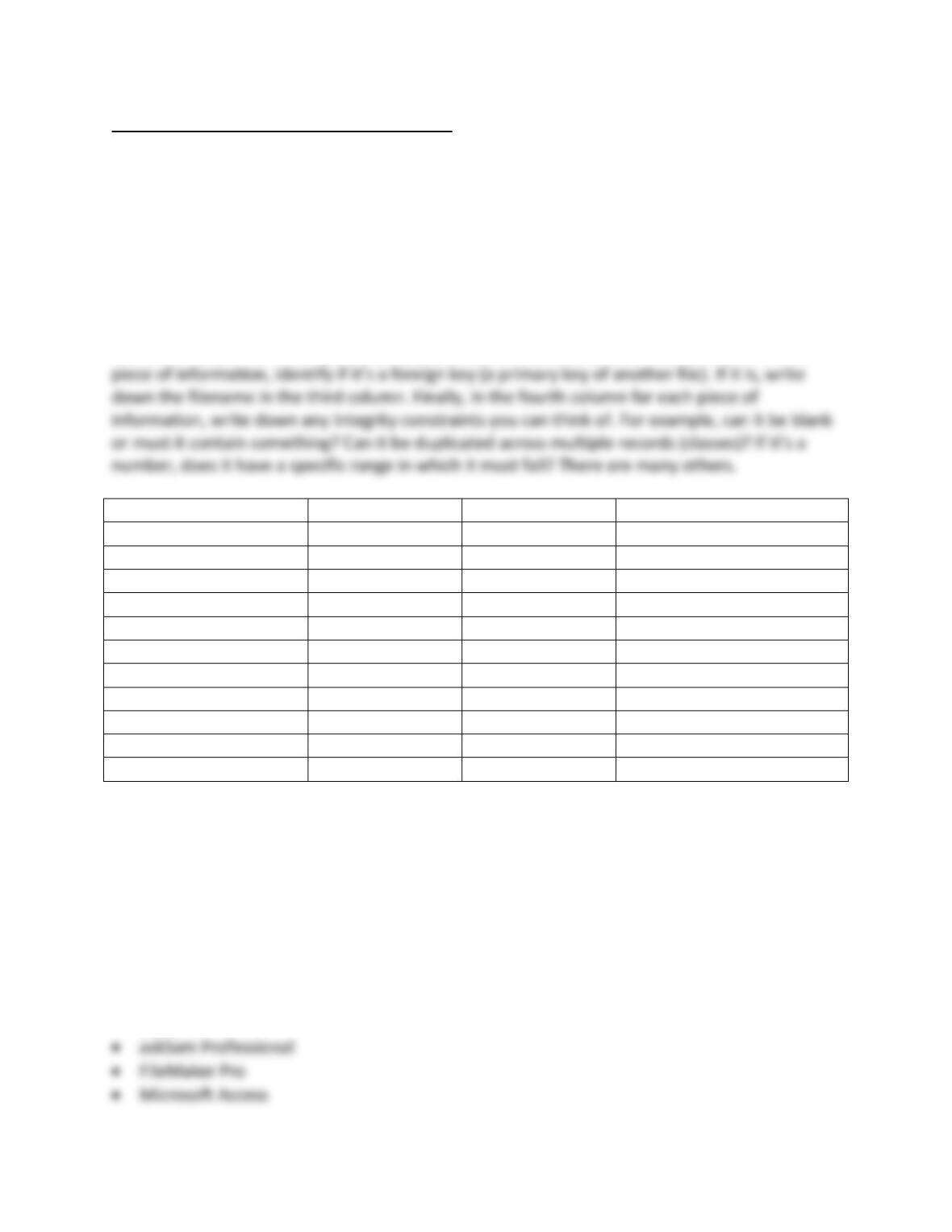
INFORMATION
PRIMARY KEY?
FOREIGN KEY?
INTEGRITY CONSTRAINTS
Department Designation
Course Number
Course Name
Course Description
Prerequisite
Number of Credit Hours
Lab Fee
Instructor Name
Room Number
Time of Day
Day of Week
RESEARCHING PERSONAL DBMSs
Note: Use this in the DBMS section.
Learning to use a DBMS is an important skill, especially if you’re attempting to land a great job.
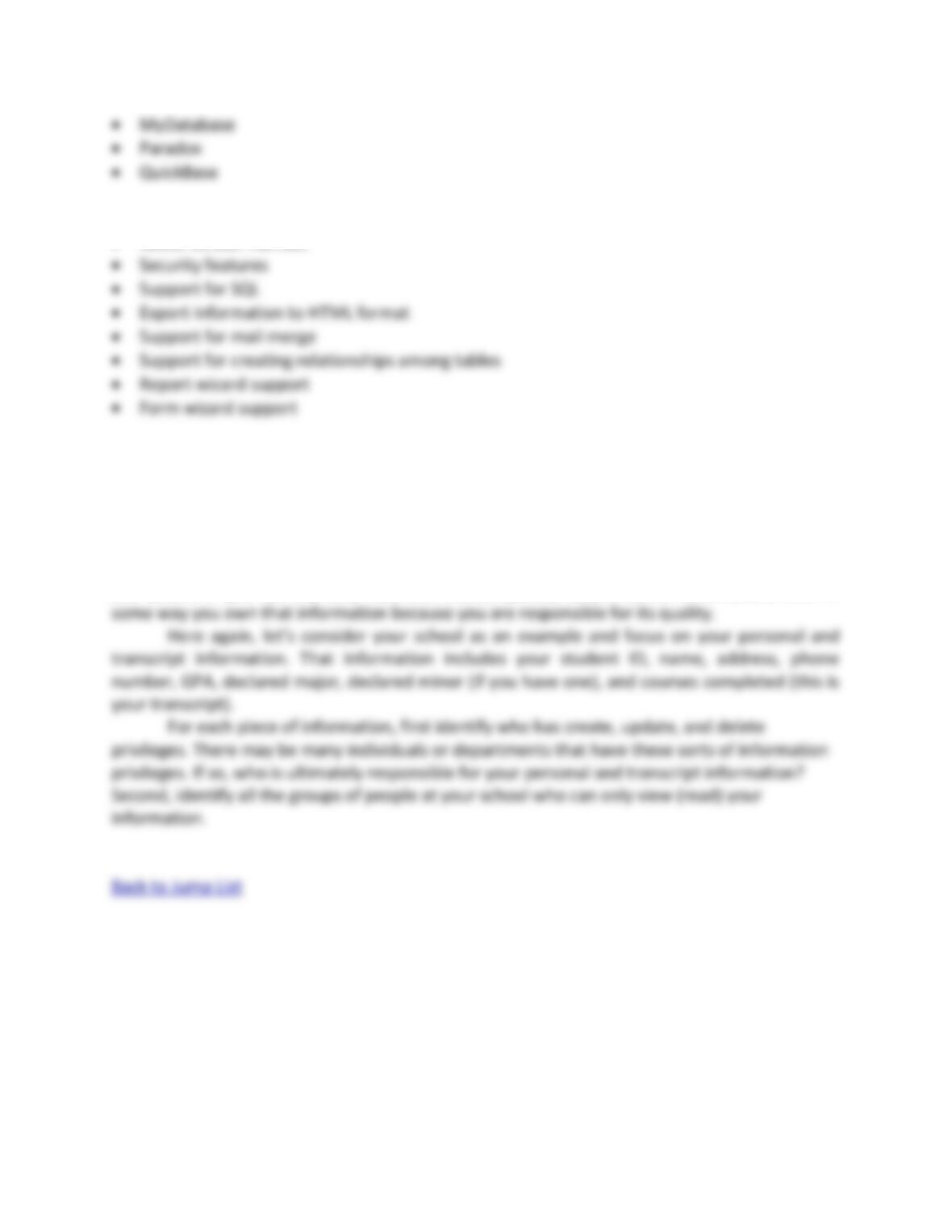
For each of the following personal DBMS packages, do some research and determine its
characteristics according to the next list.
• Alpha Five
Chapter 03 – Databases and Data Warehouses: Supporting the Analytics-Driven Organization
3-26
Characteristics:
• Latest version number
CRUD: DEFINING INFORMATION OWNERSHIP
Note: Use this in the information ownership section.
One easy way to determine information ownership is to think of CRUD—create, read, update,
and delete. If you can not only read but create, update, and/or delete information, then in