Focusing on Customers 21
18. How has the Zero Moment of Truth affected your shopping experiences? Provide some
examples.
Students will have different stories to relate in how the Zero moment of truth affects their
shopping experiences. For example, one of the authors needed to find comfortable lodging in a
medium-sized city in Nicaragua for himself and six friends, for a trip that was only three weeks
19. Write a generic customer satisfaction policy that a firm might use to convey trust to its
customers and as a means of determining employee values, policies, and training initiatives.
A customer satisfaction policy might be the following: Our employees are dedicated to doing
everything possible to ensure that our customers are delighted, not just satisfied, with our
products and services. To achieve this high level of product and service delivery, we promise to:
a. Treat customers with respect
20. Discuss the lessons that organizations can learn about customer relationships and
customer contact employees from the following experiences:
a. In shopping for a cell phone, a customer met a salesperson who introduced herself, asked
her name, went through the features that related to her needs, and didn’t try to sell her the
most expensive phone.
b. A woman encountered a sales person in a home improvement store who commented,
“Oh, shopping for your husband?”
c. A couple stranded in a restaurant booth with no waiter or silverware made eye contact
with a waitress who quickly replied, “Your waiter is late. I can’t take your order because
this isn’t my station.”
d. While shopping for a TV antenna, a customer asked the difference between various
models. The salesperson replied, “Some cost more because they look better.”
Organizations who have associates who make the following errors should endeavor to learn
about customers from their mistakes. As pointed out in the article from which these examples
were taken, the main lessons to learn are to train customer contact people (CCP’s) to focus on the
basics of courtesy and product knowledge. The authors of the article found that, after a three-
month, unscientific $5,000 shopping spree: Only 3% of their store visits had left them “very
satisfied.” The remaining 97% failed. Their advice to CCP’s:
• Make It a Relationship (as did the salesperson in point 1, above)
Focusing on Customers 22
• Listen Carefully. (As a salesman, Lewis encountered in a home-improvement store
didn’t bother to do in point number 2. The [expensive] power tool that she had come in to
buy stayed comfortably on its shelf.
• Embrace Positivity. “Shouldn’t,” “can’t,” “not my department”— have no place in
customer service as the waitress in situation 3 had failed to learn.
• Assume All Customers Are Royalty. Any customer can make your day—so treat every
customer like they’re the one. Dressed in casual garb, Brzykcy walked in expecting to
open up an account for her aunt. After being “treated like an unwelcome guest” she
21. If you were the manager of a small pizza restaurant (dine-in and limited delivery),
what customer contact requirements might you specify for your employees who take phone
orders, work the cash register, and serve as waiters? How would you train them?
Some examples: for the employees who take phone orders, it should be specified that the
employee obtain information on the name, address, phone number; directions to location, if not
easily found (or if the delivery person does not have access to a GPS); pizza type, including
22. A manager at a franchise of casual restaurant observed that there are three types of
customers who complain: those who feel they should receive exceptional service because of
the price they pay; “regulars” who become accustomed to a certain level of food and
service quality but perceive some difference; and customers in large groups who often
complain about longer waiting times.How might the restaurant address these types of
customers?
The restaurant manager needs to know the facts about complaints and adapt them to his situation.
Customer-focused organizations consider complaints as opportunities for improvement.
Encouraging customers to complain, making it easy for them to do so, and effectively resolving
complaints increases customer loyalty and retention. Of the customers who make a complaint,
Focusing on Customers 23
become the norm. If the regular customers experience a problem with their service, the CARE
steps should be immediately implemented. The customers in large groups should be encouraged
to make reservations ahead of time, but should be listened to, and ways should be provided to
entertain them while they wait.
23. Choose some e-commerce site with which you are familiar. Analyze how “customer–
focused” the organization appears to be and provide specific examples to justify your
opinions.
Answers will vary, depending on the e-commerce business that is chosen. One of the Instructor
Reserve case studies on Amazon.com provides a benchmark for how customer-focused such a
business can be.
24. An article in the Harvard Business Review (Matthew Dixon, Karen Freeman and
Nicholas Toman, “Stop Trying to Delight Your Customers,” July-August 2010, pp. 116–
122) suggests that delighting customers by exceeding service expectations does not build
loyalty, but that reducing the effort customers must do to get a satisfactory resolution
to a service issue does. Do you agree or disagree with these findings and why? Are they
necessarily at odds with one another?
The article obviously has a catchy title to attract readers. It is likely that the authors are correct to
imply that delighting customers by exceeding service expectations does not build loyalty, by
itself. It is almost inevitable that service problems will occasionally occur, even in the most
25. One of our former students discovered a way to receive great service: Ask for a
satisfaction survey at the beginning of a transaction. In one experience, the student
observed an instant change in how she was treated. What does such an experience
tell you about the company?
The experience of the student who asked for the satisfaction survey and then received better
service indicates that the company is using the customer satisfaction survey to control, rather
than to continuously improve, customer service. This is similar to a manufacturer who tries to
26. A customer survey for a pharmacy asks customers to rate the pharmacy according to
the following:
• Friendly pharmacist
• Knowledgeable pharmacist
• Friendly pharmacy technician
Focusing on Customers 24
• Knowledgeable pharmacy technician
• Quick checkout
They use a 1-5 Likert scale ranging from Disappointed to Excellent. Comment on how
actionable this survey is to measure performance and enable the pharmacy to improve. Are
there any other things you can suggest to improve the survey?
As it stands, the survey questions do not appear to be actionable, since they aren’t tied directly to
key business processes, so that what needs to be improved is clear; and information can be
translated into cost/revenue implications to support the setting of improvement priorities. The
first four items seem to focus on only one of the five service characteristics of quality: assurance.
In addition, “friendliness” can sometimes also mean “empathy” in a pharmacy setting, where the
pharmacist knows the customer’s names, and takes time to explain the technical features of a
medicine. The context is unclear. Quick checkout is an indicator of reliability, but how “quick” is
“quick”?
27. Develop some survey questions that an Urgent Care facility might ask patients about
their experience. Group your questions into categories of Physician/Nurse, Personal Issues,
and Overall Experience.
Some survey questions that an Urgent Care facility might ask patients about their experience,
include:
Registration
1. Prompt and courteous treatment at check-in
2. Ease of the registration process
3. Methods of payment clearly explained
4. Waiting time in registration
Facility
1. Convenience of parking
2. Cleanliness of the facility
3. Comfort of the waiting area
Focusing on Customers 25
4. Staff concern and response to your questions
5. After-visit instructions clearly and completely explained
Personal Issues
28. A criticism of the Net Promoter Score is that different percentages of promoters,
passives, and detractors can result in the same scores. For example, suppose that one firm
has 20% detractors, 0% passives, and 80% promoters, while another firm has 60%
promoters, 40% passives, and 0% detractors. Discuss the implications of interpreting the
Net Promoter Score and conclusions that you might reach when comparing different firms.
In this example, the first firm’s NPS is 80% – 20% = 60%, and the second firm’s NPS is also
60% – 0% = 60%. The distributions of the responses differ, suggesting that repurchase behavior
ANSWERS TO PROBLEMS
1. Ski magazine conducts and annual survey of readers to rate ski resorts. They used the
following attributes as the basis for the survey: snow, grooming, terrain variety, challenge,
value, lifts, service, weather, access, on-mountain food, lodging, dining, après-ski, off-hill
activities, family programs, scenery, terrain parks, overall satisfaction. Classify each of
these attributes using the eight dimensions of quality (i.e. performance, features, etc.)
The ski attributes may be classified as:
Snow – performance
Grooming – durability
Terrain variety – performance
Challenge – performance
Focusing on Customers 26
Lodging – performance
Dining – performance
Après-ski – features
2. Classify the following customer requirements for a hotel using the five key dimensions of
service quality—reliability, assurance, tangibles, empathy, or responsiveness.
• Hotel equipment is always functioning
• Hotel staff is knowledgeable to answer guest’s questions
• Hotel has comfortable beds, furniture, and fittings
• Guests feel safe as services are delivered to their rooms
• Hotel services are provided as promised
• Hotel has well-dressed staff
• Hotel staff is always willing to help guests
• Hotel furnishings appear to be clean and shiny
• Guests receive individual attention
• Guests feel that hotel services are provided at a competitive and affordable price
Using the five key dimensions of service quality the following customer requirements for a hotel,
the following are classified as:
• Hotel equipment is always functional – reliability
• Hotel staff is knowledgeable to answer guest’s questions – assurance
• Hotel has comfortable beds, furniture, and fittings – tangibles
• Guests feel safe as services are delivered to their rooms – assurance
3. Consider the following customer expectations for a fast-food (quick-service) restaurant.
Classify them as dissatisfiers, satisfiers, or exciters/delighters. Justify your reasoning.
a. Special prices on certain days
b. Food is safe to eat
c. Hot food is served hot
d. Service is friendly
e. Background music
f. Playland for children
g. Restaurant is clean inside
h. Food is fresh
Focusing on Customers 27
i. A “one–bite” money-back guarantee
j. Orders can be phoned in for pickup at a separate window
Several of these customer expectations items for a fast-food (quick-service) restaurant are open
to variations in individual opinion. For example, as more and more fast food restaurants have
play areas for children, it may become merely a satisfier, rather than an exciter/delighter. Using
Kano’s model, the following may be seen for items a through j:
a. Special prices on certain days – satisfier
b. Food is safe to eat – dissatisfier
c. Hot food is served hot – dissatisfier
d. Service is friendly – dissatisfier
4. Table 3.4 is a hypothetical list of customer requirements as determined through a focus
group conducted by an airline. Develop an affinity diagram, classify these requirements
into appropriate categories, and design a questionnaire to survey customers. Be sure to
address any other pertinent issues/questions as well as customer information that would be
appropriate to include in the questionnaire.
Table 3.4
• Quality food
• Ability to solve problems and answer questions during flight
• Efficient boarding procedures
• Appealing interior appearance
• Well-maintained seats
• Reservation calls answered promptly
• Timely and accurate communication of information prior to boarding
• Sufficient quantity of food
• Interesting in-flight magazine
• Courteous and efficient gate personnel
• In-flight telephone access
Focusing on Customers 28
• Correct explanation of fares and schedules
• Efficient seat-selection process
• Courteous and efficient sky cap
• Timely and accurate communication of flight information (in-flight)
• Convenient baggage check-in
a. An affinity diagram could be constructed by putting each of the customer service
requirements on a 3″ x 5″ card and clustering items that were similar to each other under a
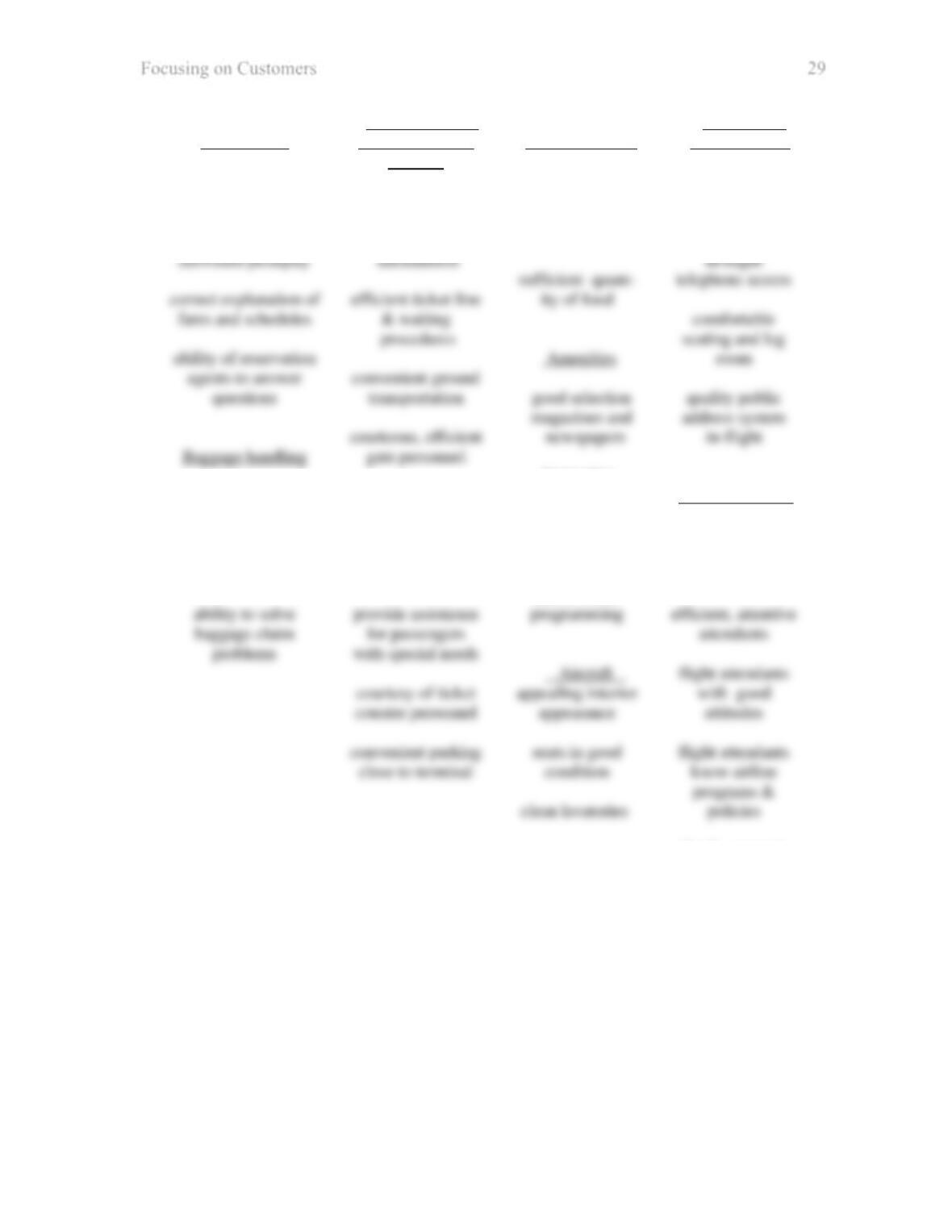
Focusing on Customers 29
Reservations
courteous reserva-
tion personnel
reservation calls
convenient baggage
check-in
timely baggage claim
upon arrival
Facilities and
Preflight Service
timely & accurate
communication of
pre- boarding
efficient seat
selection process
courteous, efficient
sky cap
Food Service
quality food
good beverage
selection
interesting
Western American
in-flight
magazine
good variety of
audio/visual
Aircraft
(Continued)
good quality
audio /visual
system
Inflight Service
ability to solve
problems, answer
questions in flight
timely, accurate
flight information
(in-flight)
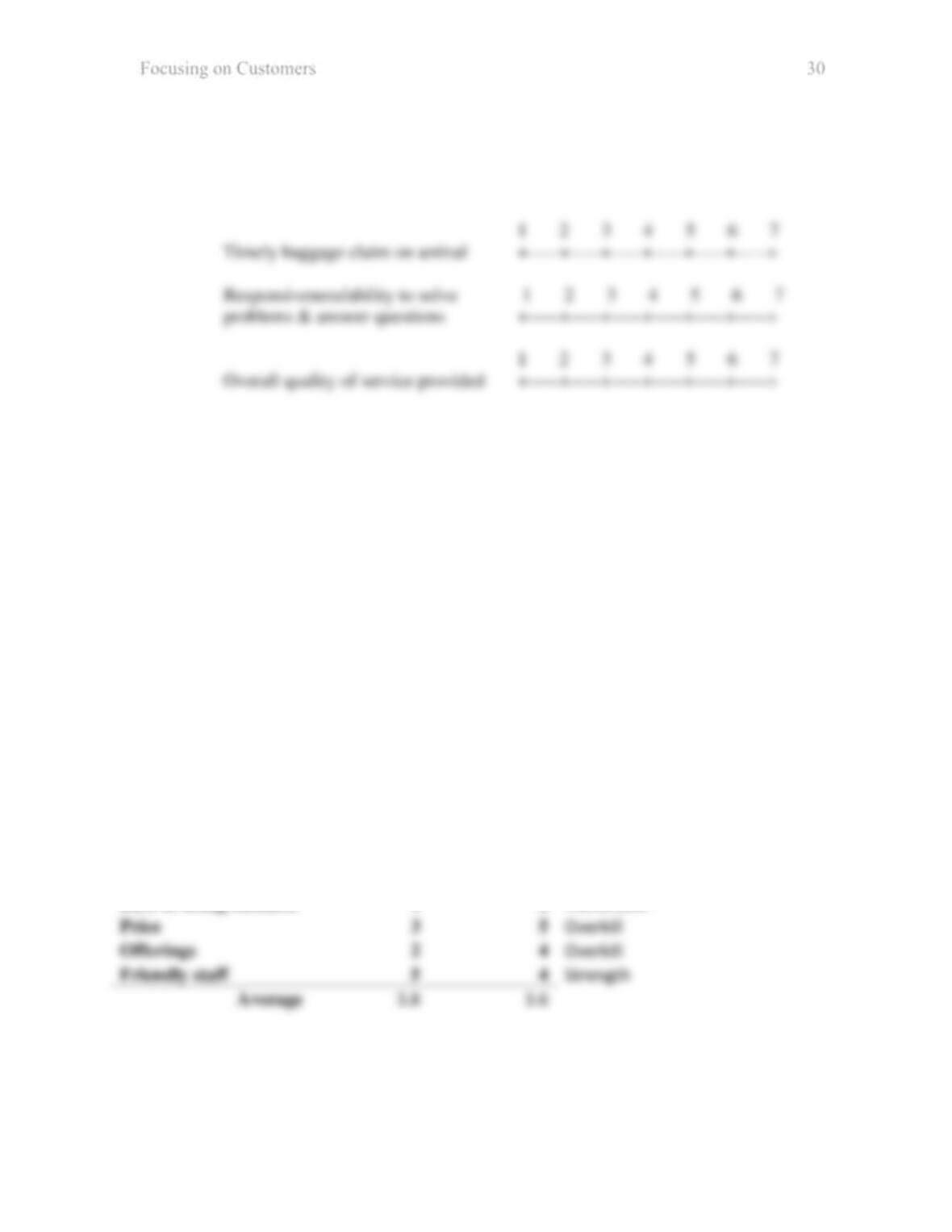
b. Once the Affinity Diagram has been developed, the design of a customer survey
questionnaire would be straightforward. Sections could be included for each of the
designated categories of: reservations, baggage handling, facilities and preflight service,
aircraft, amenities, food service, and in-flight service. Questions could be constructed on a
scale of 1-7 or 1-10, with 1 = Very poor and 7 = Outstanding. For example, in baggage
handling, the questions might include:
Focusing on Customers 30
Very Poor Outstanding
1 2 3 4 5 6 7
Convenience of baggage check-in +—–+—–+—–+—–+—–+—–+
Note that questions on overall satisfaction might be appropriate for each of the categories. Also,
questions about service personnel courtesy might be appropriate in any category where there is
face-to-face contact of employees with customers.
5. A logistics company surveyed its shipping customers. Using a scale of 1 – 5, with 5 being
the highest, they obtained the following average ratings.
Importance Performance
Quality 5 3
Ease of doing business 4 2
Price 3 5
Offerings 2 4
Friendly staff 5 4
What conclusions can be reached?
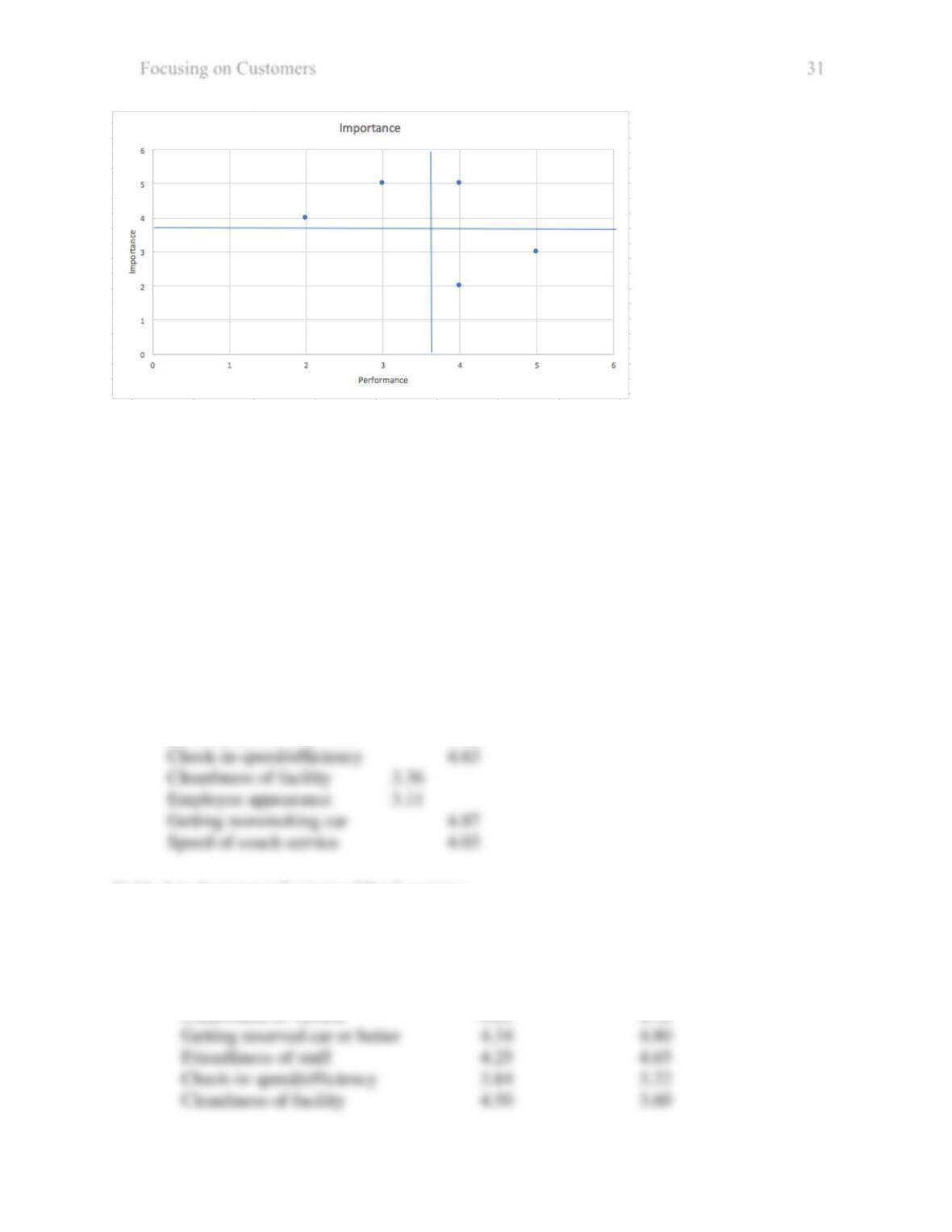
This is a simple exercise to chart and evaluate a performance-importance comparison. The table
and chart below summarizes the results (these can be found in the Ch03 Problem Solution Excel
Files folder in the Instructor materials.
Importance
Performance
Quadrant
Quality
5
3
Vulnerable
Ease of doing business
4
2
Vulnerable
Price
3
5
Overkill
Offerings
2
4
Overkill
Friendly staff
5
4
Strength
Focusing on Customers 31
6. A local franchise of the Williams Car Rental Company conducted a survey of customers
to determine their perceptions of the importance of key product and service attributes as
well as their perceptions of the company’s performance. The results are given in Tables 3.5
and 3.6. In Table 3.5, importance was measured on a four–point scale ranging from “not at
all important” to “very important.” Note that Table 3.6 is segmented by personal and
business use with ratings using a five-point scale from poor to excellent. What conclusions
might you make from these data? What possible improvements can you suggest?
Table 3.5 Importance Ratings of Product/Service Attributes
Mechanical condition of car 4.95
Check-out speed/efficiency 4.45
Cleanliness of vehicle 4.21
Getting reserved car or better 3.78
Friendliness of staff 4.12
Table 3.6 Customer Ratings of Performance
Personal use
Business use
Mechanical condition of car
Check-out speed/efficiency
4.80
3.88
4.71
3.50
Focusing on Customers 32
Employee appearance
4.72
4.66
After sorting the data in Table 3.5, we have:
Mechanical condition of car
4.95
Getting nonsmoking car
4.87
Check-in speed/efficiency
4.63
Check-out speed/efficiency
4.45
Cleanliness of vehicle
4.21
Friendliness of staff
4.12
Speed of coach service
4.03
Getting reserved car or better
3.78
Cleanliness of facility
3.36
Employee appearance
3.11
It appears that the three top items are mechanical condition, getting a non-smoking car, and
checkout speed. Getting reserved car or better, cleanliness of the facility, and employee
appearance are relatively unimportant. The rest are moderately important.
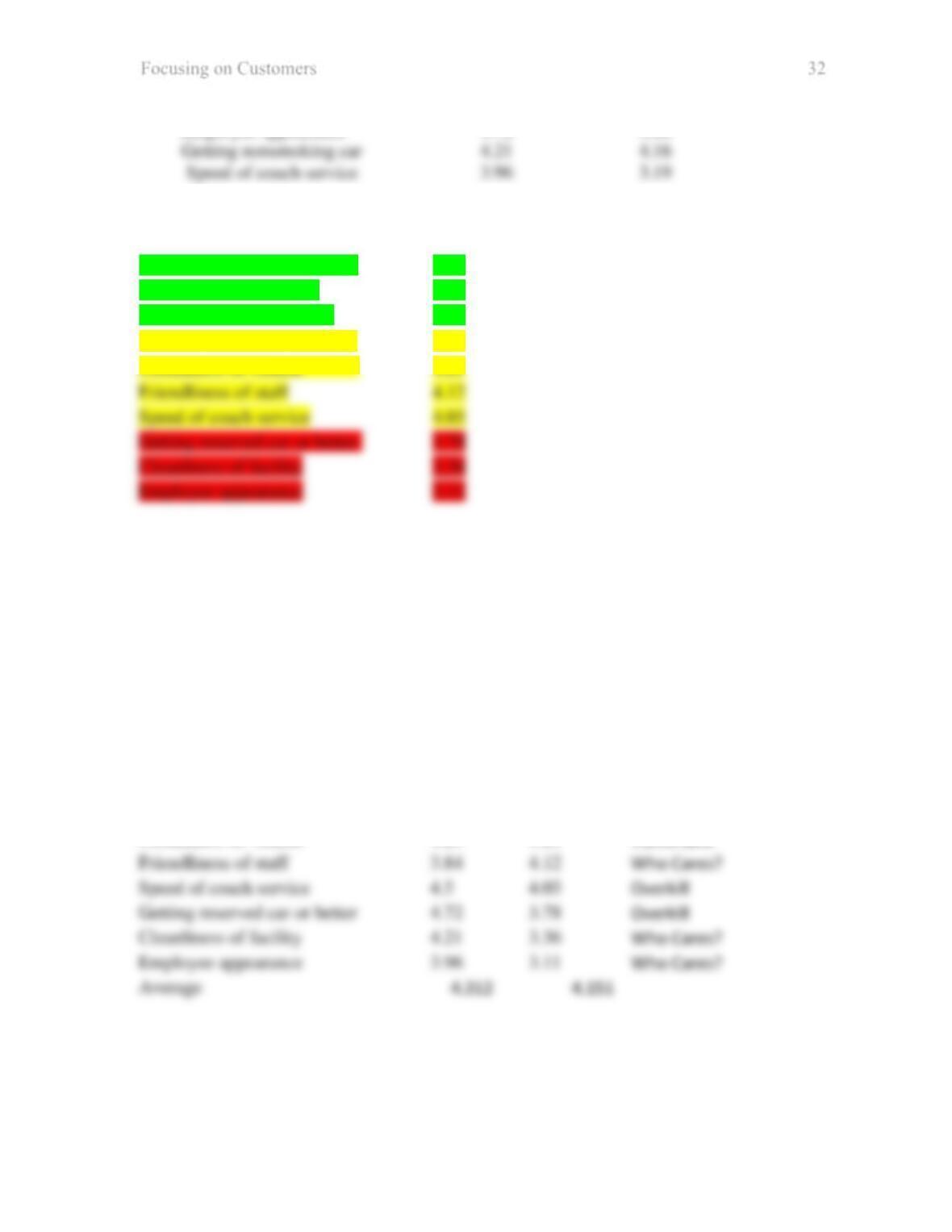
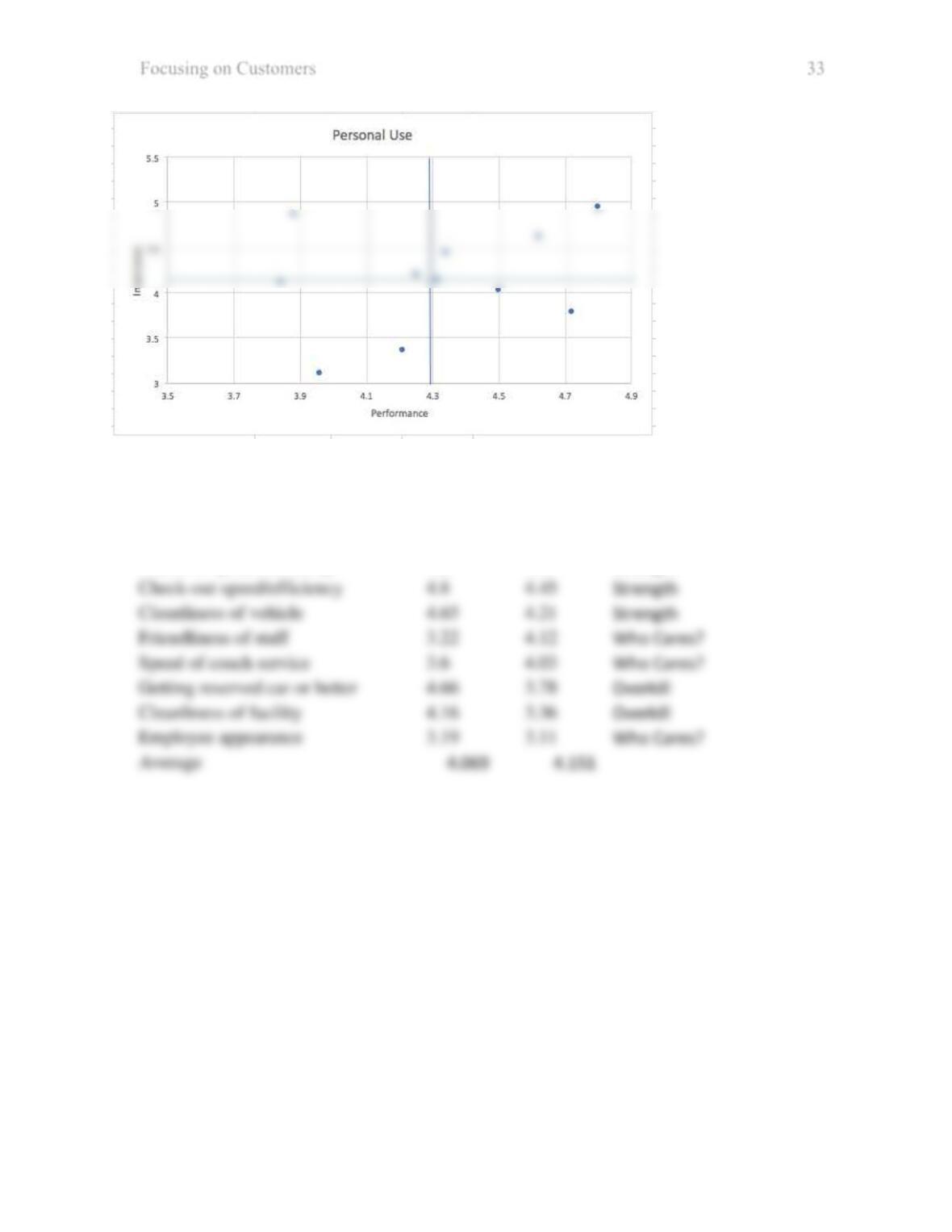
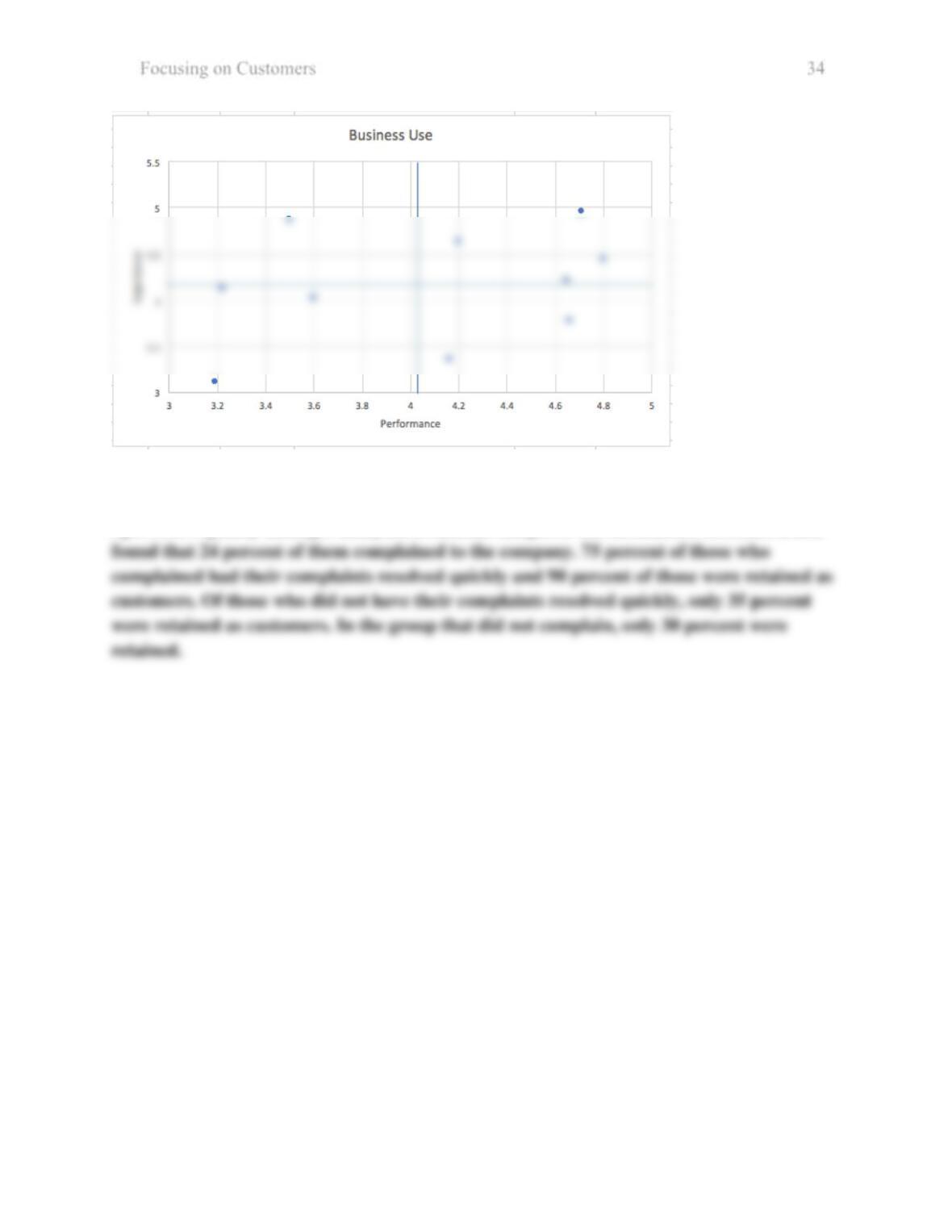
The charts and tables below show the Performance-Importance Analyses. These can be
found in the Ch03 Problem Solution Excel Files folder in the Instructor materials.
Personal Use
Performance
Importance
Quadrant
Mechanical condition of car
4.8
4.95
Strength
Getting nonsmoking car
3.88
4.87
Vulnerable
Check-in speed/efficiency
4.62
4.63
Strength
Check-out speed/efficiency
4.34
4.45
Strength
Cleanliness of vehicle
4.25
4.21
Vulnerable
Friendliness of staff
3.84
4.12
Who Cares?
Speed of coach service
4.5
4.03
Overkill
Getting reserved car or better
4.72
3.78
Overkill
Cleanliness of facility
4.21
3.36
Who Cares?
Employee appearance
3.96
3.11
Who Cares?
Average
Focusing on Customers 33
Business Use
Performance
Importance
Quadrant
Mechanical condition of car
4.71
4.95
Strength
Getting nonsmoking car
3.5
4.87
Vulnerable
Check-in speed/efficiency
4.2
4.63
Strength
Check-out speed/efficiency
4.8
4.45
Strength
Cleanliness of vehicle
4.65
4.21
Strength
Friendliness of staff
3.22
4.12
Who Cares?
Speed of coach service
3.6
4.03
Who Cares?
Getting reserved car or better
4.66
3.78
Overkill
Cleanliness of facility
4.16
3.36
Overkill
Employee appearance
3.19
3.11
Who Cares?
Average
Focusing on Customers 34
7. SportTee makes T-shirts for national sporting-goods and retail chain stores.
SportTee’s quality manager analyzed a random sample of 100 dissatisfied customers, and