Managing the Information Technology Resource Instructor’s Manual
1
CHAPTER 3 – STRATEGIC ALIGNMENT MATURITY
CHAPTER OBJECTIVES
Study of this chapter will enable the student to:
1. Appreciate the importance of IT and business alignment
3. Understand the concept of alignment maturity and the importance of alignment maturity
5. Be aware of the six criteria that characterize each level of Strategic Alignment Maturity
7. Understand Strategic Alignment as a process
CHAPTER OVERVIEW
This chapter discusses five levels of Strategic Alignment Maturity and the six criteria that characterize
each level of Strategic Alignment Maturity. A process is presented for assessing the maturity of a firm’s
business-IT alignment. Once the maturity of business-IT alignment is understood, an organization can
identify opportunities for enhancing the harmonious relationship of business and IT. Finally, a series of
steps are presented that will enable organizations to attain and sustain business-IT alignment.
CHAPTER OUTLINE
I. Introduction
II. Why Alignment is Important
III. Strategic Alignment Maturity
IV. The Six Strategic Alignment Maturity Criteria
A. Communications
B. Competency/Value Measurements
C. Governance
D. Partnerships
E. Scope and Architecture
F. Skills
V. Levels of Strategic Alignment Maturity
A. Level 1 – Initial/Ad Hoc Process
B. Level 2 – Committed Process
C. Level 3 – Established Focused Process
VI. Assessing Strategic Alignment Maturity
VII. Strategic Alignment as a Process
EXAMPLES IN ACTION
• Amazon.com – Alignment Maturity Enables Strategic Transformation – pp. 77-79
Managing the Information Technology Resource Instructor’s Manual
2
ANSWERS TO END-OF-CHAPTER REVIEW QUESTIONS
1. Describe the concept of Strategic Alignment Maturity and its importance to a company.
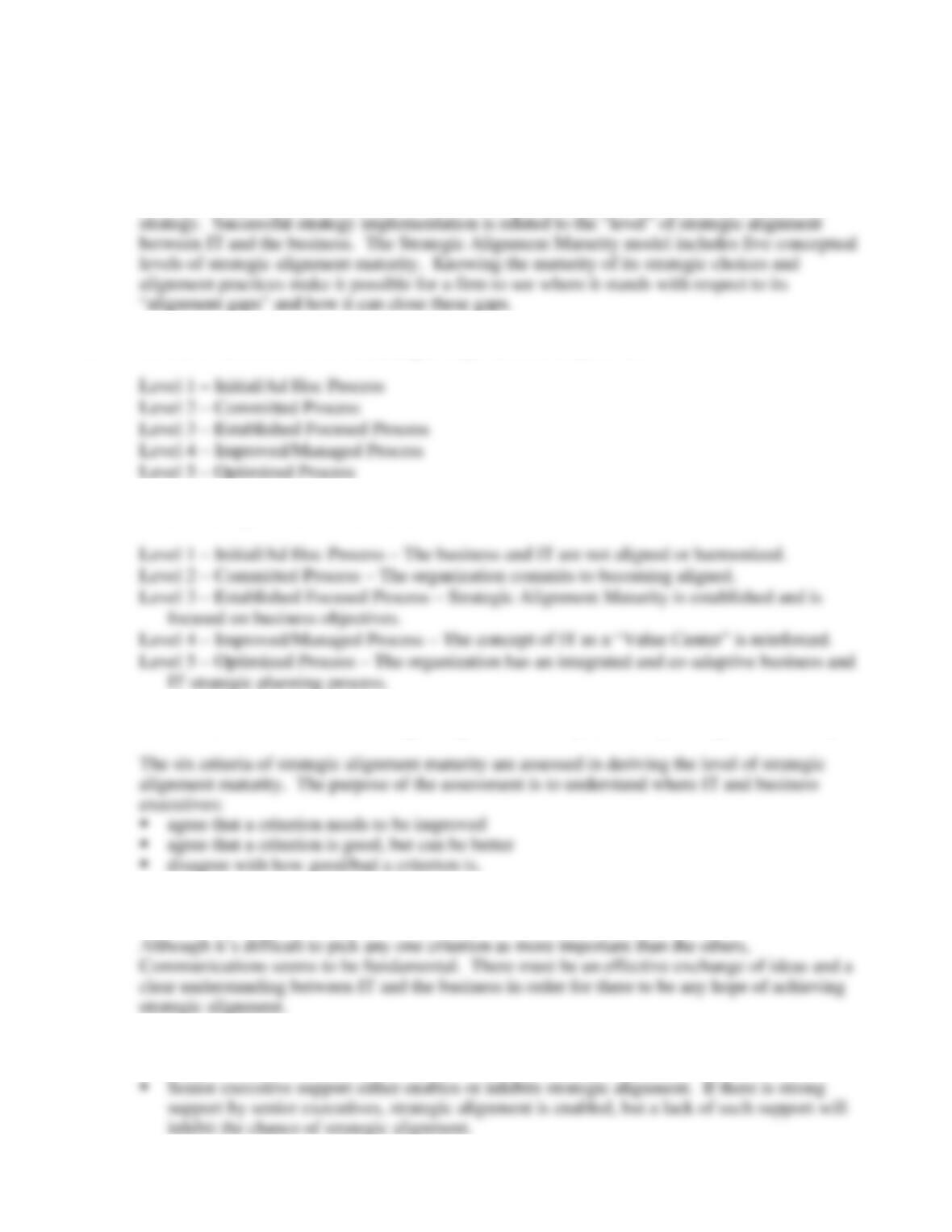
Strategic Alignment Maturity is a concept focusing on an organization’s ability to implement its
2. What are the five levels of the Strategic Alignment Maturity model?
3. What is the significance of each level?
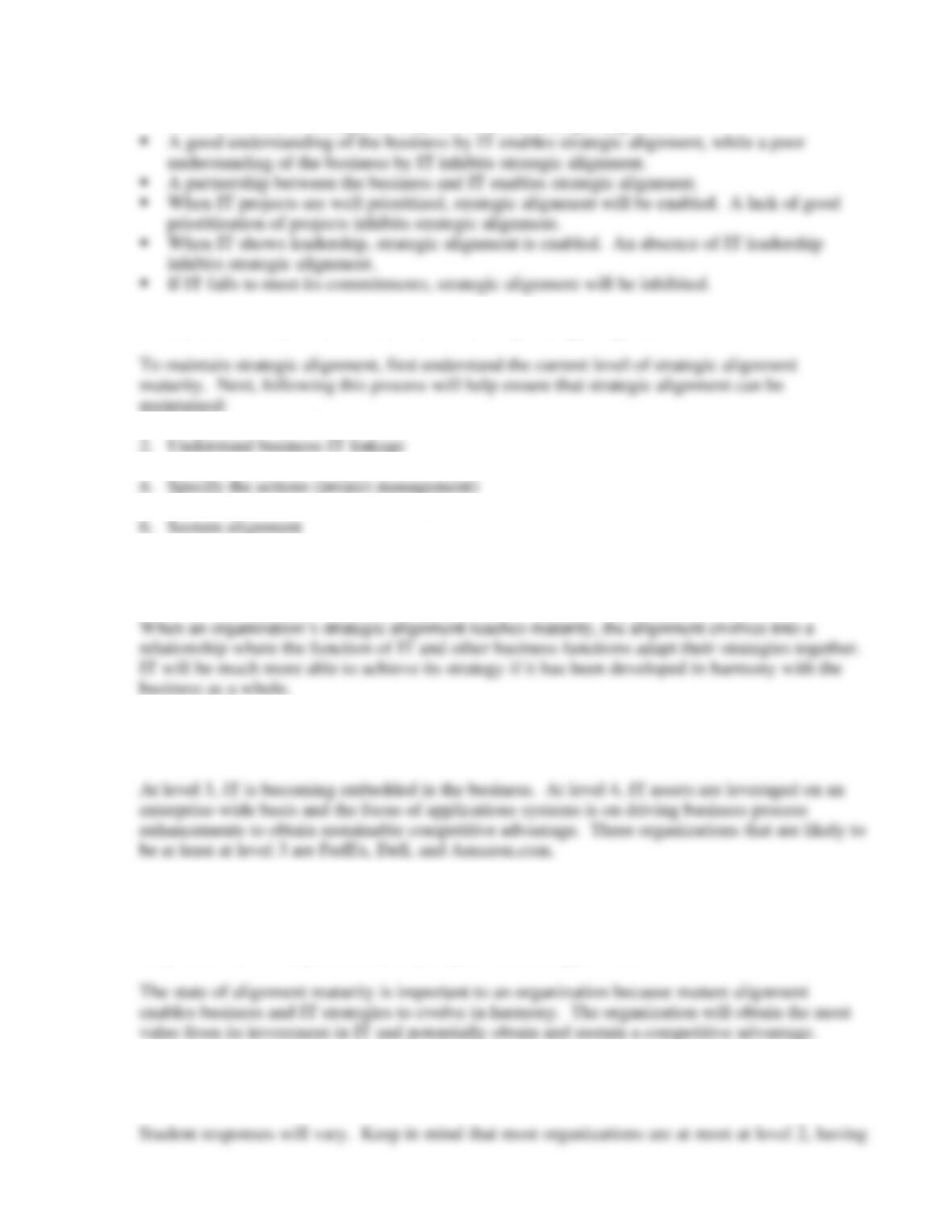
4. How do the six criteria of the Strategic Alignment Maturity model impact alignment maturity?
5. Do you believe any of the six criteria are more important than the others? Why?
6. Name some examples of enablers and inhibitors to strategic alignment.
Managing the Information Technology Resource Instructor’s Manual
3
▪ IT involvement in strategy development enables strategic alignment.
7. What processes should one consider in maintaining strategic alignment?
1. Set goals and establish the team
3. Analyze and prioritize gaps
5. Choose and evaluate success criteria
8. How can the maturity of an organization’s strategic alignment impact its ability to execute an IT
strategy?
9. Name three present-day firms that you believe have an alignment maturity level above Level 3
and explain why.
ANSWERS TO END-OF-CHAPTER DISCUSSION QUESTIONS
1. Why is the state of alignment maturity important to an organization?
2. How might you describe the state of Strategic Alignment Maturity for your own organization?
Why?
Student responses will vary. Keep in mind that most organizations are at most at level 2, having
Managing the Information Technology Resource Instructor’s Manual
4
3. What aspects of Strategic Alignment Maturity do you believe are most problematic for your
organization?
4. Why do organizations appear to rate so low on the maturity of their Strategic Alignment?
5. Would your organization welcome an assessment of Strategic Alignment Maturity?