3-32 CHAPTER 3: MATHEMATICS OF FINANCE
31. P = $5,000, r = 9% = 0.09, m = 4, i = 0.09
4 = 0.0225, A = $6,000
(1 )
6,000 5,000(1.0225)
6,000 6
n
n
n
AP i
32. (A) r = 6% = 0.06, m = 12, i = 0.06
12 = 0.005
If we invest P dollars, then we want to know how long it will take to have 2P dollars:
A = P(1 + i)n
(B) r = 9% = 0.09, m = 12, i = 0.09
12 = 0.0075
33. (A) PMT = $2,000, m = 1, r = i = 7% = 0.07, n = 45
n
i
= 2,000
0.07
= 2,000
0.07
(B) PMT = $2,000, m = 1, r = i = 11% = 0.11, n = 45
n
i
= 2,000
0.11
= 2,000
0.11
CHAPTER 3 REVIEW 3-33
34. A = $17,388.17, P = $12,903.28, m = 1, r = i, n = 3
A = P(1 + i)n
35. (A) P = $400, t = 15
360 , I = $29.00
29
(B) P = $1,800, t = 21
360 , I = $69.00
69
36. FV = $50,000, i = 0.055
12 = 0.004583 , n = 5(12) = 60
i
0.004583
37. (A) The present value of an annuity which provides for quarterly withdrawals of $5,000 for 10 years
at 7.32% interest compounded quarterly is given by:
n
i
with PMT = $5,000, i = 0.0732
(B) To determine the quarterly deposit to accumulate the amount in part (A), we use the formula:
PMT = FV (1 ) 1
i
where FV = $140,945.57, i = 0.0183 and n = 4(20) = 80
0.0183
3-34 CHAPTER 3: MATHEMATICS OF FINANCE
(C) The amount collected during the 10-year period is
($5,000)40 = $200,000.
38. PV = $4,000, i = 0.009, n = 48
PMT = PV 1(1 )
n
i
0.009
39. FV = $50,000, r = 6.12% = 0.0612, m = 12, i = 0.0612
12 = 0.0051, n = 12(6) = 72
i
0.0051
40. To determine how long it will take money to double, we need to solve the equation 2P = P(1 + i)n for n.
From this equation, we obtain:
(1 + i)n = 2
(A) i = 0.075
365 = 0.000205479
41. First, we must calculate the future value of $8,000 at 5.5% interest compounded monthly for 2.5 years.
A = P(1 + i)n where P = $8,000, i = 0.055
CHAPTER 3 REVIEW 3-35
Copyright © 2019 Pearson Education, Inc.
PMT = PV 1(1 )
n
i
i
where PV = $9,176.33, i = 0.055
12 ≈ 0.004583 3, and n = 12(5) = 60
= 9,176.33 60
0.0045833
1 (1 0.0045833)
= 60
42.058179
1 (1.0045833)
≈ $175.28
The total amount paid on the loan is:
42. A = Pert; P = 5,650, r = 8.65% = 0.0865, t = 10
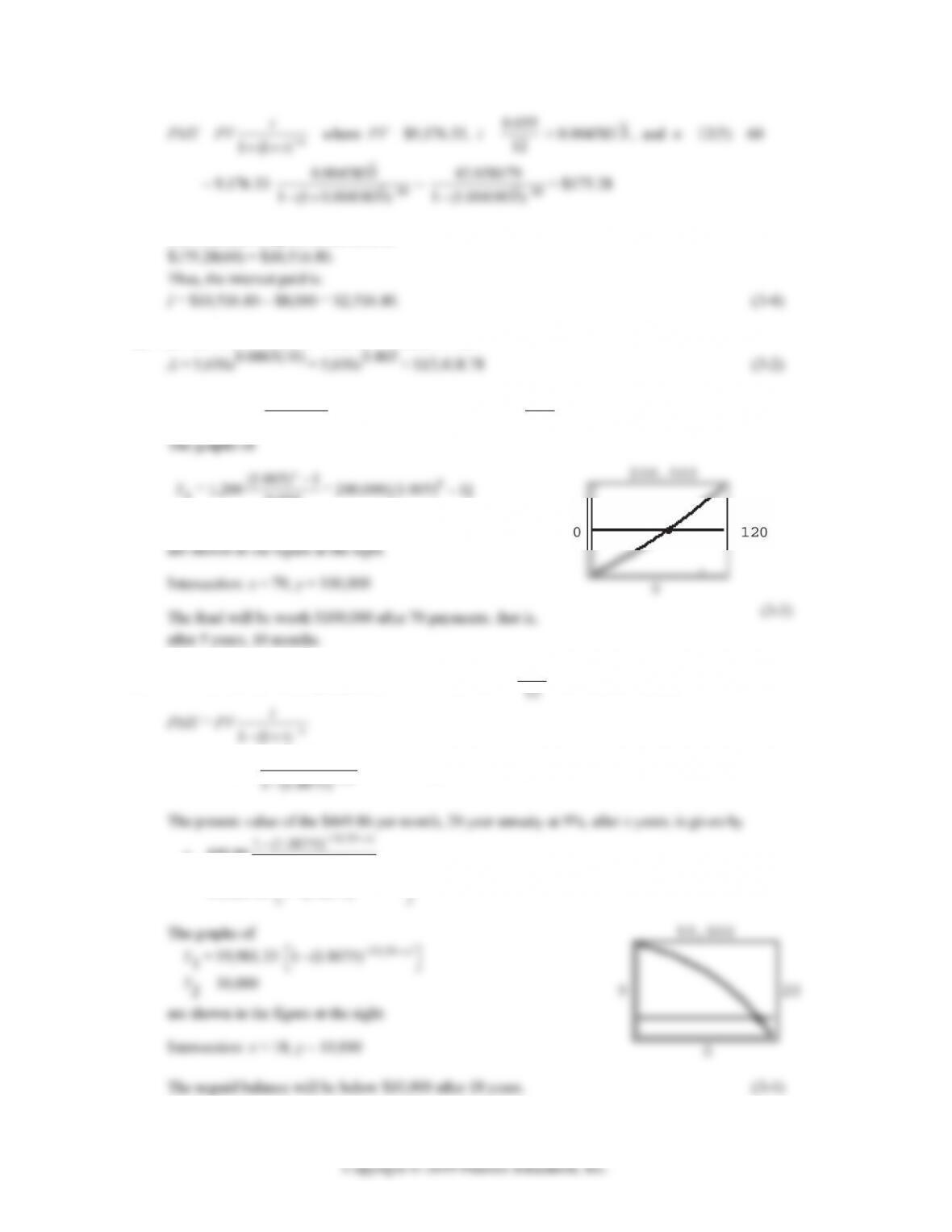
43. Use FV = PMT (1 ) 1
n
i
i
where PMT = 1,200 and i = 0.06
12 = 0.005.
0.005
Y2 = 100,000
The fund will be worth $100,000 after 70 payments, that is,
after 5 years, 10 months.
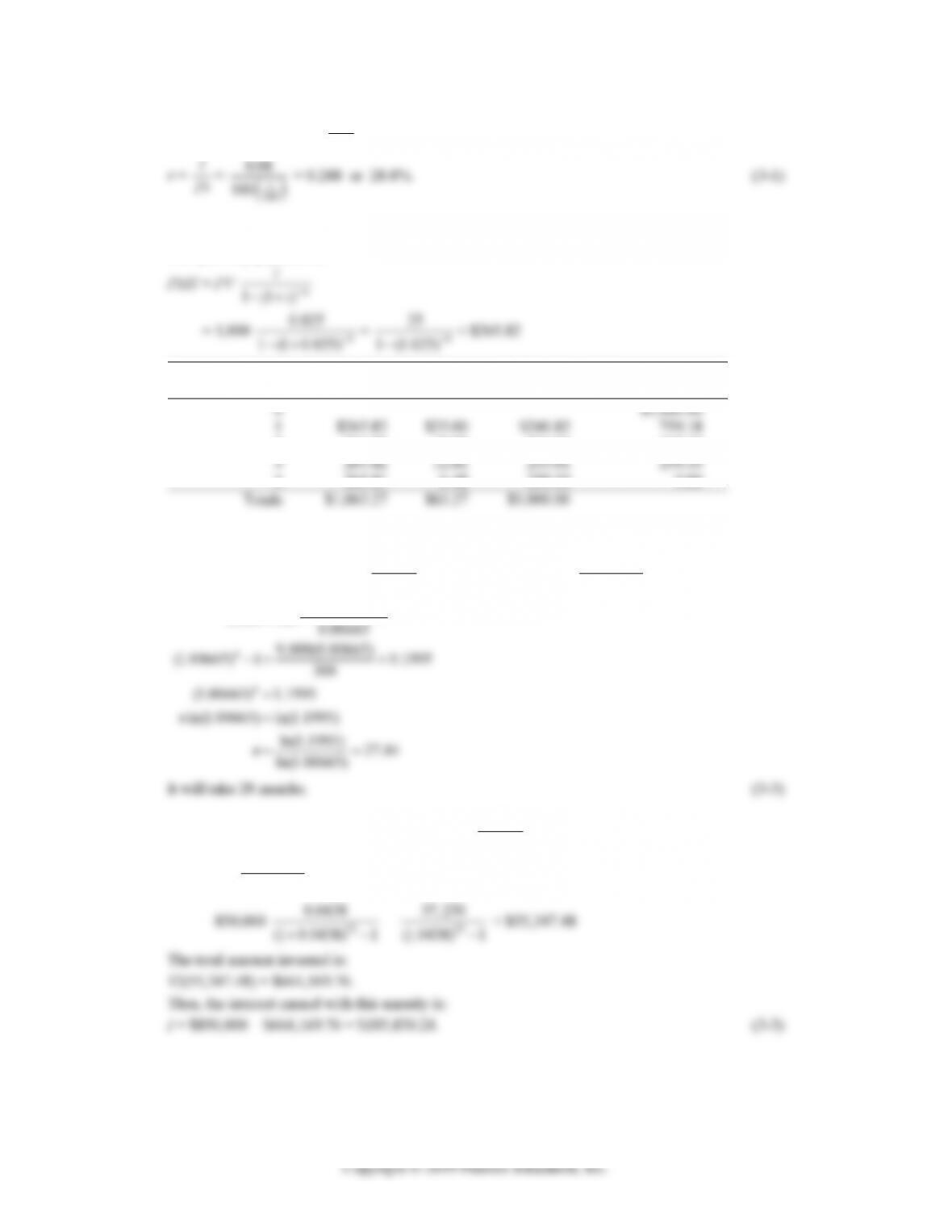
44. We first find the monthly payment: PV = $50,000, i = 0.09 0.0075, 12(20) 240
i
= 50,000 240
0.0075
y = 449.86
0.0075
= 59,981.33 12(20 )
1 (1.0075)
x
x
3-36 CHAPTER 3: MATHEMATICS OF FINANCE
45. P = $100, I = $0.08, t = 1
360
P
I
360
0.08
46. PV = $1,000, i = 0.025, n = 4
The quarterly payment is:
i
Pa
y
men
t
Unpaid balance
Pa
y
ment numbe
r
Pa
y
men
t
Interes
t
Reduction Unpaid balance
2 265.82 18.98 246.84 512.34
4 265.81 6.48 259.33 0.00
(3-4)
47. PMT = $300, FV = $9,000, i = 0.0798
12 = 0.00665; (1 ) 1
n
i
FV PMT i
(1.00665) 1
9,000 300 0.00665
n
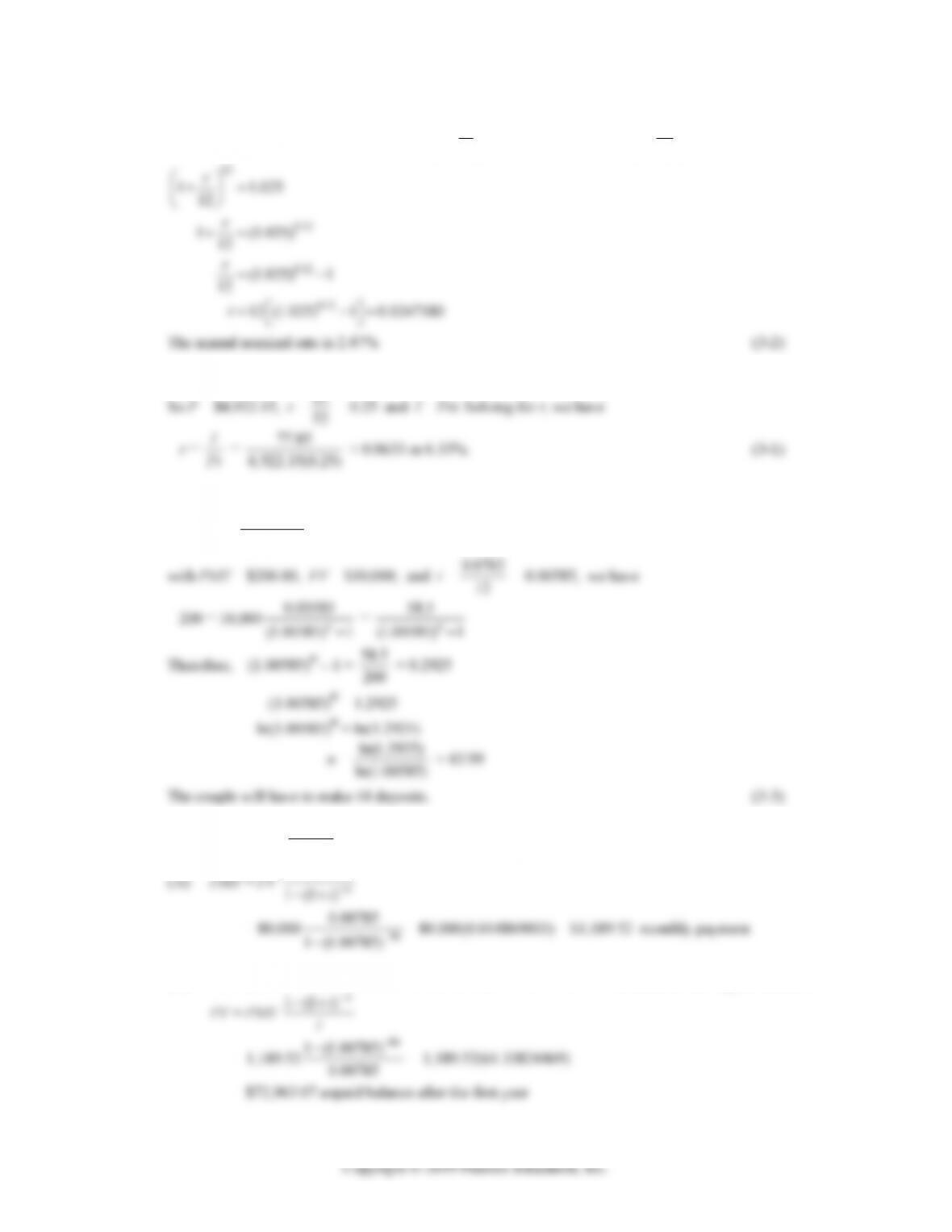
48. FV = $850,000, r = 8.76% = 0.0876, m = 2, i = 0.0876
2= 0.0438, n = 2(6) = 12
PMT = FV (1 ) 1
n
i
i
0.0438
37, 230
CHAPTER 3 REVIEW 3-37
49. APY = 2.50% = 0.025, m = 12; APY = 1
m
r
m
– 1. Solve 0.025 =
12
112
r
– 1 for r:
50. The interest earned is I = $5,000 – $4,922.15 = $77.85.
51. Using the sinking fund formula
PMT = FV (1 ) 1
n
i
i
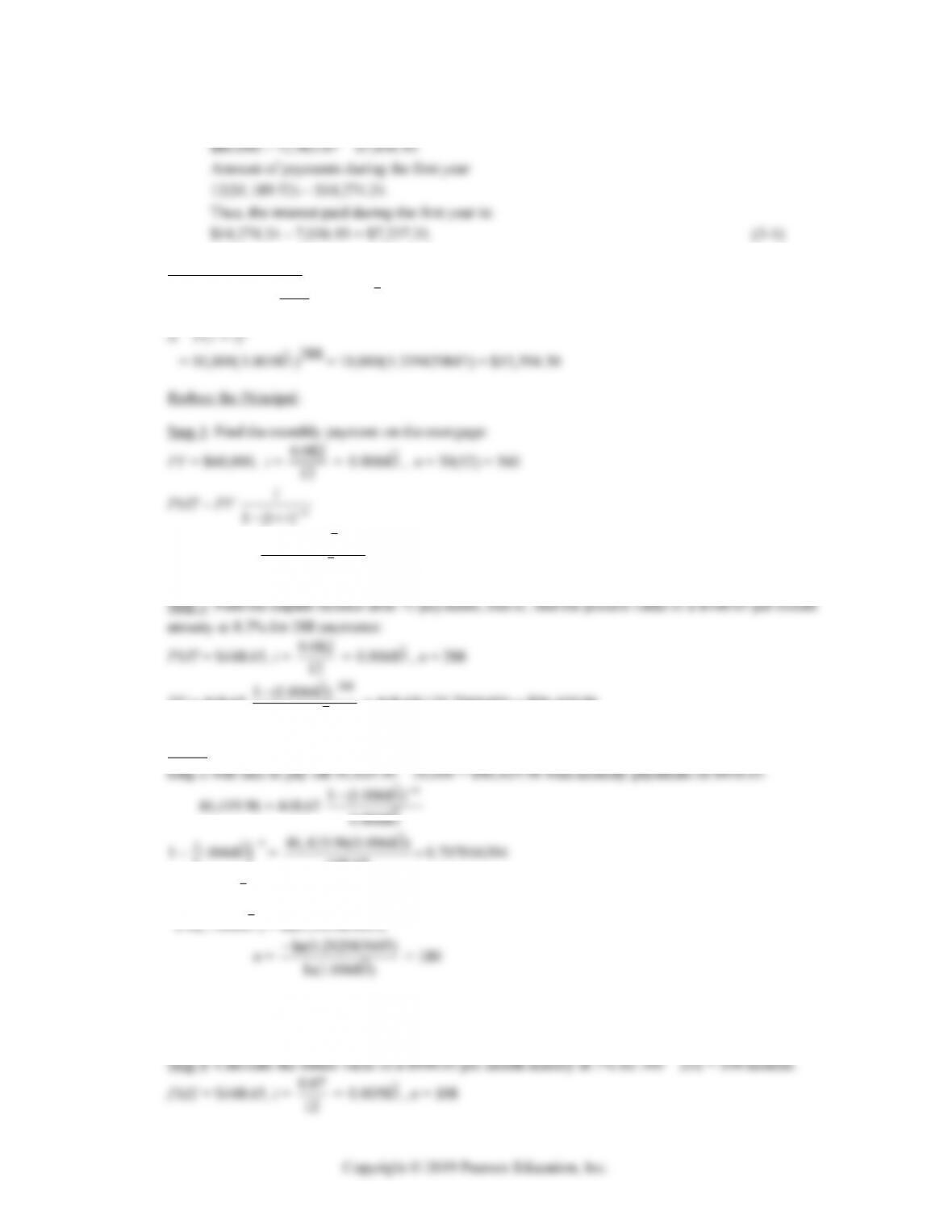
52. PV = $80,000, i = 0.0942
12 = 0.00785, n = 8(12) = 96
i
(B) Now use PMT = $1,189.52, i = 0.00785, and n = 96 – 12 = 84 to calculate the unpaid balance.
n
i
3-38 CHAPTER 3: MATHEMATICS OF FINANCE
(C) Amount of loan paid during the first year:
53. Certificate of Deposit: $10,000 at 7% = 0.07 compounded monthly for 360 – 72 = 288 months:
P = $10,000, i = 0.07
12 = 0.00583 , n = 288
= 60,000 360
0.00683
1 (1.00683)
= 60,000(0.007477544) = $448.65 per month
12 =
PV = 448.65
0.00683
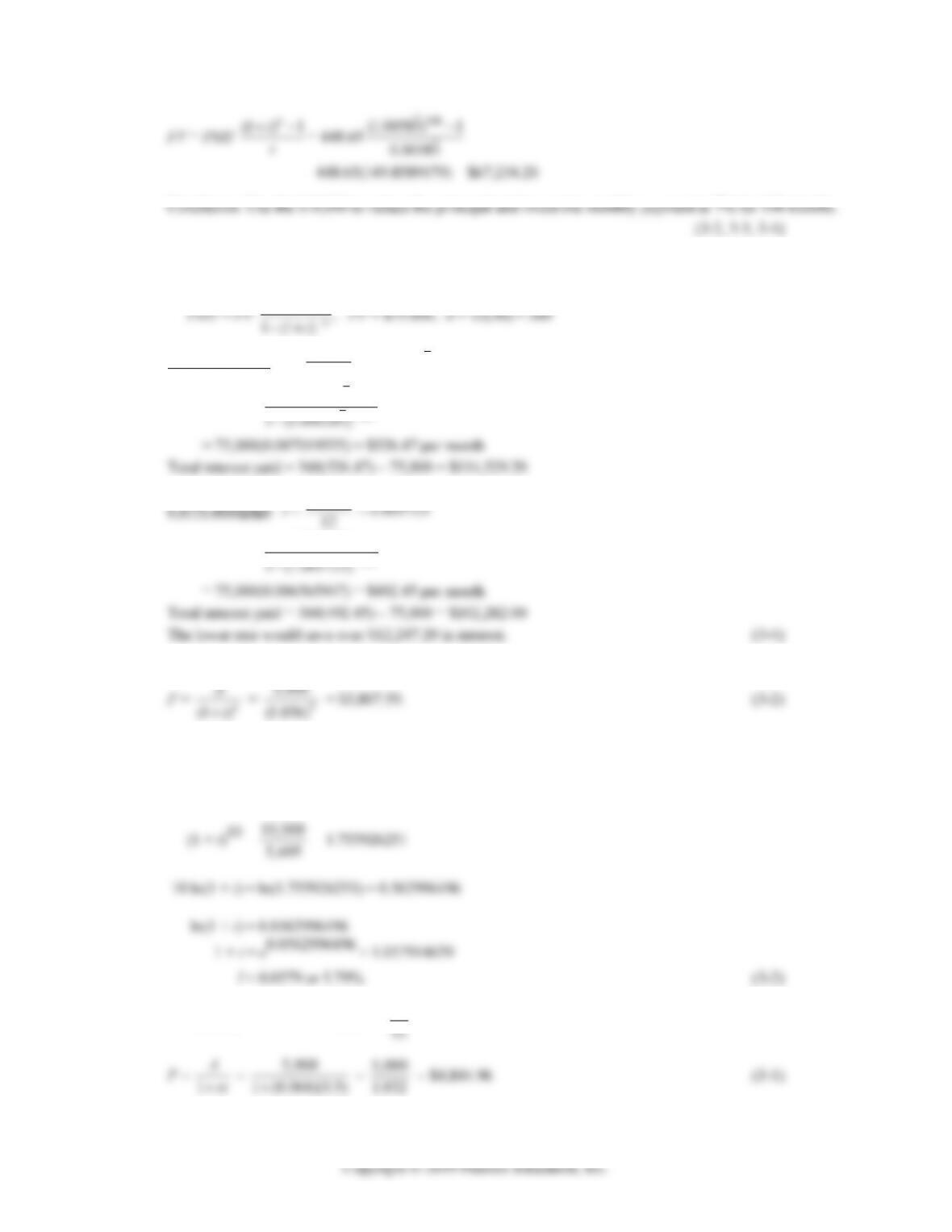
Step 3: Reduce the principal by $10,000 and determine the time to pay off the loan, that is find out how
448.65
1.00683 n= 0.292983605
n = ln(0.292983605)
ln(1.00683)
The loan will be paid off after 180 payments. Thus, by reducing the principal after 72 payments, the entire
mortgage will be paid after 72 + 180 = 252 payments.
12 =
CHAPTER 3 REVIEW 3-39
Copyright © 2019 Pearson Education, Inc.
FV = PMT (1 ) 1
n
i
i
= 448.65
108
(1.00583) 1
0.00583
= 448.65(149.8589179) = $67,234.20
Conclusion: Use the $10,000 to reduce the principal and invest the monthly payment at 7% for 108 months.
(3-2, 3-3, 3-4)
54. We find the monthly payment and the total interest for each of the options. The monthly payment is given
by:
i
7.54% mortgage: i = 0.0754
12 = 0.00628 3
PMT = 75,000 360
0.006283
PMT = 75,000 360
0.005725
55. A = $5,000, r = i = 5.6% = 0.056, n = 5
A
5,000
56. P = $5,695, A = $10,000, n = 10, m = 1, r = i
A = P(1 + i)n
10,000 = 5,695(1 + i)10
10,000
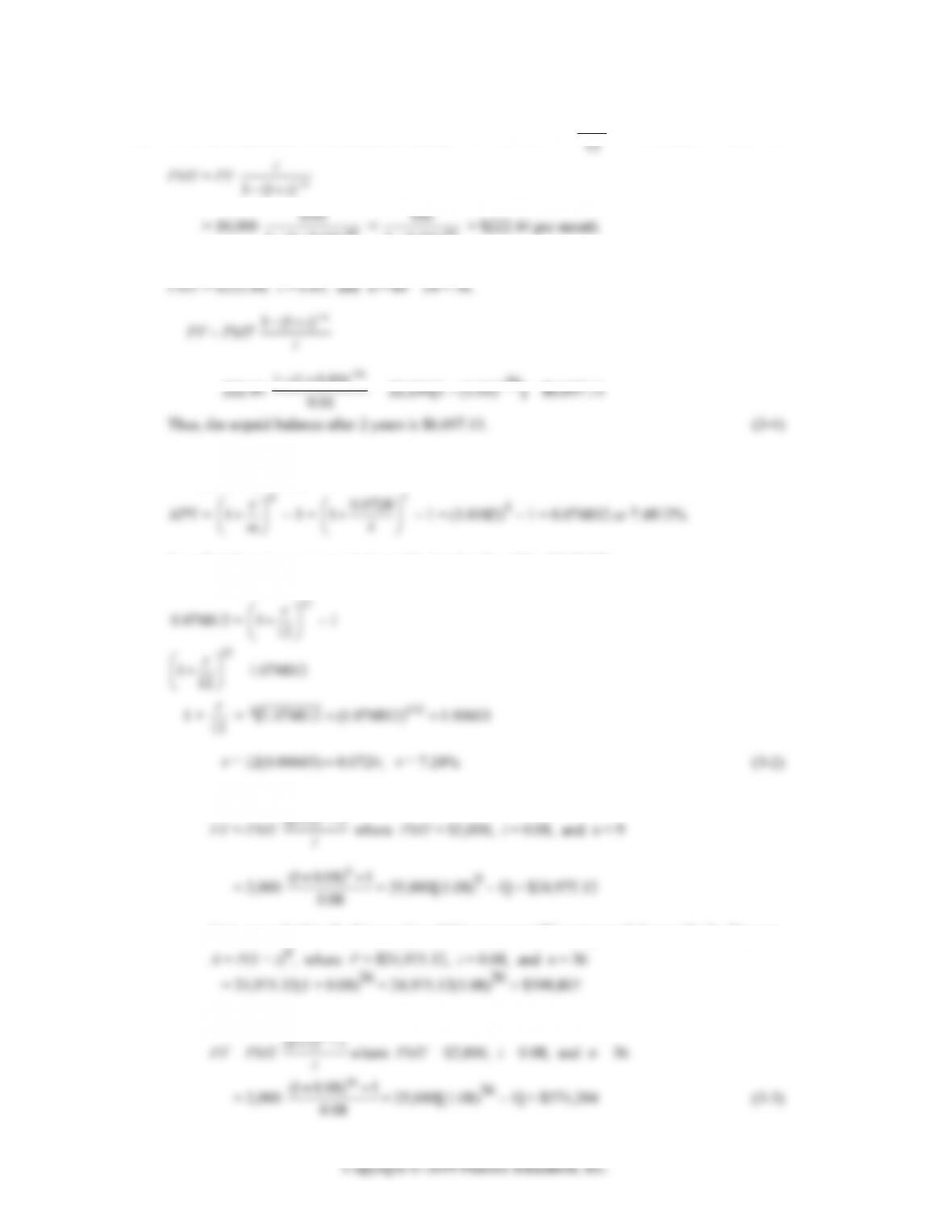
57. A = $5,000, r = 6.4% = 0.064, t = 26
3-40 CHAPTER 3: MATHEMATICS OF FINANCE
58. We first compute the monthly payment using PV = $10,000, i = 0.12
1(10.01)
= 60
1 (1.01)
= $222.44 per month
Now, we calculate the unpaid balance after 24 payments by using
= 222.44
1(10.01)
0.01
= 22,244[1 – (1.01)–36] = $6,697.11
59. First find the annual percentage yield for 7.28% compounded quarterly:
r = 7.28% = 0.0728, m = 4
m
r
m
4
0.0728
Now find the rate r compounded monthly that has the APY of 7.4812%:
APY = 0.074812, m = 12
12
r
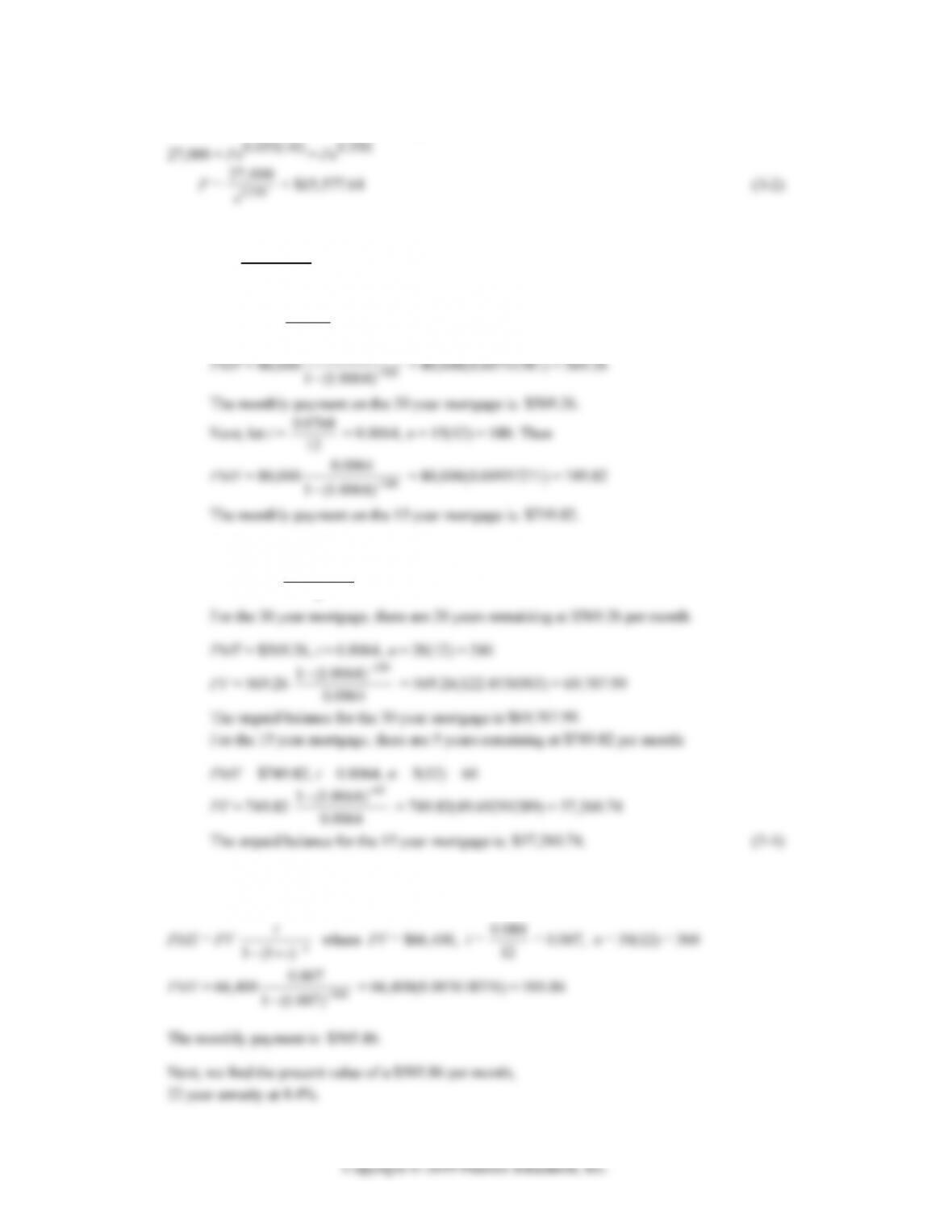
60. (A) We first calculate the future value of an annuity of $2,000 at 8% compounded annually for 9 years.
n
0.08
Now, we calculate the future value of this amount at 8% compounded annually for 36 years.
(B) This is the future value of a $2,000 annuity at 8% compounded annually for 36 years.
n
0.08
CHAPTER 3 REVIEW 3-41
61. A = Pert; A = 27,000, r = 5.5% = 0.055, t = 10
62. The amount of the loan is 0.8(100,000) = $80,000, and
PMT = PV 1(1 )
n
i
i
.
(A) First let i = 0.0768
12 = 0.0064, n = 30(12) = 360. Then
0.0064
(B) To find the unpaid balance after 10 years, we use
PV = PMT 1(1 )
n
i
i
.
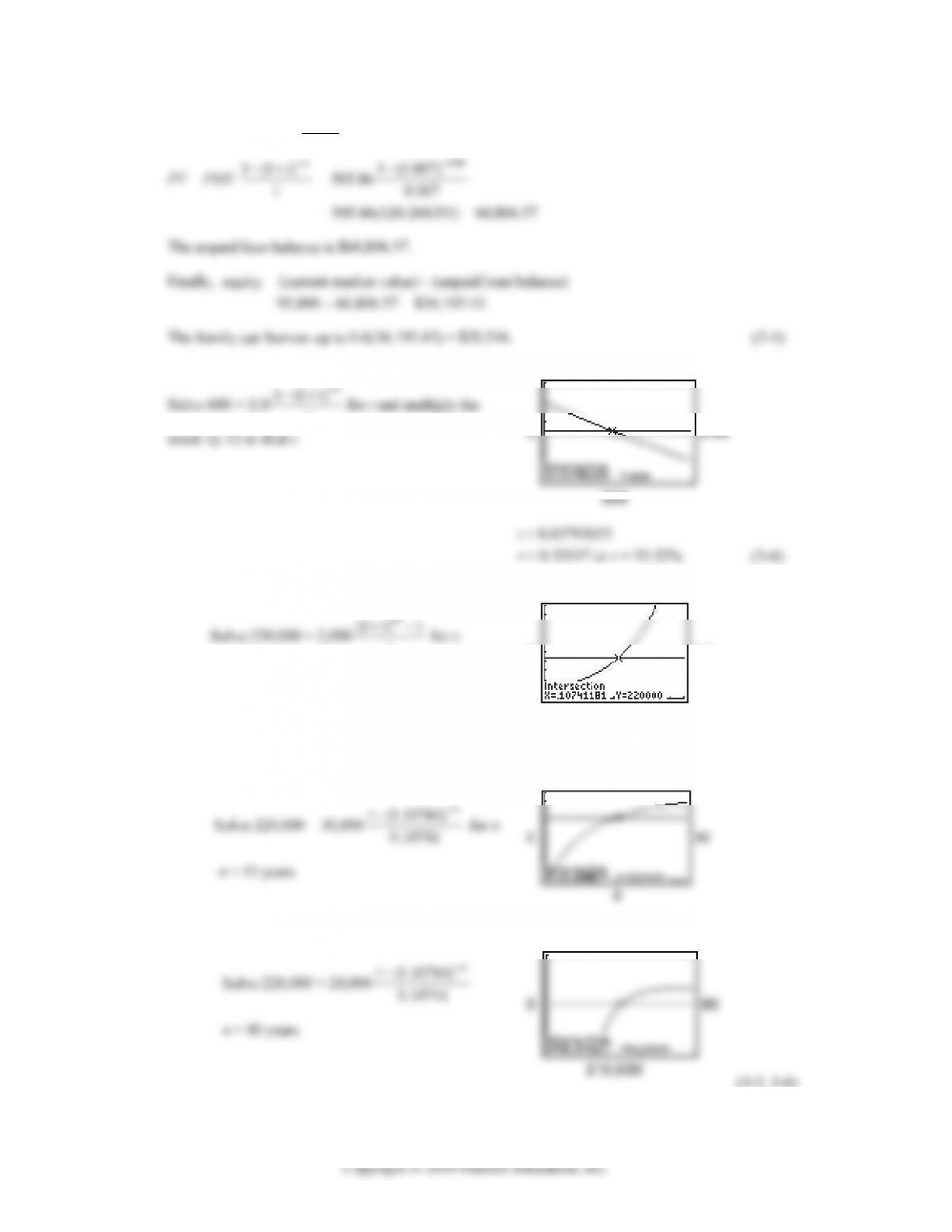
63. The amount of the mortgage is: 0.8(83,000) = $66,400.
The monthly payment is given by:
i
3-42 CHAPTER 3: MATHEMATICS OF FINANCE
PMT = $505.86, i = 0.084
12 = 0.007, and n = 22(12) = 264
n
i
= 505.86
264
1 (1.007)
64. PV = $600, PMT = 110, n = 6
700
65. (A) FV = $220,000, PMT = $2,000, n = 25.
25
i
500,000
0.2
0
0
i ≈ 0.10741 or i = 10.74%
(B) Withdrawals at $30,000 per year:
n
for n
300,000
0
Withdrawals $24,000 per year:
n
230,000