3 MATHEMATICS OF FINANCE
EXERCISE 3-1
4. The team lost 19% of its games: 0.19 21 3.99 . The team lost 4 games.
8. 5000(1 0.035 ) 5000 175 ;yxx
slope: = 175, y-intercept: =5,000.
14. Decimal d = 0.0019; rate r = 0.19% 16. Rate r = 0.36%; decimal d = 0.0036
52 26
4
26. I = Prt; P = 950, r = 0.09, t = 1; I = 950(0.09)(1) = $85.50
I
(0.08) 4
30. I = Prt; I = 28, P = 700, t = 13
52 ; r =
I
Pt = 28
13
= 0.16 or 16%
32. I = Prt; I = 96, P = 3,200, r = 0.04; t =
I
Pr = 96
(3200)(0.04) = 3
4 year
34. A = P(1 + rt); P = 3,000, r = 0.045, t = 30
360 = 1
12 ;
36. A = P(1 + rt); A = 6,608, r = 0.24, t = 3
4;
A
rt = 6, 608
3
1(0.24)4
3-2 CHAPTER 3: MATHEMATICS OF FINANCE
Copyright © 2019 Pearson Education, Inc.
38. A = P(1 + rt); A = 22,135, P = 19,000, t = 39
52 = 3
4;
r =
A
Pt
3
19,000 4
= 0.22 or 22%
40. A = P(1 + rt); A = 410, P = 400, r = 0.10;
A
42. I = Prt 44. A = P + Prt
I
I
A
Pt
46. I = Prt. Divide both sides by Pr to obtain t =
I
Pr
48. Each of the graphs is a straight line; the y intercepts are 400, 800, and 1200, and their slopes are 30, 60, and
90, respectively.
50. P = $5,000, r = 6.2% = 0.062, t = 9 months = 3
4 year; I = Prt = 5,000(0.062) 3
4
= $232.50
2 year; A = 10,000 1
56. P = $3,000, A = $3,097.50, t = 5 months = 5
12 year. The interest on the loan is
I
Pt = 97.50
5
(3,000) 12
58. P = $2,000, I = $120, t = 90 days = 90
360 = 1
4 year; r =
I
Pt = 120
1
= 120
500 = .24 or 24%.
EXERCISE 3-2 3-5
86. Days 1 – 2: 475.17; days 3 – 24: 601.10; days 25 – 30: 638.10
Average daily balance: 2(475.17) 22(601.10) 6(638.10) 600.10.
.
88. Charges for the loan: 4($15.50) = $62.
90. Charges for the loan: 350(.1675) = $58.63.
EXERCISE 3-2
2. 2
2,652.25 (1.03)P
4. 4
100 15,006.25x
6.
3
13.72 5(1 )i
8. 2,488.32 1000(1.2)n
ln(1.2)
10. P = $2,800, i = 0.003, n = 24
(1 )
n
AP i
12. A = $15,000, i = 0.01, n = 28
(1 )
n
AP i
14. For P = $995, r = 0.22 and t = 2, we have:
16. For A = $19,000, r = 0.0769 and t = 5, we have:
3-8 CHAPTER 3: MATHEMATICS OF FINANCE
(B) For t = 7, we have:
4,800 = Pe0.12(7)
4,800
52. APY =
1
m
r
m
– 1
(A) For r = 0.0432 and m = 12, we have:
12
0.0432
(B) For r = 0.0431 and m = 365, we have:
365
0.0431
54. (A) APY =
1
m
r
m
– 1
(B) APY = er – 1
56. We have P = $5,000, A = $7,000, r = 6% = 0.06, m = 4, and
i = 0.06
4 = 0.015. Since A = P(1 + i)n, we have:
58. A = Pert
For A = $60,276, P = $42,000 and r = 0.0425, we have:
60,276 = 42,000e0.0425t
0.0425 ln 60, 276
42,000
3-10 CHAPTER 3: MATHEMATICS OF FINANCE
68. A = P1
mt
r
m
70. A = P1
mt
r
m
72. (A) (1 )
(1 )
P
n
n
AP i
APi
(1 )
n
n
AP i
Ai
(1 )
ln ln ln(1 )
n
n
AP i
A
Pi
74. A = Pert
For A = $12,500, P = $10,000 and t = 4, we have:
76. A = $20,000, P = $15,000, r = 7% = 0.07, m = 4, i = 0.07
4 = 0.0175
Since A = P(1 + i)n, we have:
ln(1.0175)
EXERCISE 3-2 3-11
78. A = P1
mt
r
m
For P = $1, r = 0.02, m = 1 and t = 960, we have:
960
80. Compounded daily: A = P1
nt
r
m
: For A = 3P, m = 365 and r = 0.05, we have:
3P = P
365
0.05
1365
t
365
0.05
t
82. If an investment with initial value P doubles in n years, then we have
(1 )
n
A
Pi
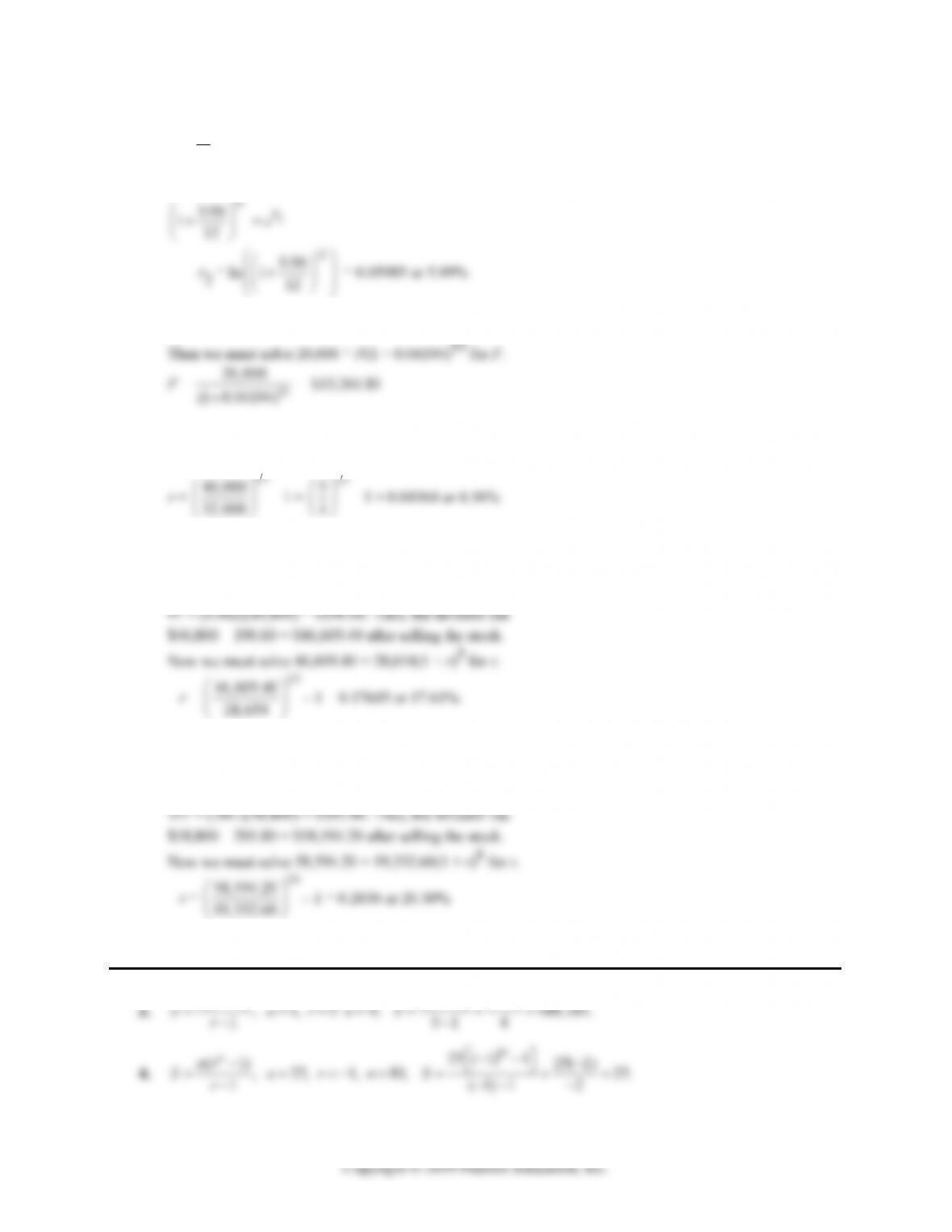
Assuming annual compounding, we have that as a decimal the annual rate is equal to i. Then as a
percentage, we have
1/
100 2 1
n
r
.
EXERCISE 3-3 3-13
90. 1
1
m
r
m
= er2
For r1 = 0.06 and m = 12, we have:
92. A = $20,000, m = 1, t = 10 years, r = 0.04194.
94. A = $40,000, P = $32,000, m = 1, t = 5.
Then we must solve 40,000 = 32,000(1 + r)5 for r.
15
40,000
32,000
15
5
4
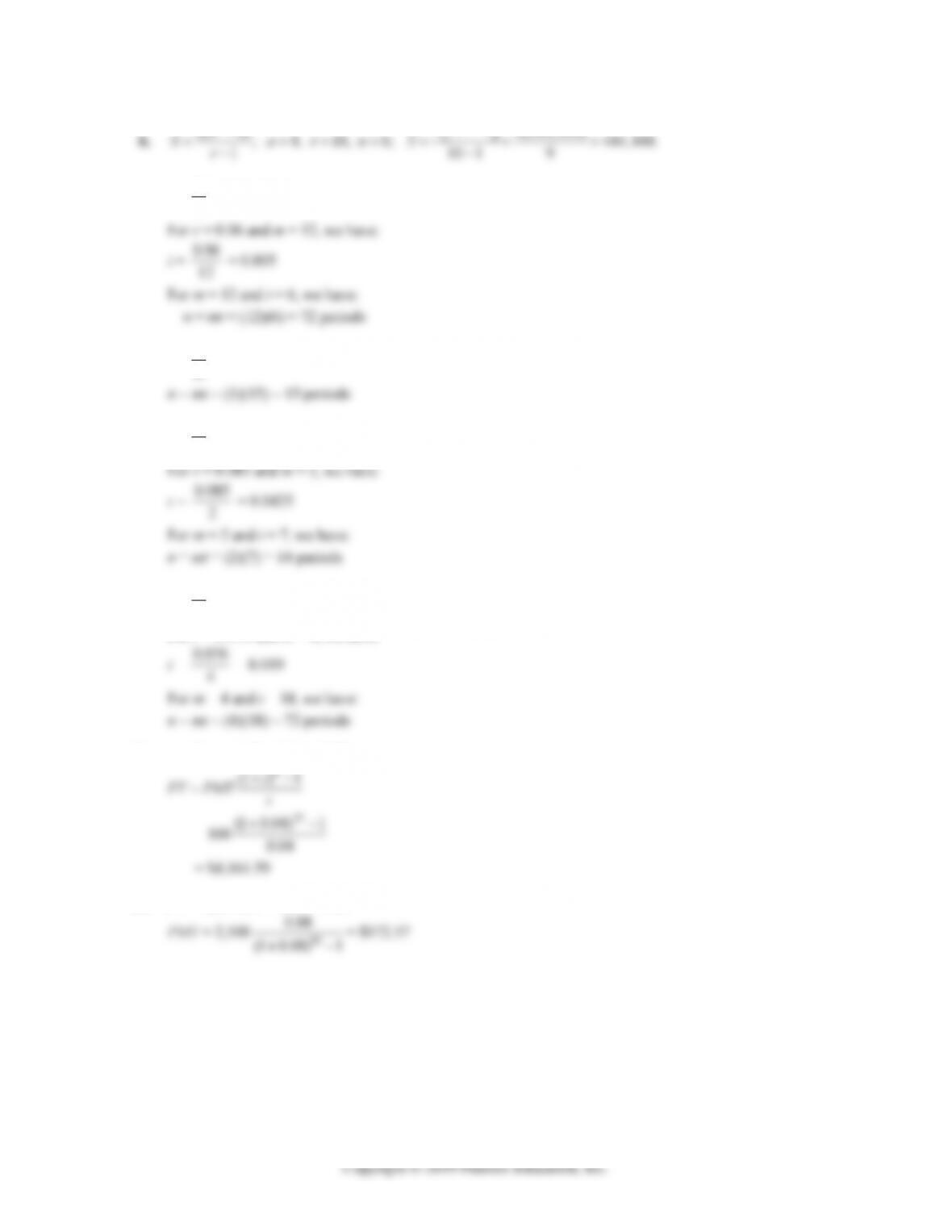
96. P = cost of the stock plus the broker’s commission =
$28,500 + $97 + (0.002)(28,500) = $28,654. The investor sells the stock for 300(156) = $46,800 and the
commission on this amount is
28,654
98. P = cost of the stock plus the broker’s commission =
$19,200 + 75 + (0.003)(19,200) = $19,332.60. The investor sells the stock for 400(147) = $58,800 and the
commission on this amount is
19,332.60
EXERCISE 3-3
99
(1) 1(51)51
n
ar
1(1)12
r
3-14 CHAPTER 3: MATHEMATICS OF FINANCE
Copyright © 2019 Pearson Education, Inc.
6
410 1
( 1) 4(999,999)
n
ar
8. i = r
m
10. i = r
m = r = 0.0625 since m = 1.
12. i = r
m
14. i = r
m
For r = 0.076 and m = 4, we have:
16. n = 25, i = 0.04, PMT = $100
n
i
18. FV = $2,500, n = 10, i = 0.08
0.08
(1 0.08) 1
EXERCISE 3-3 3-15
28. PMT = $1,000, n = 15(12) = 180, i = 12
r = 0.0725
12
180
0.0725
12
11
30. PMT = $7,500, n = 20(1) = 20, i = r = 0.08
20
(1 0.08) 1
0.08
20. FV = $8,000, i = 0.04, PMT = 500
FV = PMT (1 ) 1
n
i
i
n
22. FV = $4,100; PMT = $100; n = 20
FV = PMT (1 ) 1
n
i
i
20
(1 ) 1i
20
(1 ) 1i
24. The amount of interest added each period is
equal to i times the balance during that
26. We begin with (1 ) 1
n
i
FV PMT i
and set 2.n
(2 )
2
2
ii
FV PMT i
FV i
PMT
FV
iPMT
EXERCISE 3-3 3-17
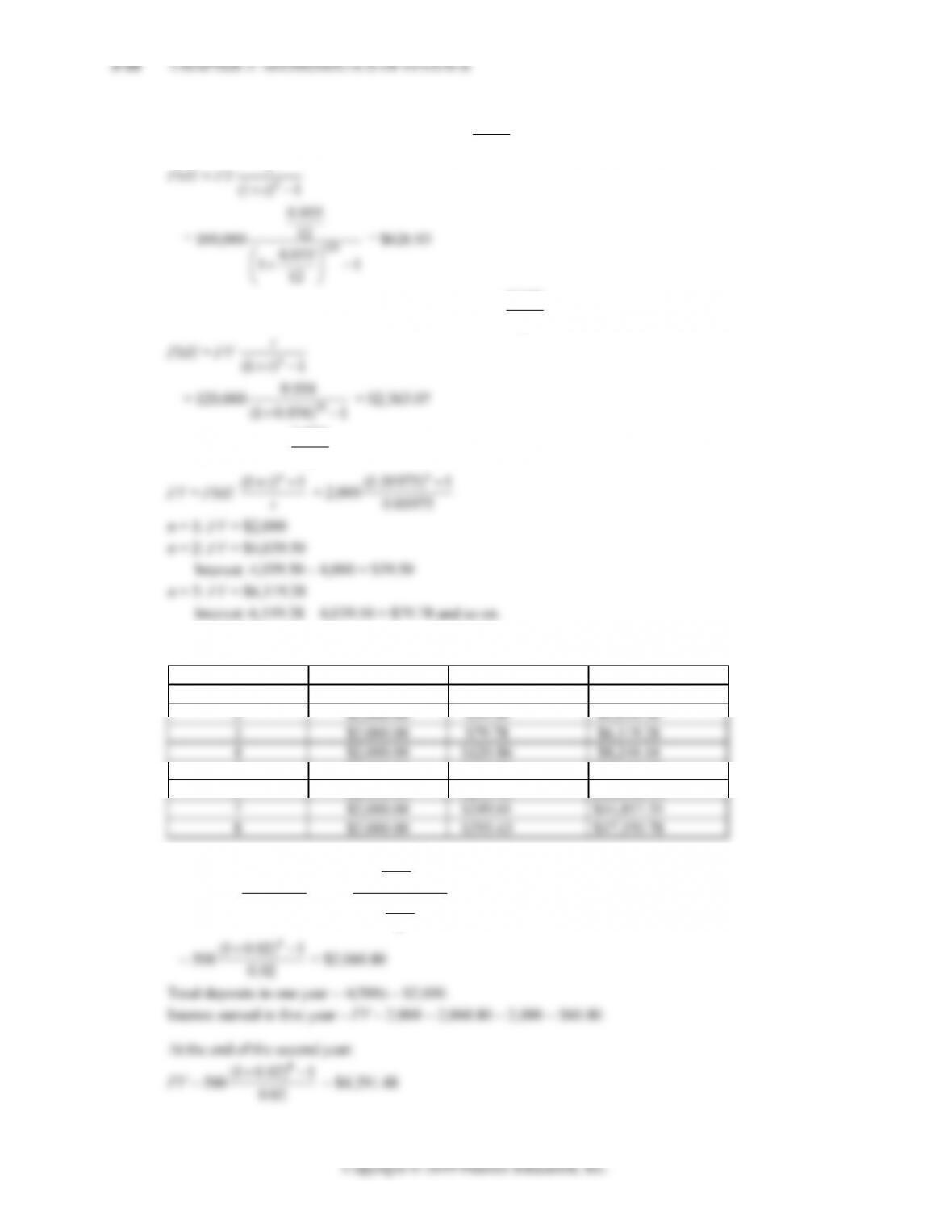
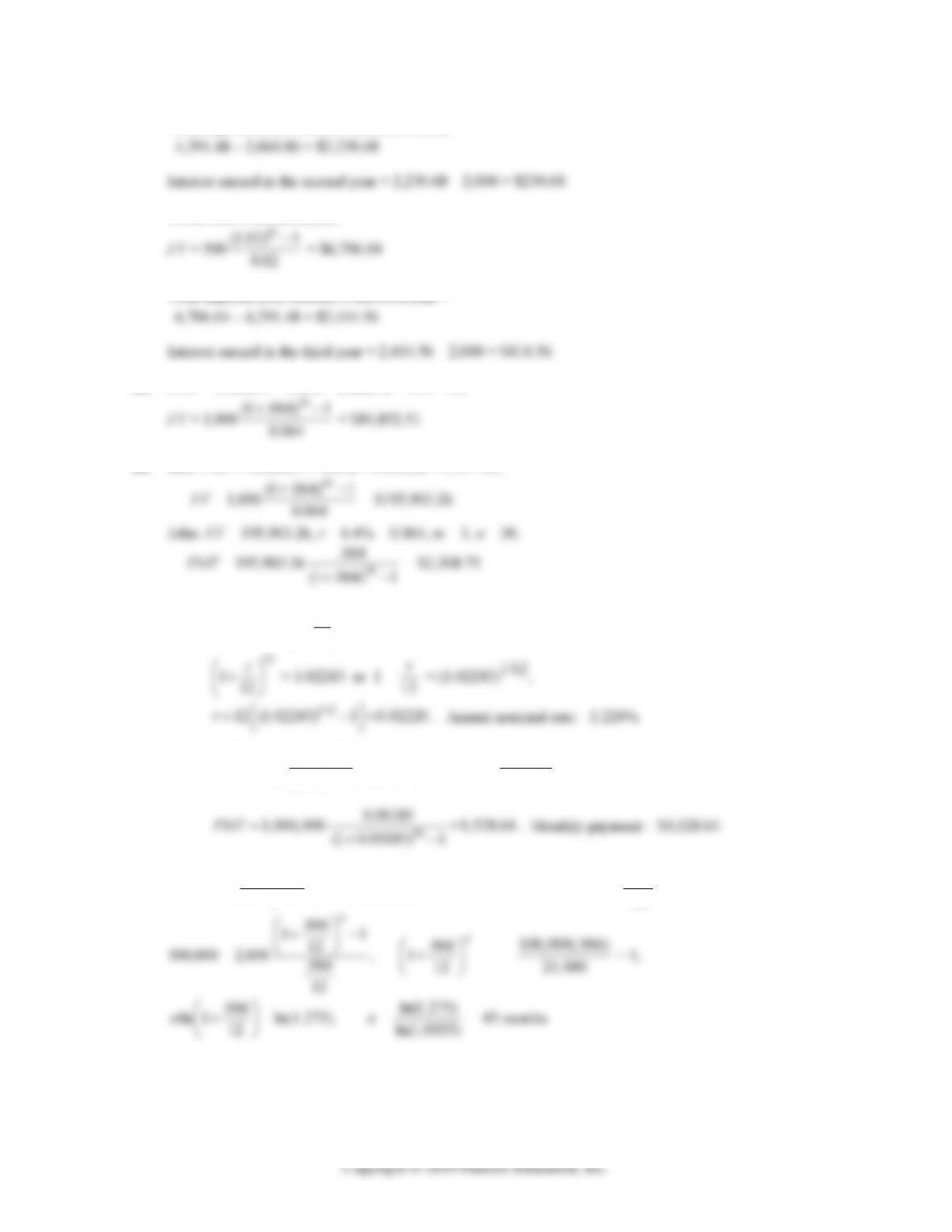
Total deposits plus interest in the second year =
At the end of the third year,
FV = 500
12
(1.02) 1
0.02
= $6,706.04
Total deposits plus interest in the third year =
40. PMT = $1,000, r = 6.4% = 0.064, m = 1, n = 30,
30
(1 .064) 1
0.064
42. Bob: PMT = $1,000, r = 6.4% = 0.064, m = 1, n = 42,
42
(1 .064) 1
(1 .064) 1
44. (A) Set APY =
12
11
12
r
= 0.02243 and solve for r:
12
r
r = (1.02243)1/12,
(B) 0.02220
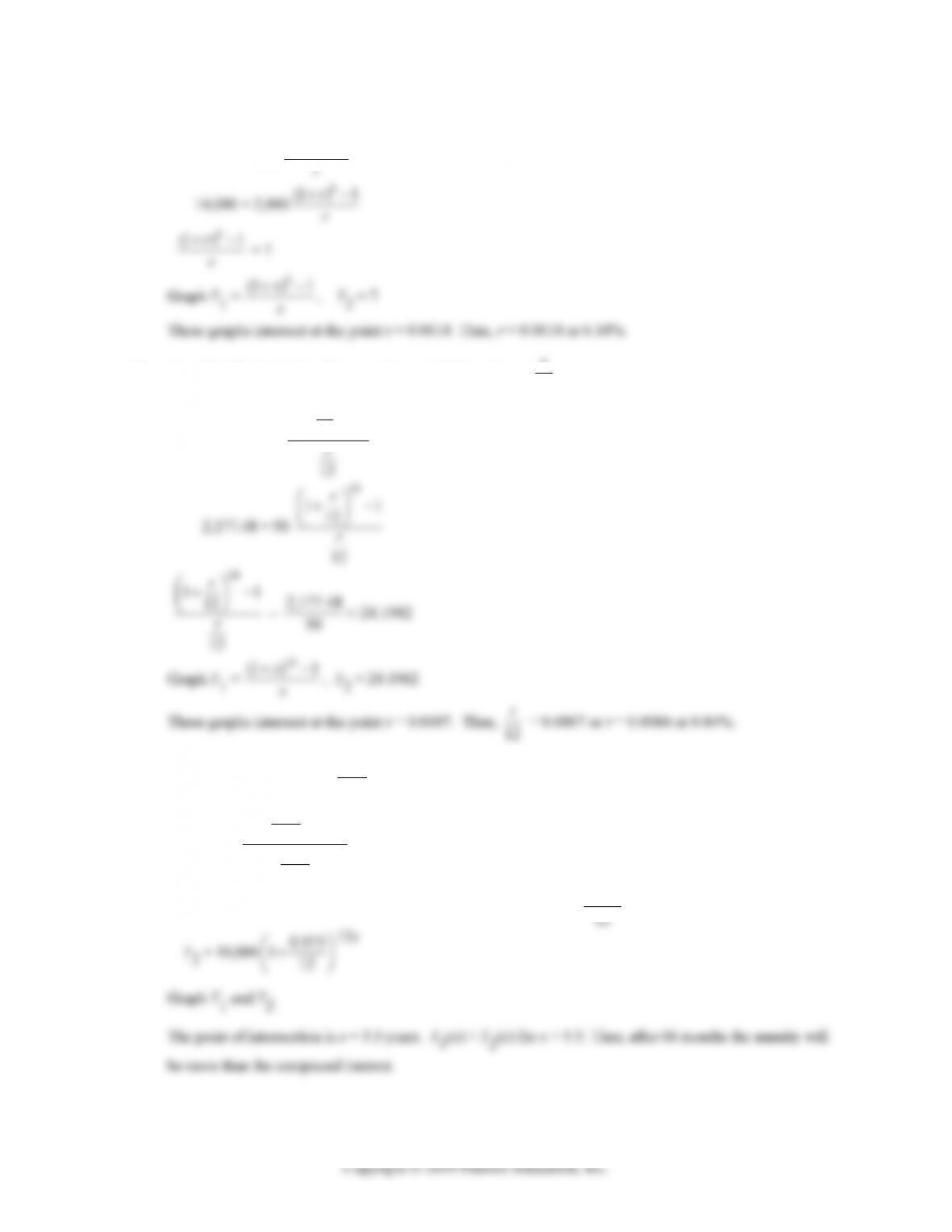
; 1,000,000, 0.00185, 12(8) 96
12
(1 ) 1
n
i
PMT FV FV i n
i
0.00185
46. FV = PMT (1 ) 1
n
i
i
; PMT = $2,000, r = 6.6% = 0.066, m = 12, i = .066
12 , FV = $100,000.
.066
11
12
n
n
100,000(.066)
3-18 CHAPTER 3: MATHEMATICS OF FINANCE
48. PMT = $2,000, FV = $14,000, n = 6, m = 1, r = i
FV = PMT (1 ) 1
n
i
6
(1 ) 1r
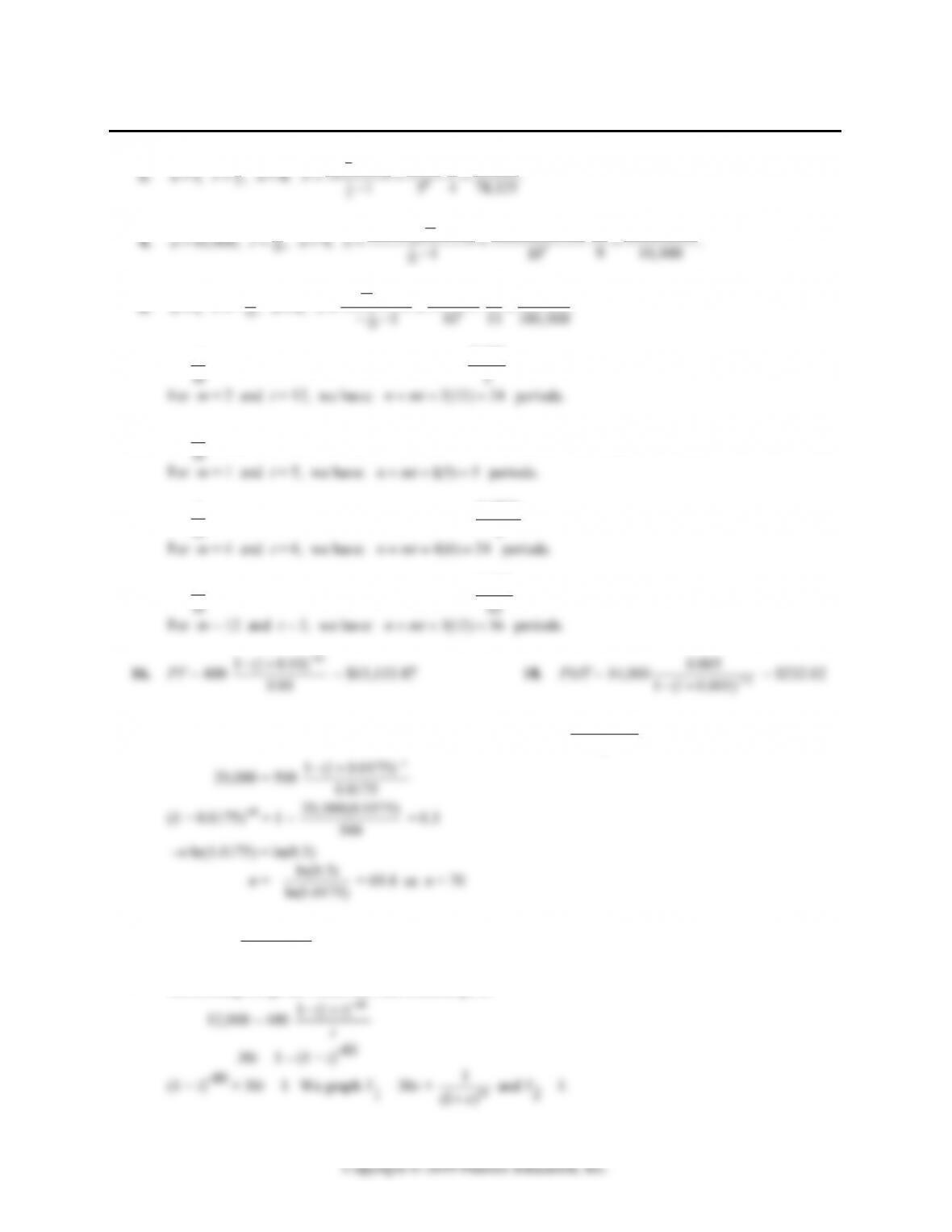
50. FV = $2,177.48, PMT = $90, m = 12, n = (12)(2) = 24, i = 12
r
FV = PMT
11
12
n
r
24
11
12
r
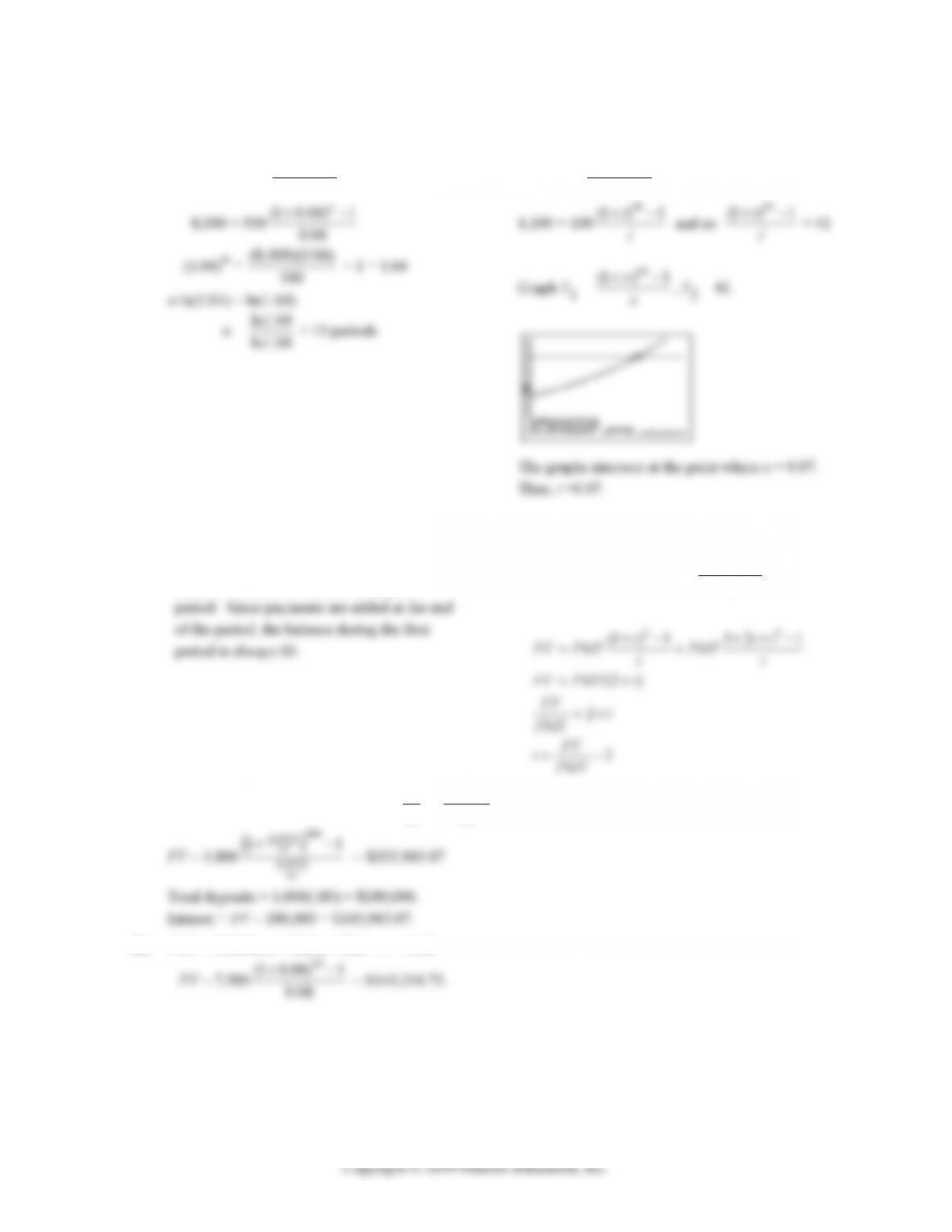
These graphs intersect at the point x = 0.0007. Thus, 12
52. Annuity: PMT = $200, i = 0.05
12 , n = 12x
Y1 = 200
12
0.05
11
12
0.05
12
x
Compound interest: P = $10,000, r = 7.5% = 0.075, m = 12, i = 0.075
EXERCISE 3-4 3-19
EXERCISE 3-4
8
18
5
1
1() 1 5 1 5 97, 656
6.
6
16
10
1
1( ) 1 (10 1) 10 90, 909
1, , 6; .
ar n S
8. i = r
10. i = r
12. i = r
m. For r = 0.0824 and m = 4, we have: i = 0.0824 0.206
4
14. i = r
20. PV = $20,000, i = 0.0175, PMT = $500. We have, PV = PMT 1(1 )
n
i
i
n
22. PV = PMT 1(1 )
n
i
i
. PV = $12,000, PMT = $400, n = 40.
Substituting the given values into this formula gives
40
1(1 )i
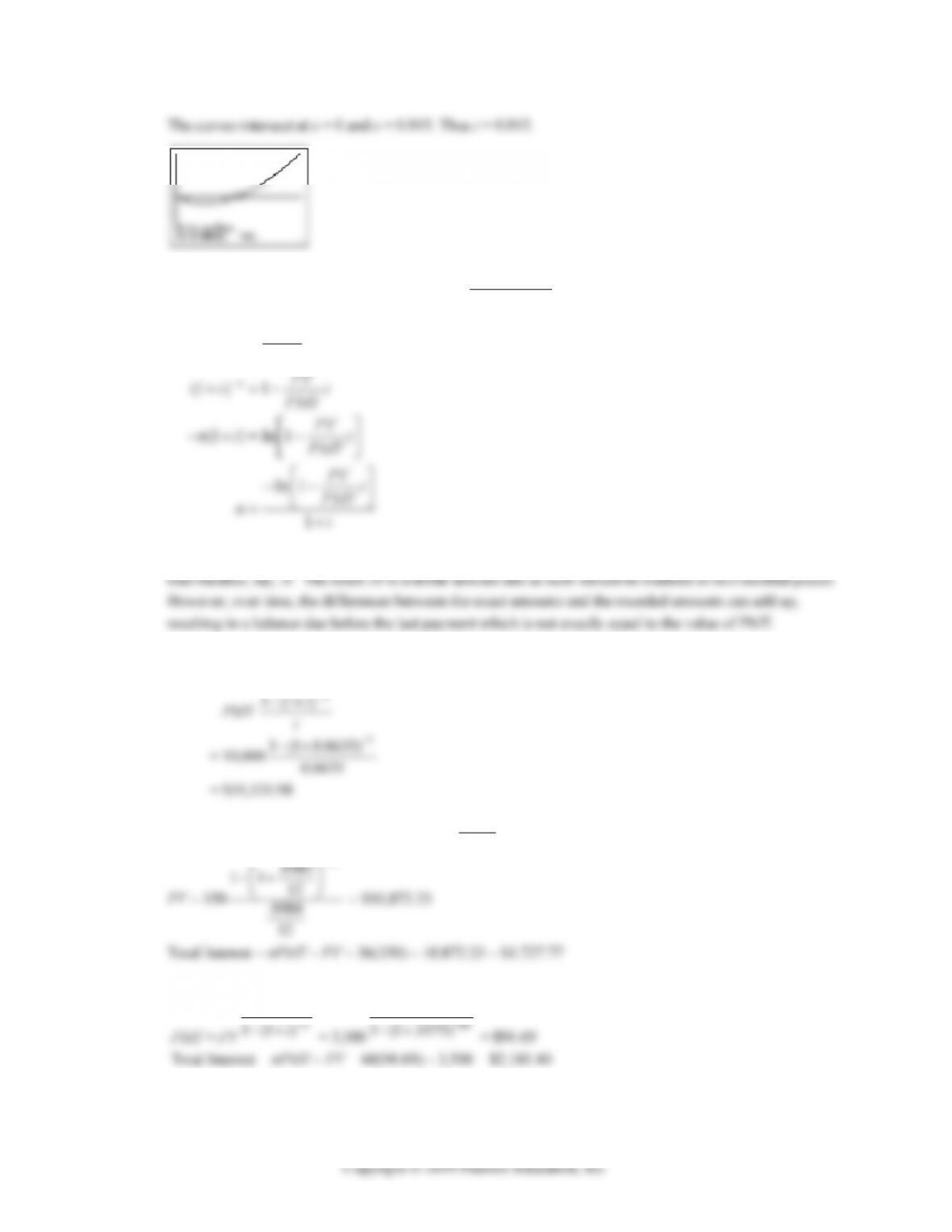
3-20 CHAPTER 3: MATHEMATICS OF FINANCE
Copyright © 2019 Pearson Education, Inc.
The curves intersect at x = 0 and x = 0.015. Thus i = 0.015.
24. We solve the PV formula (5) for n: 1(1 )
n
i
PV PMT i
:
1(1 )
n
PV
ii
PMT
26. Each row in the amortization table requires us to multiply the interest rate per period i times the previous
28. PMT = $10,000, n = 7, r = 6.35% = 0.0635, i = 0.0635
PV = Present value
n
i
30. PMT = $350, r = 9.84% = 0.0984, m = 12, i = .0984
12 , n = 36.
36
32. PV = $3,500, i = 0.0175, n = 60.
n
i
60
.0175