1
Instructor’s Manual – OMSC2 – Collier/Evans – C3 Operations Strategy
This chapter introduces students to operations strategy. We explain how organizations seek to
Questions are provided in two categories:
1. Review questions
2. Discussion questions and experiential activities
There are no computational or Excel-based problems and exercises.
The chapter has three cases:
1. The Greater Cincinnati Chamber of Commerce is the first case study. The case focuses on its
customer benefit package, competitive priorities, chamber strategy, and what processes are
2. Sustainable Lawn Care requires students to evaluate the firm’s customer benefit package
3. The integrative case study, Hudson Jewelers, with case assignment questions in all chapters,
requires the student to evaluate the customer benefit package, order winners and qualifiers,
KEY TERMS
Competitive advantage denotes a firm’s ability to achieve market and financial superiority over
its competitors.
Innovation is the discovery and practical application or commercialization of a device, method,
or idea that differs from existing norms.
Mass customization is being able to make whatever goods and services the customer wants, at
any volume, at any time, for anybody, and for a global organization, from any place in the
world.
Basic customer expectations are generally considered the minimum performance level required
to stay in business and are often called order qualifiers.
Order winners are goods and service features and performance characteristics that
differentiate one customer benefit package from another and win the customer’s business.
REVIEW QUESTIONS
1. Explain how organizations seek to gain competitive advantage.
Creating a competitive advantage requires a fundamental understanding of two things.
3
2. Define order qualifiers and order winners.
Basic customer expectations are generally considered the minimum performance level
3. Explain approaches for understanding customer wants and needs.
To correctly identify what customers expect requires being “close to the customer.” There
4. Define search, experience, and credence attributes, and provide an example of each.
Search attributes are those that a customer can determine prior to purchasing the goods
and/or services. Examples: buying furniture, equipment, ice cream, toys, and clothes.
5. Describe how customers evaluate goods and services.
Research suggests that customers use three types of attributes in evaluating the quality of
goods and services: search, experience, and credence. This classification has several
6. What are the five competitive priorities? Cite an example of an organization that
demonstrates the competitive priority.
1. Cost—Many firms gain competitive advantage by establishing themselves as the low-
cost leader in an industry. Examples: Walmart, Southwest Airlines, GlassesUSA, Uber,
Spirit Airlines, Salvation Army
2. Quality—Quality is positively and significantly related to a higher return on
investment for almost all kinds of market situations. Examples: Nordstrom, Mercedes,
Costco, Ritz-Carlton, NetJets, Red Cross
7. Define mass customization and provide two examples.
Mass customization is being able to make whatever goods and services the customer
8. What is innovation? Provide two examples from well-known companies.
Innovation is the discovery and practical application or commercialization of a device,
9. Define strategy. Explain how corporate, business, and functional strategies support overall
strategy.
Strategy is a pattern or plan that integrates an organization’s major goals, policies, and
10. Provide some examples of core competencies and explain the value to an organization of
understanding its core competencies.
Core competencies are the strengths that are unique to an organization. might be a
particularly skilled or creative workforce, customer relationship management, clever
11. What is operations strategy? How can it support competitive priorities?
An operations strategy is the set of decisions across the value chain that supports the
implementation of higher-level business strategies. Operations is about designing jobs,
12. Explain the role of OM, sustainability, and operations in strategic planning.
Developing an operations strategy involves translating competitive priorities into
operational capabilities by making a variety of choices and trade-offs in design and
operating decisions. That is, operating decisions must be aligned with achieving the desired
competitive priorities. For example, if corporate objectives are to be the low-cost and
6
13. Describe Hill’s framework for operations strategy.
Hill’s framework defines the essential elements of an effective operations strategy in the
last two columns—operations design choices and building the right infrastructure. These
14. How does Dr. Hill’s strategy framework tie corporate strategy to marketing and operations
strategy?
Exhibits 3.3 and 3.4 answer this question. Loops #1, #2, and #3 go through several
improvement cycles to support and align with Loop #4. A key feature of this framework is
the link between operations and corporate and marketing strategies. Clearly, it is
15. How would you rank McDonald’s competitive priorities in Exhibit 3.6?
In Exhibit 3.6 the authors ranked low prices #1, quick service #2, high service quality #3, high
goods quality #4, demand flexibility #5 and brand image #6. Students may rank the first three
7
16. Provide three examples of McDonald’s management making choices on sustainability. (See
Exhibit 1.13 in Chapter 1.)
• Green or zero-carbon buildings (environmental)
• Animal welfare (social and environmental)
DISCUSSION QUESTIONS AND EXPERIENTIAL ACTIVITIES
17. What might the competitive advantage be for each of the following companies?
a. eBay
b. Southwest Airlines
c. Starbucks
Competitive advantage denotes a firm’s ability to achieve market and financial superiority
over its competitors. (cost/price, quality, time, flexibility, innovation)
Some possible responses:
a. eBay – flexibility, technology (innovation), worldwide market reach, self-service and
self-reporting of quality levels
8
18. Select a business with which you are familiar and identify examples of order qualifiers and
winners. You might also research the businesses on the Internet or visit the library.
For goods-producing businesses often the order qualifier is physical goods quality while
19. Select a business with which you are familiar and identify examples of customers using
search, experience, and credence quality to evaluate the good or service. You might also
research the businesses on the Internet or visit the library.
This question allows students to apply the concepts to their own purchasing decisions and
helps them understand the nature of goods and services. Ask them how they make a
decision to buy a PC, furniture, vehicle, haircut, doctor, concert, sporting event, etc. and
frame the discussion using search, experience, and credence qualities. As students present
their examples ask them, “What is easier to evaluate? Can it be evaluated at time of
purchase?”
• Search attributes are those that a customer can determine prior to purchasing the
goods and/or services. These attributes include things like color, price, freshness, style,
fit, feel, hardness, and smell.
20. Provide examples of search, experience, and credence attributes for a ride sharing service
such as Uber or Lyft.
• Search attributes are those that a customer can determine prior to purchasing the
9
21. Choose an organization with which you are familiar that falls into one of the following
categories:
• sporting goods store
• haircut salon
Define the firm’s strategic mission, strategy, and competitive priorities. What are the
order qualifiers and winners? What would operations have to be good at to make this a
successful business or organization?
The objective of this question is to get students to think about and discuss strategy,
mission statements, order winners, the role of operations and operational capability,
22. How does a package delivery service such as UPS or FedEx use the competitive priority
“time” to its competitive advantage? Research, then explain and provide examples in a
short paper (maximum of two typed pages).
10
Managing “time” is their business—package delivery, meeting customer promise dates and
times, instantaneous tracking and status of packages, customer access to on-line Fed Ex
web sites, and so on.
23. How does Walmart use the competitive priority “cost” to its competitive advantage?
Research, then explain and provide examples in a short paper (maximum of two typed
pages).
Competitors such as Target, Safeway, and Costco have copied many of their methods and
practices so Walmart’s competitive advantage has diminished.
24. How does Procter & Gamble use the competitive priority “quality” to its competitive
advantage? Research, then explain and provide examples in a short paper (maximum of
two typed pages).
The Dammam Plant is a multi-category site where a variety of well-known Dry Laundry,
Hair Care, Dish Care and Fabric Enhancer Products are manufactured. It has demonstrated
a consistent and exceptional commitment to quality while optimizing cost delivering
millions in cost savings over the past four years while improving productivity by over 30%.
11
25. How does your cell phone provider use the competitive priority “flexibility” to its
competitive advantage? Research, then explain and provide examples in a short paper
(maximum of two typed pages).
The corporate web sites for Verizon, AT&T, Sprint, etc. offer much information on these
26. Compare Lyft (www.lyft.com) and Uber (www.uber.com) strategies. Explain the similarities
and differences in their missions, strategies, and competitive priorities, and how their
operations strategies might differ. Use the Internet or business magazines to research the
information you need. Report your findings in a short paper (maximum of two typed
pages).
This is a broad question intended to generate student interest in how strategy impacts “big
picture” operational and supply chain design and management. Given students are only in
12
27. Explain the interlinking model of quality and profitability (Exhibit 3.2). How does it connect
to business and operations strategy? Can you provide any examples of goods and services
that support and add credibility to this model?
The value of a good or service in the marketplace is influenced by the quality of its design.
Improvements in performance, features, and reliability will differentiate the good or
service from its competitors, improve a firm’s quality reputation, and improve the
28. Is it possible for a world-class organization to achieve superiority in all five major
competitive priorities—price (cost), quality, time, flexibility, and innovation? Explain your
reasoning.
Generally, no. Tradeoffs usually exist among these priorities. For example, Dell competes
on quality, time, and flexibility, and therefore mass customization. However, Dell is not
13
29. Why is sustainability a strategy and not a competitive priority? Explain your reasoning.
Competitive priorities represent the strategic emphasis that a firm places on certain
performance measures and operational capabilities within a value chain. Time, cost,
quality, flexibility, and innovation are the five competitive priorities defined in the chapter.
30. Identify two firms that endorse sustainability as part of their corporate strategy and discuss
how sustainability is integrated into their strategies.
Students will find many firms during their online searches that fulfill this requirement such
31. Research and write a short paper on a company that has a clear strategy based on social
and ethical sustainability.
The chapter write-up on sustainability at McDonald’s is a good benchmark for what you
should expect from students. Companies you might suggest to students that they will be
32. Apply Hill’s strategy framework to a goods-producing or service-providing organization of
your choice. This will require research to identify corporate objectives and competitive
priorities. See the McDonald’s example in the chapter for guidance and make sure that you
14
emphasize OM concepts, capabilities, and execution. Report your findings in a short paper
(maximum of two typed pages).
33. Identify two competing organizations (for example, AT&T and Verizon, Taylor Made and
Callaway golf club manufacturers, or Starbucks and Panera). Explain the differences in their
missions, strategies, and competitive priorities, and how their operations strategies might
differ. Use the Internet or business magazines to research the information you need.
Report your findings in a short paper (maximum of two typed pages).
your business school, and so on.
34. Research Apple and define its strategic mission, vision, corporate strategy, competitive
priorities, and operations strategy. What can you say about Apple’s strategy and practices
regarding sustainability? You might use the Internet or visit the library. Report your
findings in a short paper (maximum of two typed pages).
15
35. How do the “Veja Company: Sneakers with a Conscience” operations and supply chain
decisions, and practices support their mission and strategy? Provide examples and explain.
Report your findings in a short paper (maximum of two typed pages).
When students search for Veja they will find over 3 million hits. Many focus on the on–line store
but if you look around you will find many interesting sites and articles. Please note that students
• teach Brazilian cotton farmers how to grow organic cotton with no pesticides,
• support the production of natural rubber from trees to preserve Amazon forests,
• source leather that uses eco-tanning methods with vegetable extracts instead of toxic metals
such as chromium,
• pay these farmers higher wages and create better working conditions and family and
community services,
Vega does an especially good job supporting social sustainability, as the literature will document.
Teaching Note: The Greater Cincinnati Chamber of Commerce
Overview
16
and health of the region. The Chamber’s mission statement has evolved to “where business
goes for solutions to the competitive challenges of growth.” The chamber provides a complex
set of (intangible) services that attempt to create more tangible outcomes/outputs such as job
creation, high standards of living, new buildings and work sites, and a good quality of life. One
Case Questions for Discussion
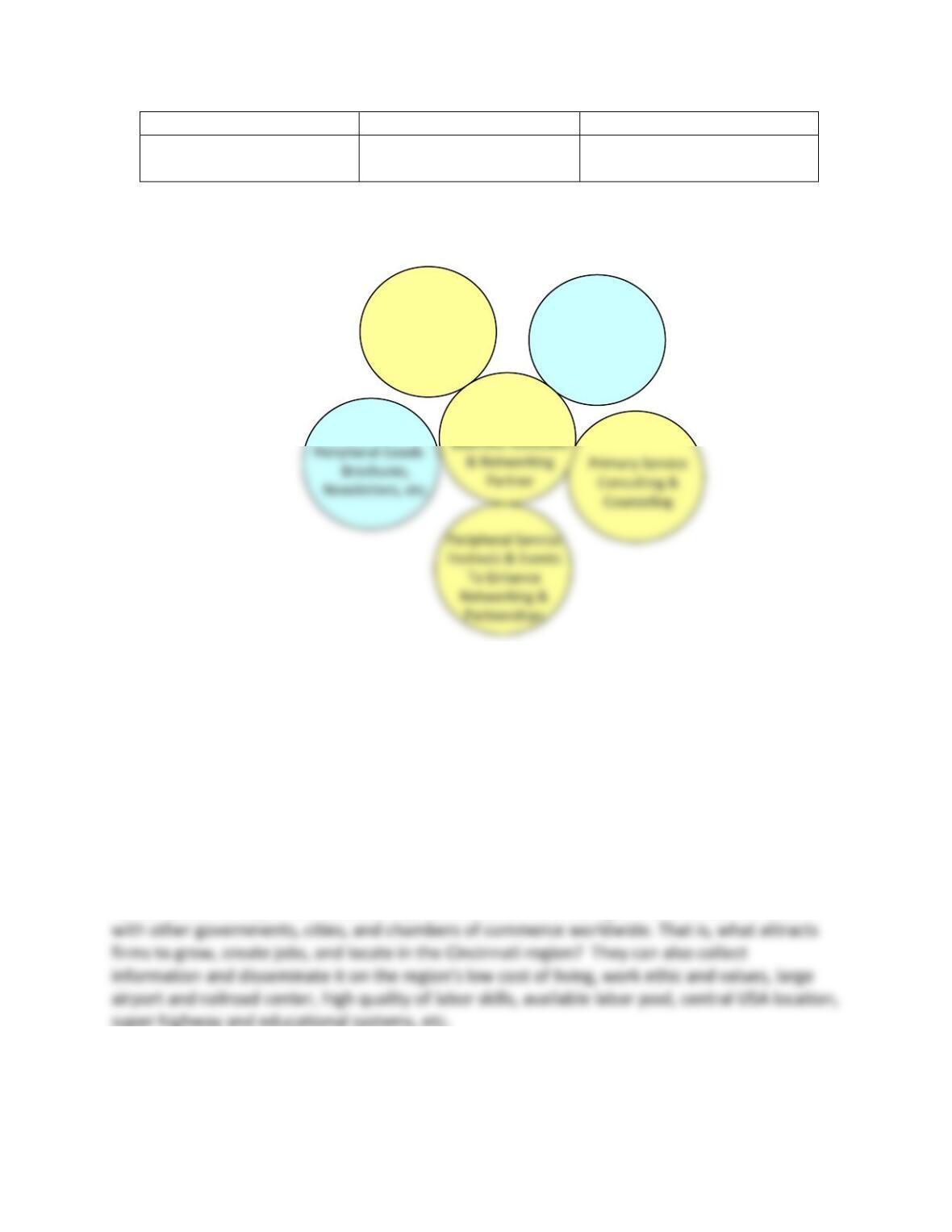
1. Characterize the customer benefit package that the Chamber offers. What other
peripheral goods might the Chamber provide to complement its services? How might this
affect their strategy?
Defined by customers –
wants and needs
CBP features defined by
management to fulfill
customers wants and
needs
Defined by management –
Processes to create/deliver
Primary want – long term
regional economic growth
and health
Business advocate and
networking partner
Business development
Educational services
Partnering opportunity and
information dissemination
Job creation and
government
networking
festivals
execution
Peripheral want – friendly
and knowledge service
Engineering and sales
staff
Hiring, training, reward,
and recognition
17
based training
Peripheral want – How are
we doing?
Report cards and statistics
Measurement report card
process
The CBP is almost all information and service intensive with few peripheral goods. Chamber
banners, pins, automobile stickers, desk paperweights, and billboards are a few peripheral
goods that help sell the city and region to local people and visitors. Other peripheral goods that
may help complement chamber services include DVDs, videos, luggage tags, commercials, and
so on.
2. What sources of competitive advantage do you feel the Chamber has? Who do they
compete with?
The GCCC appears to create a competitive advantage by differentiating itself through service,
flexibility and variety, and innovation in product and service offerings. The Chamber competes
super highway and educational systems, etc.
3. Critique their mission and strategy. What operational processes must they excel at to
accomplish their mission and vision?
Primary Good
Primary Service
Education, Training
&
Seminars
Peripheral Good
Report Cards
Primary Service