5
CHAPTER THREE
APPLYING THEORIES IN MANAGING A CHILD DEVELOPMENT CENTER
KEY CONCEPTS
Managers apply theories from at least three areas of knowledge: child development,
family ecosystems, and management.
Developmental theories can be classified as one of four types: maturationist,
behaviorist or environmentalist, interactionist, and ecological. (See Table 3.1).
Postmodern critics of child development theories question the possibility of scientific
objectivity and the ability of science and reason to solve human problems.
Organization theory can be classified according to historical period or according to
conceptual model or underlying ideas.
ACTIVITIES AND PROJECTS FOR STUDENTS
1. Make a list of physical-biological environmental factors that influence the operation of a
2. See Handout 3.1. Have students work individually or in pairs to fill in specific examples of
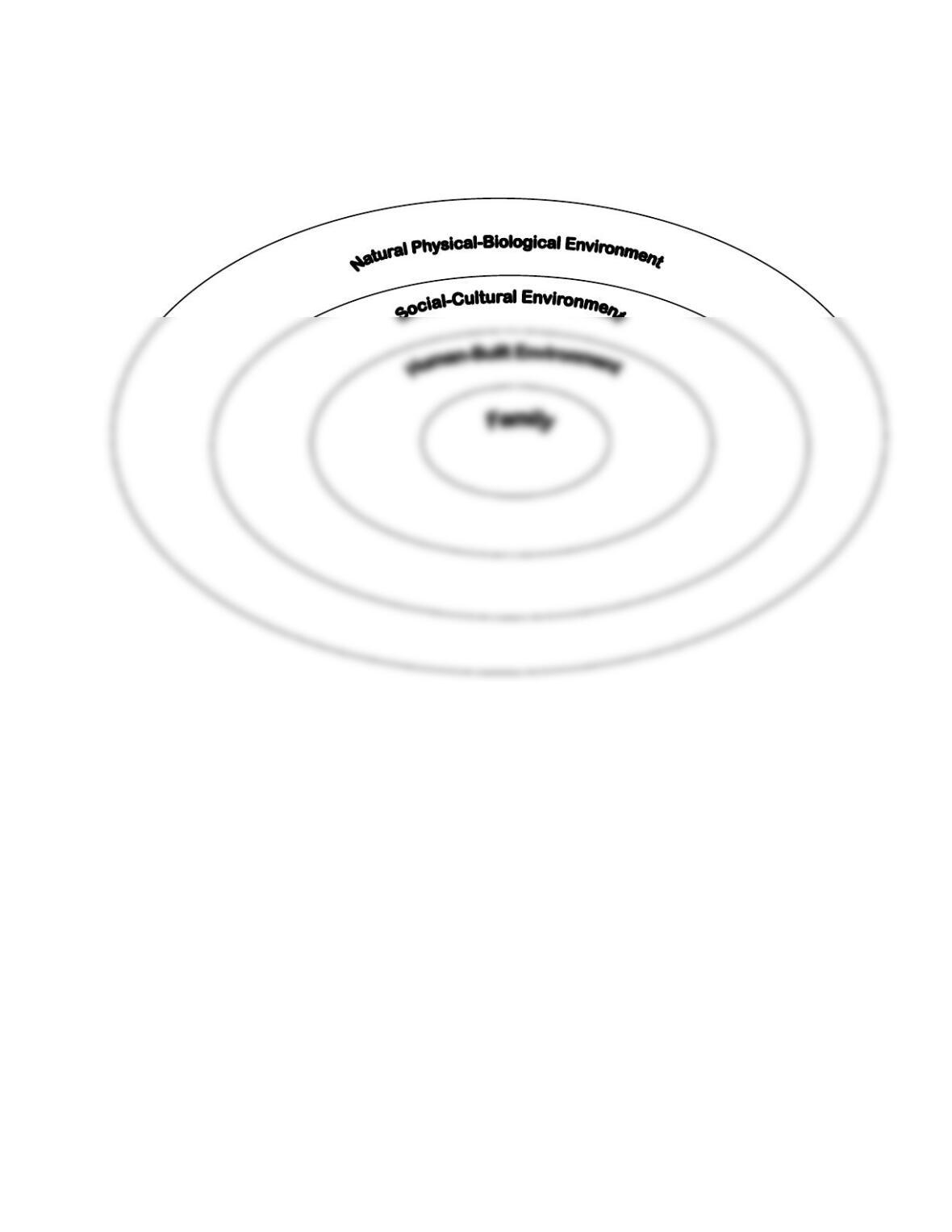
3. Have students use Handout 3.2 to represent the ecological systems of their families and the
interactions their family members have within and between each environment. Within the
appropriate section of the diagram, list specific elements within each environmental system

6
Handout 3.1 Applying Management Paradigms
Rainbow Child Development Center has been struggling with a high rate of staff turnover. Three
of its twelve full-time teachers have resigned within the past year. Depending upon the
management paradigm which shapes his or her thinking, what steps might a director take to solve
this problem?
a. The Classical Paradigm, which holds that individuals are rational beings, motivated by
economic reward:
b. The Behavioral Paradigm, which holds that individuals are primarily motivated by job
satisfaction and the social connections they make at work, and that the m
builder:
c. The Systems Paradigm, which views human nature as complex and changing, motivated by
relationships within the organization as well as between the organization and the outside world:
7
Handout 3.2 The Family
Ecosystem