SUPPLEMENTAL CASE 3
The Playskool Travel-Lite Crib*
PART A
Sanfred Koltun sat in his office in the Chicago headquarters of his company, Kolcraft Enterprises,
reading a letter. Addressed to Bernard Greenberg, president of Kolcraft, the February 1, 1993, letter had
been passed around to the company’s handful of top executives. He would get their perspectives on the
situation. But Koltun knew that, as owner and CEO, he would be the one to determine the company’s
actions. It had been that way since his father started the company in 1942.
“The CPSC has received reports of two infant fatalities resulting from the collapse of ‘Playskool’ brand
portable cribs manufactured and distributed by Kolcraft,” Schoem wrote. “In both cases it appears the
infant was entrapped when the crib collapsed while the infant was in the crib.” Schoem then requested a
“Full Report:” Kolcraft would have to provide, among other materials, “copies of all test reports,
analyses, and evaluations, including premarket tests and reports of tests and any analyses related to the
locking mechanism and/or potential for collapse of product.” The CPSC also requested copies of all
engineering drawings, any consumer or dealer complaints, lawsuits, assembly instructions in all their
History of Kolcraft
Kolcraft Enterprises was started in Chicago in 1942 as a manufacturer of baby pads, a foam product
commonly used in high chairs, play pens, and bassinets. In 1950 Kolcraft began manufacturing
mattresses for use in baby cribs. Sanfred Koltun, the founder’s son, graduated with a bachelor’s degree
*Written by David Zivan, Senior Editor, Chicago Magazine. Funded by the James S. Kemper Ethics in Business Grant to the
Graduate School of Business at the University of Chicago, under the direction of Professor Linda Ginzel.
This document is in the public domain and may be reproduced without permission. The University of Chicago and the
Supplemental Case 3: The Playskool Travel-Lite Crib 199
from The University of Chicago in 1954 and an M.B.A. from the same school in 1955. He then joined
the company, which at that time employed about 30 people.2
By the early 1980s, Kolcraft diversified into the manufacture of various juvenile seats, including car
seats and booster seats. Koltun opened a 25,000-square-foot facility in North Carolina making what are
generically known as play pens, a metal and masonite folding device typically measuring 36” by 36”
with mesh sides. Children would nap and play in these common household products. Kolcraft
eventually expanded to include operations in Pennsylvania, Georgia, and California.3 By the late 1980s,
the company had hundreds of employees, with headquarters in Chicago and a separate manufacturing
and engineering facility in Bedford Park, Illinois.4Though dwarfed by major corporations like Mattel’s
Fisher-Price and Hasbro’s Playskool, Kolcraft eventually grew to become the seventh largest juvenile
products manufacturer, with revenues around $30 million.5
In 1987, Kolcraft hired Bernard Greenberg as a vice president. A graduate of New York University,
Greenberg had worked at Macy’s for six years as a buyer, then spent a number of years with various
manufacturers of juvenile products, eventually serving as president of Century, a juvenile product
manufacturer which was a division of Gerber baby products. Greenberg became president of Kolcraft
around 1990.
Development of the Playskool Travel-Lite
In the mid-1980s, the U.S. juvenile product market saw a substantial influx of imported goods,
primarily from Asia, including a new product—portable play yards, or portable cribs as they came to be
known. Rectangular in shape, the traveling cribs often folded into a carrying bag. Sanfred Koltun
believed that Kolcraft could manufacture a similar, better product.
2. Deposition of Sanfred Koltun, 4/19/2000, pp. 6–8.
3. Deposition of Bernard Greenberg, 9/30/99, pp. 8, 20.
4. Illinois Manufacturers Directory, 1988-92.
200 Supplemental Case 3: The Playskool Travel-Lite Crib
That spring, Sanfred Koltun gave the go-ahead to create a mock-up of the portable crib. “His comment
from the very beginning was like it was the best thing he’d ever seen,” Johnson remembered later. “It
was unique because there was nothing out there with a carrying case. Nothing that was that structurally
sound. Nothing that looked as nice as that.”8 Johnson’s painted wood model of the crib was well
received by Kolcraft’s marketing department, and the company decided to try to get the portable crib
ready for the annual Juvenile Products Manufacturers Association (JPMA) trade show, scheduled for
mid-September in Dallas.
A Travel-Lite prototype was made and sat in the break room across from Johnson’s office in Bedford
Park. Soon Johnson found himself demonstrating the crib to other Kolcraft employees. “We constantly
were taking this thing down and putting it back up, kicking it around, because it was a unique product
and everybody was . . . excited about it,” Johnson remembered. “Whenever someone walked into the
room, they’d come in to me and say, ‘what is this?’ and I’d have to go through and explain it. And
every time they asked, I’d tear it down and put it back up again. This thing [was] going up and down all
the time.”10
The crib would be ready for the trade show in Dallas.
Licensing the Travel-Lite
Sanfred Koltun believed that affiliating with a recognized brand name would be beneficial for Kolcraft.
“I thought in terms of customers,” he said. “I wanted to get [our product] on the floor of juvenile
departments in retail stores.”13 In 1989, as Bernard Greenberg would later put it, Sanfred Koltun “went
after the Playskool name,” and by that summer Koltun had negotiated a licensing deal with Hasbro.14
Supplemental Case 3: The Playskool Travel-Lite Crib 201
Koltun hired Ernst Kaufmann, a 32-year veteran of Sears, to handle the merchandising of the new line,
which Kolcraft would license under the Playskool brand name.
Playskool, well known in the juvenile products market for its reputation as a maker of high quality toys,
By the end of the decade, Hasbro had begun licensing the Playskool name—a brand associated, as
Gildea put it, with “quality, fun products.”15 In an interview with Children’s Business,16 Gildea outlined
the emerging benefits of the company’s licensing business:
The non-toy products are Playskool line extensions that we don’t happen to make. Our strategy is
twofold. We gain incremental exposure of the Playskool name, [creating] brand awareness at a
Both benefits looked relatively easy to achieve, and may have seemed necessary, as one of Hasbro’s
main competitors, Fisher-Price, had already begun making products outside its traditional lines.17
In the original agreement, Kolcraft would manufacture and distribute mattresses, play pens, and car
seats with Hasbro’s Playskool name attached. The agreement stipulated, among other provisions, that:
[T]he licensee shall, prior to the date of the first distribution of the licensed articles, submit to the
licensor a test plan which lists all the applicable acts and standards and contains a certification by
the licensee that no other acts or standards apply to the licensed articles. . . . Test plan shall
describe in detail the procedures used to test the licensed articles, and licensee shall submit
15. Deposition of John Gildea, 8/26/99, p. 11.
16. Gregory J. Colman, “What’s Playskool’s Name Doing on a Pair of Sneakers?,” Children’s Business, February 1991,
p. 61.
17. Details of this expansion also included in Children’s Business, February 1991.
202 Supplemental Case 3: The Playskool Travel-Lite Crib
Going to the Show
Kolcraft’s display at the JPMA trade show in Dallas featured a separate area for its Playskool products,
staffed by Kaufmann. The Travel-Lite received a warm reception, and a press release by the JPMA,
dated September 15, 1989, named the Travel-Lite one of the top new products at the trade show:
At a press conference today, the Juvenile Products Manufacturers Association (JPMA) announced
the winners of the “Ten Most Innovative Products Contest.”
Final Preparations
On September 28, 1989, Hasbro’s David Schwartz, who handled the Kolcraft account for the company,
wrote a letter to Ernst Kaufmann, reminding him of Kolcraft’s obligations under the licensing
agreement. “Pursuant to the terms of the contract between Hasbro and Kolcraft Enterprises, please be
aware that Kolcraft must adhere to the terms set forth in Paragraph 7 (quality of merchandise), stating
that: ‘The licensee warrants that the licensed articles will be designed, produced, sold, and distributed in
accordance with all applicable U.S. laws.’”21 Schwartz then specifically asked for documents he had not
In subsequent conversations with Kaufmann, Schwartz again requested test plans for the Travel-Lite.25
Kaufmann answered with a December 21, 1989, letter,26 which in its entirety read as follows:
Dear Mr. Schwartz:
Please be advised that there are no government or industry test standards applicable to the
Playskool portable crib.
21. Deposition of Laura Millhollin, 3/29/00, p. 47.
22. Kaufmann, p. 74.
23. Deposition of Malcolm Denniss, 8/27/99, pp. 18-22.
24. Kaufmann, p. 76.
25. Deposition of David Schwartz, 3/17/00, pp. 62–66.
26. From appendix to #98L7063, tab 17.
Supplemental Case 3: The Playskool Travel-Lite Crib 203
Going to Market
Kolcraft began producing and shipping the Travel-Lite in January 1990. Both the crib and its packaging
featured prominent placement of the Playskool name, and it was available in retail chains such as Toys
’R’ Us, K-Mart, JC Penney, and Wal-Mart. An instruction sheet for setting up the crib was affixed to
the floor of the crib, underneath the mattress—“a standard production step,” Johnson noted. “It’s in the
specifications for [conventional] play yards. . . . All the other play yards have them.”27
Sanfred Koltun would later attribute the poor sales of the Travel-Lite to the fact that the crib was more
expensive than similar imported items, causing discount retailers like K-Mart and Wal-Mart to shy
away from the product. The design team felt that the product had simply become too heavy. “As far as
the buyers go, [the] unit [was] too heavy,” Johnson said. “I don’t think it was the consumer. The buyers
kept asking for more and more–more padding, things like that. And eventually, enough buyers said,
‘no.’”30
The First Deaths
On July 3, 1991, an 11-month-old boy in California died of strangulation while in a Travel-Lite crib.32
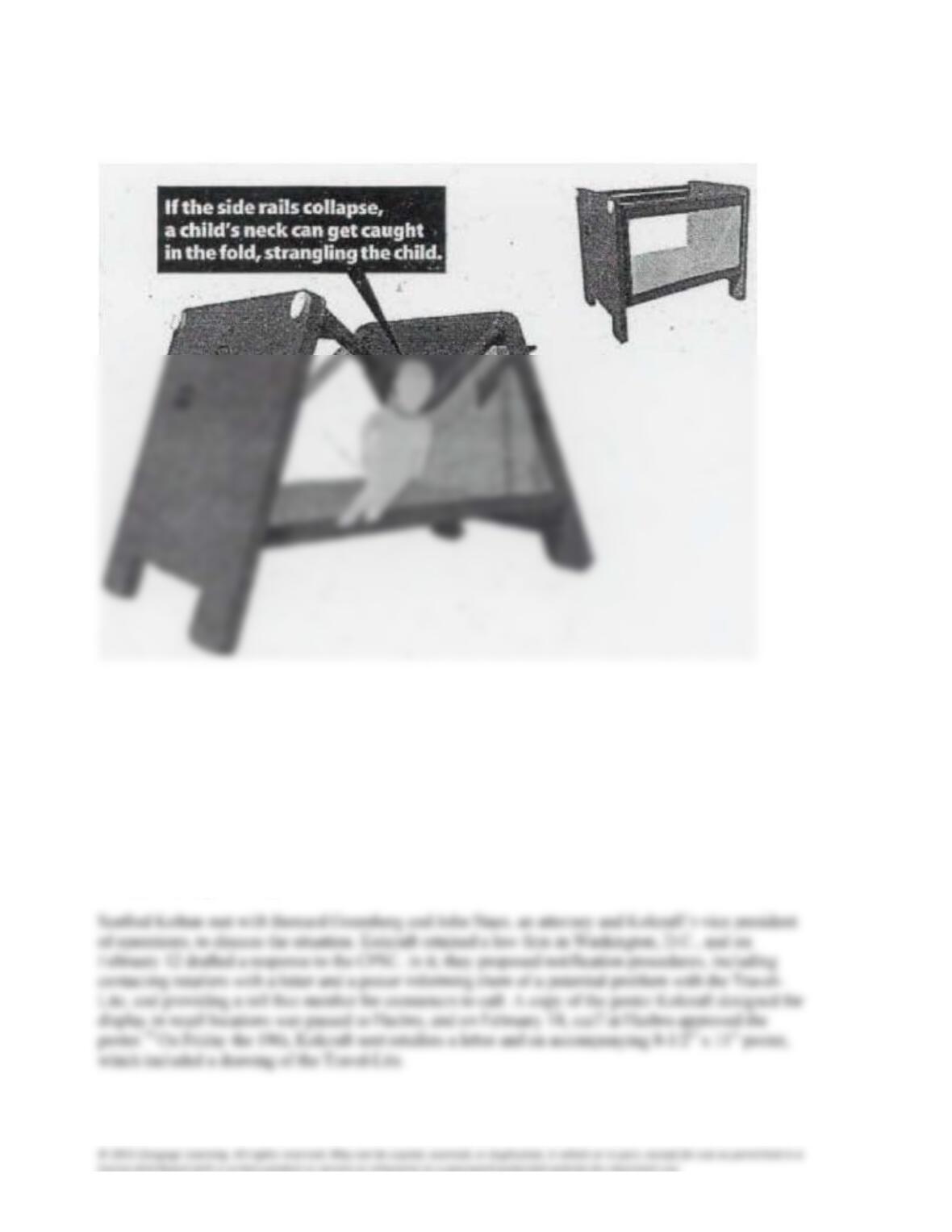
The child’s neck was caught in the “V” created when the crib’s top rails collapsed (Exhibit 3). The
CPSC investigated the incident, and produced a report by the end of the year.
That spring, the report was mailed to Hasbro, which forwarded it to Kolcraft. In June 1992, Kolcraft
responded with a letter to the CPSC which stated in part:
The letter also noted that nothing in the report “suggests at this point that the Travel-Lite portable crib
is defective in any way or presents a substantial hazard.”33
27. Johnson, p. 94.
28. S. Koltun, p. 61.
29. Report of Shelly Waters Deppa, Safety Behavior Analysis, Inc. 11/16/2000, p. 3.
204 Supplemental Case 3: The Playskool Travel-Lite Crib
On November 30, 1992, a nine-month-old girl in Arkansas died when her Travel-Lite collapsed,
strangling her in the “V.” A ten-month-old girl in California was killed in the same manner in another
Travel-Lite on January 5, 1993.
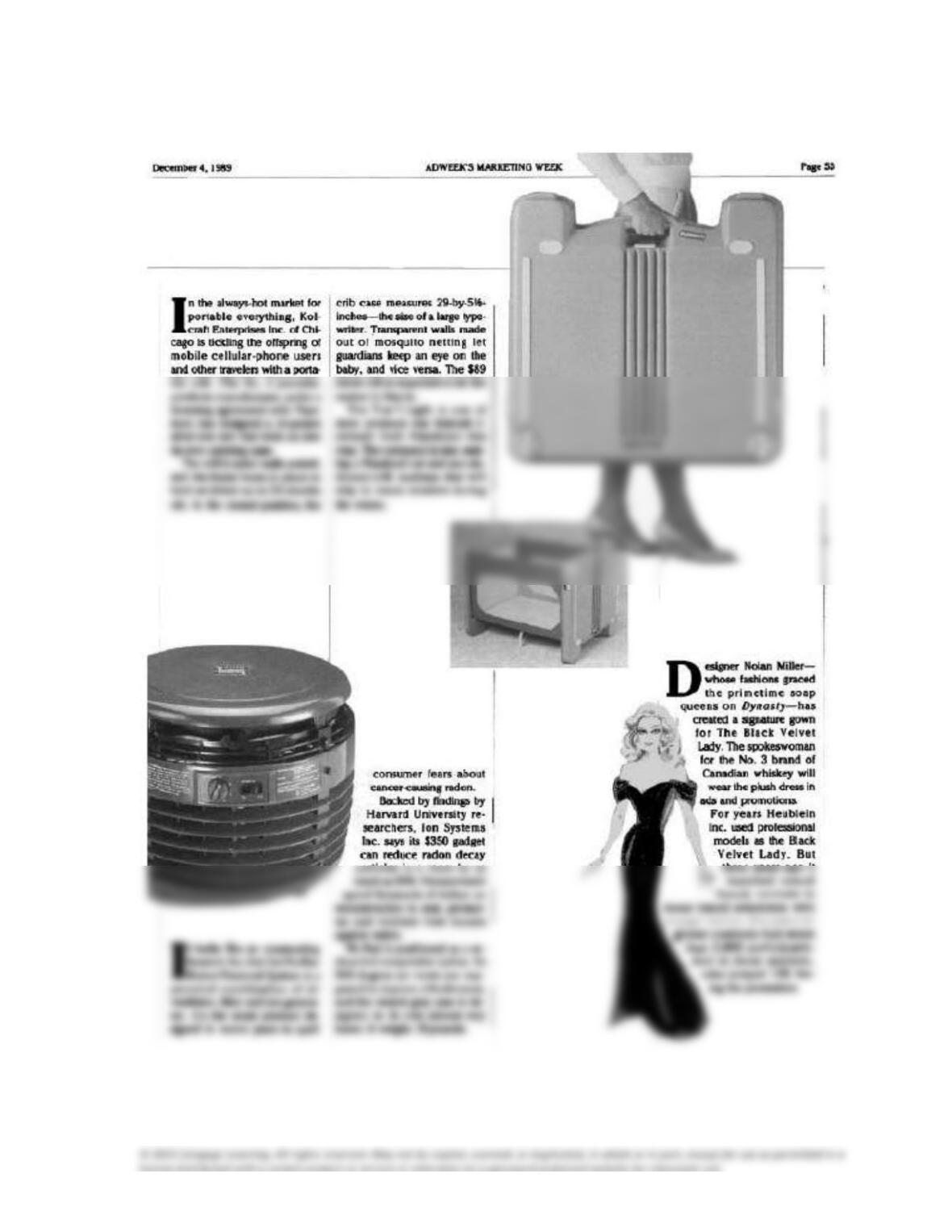
Exhibit 1 Travel-Lite crib with view of two side knobs
34. S. Koltun, pp. 62–63.
Supplemental Case 3: The Playskool Travel-Lite Crib 205
Exhibit 2 Travel-Lite crib in Adweek magazine
206 Supplemental Case 3: The Playskool Travel-Lite Crib
Exhibit 3 Travel-Lite crib in collapsed position
PART B
Starting the Recall
The Travel-Lite had been off store shelves for almost a year when Kolcraft received the February 1,
1993, letter from the CPSC. And although the crib carried a limited one-year warranty, the product had
not included a mail-in warranty registration card for consumers. By February 1993, the earliest users of
the crib would have long outgrown it, and in many cases the original purchasers would have discarded,
stored, sold, or given away their cribs.
35. Denniss, p. 64.
Supplemental Case 3: The Playskool Travel-Lite Crib 207
Also on February 19, Kolcraft’s lawyers in Washington received notice that the compliance staff at the
CPSC had made a preliminary determination that the Playskool Travel-Lite crib presented “a
substantial risk of injury to children as defined by section 15 (a) of the Federal Hazardous Substances
Act (FHSA), 15 U.S.C. § 2064 (a). Specifically, there have been three reports to the Commission of
infant fatalities resulting from the product folding up during use.”36 On February 22, 1993, the CPSC
received from Kolcraft a copy of the letter and poster the company had mailed to retailers the previous
Friday. On February 24, 1993, William J. Moore, Jr., an attorney in the office of compliance and
enforcement of the CPSC, wrote a letter to Kolcraft’s attorneys in Washington, D.C. His letter stated,
in part:
Moore added that his staff “wishes to work with Kolcraft to make this an effective . . . recall and to
prevent further tragedy.”37
In a conference call on March 1, Kolcraft’s attorneys in Washington tried to reassure the CPSC that
Kolcraft and their firm were responding quickly and responsibly. Kolcraft had by then agreed to send a
notice to approximately 26,000 pediatricians on a list maintained by the American Academy of
Pediatrics. In addition, it would send a revised letter to Sears and to smaller retailers. The JC Penney’s
36. Linda Ginzel, as independent administrator of the estate of Daniel Keysar, deceased, and on behalf of Boaz Keysar, Ely
Keysar, and Linda Ginzel, next of kin, plaintiff, v. Kolcraft Enterprises, Inc., a Delaware Corporation, and Hasbro, Inc., a
Rhode Island Corporation, defendants, #98L7063, pending in the Circuit Court of Cook County, County Department, Law
208 Supplemental Case 3: The Playskool Travel-Lite Crib
Using the ASTM play yard standard as a model Kolcraft measured and maintained the following
performance features on the Travel-Lite crib:
(1) Caps, sleeves, etc. secured to stay on with 15 lbf force or more.
(5) Floor strength to withstand 50 cycle 30 ft. load.
(6) Holes sized to avoid finger entrapment.
(7) Mesh openings to avoid finger and toe entrapment and snaring of buttons.
Staas mentioned reaching compliance with regulations on sharp points and edges, and flame-retardant
standards, and added that:
Kolcraft designers conducted use and abuse tests on these cribs, consisting of repeated cycles of
leaning, pushing, sitting on and throwing the crib, and turning it on its sides. Kolcraft also tested
the folding mechanism to determine if it could be inadvertently folded or lowered by a child while
the crib was in use. Kolcraft used CPSC 16 CFR § 1500.53 (e) (3) as its standard to test the
folding mechanisms.
Kolcraft was able to produce no records on the testing of such a twisting motion. Later, Edward
Johnson said he could not recall which of the tests his department performed had received written
notations, and which had been informal.41 In addition to simply turning the dials at either end of the
crib, as intended, the crib could also fold closed if the collapsible top rails were turned firmly enough
(i.e., 15-20 inch-pounds, as noted by Kolcraft) to dislodge the nub holding them in place.
41. Johnson, pp. 20–26.
42. Mitch Lipka, “Deaths of Six Babies Expose Fatal Flaws of System.”