Page 1 of 15
Chapter 3: Global Supply Chain Quality and International
Quality Standards
Chapter Outline
• Managing Quality for the Multinational Firm
• Quality Improvement:
o The American Way
o The Japanese Way
o The European Way
o The Chinese Way
• ISO 9000:2008
• Are Quality Approaches Influenced By Culture?
Overview
The task of managing quality is affected by increased globalization. This chapter
discusses the opportunities and obstacles created by globalization. The differences
between regions of the world also include discussions of various quality approaches that
have been developed in those regions and the awards that act as quality barometers within
each.

Page 2 of 15
In this chapter, the global economy was discussed and the role quality plays in
that world economy. We considered different quality models from different regions.
From an integrative perspective, it is reasonable to borrow from all these models if it
helps a firm perform better. The underlying theme in the chapter is the importance of
learning from other cultures to compete effectively.
Discussion Questions
1. What are the advantages or disadvantages of licensing as a means of gaining
access to foreign markets?
Through licensing, a firm expands its market and retains earnings made in a foreign
market. With markets as large as China, this is a considerable amount. A licensor may
also have an existing marketing establishment and existing contacts. The cultural aspects
2. What are the advantages and disadvantages of globalization? Provide an example
of a firm that has engaged in globalization. What are some of the potential
advantages and disadvantages of globalization for this particular organization?
The primary advantage of globalization is that a firm retains all of the profits from the
sale of its products or services in a foreign country. This is a significant advantage when
Page 3 of 15
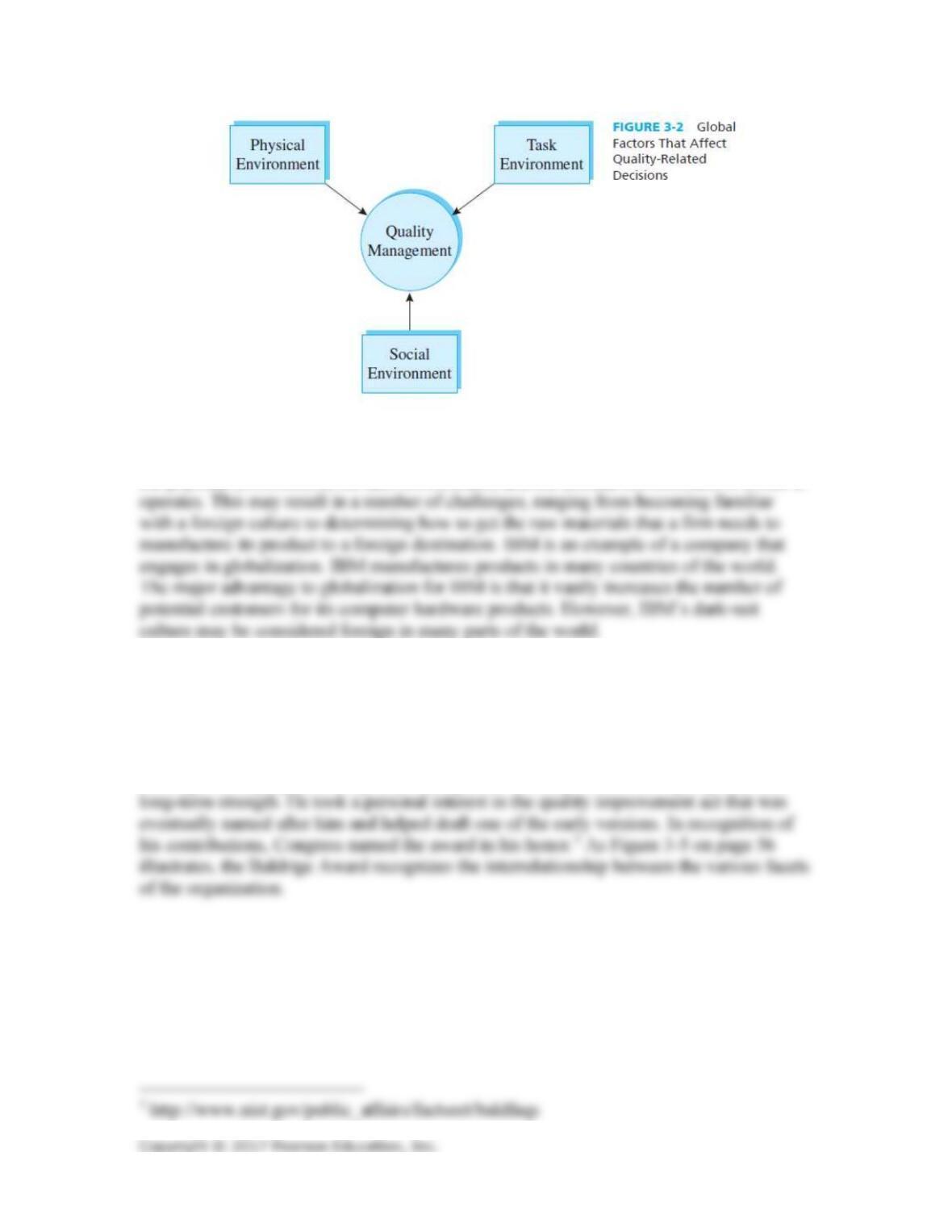
The primary disadvantage of globalization is that it is complicated and forces a firm to, in
essence, “set up shop” in a foreign country. By going abroad, a firm significantly changes
the physical environment, the task environment, and the societal environment in which it
3. What motivates U.S. firms to compete for the Malcolm Baldrige Award? How
could a firm benefit from participating in the Baldrige competition, even if it did not
apply for the award?
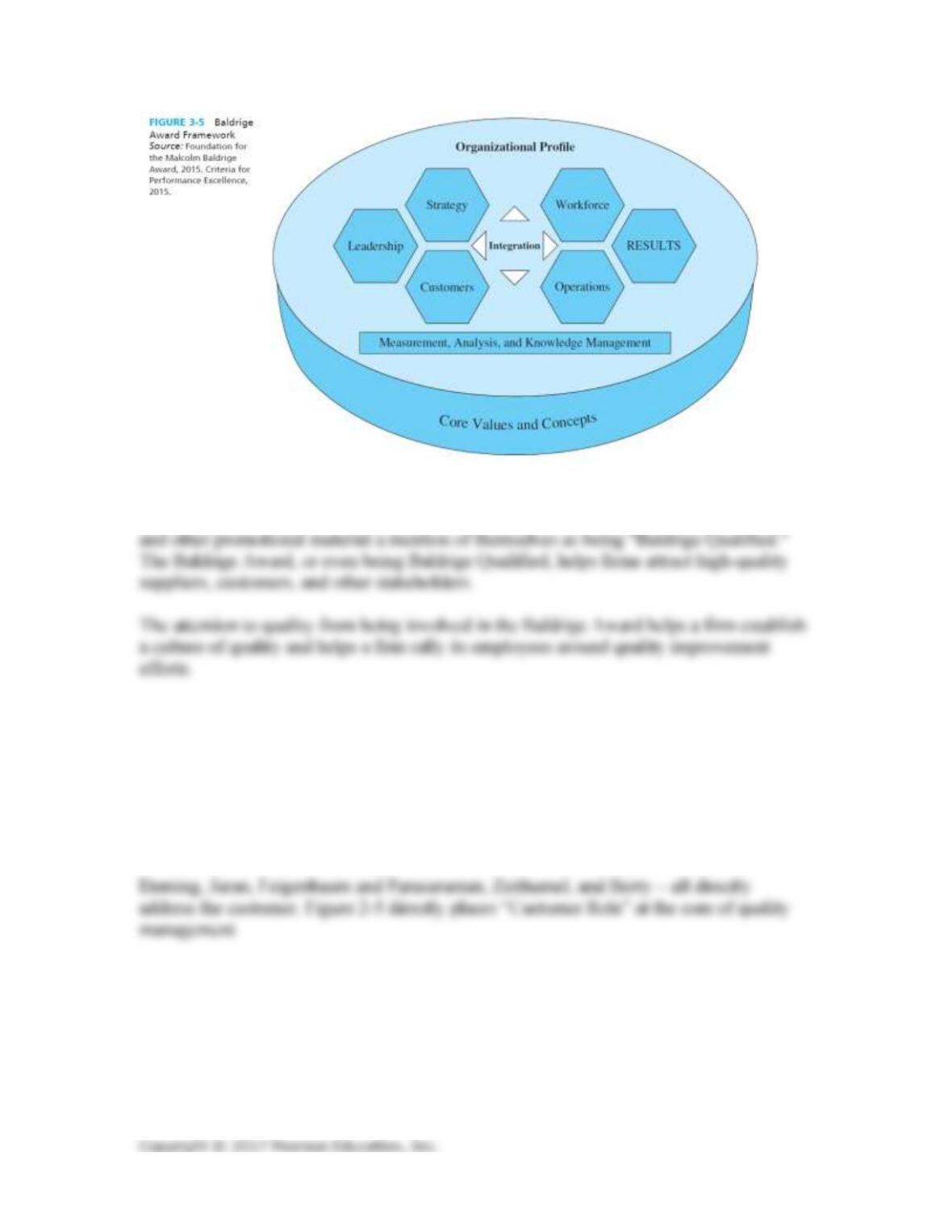
Malcolm Baldrige was Secretary of Commerce from 1981 until his death in July 1987.
Baldrige was a proponent of quality management as a key to the U.S.’s prosperity and
Page 4 of 15
There is great prestige in winning the Baldrige Award. Firms that do not win the award
but receive a site visit from Baldrige examiners often include in their company brochures
4. Category 3 of the Baldrige criteria focuses on the importance of the customer in
assessing the quality of the products and services that a firm sells. Why do you think
the authors of the Baldrige criteria included this category? How is the customer
important in assessing the quality of the products and services that a company sells?
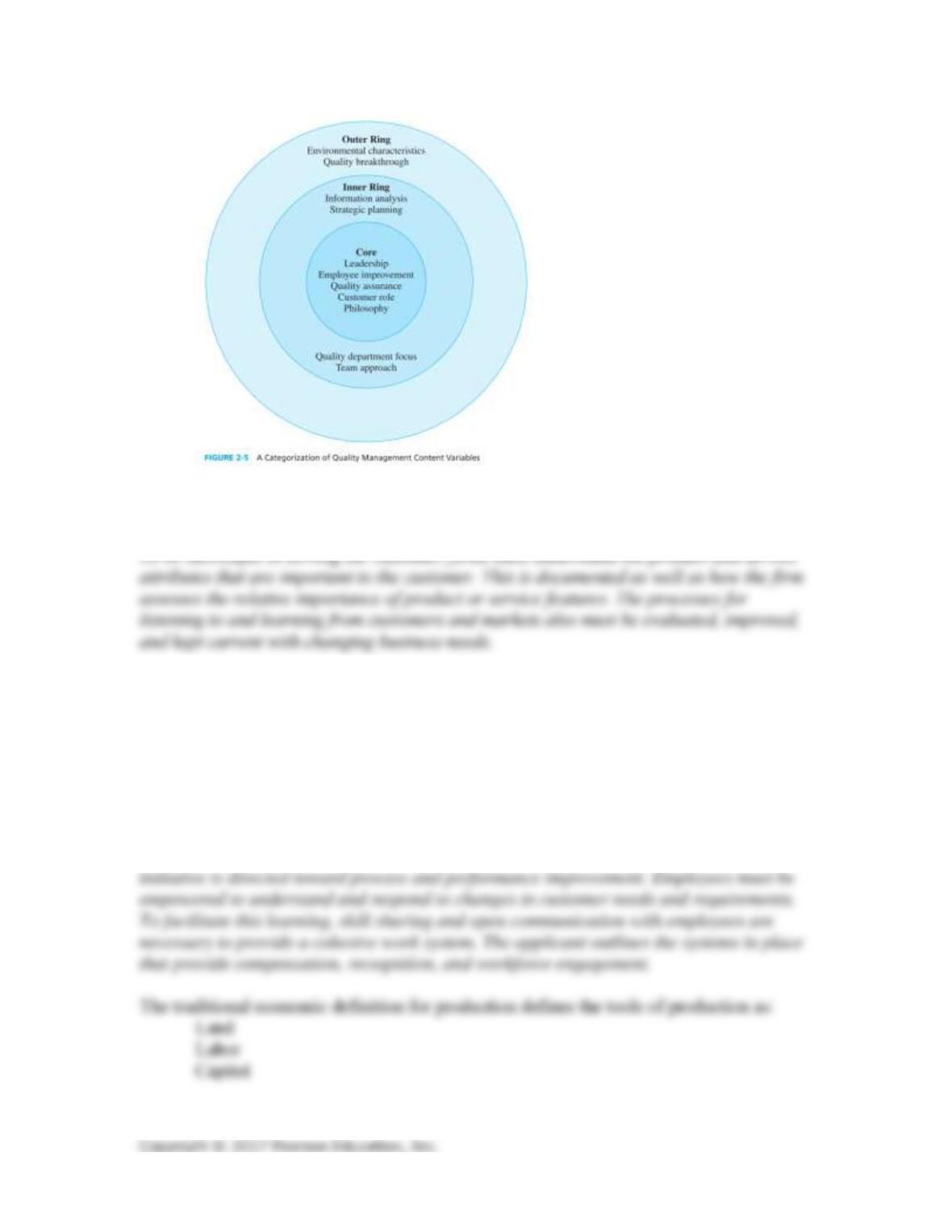
Ishikawa’s second point is: The first step in quality is to know the requirements of the
customer.
Page 5 of 15
The Baldrige Award’s category 3 directly speaks to the importance of the customer:
5. Category 5 of the Baldrige criteria focuses on workforce. Why do you think the
authors of the Baldrige criteria included this category? Why is human resource
management an important consideration in quality planning and management?
Baldrige’s category 5 directly addresses the workforce:
The workforce is to be enabled to develop and use its full potential, aligned with company
objectives. This involves developing an internal environment conducive to full
participation and personal growth, including human resources development. This

Page 6 of 15
6. Do you believe the Baldrige should include a category for not-for-profit
organizations? If so, what adjustments should be made in the Baldrige criteria to
make it applicable for this category?
The differences between a for-profit and a not-for-profit organization are vast. On page
54, the text outlines the purpose of the award:
The criteria focus on business results. Organizations must show outstanding results in
areas such as financial performance, customer satisfaction, customer retention, product
7. If you were the CEO of a manufacturing firm, would you encourage your firm to
apply for the Malcolm Baldrige Award? Why or why not?
Even if a company is not selected for the award, the intensive investigation will supply
invaluable information.
There is a three-stage process for the award. Figure 3-6 shows that at each step, a
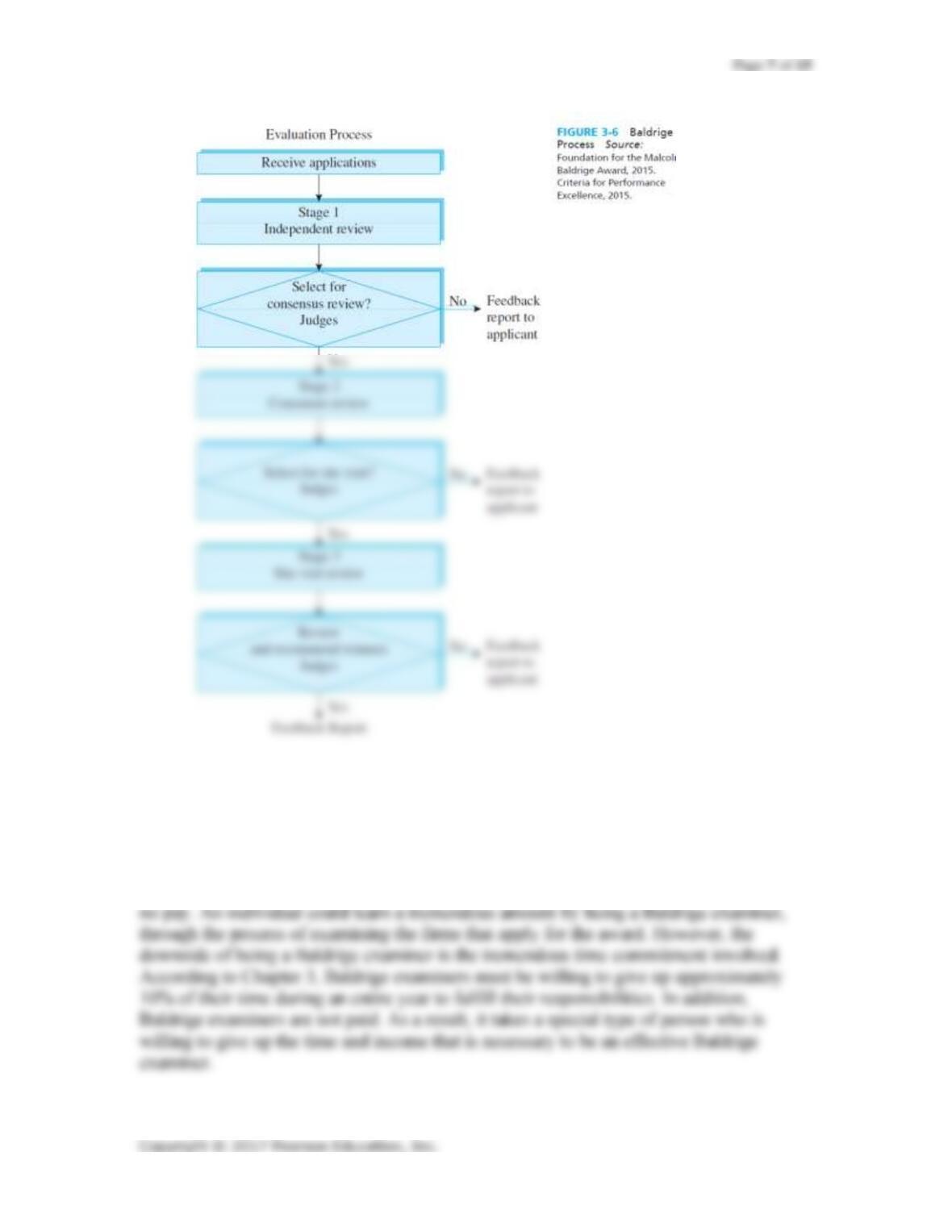
8. If you were presented the opportunity to be a Baldrige examiner, would you
accept it? Why or why not? Make your answer as substantive as possible.
Being a Baldrige examiner is a very prestigious and time-consuming distinction. The job
is intensive and requires a dedication to the end product. It is also performed gratis – for
9. How can firms use lean production to improve quality? Is lean production a
useful concept for both service and manufacturing organizations?
There are two primary ways that firms can use just-in-time (JIT) to improve quality. First,
JIT is comprised of a group of techniques or systems focused on optimizing quality.
Second, JIT is a philosophy that helps rally the members of an organization around the
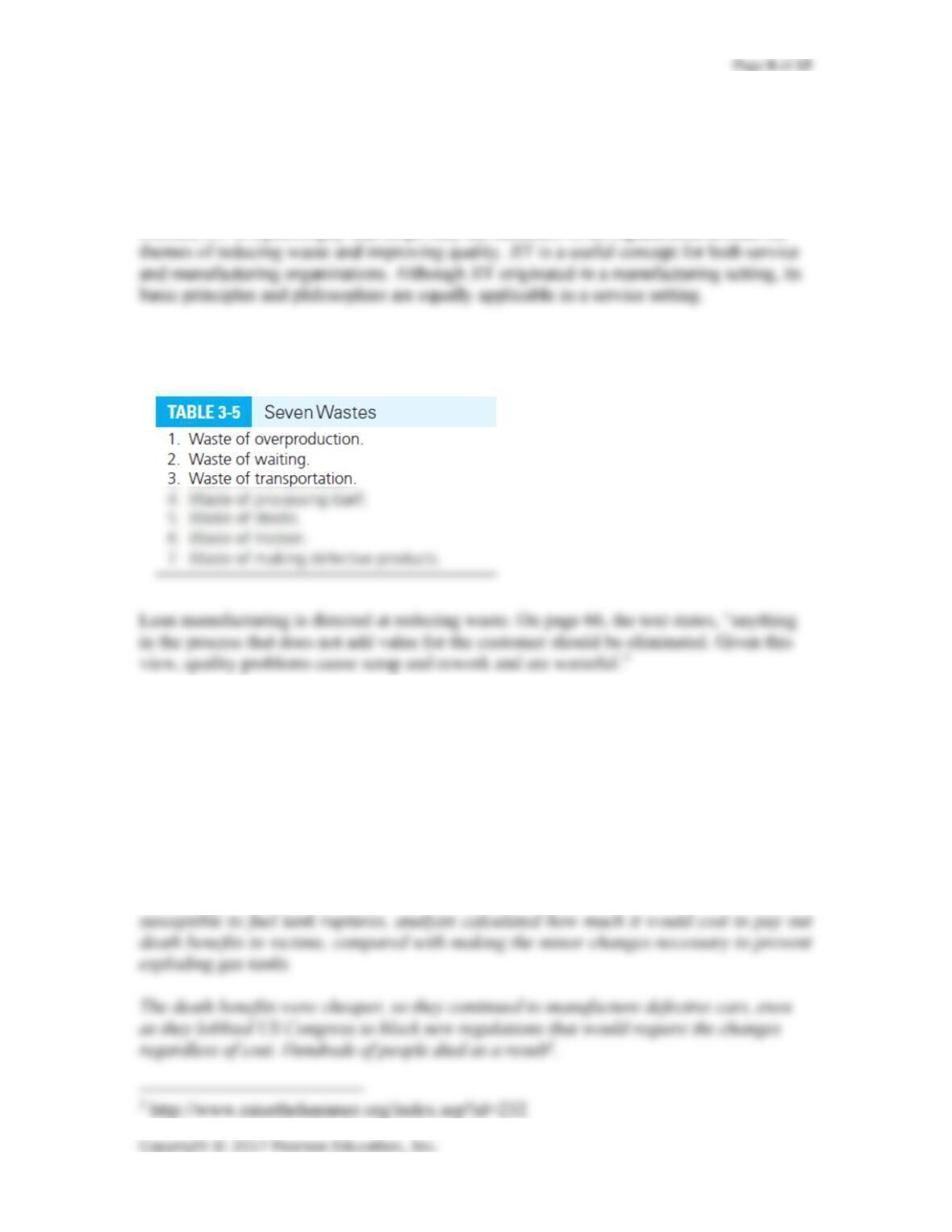
The focus of lean production is eliminating waste. Shigeo Shingo’s Seven Wastes
identifies the characteristics of waste, as seen in Table 3-5.
Following Shingo’s philosophy, reducing waste directly increases quality.
10. Describe the concept of “visibility” in the context of the Japanese total quality
approach. How does the concept of visibility help a firm identify problems in its
production processes?
A noted example of the problems incurred by lack of vision is the Ford Pinto automobile.
As the text illustrates:
In the 1970s, after Ford engineers discovered a design flaw in the Pinto that made it
Page 9 of 15
The concept of visibility eliminates this problem. The Japanese empower any employee
11. In what sense does excess inventory act as a “security blanket” for
manufacturing firms?
Excess inventory acts as a security blanket for a firm if the firm always has inventory
readily available to substitute for parts that were scrapped or need to be reworked before
12. Describe the concept of line-stop authority. If you were an operator in a
production facility, would you want to have line-stop authority? Why or why not?
Line-stop authority pertains to the authority to stop a production line if a problem is
identified. Line-stop authority empowers the line worker. Quality control is now being
conducted at the lowest possible level. A key point is that line-stop authority minimizes
13. Why is it a good idea for workers to inspect their own work?
It is a good idea for workers to inspect their own work for two reasons. First, if workers
14. In what ways are the Malcolm Baldrige Award and the Deming Prize similar,
and in what ways are they different?
Table 3-4 on page 66 address this point extremely well.

15. Is it appropriate to use the criteria for quality awards as a framework for
organizational improvement and change? Why or why not?
Using the criteria for quality awards as the framework for organizational improvement
forces change upon the corporate culture. If the corporate culture already emphasizes
16. What are the major substantive differences between the quality awards
discussed in the chapter and ISO 9000:2008? Are they intended for similar or
entirely different purposes?
The purposes of ISO 9000:2008 and the award programs are radically different. The
purpose of ISO 9000:2008 is not to provide a framework for organizational improvement
and change (although this can occur through the implementation of ISO 9000:2008). The
focus of ISO 9000:2008 is for companies to document their quality systems in a series of
manuals for the purpose of facilitating trade through supplier conformance.
The ISO 9000 process can be described as:
2. Leadership
4. The process approach
6. Continual improvement
8. Mutually beneficial supplier relationship
17. Describe the purpose and the intent of the ISO 9000:2008 program. What are
the advantages of becoming an ISO 9000:2008-certified company? Are there any
disadvantages?
The International Organization for Standardization (ISO) is an international developer of
standards for industry. These standards are in place to enable making the development,
manufacturing, and supply of products and services more efficient, safer, and cleaner.
They make trade between countries easier and fairer.
management must ask is: What is the value of the certification?
18. Describe the purpose and the intent of the ISO 14000 program.
ISO 14000 is an international standard for environmental compliance. The compliance
standard is ISO 14001, Environmental Management Systems. ISO 14001 uses the same
19. What are the pros and cons for an American firm that is considering pursuing
ISO 14000 certification? If you were the CEO of a manufacturing firm, would you
pursue ISO 14000. Why or why not?
Environmental control has become a major international issue. The economic and
political problems that might be raised if a firm pursues ISO 14000 are great. As a result
of the self-study process incorporated in the ISO standard, firms can possibly discover

20. Do you believe quality approaches are influenced by culture? How?
As stated at the end of the chapter, culture has a great influence on corporate tradition.
• American companies are results-oriented. They are driven by the bottom line. As
a result, if an aspect of quality appears to be expensive, it might well be ignored.
Case 3-1: Denver International Airport Becomes ISO 14001 Certified
Case Study Questions
1. What do you view as the benefits of ISO 14001 adoption and implementation?
ISO 14000 is an international standard for environmental compliance. The compliance
standard is ISO 14001, Environmental Management Systems. ISO 14001 uses the same
basic approach as ISO 9000:2008 with documentation control, management system
auditing, operational control, control of records, management policies, audits, training,
statistical techniques, and corrective and preventive action. In addition to these controls,
2. Is ISO registration useful for airports? Why or why not?
The answer to this question is totally dependent on the airport, its location and its
competition. Or is it? Do all airports basically function in a common manner where the
business of the airport is concerned? Do customers think that the business of running an
airline and an airport will ever be standardized? Is standardization of the business
3. How can the benefits of ISO registration extend outside the company?

Case 3-2: Wainwright Industries: An Entirely New Philosophy of Business
Based on Customer Satisfaction and Quality
Case Study Questions
1. In its pursuit of improved quality, Wainwright emphasized two sets of initiatives:
one based on improvements in its manufacturing operations (i.e., just-in-time
manufacturing, computer-aided design) and the other based on human resource
management (i.e., employee empowerment, profit sharing). Why was it necessary
for Wainwright to emphasize both of these sets of initiatives? How are they related?
Wainwright’s dual emphasis on improvements in manufacturing operations and human
resource management seems to be the ideal formula for improving an organization’s
overall quality related efforts. As mentioned in the previous two chapters, a key to the
The key to this discussion is in the case itself:
The results of the company’s continuous improvement efforts are linked to five strategic
indicators, including safety, internal customer satisfaction, external customer
2. What is an egalitarian culture? How does the development of an egalitarian
culture help a company like Wainwright Industries become more quality minded?
The case states the approach towards egalitarianism as:
The employees at Wainwright (including the CEO) now all wear the same uniform, eat in
the same cafeteria, and park in the same parking lot. Office walls have literally been torn
down and replaced with glass, based on the premise that if the managers can watch the
frontline employees work, the frontline employees should be able to watch the managers
The immediate response to this might be expressed as fear of this turning into a
communal society. Marx said, “From each according to his ability to each according to
his need.” Is this culture a possibility? Is there a danger of the new culture hurting

Page 15 of 15
3. Although quality is important for every product or service, it may be particularly
important for the precision auto parts industry. Do you agree with this statement?
Why or why not?
What is the difference between a Mercedes and a Chevrolet? Functionally, they are
identical. They both have the same basic parts; however, there is a large difference in cost
between the two automobiles. A Rolex watch performs the same function as a Timex.
The Rolex, however, is far more expensive than the Timex. Why?