Supplemental Case 3: The Playskool Travel-Lite Crib 209
After the Recall
On May 12, 1998, during naptime at his childcare provider, 16-month-old Danny Keysar was found
unconscious in the “V” of a Travel-Lite. He was rushed to the emergency room but could not be
revived. He was the fifth reported death in a Travel-Lite (Exhibit 5).
210 Supplemental Case 3: The Playskool Travel–Lite Crib
Exhibit 4
NEWS FROM CPSC
S. Consumer Product Safety Commission
Office of Information and Public Affairs Washington, DC 20207
FOR IMMEDIATE RELEASE CONTACT:
PLAYSKOOL TRAVEL-LITE PORTABLE CRIBS RECALLED BY
KOLCRAFT—SUFFOCATION RISK CITED
PRODUCT: 11,638 Playskool Travel-Lite Portable Cribs, models 77101 and 77103 manufactured by
Kolcraft Enterprises, Inc.
PROBLEM: If the side rails of the portable crib fold during use, an infant can become entrapped and
suffocate. Three deaths have been reported.
The incidents reported to CPSC suggest that if the side rails of the crib fold during use, an infant may
become entrapped in the “V” where the side rails fold. While it is still unclear exactly why the crib side
rails folded, Kolcraft is recalling all Travel-Lite cribs in an effort to prevent any further risk of injury to
infants using these cribs.
The Playskool Travel-Lite portable crib has two nylon mesh sides and two blue solid plastic ends.
“Playskool” appears in white letters on a red background on each end. The crib folds in the center for
storage and handling.

Supplemental Case 3: The Playskool Travel-Lite Crib 211
hazard or can injure children. The CPSC’s work to ensure the safety of consumer products – such as
toys, cribs, power tools, cigarette lighters, and household chemicals – contributed significantly to the 30
percent decline in the rate of deaths and injuries associated with consumer products over the past 30
years.
212 Supplemental Case 3: The Playskool Travel–Lite Crib
Exhibit 5
NEWS FROM CPSC
U.S. Consumer Product Safety Commission
Office of Information and Public Affairs Washington, DC 20207
FOR IMMEDIATE RELEASE
CPSC Consumer Hotline: (800) 638-2772
CPSC URGES SEARCH FOR PREVIOUSLY RECALLED PORTABLE
CRIBS AND PLAY YARDS
WASHINGTON, D.C. – The U.S. Consumer Product Safety Commission (CPSC) is urging consumers
to search for and stop using previously recalled child products, in particular the “Playskool Travel-Lite”
portable crib, which was manufactured by Kolcraft from 1990 through 1992 and recalled in 1993. In
May of 1998, a Chicago toddler died after a Playskool Travel-Lite portable crib collapsed.
“A death caused by a previously recalled product is a tragedy,” said CPSC Chairman Ann Brown. “We
urge consumers to make an all out effort to search their homes and daycare centers for these portable
cribs and play yards and stop using them.”
The Playskool Travel-Lite portable cribs have two nylon mesh sides and two blue solid plastic ends.
“Playskool” appears in white letters on a red background on each end. The portable crib folds in the
center for storage and handling. Stores nationwide sold 11,600 of the products from 1990 through 1992.
Supplemental Case 3: The Playskool Travel-Lite Crib 213
Date
Recalled
Product and Firm Numbers/Dates Sold Remedy
6/25/97 Evenflo “Happy Camper,” “Happy Cabana,”
and “Kiddie Camper” Portable Play Yards
1.2 million units sold
between 1990 and 1997
Free hinge covers.
Call firm 800-447-
9178
11/21/96 Century “Fold-N-Go Models 10-710 and 10-
212,000 units sold
Free repair. Call
CPSC is asking the help of consumers, childcare providers and child welfare associations to help spread
the word about the search for these portable cribs and play yards in an effort to avoid another tragic
incident. “CPSC gets recalled products off store shelves, but we can’t go into consumers’ homes and
remove the products,” said Brown. “That’s why we want to get this message out and have consumers
Send the link for this page to a friend! The U.S. Consumer Product Safety Commission is charged with
protecting the public from unreasonable risks of serious injury or death from more than 15,000 types of
consumer products under the agency’s jurisdiction. Deaths, injuries and property damage from
consumer product incidents cost the nation more than $700 billion annually. The CPSC is committed to
protecting consumers and families from products that pose a fire, electrical, chemical, or mechanical
hazard or can injure children. The CPSC’s work to ensure the safety of consumer products – such as
214 Supplemental Case 3: The Playskool Travel–Lite Crib
Exhibit 6
NEWS FROM CPSC
S. Consumer Product Safety Commission
Office of Information and Public Affairs Washington, DC 20207
FOR IMMEDIATE RELEASE
CPSC Consumer Hotline: (800) 638-2772 CPSC Media
IN WAKE OF ANOTHER DEATH, CPSC AGAIN URGES SEARCH FOR
PREVIOUSLY RECALLED PORTABLE CRIBS AND PLAY YARDS
WASHINGTON, D.C. – The U.S. Consumer Product Safety Commission (CPSC) again is urging
consumers to immediately search for and stop using previously recalled child products, in particular the
Manufacturers of portable cribs and play yards have joined in the effort to warn consumers and
childcare providers to stop using the more than 1.5 million portable cribs and play yards that have been
recalled in past years. Top rail hinges must be turned to set up the cribs and play yards. These top rails
can collapse, entrapping children and suffocating them. Thirteen children have died from suffocation in
collapsed play yards and portable cribs manufactured by various firms. Current production play yards
have top rails that automatically lock into place when the play yards are fully set up.
“Once again, we urge consumers to immediately search their homes and daycare centers for these
portable cribs and play yards and stop using them,” said CPSC Chairman Ann Brown. “We are asking
the news media to help us get word of these dangerous products out to consumers so that another
tragedy is prevented. The media plays a critical role in reaching consumers. We can’t go into
everyone’s home, but newspapers, and radio and television stations can. I ask every newspaper and
Supplemental Case 3: The Playskool Travel-Lite Crib 215
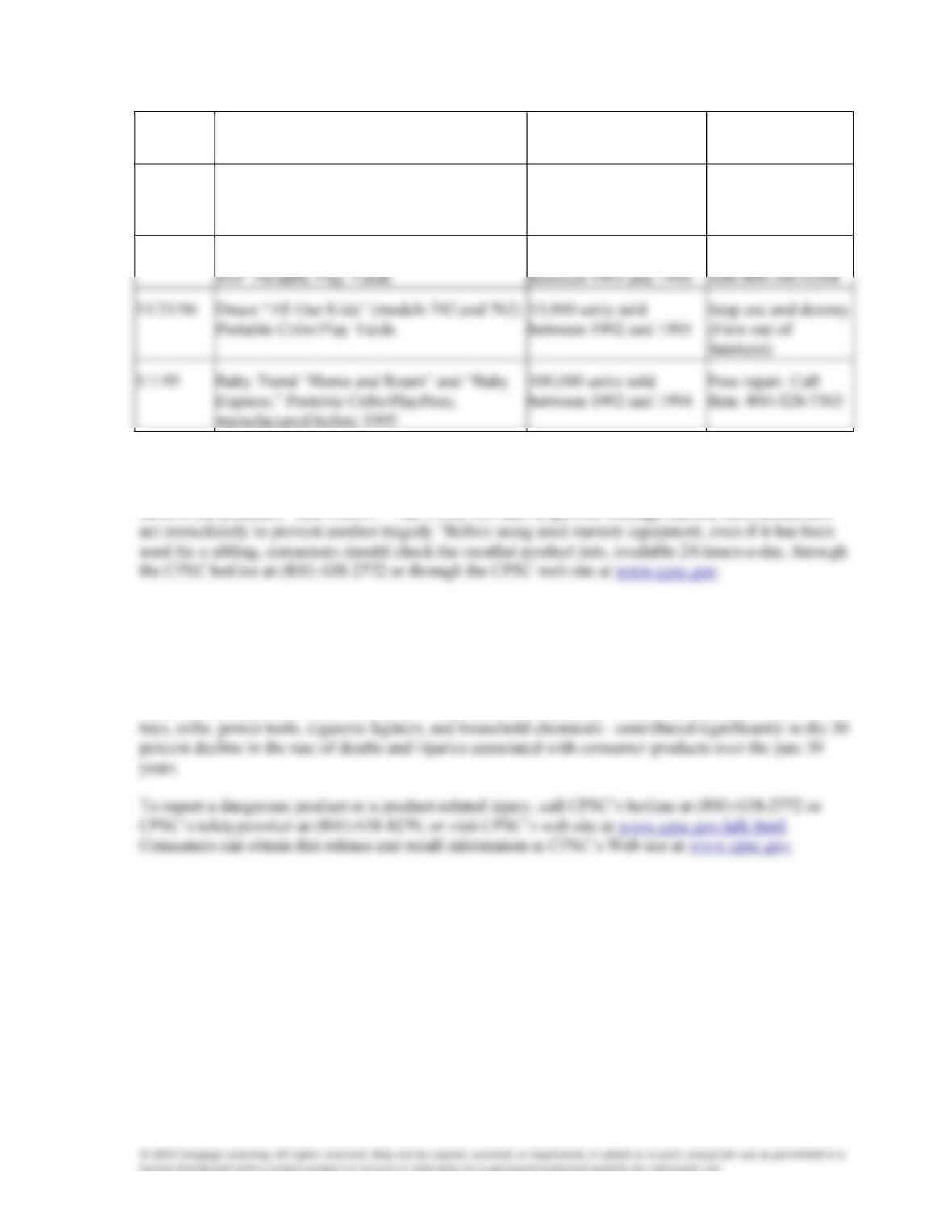
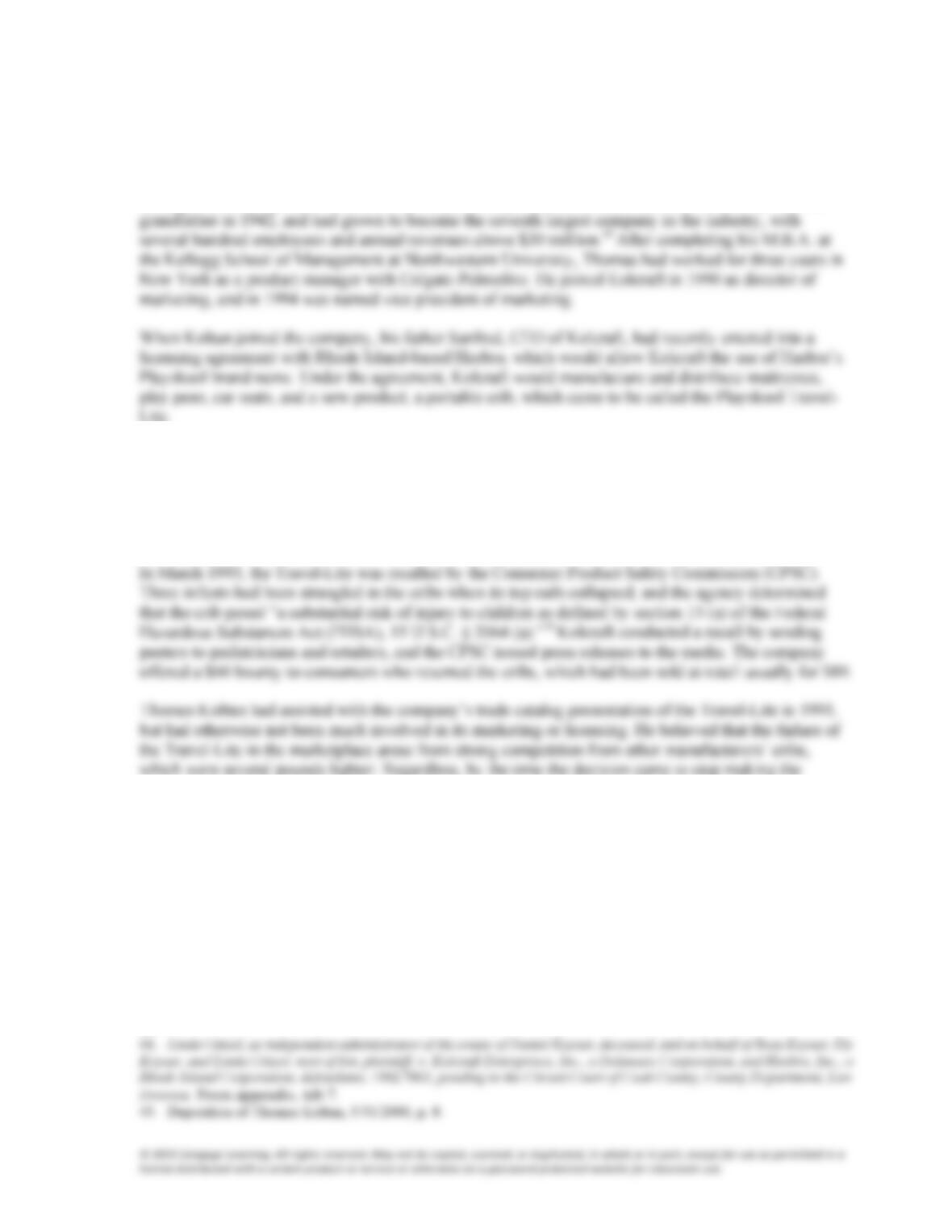
The following table lists the portable cribs and play yards, manufactured by various companies, that
have been recalled because of similar hazards. Consumers and childcare providers should check for the
following recalled play yards and portable cribs. If these products are found, consumers should call the
company listed below.
Date
Recalled
Product and Firm Number/Dates Sold Remedy
6/25/97 Evenflo “Happy Camper,” “Happy
Cabana,” and “Kiddie Camper” Portable
Play Yards
1.2 million units sold
between 1990 and 1997
Free hinge coversCall
firm800-447-9178
2/17/93 Kolcraft “Playskool Travel-Lite” Portable
Cribs
11,600 units sold
between 1990 and 1992
$60 refundCall firm800-
453-7673
Consumers can also view video clips showing how the top rails of some of these recalled portable cribs
and play yards can collapse.
Before using used nursery equipment, even if it has been used for a sibling, consumers should check the
recalled product lists. Consumers can get information about recalled products in the following ways:
Call the CPSC hotline, available 24-hours-a-day, at (800) 638-2772.
Send the link for this page to a friend! The U.S. Consumer Product Safety Commission is charged with
protecting the public from unreasonable risks of serious injury or death from more than 15,000 types of
consumer products under the agency’s jurisdiction. Deaths, injuries and property damage from

216 Supplemental Case 3: The Playskool Travel–Lite Crib
consumer product incidents cost the nation more than $700 billion annually. The CPSC is committed to
protecting consumers and families from products that pose a fire, electrical, chemical, or mechanical
hazard or can injure children. The CPSC’s work to ensure the safety of consumer products – such as
toys, cribs, power tools, cigarette lighters, and household chemicals – contributed significantly to the 30
percent decline in the rate of deaths and injuries associated with consumer products over the past 30
years.
Supplemental Case 3: The Playskool Travel-Lite Crib 217
PART C
In the early 1990s, Thomas Koltun was being groomed to take over Kolcraft Enterprises, his father’s
Chicago-based company. A manufacturer of juvenile products, Kolcraft had been started by Thomas’
Kolcraft had initially been optimistic about the crib, introduced in January 1990. The company believed
that the well-known Playskool name would bring consumer attention to the product. They also believed
that the portability of the crib—it could fit into the trunk of a car—would provide a useful solution for
various situations parents would encounter. But the crib did not sell well, and by April 1992, when it
stopped shipping, only about 11,600 of the cribs, models 77101 and 77103, had been sold.
Travel-Lite, he was already looking past the product toward the company’s future. “I was involved
somewhat,” he put it simply. “The product wasn’t selling, so it was time to move on to another
product.”45
Further Travel-Lite History
On July 12, 1995, while the recall of the Travel-Lite was still active, a ten-month-old boy in
Indianapolis was strangled in the “V” of his collapsed Travel-Lite. He was the fourth known victim of
the crib.
43. E. Marla Felcher, It’s No Accident: How Corporations Sell Dangerous Baby Products, Common Courage Press, 2001, p.
83.
218 Supplemental Case 3: The Playskool Travel–Lite Crib
By June 1996, of the 11,600 sold, 2,736 Travel-Lites could be accounted for. Noting that the returns
had stopped, and that there had been no recent injury or death reports, the CPSC closed its case. The
status of 76 percent of the cribs remained unknown.46
Kids in Danger—And a Lawsuit
In mid-1995, a Travel-Lite crib found its way into a childcare home in Chicago—the third owner of that
particular Travel-Lite. The provider set up, used, and took down the crib each day she was open for
business, from the time she received it until May 1998. During naptime on May 12, 1998, 16-month-old
Danny Keysar was found unconscious in the “V” of his Travel-Lite. He was rushed to the emergency
room but could not be revived. He was the fifth reported death in a Travel-Lite.
Ginzel and Keysar felt they had to take action, and created a nonprofit organization, Kids In Danger
(KID), whose mission would be to promote the development of safer children’s products, advocate for
legislative and regulatory strategy for children’s product safety, and educate the public, especially
parents and caregivers, about dangerous children’s products. The organization started a Web site,
www.KidsInDanger.org, and their efforts to bring the tragedy into the open resulted in substantial press
attention.
On June 18, 1998—the same day the CPSC issued a press release headlined, “CPSC Urges Search for
Previously Recalled Portable Cribs and Play Yards”—Linda Ginzel and Boaz Keysar filed suit against
Kolcraft and Hasbro, seeking damages for their negligence in bringing the Travel-Lite to market. The
suit alleged that not only was the product unreasonably dangerous, but that Kolcraft and Hasbro had
failed to properly warn the public about its danger. Hasbro was also responsible, Ginzel and Keysar
contended, because by receiving licensing fees and allowing its Playskool brand name to be used
prominently on the product, it was, to the public, the “apparent manufacturer” of the product.50
News of the lawsuit was featured on the Reuters and UPI newswires, and received national press
coverage. The Chicago Tribune ran a short feature story, including a photo of the Travel-Lite that had
Supplemental Case 3: The Playskool Travel-Lite Crib 219
killed Danny Keysar, shown in the collapsed position by Dan Webb, one of the plaintiff’s co-counsels
and a former U.S. attorney.51
ACKNOWLEDGEMENTS
The author wishes to thank a number of individuals who gave generously of their time and expertise
during the creation of this case.
Numerous faculty members, Ph.D. candidates, and MBA students from the Graduate School of
Business at the University of Chicago attended several brown bag seminars to critique drafts of the case
study. Their input was extremely helpful, as was the help of various experts from around the nation. I
thank all those listed here and apologize to those whose names do not appear: Robert Adler, Holly Burt,
Jonathan Eig, Howard Haas, Josh Klayman, Richard Larrick, Harold J. Leavitt, Carmen Marti, Cade
Massey, David Messick, Sharon Peck, Megan Rostan, Caroline Schoenberger, George Wu, and Jeff
Zivan.
Marla Felcher’s It’s No Accident: How Corporations Sell Dangerous Baby Products is a tour de force
of investigative reporting in the area of juvenile product safety, and her work was a valuable resource
and an inspiration.
51. Jon Bigness, “Suit filed over faulty playpen,” Chicago Tribune, June 19, 1998.
52. Mitch Lipka, ibid.