Focusing on Customers 35
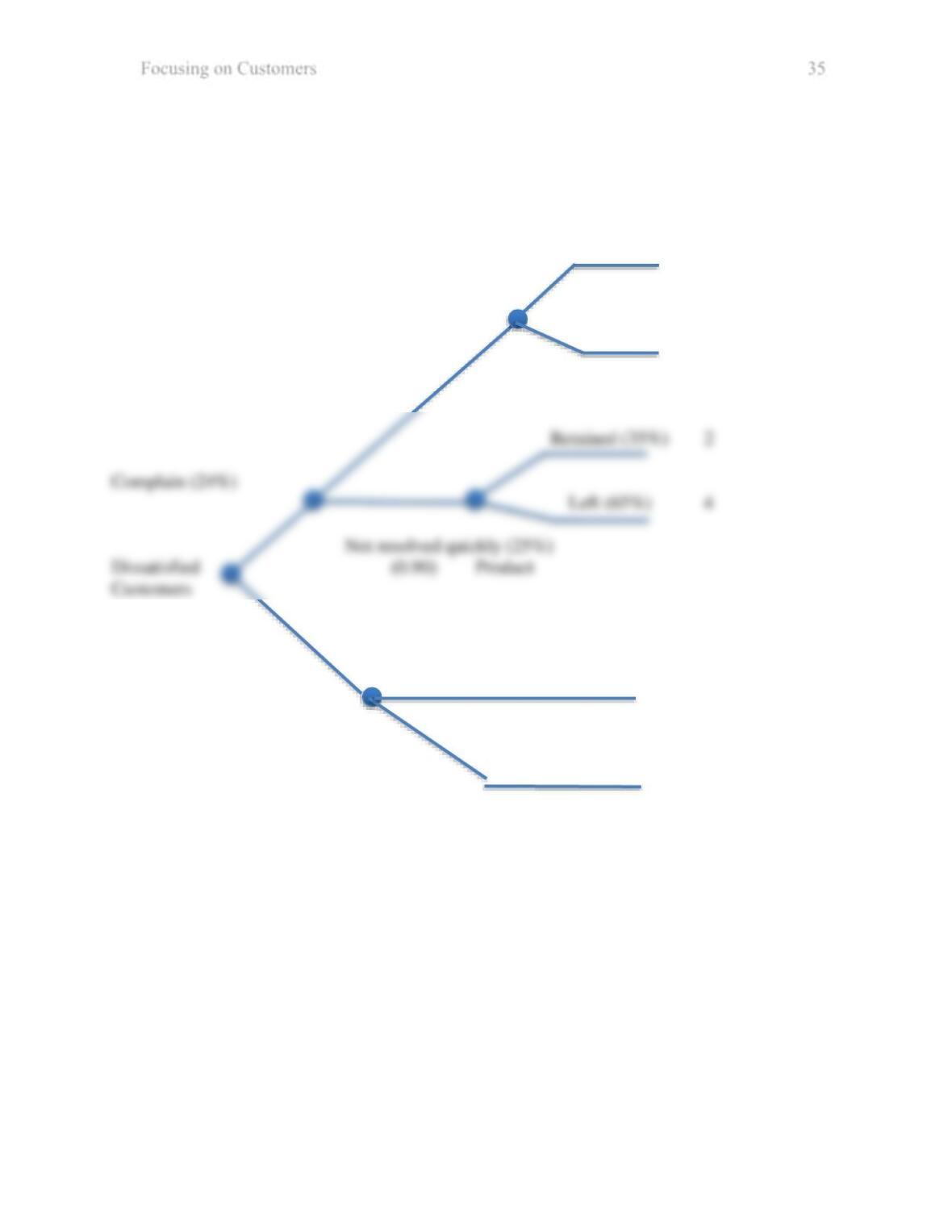
a. What total percent of the dissatisfied customers who complained and who did not
complain were retained? (Hint: draw a decision tree diagram to illustrate this
information.)
Outcomes
Retained (90%)
16
Left (10%)
2
Resolved quickly(75%)
Do not
Complain (76%) Retained (30%)
23
Left (70%)
Focusing on Customers 36
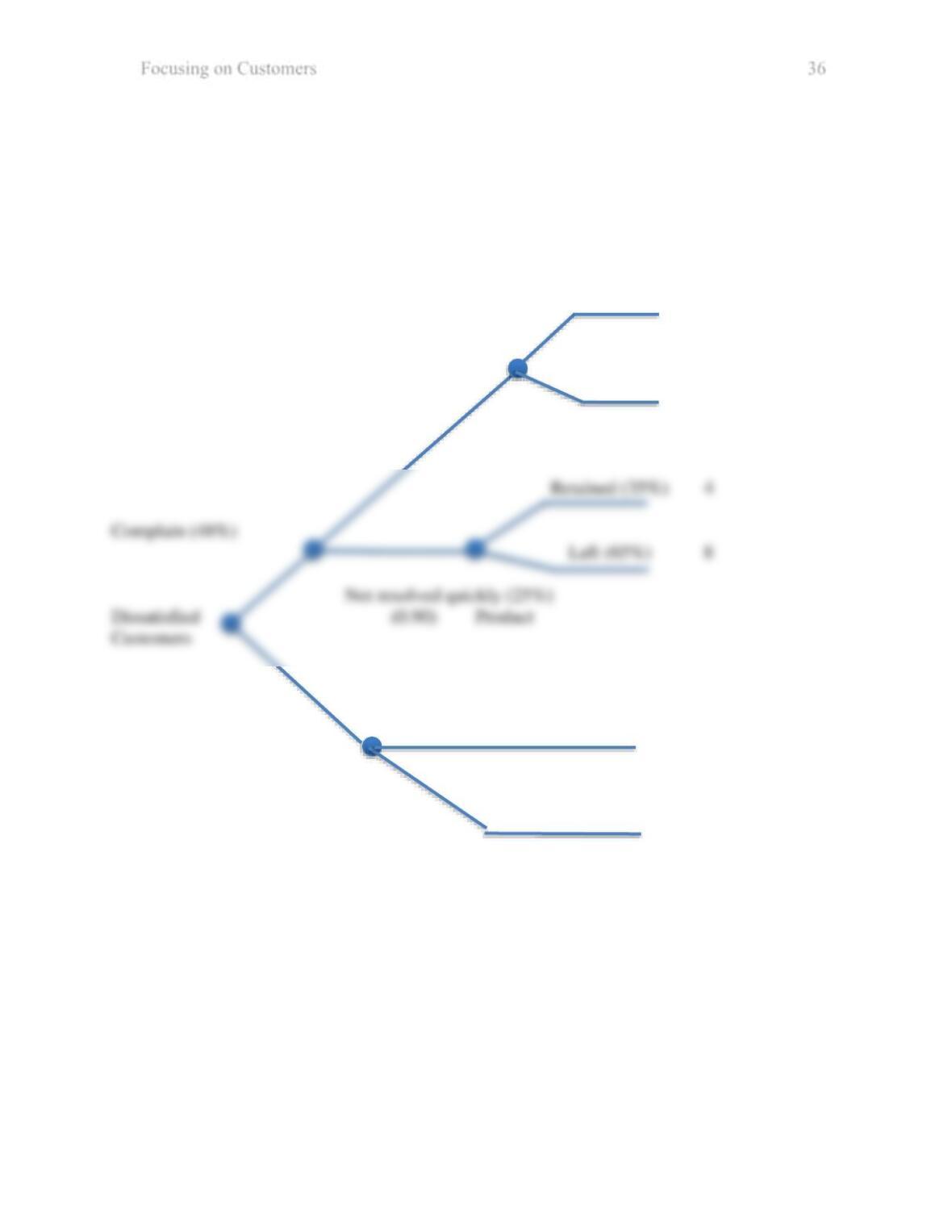
b. The manager at SportTee realized that if they could get more of their dissatisfied
customers to complain to the company, they were more likely to be able to solve their
problems and retain them as customers. If they could get twice as many of the dissatisfied
group to complain (48 percent, rather than 24 percent), and all other information remained
the same, what total percentage of dissatisfied customers could Mellow retain?
Outcomes
Retained (90%)
32
Left (10%)
4
Resolved quickly(75%)
Do not
Complain (52%) Retained (30%)
16
Left (70%)
36
c. What implications does this have for an organization?
The implications for any organization are that companies who make it easy to complain, and then
resolve their complaints rapidly, are more likely to be able to retain their customers than those
who don’t.
8. Versailles Sporting Goods is a family-owned regional sporting goods store located in a
small Midwestern town, and competes with a larger national sporting goods chain in a
larger city about 40 miles away, as well as major national retail “superstore” with

Focusing on Customers 37
generally lower prices. Versailles specializes is athletic equipment, accessories, and clothing
and it seeks to create a competitive advantage through high-quality customer service.
Their vision is to be the “best–run sporting goods store in America.” They hire people who
are passionate about sports, engage in sporting activities so that they can better relate to
the products and customers, and cross-train associates so that they have in-depth
knowledge of all product lines, no matter what their personal interests are.
To better understand what customers value and how they perform relative to their
competition, they conducted a survey to rate customers’ perceptions for their store and
their two main competitors on the following attributes (using a 1-7 Likert scale):
• Friendliness of employees
• Knowledge of products
• Helpfulness in selecting the right product
• Store layout
• Product availability
• Product quality
• Ease of checkout
• Overall customer satisfaction
• Willingness to recommend to others
a. Results from the survey, taken from a random sample of 50 customers per month for 12
months, can be found in the Excel file C03Data in the Problem & Case Data folder on the
Student Companion Site. Analyze the data in groups relating to employee attributes, store
characteristics and customer attitudes. From your analysis, what might Versailles do to
create “exciters/ delighters” that would help them compete with the larger national chain
and the local superstore?
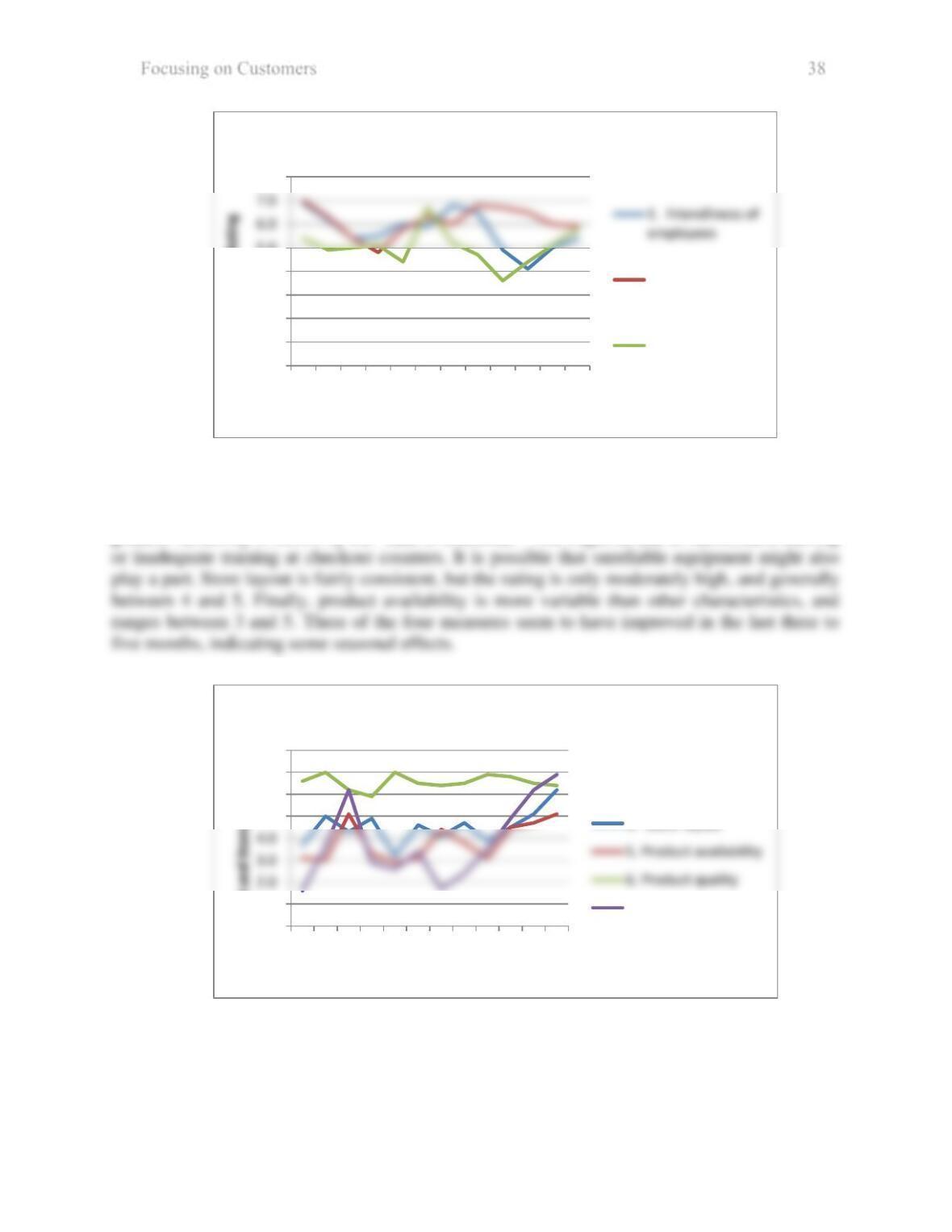
The results, found in spreadsheet Ch03Problem8 in the Instructor’s materials show three sets of
interrelated patterns. The employee attributes of friendliness, knowledge, and helpfulness show
some interesting variation. The knowledge of products by employees appears to be fairly stable,
Focusing on Customers 38
The product and store characteristics of store layout, product availability, product quality,
and ease of checkout show a great deal of variability, except for product quality. Perhaps the
greatest variability is shown by the “ease of checkout.” This might be due to inconsistent staffing
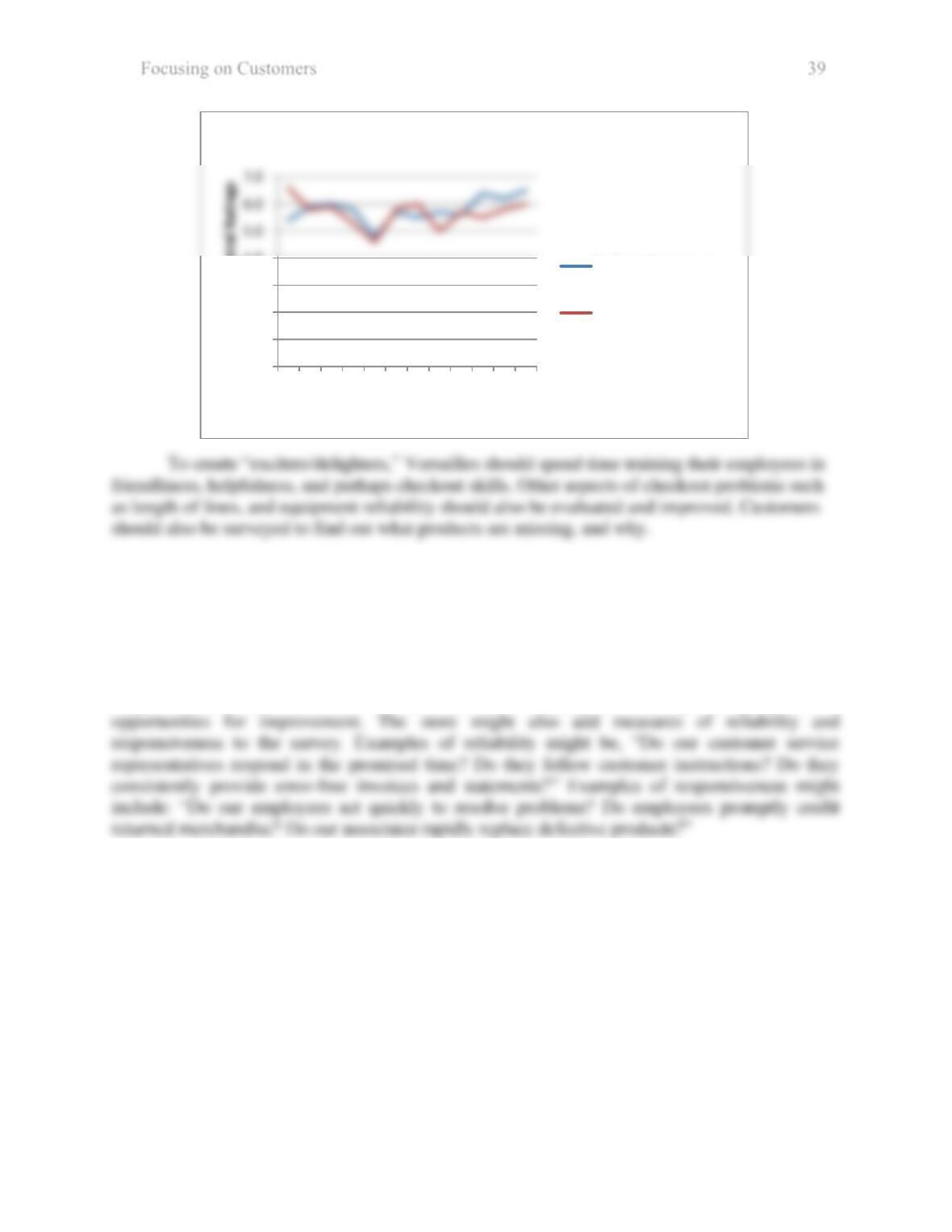
The two measures of customer satisfaction and referrals appear to be closely related. They
generally range from slightly below 5 to as high as 6.6.
0.0
1.0
2.0
3.0
4.0
5.0
8.0
1 2 3 4 5 6 7 8 9 10 11 12
Attribute Rating
Months
Employee Attributes
2. Knowledge of
products
3. Helpfulness in
selecting the right
product
0.0
1.0
5.0
6.0
7.0
8.0
1 2 3 4 5 6 7 8 9 10 11 12
Product and Store Attributes
Months
Product and Store Characteristics
4. Store layout
7. Ease of checkout
Focusing on Customers 39
b. Using the five dimensions of service quality, what other attributes might the store
include in the survey?
Using the five dimensions of service quality, reliability, assurance, tangibles, empathy, and
responsiveness, it appears that the dimensions of reliability (product quality, product
availability), assurance (helpfulness in selecting the right product, friendliness of employees),
tangibles (store layout, ease of checkout), and empathy ((knowledge of product) are
9. Richard’s Radical Reservations (RRR.com) takes and processes reservations on land,
sea, air, and even space travel and prides itself in being a “one–stop” service for adventure
travel. Data in spreadsheet C03Data on the Student Companion Site shows results from 200
customers who were sampled during one representative week. Count the number of
responses at each level (10 through1), determine the number and percentage of customers
at the promoter, passive, and detractor levels. Then calculate net promoter score (NPS). Is
it at a high, medium or low level? What should the firm do, considering that this is a
typical week’s score?
Results
0.0
1.0
2.0
3.0
4.0
12345678910 11 12
Satisfaction and Referral Ratings
Months
Customer Satisfaction and Referrals
8. Overall customer
satisfaction
9. Willingness to
recommend to others
Focusing on Customers 40
Promoters (10-9)
54.0%
Passives (8-7)
26.5%
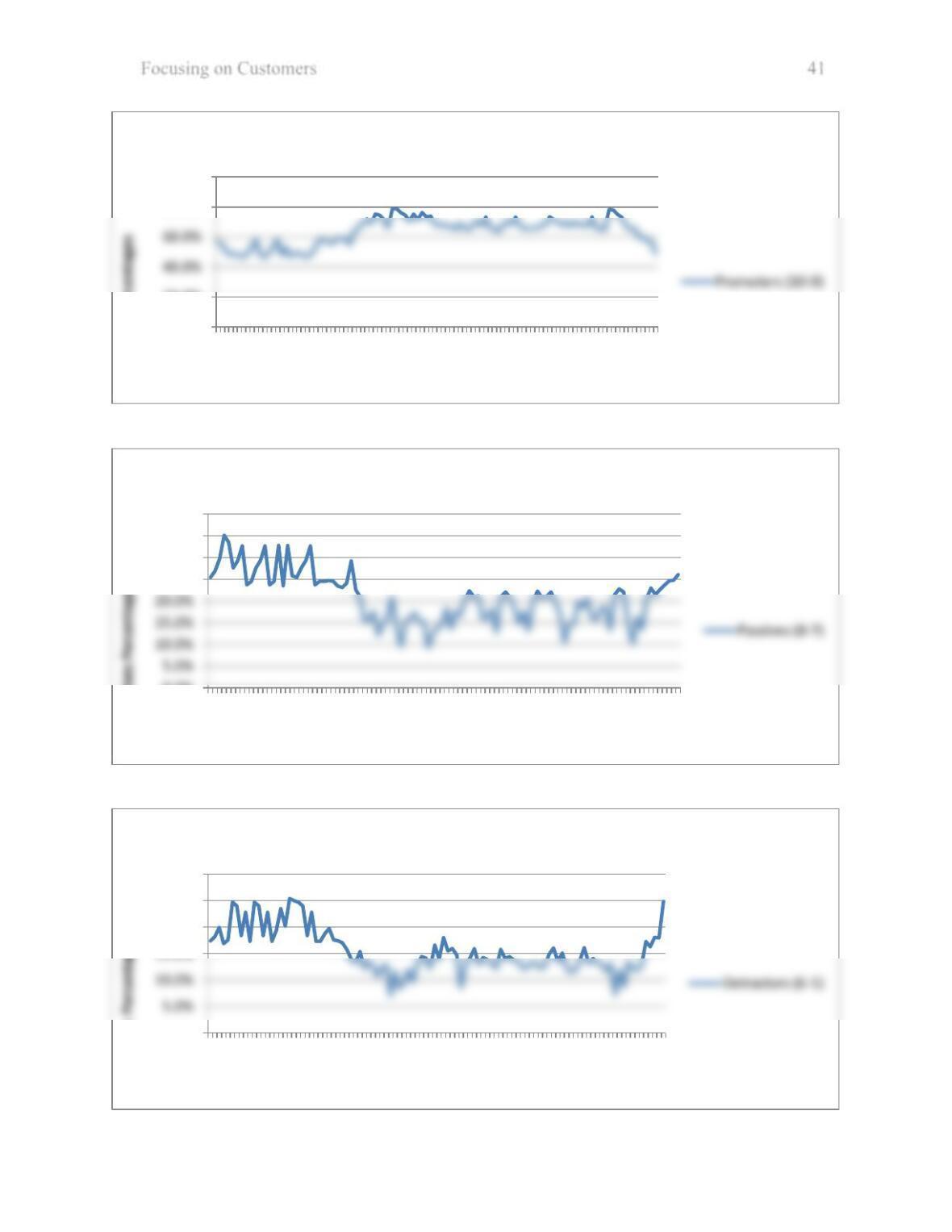
The results, calculated in spreadsheet Ch03Problem9 in the Instructor materials, show that the
promoter percentage is not extremely high, but the passive percentage is fairly high, and the
detractor percentage is almost as high. Consequently, the net promoter score is rather low at
10. Audrey’s Beauty Boutique started out with a mission of providing hair care, beauty
treatment and spa services to middle income women. Audrey would like to move to a more
upscale clientele, if possible. She has collected weekly data for the past two years (104
weeks) by asking over 200 clients per week to answer the question: “What is the likelihood
that you would recommend us?” evaluated on a scale from 0 to 10. Data can be found in
C03Data on the Student Companion Site. Compute the percentage of respondents who are
promoters, passives, and detractors, and then compute the NPS score. a) Plot these scores
on several graphs and give an explanation for possible causes of any trends that you see in
the data. b) Audrey tried a promotion for upscale clients during 8 weeks (from week 41 to
49) and four weeks (between weeks 92 and 95). What do the results show?
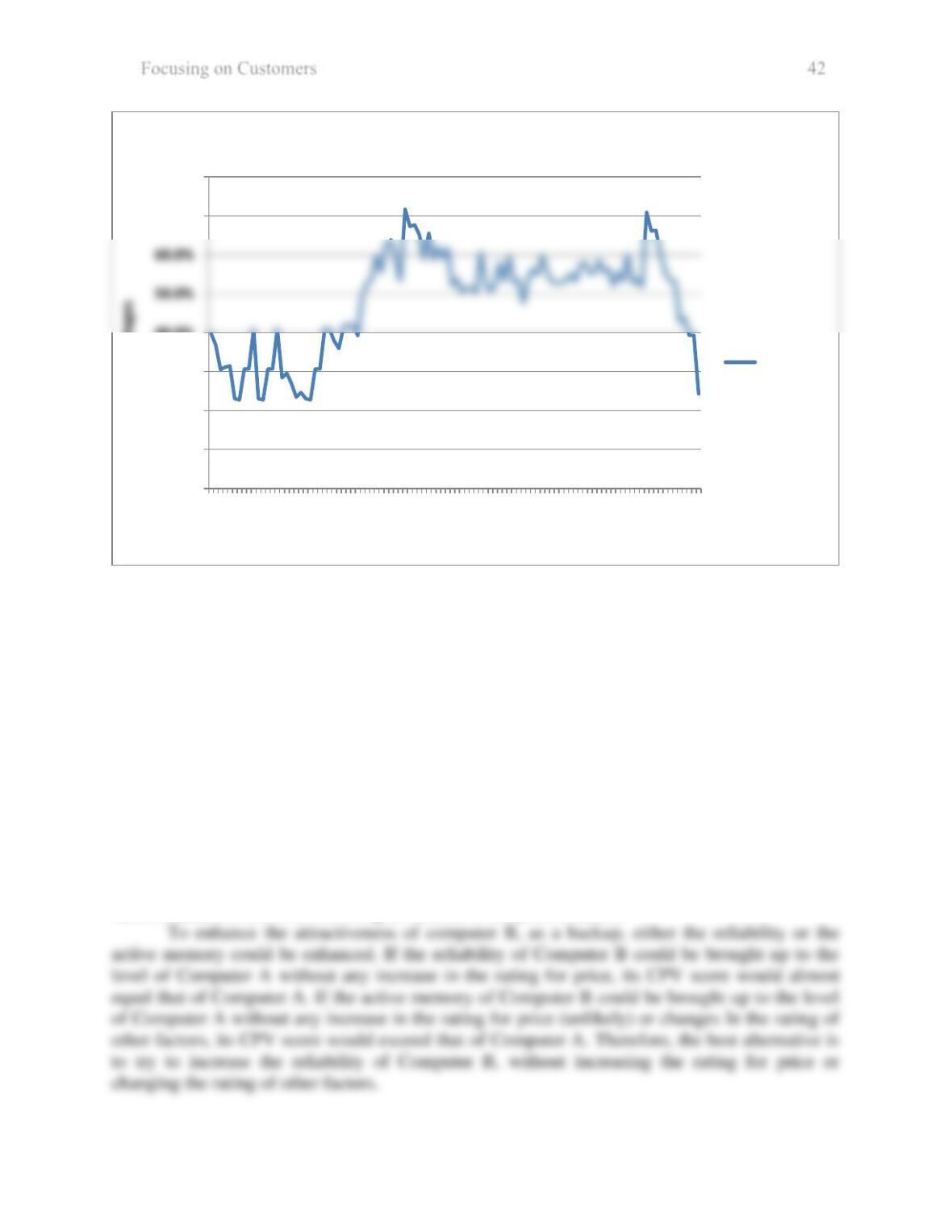
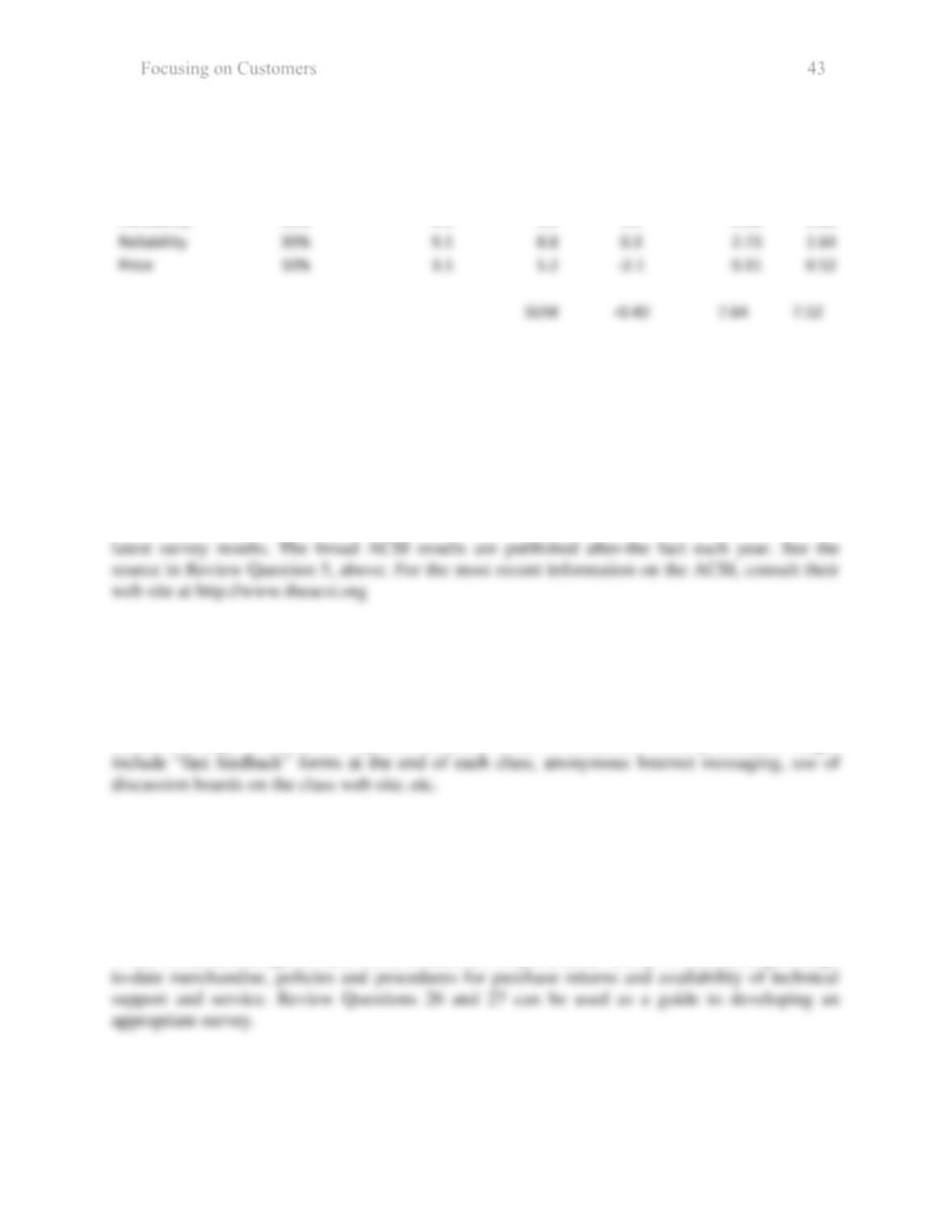
As the charts of Promoters, Passives, and Detractors Scores (see spreadsheet Ch03Problem10 in
the Instructor materials for details) show, the Promoters scores actually began climbing prior to
Detractors (6-1)
19.5%
NPS
34.5%
Focusing on Customers 41
0.0%
20.0%
80.0%
100.0%
1
6
11
16
21
26
31
36
41
46
51
56
61
66
71
76
81
86
91
96
101
Promoters Percentages
Weeks
Audrey’s Beauty Boutique – Promoters Scores
0.0%
25.0%
30.0%
35.0%
40.0%
1
6
11
16
21
26
31
36
41
46
51
56
61
66
71
76
81
86
91
96
101
Passives Percentages
Weeks
Audrey’s Beauty Boutique – Passives Scores
0.0%
20.0%
25.0%
30.0%
1
6
11
16
21
26
31
36
41
46
51
56
61
66
71
76
81
86
91
96
101
Detractors Percentages
Weeks
Audrey’s Beauty Boutique – Detractors Scores
Focusing on Customers 42
11. Easy Quality Solutions (EQS) is trying to design a powerful, portable computer
targeted toward quality managers. They have surveyed a panel of quality managers and
have found that the characteristics that are important to such managers are: speed, active
memory, portability, reliability, and price. EQS has two different models that they had the
panel to rate. The relative importance percentages and ratings are shown in the table in
spreadsheet C03Data on the Student Companion Site. Calculate the relative performance
and weighted customer perceived value (CPV) of each pilot computer product. Which one
should EQS scale up for full production? If they wanted to produce the other design as a
backup, which one characteristic of the second-best computer should they try to enhance?
The results (see spreadsheet Ch03Problem11 in the Instructor materials for details) are shown in
the table, below. Computer A should be chosen for production, based on comparison of CPV-A
versus CPV-B. The Relative Performance total should be cautiously considered as a decision
factor, because of the overwhelming difference in the price measure.
0.0%
10.0%
20.0%
30.0%
40.0%
70.0%
80.0%
1
6
11
16
21
26
31
36
41
46
51
56
61
66
71
76
81
86
91
96
101
NPS Percentages
Weeks
Audrey’s Beauty Boutique – NPS Scores
NPS Score
Focusing on Customers 43
Relative
Relative
Attribute
Importance
Computer A
Computer B
Performance
CPV-A
CPV-B
Speed
20%
7.5
7.8
-0.3
1.50
1.56
Active memory
25%
8.5
8.0
0.5
2.13
2.00
Portability
15%
6.5
5.3
1.2
0.98
0.80
SUGGESTIONS FOR PROJECTS, ETC.
1. Perform some research to examine recent trends in the American Customer Satisfaction
Index. What economic sectors show improvement? Which don’t? How has the overall
index changed?
The ACSI uses a proprietary survey technique, where fee-paying subscribers provide data about
themselves and their industry to surveyors and receive comparative information and the very
2. Based on the information in this chapter, propose new approaches for measuring
customer satisfaction for your faculty and instructors that go beyond the traditional course
evaluation processes that your school may use.
This project can provide some interesting insight into student’s perceptions of how customer
satisfaction may be measured beyond traditional course evaluations. Some possibilities might
3. You may have visited or purchased items from large computer and software retail
stores. In a group brainstorming session, identify those characteristics of such a store that
would be most important to you, and design a customer survey to evaluate customers’
importance and the store’ s performance.
Some characteristics that are brainstormed may include location of the store, store hours, layout
of the store, knowledge of sales staff, friendliness of personnel, variety of selections, price, up–
4. Interview some managers of small businesses to determine how they respond to
complaints and use complaint information in their organizations.
Reliability
30%
9.1
8.8
0.3
2.73
2.64
Price
10%
3.1
5.2
-2.1
0.31
0.52
Focusing on Customers 44
Answers will vary, depending on the sophistication of the business in complaint handling. Many
small businesses will ensure that making restitution, or providing perks satisfies the complaining
5. Describe some ways that organizations can improve websites and make them more
customer-focused. You might consider examining a variety of websites and identifying
“best practices.”
Answers will vary, depending on the type of business and the web sites involved. There are sites
that have won awards that may be looked at for some ideas on best practices
6. Gather several customer satisfaction surveys or comment cards from local
establishments. Analyze them as to their ability to lead to actionable information that will
help the organization, and propose any improvements or redesign you deem appropriate.
Answers will vary, depending on the cards that are gathered and who designed them.
7. You have undoubtedly made numerous purchases in retail clothing stores such as the
Gap, Banana Republic, Old Navy, and so on. Develop a customer satisfaction survey based
upon the five service quality dimensions discussed in this chapter. You should have at least
two questions for each dimension.
The Banana Republic, Gap, and Old Navy are divisions of the same company, Gap, Inc., which
are targeted at different demographic market segments from upscale to middle market to bargain
hunters. Key dimensions of service quality which should be considered for customer satisfaction
surveys should include:
1. Reliability: The ability to provide what was promised, dependably and accurately.
Examples include customer service representatives (CSR’s) in retail clothing stores, such
as Banana Republic, Gap, and Old Navy responding in the promised time, following
customer instructions, providing error-free invoices and statements, and making repairs
Focusing on Customers 45
4. Empathy: the degree of caring and individual attention provided to customers. Some
examples are the attitude of Bob Wheaton, VP and general manager, “… we want our
8. This exercise provides an experience with developing an affinity diagram for analyzing
complaints and would best be performed by the class as a whole. Each student writes one
or more descriptions of personal experiences of frustration and dissatisfaction with
products and services. Two examples might be: “Every time I purchase a DVD, the seal is
difficult and time-consuming to remove. I have even cracked the case a few times while
trying to remove it.” “I purchased a new pair of running shoes, and the laces were too
long.” These experiences should be written on large sticky notes and posted on the
classroom wall. Students then group the responses into logical categories and develop
descriptive headers for each group that explain the causes of dissatisfaction and then create
the affinity diagram. For instance, the shoe example might fall into a group titled “ Product
components are incompatible.” An alternative project is to use positive comments about
products and services.
Instructors might have different groups of students do this exercise and compare approaches they
used.
9. A number of pizza chains or restaurants are probably located around your college
campus. Using a focus group of students, conduct an interview to determine what factors
are important in selecting a traditional or pizza restaurant. Once you have identified these
factors, design a satisfaction survey to compare perceptions among the most popular
restaurants in your area. Ask a sample of students who visited at least to two of them to
complete the survey. Analyze the results and draw conclusions in a written report.
This is a hands-on exercise in designing a questionnaire and testing it out.
10. Design customer satisfaction questionnaires for high school students and their parents
who take a campus visit and are considering applying to your school.
This type of questionnaire might be useful for the college or university, because it could reveal
aspects of the campus tour that students are very interested in and those that they could “care
11. Find an example of a highly-publicized service or product failure in the news (such as
unreasonable waiting on a plane on a runway or the poor reception on the first release of
the iPhone 4). Research and write a short paper on how the company addressed the
problem to recover customer confidence and loyalty.
Focusing on Customers 46
Many examples exist. This exercise can demonstrate the level of commitment a company has to
its customers.
ANSWERS TO CASE QUESTIONS
I. Rosie’s Pizzeria
Questions for Discussion
1. What were the customers actually saying in the four responses given in this case?
Translate them into customer requirements using actionable business language.
The in-depth interviews required by the VOC methodology have strengths and limitations, just as
any consumer research technique does. It is a form of focus group. As pointed out in the chapter,
a focus group is a panel of individuals (customers or non-customers) who answer questions about
2. In addition to your responses to question 1, the voice of the customer process identified
the following customer requirements: food and drinks at their proper temperature, fresh
food, meeting the unique needs of adult guests as well as families, exceeding service
expectations, an easy to read and understand menu, and caring staff. Suggest how these
customer requirements can be translated into production and service delivery processes
and activities.
Rosie’s was able to identify and prioritize the most important customer requirements. In
addition, the perspective was changed from a “product–out” to a “market–in” mentality, forming
3. Conduct a similar mock voice of the customer process for your school or college. What
did you learn?
Focusing on Customers 47
Conducting a mock VOC study will be an interesting exercise that can help students understand
the difficulties and benefits of action research in order to listen to, and obtain information from
actual customers and consumers.
II. Captain Mark’s Seafood
Questions for Discussion
1. Why do you think the restaurant went to such lengths in response to Sandy’s call?
The restaurant went to great lengths in response to Sandy’s call because the last thing that a high-
quality restaurant wants is any hint of food contamination. This is the prime source of such a
restaurant’s reputation. Customer satisfaction, loyalty, and word-of-mouth advertising depend on
the quality of their food.
2. How does this experience illustrate the five customer service dimensions: tangibles,
reliability, responsiveness, assurance, and empathy?
This experience illustrates the five customer service dimensions: tangibles, reliability,
responsiveness, assurance, and empathy? Tangibles were shown in where the hostess seated the
III. Newcraft Ale Microbrewery
Draft a response to this customer. Analyze the responses of your classmates. What makes a
good “service recovery” response? Develop some general guidelines.
This is an actual experience. One of the authors had sent the email to the restaurant’s corporate
office in another city, and the next day received this reply from the local general manager of the
restaurant:
I would like to take this opportunity to thank you for your comments regarding your
unacceptable experience at [our restaurant] on Saturday. I cannot begin to apologize
enough or to express how disappointed I am that we failed to deliver you the exceptional

Focusing on Customers 48