Chapter 03 – Skills for Developing Yourself as a Leader
3-1
Part 1: Leadership Is a Process, Not a Position
Chapter 3: Skills for Developing Yourself as a Leader
Leader

Chapter 03 – Skills for Developing Yourself as a Leader
3-2
Overview of Chapter 3: Skills for Developing Yourself as a Leader
The intent of this chapter of the Instructor’s Manual, as well as the chapters at the conclusion
of Part 2 (chapter 8 ) and Part 3 (chapter 11) and Part 4 (chapter 16), is to align the IM chapters
with the “Leadership Skills” chapters that appear at the conclusion of major sections of the text.
Specifically, we believe that skill development is an integral portion of leadership development.
Chapter 03 – Skills for Developing Yourself as a Leader
3-3
Chapter 3 Outline
Skills for developing yourself as a leader
Introduction
Your First 90 Days as a Leader
Before You Start: Do Your Homework
Building Technical Competence
Determining How the Job Contributes to the Overall Mission
Becoming an Expert in the Job
Seeking Opportunities to Broaden Experiences

Chapter 03 – Skills for Developing Yourself as a Leader
3-4
Bridging the Gaps: Building a Development Plan

Chapter 03 – Skills for Developing Yourself as a Leader
3-5
Overview of the Learning Resources for Chapter 3
Exercise 3-1: Tent Building. In this 45-minute competitive exercise, student teams must follow
Exercise 3-2: The Leadership Transitions Questionnaire. This 40-minute exercise consists of a
Exercise 3-4: Developing a Structured Interview. Students form small groups and build a set of
structured interview questions for a targeted leadership position. This exercise works quite well
when combined with Exercise 2 and can be done as a homework assignment. It will take groups
20–30 minutes to develop their questions, and then some time to present and discuss their
questions with the larger group.
Exercise 3-5: Criteria of Leadership Effectiveness. In this 20-minute small group exercise,
Exercise 3-6: The Perfect Apple. In this 30-minute exercise, students discuss the criteria they
Exercise 3-7: How Organizations Evaluate Leadership Effectiveness. Small groups of students
are tasked with obtaining a performance appraisal form used to evaluate leaders. The groups
Exercise 3-8a: Leadership and Maxims. Students write down the leadership maxims of a
personal or famous leader. Some of these maxims are shared with the larger group, and the large

Chapter 03 – Skills for Developing Yourself as a Leader
3-6
Exercise 3-8b: Colin Powell’s Leadership Lessons. Students (assigned to small groups) assess
whether the “Leadership Lessons” asserted by Colin Powell are maxim or theory and how they
Exercise 3-9: Designing Leadership Studies. In this exercise, small groups of students are
assigned various research methodologies and asked to design a study to answer a specific
Exercise 3-10: OSS In-Basket Exercise. This is an example of a work simulation typically found
in an assessment center. Students read about a fictitious company and play a leadership role

Chapter 03 – Skills for Developing Yourself as a Leader
Chapter 3: Skills for Developing Yourself as a Leader
Exercise 3-1
Exercise Title: Tent Building
Purpose: To demonstrate effective ways to interact with peers to accomplish a task. The
exercise also highlights leadership, teamwork, problem solving, and communication.
Summary: A minimum of two tents (preferable with a window) is required for the exercise.
This exercise will take 45 minutes to complete.

Chapter 03 – Skills for Developing Yourself as a Leader
3-8

Chapter 03 – Skills for Developing Yourself as a Leader
3-9
Exercise 3-2
Exercise Title: The Leadership Transitions Questionnaire
Purpose: Tells participants how their day-to–day activities relate to different leadership levels, and
whether they are spending enough time at the appropriate level.
Summary: Have students individually complete the Leadership Transitions Questionnaire and calculate
A, B, C, and D subscores found on the next few pages. (This will take about 10 minutes and can either be
If the questionnaire is completed and discussed in class, then this exercise takes about 40 minutes to
Chapter 03 – Skills for Developing Yourself as a Leader
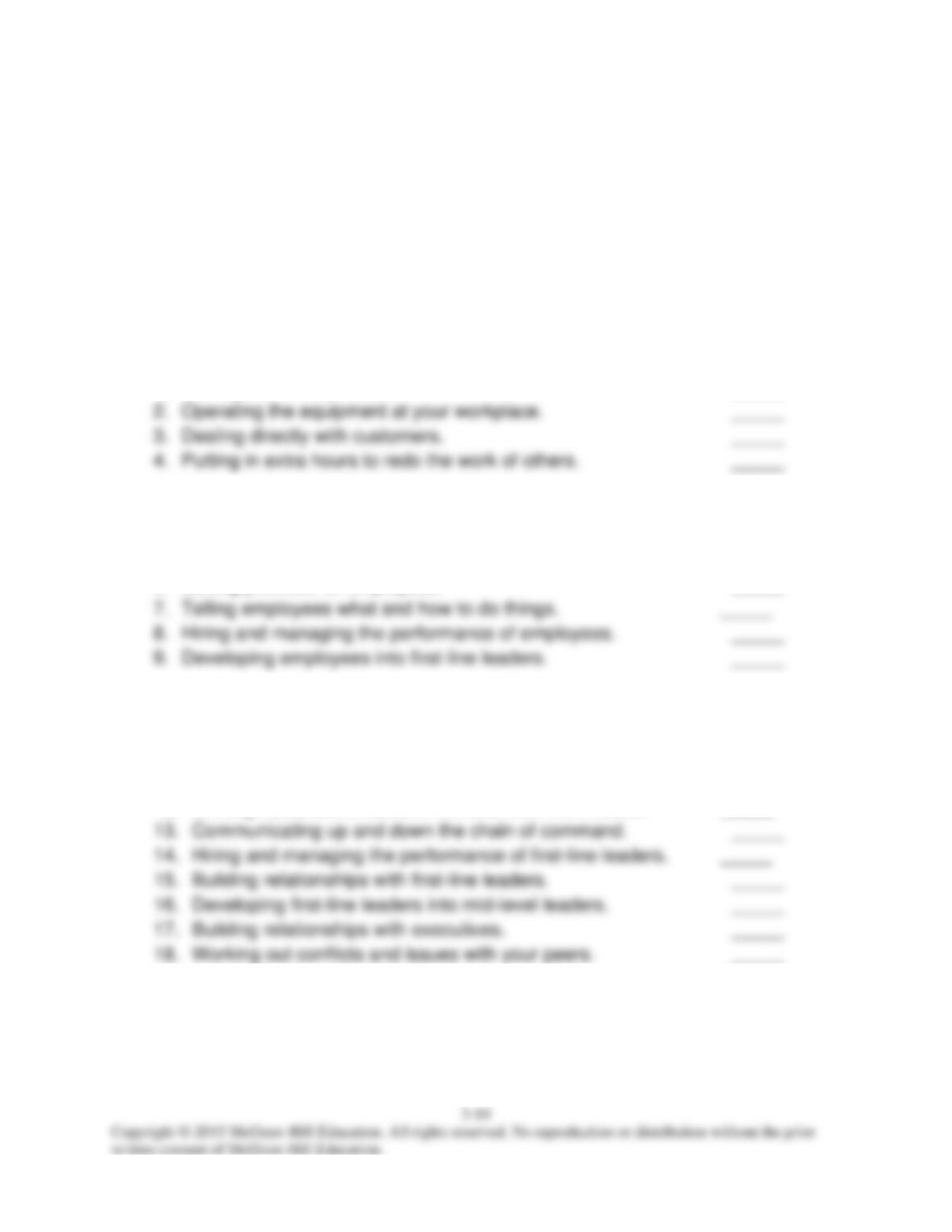
The Leadership Transitions Questionnaire
By Gordy Curphy. © Curphy Consulting Corporation, 2004
Estimate the average number of hours per week you spend:
Number
Of Hours
1. Solving technical problems. _____
Subtotal A Number of Hours = _____
5. Planning and coordinating the work of employees. _____
6. Setting priorities for employees. _____
Subtotal B Number of Hours = _____
10. Reviewing department financial and operational results. _____
11. Setting priorities for your department or work unit. _____
12. Shifting resources to achieve the best work unit results. _____
Subtotal C Number of Hours = _____
19. Keeping up to date on market and industry trends. _____
20. Developing strategies to counter competitive threats. _____

Chapter 03 – Skills for Developing Yourself as a Leader
3-11
21. Allocating and managing human resource, IT, financial, facility,
customer service and operational resources to achieve

Chapter 03 – Skills for Developing Yourself as a Leader
The Leadership Transitions Questionnaire
The purpose of this questionnaire is to determine at what level you are operating as a
leader. Write your subtotal scores from the previous page in the graphic below.
THE LEADERSHIP PIPELINE
Individual Front-Line Mid-Level Business-Unit
Contributor Leader Leader Leader
• Individual Contributors (ICs): Focus on solving technical and customer
problems, building technical expertise, and getting tasks done. The best
individual contributors manage their own time and resources wisely, take pride in
their technical proficiency, and perform high quality work.
• Front-Line Leaders (FLLs): Focus on getting work done through others. The
• Mid-Level Leaders (MLLs): Keep track of work unit performance, set priorities
for the work unit, allocate resources to achieve optimal work unit results, get work
done through front-line leaders, and manage issues and relationships with other
mid-level leaders. The best MLLs focus on hiring the best FLLs, developing FLL
bench strength, and building effective teams of FLLs.

Chapter 03 – Skills for Developing Yourself as a Leader
3-13
Chapter 03 – Skills for Developing Yourself as a Leader
3-14
Leadership Transitions: Reflection Exercise
Leaders in organizations get involved in a wide variety of activities. Sometimes these
activities happen because of personal preferences; other times they happen because of
job demands.
The most common mistake among team leaders is to spend too much time operating at
the wrong level. Leaders operating at too low a level run the risk of:
• working unnecessarily long hours
What will you need to do if you want to be a more effective leader?

Chapter 03 – Skills for Developing Yourself as a Leader

Chapter 03 – Skills for Developing Yourself as a Leader
3-16
Exercise 3-3
Exercise Title: Building Leadership Competency Models
Purpose: To give students insight and practice in building leadership competency models.
Summary: Have students break into teams of 4–6 people. Instructors should then explain the concept of a
competency model (a set of knowledge, skills, behaviors, or attributes), which defines what is needed by a
person to be effective in a particular leadership position. Then give the groups 20 minutes to develop a
.
This exercise takes about 35 minutes to complete in class, or can be done as a group homework
assignment and the results presented in class.

Chapter 03 – Skills for Developing Yourself as a Leader
Exercise 3-4
Exercise Title: Developing a Structured Interview
Purpose: To help students practice building structured interviews for a leadership position.
Summary: Have students break into teams of 4–6 people. Their task is to develop a set of structured
interview questions they would use to assess candidates for a high school principal, college president, or

Chapter 03 – Skills for Developing Yourself as a Leader
3-18
Exercise 3-5
Exercise Title: Criteria of Leadership Effectiveness
Purpose: To examine similarities and differences in criteria of effectiveness for several familiar
leadership roles.
Summary: Assign groups of students the task of identifying various criteria by which the effectiveness of
any one of the following leaders (or any others) might be evaluated: an assistant coach; a teacher; a
ASSISTANT COACH
The team’s win-loss record
The coach’s contract renewal and/or raise
Player perceptions and team morale
TEACHER
Students’ grades
Students’ critiques or evaluations of the teacher
Students’ scores on standardized tests
MINISTER
Growth in the church’s membership
The minister’s moral influence in the community

Chapter 03 – Skills for Developing Yourself as a Leader
3-19

Chapter 03 – Skills for Developing Yourself as a Leader
Exercise 3-6
Exercise Title: The Perfect Apple
Purpose: Shows how different criteria can be used to evaluate a leader and that even when criteria can be
agreed upon, differences in ratings still exist.
Summary: Instructors should write on a flipchart or overhead, “What is the one criterion you would use
to judge an apple?” Instructors should then bring an apple to class and have it passed around to all
students. When a student is handling the apple they should publicly state the criterion they would use to
judge the apple. Instructors should record the criteria as they are being stated, and then break the class
This exercise takes about 30 minutes.