College Mathematics: Learning Worksheets Chapter 3
Name ________________________________ Date ______________ Class ____________
Goal: To solve problems involving simple interest
(Unless otherwise noted, round monetary answers to the nearest dollar, percents to two decimal places when written as a
percentage, and time to the nearest tenth of a year.)
1. If Ms. Gonzalez borrows $1000 for 4 years from a bank that charges 5% annual simple
interest, how much interest will she owe at the end of the four years? How much (in total:
interest + principal) will she pay to the bank at the end of the four years?
IPrt
=
API
=+
2. If Mr. Xu borrows $3000 for 3 years from a bank that charges 2% annual simple interest,
how much interest will he owe at the end of the three years? How much will Mr. Xu have to
pay to the bank at the end of the three years?
IPrt
API
Section 3-1 Simple Interest
To calculate the simple interest: ,
I
Prt=where I = amount of interest ($)
To calculate the amount of money in an account:
A
3. Mr. and Mrs. Smith are running short of money this month and they decide to borrow $500
from the bank and repay the money in 6 months when they get their income tax refund check.
The bank charges 6% annual simple interest. How much interest will they owe at the end of
the six months? How much will they have to pay to the bank at the end of the 6 months?
(500)(0.06)(0.5)
I
=
500 15
A
=+
4. Joe is borrowing $600 from his parents in order to finish paying his tuition bill. His
parents agree to the loan if Joe will repay the money at the end of nine months. His parents
will charge him 3% annual simple interest. How much interest will Joe owe his parents?
How much will Joe have to pay his parents at the end of the nine months?
IPrt
=
API
=+
5. Find the amount needed to pay off a simple interest loan of $5000 at 6% for 2½ years.
(1 )
AP rt
=+
6. Find the amount needed to pay off a simple interest loan of $2000 at 10.5% for 3 years.
(1 )
AP rt
7. What amount needs to be invested today at 4% simple interest in order to have
$6000 in 3 years?
8. What amount needs to be invested today at 3.5% simple interest in order to have $500
in 6 months?
9. Fred would like to buy a new computer but only has $500 and a new computer costs
$900. He can invest the $500 in an account that pays 4% simple interest. How long will it
be before Fred can buy the new computer? Do you think the same computer will be offered
at the same price when he has saved the additional $400? Why or why not?
72
10. Mary has $2700 in a simple interest account paying 4.5%. She would like to have
$3000 for a down payment on a new car. How long will it take Mary to have $3000 in the
account?
300 121.5
t
11. Mr. Wong’s daughter needs to borrow $1000 from him to buy her textbooks. He agrees
to the loan and tells her that she must pay $1100 back in 9 months. What simple interest rate
is Mr. Wong charging his daughter?
12. Charlie is due a tax refund of $500. A tax service will give him the money two months
early, but will charge $50 up front to do so. What annual simple interest rate is the tax
service charging him?
2
IPrt
=
73
13. Mr. Jones goes to a check-cashing business to get money before his paycheck is due.
The business charges him $25 up front to loan him the money one week before payday. If
his paycheck is for $550, what annual simple interest rate is the business charging him?
1
IPrt
14. A late charge on a utility bill can be interpreted as an interest charge. If John’s water bill
is $85 with a $2.50 charge for being late, what annual simple interest rate is being charged if
John pays the bill 2 weeks late?
IPrt
15. A man used his motorcycle as collateral on a $325 loan from a pawn shop for 3 months.
The pawnshop charge was $33. What annual simple interest rate does the pawnshop charge?
IPrt

College Mathematics: Learning Worksheets Chapter 3
74
College Mathematics: Learning Worksheets Chapter 3
Name ________________________________ Date ______________ Class ____________
Goal: To solve problems involving compound interest
(Unless otherwise noted, round monetary answers to the nearest dollar, percents to two decimal places when written as a
percentage, and time to the nearest year.)
1. Suppose that $3000 is invested in an account paying 2% annual interest. Compare the
balance after 20 years using simple interest and compound interest (compounded once a
year) formulas.
(1 )
AP rt
=+
(1 )
mt
r
m
AP
=+
Section 3-2 Compound and Continuous
Compound Interest
Interest Formulas
Simple Interest: (1 )AP rt
mt
r
Compound Interest: rt
APe
m
r
⎛⎞
2. If $6000 is invested in an account that pays 3% annual compounded interest, compare the
amount in the account after 10 years if the interest is compounded
a) semiannually (twice a year)
b) quarterly (four times a year)
c) monthly (twelve times a year)
d) continuously
a)
(1 )
mt
r
m
AP
=+
b)
(1 )
mt
r
m
AP
=+
c)
12(10)
0.03
(1 )
6000(1 )
mt
r
m
AP
A
=+
=+
d)
.03(10)
6000
rt
APe
Ae
=
=
3. If $1500 is invested in an account that pays 4% annual interest compounded
semiannually for 4 years, find the amount of interest earned each year and use the results to
fill in the following chart. (Round monetary amounts to nearest penny.)
Compound Period
(at end of year)
Amount of Interest Amount in Account
(at the end of the year)
4 $68.25 $1757.50
2
2(1)
0.04
22
(1 )
1560.60(1 )
mt
r
m
AP
A
3
2(1)
0.04
32
(1 )
1623.65(1 )
mt
r
m
AP
A
4
2(1)
0.04
42
(1 )
1689.25(1 )
mt
r
m
AP
A
1623.65 1560.60
63.05
I
I
1689.25 1623.65
65.60
I
I
1757.50 1689.25
68.25
I
I
77
4. You are saving for the down payment on a house and plan to buy the house in 5 years.
How much would you need to invest in an account that pays 3.5% compounded monthly in
order to have $15,000 for your down payment?
12(5)
0.035
(1 )
15,000 (1 )
mt
r
m
AP
P
=+
=+
5. Before you invest your money in the account in problem 4, you find another bank that
pays 4.25% compounded quarterly. Will this account allow you to invest more or less
money than the account in problem 4?
4(5)
0.0425
4
(1 )
15,000 (1 )
mt
r
m
AP
P
=+
=+
6. Joe has inherited $6000 and would like to use the money for buying property. If he needs
$7000 for the investment, how long would he have to wait to buy property if he invests the
money in an account that pays 3.5% compounded weekly?
52
0.035
52
52
7
(1 )
7000 6000(1 )
mt
r
m
t
t
AP
78
7. Susan invests $2500 for 3 years in an account paying 3.5% annual interest compounded
monthly. At the end of that time, she moves the money to a different account that pays 4%
annual interest compounded quarterly, where it stays for an additional 2 years. What is the
value of the account at the end of that time?
12(3)
0.035
(1 )
2500(1 )
mt
r
m
AP
A
4(2)
0.04
(1 )
2776(1 )
mt
r
m
AP
A
8. Robert invests $1500 in a 9-month certificate of deposit (CD) that pays 4.2% annual
interest compounded monthly. At the end of the 9 months, he moves the money plus the
interest it has earned to another CD for 6 months that pays 4.5% compounded monthly.
What is the value of the account at the end of the time?
(1 ) (1 )
mt mt
rr
mm
AP
=+ +
9. By comparing their APYs, decide which is better: an investment at 4.26% compounded
monthly, an investment at 4.3% compounded quarterly, or an investment at 4.38%
compounded semiannually?
11
m
r
APY m
11
m
r
APY m
11
m
r
APY m
79
10. Joel can choose between two different banks to invest his money. Bank A offers 5.9%
interest compounded quarterly. Bank B offers 5.82% interest compounded monthly. Find
the APY of each investment so that you can tell Joel in which bank it is better for him to
invest.
4
11
m
r
APY m
12
11
m
r
APY m
11. To accumulate $25,000 on your daughter’s 18th birthday, how much must you invest on
her third birthday in a CD paying 5% compounded quarterly?
4(15)
0.05
(1 )
25,000 (1 )
mt
r
m
AP
P
=+
=+
12. To accumulate $20,000 on your son’s 21st birthday, how much must you invest on his
5th birthday in a CD paying 3.25% compounded daily?
365(16)
0.0325
365
(1 )
20,000 (1 )
mt
r
m
AP
P
=+
=+

College Mathematics: Learning Worksheets Chapter 3
80
College Mathematics: Learning Worksheets Chapter 3
Name ________________________________ Date ______________ Class ____________
Goal: To calculate future values of annuities and solve problems involving sinking funds
(Unless otherwise noted, round monetary answers to the nearest dollar, percents to two decimal places when written as a
percentage, and time to the nearest year.)
1. a) Suppose you deposit $2500 each year for 20 years in a savings account paying 5%
compounded annually. How much would the account contain after 20 years? How much of
the FV did you actually contribute?
nt
⋅
Section 3-3 FV of an Annuity; Sinking Funds
Any sequence of payments at equal time intervals is called an annuity.
To calculate the future value of an annuity:
nt
⋅
⎛⎞
r = annual interest rate (as a decimal) t = time in years
and n = number of payments per year (periods)
College Mathematics: Learning Worksheets Chapter 3
82
20
(1.05) 1
$82,665
FV
−
=
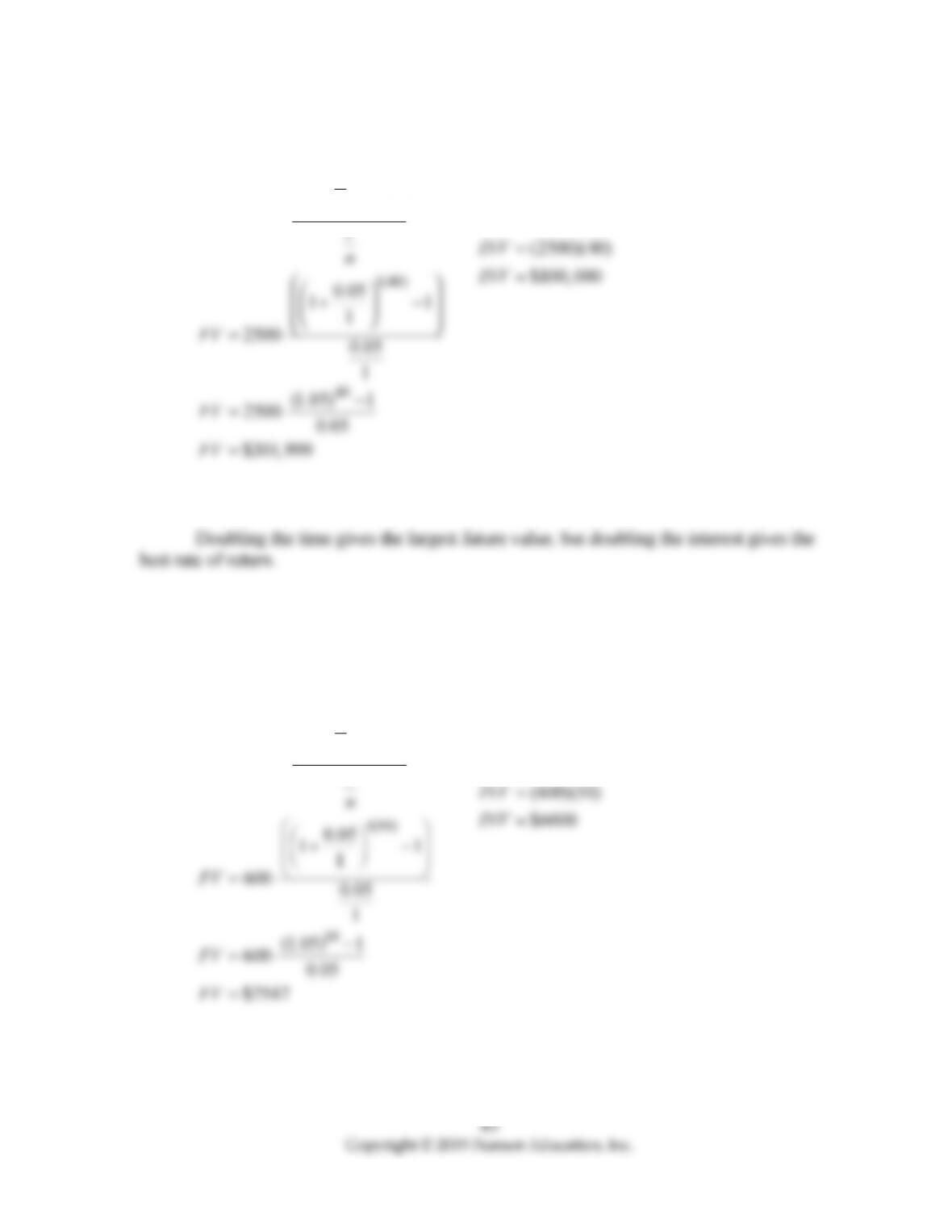
If you could double only one of these, which would benefit you more?
b) The amount invested. How much of the FV did you actually contribute?
11
nt
r
n
FV PMT r
⋅
⎛⎞
⎛⎞
⎜⎟
+−
⎜⎟
⎜⎟
⎝⎠
⎝⎠
=⋅
()()
I
NV PMT n
=
20
(1.05) 1
$165,330
FV
−
=
c) The interest rate. How much of the FV did you actually contribute?
11
nt
r
n
FV PMT r
⋅
⎛⎞
⎛⎞
⎜⎟
+−
⎜⎟
⎜⎟
⎝⎠
⎝⎠
=⋅
()()
I
NV PMT n
=
20
(1.10) 1
−
College Mathematics: Learning Worksheets Chapter 3
d) The time. How much of the FV did you actually contribute?
11
nt
r
n
FV PMT r
⋅
⎛⎞
⎛⎞
⎜⎟
+−
⎜⎟
⎜⎟
⎝⎠
⎝⎠
=⋅
()()
I
NV PMT n
=
40
(1.05) 1
$301,999
FV
−
=
e) Write a short paragraph describing the results of parts a) – d).
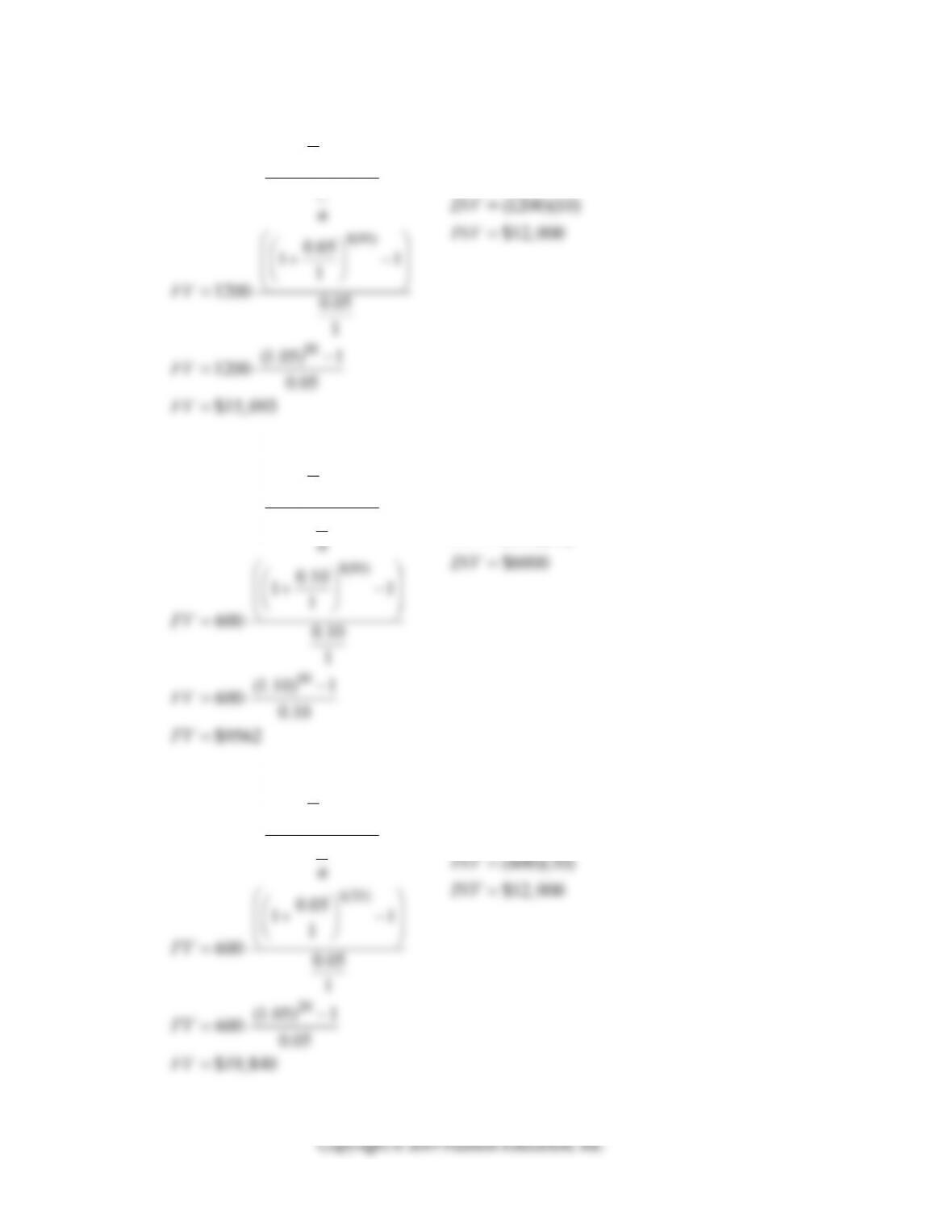
2. Suppose you are able to only contribute $600 a year to the account described in
Problem 1a). Answer parts a) – d) of Problem 1 based on the $600 per year contribution.
a)
11
nt
r
n
FV PMT r
()()
I
NV PMT n
10
(1.05) 1
College Mathematics: Learning Worksheets Chapter 3
84
b)
11
nt
r
n
FV PMT r
()()
I
NV PMT n
10
(1.05) 1
$15,093
FV
c)
11
nt
r
n
FV PMT r
()()
(600)(10)
I
NV PMT n
INV
10
(1.10) 1
$9562
FV
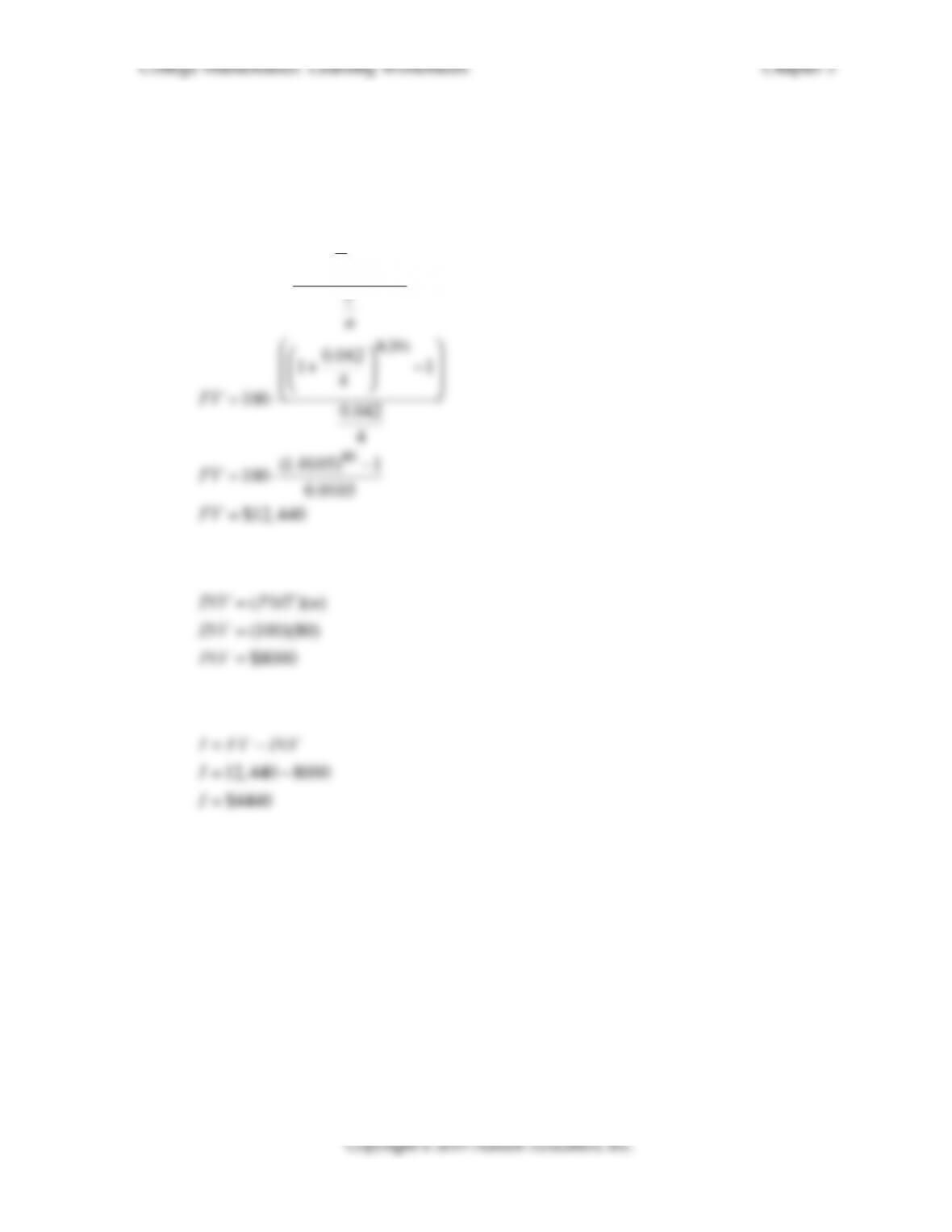
d)
11
nt
r
n
FV PMT r
()()
I
NV PMT n
20
(1.05) 1
$19,840
FV
85
3. Julia deposits $100 at the end of each quarter for 20 years into an account paying 4.2%
annual interest compounded quarterly.
a) How much is in the account at the end of 20 years?
11
nt
r
n
FV PMT r
⋅
⎛⎞
⎛⎞
⎜⎟
+−
⎜⎟
⎜⎟
⎝⎠
⎝⎠
=⋅
80
(1.0105) 1
$12, 440
FV
−
=
b) How much did Julia actually contribute to the account?
(100)(80)
$8000
INV
INV
=
=
c) How much interest did the account earn in those 20 years?