3-12
Apple uses product differentiation to help market its iPod and online music system to a
broad swath of the population and create barriers that its competitors are having difficulty
overcoming.
Focus on Market Niche
If an organization is in a fiercely competitive market, it can choose to focus on a very
narrow segment of the market rather than a broad general audience. A firm can gather
very specific information about its customers using data mining techniques. Then it
Strengthen Customer and Supplier Intimacy
Supply chain management (SCM) systems increase supplier intimacy while customer
relationship management systems increase customer intimacy. SCM systems create
immense switching costs between a company and its suppliers because of the investment
3-13
Interactive Session: Technology: Technology Helps Starbucks Find New Ways to
Compete (see page 129 of the text) discusses how the company uses innovative
technologies to improve its processes, create new ways to attract and keep its
customers, and enhance its product differentiation.
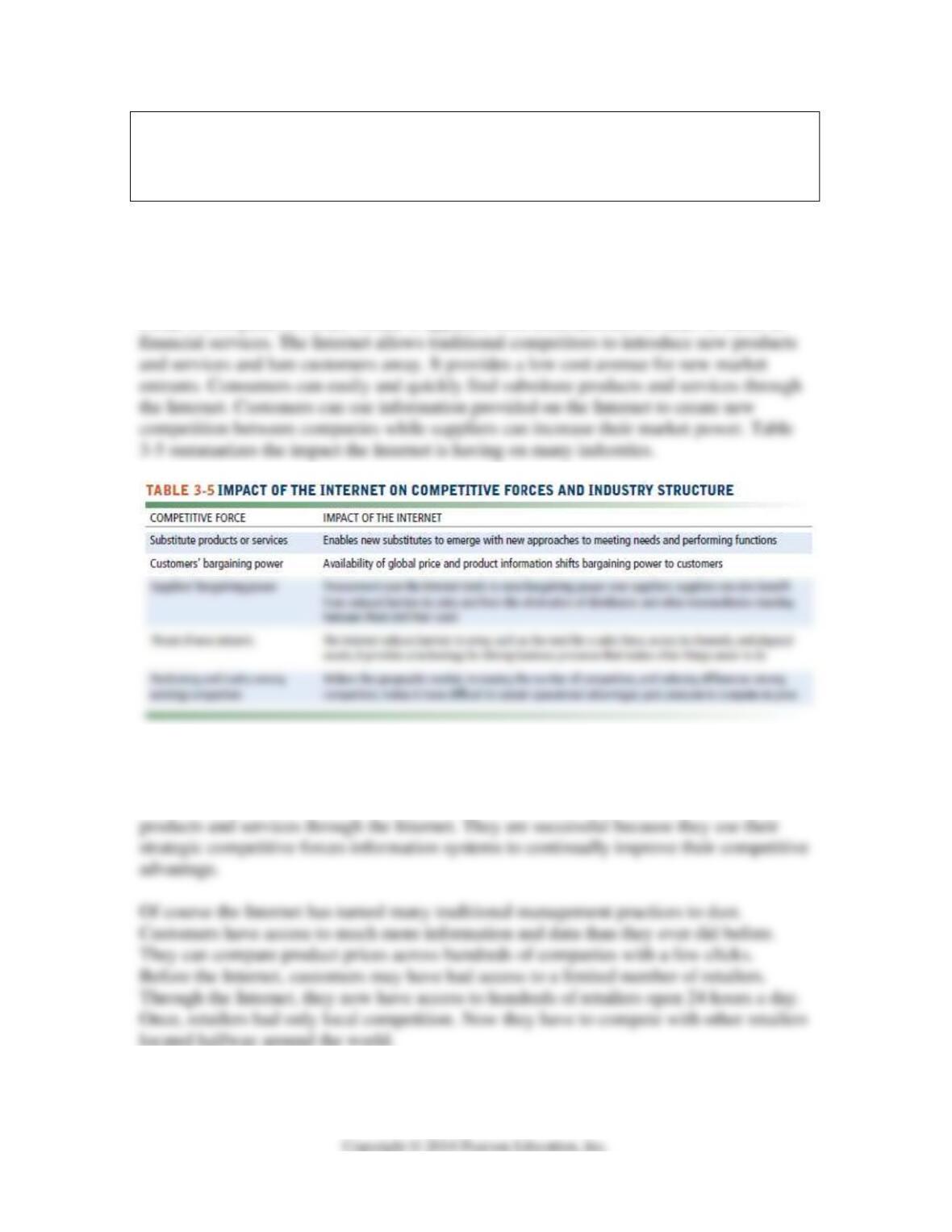
The Internet’s Impact on Competitive Advantage
Try to think of one industry that has not been touched by the Internet. Its impact on
Porter’s Competitive Forces Model is apparent from entertainment to retail to travel to
Not all of the news is bad though. The Internet provides new opportunities for companies
to increase their customers and markets while reducing their costs. The companies we
first mentioned in this section, Google, Amazon, and eBay are continually creating new
3-14
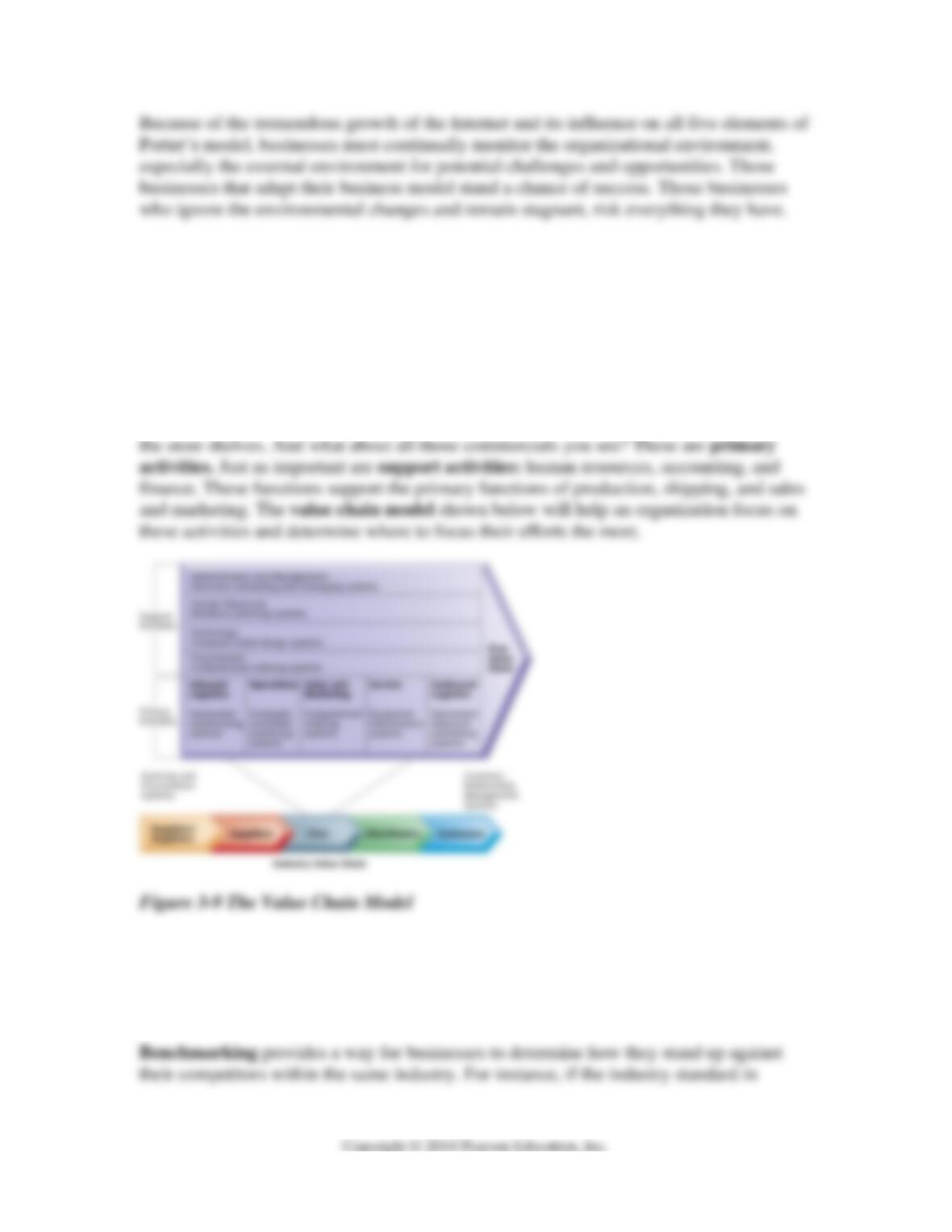
The Business Value Chain Model
Be better than the competition. That’s the mantra of most companies that are serious
about winning the game. Areas of the organization most affected by leveraging
technology are in producing the product, getting it to the stores, and making the customer
happy. Remember the WorldWide Candy Corporation from Chapter 2? Think of all the
activities that go into getting the Cybernuts candy bar made, from procuring raw
materials to actual production. Then consider how the candy bar gets from the factory to
By effectively using an information system in a strategic role at any, or preferably all,
levels of the organization, a digital firm can provide more value in their products than the
competition. If they can’t provide more value, then the strategic information system
should help them provide the same value but at a lower price.
3-15
Interactive Session: Technology: Auto Makers Become Software Companies (see
page 134 in the textbook) explains why automakers must now devote resources to
updating and testing software, as well as coordinating their car development cycles
more closely with their software development cycles.
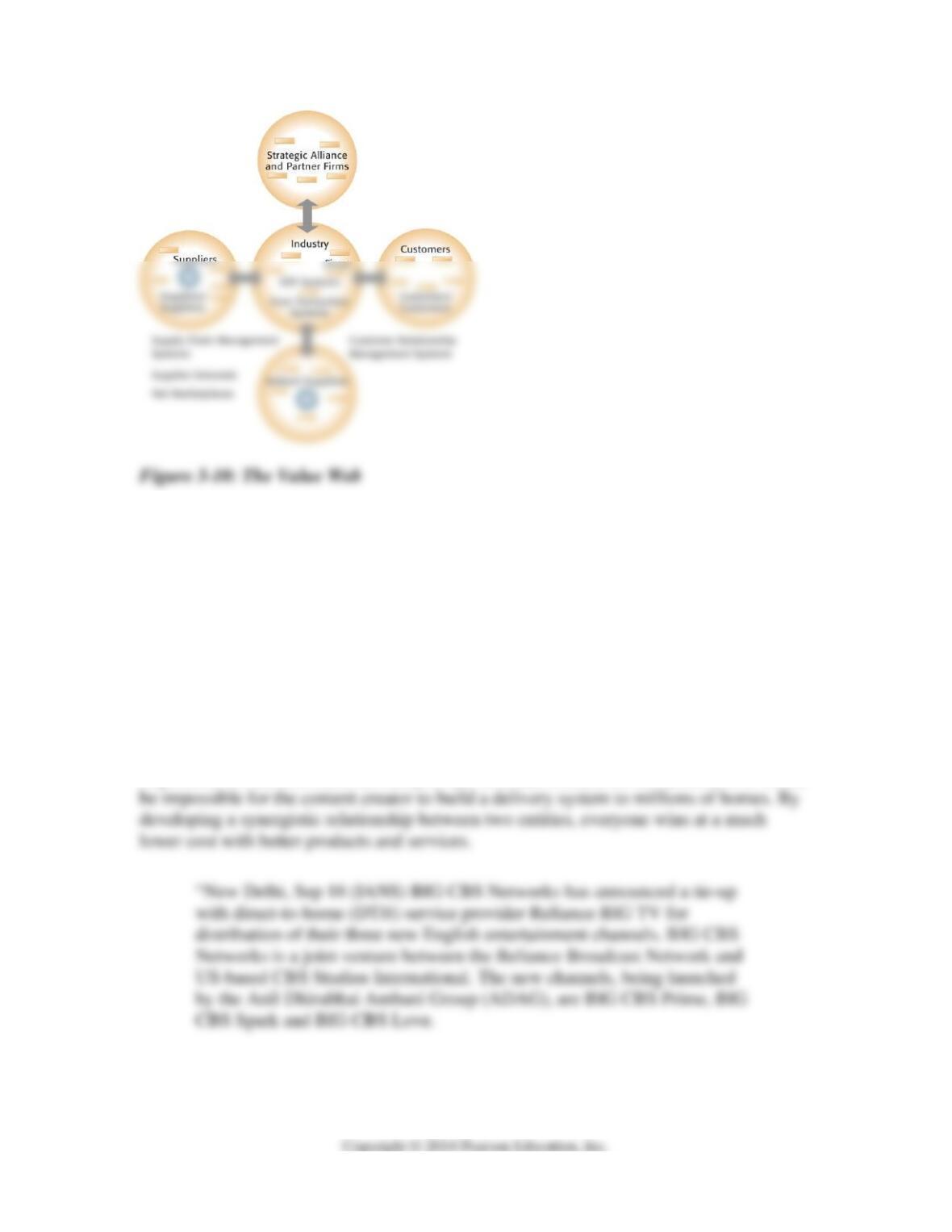
Extending the Value Chain: The Value Web
More and more companies are incorporating the Internet in their business strategies
through the use of value webs. Ford Motor Company is forming many partnerships and
alliances via the Web to offer services and products that otherwise would be too difficult,
costly, or time-consuming.
“Suppliers are an integral part of our business, and our success is
interdependent with theirs. We rely on more than 2,000 production
3-16
Synergies, Core Competencies, and Network-based Strategies
Very seldom will you find a business that provides all of its own services, supplies, and
processes throughout the entire chain. It isn’t practical or efficient to do so. Almost every
business relies on partnerships with other companies to produce goods and services. The
most successful companies will determine the best synergies, core competencies and
network-based strategies to reduce costs, improve products and services, and increase
profits.
Synergies
The news article below demonstrates how effective synergy can be. It would be
impossible for the television service provider to create content for its customers. It would
3-17
The three channels will provide a variety of programmes. The target
audience of BIG CBS Spark is youths, while BIG CBS Love will aim at
women, and BIG CBS Prime will be a complete entertainment channel.
“Our partnership with BIG CBS brings great value to our viewers. It is
backed with world-class entertainment content expertise generating top
rated programmes consistently. The three BIG CBS channels will offer an
Enhancing Core Competencies
Why did Ford Motor Company form an alliance with UPS instead of continuing its long-
time practice of delivering vehicles to dealers itself? Because Ford wanted to concentrate
on its core competency of manufacturing vehicles and let UPS concentrate on its core
competency of delivering products.
UPSLogistics’ Web site says “By shaving four days off the delivery cycle
and reengineering the network, Ford is realizing a $1 billion dollar
3-18
Network-based Strategies
It’s long been known in the economics field that the economics of manufacturing
produces a diminishing return on investment at some point in time. But in network
economics the opposite is true.
Technology makes virtual companies more feasible, cheaper, and easier to set up and
tear down than before. Let’s say you own a small company in northern Arizona that
offers white-water rafting trips through the Grand Canyon. You have a fleet of rafts and
35 full-time employees. Rather than you trying to manage the payroll and benefits
program for your employees you could use a company that specializes in payroll,
employee benefit programs, and even retirement plans. Intuit, who manufactures Quicken
and QuickBooks, provides an online service for businesses that does all of these things.
You access Intuit’s Web site, enter the necessary data, and it takes care of the rest of the
processes, even down to filing the government tax forms. You concentrate on your
rafting business instead.
3-19
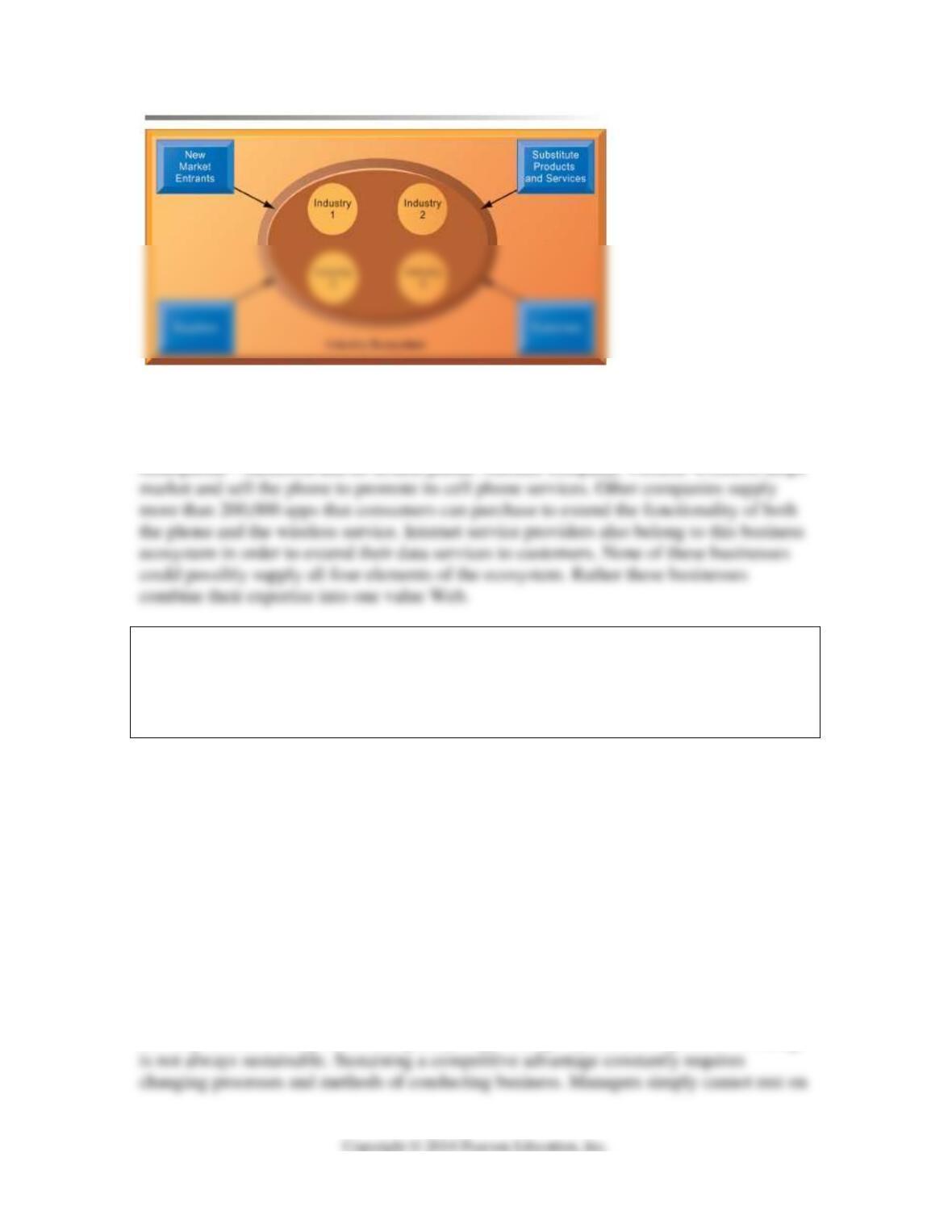
Figure 3-11 An Ecosystem Strategic Model
Think smartphones and apps. In this business ecosystem, one company builds a
smartphone—Motorola and its RAZR phone. Another company, Verizon Wireless, helps
Bottom Line: Using information systems can help a company beat the competition
through differentiation and through providing services that are valuable to both
customers and suppliers. Companies can also use information systems to reduce
costs. Information technology is also challenging the traditional concepts of
competition and partnerships that have existed for years.
3.4 Using Systems for Competitive Advantage: Management
Issues
Strategic information systems often change the organization as well as its products,
services, and operating procedures, driving the organization into new behavioral patterns.
Successfully using information systems to achieve a competitive advantage is challenging
and requires precise coordination of technology, organizations, and management.
Sustaining Competitive Advantage
Using information systems to beat the competition and increase the value of a product is
not easy. Because competitors can quickly copy strategic systems, competitive advantage
3-20
Aligning IT with Business Objectives
It’s such a basic idea—an organization should align its information technology with its
business objectives. Yet, too many times it seems that a firm’s IT is actually working
Management Checklist: Performing a Strategic Systems Analysis
Completing a strategic systems analysis is one of the first steps managers should take to
help determine how they can use information systems to gain a competitive advantage.
Ask yourself these questions about your own firm:
1. What is the structure of the industry in which your firm is located?
Managing Strategic Transitions
A vital attribute of any manager’s success is the ability to adapt to change. The pace of
technological change is at its highest level ever. With each advance, the organization
must use strategic transitions, a movement between levels of sociotechnical systems, to
Bottom Line: A well-developed strategic information system that is integrated
throughout the company can be used to lower overall costs and provide greater
value to the company, the supplier, and the customer.
CHAPTER 3
Discussion Questions
1. Discuss the impact new information systems may have on organizational culture and
organizational politics.
2. Describe the difference between the Economic Theory and the Behavioral Theory of
how information systems affect organizations.
3-22
Answers to Discussion Questions
1. Political resistance is one of the great difficulties of bringing about organization
change—especially the development of new information systems. Employees have
different viewpoints about how resources, rewards, and punishments should be
2. The answer should discuss the Economic Theory benefits of information systems and
how they allow companies to replace humans with machines, reduce transaction
3. Business ecosystems allow companies to concentrate on their core competencies
4. Answers should include information about the increased number of people the
manager can easily and effectively communicate with. By giving the manager timely
5. Answers will vary depending on the student’s particular situation but should include