
– 384 –
Lola’s Market: Capturing a New
Generation
Overview
In the fifteen years since Lola’s Market opened its doors on February 8, 1992, David Ortega and his family had
worked diligently to weave quality and tradition into the fabric of Lola’s across its five stores, all located in the
North Bay, about 60 miles north of San Francisco, California, Lola’s catered primarily to a sizable Hispanic
community that had settled in this region, which was known primarily for agriculture and wine production. In
recent years, however, supermarket shoppers had changed the way they shopped and become savvier, i.e. more
aware of marketing and advertising tactics, particularly those employing social media, thereby increasing the
already potent power of the retail supermarket consumer. By late 2017, Ortega began to take under consideration
strategic alternatives that could enable his regional supermarket chain to adapt to the emerging market trends and
by doing so, engage the newest and largest emerging market segment—the Millennial supermarket shopper. At
the same time, Ortega remained mindful of the tradeoffs of evolving his strategy to attract Millennial consumers
while not alienating his traditional Hispanic customer base, which was rooted in certain traditions and values that
had sustained Lola’s Market since its inception. The case includes information on the history of Lola’s Market,
abbreviated financial information due to its privately-held status, the company’s current and planned strategies,
as well as data on the supermarket industry in 2016.
Suggestions for Using the Case
This is a high-interest case because of students’ familiarity with supermarkets. Students will also have an
opportunity to consider and debate about the size and power of Hispanic and Millennial consumer segments.
The Lola’s Market case is thus one that will certainly trigger lively classroom discussions over staying the course
with a successful strategy that is based on maintaining tradition, versus evolving Lola’s strategy to serve a new
customer-market segment.
Students should develop an appreciation of the need for companies to tailor a strategy and shore up their dynamic
capabilities to contend with changes in customer power.
This case is crafted for use in your business strategy module after covering Chapters 1–5. The case is meant to
illustrate the following concepts and frameworks and provide students with ample opportunities to use the tools
of analysis:
case 10 teaching note
*
Case 10 Teaching Note Lola’s Market: Capturing a New Generation
385
Identify threats to Lola’s Market’s position using Porter’s Five Forces Model of Competition (Chapter
3) and then generate strategic alternatives that could successfully deter threats to its competitive position
(Chapter 5)
The Lola’s Market case could also pair well with the textbook material on what constitutes effective managerial
leadership in the strategy execution effort, a topic covered at the end of Chapter 12.
For an enterprise to execute its strategy in truly proficient fashion, top executives like David Ortega must take
the lead in the strategy implementation process and personally drive the pace of progress. In general, leading the
drive for good strategy execution and operating excellence calls for three actions on the part of the managers in
charge:
Staying on top of what is happening and closely monitoring progress
The assignment questions and teaching outline presented below reflect our thinking and suggestions about
how to conduct the class discussion and what aspects to emphasize.
To guide students in thinking about which analytical tools can be used to prepare the Lola’s Market: Capturing
a New Generation case for class discussion, we strongly recommend (1) providing class members with a set of
study questions and (2) insisting that they prepare good notes/answers to these questions.
This case is suitable for both written and oral presentations, and because of its broad scope, works well as for
a midterm (or review for a final examination) writing exercise. Our recommended assignment questions are as
follows:
2. David Ortega, Owner/founder and CEO of Lola’s Market, has learned of your considerable skills in
strategic analysis and has hired you to develop a strategic plan that will enable Lola’s Market to improve
Assignment Questions
1. What are the strategically relevant components of the U.S. supermarket industry macro-environment?
2. What is competition like in the supermarket industry? Which of the five competitive forces is strongest?
Which is or are weakest? What competitive forces seem to have the greatest effect on industry attractiveness
and the potential profitability of new entrants?
3. What does your strategic group map of the supermarket industry look like? Is Lola’s Market well positioned?
Why or why or why not?
Teaching Outline and Analysis
1. What are the strategically relevant components of the U.S. supermarket industry macro-
environment?
Students should at a minimum be able to assess the impact of macro-environmental forces on the U.S.
supermarket industry using a PESTEL analysis. Advanced students should also be able to gauge the impact
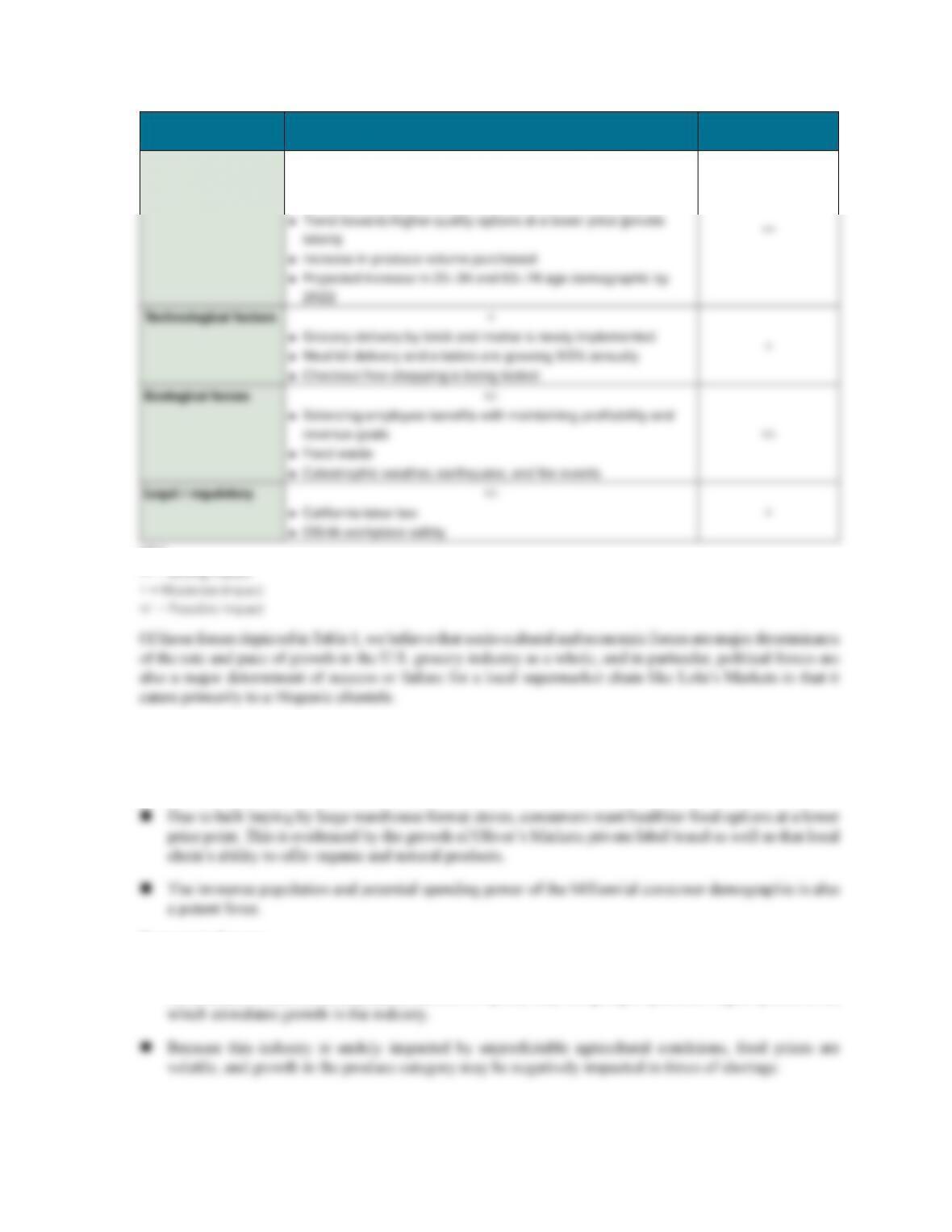
of those forces on Lola’s Markets. See Table 1, “PESTEL Assessment for the US Supermarket Industry.”
TABLE 1. PESTEL Assessment for the U.S. Supermarket Industry
Macro-
Environmental Force U.S. Supermarket Industry
Potential Impact on
Lola’s Market
Political +/-
lTax policies
++
lAgricultural price index volatility
lFood inflation rates
Case 10 Teaching Note Lola’s Market: Capturing a New Generation
387
Macro-
Environmental Force U.S. Supermarket Industry
Potential Impact on
Lola’s Market
Socio-cultural forces ++
lConsumer attitudes shifting towards healthy eating
lIncreased demand for organic and natural food
lOSHA workplace safety
KEY:
++ = Strong impact
Socio-Cultural Forces:
Living in an era of health awareness and increased lifespans, consumers’ attitudes about food are
trending towards purchasing more organic food products and local produce.
Economic Forces:
In a commodity industry like food, growth is small and stated to be at the mercy of a strong economy.
As consumers have more disposable income to spend, they are going to purchase higher priced food,
which stimulates growth in the industry.
Because this industry is unduly impacted by unpredictable agricultural conditions, food prices are
volatile, and growth in the produce category may be negatively impacted in times of shortage.
l
Case 10 Teaching Note Lola’s Market: Capturing a New Generation
388
Political Forces:
2. What is competition like in the supermarket industry? Which of the five competitive forces
is strongest? Which is or are weakest? What competitive forces seem to have the greatest
eect on industry attractiveness and the potential profitability of new entrants?
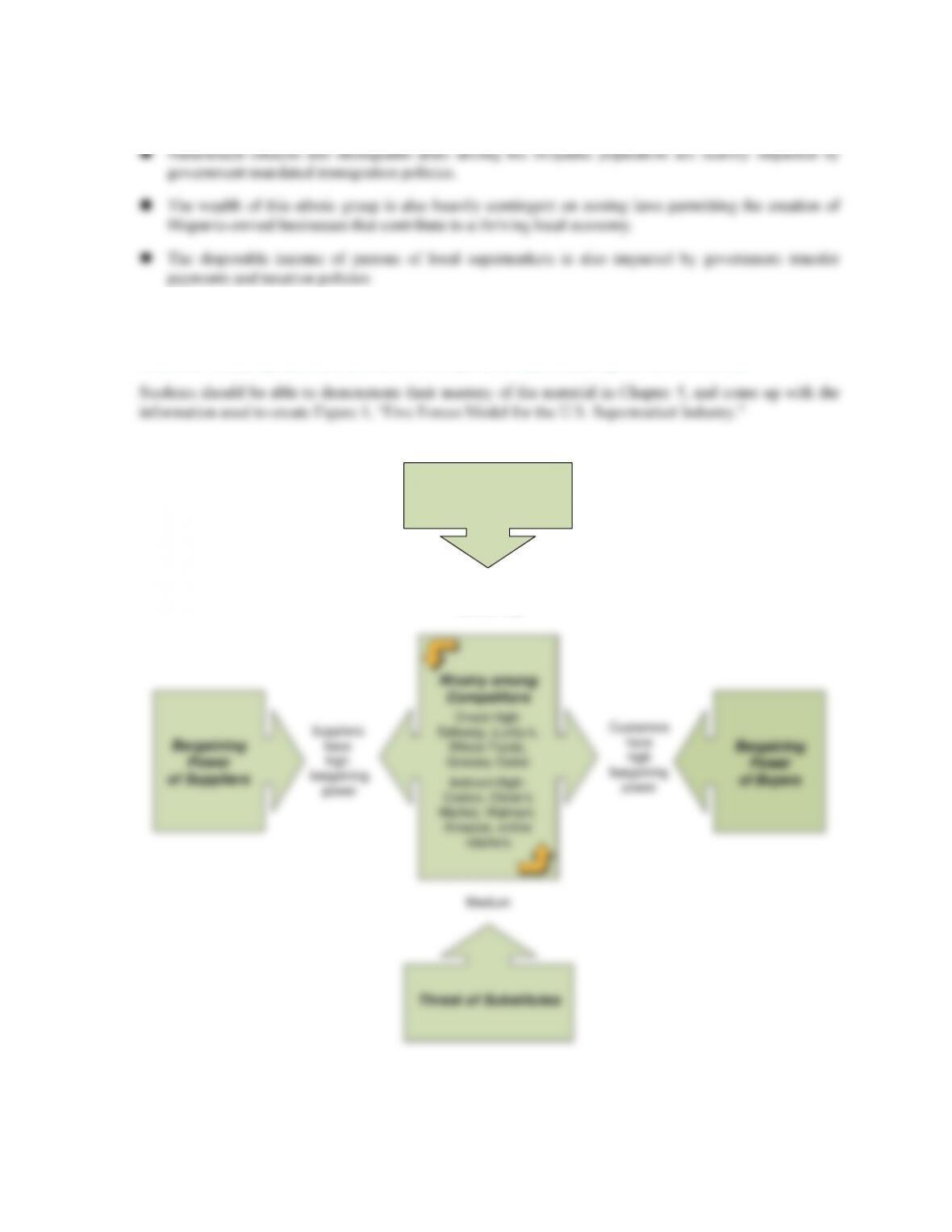
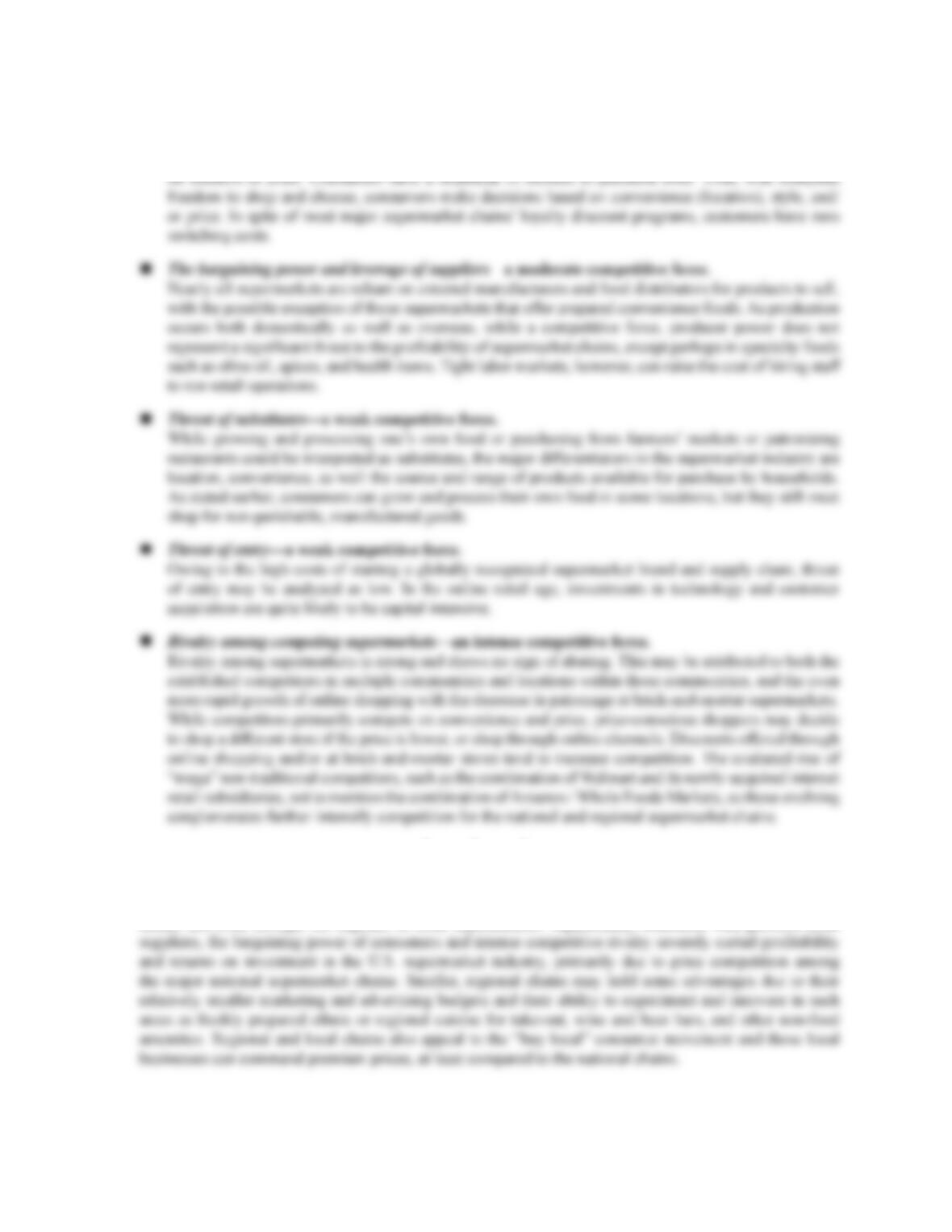
FIGURE 1. The Five Forces Model for the U.S. Supermarket Industry
Threat
of New Entrants
Direct: Low
Indirect: High
Threat of Substitutes
Medium
Case 10 Teaching Note Lola’s Market: Capturing a New Generation
389
The bargaining power and leverage of buyers—a strong competitive force.
Although not acting as one buyer, supermarket consumers have tremendous bargaining power as they
are not forced to shop at one or another supermarket, and base their patronage decisions primarily
***
Overall assessment of industry attractiveness—moderately attractive.
While substitution and entry threats remain weak, supplier power is moderate at least for the large national
chains and even stronger for regional or local supermarkets. Significantly, combined with pressure from
Case 10 Teaching Note Lola’s Market: Capturing a New Generation
390
3. What does your strategic group map of the supermarket industry look like? Is Lola’s Market
well positioned? Why or why or why not?
Good coverage of the conceptual framework needed to answer this question is found in Chapter 3 of the text.
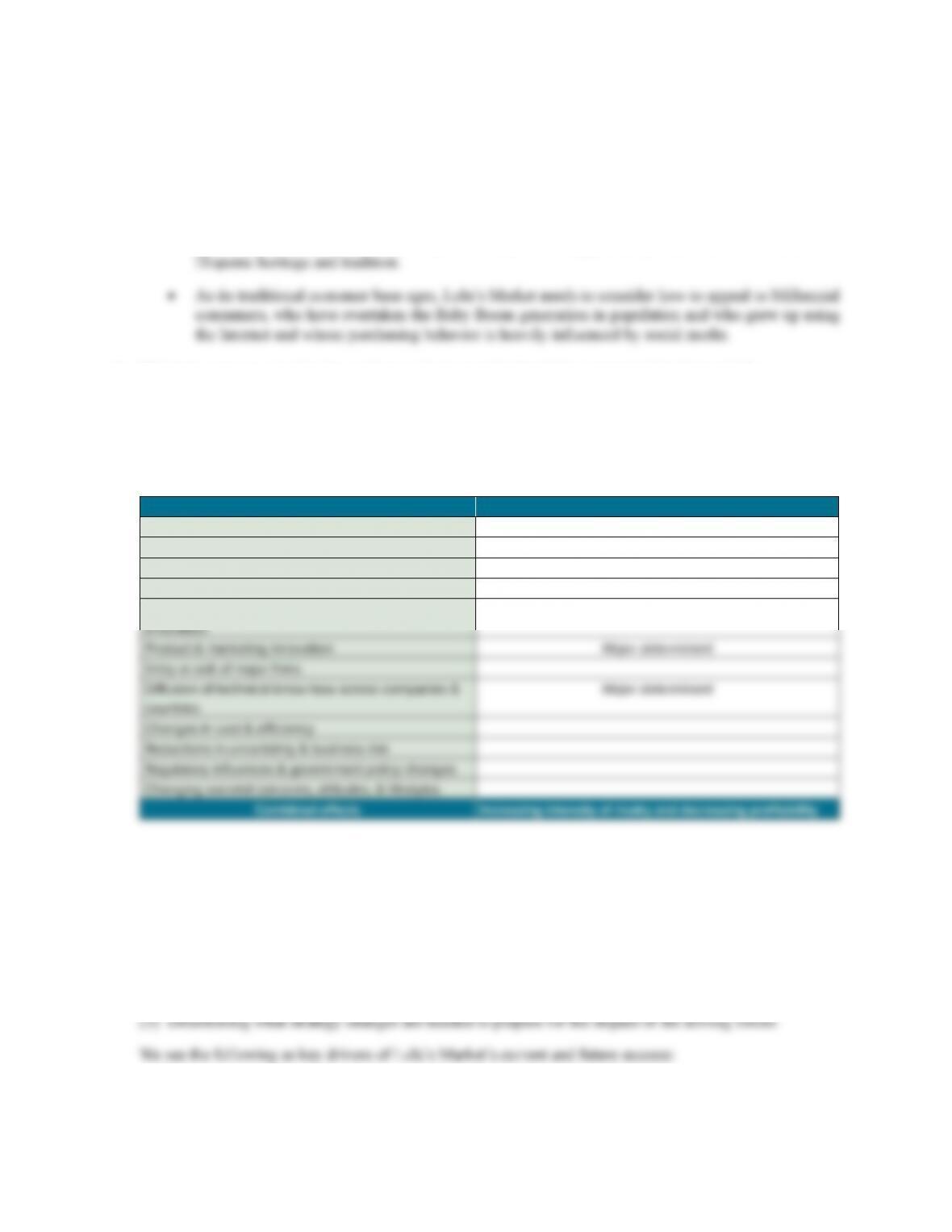
See suggested “U.S. Supermarket Industry Group Map” in Figure 2, below.
FIGURE 2. Strategic Group Map of the U.S. Supermarket Industry
Generic Strategy
National chains +
Internet
Walmart
Amazon
Whole Foods
Understanding which supermarket chains are strongly positioned and which are weakly positioned is an
integral part of analyzing this particular industry’s competitive structure.
The best technique for revealing the market positions of supermarket industry competitors is strategic
group mapping.
Case 10 Teaching Note Lola’s Market: Capturing a New Generation
391
In order to create strategic groups for the supermarket industry in which Lola’s Market competes, we
have arbitrarily chosen geographic market focus (national + Internet, national chains, and local/regional
chains) and generic strategy (low cost leaders, best cost providers, and differentiated chains).
Lola’s Market is clearly differentiated from other national, regional, and local chains.
• The company is currently alone in its market space owing to its Hispanic image, products of origin
from Hispanic countries, prepared ethnic foods, and catering primarily to a clientele reflective of its
4. What do you see as the key drivers of change in the U.S. supermarket industry?
Superior students who have read Chapter 3 carefully should be able to enumerate and evaluate the key
drivers of change in the supermarket industry, to support the contention that this industry has become: (1) at
best, moderately attractive (2) more intensely competitive and (3) less profitable. See Table 2 below:
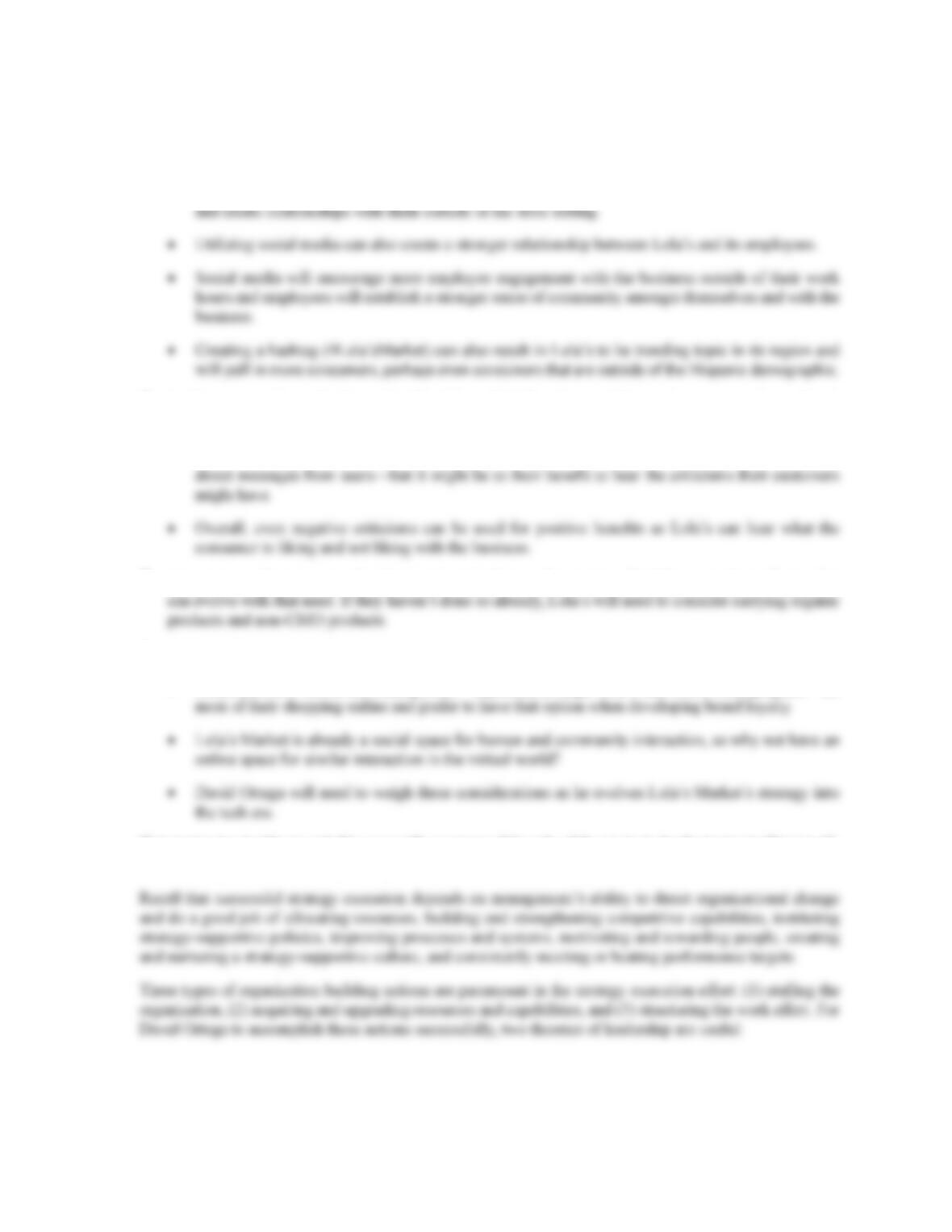
TABLE 2: Key Drivers of Change in the U.S. Supermarket Industry
Key drivers of industry change (from Table 3.3 in text) Impact of major factor on industry segment
Changes in the long-term industry growth rate
Increasing globalization
Emerging new Internet capabilities & applications Major determinant
Changes in who buys the product & how they use it Major determinant
Technological change & manufacturing process
5. What key factors may determine the success of Lola’s Markets?
An analysis of key factors or driving-forces entails three steps:
(1) Identifying what the driving forces are,
(2) Assessing whether the drivers of change are, on the whole, acting to make the industry more or less
attractive, and

Case 10 Teaching Note Lola’s Market: Capturing a New Generation
392
Current success factors:
Strong leadership in owner/founder
Offer a variety of products in cross-over format
Practicing financial discipline with profitability
6. What recommendations would you make to David Ortega to improve Lola’s Market’s
competitiveness in the market while mitigating any current and future risks?
While there is much to commend Lola’s Market, we feel that there nevertheless are several areas that need
attention and will require at least modest investments to sustain this company’s future competitiveness:
Lola’s plans for remodeling will distinguish it from competitors like Whole Foods, because it will be
authentic Mexican cuisine that its customer base seeks.
Lola’s creates a space for community in its stores as it is an environment where Spanish-speaking
customers feel comfortable shopping and spending their time.
Case 10 Teaching Note Lola’s Market: Capturing a New Generation
393
Lola’s can benefit from Social Media to provide more exposure for their business; they will be able
to reach more consumers that they might not have been able to access with their traditional marketing
methods
• Implementing social media will allow for Lola’s to be able to speak directly with their customers
As the case mentions, the downside of social media is that there can be negative repercussions when it
comes to consumer feedback and customers having access to the company directly
• Social media opens Lola’s up for scrutiny: Lola’s can filter who they allow messages from and block
As consumers become more health conscious, Lola’s needs to ensure that it has a product offering that
Lola’s will eventually have to create a platform for its customers to shop online.
• Consumers now and in the coming years—especially younger Gen Y and Gen Z demographics—do
If an instructor decides to pair this case with coverage of the role of the strategic leader topics in Chapter 10,
the following observations may be helpful:
Case 10 Teaching Note Lola’s Market: Capturing a New Generation
394
David Ortega and his management team would benefit from Transformational Leadership.
• If the leaders of the organization work with employees—at all levels—to identify needed changes,
Utilizing Participative Leadership would also be beneficial to Lola’s Market, particularly at a time when
the company is trying to rebrand itself in order to target and attract a new, younger consumer.
• In the case, it was mentioned that Ortega has employees that are part of the millennial generation:
getting feedback from these employees and having an open conversation with them about what they
Epilogue
By early 2018, David Ortega was already making moves to develop his Dutton Ave location in Santa Rosa.
However, Ortega remained reluctant to consider the implementation of multiple social media platforms, as these