Case 7 Teaching Note Under Armour’s Turnaround Strategyin 2018
350
Competitive pressures associated with the bargaining power of buyers—a weak to moderate
competitive force depending on the type of buyer
In assessing this competitive force, students should draw upon the information in Figure 3.8 in Chapter
3 (and the related text discussion).
The two types of buyers that really matter here are (1) the big chain retailers of performance athletic
apparel and (2) prominent and highly visible sports teams.
Factors that act to enhance the bargaining power of retailers and/ prestige sports teams:
• The retailers of performance athletic apparel have some freedom to decide which brands they want
to stock in their stores and also which specific apparel items within a branded product line to
stock—retailers are unlikely to stock all brands and all models/styles of each brand of performance
Case 7 Teaching Note Under Armour’s Turnaround Strategyin 2018
351
Factors that act to weaken the bargaining power of retailers and/ prestige sports teams:
• The vast majority of retailers of performance athletic apparel do not pose a credible threat to
integrate backward into the design, manufacture, and marketing of performance sports apparel and
Buyer bargaining power tends to be:
Strong for large chain retailers who buy performance sports apparel directly from Under Armour,
Nike, and Adidas-Reebok to sell in their retail locations (and even stronger in negotiating with the
marketers of lesser-known brands of performance sports apparel).
4. Does Under Armour have any core competencies and, if so, what are they?
We think students ought to single out the following as qualifying as Under Armour core competencies:
Designing innovative performance sports apparel
Capabilities in using the endorsement of prominent sports teams and professional athletes and the
sponsorship of sports events to build growing awareness of the Under Armour brand
• Under Armour is succeeding in building a growing portfolio of celebrity endorsements and in
contracting with growing numbers of prominent sports teams to wear its apparel—these clearly
Case 7 Teaching Note Under Armour’s Turnaround Strategyin 2018
352
Securing retailers to stock Under Armour products in their stores—UA’s distribution capabilities
are growing stronger and are definitely helping drive the company’s revenue growth in international
markets.
5. Does Under Armour have any resource strengths or competitive capabilities that qualify as
a distinctive competence?
We do not see any credible evidence that any of UA’s resource strengths and capabilities have developed
6. What does a SWOT analysis reveal about the overall attractiveness of Under Armour’s
situation?
Under Armour’s Resource Strengths and Competitive Assets
A growing lineup of product offerings—the company has a growing array of moisture-wicking apparel
items in many designs and styles for wear in nearly every type of climatic conditions. Indeed, Under
Armour’s diverse product offerings in 2017-2018 consisted of apparel, footwear, and accessories
Case 7 Teaching Note Under Armour’s Turnaround Strategyin 2018
353
Growing skills and capabilities in promoting the sales and use of UA-branded products to high-
performing athletes and teams on the high school, collegiate, and professional levels. As of 2018, UA
was the “official supplier of performance apparel” to increasing numbers of sports teams. Management
believed that having audiences see Under Armour products (with the interlocking UA logo prominently
displayed) being worn by athletes on the playing field helped the company establish on-field authenticity
of the Under Armour brand with consumers.
Growing, albeit still limited, distribution capabilities outside the U.S.
Under Armour’s Resource Weaknesses and Competitive Liabilities
Weaker brand name recognition and reputation than key competitors—Nike and The adidas Group
Under Armour’s Market Opportunities
Under Armour has good opportunities to expand the company’s still relatively limited product lineup
and brand name appeal into product categories where it currently had little or no market presence—
The External Threats to Under Armour’s Future Well-Being
Conclusions regarding the attractiveness of UA’s overall situation: Under Armour’s overall
situation is highly attractive (although it may well struggle for a period of 1-2 year to regain its market
Case 7 Teaching Note Under Armour’s Turnaround Strategyin 2018
354
7. What are the key elements of Under Armour’s strategy?
Class members should be expected to identify the following key elements of Under Armour’s strategy:
Broaden the company’s product offerings to men, women, and youths for wear in a widening variety of
sports and recreational activities
Grow global awareness of the Under Armour brand name and strengthening the appeal of Under Armour
products worldwide
Utilize endorsements and advertising to drive consumer demand for its products and build awareness of
Under Armour as a leading performance athletic brand
Promote the sales and use of its products to high-performing athletes and teams on the high school,
collegiate, and professional levels. This included:
Increase the oor space exclusively dedicated to Under Armour products in the stores of its major retail
accounts.
• The main initiative here was to design and fund Under Armour “concept shops”—including
ooring, lighting, walls, fixtures and product displays, and images—within the stores of its major
Case 7 Teaching Note Under Armour’s Turnaround Strategyin 2018
355
Use high-tech fabrics produced by third parties (fabric manufacturers) that were developed in
collaboration with the company’s product development team.
Use contract manufacturers to produce all UA products. Specific components of UA’s production
strategy were as follows:
• In 2017, substantially all UA products were made by 39 primary contract manufacturers,
operating in 17 countries; 10 manufacturers produced approximately 57 percent of UA’s products.
Approximately 61 percent of UA’s apparel and accessories products were manufactured in China,
Under Armour had a 17,000 square-foot Special Make-Up Shop located at one of its distribution
facilities in Maryland where it had the capability to make and ship customized apparel products on tight
Under Armour based the amount of inventory it needed to have on hand for each item in its product line
on existing orders, anticipated sales, and the need to rapidly deliver orders to customers. Its inventory
strategy was focused on (1) having sufficient inventory to fill incoming orders promptly and (2) putting
strong systems and procedures in place to improve the efficiency with which it managed its inventories
of individual products and total inventory.
8. Which one of the five generic competitive strategies discussed in Chapter 5 most closely
approximates the competitive approach that Under Armour is employing?
9. What financial performance issues do you see at Under Armour based on the data in case
Exhibits 1, 2, and 3?
You should push class members to use the financial ratios in Table 4.1 of Chapter 4 in performing calculations
to determine what aspects of UA’s financial performance qualify as issues that need top management
There are several things that class members should be expected to identify as financial performance issues
(based on the data in case Exhibits 1, 2, and 3):
In case Exhibit 1, the obvious performance issue relates to the sudden and unexpected downturn in
revenue growth that emerged in the fourth quarter of 2016 and that continued throughout all four quarters
10. As of 2018, how does Under Armour’s competitive strength in the global market for sports
apparel and athletic footwear compare against that of Nike and The adidas Group? Do a
weighted competitive strength assessment using the methodology presented in Table 4.4
in Chapter 4 to support your answer. Based on your assessment and calculations, does
Under Armour have a net competitive advantage or disadvantage in competing globally
against Nike and The adidas Group?
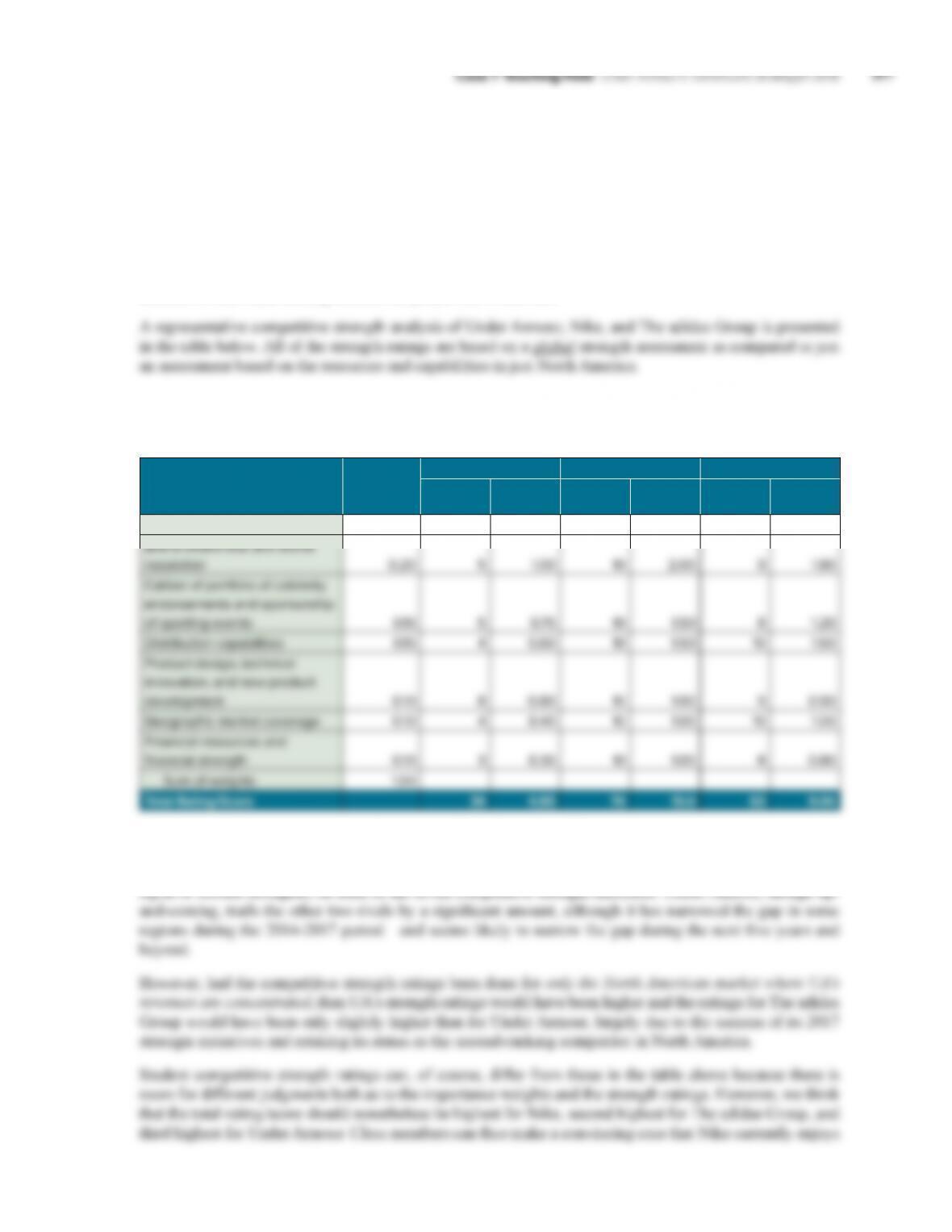
There is ample information in the Under Armour case for students to do a competitive strength assessment
and practice using the methodology presented in Table 4.4 in Chapter 4. We urge spending about 10-15
minutes of class time drilling students on proper use of this tool.
Competitive Strength Assessments of Under Armour, Nike, and The adidas Group
(Rating scale for each strength measure: 1 = very weak; 5 = average; 10 = very strong)
Competitive Strength Measures
Importance
Weight
Under Armour Nike adidas Group
Strength
Rating
Weighted
Score
Strength
Rating
Weighted
Score
Strength
Rating
Weighted
Score
Product line breadth 0.20 51.00 10 2.00 91.80
The competitive strength ratings in the above table indicate that Nike has the greatest competitive strength
of the 3 companies—in our view, it is the most formidable competitor on every one of the strength measures
(hence the rating scores of 10 on each measure). We also see The adidas Group as being quite strong (an
equal or second strongest) on each of the seven competitive strength measures. Under Armour, though up-
Case 7 Teaching Note Under Armour’s Turnaround Strategyin 2018
358
a net competitive edge over both The adidas Group and Under Armour. Worldwide, The adidas Group
seems at a “small” net competitive disadvantage vis-à-vis Nike and at a currently sizable net competitive
11. What are the key issues confronting Under Armour’s top management team as of mid-2018?
We think it is always a good idea to push the class for their assessment of what issues management needs
to address before proceeding to ask for action recommendations. Issue identification (or compilation of a
“worry list”) is a way for students to draw conclusions from all the preceding analysis, plus it sets the stage
for what actions need to be taken.
In Under Armour’s case, we see several high-priority issues that merit top management consideration:
What more (besides successfully executing the restructuring plan) can/should Under Armour do to
rejuvenate is sales growth and quickly boost its operating profit margins and overall profitability in
North America?
What to do about the ongoing losses in connected fitness? Can this business ever become profitable? Is
it worth staying in the business even if it “never” becomes profitable—because it keeps users in contact
with Under Armour?
12. What recommendations and suggestions for improvement would you make to Kevin Plank
regarding the turnaround strategy being put in place at Under Armour? What actions, besides
those related to the restructuring plan, merit consideration? What would you propose that
top management do to address/resolve the issues identified in the prior question?
The information in the case about the restructuring efforts underway at Under Armour is too general and
lacking in detail to permit students to evaluate/critique the pros and cons of the restructuring effort being
Case 7 Teaching Note Under Armour’s Turnaround Strategyin 2018
359
The following recommendations seem to us to be on target and actions that students should propose be part
of Under Armour’s strategy to improve its strategic and financial performance:
Conduct a thorough strategic and financial review of UA’s connected fitness business to determine what
can be done to reduce the losses and, ideally, become profitable within the next 2-4 years. Specifically,
explore ways to boost revenues and trim costs. Will it take more members/users for this business to
become profitable? Is membership/usage growing rapidly enough to signal that connected fitness is
something that UA should be doing in the long-run—because it contributes to sales growth, greater
loyalty to the Under Armour brand, or other benefits that justify the costs and operating losses currently
being incurred?
Continue to broaden the company’s product offerings by entering new segments of the market for
performance sports apparel, sports equipment, and sports accessories.
Continue to expand into additional foreign countries and geographic regions of the world as fast as
practical—the long-term strategic objective here should be to achieve greater global market coverage
but at a speed/pace that is within UA’s resource capabilities and that does not stretch UA resources too
thinly across too many geographic markets.
• Make a point of boosting market penetration in Latin America in the near term to curtail the
operating losses currently being incurred (see case Exhibit 3C).
Continue to build consumer awareness of the Under Armour brand and to enhance the company’s brand
reputation by:
• Signing additional appealing celebrities to endorse and promote Under Armour products.
Case 7 Teaching Note Under Armour’s Turnaround Strategyin 2018
360
Epilogue
In October 2018, Under Armour announced financial results for the third quarter ended September 30, 2018.
Highlights included the following:
Revenue was up 2 percent to $1.4 billion, as compared to Q3 of 2017.
Wholesale revenue increased 4 percent to $914 million and direct-to-consumer revenue was at at $465
million, representing 32 percent of total revenue.
Gross margin increased 10 basis points to 46.1% compared to the prior year including a $5 million impact
related to restructuring efforts. Excluding restructuring efforts in both periods, adjusted gross margin
increased to 46.5%, driven predominantly by product cost improvements and lower promotional activity.
Management’s updated outlook for Under Armour for full-year 2018 was as follows:
An expected revenue increase of approximately 3 to 4 percent, reecting a low single-digit decline in North
America and international growth of approximately 25 percent. From a product perspective, apparel was
Case 7 Teaching Note Under Armour’s Turnaround Strategyin 2018
361
An expected operating loss of approximately $50 to $55 million versus a previously expected $60 million loss.
On an adjusted basis, full-year operating income was expected to be in the $150 to $165 million range versus
In commenting on UA’s results for Q3 2018, CEO Kevin Plank said:
As I look to the future, I’ve never been more energized, confident and excited about what is ahead for us,
both as a brand and as an operator.