
– 287 –
Wil’s Grill
Overview
John Christ is an entrepreneur in his early 20’s and owner of Wil’s Grill, a street food business based in
Flagstaff, AZ, serving customers throughout Northern Arizona. Wil’s Grill was founded in January 2014.
$129,000 in revenue had been recognized from January 2014 through December 2016. In January 2017,
John had to decide how he was going to grow revenue if Wil’s Grill was to provide him with a livelihood. He
was determined to make a strategic decision to either expand his focus on the street food business upon which
Wil’s Grill was founded, add a catering business, or do something else.
Suggestions for Using the Case
This is a high-interest case and one that will certainly trigger lively classroom discussion. Students are very
interested in discussing the Wil’s Grill case, given the current interest in street food and related student
entrepreneurial activities on many college campuses.
This case provides a unique opportunity for students to discuss Wil’s Grill’s attempts to gain traction given its
resources, capabilities, core competencies and position within a segmented market. Students should develop an
appreciation of the need for companies to tailor a strategy and develop capabilities that fit the specific industry
to build a sustainable competitive advantage.
case 3 teaching note
*
Case 3 Teaching Note Wil’s Grill
288
The Wil’s Grill case might also pair well with the material on how to evaluate a company’s potential for
diversification, covered in Chapter 8.
Sticking closely with an existing business lineup and pursuing opportunities presented by these
businesses
The assignment questions and teaching outline presented below reflect our thinking and suggestions about
how to conduct the class discussion and what aspects to emphasize.
To guide students in thinking about which analytical tools can be used to prepare the Wil’s Grill case for class
discussion, we strongly recommend (1) providing class members with a set of study questions and (2) insisting
that they prepare good notes/answers to these questions.
This case is suitable for both written and oral presentations. Our recommended assignment questions are as
follows:
1. As part of your internship requirements with Wil’s Grill, Inc., you have been asked to prepare an
analysis of Wil’s Grill’s competitive position in the food service marketplace. Your report should
2. Wil’s Grill’s founder/CEO John Christ has learned of your considerable skills in strategic analysis and
has hired you to develop a strategic plan that will enable Wil’s Grill to improve its position in the food
service industry, continue to build a stronger financial position, and decide about future diversification
Assignment Questions
1. What are the resources, capabilities and core competencies required to compete in the street food market
segment? How well do Wil’s Grill’s resources, capabilities, and core competencies stack up?
2. What does a VRIN analysis for Wil’s Grill reveal about its current resource strengths and capabilities, as
well as competitive liabilities? Use the methodology in Table 4.3 to support your answer.
3. What does a SWOT analysis for Wil’s Grill reveal about its current position? Use the methodology in Table
4.2 to support your answer. Based on the SWOT, does Wil’s Grill have what it would take to compete in the
catering industry?
Case 3 Teaching Note Wil’s Grill
289
Teaching Outline and Analysis
1. What are the resources, capabilities and core competencies required to compete in the
street food market segment? How well do Wil’s Grill’s resources, capabilities, and core
competencies stack up?
Resources: Students should be reminded that a resource is considered an asset that an organization can draw
on when formulating and implementing a strategy. A tangible resource has physical attributes and is visible.
An intangible resource has no physical attributes and is thus invisible.
Examples of tangible resources required to compete in the street food market segment include:
For Wil’s Grill, the most important tangible resources are:
Case 3 Teaching Note Wil’s Grill
290
Grilling equipment used to cook the smoked meats
For Wil’s Grill, the most important intangible resources are:
Examples of Wil’s Grill’s core competencies include:
John’s experience with smoked meat and barbeque cooking.
Students should be pushed to analyze and determine which among all of these resources and capabilities
provide Wil’s Grill with a distinct competitive advantage.
Case 3 Teaching Note Wil’s Grill
291
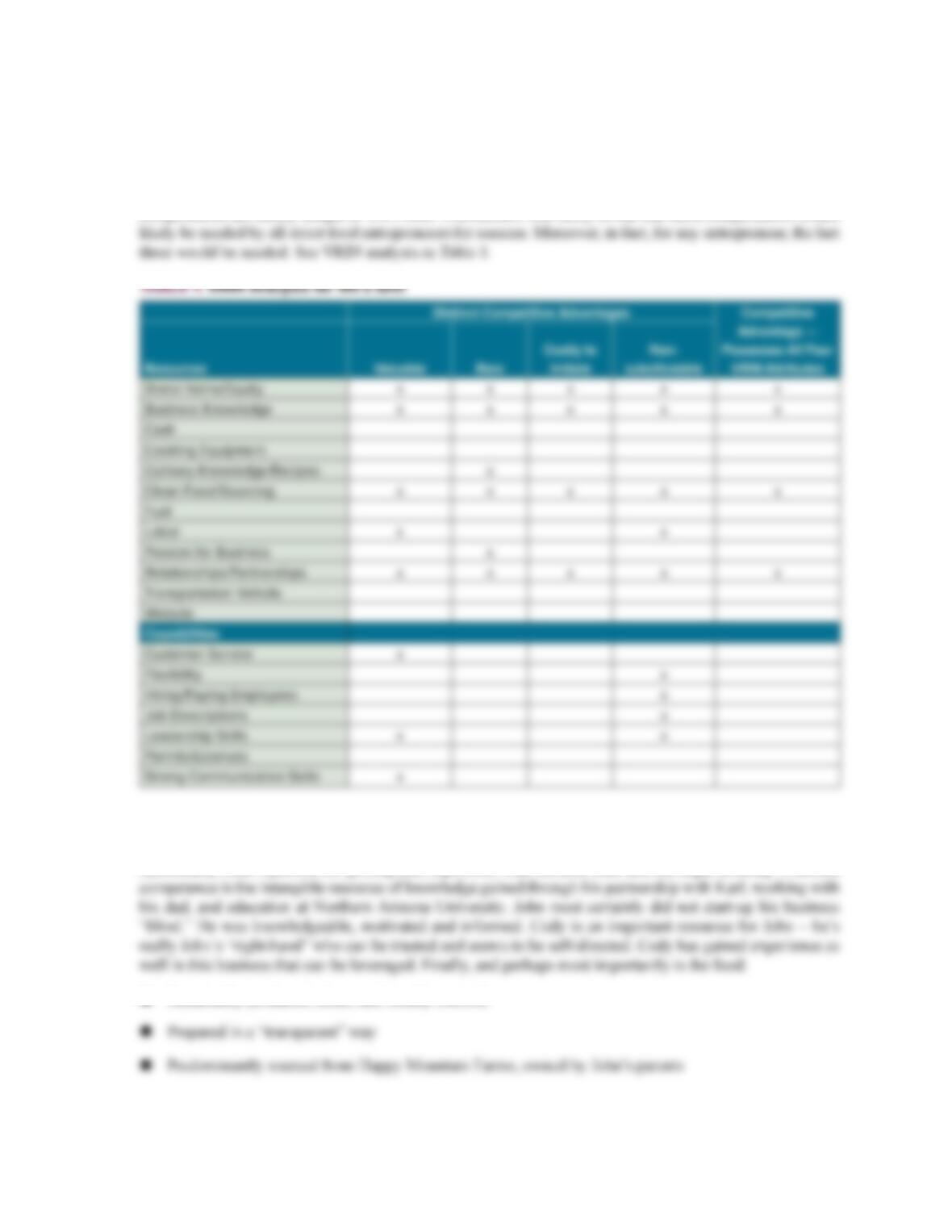
2. What does a VRIN analysis for Wil’s Grill reveal about its current resource strengths and
capabilities, as well as competitive liabilities? Use the methodology in Table 4.3 in the
textbook to support your answer.
Students should recognize that while Wil’s Grill’s customer value proposition is compelling, these
competencies are hardly unique to Wil’s Grill. A discussion will likely reveal that these competencies would
Wil’s Grill’s resources and capabilities include the legacy or “story” behind the Wil’s Grill name i.e. a
young, passionate man and his start-up business, John, who is working diligently to acquire new customers.
Specifically, John’s passion for grilling and experience with smoked meat and barbeque cooking. A second
Sustainably produced, clean, and locally sourced
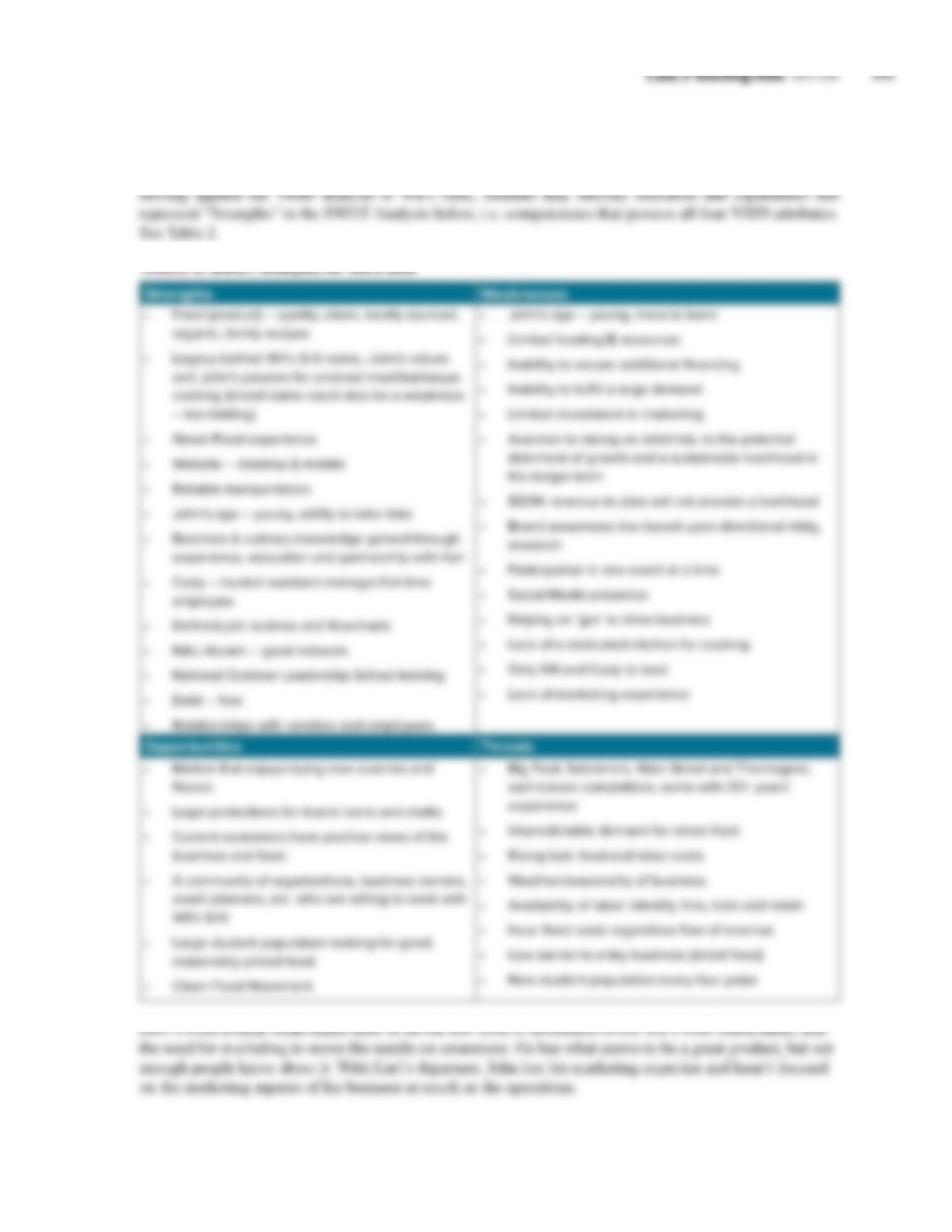
3. What does a SWOT analysis for Wil’s Grill reveal about its current position? Use the
methodology in Table 4.2 to support your answer. Based on the SWOT, does Wil’s Grill have
what it would take to compete in the catering industry?
Case 3 Teaching Note Wil’s Grill
293
Regarding opportunities and threats, Wil’s Grill faces some larger, well-established competitors in
Flagstaff, Arizona. Additionally, John will likely need to secure additional financing and perhaps assume
some debt to support needed investment in continuing his street food business, and probably more to
compete in the catering segment.
As to what it takes to compete in catering, although similarities exist between the two segments, there are
several significant differences:
4. Does it make good strategic sense for Wil’s Grill to be a competitor in both the street
food and catering segments? Which one of these product lines — street food and catering
segments — do you think is most important to Wil’s Grill’s future growth and profitability?
Why?
Owing to John’s inexperience in the catering segment, securing management expertise in catering, i.e. hiring
a new manager or retraining his current manager Cody and further developing his professional network and
relationships to identify catering opportunities would be critical. To close the experience gap, John may
Case 3 Teaching Note Wil’s Grill
294
John’s estimated annual marketing budget for both street food and catering would be $7,500, so there
may be an opportunity for some synergy in his marketing efforts across both segments.
The transferability of Wil’s Grill brand name to a catering business venture is questionable.
Related to the brand extension / diversification opportunity is additional investment in marketing.
Arguments in support of expanding in the street food segment include:
John’s familiarity and investment to date in this segment, recognizing that some additional
investments will need to be made.
Arguments in support of focusing on expanding into the catering segment include:
Realizing greater stability with this business model and higher margins on this business. Although
significantly additional investment would be required in food, equipment, labor, etc., average margins
are much higher than in the street food segment.
Arguments in support of John doing something else include:
John’s overestimating future business potential for earning a livelihood and his ability to be a
successful entrepreneur. While he has three years of historical data on the street food segment to
project future growth, his projections for the catering segment are based upon his estimates of the
marketing opportunity, and not historical data.
Case 3 Teaching Note Wil’s Grill
295
5. What is your assessment of Wil’s Grill’s financial performance over the 2014 – 2016 period?
(Use the financial ratios in Table 4.1 of the text as a guide in doing your financial analysis.)
Students should be able to use the financial information provided in case Exhibit 2 and the financial
ratios provided in the Financial Summary Table 4.1 and also the Appendix of the text to make
calculations and come up with the following conclusions about Wil’s Grill’s financial situation:
Funding is a critical gap for John.
Based upon the profit and loss statement in Exhibit 2 for 2016, net income before taxes was
approximately 27% of food sales for the street food segment.
6. Assess Wil’s Grill’s projections for 2017 – 2019. Are these realistic? How do you know?
John indicates that his estimates in case Exhibit 3 for future cash flows and investment are “high level
ballpark.” The instructor can engage students in a discussion of John’s estimates and assumptions.
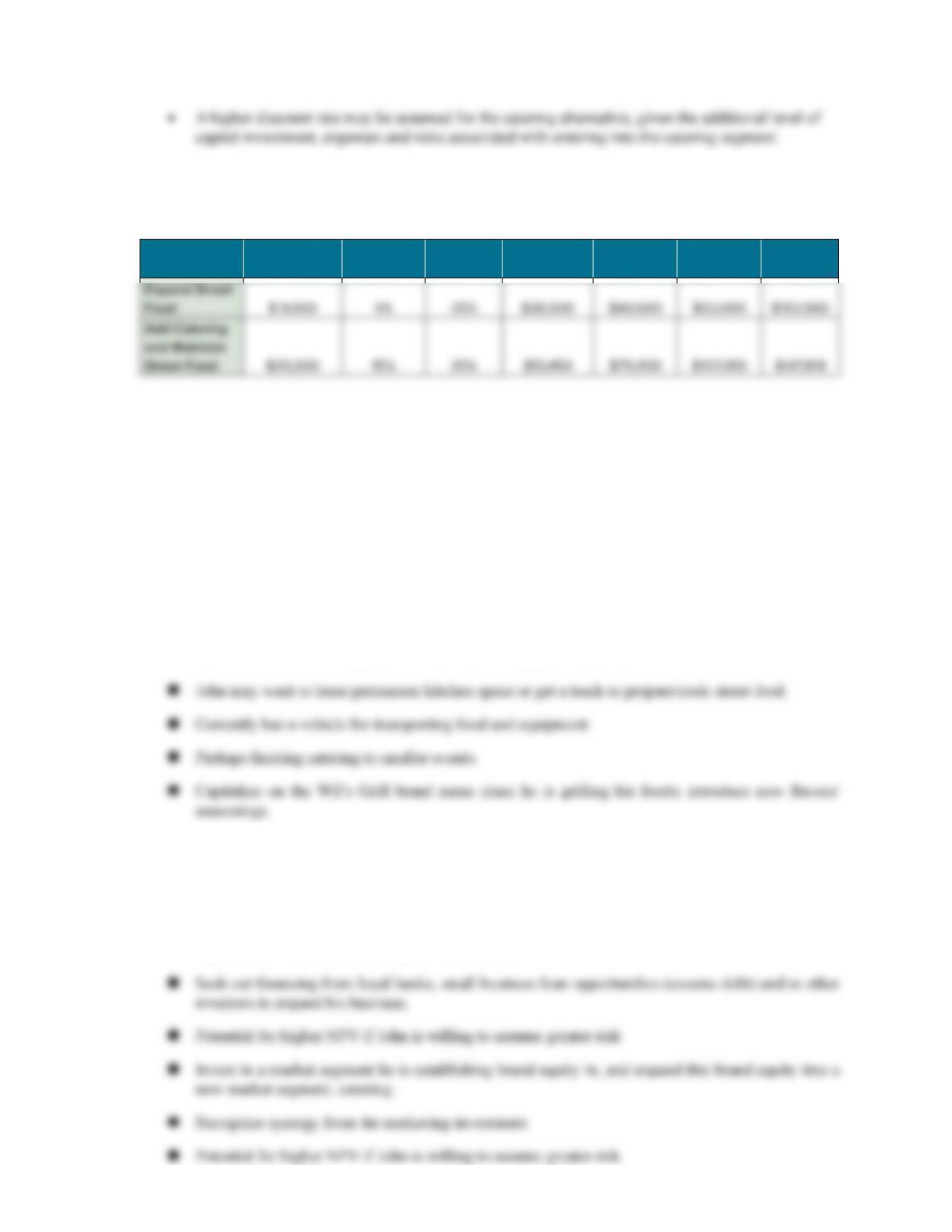
Students can debate which discount rate to apply to each of the above options, expanding into street
food or expanding into catering. John assumes a discount rate between 5% and 18%. John estimates
investment amounts of $9,000 and $25,000 for the “expand street food” and “add catering” options
respectively.
Case 3 Teaching Note Wil’s Grill
296
Using the data and assumptions in case Exhibit 3, a student’s NPV analysis may look like the example in
Table 3.
TABLE 3. NPV Analysis for Wil’s Grill
Options Investment
Discount
Rate
Cash Flow
Margin
Net Cash
Flow Year 1
Net Cash
Flow Year 2
Net Cash
Flow Year 3 NPV
7. What recommendations would you make to Wil’s Grill to address the strategic issues
confronting it in 2016 in order to sustain its impressive growth in street food sales and
sustain its newly-achieved profitability?Should John Christ expand in its current street food
market segment, add a new market segment, catering, or do something else?
Again, we see three options for John:
1. Expand in Street Food (lowest NPV)
Reinvest and expand in a market segment he is familiar with and is beginning to establish brand
equity in.
More cost effective and less resource intensive than catering. Many gaps to close requiring greater
investment, and assuming additional risk (including possibly debt).
2. Expand into Catering, Maintain Street Food (highest NPV)
Greater stability with this business model and in this market segment, less seasonality, potentially
greater demand and higher margins on the business.
Conduct additional marketing research to determine if the Wil’s Grill brand name has equity in this
segment and if so, better leverage the brand name.
3. Do something else (unknown NPV)
Based on a realization that John is unwilling to take the required risks to grow his business.
John determines that he has overestimated the market opportunity in both segments to sustain a
livelihood from his business.
Epilogue
Company updates can be found at Wil’s Grill’s website: https://www.wilsgrillflagstaff.com as well as on its
Facebook page.