– 338 –
Under Armour’s Turnaround Strategy
in 2018
Overview
Founded in 1996 by former University of Maryland football player Kevin Plank, Under Armour was the
originator of sports apparel made with performance-enhancing fabrics—gear engineered to wick moisture
from the body, regulate body temperature, and enhance comfort regardless of weather conditions and
activity levels. It started with a simple plan to make a T-shirt that provided compression and wicked perspiration
off the wearer’s skin, thereby avoiding the discomfort of sweat-absorbed apparel.
Under Armour quickly earned a reputation as an up-and-coming company in the sports apparel business, achieving
sales of $1 billion in 2010 and $3 billion in 2014. Starting in the second-quarter of 2010 and continuing through
the third-quarter of 2016, Under Armour cemented its status as a growth company by achieving revenue growth
of 20+ percent for 26 consecutive quarters—see Exhibit 1. In announcing the company’s 2016 third-quarter
financial results, Chairman and CEO Kevin Plank said:
Over the past twenty years, we have established ourselves as a premium global brand with a track record of
strong financial results. Looking back over the past nine months, it has never been more evident that we are
at a pivotal moment in time, where the investments we are making today will fuel our growth and drive our
industry leadership position for years to come. As a growth company with an expanding global footprint and
businesses like footwear and women’s each approaching a billion dollars this year, we have never been more
focused on the long-term success of our Brand.
: Efforts to Revive North American
case 7 teaching note
Sales and Profitability
Case 7 Teaching Note Under Armour’s Turnaround Strategyin 2018
339
to approximately $320 million, partly because of “strategic investments in the company’s fastest growing
businesses.” Nonetheless, Kevin Plank believed the company’s resources and capabilities would enable it to
cope with the challenges ahead:
2017 Turned Out to Be a Terrible Year for Under Armour. Overall, Under Armour’s performance in
2017 turned out to be worse than management’s earlier expectations. In its core North American market, Under
Armour found itself on the defensive throughout 2017. A year after growing North American sales from almost
$1.0 billion in 2012 to $4.0 billion in 2016 (a compound growth rate of 41.4 percent), Under Armour’s 2017
sales in North America dropped $200 million (5.1 percent) to $3.8 billion. Total revenues worldwide were up a
meager 3.1 percent—from $4.83 billion to $4.98 billion, after growing at a compound rate of 27.3 percent during
the 2012-2016 period. Operating income dropped from $417.5 million in 2016 to $27.8 million in 2017. Net
income fell from a record high of $257.0 million to a net loss of $48.3 million. The prices of the company’s Class
A shares and Class C shares which began 2017 trading at $29.34 and $25.49, respectively, closed at $14.43 and
$13.32 on the last trading day of December 2017. These declines in Under Armour’s stock prices were all the
more disheartening to the company’s shareholders because the value of stocks listed on the NYSE and Nasdaq
stock exchanges had climbed by more than $7 trillion in the 16 months since the 2016 presidential election.
The big drops in Under Armour’s operating income and the net loss of $48.3 million were partially due to
management’s announcement in August 2017 that it would pursue a $140 to $150 million restructuring plan
Case 7 Teaching Note Under Armour’s Turnaround Strategyin 2018
340
How Under Armour’s 2017 Sales Performance in North America Compared Against Its Two
Biggest Rivals. Under Armour’s 5.1 percent decline in 2017 sales in the North American market compared
unfavorably with long-time industry leader Nike, whose sales of $15.2 billion in North America during December
1, 2016 through November 30, 2017 were essentially unchanged from the $15.1 billion in sales Nike reported
for December 1, 2015 through November 30, 2016. But the real threat to Under Armour’s competitive standing
in the North American market going into 2018 came from Germany-based The adidas Group—the industry’s
Under Armour’s Outlook for 2018 In February 2018, top executives at Under Armour did not foresee a
quick turnaround. Their 2018 outlook for North American revenues was a mid-single-digit decline, although
international sales were expected to grow 25 percent. Gross margins were expected to improve 50 basis points
to 45.5 percent, but only because of lower planned promotional activity, anticipated savings in product costs,
favorable shifts in sales to distribution channels with better margins, and favorable changes in foreign currency.
Operating income was projected to be $20 million to $30 million (versus $28.7 million in 2017). Management
explained the projections of operating income were low because, after additional review, a decision had been
made to pursue a second restructuring plan in 2018 to further optimize operations. This plan entailed:
Case 7 Teaching Note Under Armour’s Turnaround Strategyin 2018
341
Suggestions for Using the Case
This freshly-updated case should generate considerable student interest and provoke a lively, interesting class
discussion. Under Armour performance in 2017 and its stated outlook for 2018 represents a stunning reversal of
the company’s prior performance. The case presents students with the challenge of assessing the reasons for the
sudden and unexpected performance drop-off and the company’s prospects for a successful turnaround. What
happened at Under Armour—why did the company’s performance fall off so quickly in North America? How big
a jam is the company in? Does management have a good plan for turning things around—why will the planned
turnaround in North America take so long?
Videos for Use with the Under Armour Case. There are two videos you can show (or let students view on
their own) when having class discussion of the Under Armour case:
The Connect-based Exercise for the Under Armour Case. We developed an exercise for Under Armour
for inclusion in the publisher’s Connect™ Management web-based assignment and assessment platform
because:
Case 7 Teaching Note Under Armour’s Turnaround Strategyin 2018
342
This particular Connect-based exercise concerns the following questions:
1. What is your assessment of the Under Armour’s performance downturn in North America that first
appeared in the fourth quarter of 2016? Causes? Reasons?
2. What is your assessment of the strength of the competitive rivalry among the leading participants in the
North American market for performance sports apparel?
3. What is your assessment of the strength of competitive pressures stemming from the threat of entry of
new competitors into the North American market for performance sports apparel?
4. What is your assessment of the strength of competitive pressures stemming from substitutes for
performance sports apparel?
5. What is your assessment of the strength of competitive pressures stemming from suppliers to the
marketers of performance sports apparel?
What to Tell Students in Preparing the Under Armour Case for Class. To give students guidance in
what to do and think about in preparing the Under Armour case for class discussion, we strongly recommend
two things:
OR
2. Provide class members with assignment questions and insist that they prepare good notes/answers to
these questions before coming to class. Our recommended assignment questions for the Under Armour
Case 7 Teaching Note Under Armour’s Turnaround Strategyin 2018
343
To facilitate your use of assignment questions and making them available to students, we have posted a file of
the Assignment Questions contained in this teaching note in the instructor resources section of the Connect
Library. (You should be aware that there is a set of assignment questions posted in the Connect Library for
each of the cases included in the 22nd edition.) In all instances, these assignment questions correspond to the
assignment questions in the teaching note for the case.
Utilizing the Guide to Case Analysis. If this is your first assigned case, you may find it beneficial to have
class members read the Guide to Case Analysis that is posted in instructor resources section of the Connect
Suggested Assignment Questions for an Oral Team Presentation or Written Case Analysis. We
definitely recommend use of the Under Armour case for written assignments and oral team presentations. Our
suggested assignment questions are as follows:
■ Under Armour CEO Kevin Plank has employed you as a consultant to assess the company’s overall
situation and recommend a set of actions to improve the company’s future prospects. Please prepare a
report to Mr. Plank that includes (1) an evaluation of the five competitive forces in the global market
■ Prepare a brief report to Under Armour CEO Kevin Plank outlining the 3-4 top priority issues that Under
Armour management needs to address and the actions you think Kevin Plank should initiate to address
Case 7 Teaching Note Under Armour’s Turnaround Strategyin 2018
344
Assignment Questions
1. What is your assessment of the Under Armour’s performance downturn in North America that first appeared
in the fourth quarter of 2016? Causes? Reasons?
2. What financial performance issues do you see at Under Armour based on the data in case Exhibits 1, 2, and
3?
3. What is your assessment of the strength of the competitive rivalry among the leading participants in the
North American market for performance sports apparel headed into 2018?
4. How strong are the other four competitive forces confronting Under Armour, Nike, and The adidas Group as
of 2018? Do a five-forces analysis to support your answer.
5. Does Under Armour have any core competencies and, if so, what are they?
6. Does Under Armour have any resource strengths or competitive capabilities that qualify as a distinctive
competence?
Teaching Outline and Analysis
1. What is your assessment of the Under Armour’s performance downturn in North America
that first appeared in the fourth quarter of 2016? Causes? Reasons?
Students should identify the following causes/reasons for UA’s sudden and unexpected performance
downturn starting in the fourth quarter of 2016 and continuing on into 2018:
For reasons that are not entirely clear, Under Armour’s brand power in North America seems to have
taken a dive.
Case 7 Teaching Note Under Armour’s Turnaround Strategyin 2018
345
2. What financial performance issues do you see at Under Armour based on the data in case
Exhibits 1, 2, and 3?
The data in case Exhibit 1 shows that, starting with the fourth quarter of 2016 and continuing through
all of 2017, quarterly revenues and revenue growth at Under Armour took a sudden turn for the worse
Case 7 Teaching Note Under Armour’s Turnaround Strategyin 2018
346
The two restructuring programs were partly necessitated by 2015 management efforts to begin scaling
3. How strong are the competitive forces confronting Under Armour, Nike, and The adidas
Group in 2018? Do a five-forces analysis to support your answer.
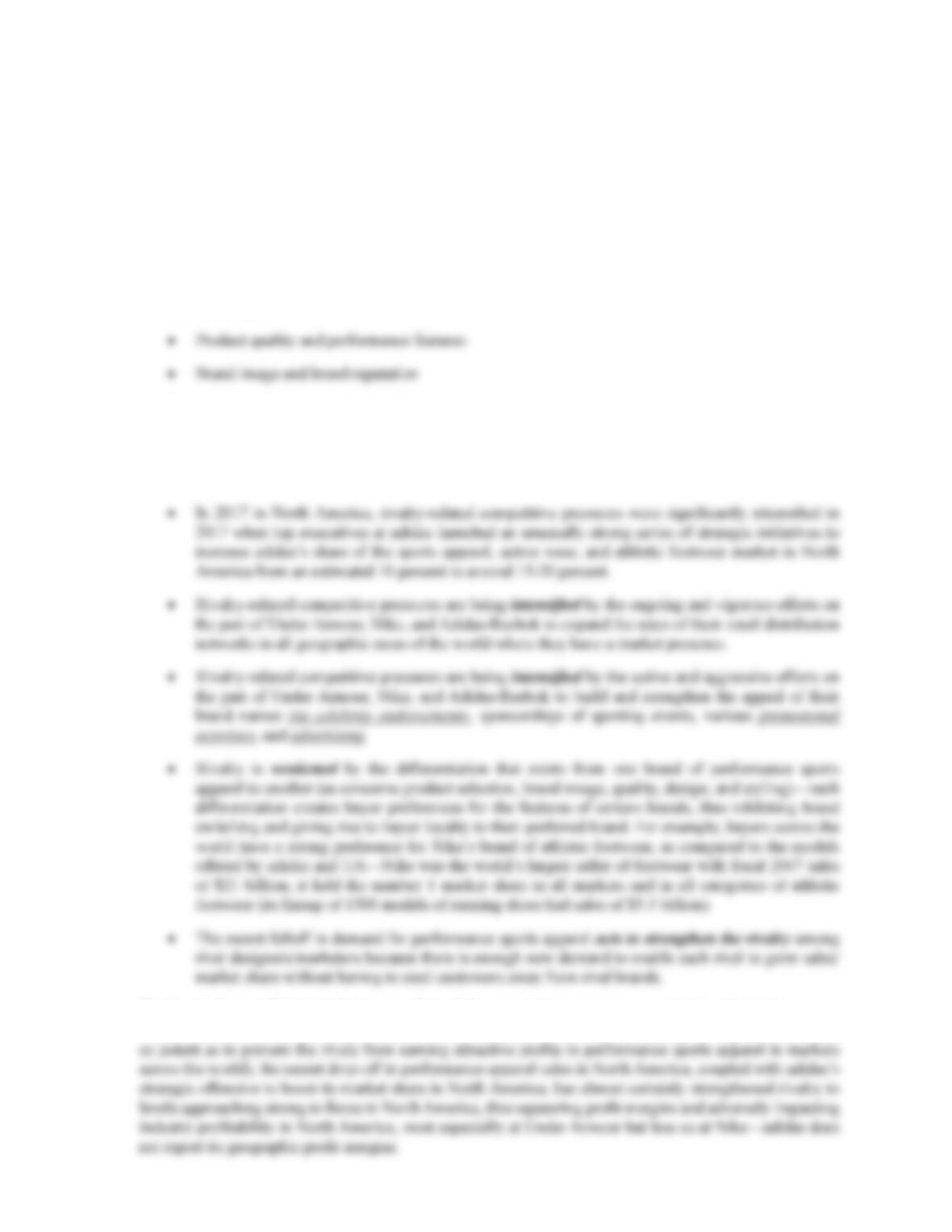
Below is a representative five-forces model of competition for the performance sports apparel industry:
Substitutes for
Performance
Athletic Apparel
Competitive pressures coming from
the market attempts of sellers in
other industries to win buyer patronage
away performance athletic apparel
Rivalry among the designers and marketers of performance sports apparel—a strong, perhaps
even fierce, competitive force. In North America, adidas’ 2017 strategic offensive in North America
(particularly the U.S.) has made competition in this region particularly fierce.
Case 7 Teaching Note Under Armour’s Turnaround Strategyin 2018
347
In assessing this competitive force, students should draw upon the information in Figure 3.4 in Chapter
3 (and the related text discussion).
The rivalry among Under Armour, Nike, and The Adidas Group is vigorous most everywhere across
the world (where Under Armour has a market presence) and is likely to remain so. Adidas turned up
the competition a big notch in North America with its strategic initiatives at the beginning of 2017 to
increase its share of the sports apparel, active wear, and athletic footwear market in North America from
an estimated 10 percent to around 15-20 percent. The results were impressive considering stagnant
market demand for sports apparel and products in North America—sales of adidas-branded products in
North America grew by a resounding 34 percent in the first nine months of 2017. Rivalry is centered on
two main factors:
Students should be pressed to identify the following rivalry-related competitive pressures at work:
• Rivalry-related competitive pressures are being intensified by the ongoing and vigorous efforts on
the part of Under Armour, Nike, and Adidas-Reebok to expand their product lines and offer wider
selection to those people who wear performance sports apparel.
On the whole, we think it is fair to say that while competitive pressures associated with rivalry among
Under Armour, Nike, and Adidas-Reebok have historically been only moderately strong (definitely not
Case 7 Teaching Note Under Armour’s Turnaround Strategyin 2018
348
Competitive pressures associated with the threat of new entry into the performance athletic apparel
marketplace—a weak to moderate competitive force
In assessing this competitive force, students should draw upon the information in Figure 3.5 in
Chapter 3 (and the related text discussion).
Factors that are acting to intensify the threat of entry:
Factors that are acting to weaken the threat of the entry:
• The small pool of entry candidates
All things considered, we think it is fair to say that the competitive pressures associated with the threat
of additional entry into the performance athletic apparel marketplace are:
Competitive pressures associated with substitutes for performance athletic apparel—a moderate
competitive force
In assessing this competitive force, students should draw upon the information in Figure 3.6 in Chapter
3 (and the related text discussion).
Factors that are acting to intensify competitive pressures from substitute products:
• The widespread availability of other types of athletic apparel products that are not made of
performance fabrics
Case 7 Teaching Note Under Armour’s Turnaround Strategyin 2018
349
Factors that are acting to weaken competitive pressures from substitute products:
• Substitute types of athletic apparel deliver less comfort and are viewed by many users as being of
Competitive pressures associated with the bargaining power of suppliers—a moderate competitive
force
In assessing this competitive force, students should draw upon the information in Figure 3.7 in Chapter
3 (and the related text discussion).
The two types of suppliers that really matter here are (1) the suppliers/makers of performance-based
fabrics and (2) the contract manufacturers that actually produce the apparel items.
Factors that are acting to intensify the bargaining power of suppliers:
• Fabric suppliers having proprietary fabrics with superior performance features and/or superior
quality have significant bargaining power to influence the prices and other terms and conditions
Factors that are acting to weaken the bargaining power of suppliers:
• The presence of numerous contract manufacturers who are eager to win the business of producing
apparel items for Nike, Under Armour, and adidas-Reebok and who also have the capabilities (1) to