Starbucks in 2018: Striving for Operational
Excellence and Innovation Agility
Overview
Since its founding in 1987 as a modest nine-store operation in Seattle, Washington, Starbucks had become
the premier roaster, marketer, and retailer of specialty coffees in the world, with over 28,200 store locations
in 76 countries as of April 2018 and annual sales that were expected to exceed $24 billion in fiscal year
2018, ending September 30. In addition to its flagship Starbucks brand coffees and coffee beverages, Starbucks’
other brands included Tazo and Teavana teas, Seattle’s Best Coffee, Evolution Fresh juices and smoothies, and
Ethos bottled waters. Starbucks stores also sold snack foods, pastries, and sandwiches purchased from a variety
of local, regional, and national suppliers. In January 2107, Starbucks officially announced it would:
• Open 20 to 30 Starbucks Reserve™ Roasteries and Tasting Rooms, which would bring to life the theater
of coffee roasting, brewing, and packaging for customers, include a coffee bar with a full menu of coffee
beverages, space for a mixology bar serving traditional Italian cocktails, and an upscale Princi bakery—a
case 29 teaching note
Case 29 Teaching Note Starbucks in 2018: Striving for Operational Excellence and Innovation Agility
639
and operating practices the company has employed in executing its evolving strategy, the many strategic and
operating adjustments company has made in the past 20 years or so, the company’s social responsibility strategy,
Suggestions for Using the Case
This case is comprehensive in nature. It involves both crafting and executing strategy, and it calls upon students
to apply what they have read in many of the 12 text chapters. Consequently, you can use this case to drill students
in identifying and evaluating a company’s strategy, evaluating the role of the CEO in the strategy-making/
strategy-executing process, and evaluating how well Starbucks management has handled the strategy execution
The comprehensive nature of the case and the depth of detail provided about the company make the Starbucks
case ideal for oral team presentations or a comprehensive written assignment toward the end of the course.
On the other hand, you can certainly position coverage of Starbucks early in the course—as a leadoff case for
the course or as a follow-on to Mystic Monk Coffee or Costco Wholesale. Howard Schultz was a fascinating
entrepreneur and corporate leader until he stepped down in 2018, and Starbucks is a fascinating company.
Students quickly become engrossed in “the Starbucks story.” Assigning the Starbucks case early in the term-
-as a first or second case immediately following your coverage of Chapters 1 and 2 or as a company that has
globalized it strategy (which draws upon the content of Chapters 5-7) will help students gain a more clear-
headed view of the tasks and challenges of managing the strategy process and why good strategy + good strategy
execution typically equates to good management and good company performance.
Videos for Use with the Starbucks Case. There are two videos available for use with the Starbucks case:
A 3:38-minute 2016 video interview of Howard Schultz entitled “Starbucks CEO: Growth Isn’t a
Strategy,” that can be accessed at https://www.youtube.com/watch?v=-xVekEX2qkQ.
Case 29 Teaching Note Starbucks in 2018: Striving for Operational Excellence and Innovation Agility
640
The Connect-based Exercise for the Starbucks Case. We developed an exercise for Starbucks for
inclusion in the publisher’s Connect™ Management web-based assignment and assessment platform as a means
for helping you drill class members in utilizing the material in Chapters 10-12 to identify and evaluate the
This particular Connect-based exercise calls upon class members to answer the following questions:
1. Which one of the five generic competitive strategies discussed in Chapter 5 most closely approximates
the competitive approach that Starbucks is employing?
5. What grade should shareholders give Howard Schultz for his leadership and performance? Do you
predict the company will continue to do well, not that he has “retired” to pursue other interests?
Since the questions comprising the Connect exercise for the Starbucks case are a subset of the suggested
Assignment Questions contained in the following section of this TN, the content of the Teaching Outline and
Analysis section of the TN serves as your set of “answers” to the questions posed to students in the Connect-
based exercise for Starbucks.
What to Tell Students in Preparing the Starbucks Case for Class. To give students guidance in what
to do and think about in preparing the Netflix case for class discussion, we strongly recommend two things:
1. Have class members complete the Connect-based exercise for the Starbucks case (in the event you
have opted to make the Connect supplement for the 22nd Edition a part of the materials required for
your course).
Suggested Assignment Questions for an Oral Team Presentation or Written Case Analysis. The
Starbucks case merits strong consideration for a written case analysis or oral team presentation. Our suggested
assignment questions are as follows:
■ Kevin Johnson, Starbucks’ CEO, has hired you as a consultant and asked you to do three things: (1)
critique the company’s present strategy, (2) identify the strategic issues and problems confronting the
company as of mid-2018, and (3) recommend what actions he should take to make sure that Starbucks
stays on a path of sustained growth and strong financial performance.
Case 29 Teaching Note Starbucks in 2018: Striving for Operational Excellence and Innovation Agility
641
Assignment Questions
1. What was Howard Schultz’s original strategic vision for Starbucks? How many times has his strategic
vision changed or evolved into something different? Is Kevin Johnson likely to continue with Shultz’s latest
strategic vision for Starbucks for several more years or is the vision likely to undergo change before year-end
2018?
2. Which one of the five generic competitive strategies discussed in Chapter 5 most closely approximates the
competitive approach that Starbucks is employing?
3. What are the key policies, practices, business principles, and procedures that underlie how Howard Schultz
and Starbucks’ management implemented and executed the company’s evolving strategy?
Teaching Outline and Analysis
1. What was Howard Schultz’s original strategic vision for Starbucks? How many times did
his strategic vision change or evolve into something different until he left the company in
2018? Is Kevin Johnson’s strategic vision for Starbucks as of 2018 likely to undergo further
evolution?
This question merits 10-15 minutes of class time if you are using Starbucks as a leadoff case.
Early on in the course, students need to understand that missions, visions, objectives, and strategies are
not set in concrete. They evolve and, on occasion, undergo radical change. The case of Starbucks is one of
evolution.
The Original Vision (mid-1980s)
■ Began to materialize in 1983 when Schultz went to a housewares show in Milan, Italy—his first exposure
to Italian-style espresso bars.
Case 29 Teaching Note Starbucks in 2018: Striving for Operational Excellence and Innovation Agility
642
• His original vision, upon acquiring Starbucks, was to create a nationwide chain of modified Italian-
style coffee bars that also sold beans and coffee-making equipment. Freshly-brewed coffee drinks
■ Company-owned stores only/no franchising.
■ Build a company with values and principles that employees could be proud of.
• Include employees in decision-making
The Mission Statement (1990) and the Subsequent Revisions in 2008
■ Revising the mission/vision to become a global company and be “the premier purveyor of the finest
coffee in the world.”
Vision Revisions/Adjustments/Modifications (1991-2012)
■ Create a variety of store designs and formats, including two mini-store formats (1995-1996)
■ Sell food items (pre-prepared, not cooked in-house)
■ Build the Starbucks brand, and drive revenue growth, largely by developing new distribution channels
for Starbucks products
• Joint venture with Pepsi—Frappuccino
• Partner with Dreyer’s Grand Ice Cream—coffee ice cream flavors under the Starbucks brand.
■ Add Internet capability and digital entertainment in stores
■ The reloadable Starbucks card
Case 29 Teaching Note Starbucks in 2018: Striving for Operational Excellence and Innovation Agility
643
The Drive to Make Starbucks a Global Enterprise and Become Increasingly Innovative (2000-
2018)
■ Add both company-owned and franchised Starbucks in increasing numbers of locations outside the U.S.
Bring premium experiences to customers
■ Transform about 20 percent of the company’s existing portfolio of Starbucks stores into Starbucks
Reserve coffee bars
■ Continue to tweak store menu offerings
2. Has Starbuck’s strategy evolved as the strategic vision has evolved?
Clearly Starbucks strategy (like the strategic vision, mission, and core values) has evolved over the years.
Schultz is a believer in making ongoing strategic adjustments at Starbucks and his track record in doing so
is readily evident:
■ The strategy has been adjusted to expand the company’s competitive presence from local to regional to
national to multi-national to global
Case 29 Teaching Note Starbucks in 2018: Striving for Operational Excellence and Innovation Agility
644
3. Which one of the five generic competitive strategies discussed in Chapter 5 most closely
approximates the competitive approach that Starbucks is employing?
In our view, Starbucks is employing a global differentiation strategy. You may want to ask the class to
enumerate all the things Starbucks is doing to set itself apart from rivals and establish a differentiation-
based competitive advantage. Moreover, Starbucks had plainly been on a path to globalize its operations and
be the dominant retailer of coffee drinks worldwide.
Case 29 Teaching Note Starbucks in 2018: Striving for Operational Excellence and Innovation Agility
645
u The Starbucks Roaster and Tasting Room stores were designed in an open, marketplace style
to (a) showcase the theater of roasting Starbucks Reserve™ coffees and the baking and other
food preparation activities ongoing in the Princi kitchen, (b) enable customers to engage with
■ Expand the number of Starbucks stores domestically and internationally (see case Exhibit 3).
• Slowing the pace of new store openings in the U.S. as of 2008-2010 and putting more stress on
opening new stores internationally (a component of Schultz’s 2008-2012 transformation agenda).
■ Multiple store formats/designs that are attractive, visible, and appealing
■ A big emphasis on store ambience and elevating the customer experience at Starbucks stores. This was
being accomplished in a variety of ways:
Case 29 Teaching Note Starbucks in 2018: Striving for Operational Excellence and Innovation Agility
646
■ Broaden and periodically refresh in-store product offerings
• teas
• fresh pastries and other food items
■ Make it easier and more convenient for regular patrons to purchase Starbucks products via re-loadable
Starbucks cards
■ Fully exploit the growing power of the Starbucks name and brand image with out-of-store sales of
Starbucks products
Case 29 Teaching Note Starbucks in 2018: Striving for Operational Excellence and Innovation Agility
647
4. What key policies/practices/procedures underlie how Howard Schultz and Starbucks have
implemented and executed the company’s strategy?
Students need to be clear about the difference between a company’s strategy and the actions taken internally
to implement the strategy and execute it proficiently. This question is worth 10-15 minutes of the class
period because it calls upon students to utilize the content of Chapters 10-12 to identify what exactly Howard
Schultz and Starbucks have done to promote effective strategy implementation and execution.
In our view, a good answer to this question should include the following:
■ Staffing the organization with executives and employees capable of executing the strategy well
■ Striving to make Starbucks a great place to work
• Health care for part-timers as well as full-time employees
■ Building/nurturing a strong, innovative culture
• Ingrain company values, principles, culture in employee training programs
• Tightly connect the company’s core values to both the culture and the strategy
Case 29 Teaching Note Starbucks in 2018: Striving for Operational Excellence and Innovation Agility
648
■ Installing support systems
• Systems for recruiting, hiring, and training baristas and store managers to staff new and existing
stores
• Store development process
u centralized buying, standard contracts and fixed fees for certain items, consolidate work under
those contractors who display good cost-control practices
u modular designs
5. What “values” does this company have? How well do they connect to the strategy and to
the manner in which the company conducts its business?
Students should generally agree that Starbucks is a company that has values and tries to live up to them. But
to generate some discussion on this point you may want to pose some of the following questions:
■ What do you see as Starbucks “core values”?
While Starbucks has no formal statement of core values (like many companies now do, although
Starbucks strongly hints at what its core values are in its mission statement—see case Exhibit 6).
The information in the case indicates that Starbucks management has adopted and practices the following
core values:
• Making Starbucks a great place to work
Case 29 Teaching Note Starbucks in 2018: Striving for Operational Excellence and Innovation Agility
649
■ Do the “core values” connect well to the strategy?
■ Is Starbucks genuinely trying to operate in accordance with these core values and the business principles
which Howard Schultz has articulated or is it just giving them lip service? What evidence can you cite
in support of your position?
6. What is your evaluation of Starbucks social responsibility strategy? Is it sincere or just
something the company does and talks about to create a good public image? What grade
would you give Howard Schultz for the job he has done in trying to make Starbucks a great
place to work?
We think Starbucks deserves high marks for its social responsibility strategy.
■ The strategy involves
• Ethical sourcing
■ The Starbucks Foundation orchestrates the company’s philanthropic activities.
■ Starbucks has been named to Corporate Responsibility Magazine ’s list “The 100 Best Corporate
7. What is your assessment of Starbucks financial performance during the 2010-2017 period?
Case 29 Teaching Note Starbucks in 2018: Striving for Operational Excellence and Innovation Agility
650
There is ample data in case Exhibit 1 for class members to draw out a number of telling financial statistics:
■ Total net revenues rose from $10.7 billion in fiscal 2010 to $22.4 billion in fiscal 2017, a compound
average growth rate (CAGR) of 11.1%.
■ Revenues at company-operated stores rose from $8.96 billion in FY 2010 to $17.65 billion in FY 2017,
a CAGR of 10.2%.
■ Starbucks long-term debt as a percentage of stockholders’ equity has jumped from a modest 15.0%
to a much higher 72.1% in 2017. Many students, however, may opt to calculate long-term debt as a
percentage of total assets, in which case they will report that long-term debt as a percentage of total
assets rose from a meager 8.6% in 2010 to a significantly larger 27.4% in 2017. But the 2017 level of
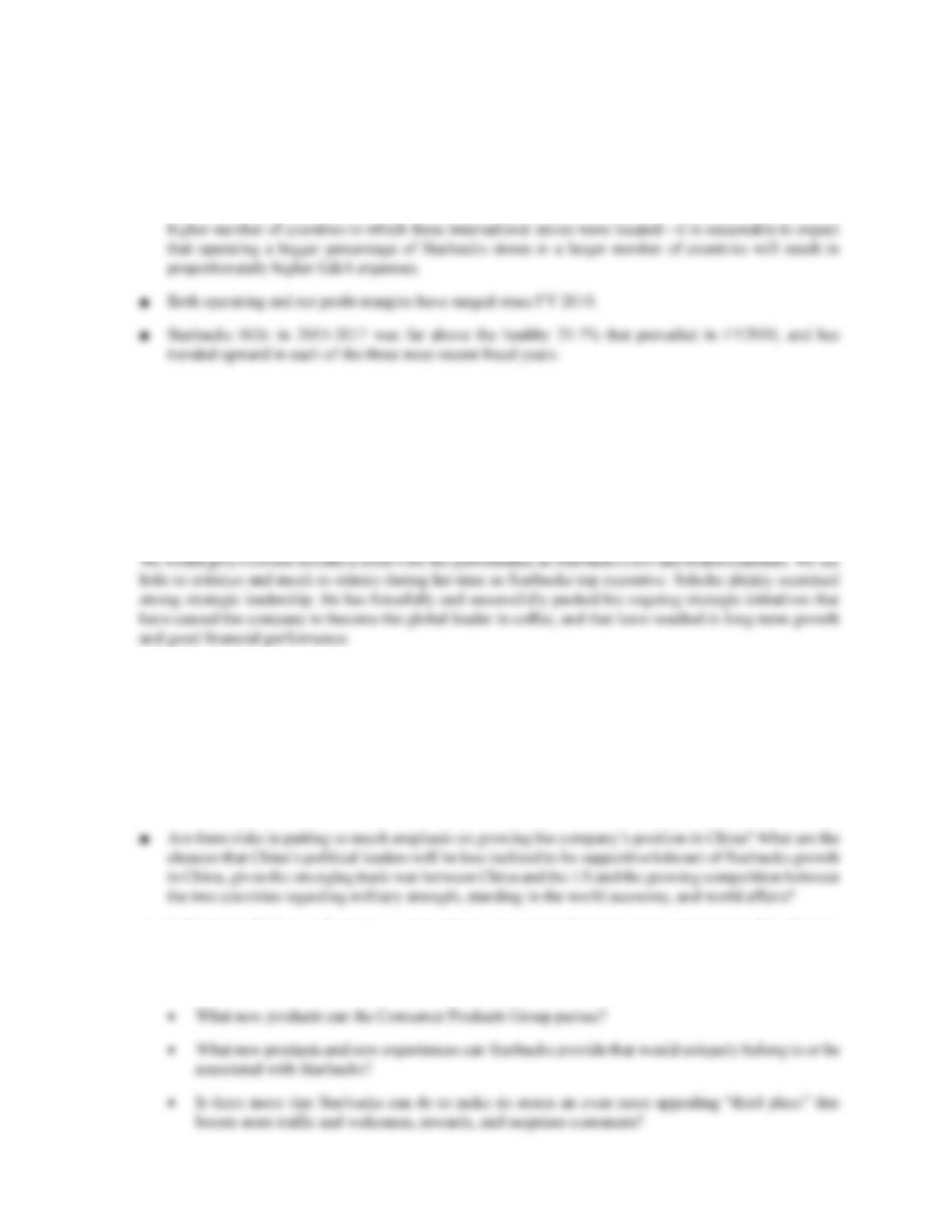
Some other operating and profitability stats based on the data in case Exhibit 1:
2017 2016 2015 2010
Cost of sales as a % of total net revenues 40.4% 41.6% 40.6% 41.6%
Store operating expenses as a % of net revenues from
company-operated stores
36.8% 36.0% 35.6% 39.6%
General and administrative expenses as a % of total net
revenues
6.2% 6.4% 6.2% 5.3%
Case 29 Teaching Note Starbucks in 2018: Striving for Operational Excellence and Innovation Agility
651
■ Store operating expenses as a percentage of net revenues from company-operated stores have trended
upward the past three fiscal year, but are well below the percentage in 2010.
■ General and administrative expenses as a percentage of total net revenues have been stable during
2015-2017 but are about one percentage point above the 2010 figure. One can speculate that the higher
G&A expenses in 2015-2017 have to do with the growing number of international locations and the
Conclusions Regarding Starbucks Financial Performance: all things considered, Starbucks financial
and operating ratios in fiscal years 2015-2017 were better than in FY2010—the primary exception was the
one percentage point increase in general and administrative expenses as a percent of total net revenues.
Moreover, students should recognize that the company’s balance sheet is adequately strong and that cash
flows from operations are more than ample to fund capital expenditures.
8. Did Howard Schultz do a good job during his years as Starbucks’ CEO? Why or why not?
What evidence can you cite in support of your position?
9. What issues confront the company as of mid-2018? What should Starbuck’s management
be worried about?
We see several important issues:
■ Can Starbucks continue to do well without Howard Schultz around to watch over things? Is the new
executive team up to dealing with the challenges that will ultimately be encountered and require effective
resolution?
■ Is Starbucks likely to exhaust its opportunities to innovate and sustain its long-term growth in the next
5 to 10 years?
• What new products can be offered in Starbucks stores?
10. What recommendations would you make to Kevin Johnson to sustain the company’s growth
and support continued strong financial performance in the years ahead?
Students may struggle a bit to come up with more than just keep on doing what the company is doing as of
mid-FY 202018. And the struggle is understandable—Starbucks has a comprehensive strategy that covers
many bases and leaves little out; Schultz has left the company firing on all cylinders. So no major overhaul
Nonetheless, it should be fairly easy for class members to come up with some definitive prescriptions for
management action for the 2019-2021 period:
■ The company must aggressively pursue new store openings (including Roasteries) and also transforming
some current Starbucks locations into Starbucks Reserve locations. Furthermore, in the years to come,
■ Continue to build the Starbucks brand name and perpetuate the Starbucks mystique.
Case 29 Teaching Note Starbucks in 2018: Striving for Operational Excellence and Innovation Agility
653
Epilogue
Starbucks financial performance in FY 2018 was stronger than in FY 2017. Full-Year 2018 highlights included
the following:
■ Consolidated net revenues of $24.7 billion, up 10% over the prior year.
■ GAAP Earnings Per Share of $3.24, up 64.5% from $1.97 in fiscal 2017.
■ Non-GAAP EPS of $2.42, up 17% over the prior year.
■ Operating income for fiscal 2018 was $3.88 billion in fiscal 2018 versus $4.13 billion in fiscal 2017.
■ Operating margin was 15.7% versus 18.5 percent in fiscal 2017.
■ Net cash flow provided by operating activities totaled $11.4 billion versus $4.25 billion in fiscal 2017.
■ Starbucks returned approximately $8.9 billion to shareholders through share repurchases and dividend
payments in fiscal 2018, in line with its target to return $25 billion by the end of fiscal 2020
■ The company repurchased 58.5 million shares of common stock in Q4 FY18.
Starbucks announced the following fiscal year 2019 targets:
■ Add approximately 2,100 net new Starbucks stores globally
■ Global comparable store sales growth near the lower end of the company’s current 3% to 5% range
In commenting on the company’s performance, CEO Kevin Johnson said: “we have a clear set of strategic
priorities for the future. These priorities include accelerate growth in our targeted long-term growth markets
of the U.S. and China; expand the global reach of the Starbucks brand; and sharpen our focus on increasing
shareholder returns.”
Case 29 Teaching Note Starbucks in 2018: Striving for Operational Excellence and Innovation Agility
654
OTHER RELEVANT UPDATES AT STARBUCKS AT THE END OF FISCAL 2018
In August 2018, Nestlé and Starbucks Corporation announced the closing of a deal granting Nestlé the perpetual
rights to market Starbucks Consumer Packaged Goods and Foodservice products globally, outside of the
company’s coffee shops.
In October 2018, Starbucks announced its intention to fully license its Starbucks operations in France, the
Netherlands, Belgium and Luxembourg to its longstanding business partner, Alsea. Furthermore, it introduced
a new support structure in the company’s EMEA head office to better serve an increasingly-licensed regional
strategy; plans called for closing its support center in Amsterdam, but continuing to operate its coffee roasting
facility in the Netherlands to serve European stores. Management said it would continue to invest in growing
a healthy store portfolio in the EMEA region, with company-operated stores serving as innovation centers for