– 677 –
Profiting from Pain: Business
and the U.S. Opioid Epidemic
Overview
Many observers traced the modern opioid epidemic to the introduction, in 1996, of a new prescription
medication called OxyContin. Opioids like OxyContin were highly addictive, and as users developed
tolerance, they required larger and larger doses to get high or just to feel normal. Withdrawal from
opioids, which could occur after even a single dose, could be excruciating. Opioids were killers. In high doses,
these drugs caused breathing to slow and finally stop, bringing death by respiratory arrest. In 2015, 33,091
Americans died from an opioid overdose. This tally was just slightly less than the number that died that year in
car accidents. Between 1999 and 2015, the rate of death from opioid overdose (number of deaths per 100,000
people) quintupled, that is, it was five times higher in 2015 than it was a decade and a half earlier.
In 2017, McKesson Corporation, a leading wholesale drug distributor, agreed to pay $150 million in fines to
the U.S. Department of Justice, stemming from charges that the company had failed to implement effective
controls to prevent the diversion of prescription opioids for non-legitimate uses, in violation of the Controlled
Substances Act. At the time McKesson was the fifth largest company in the United States—with almost $200
billion in annual revenue—and it had played a largely unnoticed middleman role in the pharmaceutical industry.
McKesson and other drug distributors were not the only businesses implicated in the nation’s burgeoning
What responsibility did these businesses bear for the tragedy of opioid addiction, disability, and death? Did any
other stakeholders also bear responsibility?
*
case 32 teaching note
Case 32 Teaching Note Profiting from Pain: Business and the U.S. Opioid Epidemic
678
Suggestions for Using the Case
The case pairs particularly well with the coverage of ethics and corporate social responsibility, covered in Chapter
9. It fits particularly well with a guided discussion to achieve a major learning objective in Chapter 9: “Apply the
concepts of corporate social responsibility and environmental sustainability and learn how companies—in this
instance, the large pharmaceutical manufacturers of opioids as well as the myriad of legitimate pain clinics as well
as non-legitimate businesses that acted as their distributors—balance these duties with economic responsibilities
to shareholders.” Instructors can direct students to critically evaluate the actions of multiple stakeholders, by
Specific and measurable learning objectives that can be met with this case include:
Develop students’ understanding that the term corporate social responsibility concerns a company’s
duty to:
• Operate in an honorable manner
• Provide good, safe, healthy working conditions for employees
Apply Chapter 9 concepts of Ethical universalism, Ethical relativism, and Integrative social contracts
theory to a pervasive social problem:
• Ethical universalism, which holds that the most fundamental conceptions of right and wrong are
universal and apply to members of all societies, all companies, and all businesspeople.
• Ethical relativism, which holds that differing religious beliefs, customs, and behavioral norms
across countries and cultures give rise to multiple sets of standards concerning what is ethically
right or wrong. These differing standards mean that whether business-related actions are right or
wrong depends on the prevailing local ethical standards
Case 32 Teaching Note Profiting from Pain: Business and the U.S. Opioid Epidemic
679
Illustrate how well-crafted CSR strategies are in the best long-term interest of shareholders, for the
reasons just mentioned and because they can avoid or preempt costly legal or regulatory actions
• CSR strategies that both provide valuable social benefits and fulfill customer needs in a superior
fashion can lead to a competitive advantage
• In addition to providing a competitive advantage, there are solid reasons why CSR strategies may
be good business—they can be conducive to:
Analyze the three types of business costs of ethical failures described in Chapter 9:
• Visible costs:
• Internal administrative costs:
— Legal and investigative costs incurred by the company
• Intangible or less visible costs:
— Customer defections
— Loss of reputation
Case 32 Teaching Note Profiting from Pain: Business and the U.S. Opioid Epidemic
680
To facilitate your use of study questions and to make them available to students, we have posted a file of the
assignment questions contained in this teaching note for the Profiting from Pain in the instructor resources
section of the Connect Library.
You may also find it beneficial to have your class read the Guide to Case Analysis that is also posted in the
instructor resources section of the Connect Library. Students will find the content of this Guide particularly
helpful if this is their first experience with cases and they are unsure about the mechanics of how to prepare a
case for class discussion, oral presentation, or written analysis.
The Connect-based Exercise for the Profiting from Pain: Business and the U.S. Opioid Epidemic
case. A Connect case exercise has been developed for all cases included in the 22nd Edition. Each case exercise
follows the assignment questions listed in the teaching note for the case and require students to work through
What grade would you give to the U.S. pharmaceutical industry for its companies’ individual and collective
efforts to sustain corporate social responsibility? Prepare a report that includes: (1) an evaluation of the
U.S. opioid epidemic’s impacts on stakeholders, (2) an assessment of the pharmaceutical industry and
Case 32 Teaching Note Profiting from Pain: Business and the U.S. Opioid Epidemic
681
Assignment Questions
1. How would you describe the pharmaceutical industry’s strategy leading up to the opioid crisis? Is it ethical?
Why or why not?
2. Is there anything that the pharmaceutical industry has done or is now doing in the aftermath of that crisis
that could legitimately be considered as “unethical” by its stakeholders? What grade would you assign to the
industry for its handling of the crisis? Explain.
Teaching Outline and Analysis
1. How would you describe the pharmaceutical industry’s strategy leading up to the opioid
crisis? Is it ethical? Why or why not?
Instructors should push students to reach their own conclusions as to whether or not the actions of various
pharmaceutical industry stakeholders leading up to, during, and in the immediate aftermath of the U.S. opioid
Case 32 Teaching Note Profiting from Pain: Business and the U.S. Opioid Epidemic
682
II. Other students may well argue that, from “the business of business is business, not ethics” kind of
thinking apparent in recent high-profile business scandals illustrated in Chapter 9 of the text.
a. At least three aspects of unethical business behavior were apparent at the pharmaceutical industry:
(1) faulty oversight, enabling the unscrupulous pursuit of personal gain and self-interest, particularly
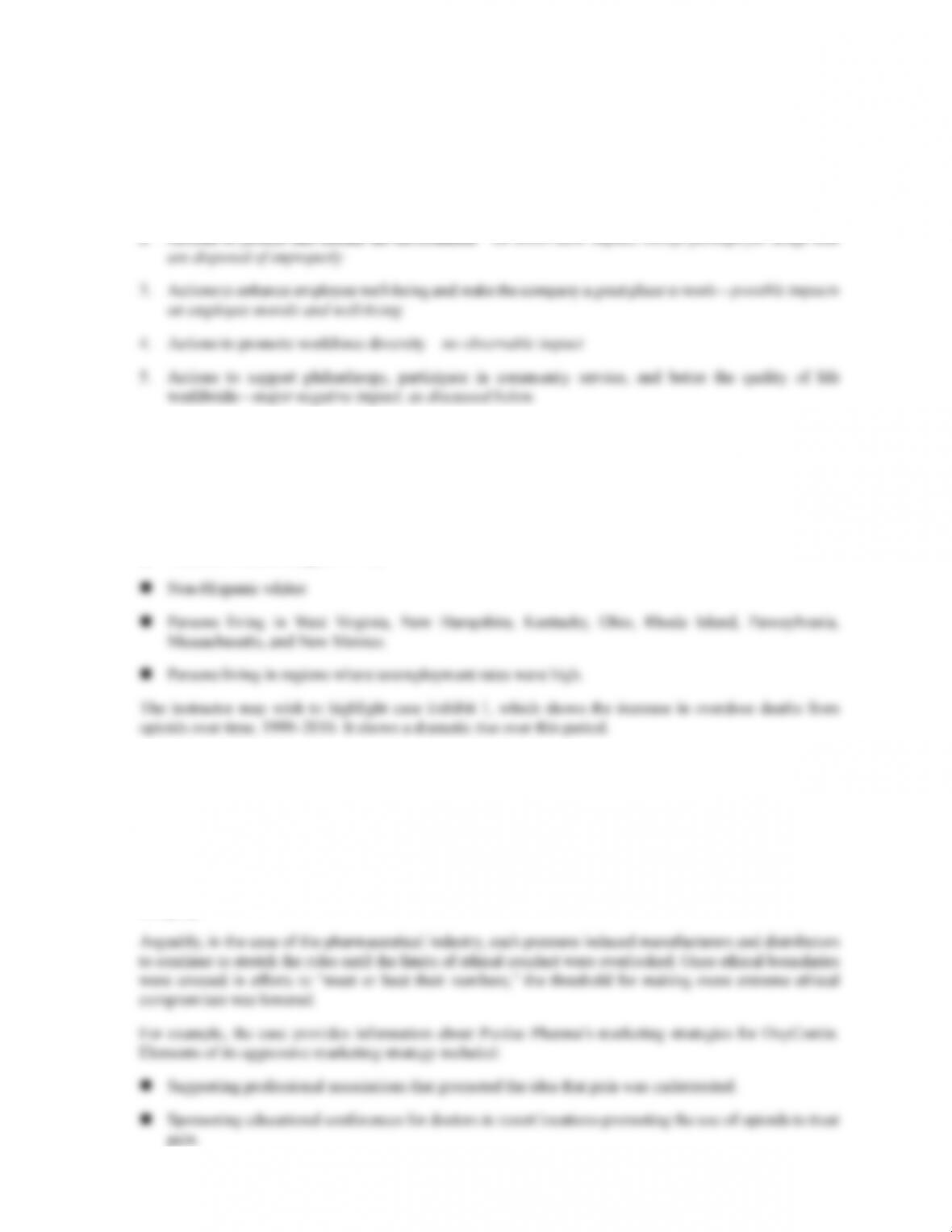
See Table 1, “Business Stakeholder Actions in the U.S. Opioid Crisis and Stakeholders Impacted”
TABLE 1. Business Stakeholder Actions and Stakeholders Impacted in the U.S. Opioid Crisis
Stakeholder
No, did not act
responsibly
Yes, acted
responsibly Stakeholders helped Stakeholders hurt
Drug manufacturers
Purdue Pharma
Also: Teva,
Johnson &
Johnson, Endo,
Allergan
Aggressively marketed
Oxycontin, causing its
use to soar
Downplayed potential
for addiction, without
solid scientific basis
Brought to market
a drug that treated
pain
In 2010, changed
formulation
of OxyContin
Some patients with
chronic pain had access
to pain medication who
might not have had
access previously
Shareholders and owners
Addicts: tens of
thousands of deaths
due to opioid overdose
Communities
and government:
increased costs for law
Distributors
McKesson
Also:
Paid $170 million in fines
for failure to implement
Shipped only FDA-
approved drugs
Efficient delivery of
medication, benefitting
Failure to divert
drugs that were used
Pain clinics
American Pain
Prescribed almost 2
million opioids over a
2-year period
Owners and doctors
made a lot of money
Inappropriate
prescribing and
dispensing of opioids
Drug dealers
“Xalisco Boys”
Delivered heroin directly
Cartel bosses made a lot
Illegal sale of heroin
Case 32 Teaching Note Profiting from Pain: Business and the U.S. Opioid Epidemic
683
Were any of these actions consistent with corporate social responsibility?
As depicted in Figure 9.2 in the textbook, taken together, environmental sustainability and corporate social
responsibility (CSR) programs commonly include the following five elements:
1. Actions to ensure the company operates honorably and ethically—possibly
2. Actions to protect and sustain the environment—no observable impact, except perhaps for drugs that
What has been the impact of the U.S. opioid crisis thus far?
According to the case, in 2015, 33,091 Americans died from an opioid overdose. Between 1999 and 2015,
the rate of death from opioid overdose (number of deaths per 100,000 people) quintupled, that is, it was five
times higher in 2015 than it was a decade and a half earlier. Demographics of those citizens heavily impacted
include:
Persons in mid-life (aged 45–54)
2. Is there anything that the pharmaceutical industry has done or is now doing in the aftermath
of that crisis that could legitimately be considered as “unethical” by its stakeholders? What
grade would you assign to the industry for its handling of the crisis? Explain.
As discussed in Chapter 9, oftentimes pressure to “never miss a quarter”—so as not to upset the expectations
of analysts, investors, and creditors—prompts “nearsighted managers to engage in short-term maneuvers
to make the numbers, regardless of whether these moves are really in the best long-term interests of the
company.”
Case 32 Teaching Note Profiting from Pain: Business and the U.S. Opioid Epidemic
684
Doubling its staff of sales representatives and incentivized them based on sales.
Utilitarian or cost-benefit analysis
To explore the question of the pharmaceutical industry’s ethics using a utilitarian approach, instructors
may first wish to ask students to consider the potential costs of its strategy leading up to the mine disaster.
See Table 2, “Assessing the Potential Costs of the Pharmaceutical’s Industry’s Opioid Strategy,” which is
adapted from Figure 9.1 in the textbook.
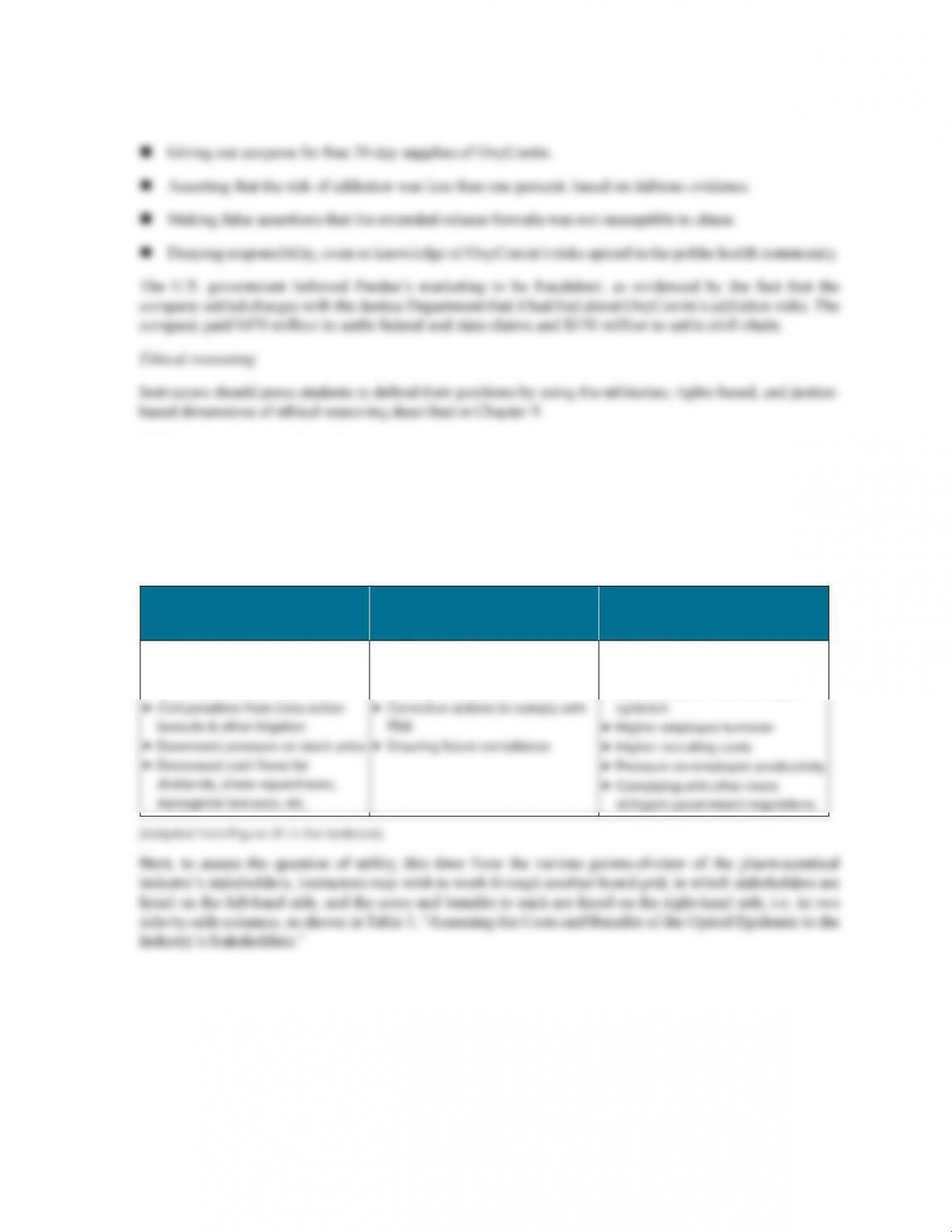
TABLE 2. Assessing the Potential Costs of the Pharmaceutical Industry’s Opioid Strategy
Potential Visible
Costs
Potential Internal
Administrative
Costs
Potential Intangible
( less visible)
Costs
• Addiction, loss of life & physical
injuries
• Government fines & penalties
• Legal & investigative
• Remedial safety education & ethics
training to company personnel
• Customer defections
• Loss of reputation
• Lost employee morale & higher
Case 32 Teaching Note Profiting from Pain: Business and the U.S. Opioid Epidemic
685
TABLE 3. Assessing the Costs and Benefits of the Opioid Epidemic to the Pharmaceutical
Industry’s Stakeholders
Stakeholder Benefits Costs/risks
Managers Relatively high pay and status Demanding government regulations, stressful
jobs
Board of directors Annual compensation for a few days
of meetings
Reputational risks due to association with
companies with a poor reputation for
monitoring the usage of their pain medications
Shareholders Returns on par with or not much
different from industry averages
High volatility, high risk investments
Costs of payouts to families of deceased
Employees For some, a relatively high-paying
job in a high technology field
For the families of victims: addiction, illness,
and potential loss of a loved one
Customers A steady supply of high-quality,
Addiction, illness, and potential loss of life
Local community Some jobs, some taxes, some
Costs of addiction treatment
Government regulators May contribute to greater allocation
of funding and positions to the
Costs of addiction treatment programs
Costs of monitoring compliance
Based on the above lists, a utilitarian could argue this case either way.
Some would conclude that the benefits (ends, or results) of the pharmaceutical industry’s actions did not
justify the costs (means).
Rights-based analysis
This approach to ethical reasoning holds that, individuals are to be treated as valuable ends in themselves,
just because they are human beings. Using others for your own purposes is unethical if, at the same time,
you deny them their goals and purposes. Using the rights-based or moral ethical viewpoint, some students
may argue that:
Case 32 Teaching Note Profiting from Pain: Business and the U.S. Opioid Epidemic
686
Justice-based analysis
While a person using utilitarian reasoning adds up costs and benefits to see if one is greater than the other;
if benefits exceed costs, then the action would probably be considered ethical, alternatively, a person using
justice reasoning considers who pays the costs and who gets the benefits; if the shares seem fair (according
3. In what ways, if any, should the stakeholders in the U.S. opioid crisis bear responsibility? Are
there any changes to the industry actors’ CSR strategy that you would suggest?
This question provides the greatest potential for higher-order reasoning and critical thinking.
Individuals. Ultimately, individuals are responsible for their own drug use. If people had taken medication
strictly as prescribed by their doctors, they would not have become addicted. If they started to become
dependent, they should have discussed this issue with their doctors and entered a rehabilitation program if
Case 32 Teaching Note Profiting from Pain: Business and the U.S. Opioid Epidemic
687
Students may less often make the case that the following actors were primarily responsible:
Drug dealers, particularly the Mexican drug cartels.
Businesses should act in a manner that benefits all of a company’s and industry’s stakeholders—not just
shareholders: “It’s the right thing to do.” Ordinary decency, civic-mindedness, and contributions to society’s
well being should be expected of any business.
A complementary school of thought acknowledges that business operates on the basis of an implied
social contract with the members of society.
• According to this contract, society grants a business the right to conduct its business affairs and
agrees not to unreasonably restrain its pursuit of a fair profit for the goods or services it sells
The business case for CSR
The business case for the pharmaceutical industry to manufacture, market, and distribute opioids has thus
far resulted in:
Increased buyer patronage—probably, since opioid production increased dramatically from 1994–2013,
as shown in case Exhibit 2
Case 32 Teaching Note Profiting from Pain: Business and the U.S. Opioid Epidemic
688
Lower costs/enhanced employee recruiting and workforce retention—unknown impact on employee
recruitment and retention
4. If some shareholders complained that the pharmaceutical industry has been spending too
little or too much effiort on corporate social responsibility, what would you tell them?
Clearly, the pain inflicted by the opioid epidemic has exceeded addiction and the astonishing rise in overdose
deaths as graphically shown in case Exhibit 1:
People who were addicted to opioids stole from their neighbors to support their habit, ignored their
work and family responsibilities, and strained public welfare, law enforcement systems, and detention
centers.
Case 32 Teaching Note Profiting from Pain: Business and the U.S. Opioid Epidemic
689
5. Is the pharmaceutical industry striving to conduct business in a socially responsible manner?
What specific additional actions could the pharmaceutical industry take that would make an
even greater contribution to CSR? What might be the long-term interests of shareholders?
How might a commitment to CSR contribute to the pharmaceutical industry’s competitive
advantage or profitability?
The arguments as to whether or not the pharmaceutical industry is behaving in a manner consistent with
CSR generally comes down to the debate between legal scholars that is quoted at the end of the case:
Pro:
Pursue R&D for substitute, non-addictive, non-lethal pain medications:
• Discontinue production of and voluntarily withdraw all opioid-based medicines
• (Company managers and boards of directors) Design compensation systems that reward the
development of safe and non-addictive substitutes for opioids as well as medications that can be
Case 32 Teaching Note Profiting from Pain: Business and the U.S. Opioid Epidemic
690
On the public policy or governmental side, students may propose to:
Strengthen protective legislation:
• Congress needs to strengthen powers of regulatory agencies that have jurisdiction over opioids,
such as DEA and FDA, and give these agencies sufficient authority to enforce their citations.
Close the border with Mexico to prevent the movement of drug dealers and illegal drugs.
Prosecute executives of drug makers, distributors, pharmacies and clinics that improperly make, market,
distribute, or prescribe opioids.
Bring civil suits against those responsible.
Wrapping Up The Class
This is a good place to wind up the discussion of the case by reminding students that:
CSR strategies can provide both valuable social benefits and fulfill customer needs in a superior fashion—
and lead to competitive advantage for a company
Epilogue
For updates, go to the U.S. Department of Health and Human Services web page: https://www.hhs.gov/opioids/.