– 439 –
Netflix’s Strategy in 2018
Overview
Throughout 2017 and the first three months of 2018, Netflix was on a roll. Movie and TV show enthusiasts
across the world were flocking to become Netflix subscribers in unprecedented numbers, and shareholders
were exceptionally pleased with Netflix’s skyrocketing stock price. Over the past eight years, the company
had successfully transformed its business model from one where subscribers paid a monthly fee to receive an
unlimited number of DVDs each month (delivered and returned by mail with one title out at a time) to a model
where subscribers paid a monthly fee to watch an unlimited number of movies and TV episodes streamed over
the Internet. In 2018, Netflix was the world’s leading Internet television network with over 117 million streaming
memberships in over 190 countries enjoying more than 140 million hours of TV shows and movies per day,
including original series, documentaries, and feature films. Netflix members could not only watch as much
streamed content as they wanted—anytime, anywhere, on nearly any Internet-connected screen—but they could
also play, pause, and resume watching, all without commercials. In the United States, Netflix still had 3.4 million
members in 2018 who, because of slow or limited Internet service, continued to receive DVDs solely by mail
(but the numbers of mail-only subscribers were steadily declining).
Netflix’s swift growth in the United States and its promising potential for further expanding its international
subscribers pushed the company’s stock price to an all-time high of $331.44 on March 5, 2018, up from an
opening price of $124.96 on January 3, 2017. Already solidly entrenched as the biggest and best-known Internet
Suggestions for Using the Case
This freshly updated and revised Netflix case has all the ingredients for an outstanding and enlightening class
discussion. The market for online viewing of all types of entertainment programs has been in a state of rapid
flux during most of the past two years, and Netflix is driving hard to win a commanding leadership position in
: Does the
case 14 teaching note
Company Have Suffcient Competitive
Strength to Fight O Aggressive Rivals?
Case 14 Teaching Note Netflix’s Strategy in 2018
440
We think the Netflix case is probably best assigned after you have covered Chapters 1-7. It is an ideal case for
drilling students in the tools of analysis covered in Chapters 3 and 4. The material in Chapters 5 and 6 is pertinent
to student identification and assessment of Netflix’s strategy and competitive approaches. And, with Netflix’s
strategy to rapidly grow its worldwide subscriber base, the material in Chapter 7 regarding competing in foreign
Videos for Use with the Netflix Case. There is a 2016 YouTube video which you might want to show the
class (or have students watch on their own). It is a 3:06-minute video entitled “Inside Netflix’s Plan to Get the
Whole World Watching.” It can be accessed at https://www.youtube.com/watch?v=JdtnX_P-4Qc.
The Connect-based Exercise for the Netflix Case. We developed an exercise for Netflix for inclusion in
the publisher’s Connect™ Management web-based assignment and assessment platform because:
The case ties tightly to many of the topics covered in Chapters 3 through 7.
This particular Connect-based exercise focuses on concerns the following four questions:
1. What forces are driving change in the streamed entertainment industry? Are the combined impacts
of these driving forces likely to be favorable or unfavorable in terms of their effects on competitive
intensity and future industry profitability?
2. What does your strategic group map of the industry look like as of 2018? How attractively is Netflix
positioned on the map? Why?
3. What concerns do you have about Netflix’s situation, given the financial data contained in case Exhibits
2, 3, 6, and 7?
4. How does Netflix’s competitive strength compare against that of Blockbuster and Amazon? Do a
weighted competitive strength assessment using the methodology presented in Table 4.4 in Chapter 4
to support your answer. Based on your assessment and calculations, does Netflix have a net competitive
advantage over Blockbuster and/or Amazon?
It should take class members roughly 45 minutes to complete the exercise, assuming they have done a
conscientious job of reading the case and absorbing the information it contains.
Case 14 Teaching Note Netflix’s Strategy in 2018
441
However, be alert to the fact that the competitive strength assessment portion of the exercise is not subject to
definitively correct answers because the weights students assign to the strength factors are partly subjective.
For instance, while class members may well view a particular measure of competitive strength as being “very
What to Tell Students in Preparing the Netflix Case for Class. To give students guidance in what to do
and think about in preparing the Netflix case for class discussion, we strongly recommend two things:
1. Have class members complete the Connect-based exercise for the Netflix case in the event you have
adopted the Connect software for your course.
To facilitate your use of assignment questions and making them available to students, we have posted a file of
the Assignment Questions contained in this teaching note in the instructor resources section of the Connect
Library (You should be aware that there is a set of assignment questions posted in the Connect Library for
each of the cases included in the 22nd edition.) In all instances, these assignment questions correspond to the
assignment questions in the teaching note for the case.
Utilizing the Guide to Case Analysis. If this is your first assigned case, you may find it beneficial to have
Suggested Assignment Questions for an Oral Team Presentation or Written Case Analysis. We
definitely recommend use of the Netflix case for written assignments and oral team presentations. Our suggested
assignment questions are as follows:
Netflix CEO Reed Hastings has employed you as a consultant to assess the company’s overall situation
and recommend a set of actions to improve the company’s future prospects. Please prepare a report to
Case 14 Teaching Note Netflix’s Strategy in 2018
442
and financial performance, (6) a weighted competitive strength assessment using the methodology in
Assignment Questions
1. How strong are the competitive forces in the rapidly evolving global market for streamed video content? Do
a five-forces analysis to support your answer.
2. What forces are driving change in this “new” global industry? Are the combined impacts of these driving
forces likely to be favorable or unfavorable in term of their effects on competitive intensity and future
industry profitability?
3. What does your strategic group map of this industry look like? How attractively is Netflix positioned on the
map? Why?
4. What key factors will determine a company’s success in this industry in the next 3-5 years?
5. What is Netflix’s strategy? Which of the five generic competitive strategies discussed in Chapter 5 most
closely fit the competitive approach that Netflix is taking? What type of competitive advantage is Netflix
trying to achieve?
Case 14 Teaching Note Netflix’s Strategy in 2018
443
Teaching Outline and Analysis
1. How strong are the competitive forces in the movie rental marketplace? Do a five-forces
analysis to support your answer.
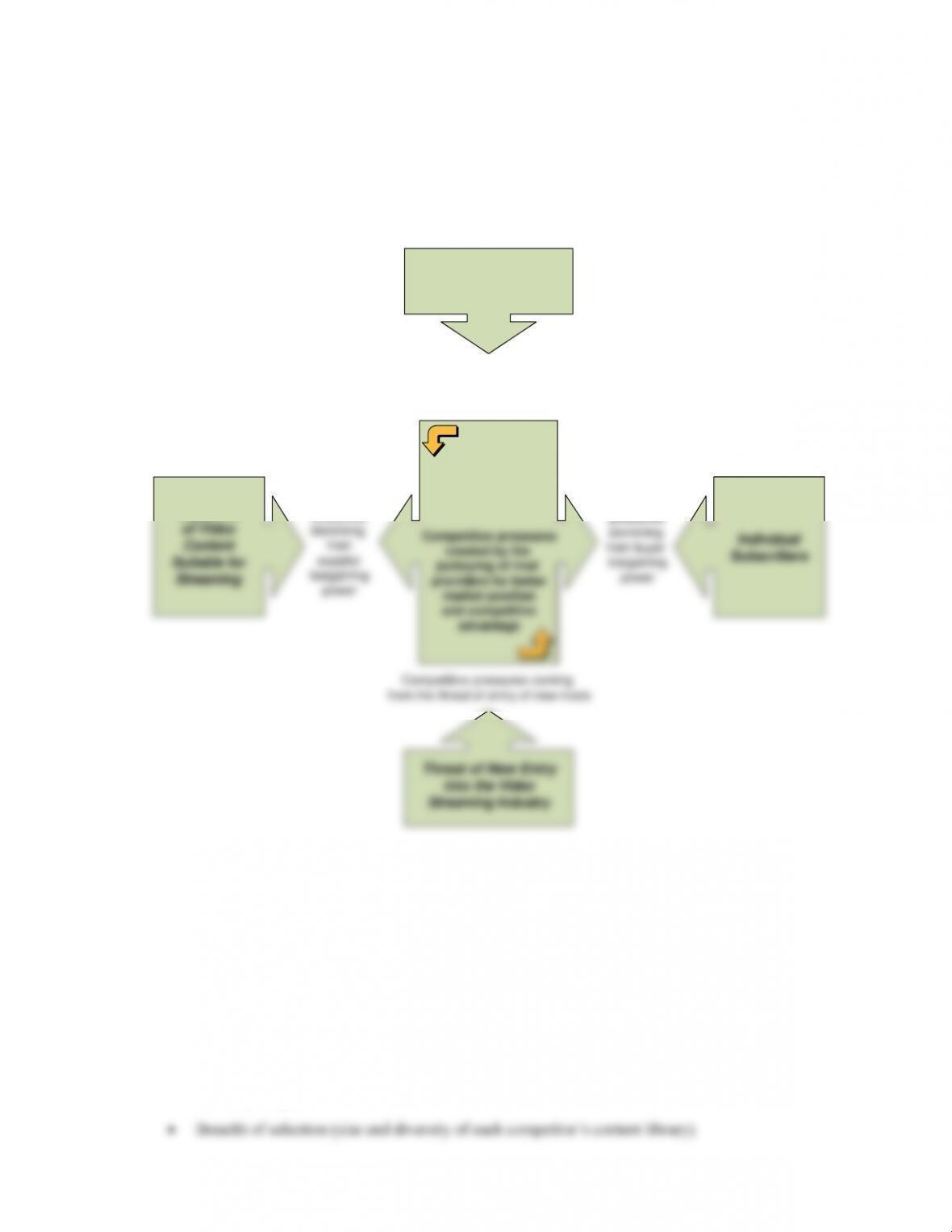
Below is a representative five-forces model of competition in the online video streaming industry:
Competitive pressures coming
from the threat of entry of new rivals
Suppliers
Competitive
Competitive
Substitutes for
Online Streaming
Competitive pressures coming from
the market attempts of outsiders
to win buyers over to their products
Rivalry among
Streaming Video
Providers
Threat of New Entry
into the Video
Streaming Industry
Rivalry among subscription-based providers of streamed video content—a strong to fierce competitive
force that is likely to intensify in the years ahead
In assessing this competitive force, students should be directed to refer to and utilize the presentations in
Table 3.2, Figure 3.4, and the associated discussion on rivalry in Chapter 3.
Students should conclude that rivalry among Netflix, Amazon Prime, Hulu, HBO, and other competitors
(especially video-on-demand providers that stream movie rentals directly to the renter’s TV or PC or
handheld device) seems destined to grow more intense. All competitors are scrambling to attract the
patronage of individuals/households that rent movies—the battle for sales revenues and market shares
is very contested and seems destined to become more fierce. Rivalry is centered on such factors as
• Subscription price.
Case 14 Teaching Note Netflix’s Strategy in 2018
444
• Ease of browsing through all the selections to identify appealing options and select which content
to watch.
Most streaming competitors pursue some version of a differentiation strategy to try to set themselves
apart on the basis of one or more competitive factors—typically subscription price, content, and brand
recognition and reputation.
Several factors were working to intensify rivalry among industry participants:
• All rivals are actively and busily launching fresh promotional initiatives (free trials and ads
promoting new original content, for example) A large number of fresh, ongoing strategic initiatives
on the part of various rivals heightens rivalry.
Case 14 Teaching Note Netflix’s Strategy in 2018
445
Threat of entry—a weak to moderate to strong competitive force, depending on geographic location
and subscriber access to high-speed Internet service.
In assessing this competitive force, students should be directed to refer to and utilize the presentation in
Figure 3.5 and the related text discussion.
In 2012, the windows for entering the brick-and-mortar segment of the movie DVD rental business and
the mail-delivery subscription segment are pretty much closed. It will become increasingly difficult for
new entrants using business models like Netflix or Apple or Amazon or Hulu or Vudu or Redbox to
overcome entry barriers and capture enough business to compete profitably. Trying to go head-to-head
against Netflix and Amazon in the online subscription segment seems unattractive to most any new
entrant (the entry barriers are high). The barriers to entry into online subscription segment of the movie
rental business for enterprises wanting to cover a large geographic area and compete on a “national” or
“international” scale include:
• The rapidly escalating cost of licensing attractive content from movie studios and TV networks,
producing original content, and gaining rights to stream live sporting and entertainment events.
Clearly, the biggest entry threat into the streaming marketplace in 2018 and beyond are new or
existing enterprises that enter geographical areas where they have heretofore not had a market
presence. But the remaining time to enter this segment in many countries of the world and currently
underserved areas within countries is growing shorter. The most likely entry candidates into the
Internet-streaming segment are those few companies that have the resources and name recognition
Case 14 Teaching Note Netflix’s Strategy in 2018
446
Competition from substitutes—a moderate to strong competitive force, depending on the extent to
which consumers prefer to watch content on-demand versus watching movies at movie theaters or
buying movie DVDs for their own personal library.
In assessing this competitive force, students should be directed to refer to and utilize the presentation in
Figure 3.6 and the related text discussion.
There are currently four principal substitutes for watching movies/TV shows: (1) buying movie DVDs
and/or the DVDs of new and old TV shows for one’s own personal library, (2) watching a movie on
In addition, there are hordes of entertainment substitutes for watching movies/TV shows altogether
(most specially going to live sports events or concerts)—but all these other entertainment forms may
not be good substitutes for people who prefer to watch movies in their home at their own convenience
and are frequent or dedicated movie watchers.
All things considered, class members should conclude that substitutes for streamed entertainment are a
relatively strong competitive force, given that
• Acceptable substitutes are readily available and competitively priced (in some cases).
The bargaining power and leverage of suppliers—a moderate to very strong competitive force,
depending on the type of supplier.
In assessing this competitive force, students should be directed to refer to and utilize presentation in
Figure 3.7 and the related text discussion.
Class members should recognize that movie studios and TV networks and the “owners” of live sports
events (like professional and collegiate sports and the Olympics) have great bargaining power and
Case 14 Teaching Note Netflix’s Strategy in 2018
447
The bargaining power and leverage of individual subscribers/viewers of streamed content—a weak
competitive force
In assessing this competitive force, students should be directed to refer to and utilize the presentation in
Figure 3.8 and the related text discussion.
• Individuals have virtually no power to bargain for a lower price on streamed content from Netflix,
Amazon Prime Video, or other streamed content providers. They can choose to pay the going rates
Conclusions concerning the overall strength of competitive forces: Competitive pressures in
the streamed entertainment industry are definitely strong and could grow stronger in upcoming years—
there seems little likelihood of competition becoming weaker. Currently, we see rivalry as the strongest of
the five competitive forces, followed closely by the bargaining power of content providers and, somewhat
2. What forces are driving change in the streamed entertainment industry? Are these driving
forces likely to have a favorable or unfavorable impact on competitive intensity and future
industry profitability?
You may want to direct students to Table 3.3 and the related discussion in Chapter 3 in singling out the
driving forces that are at work.
Class members, especially those that have completed the Connect-based exercise for this case, should
identify many of the following as driving forces:
Technological changes related to the Internet.
• Many TVs and DVRs are now Internet ready or have built-in Internet connectivity (which is
reflective not only of technological change but also of product innovation).
Case 14 Teaching Note Netflix’s Strategy in 2018
448
Changes in how the product is used/viewed. There has been a rapid switch from renting DVDs to watch
movies to watching streamed content on big-screen, high definition screens and, increasingly, on all
kinds of mobile devices.
Changes in costs
• Prices for wide-screen, high definition TVs have been dropping rapidly and picture quality has
dramatically improved (and become stunning on the latest generation of TVs). The latest generation
Product innovation (partly driven by technological changes)
• The latest generations of TVs have stunning picture quality. Such quality is being migrated to
Marketing innovations
Netflix’s recent moves to enter the markets of virtually all foreign countries and become the global market
leader in streaming content to subscribers across the world has become a driving force that pressures
Conclusions: The combined impact of these driving forces in the marketplace should be analyzed by
answering three questions:
What is the likely effect of the driving forces on demand for streamed content? Students should
conclude that the driving forces will likely result in streamed content becoming the standard way for
Are the driving forces acting to strengthen or weaken competition? The weight of evidence indicates
that the driving forces will all act to intensify competition among the various streaming providers.
Will the driving forces lead to higher profitability among the streaming providers? We think the best
answer here is probably “no,” because of the power of content providers to extract a “high/rising” price
Case 14 Teaching Note Netflix’s Strategy in 2018
449
3. What does your strategic group map of this industry look like? Is Netflix well-positioned?
Why or why not?
Strategic group maps are beneficial for determining relative company placement in the industry. A good
strategic group map should utilize two strategic variables that differentiate the various competitors in the
movie rental marketplace.
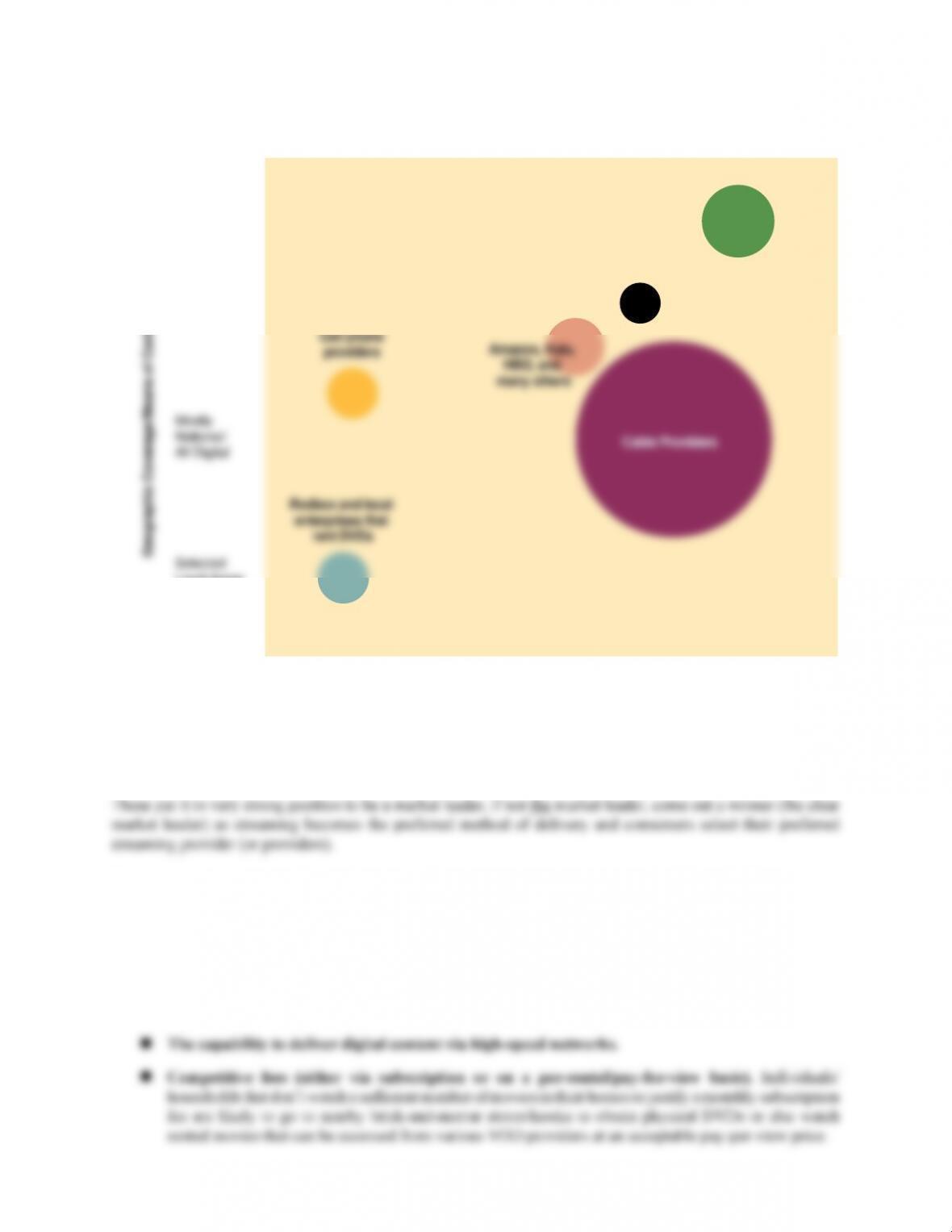
A representative strategic group map is shown in Figure 1 (it matches what class members will be using in
the Connect-based exercise for this case).
Once students have come up with a map, then we think you should press them for their evaluation of what we
learn from the map. Any of the following questions can be posed to help draw out their views:
Which company is better positioned—Netflix or Redbox? (We favor Netflix because of its lead in
migrating to streaming technology and devices for delivering rented movies to subscribers.)
The point here is that students should not stop their analysis with just drawing a strategic group map. The
most important part of strategic group mapping is to draw some conclusions about the story the map tells.
On the whole, we definitely like Netflix’s position on the map—it has the strongest geographic coverage and
it has excellent digital delivery capability; its DVD by mail business is shrinking rapidly. However, Amazon,
Case 14 Teaching Note Netflix’s Strategy in 2018
450
FIGURE 1 A Representative Strategic Group Map of the Providers of Video
and Streamed Content
Cell phone
Wide
Breadth of Product Offerings
Global/
Mostly Digital
Multinational/
All Digital
Local Areas
Only/All DVD
Narrow
Netflix
Satellite
providers
Class members should definitely like the position that Netflix has on the strategic group map shown above, for
two reasons. It has both mail delivery and streaming capability. It has a wide variety of titles in its content library.
4. What key factors will determine a company’s success in the digital entertainment industry
in the next 3-5 years?
We see perhaps as many as 5 key success factors for companies that want to make money in streaming
digital content to in-home or mobile devices:
A wide selection of titles that includes most all of the following: movies, TV episodes, video games,
and live events.