– 362 –
MoviePass—Are Subscribers
Loving It to Death?
Overview
Attendance at movie theaters had dropped significantly in the U. S. Ticket sales fell from a high of 1.58
billion tickets in 2002 to 1.28 billion in 2011, as Americans were increasingly willing to pay for home
movie rentals through Netflix and for cable TV entertainment. In 2011, Stacy Spikes and Hamet Watt
launched MoviePass, intended to combat the steady decline in theater movie ticket sales. The pair believed they
could drive patrons to theaters through a subscription-based movie ticket service. The traditional movie ticket
model was based on a theater – customer transaction. When a customer wanted to see a movie, they purchased a
ticket for a specific time and location. Spikes and Watt introduced a service that allowed customers to pay a flat
monthly fee (originally $30 per month which fell to $7.95 per month by 2018), that allowed customers to see one
2D movie a day (no 3D or IMAX movies), and to choose between a variety of theaters.
In 2016, Mitch Lowe, an executive with previous experience at Redbox and Netflix, joined the company and
began to experiment with prices ranging from $15 a month plan for two movies a month in small markets to an
unlimited plan for $50. In early August 2017 the company had approximately 20,000 subscribers. On August 15,
2017, the company announced an aggressive $9.95 subscription price and that an agreement had been made for
Helios and Matheson Analytics, Inc., to acquire 53.71 percent of MoviePass for $28.5 million. The plan was for
Helios and Matheson to monetize the data generated by MoviePass’s subscriber platform. By October 24, when
the deal with Helios and Matheson Analytics, Inc. closed, MoviePass subscriber base had grown to over 600,000.
case 8 teaching note
*
Case 8 Teaching Note MoviePass—Are Subscribers Loving It to Death?
363
advertising revenue, and the launch of a movie distribution company—MoviePass Ventures—that would allow
them to distribute independently. By July 2018, as MoviePass exceeded three million subscribers, Helios and
Matheson’s stock price fell to record lows of less than 40 cents a share. Investor confidence was deeply shaken
as the company’s cash flow deficits ballooned past $20 million per month.
The future of MoviePass and Helios & Matheson became uncertain as losses increased. The December 31,
2017 balance sheet showed an accumulated deficit of $189.5 million, and monthly losses continued into 2018.
As its share price plummeted, Helios & Matheson was faced with decisions about its future and the future of
MoviePass. Although there was potential value in the data from the millions of subscribers that MoviePass had
acquired over its life, and the company had millions of active subscribers, the magnitude of losses had become
untenable. Sound decisions needed to be made quickly.
There is ample detail in the case for students to evaluate:
MoviePass and Helios & Matheson’s strategy
Suggestions for Using the Case
This brand new, highly interesting case should generate considerable student interest because many students
will be familiar with MoviePass and some may be subscribers. There will be lively, interesting class discussion
of whether it was ever possible for the company to attain a profit, given its business model. Also, MoviePass
had recently tarnished its image with poor customer service, changing the terms of subscriptions (the number of
movies customers could see), and experimenting with pricing. Students will have spirited debate, focusing on the
pros and cons of changing the subscription prices and terms, and how should they be changed.
The MoviePass case is an excellent mid to late semester case and is probably best assigned after you have
covered Chapters 1–4, but it can be successfully used after students have read just Chapters 3, 4, and 5. The
topics covered in Chapter 9 are pertinent to student identification and assessment of the ethics and sustainability
of MoviePass’ business model and Helios & Mathesons’ strategy and competitive approaches.
Videos for Use with the MoviePass Case There are two videos that you can show in class (or have students
view on their own):
Case 8 Teaching Note MoviePass—Are Subscribers Loving It to Death?
364
What to Tell Students in Preparing the MoviePass Case for Class. To give students guidance in what
to do and think about in preparing the MoviePass case for class discussion, we strongly providing class members
with assignment questions and insist that they prepare good notes/answers to these questions before coming to
class.
To facilitate your use of assignment questions and making them available to students, we have posted a file of
the Assignment Questions contained in the instructor resources section of the Connect Library for the 22nd
Edition.
Utilizing the Guide to Case Analysis. If this is your first assigned case, you may find it beneficial to have
Suggested Assignment Questions for an Oral Team Presentation or Written Case Analysis. We
believe the MoviePass case is very well-suited for written assignments and/or oral team presentations. Our
suggested assignment questions are as follows:
■ Mitch Lowe and MoviePass top management team have employed you as a consultant to assess the
company’s overall situation and recommend a set of actions to help the company achieve profitability.
Case 8 Teaching Note MoviePass—Are Subscribers Loving It to Death?
365
Assignment Questions
1. Describe the Movie Pass business model. From the data in the case, does it appear to be a sound corporate
strategy? Support your answer.
2. What are the key elements of MoviePass’ strategy going into 2018?
3. Identify the threats that Movie Pass may face in its competitive environment. Prepare a SWOT analysis
of the company. From this information, how do you evaluate the company’s overall situation and future
prospects?
4. Assess the financial condition of Helios & Matheson. What is your assessment of the company’s liquidity
and profitability?
Teaching Outline and Analysis
1. Describe the MoviePass business model. From the data in the case, does it appear to be a
sound corporate strategy? Support your answer.
The MoviePass’ business model concentrated on the customer value proposition and miss-specified the profit
formula. The business model had an excellent blueprint for delivering a valuable service (movie tickets) at
a price that customers considered a good value (customer value proposition), however the company’s cost
structure was poorly
Case 8 Teaching Note MoviePass—Are Subscribers Loving It to Death?
366
MoviePass’s parent company, Helios and Matheson, also concluded that efforts to sustain the company’s
business model needed to include the development of new revenue streams that would have synergy with
2. What were the key elements of MoviePass’ strategy going into 2018?
Students will be able to easily find MoviePass’ strategy going into 2018 from information provided in
the case. Going into 2018, MoviePass strategy was: 1) to achieve profitability by driving down costs and
increasing revenues, and 2) to reach a break-even point on MoviePass subscriptions and begin to realize
profit through revenues from marketing and data.
Mitch Lowe believed that four key factors would evolve which would help drive down subscription related
costs:
1. MoviePass subscribers would eventually start seeing fewer movies. Lowe predicted that while
Case 8 Teaching Note MoviePass—Are Subscribers Loving It to Death?
367
3. Identify the threats that Movie Pass may face in its competitive environment. Prepare a
SWOT analysis of the company. From this information, how do you evaluate the company’s
overall situation and future prospects?
Students should identify two major sources of threat: 1) the competitive threats from its two major movie
subscription competitors, Sinemia and Cinemark Movie Club, and 2) threats from movie theaters. Also there
are several additional competitive issues identified in the SWOT analysis.
Competitive threats from its two major movie subscription competitors:
Sinemia
A major competitive threat to MoviePass was Sinemia, a Turkish company, which offered a movie subscription
Case 8 Teaching Note MoviePass—Are Subscribers Loving It to Death?
368
Cinemark Movie Club
Threats from Major Theaters
In addition to the threats posed by Sinemia and Cinemark Movie Club, MoviePass faced threats from major
theaters. When theaters first heard about MoviePass, their pushback was so strong that the company had to
postpone its initial launch. The tension has seen little reduction since this first encounter, however, AMC and
MoviePass did try a premium joint subscription plan for a year before returning to their initial relationship.
Despite the option for both parties to benefit from a partnership, both sides have made gestures indicating
this is not likely in the near future.
In August 2017, Mr. Lowe had been declared an “enemy of the state” and “not welcome here”, by AMC
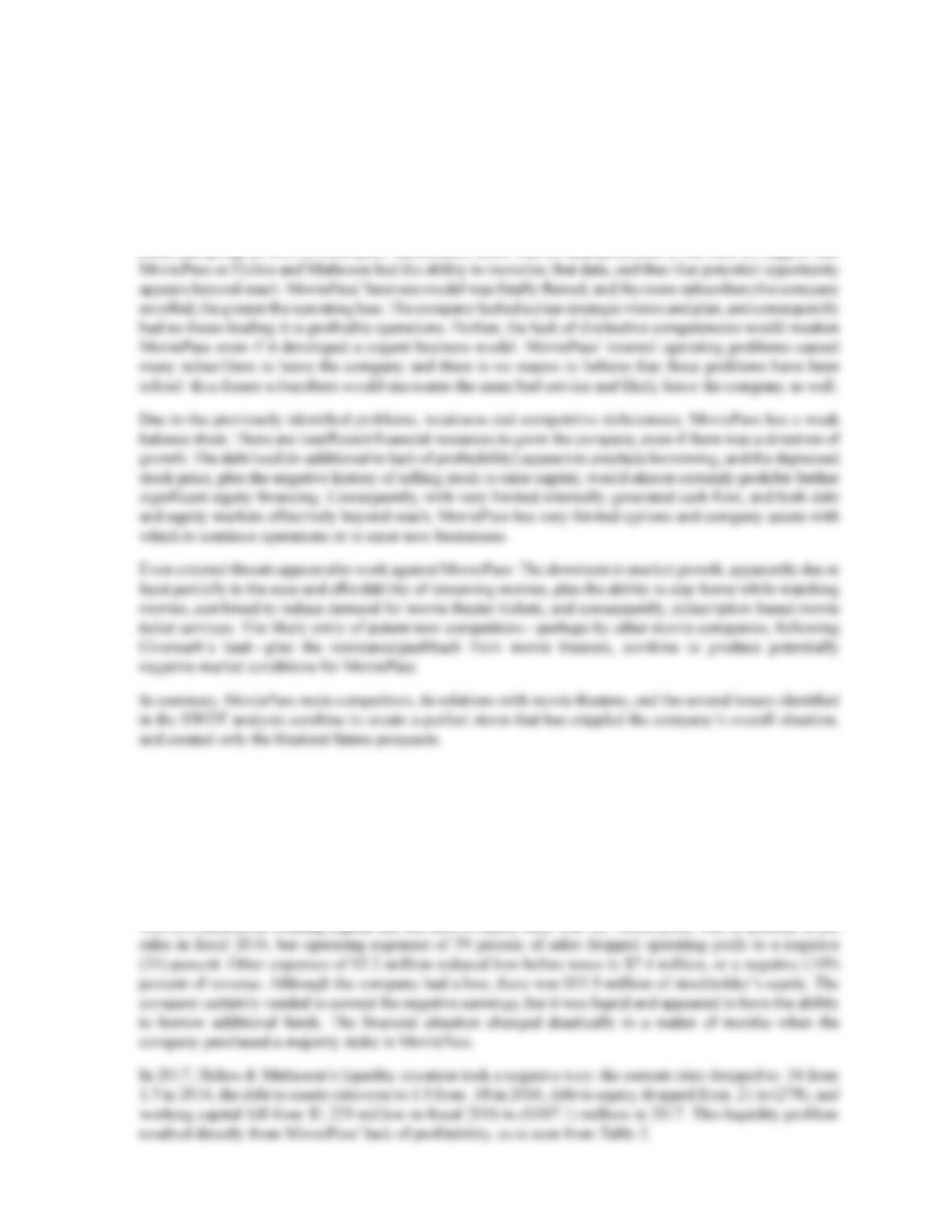
SWOT Analysis
Potential Strengths and
Competitive Assets
l Large number of subscribers
l Large amount of potentially valuable data from their past and present
subscribers
Potential Weaknesses and
Competitive Deficiencies
l Fatally flawed business model
l No clear strategic vision or strategic plan
l No distinctive competencies
The threats posed by Sinemia and Cinemark Movie Club, combined with the threats from the major movie
theaters, paint a dim picture of MoviePass’ present competitive situation and future prospects. Sinemia
Case 8 Teaching Note MoviePass—Are Subscribers Loving It to Death?
369
one of the largest U.S. theater chains, launched its subscription service, which further reduced the pool of
subscribers. Consequently, MoviePass faces aggressive and significant competition, and there is no data in
the case to suggest that the company’s business model and strategy have evolved to enable the company to
compete with Sinemia or Cinemark. Sinemia and Cinemark appear to be potent competitors for any movie
subscription company, but for MoviePass with its flawed business model, they may be the death knell.
Although MoviePass had potential strengths in its large number of subscribers and the large amount of data
from that group as well as from prior subscribers, there was no data presented in the case to suggest that
4. Assess the financial condition of Helios & Matheson. What is your assessment of the
company’s liquidity and profitability?
This is an excellent case for students to practice their skills in financial analysis and draw practical conclusions
from their work.
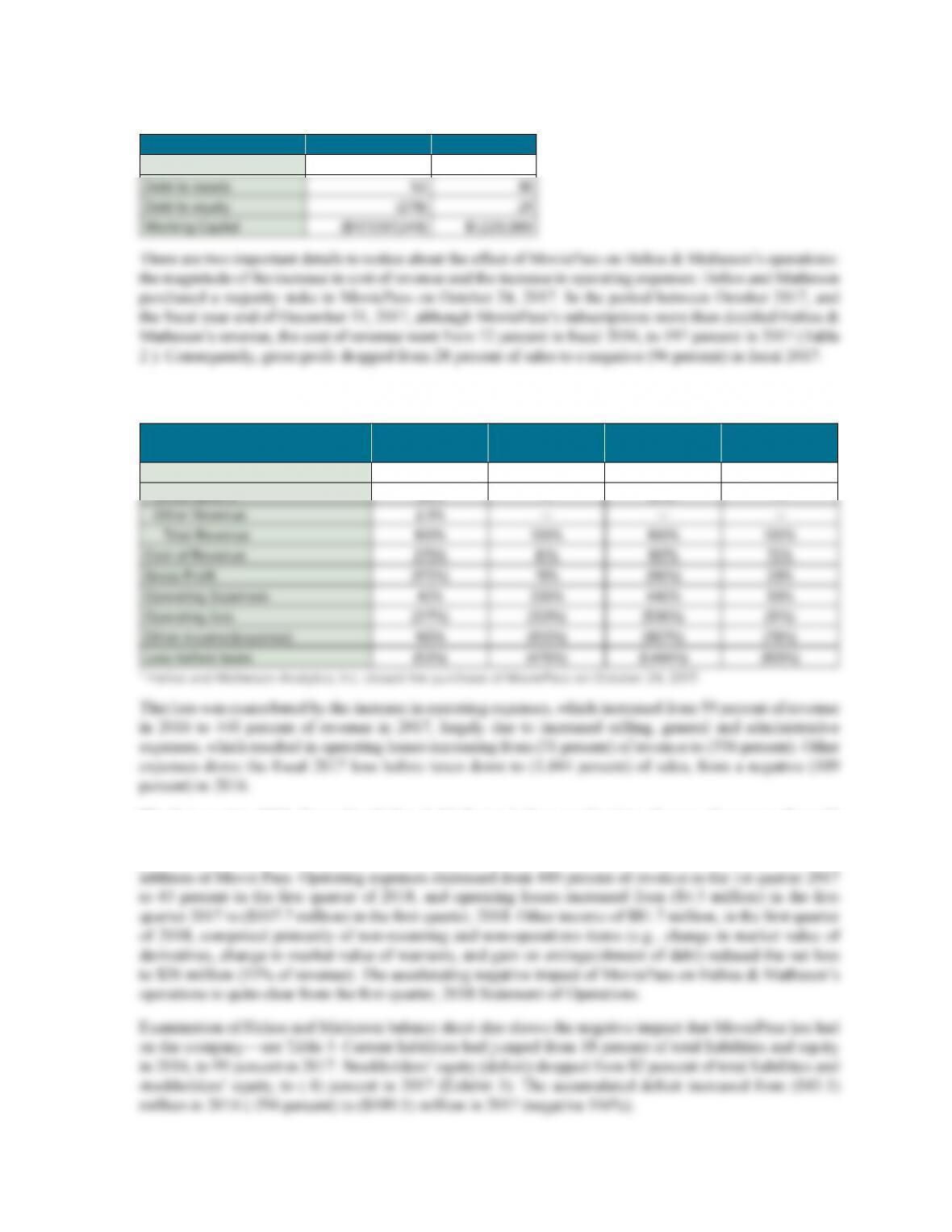
A quick inspection of Helios and Matheson’s financial statements reveals a company that was liquid, though
not profitable in fiscal 2016. The company had a current ratio of 1.5 and debt to assets of .18 (Table 1). There
was $1.2 million in working capital and the debt to equity ratio was .21. Gross profit was 28 percent of net
Case 8 Teaching Note MoviePass—Are Subscribers Loving It to Death?
370
TABLE 1. Helios and Matheson Analytics, Inc. Financial Ratios and Working Capital
Fiscal 2017 Fiscal 2016
Current .34 1.5
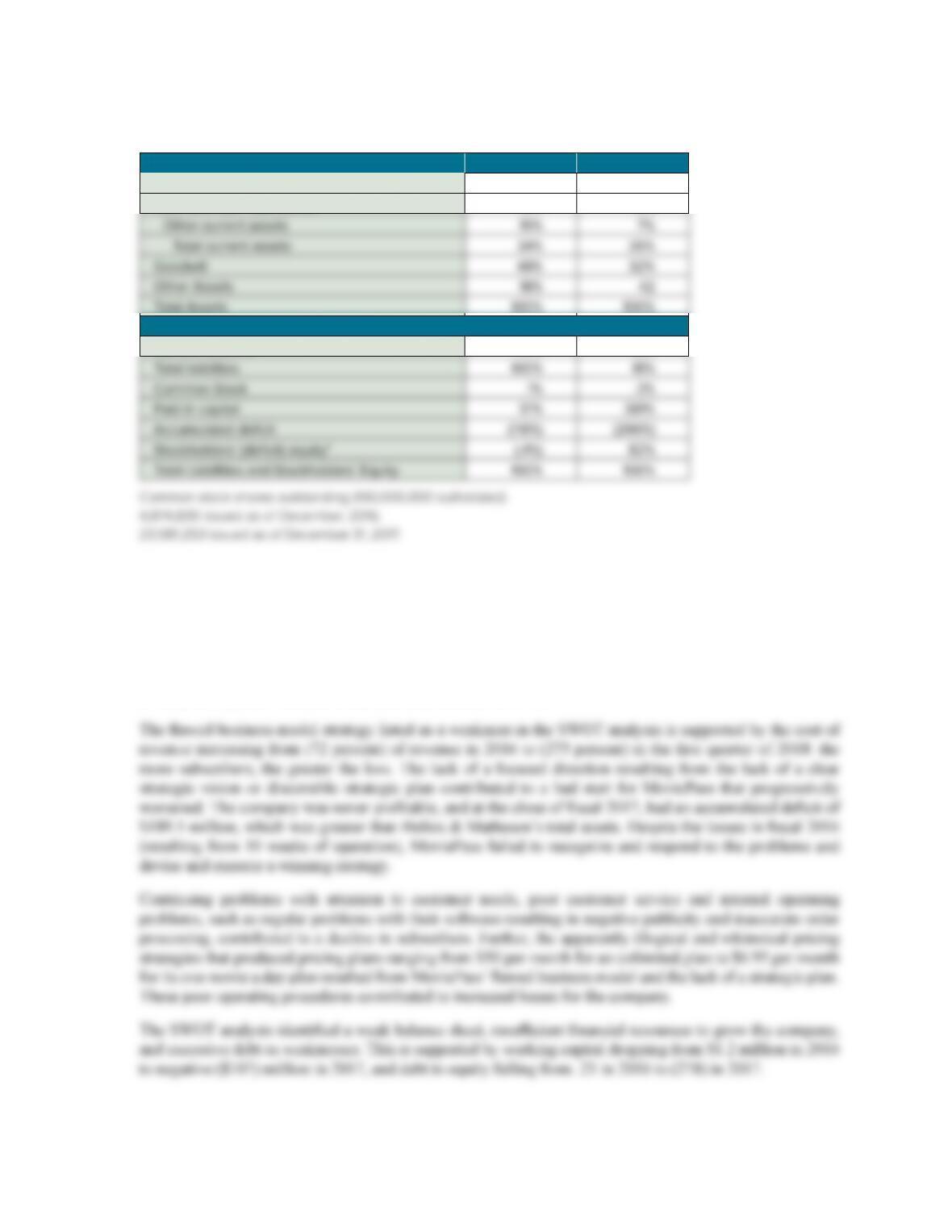
TABLE 2. Helios and Matheson Analytics, Inc. Fiscal 2016–2017, 1st Quarter, 2018
Common Size Statement of Operations
Revenue
1st Quarter
2018
1st Quarter
2017
Fiscal
2017
Fiscal
2016
Consulting 1.7% 100% 43% 100%
Subscriptions 95% — 57%* —
The first quarter, 2018 shows that Helios & Matheson had an acceleration of costs of revenue (from 81
percent in first quarter 2017, to 275 percent in first quarter, 2018) and a decrease in gross profit from 19
percent of revenue in first quarter 2017, to negative (175 percent) in the first quarter of 2018, due to the
Case 8 Teaching Note MoviePass—Are Subscribers Loving It to Death?
371
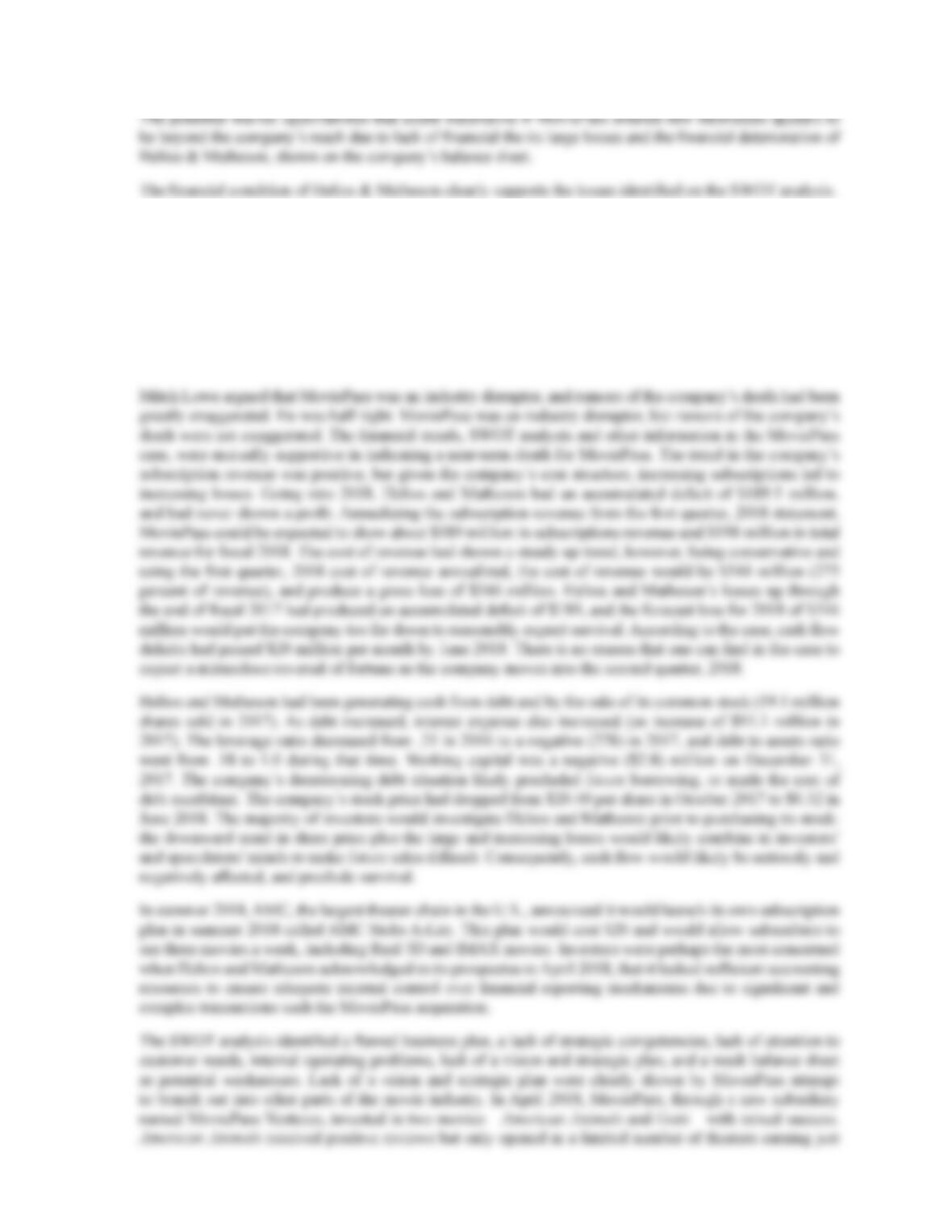
TABLE 3. Helios and Matheson Analytics, Inc. December 31, 2016–2017
Common Size Balance Sheet
Assets: Fiscal 2017 Fiscal 2016
Current Assets:
Cash and cash equivalents 15% 19%
Liabilities and Stockholders’ Equity:
Current liabilities 99% 18%
5. Does the financial condition of MoviePass support your SWOT assessment?
This question provides a great exercise for students to examine the “fit” between the somewhat objective
SWOT and an empirical financial analysis.
The financial condition of MoviePass supports the SWOT assessment. The large number of subscribers was
identified as a strength: the financial statements support this, showing revenue increasing from $5.9 million
in fiscal 2017, to $47 million in the first three months of 2018.
Case 8 Teaching Note MoviePass—Are Subscribers Loving It to Death?
372
6. Consider the financial trends, the SWOT analysis and other information from the Movie
Pass case: does the collective information indicate survival for Movie Pass? Support your
conclusion.
This exercise will provide students with additional opportunity to arrive at “real world” conclusions from
their analysis of the MoviePass case. Students will present various approaches to this question; however, we
believe that analyses and conclusions of anything other than business failure for MoviePass and Helios and
Matheson are faulty in some respect.
Case 8 Teaching Note MoviePass—Are Subscribers Loving It to Death?
373
7. From the data in the case, would you expect MoviePass to be able to achieve profitability
before the cash runs out?
Students will give very different answers to this question. Many will answer “yes” and point to the balance
sheet (Case exhibit 2) showing the large case balance as the reason MoviePass can continue to operate until
it achieves profitability. This question provides an excellent real-world application of the case material.
8. What advice would you give to the MoviePass/ Helios & Matheson’s Board of Directors?
Students will present a wide range of advice for the Directors. We believe that the advice should contain the
following:
The financial data and other available information in the case paint a clear picture of immediate insolvency
Case 8 Teaching Note MoviePass—Are Subscribers Loving It to Death?
374
Epilogue
A key board member resignation resulted in MoviePass’ parent, Helios & Matheson, being out of compliance
with a Nasdaq rule regarding independent director and audit committees, according to Business Insider, July
30, 2018. Also, according to NBC News (October, 18, 2018), the New York Attorney General’s Office was
In October 2018, Helios & Matheson proposed a 1-for-500 reverse stock split, but did not get board approval.
MoviePass saw a large drop in subscribers since changing its plan from one free movie per day to three per
month and the 10-Q filing noted “future changes to our subscription plan may not be favorably received by
customers,” as set out below:
“Due to recent changes to our subscription plans, the number of our subscribers has decreased, and we
may continue to lose subscribers or fail to attract new subscribers.”
Source” MoviePass 10-Q, September 30, 2018
The company planned to seek other sources of capital, however if it fell behind on payments to merchants and
fulfillment processors, it could experience another service interruption similar to earlier in 2018, according to
Fortune (November 16, 2018). The company also said its stock could be delisted by Nasdaq by December 18.
Nasdaq requires a minimum of $1.00 per share price for 10 straight trading days and market capitalization of
$50 million.
Case 8 Teaching Note MoviePass—Are Subscribers Loving It to Death?
375
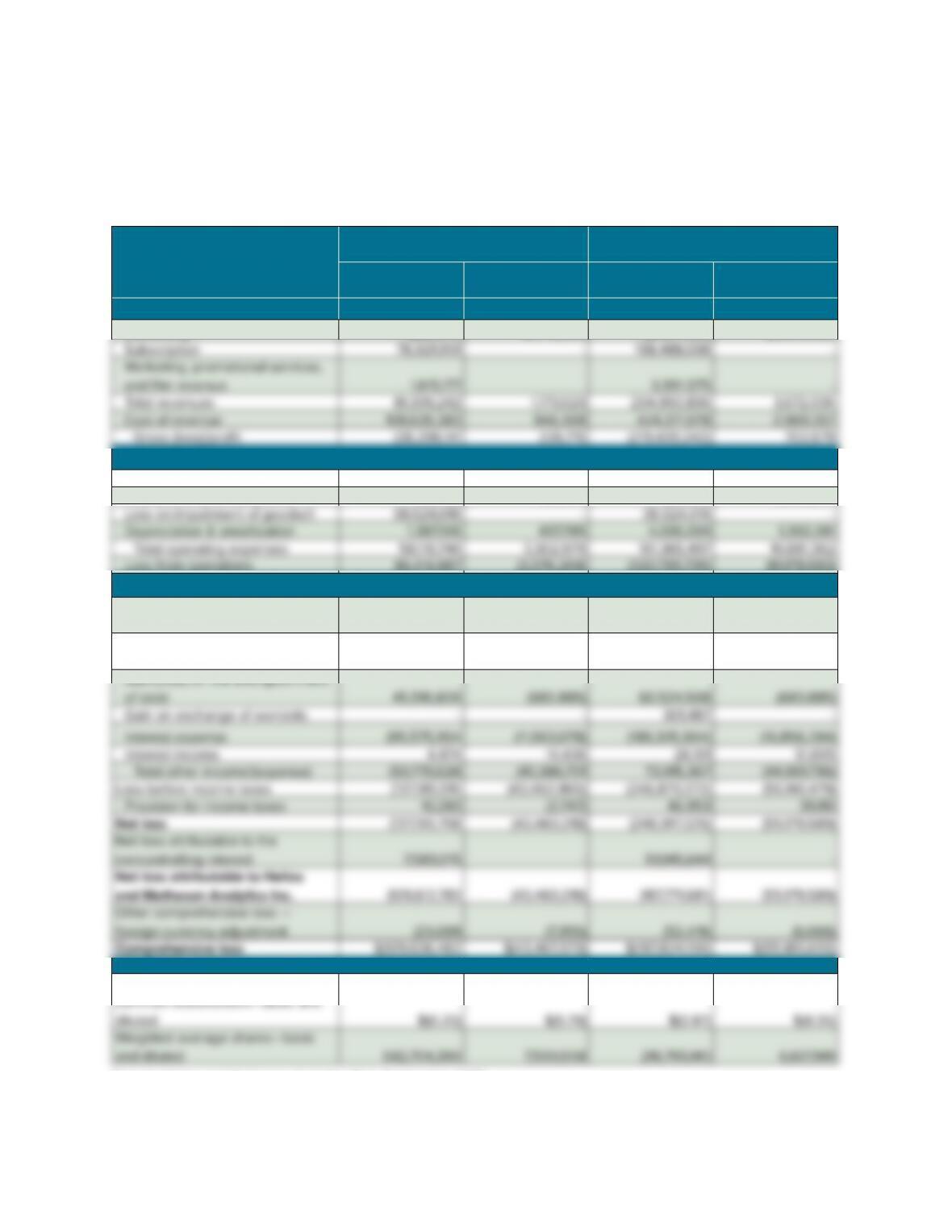
Helios & Matheson’s third quarter 10-K financial statements, below, support the imminent demise of MoviePass:
HELIOS AND MATHESON ANALYTICS INC.
CONDENSED CONSOLIDATED STATEMENTS OF OPERATIONS AND COMPREHENSIVE LOSS
(UNAUDITED)
Three Months Ended
September 30,
Nine Months Ended
September 30,
2018
(Unaudited)
2017
(Unaudited)
2018
(Unaudited)
2017
(Unaudited)
Revenues
Consulting $802,114 $1,173,023 $2,471,223 $3,672,036
Operating expenses
Selling, general & administrative 18,121,681 2,243,440 58,340,040 8,023,886
Research and development 85,943 621,754 465,407 1,555,095
Other income/(expense)
Change in fair market value—
derivative liabilities (4,933,938 (11,115,463) 8,311,106 (10,434,611)
Change in fair market value—
warrant liabilities 4,217,981 (17,038,711) 194,058,069 (17,038,711)
Basic and diluted loss per share
Net loss per share attributable to
Source: Helios and Matheson Analytics 10-K, September, 2018
Case 8 Teaching Note MoviePass—Are Subscribers Loving It to Death?
376
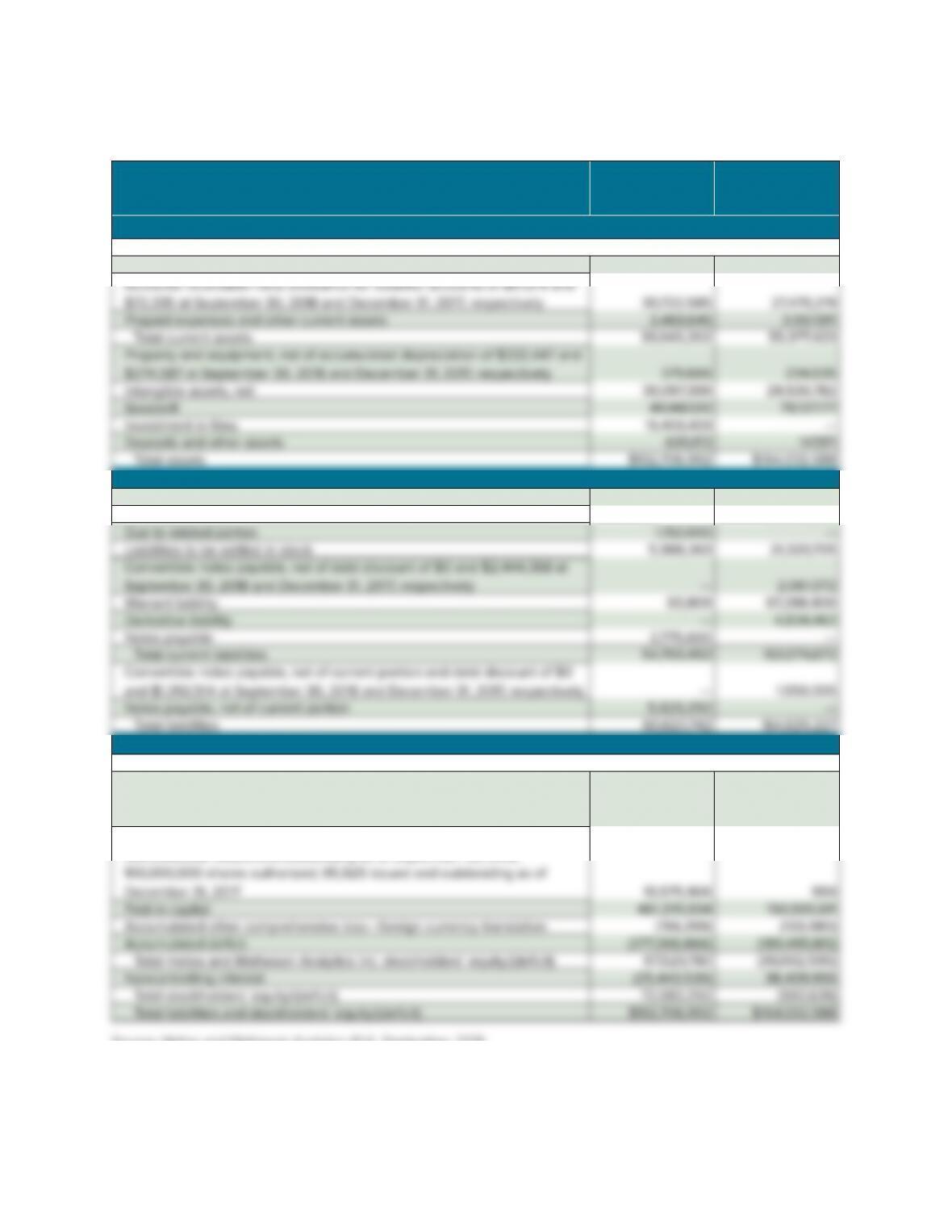
HELIOS AND MATHESON ANALYTICS INC.
CONDENSED CONSOLIDATED BALANCE SHEETS
September 30,
2018
(Unaudited)
December 31,
2017
ASSETS
Current assets:
Cash and cash equivalents $4,850,972 $24,949,393
Current liabilities
Accounts payable and accrued expenses $17,691,260 $13,144,003
Deferred revenue 27,035,060 54,425,630
Commitments and Contingencies
Stockholders’ equity/(deficit):
Preferred stock, $0.01 par value; 2,000,000 shares authorized; 20,500 and
0 shares issued and outstanding as of September 30, 2018 and December
31, 2017, respectively 205 —
Common stock, $0.01 par value; 5,000,000,000 shares authorized;
1,357,590,536 issued and outstanding as of September 30, 2018;
Source: Helios and Matheson Analytics 10-K, September, 2018.