– 520 –
Mattel Incorporated in 2017:
Can Ynon Kriez Save the Toys?
Overview
I
t was April 26, 2018, and it was Ynon Kreiz’s first day on the job as Mattel CEO. Mattel, maker of Barbie
Dolls and Hot Wheels cars, had just received a letter offering to merge Mattel with privately held MGA
Entertainment, run by CEO Isaac Larian. In his offer letter, Mr. Larian had proposed that the two companies
merge. Larian also argued that he, not Kreiz, should be the executive to lead the turnaround of Mattel.
Kreiz had been named Chairman and CEO of Mattel on April 19, 2018, and was succeeding Margo Georgiadis in
the job. Ms. Georgiadis, hired away from Alphabet Inc.’s Google division, had been appointed as Mattel CEO in
February 2017. Unfortunately, Georgiadis had been unable to reverse a sharp drop in Mattel’s revenues, earnings,
and stock price. The slide in Mattel’s fortunes had been sharpened by the bankruptcy of the retailer Toys “R” Us
in 2017, a key customer for Mattel’s products. Kreiz was now the fourth CEO for Mattel in four years.
Mr. Kreiz had numerous problems with which to contend as the incoming CEO of Mattel. To begin, there was
the unsolicited offer to merge with MGA Entertainment. Mattel had also been in involved in off and on merger
negotiations with rival toymaker Hasbro. The toy industry was also changing rapidly. Children around the world
were growing up fast and they were increasingly drawn to online content. Against this backdrop, toy wholesalers
were competing intensely for store space, sales and market share. The traditional sales channel for the industry,
physical retail stores, was increasingly under strain and consolidating. The bankruptcy of Toys “R” US in 2017
was symptomatic of this retail consolidation. Online retail competition, notably Amazon.com, was increasingly
making inroads into the sales of traditional bricks and mortar retailers, further pressuring toy wholesalers. Mattel
had also stumbled in their competition with Hasbro, their closest competitor in the toy industry.
Kreiz had taken the reins of the company with a mandate from investors to streamline Mattel operations, improve
the company’s focus on technology and entertainment, and to deliver a recovery in Mattel’s struggling stock
price. From a peak of $47.82 per share in 2013, Mattel was now trading between $12 and $18 per share. The
company had reported a $1 billion loss in 2017. Sales, deeply affected by the bankruptcy of Toys “R” US, were
down 10% from 2016 to 2017. It was with this deep list of company and industry problems that Ynon Kreiz faced
his first day on the job as CEO of Mattel.
case 19 teaching note
*
Case 19 Teaching Note Mattel Incorporated in 2017: Can Ynon Kriez Save the Toys?
521
Suggestions for Using the Case
The Mattel Incorporated in 2018 case is should generate significant interest and classroom discussion because
of students’ childhood experiences with Mattel toys. A spirited debate about what strategy is needed to compete
in the troubled toy industry. Students will have differing opinions about the role of brick-and-mortar toy stores,
online toy retailing, and competition with smartphones and other electronic devices. You may find there is quite
a bit of disagreement about what strategic actions are needed to improve the company’s performance.
The Mattel Incorporated case is probably best assigned after you have covered Chapters 5–7, but it can be
successfully used after students have read just Chapters 3, 4, and 5. The Mattel Incorporated case is ideal for
To facilitate your use of assignment questions and making them available to students, we have posted a file of
the Assignment Questions contained in the instructor resources section of the Connect Library for the 22nd
Edition.
Utilizing the Guide to Case Analysis. If this is your first assigned case, you may find it beneficial to have
class members read the Guide to Case Analysis following Case 32 in the text and located in the instructor
Video for Use with the Mattel Incorporated in 2018 Case. There is an accompanying 4:27 YouTube
video that you might want to show the class (or have students watch on their own). It is entitled “Mattel CEO on
Film Unit and Toy Industry’.” The link to the video is https://www.youtube.com/watch?v=iUJxC_50c8w.
Suggested Assignment Questions for an Oral Team Presentation or Written Case Analysis.
We believe the Mattel Incorporated in 2018 case is quite well-suited for written assignments and/or oral team
presentations. Our suggested assignment questions are as follows:
■ Mattel Incorporated has employed you as a consultant to assess the company’s overall situation and
recommend a set of actions to improve the company’s future prospects. Prepare a report to management
that includes: (1) an evaluation of the toy industry in 2018T, (2) an evaluation of Mattel’s strategic
Case 19 Teaching Note Mattel Incorporated in 2017: Can Ynon Kriez Save the Toys?
522
with market opportunities and will lead to improved financial performance. It is imperative that the
support offered for each of your recommendations be based on: (a) conclusions drawn from application
of the concepts and analytical tools discussed in Chapters 3 and 4 and (b) the content of Chapters 5-7
regarding strategic moves that may be suitable for Mattel Incorporated.
Assignment Questions:
1. What is your opinion of Ms. Georgiadis’ job performance as CEO of Mattel? What problems was she facing
during her short tenure?
2. Conduct a Five Forces Analysis of the Toy Industry. What is your overall conclusion regarding the collective
strength of the five competitive forces?
3. Evaluate Mattel’s internal strengths and competitive deficiencies (SWOT Analysis). What are Mattel’s
strengths, weaknesses, opportunities, and threats?
4. What is Mattel’s competitive strategy? Which of the five generic competitive strategies discussed in Chapter
5 most closely fit with the competitive approach that Mattel is taking?
5. What is Mattel’s global strategy? Which of the international strategies discussed in Chapter 7 most closely
align with the global approach that Mattel is taking?
6. Conduct an analysis of Mattel’s financial statements. What is your assessment of the overall condition and
strength of Mattel’s finances?
7. What are the main strategic issues faced by Mattel and CEO Kreiz as of April, 2018?
8. Review the offensive strategies discussed in Chapter 6. Of these offensive strategies, which, if any, would
you recommend for Mattel?
9. Review the defensive strategies discussed in Chapter 6. Which, if any, would you recommend for Mattel?
10. What recommendations would you make to Mattel’s new CEO, Ynon Kreiz?
Teaching Outline and Analysis
1. What is your opinion of Ms. Georgiadis’ job performance as CEO of Mattel? What problems
was she facing during her short tenure?
Classroom tip: This question is designed to start class discussion and begin analysis of the case.
Margo Georgiadis had been appointed CEO of Mattel in February 2017 and stepped down in April 2018.
While the case offers little information about Ms. Georgiadis’ tenure as CEO, it does state that she was
Case 19 Teaching Note Mattel Incorporated in 2017: Can Ynon Kriez Save the Toys?
523
2. Conduct a Five Forces Analysis of the Toy Industry. What is your overall conclusion regarding
the collective strength of the five competitive forces?
Five Forces Analysis
U.S. Toy Industry
Suppliers: Strong
• Suppliers have the power to vertically integrate and bypass Mattel to sell directly to consumers such
as Walmart and Target
Case 19 Teaching Note Mattel Incorporated in 2017: Can Ynon Kriez Save the Toys?
524
• Major brand recognition with Mattel and Hasbro
• Small competitors can easily enter, but survival rates are low
Five Forces Analysis Conclusion: Unfavorable for Businesses
3. Evaluate Mattel’s internal strengths and competitive deficiencies (SWOT Analysis). What
are Mattel’s strengths, weaknesses, opportunities, and threats?
Mattel SWOT Analysis
Strengths
• Core products with enduring popularity—Barbie and Hot Wheels
• A strong history of providing quality products
Case 19 Teaching Note Mattel Incorporated in 2017: Can Ynon Kriez Save the Toys?
525
Opportunities
• The growing information technology (IT) market
• Growing demand for digital content from children over age six
• Merger/Acquisition by Hasbro
Threats
• The closure of Toys R US
• Manufacturers selling directly to retailers, vertically integrating, bypassing Mattel
• Children growing out of Mattel’s products at a younger and younger age
• Flat or slightly declining demand for traditional toys
Mattel SWOT Analysis Discussion
Mattel has had many issues lately resulting from internal and external factors. It has a very hard road ahead
of it to change and turn things around. However, there are some very intriguing opportunities both internally
and externally. It will be hard for Mattel to turnaround. However, it has a reasonable chance of success if it
is able to take advantage of its opportunities.
Mattel’s Strengths
• Mattel has some very strong internal strengths that could help propel Mattel back into being
successful. One of Mattel’s biggest strengths is the brand image of its staple products, such as
Mattel’s Weaknesses
• Mattel’s has numerous and glaring weaknesses. One of its biggest weaknesses is declining revenues,
profit margins, and profits. There are many reasons for this, but a major issue is the loss of a key
Case 19 Teaching Note Mattel Incorporated in 2017: Can Ynon Kriez Save the Toys?
526
Mattel’s Opportunities
• Mattel has two major external opportunities it could capitalize on. The biggest of its opportunities
Mattel’s Threats
• There are many threats Mattel faces, but the biggest has to be manufacturers vertically integrating
and bypassing Mattel. This is a huge problem that Mattel needs to address to be able to be successful.
4. What is Mattel’s competitive strategy? Which of the five generic competitive strategies
discussed in Chapter 5 most closely fit with the competitive approach that Mattel is taking?
Mattel’s Generic Strategy: Broad Differentiation
Mattel has a wide range of products that appeal to many different kids
Mattel offers relatively high quality products at a reasonable price
5. What is Mattel’s global strategy? Which of the international strategies discussed in Chapter
7 most closely align with the global approach that Mattel is taking?
Mattel’s International Strategy: Global
Mattel uses a Global Strategy (Think Global – Act Global)
• Mattel offers the same products worldwide
Case 19 Teaching Note Mattel Incorporated in 2017: Can Ynon Kriez Save the Toys?
527
6. Conduct an analysis of Mattel’s financial statements. What is your assessment of the overall
condition and strength of Mattel’s finances?
Between 2013 and 2017, Mattel faced considerable challenges. Non-financial challenges included high CEO
turnover, flat to decreasing demand in the U.S. toy market, toy manufacturers vertically integrating, retail
consolidation and the Toys “R” Us bankruptcy. As might be expected, all of these factors combined to affect
Mattel. The extent of these problems can be seen clearly in its financial ratios—see Table 1.
Summary: All financial measures for Mattel declined sharply from 2013 to 2017. Revenue growth was
solidly negative during this time period, margins were under pressure, and profitability was sharply negative
Case 19 Teaching Note Mattel Incorporated in 2017: Can Ynon Kriez Save the Toys?
528
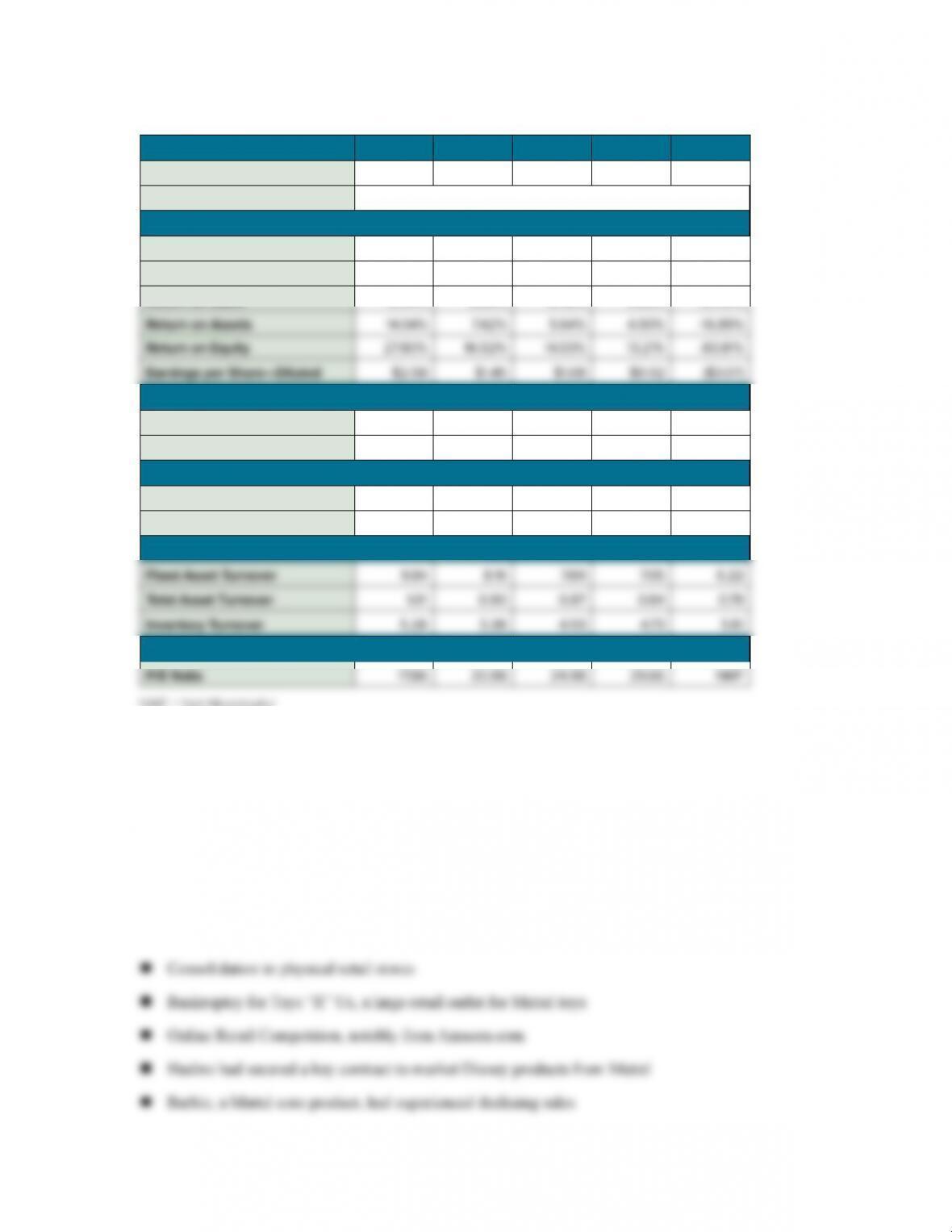
TABLE 1. Mattel Financial Ratio Analysis
2013 2014 2015 2016 2017
Revenue 1 Year Growth Rate -7.11% -5.33% -4.31% -10.53%
Revenue CAGR (2013 to 2017) -6.85%
Profitability Ratios
Gross Margins 53.65% 49.82% 49.21% 46.81% 37.30%
Operating Margin 18.01% 10.85% 9.49% 9.52% -7.02%
Return on Sales 13.94% 8.28% 6.48% 5.83% -21.59%
Liquidity Ratios
Current Ratio 3.22 2.93 1.94 1.95 1.92
Quick Ratio 2.68 2.41 1.59 1.55 1.55
Leverage Ratios
Debt to Assets Ratio 49.51% 56.13% 59.81% 62.92% 79.84%
Debt to Equity Ratios 98.05% 127.94% 148.84% 169.70% 396.12%
Activity Ratios
Valuation Ratio
NMF = Not Meaningful
7. What are the main strategic issues faced by Mattel and CEO Kreiz as of April 2018?
The problems faced by Mattel in April 2018 were extensive and significant. After a detailed class discussion,
the list of issues should look similar to the following:
Strategic Issues for Mattel
An unsolicited merger offer from MGA Entertainment
Unresolved merger negotiations with Hasbro
Change in children’s preferences to electronic toys and online content
Case 19 Teaching Note Mattel Incorporated in 2017: Can Ynon Kriez Save the Toys?
529
Overall flat to declining demand for toys in the toy industry
High executive turnover at Mattel – 4 CEOs in 4 Years
Overseas manufacturers vertically integrating and selling directly to retailers such as Walmart and
Target
Summary: Mattel faced problems in almost all aspects of their business. Symbolic to the dilemma facing
Mattel going forward was the decline in the company’s core product, the Barbie Doll. A billion dollar brand,
the Barbie Doll was literally the essence of Mattel’s core identity as a toy company. The loss of leadership
8. Review the oensive strategies discussed in Chapter 6. Of these oensive strategies, which,
if any, would you recommend for Mattel?
The principal offensive strategies are as follows:
1) Offering an equally good or better product at a lower price.
Mattel Oensive Options
(1) Offering an equally good or better product at a lower price.
Mattel competed on the basis of a broad differentiation strategy, and their toys were often tied to
distinctive brand names. Manufacturing was conducted overseas, either from wholly-owned or contracted
manufacturers. As such, the ability for Mattel to offer their products at lower wholesale prices was likely
Case 19 Teaching Note Mattel Incorporated in 2017: Can Ynon Kriez Save the Toys?
530
Summary: Mattel, tied to a heavy debt load and declining sales, was limited in the offensive moves that
it had available. Of the options considered, offensive moves tied to product innovation and leapfrogging
competitors appeared to be the most feasible given the company’s resource constraints. CEO Kreiz’s ties to
Hollywood were arguably a key asset in the struggle for new intellectual content, brands, and digital outlets
for existing and future Mattel products and services.
Case 19 Teaching Note Mattel Incorporated in 2017: Can Ynon Kriez Save the Toys?
531
9. Review the defensive strategies discussed in Chapter 6. Which, if any, would you recommend
for Mattel?
From Chapter Six, defensive strategies can take one of two forms. One, the company can take actions to
block challengers. Second, the company can signal the likelihood of strong retaliation in response to an
Defensive Options:
(1) Take Actions to Block Challengers. Because of Mattel’s weakened financial condition, the company
has limited room for maneuver in the marketplace. Typical defensive options, such as the addition of new
10. What recommendations would you make to Mattel’s new CEO, Ynon Kreiz?
From Question Seven, there were extensive strategic issues that needed to be addressed by Mattel CEO
Ynon Kreiz. From Question Six, the financial resources of the company have been weakened, resulting in
a narrow amount of time and range of resources available for the new CEO to enact a turnaround of the
company’s operations.
Strategic Issues for Mattel
An unsolicited merger offer from MGA Entertainment
Unresolved merger negotiations with Hasbro
Case 19 Teaching Note Mattel Incorporated in 2017: Can Ynon Kriez Save the Toys?
532
Mattel saddled with negative cash flow and a heavy debt load
Declining revenues at Mattel over the past five years
Strong competition from Hasbro
Each of these strategic issues are discussed below:
1) An unsolicited merger offer from MGA Entertainment. Based upon the lack of offer details in the offer
letter from MGA Entertainment and the disparaging tone toward Mattel CEO Ynon Kreiz, this merger
offer could be interpreted as not credible.
Case 19 Teaching Note Mattel Incorporated in 2017: Can Ynon Kriez Save the Toys?
533
10) High executive turnover at Mattel—4 CEOs in 4 Years. A successful turnaround effort by new CEO
Ynon Kreiz would also involve stabilizing the executive ranks of the company. Successfully stabilizing
the executive ranks would serve to boost morale and also provide continuity as the company sought to
stabilize their operations and market standing.
Summary: CEO Ynon Kreiz was under tremendous pressure to immediately stabilize Mattel operations,
stop the exodus of Mattel executives, adapt to rapidly shifting consumer preferences, seek new retail outlets
Epilogue
Reporting third quarter 2018 financial results to investors, Ynon Kreiz, Chairman and CEO of Mattel, said: “We
are on track with the execution of our strategy and have made meaningful progress towards restoring profitability,
as we transform Mattel into an IP-driven, high-performing toy company. In the quarter, we achieved Operating
Income of $122 million, up 41% versus the same period last year, which is the first time in eight quarters that we
have posted year-over-year growth.”
Case 19 Teaching Note Mattel Incorporated in 2017: Can Ynon Kriez Save the Toys?
534
Based upon his comments, Mattel’s new CEO Ynon Kreiz clearly has a vision of turning Mattel into an Intellectual
Property (IP) company. Kreiz believes this will help Mattel be more successful in the long run. This is a drastic
change from the company’s roots, but is likely prudent given the dramatic changes in consumer behavior for the
toy industry. It will be very interesting to see if Ynon Kreiz can accomplish his goals for Mattel.
In the short run, Ynon Kreiz is clearly focused on strategy execution and streamlining operations. For the long
run, Kreiz has stated that he wants to take advantage of Mattel’s popular characters to create things such as
television, gaming, films, and additional online content based upon popular Mattel characters. Mattel has tried