
– 557 –
IKEA’s International Marketing Strategy
in China
Overview
While today IKEA is considered a success story in China, the Swedish furniture giant had to face numerous
challenges when it initially entered China in the late 1990s. China was very different from IKEA’s traditional
markets in the West. IKEA had to adapt its strategy to suit the country. IKEA was able to project itself as an
aspirational Western brand among the Chinese middle class. After initial failures, the company positioned its
brand in China in such a way as to reflect consumers’ needs and that enabled it to create a positive brand image
for itself. China soon became the fastest growing market for IKEA. The company saw significant growth in the
country. However, with worldwide speculation over China’s increased economic and financial risks from its
rapid build-up of debt, and IKEA itself becoming embroiled in controversies, could IKEA expand its market
and sustain its business in China? The case discusses the challenges before Angela Zhu (Angela), country retail
manager of IKEA China, in 2017, as the company planned to grow the number of its outlets in China from
24 in fiscal year 2017, to 34 in 2020. The onus was on Zhu and her marketing team to make this happen, but
which strategies to compete ni international markets would need to deploy in order to increase IKEA’s appeal to
Chinese customers and that country’s customer base?
Suggestions for Using the Case
The IKEA in China case pairs particularly well with the coverage of strategies for competing in international
markets in Chapter 7. It can also be useful to review the interactions between a business and the macro forces
in its external environment, in particular the five forces driving profitability in the home furnishings industry,
covered in Chapters 3 and 5.
Particular learning objectives that can be met include:
Building students’ awareness and understanding of cross-country differences in demographic, cultural,
and market conditions
Developing students capabilities to assess and choose among strategy options for competing in
developing-country markets—where companies, faced with sometimes unusual or challenging
circumstances, often face considerable challenges
*
case 22 teaching note
Case 22 Teaching Note IKEA’s International Marketing Strategy in China
558
Getting students to think critically about how a business sometimes must adapt its model to local
conditions, which often might not be possible or desirable. In developing regions such as Africa, Asia,
China, India, and South America, building a local market for a company’s products can often turn into
a long-term process.
The assignment questions and teaching outline presented below reflect our thinking and suggestions about
how to conduct the class discussion and what aspects to emphasize.
To facilitate your use of study questions and to make them available to students, we have posted a file of the
assignment questions contained in this teaching note for the IKEA in China case in the instructor resources
section of the Connect Library.
Assignment Questions
1. How did IKEA adapt its strategy for competing in international markets to suit the Chinese market?
2. Which macro-environmental forces most impact IKEA’s China operations?
3. What has IKEA done to cope with competition from its rivals in the Chinese furniture industry?
4. How should IKEA strike a balance between ‘global’ and ‘local’ in designing an effective marketing strategy
in China?
Case 22 Teaching Note IKEA’s International Marketing Strategy in China
559
Teaching Outline and Analysis
1. How did IKEA adapt its strategy for competing in international markets to suit the Chinese
market?
Owing to disappointing early results in China, IKEA was forced to adapt its strategy from its traditional
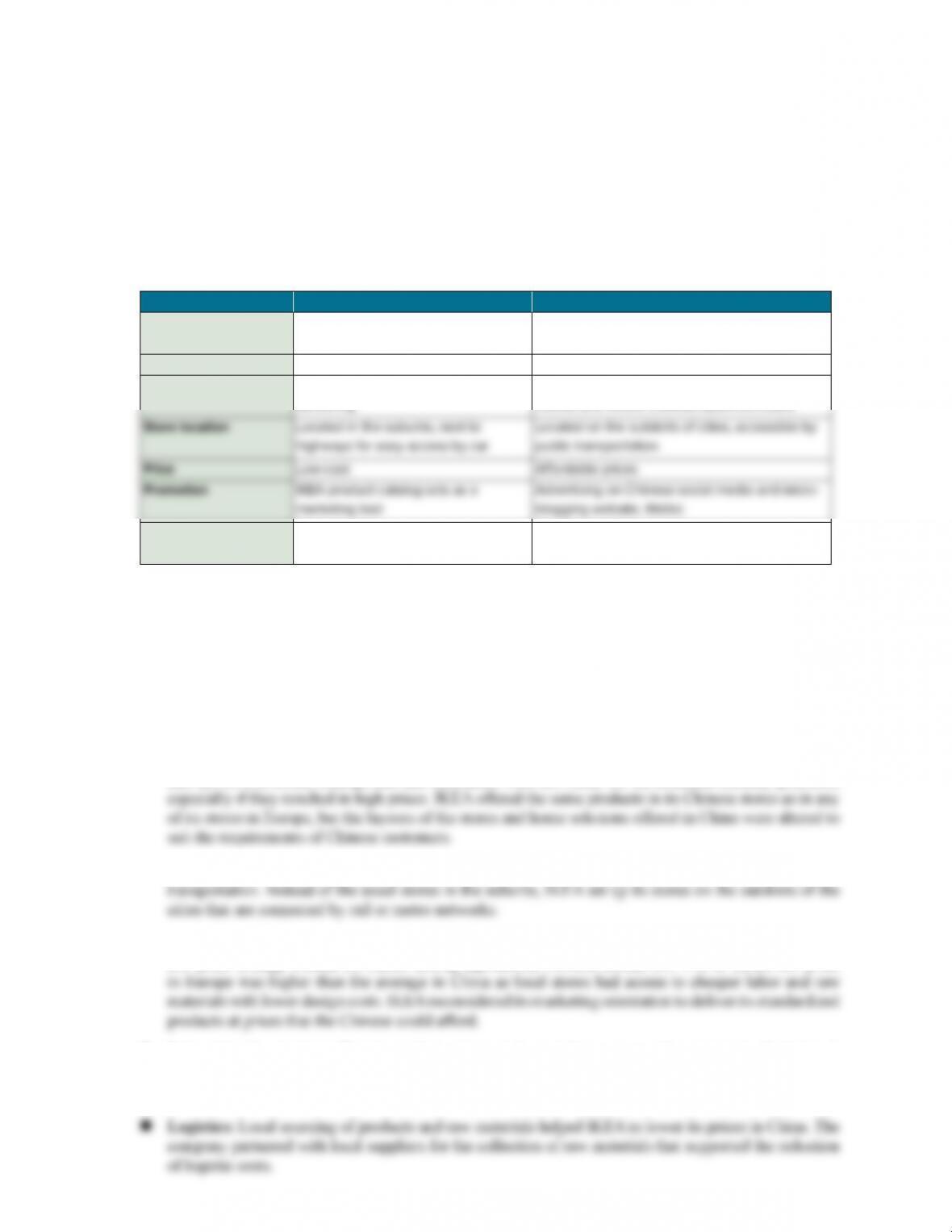
markets in Europe. Refer to Table 2, “How IKEA Adapted Its International Strategy to the Chinese Market.”
TABLE 2. How IKEA Adapted Its International Strategy to the Chinese Market
Europe China
VALUE PROPOSITION Good quality, stylish furniture at
affordable prices
Good quality, Western-styled aspirational brand
for the middle class population
VALUE COMPONENTS
Product Stylish, functional products and home
furnishing
Slight product modifications to suit the local
market and reflect Chinese apartment sizes
Logistics Product are sourced from developing
countries and shipped to Europe
Products and raw materials are sourced locally
and manufactured in its own factories
Among the distinct characteristics of IKEA’s adapted strategy for the Chinese market were:
IKEA’s Value Proposition
In China, IKEA products are treated as innovative and fashionable by the middle class. IKEA’s creative
home furnishing ideas fascinate the younger generation who prefer its products and services as a diversified
brand rather than solely as a maker of DIY furniture.
IKEA’s Value Network
Product: IKEA, famous for its flat-packed furniture, soon became aware that the Chinese did not
like the do-it-yourself concept and that customers were not ready for environment-friendly practices,
Store location: In China, IKEA adjusted its store location strategy as most customers used public
Price: IKEA is known for its low prices and innovatively designed furniture. In China, however, its
low price strategy created confusion among aspirational Chinese consumers. The so-called low price
Promotion: In contrast to Western markets where product catalogs were used as a major marketing tool,
IKEA used digital technologies using the internet such as Chinese social media and micro-blogging for
its marketing campaigns to gain market attractiveness and brand recognition.
Case 22 Teaching Note IKEA’s International Marketing Strategy in China
560
2. Which macro-environmental forces most impact IKEA’s Operations in China?
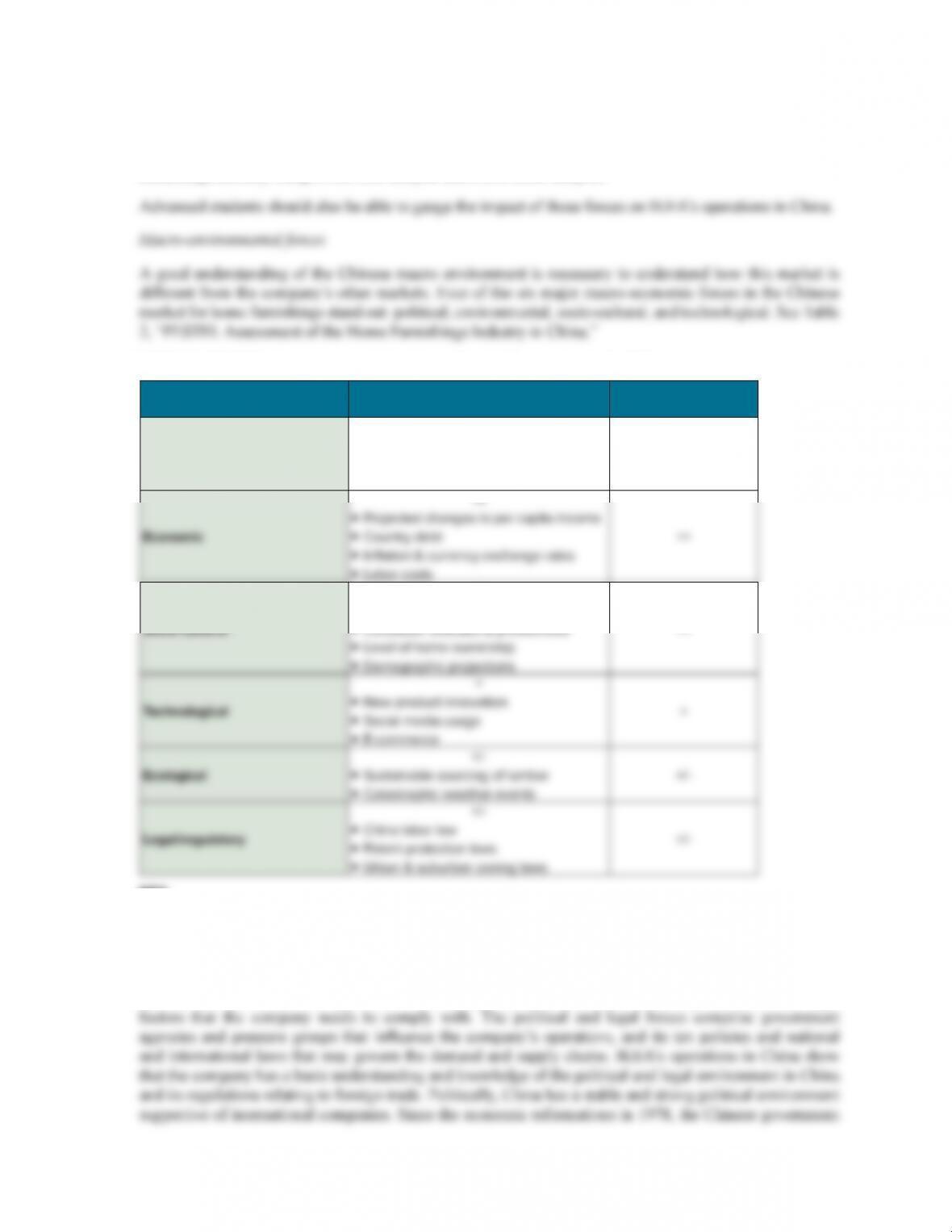
Students should at a minimum be able to assess the impact of macro-environmental forces on the home
furnishings industry using a PESTEL analysis and a five-force analysis.
TABLE 2. PESTEL Assessment of the Home Furnishings Industry in China
Macro-Environmental Force Chinese Home Furnishings Industry
Potential Impact
on IKEA in China
Political
+/+
l Import policies & tariffs
l Inward investment & JV policies
l Bureaucratic “wait-states”
++
++
l Projected changes in per capita income
l Patent protection laws
l Urban & suburban zoning laws
KEY:
++ = Strong impact
+ = Moderate impact
+/- = Possible impact
Political forces refer to the stability of the political environment and attitude of the political parties and
decision makers toward the operation of a company. Political factors are inevitably entwined with legal
Case 22 Teaching Note IKEA’s International Marketing Strategy in China
561
Economic factors affect the ability of a company to grow or at least maintain profitability. The economic
environment assesses the purchasing power of the people in an economy, which depends on current prices,
credit availability, comparative foreign exchange rates, and business cycles. Although China is a less
Socio-cultural factors represent the culture of the society that comprises customs, taboos, language,
beliefs, values, attitudes, norms, gender, and demographics of the population that affect the business of a
Technological factors include innovations brought to market via research and development, changes in
information technology, and government spending on research. These factors impact the quality of goods
and services offered by a company in as mush as they enable a company to stay ahead of competitors.
Case 22 Teaching Note IKEA’s International Marketing Strategy in China
562
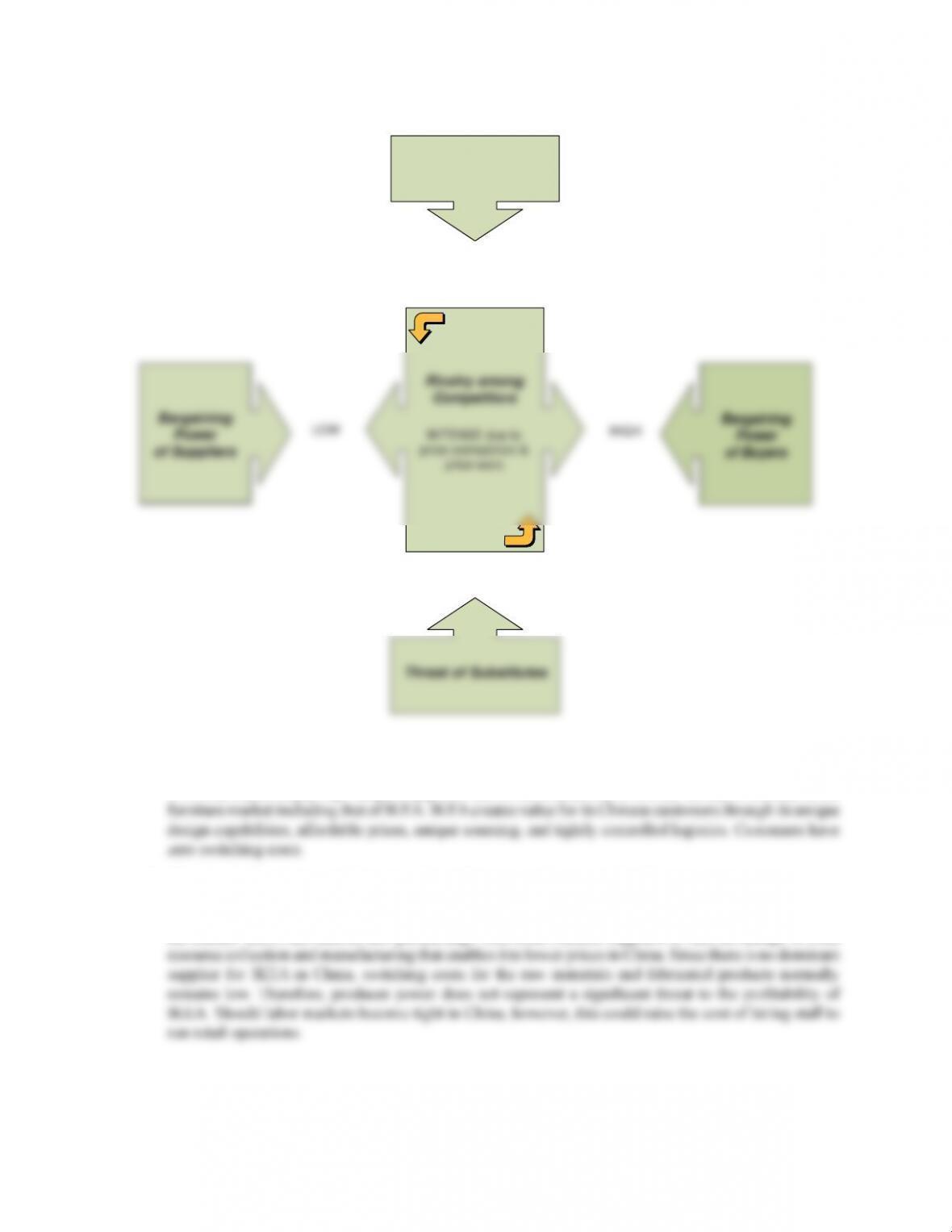
FIGURE 1. The Five Forces Model for the Chinese Home Furnishings Industry
Threat
of New Entrants
LOW
The bargaining power and leverage of buyers—a strong competitive force.
In China, buyers enjoy high bargaining power due to the availability of a wide variety of choices in the
The bargaining power and leverage of suppliers—a weak competitive force.
The bargaining power of suppliers for IKEA in China is low because of the vast number of suppliers in
the market. IKEA has entered into partnerships with local Chinese suppliers to take advantage of local
Case 22 Teaching Note IKEA’s International Marketing Strategy in China
563
Threat of substitutes—a weak competitive force.
For IKEA’s products in China, the threat of substitutes is low because of the limited number of substitutes
available in the market. As global tastes become more Westernized in China, IKEA’s further expansion
Threat of entry—a weak competitive force.
Owing to the high costs of starting a globally recognized home furnishings brand and supply chain,
Rivalry among competing supermarkets—an intense competitive force.
The home furnishings market in China is seasonal, as indicated by case Exhibit 5, with the bulk of
annual sales occurring through the pre year-end, October-November-December quarter. In China, IKEA
***
Overall assessment of industry attractiveness— Attractive.
Despite high buyer bargaining power and intense competitive rivalry in China, the presence of weak threats
of market entry, weak supplier bargaining power, and weak threats of substitution taken together made the
3. What has IKEA done to cope with competition from its rivals in the Chinese furniture
industry?
Careful examination of case Exhibit 7 should indicate that the share of IKEA’s revenues in China has been
increasing steadily but slowly from 2013–2016, from 22% to 26%, while other international markets’ shares
of IKEA revenues have been flat or in steady decline. Accordingly, IKEA has appeared to heed the need
to build out its broad differentiation strategy in China to set it apart from local rivals, and IKEA did so by
adapting to a different target customer than in its home European markets.
IKEA targeted different age demographic groups in China than in most of its other countries
Case 22 Teaching Note IKEA’s International Marketing Strategy in China
564
IKEA has set up its outlets on the outskirts of cities, connected by rail and metro networks
4. How should IKEA strike a balance between ‘global’ and ‘local’ in designing an effective
marketing strategy in China?
Any business contemplating strategies for international markets must make decisions regarding:
The need to balance the cost with the multi-brand and multi-positioning (differentiation) sides of its
business model,
Case 22 Teaching Note IKEA’s International Marketing Strategy in China
565
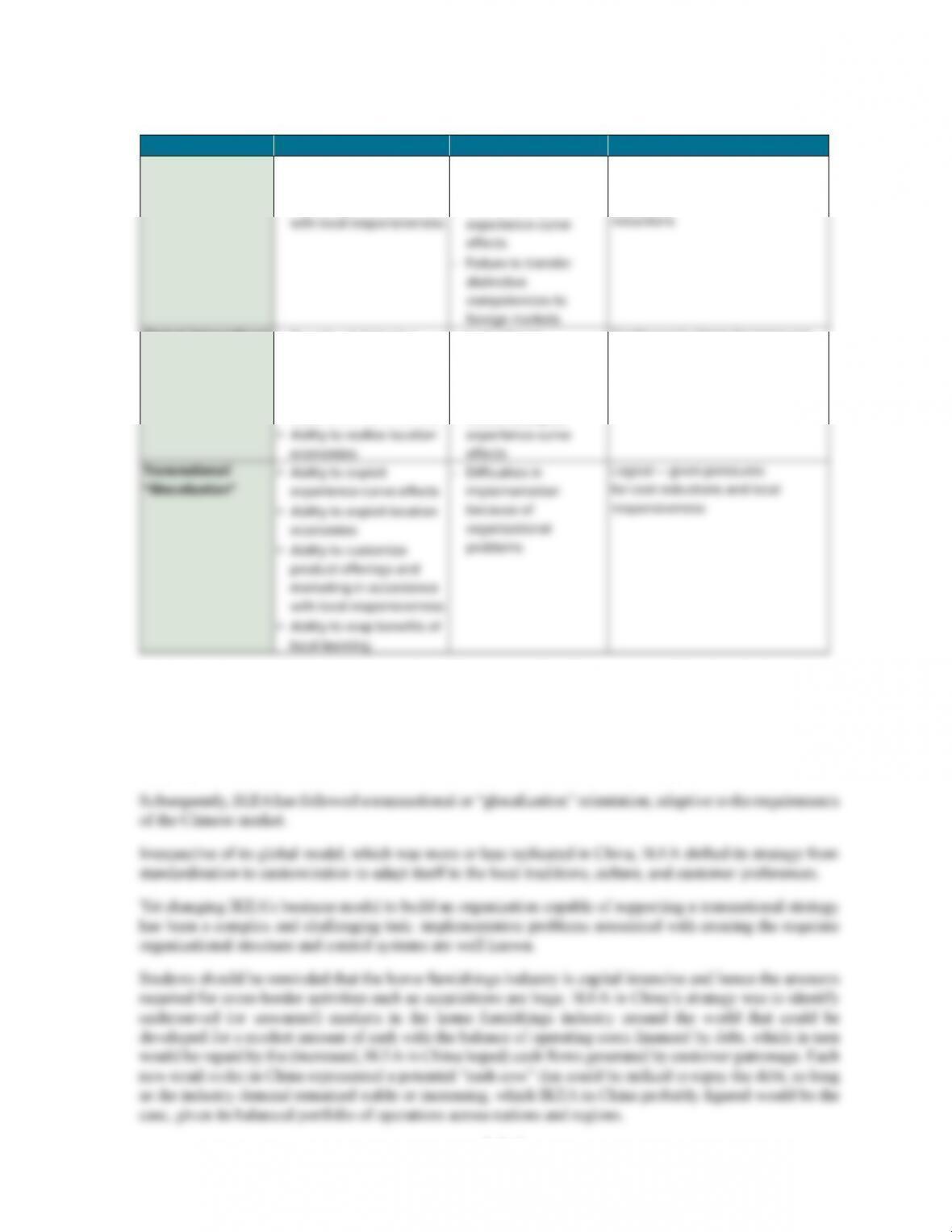
TABLE 3. Globalization Alternatives for IKEA in China
Strategy Advantages Disadvantages Challenges for IKEA
Multi-domestic + Ability to customize
product offerings and
marketing in accordance
– Inability to realize
location economies
– Failure to exploit
JV and alliances meet needs for
localization in emerging markets
but do not address need for cost
Global/ International + Transfer of distinctive
competencies to foreign
markets
+ Ability to exploit
experience-curve effects
– Lack of local
responsiveness
– Inability to realize
location economies
– Failure to exploit
Continuously driven by pressures
for cost reductions & challenges to
integrate & convert local systems,
styles, cultures, processes, etc.
economies
+ Ability to customize
product offerings and
marketing in accordance
with local responsiveness
+ Ability to reap benefits of
local learning
organizational
problems
IKEA has thus pretty much abandoned its European-style ethnocentric model of applying distinct
organizational culture and retail business strategies in its Chinese stores.
In the early stages of China market entry IKEA’s standardized concepts of company showrooms, flat-packed
products, and Do-It-Yourself (DIY) failed to attract Chinese customers. IKEA thus faced the problem of
adapting to the Chinese culture, as a result of which its stores became loss-making units.
***
Case 22 Teaching Note IKEA’s International Marketing Strategy in China
566
5. Is IKEA’s business strategy producing good financial results? Use the financial ratios in Table
4.1 in the text as a guide.
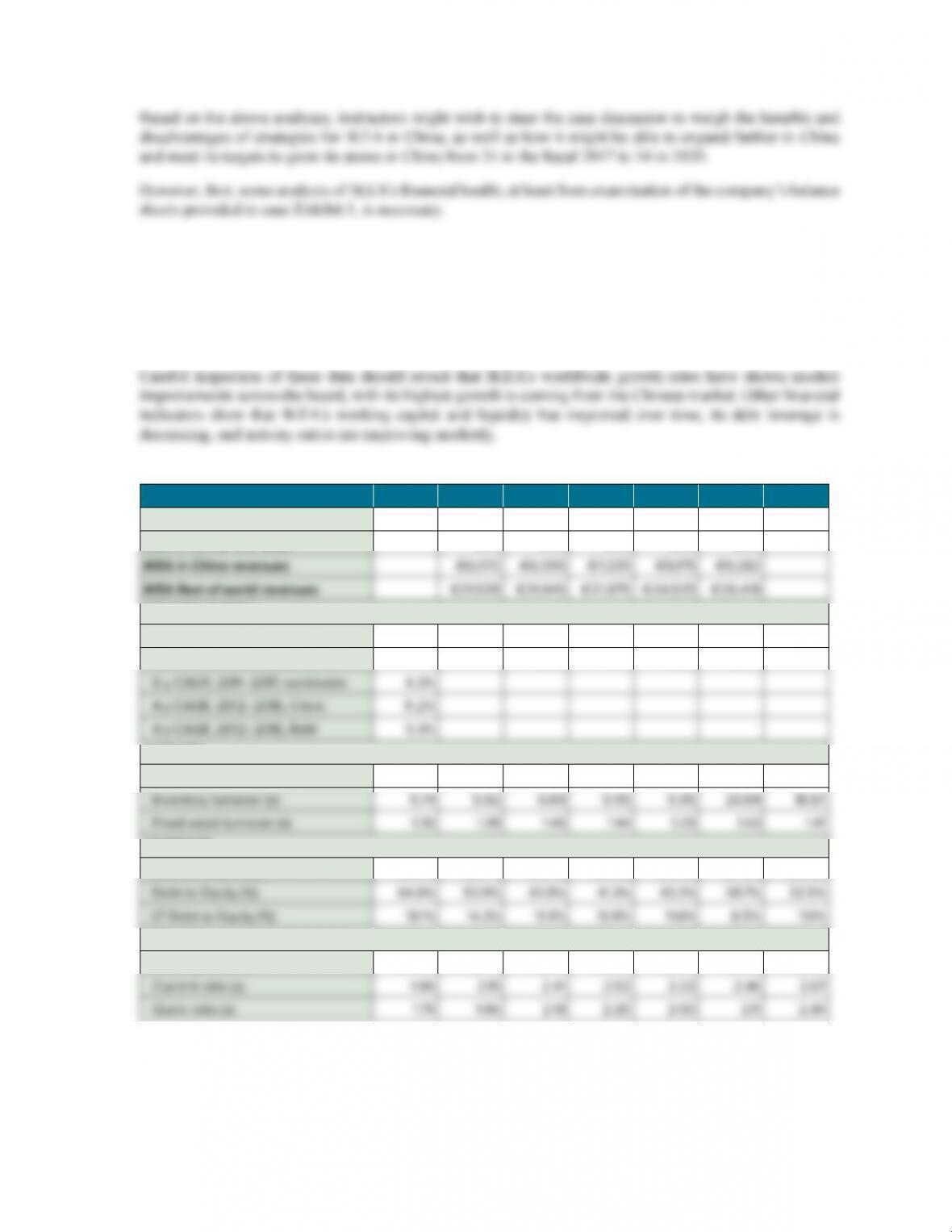
Analysis of IKEA’s financial health should involve an examination of the company’s balance sheets and
revenue trend data provided in case exhibits 1 and 7, respectively. See Table 4, “Financial Analysis for IKEA
Worldwide, 2013–2017.”
TABLE 4. Financial Analysis for IKEA Worldwide (2013–2017)
€ millions, unless otherwise indicated 2011 2012 2013 2014 2015 2016 2017
IKEA Worldwide revenues† €25,200 €27,600 €28,500 €29,300 €32,700 €35,700 €36,300
IKEA in China % of total^ 22% 23% 25% 25% 26%
GROWTH RATES*
IKEA Worldwide revenues, YoY % 9.5% 3.3% 2.8% 11.6% 9.2% 1.7%
IKEA in China revenues, YoY % 8.0% 11.7% 11.6% 13.5%
ACTIVITY
Total asset turnover (x) 0.602 0.617 0.679 0.656 0.654 0.662 0.686
LEVERAGE
Debt to Assets (%) 39.3% 35.0% 30.4% 29.2% 30.2% 27.9% 24.6%
LIQUIDITY
Working Capital €11,414 €13,284 €13,138 €14,710 €13,573 €17,212 €17,060
NOTES
†Provided in case Exhibit 6.
^Provided in case Exhibit 7.
*CAGR = Compound Annual Growth Rate, YoY = year over year, and RoW = Rest of world.
Case 22 Teaching Note IKEA’s International Marketing Strategy in China
567
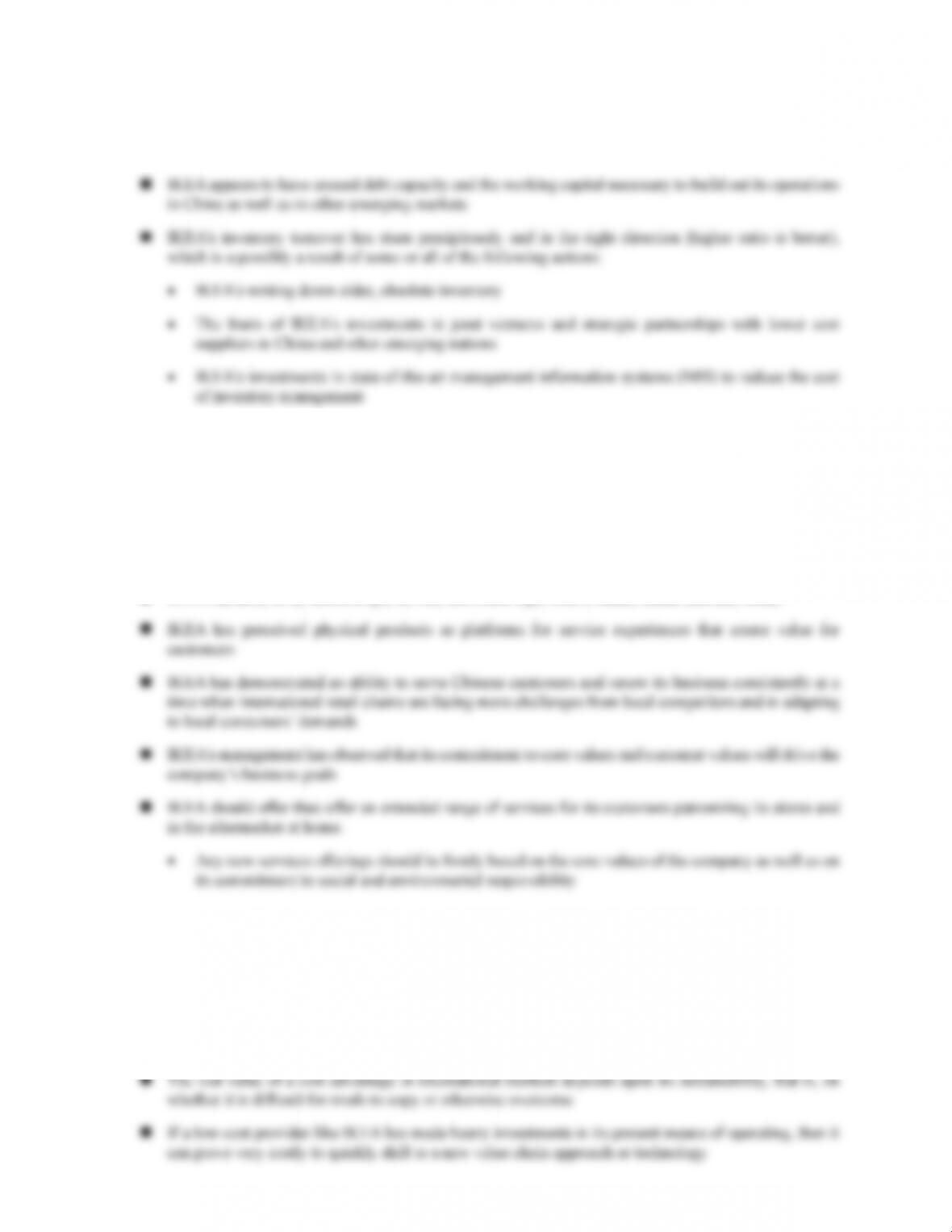
From Table 4, advanced analysts may conclude that:
IKEA is indeed a capital-intensive company, evidenced by a small Total Asset Turnover ratio
6. What recommendations would you make Angela Zhu and her team to foster IKEA’s future
growth in China?
We believe that, based on its recent operating history and on its future prospects, IKEA in China’s management
team needs to consider the following recommendations.
IKEA in China has not only focused on furniture but also sought to find solutions to the real-life problems
of the Chinese consumer populace
IKEA has done so by combining a service-dominant logic with a values-based business model
Wrapping Up The Class
This is an excellent opportunity for instructors to close the discussion by reiterating some of the important
lessons of Chapters 6 and 7:
Higher unit sales and market shares in international markets like China do not automatically translate
into higher total margins
Case 22 Teaching Note IKEA’s International Marketing Strategy in China
568
Similarly, cost savings for international market entrants may prove smaller than expected across borders
and particularly in emerging markets with cultures far more diverse than a firm’s traditional or home
markets
As IKEA has learned from its entry into China, competitive capabilities take substantially longer to
realize (or may never materialize) in international markets than in traditional or home markets
A combination of low operating and low financial leverage can permit increased investment or prove to
be beneficial to firms like IKEA that are highly vulnerable to shifts in economic cycles
Companies like IKEA that are racing for global leadership have to consider competing in other
developing-economy markets like India, Brazil, Indonesia, Thailand, and Russia—countries where the
business risks are considerable but where the opportunities for growth are huge, especially as those
economies develop and their populations’ living standards climb toward levels in the industrialized
world
The options for tailoring IKEA’s strategy to fit the sometimes unusual or challenging circumstances
presented in developing-country markets like India, for example, will include:
• Preparing to compete on the basis of low price
Crafting a strategy to compete in one or more countries of the world is inherently complex for five
reasons:
• Different countries have different home-country advantages in different industries; competing
effectively requires an understanding of these differences
Case 22 Teaching Note IKEA’s International Marketing Strategy in China
569
Crafting a strategy that includes a commitment to sustainability and corporate social responsibility will
also be of paramount importance to IKEA as it continues its global expansion (and these challenges will
be covered in Chapter 9).
Epilogue
Recent company information is available at IKEA’s corporate investor relations website, https://www.ikea.com/
ms/en_US/this-is-ikea/reports-downloads/index.html#. Recent financial highlights from FY 2017 include:
IKEA Consolidated Income Statement
(in millions of EUR)
FY17
12 months
FY16
8 months
Sales of goods 20,778 1,337
Franchise fees 1,156 725
Other income 944 114
Total revenue 22,878 2,176
Cost of goods sold 18,688 1,292
Total income before taxes 1,153 329
Income taxes -241 -71
Net income 912 258
IKEA Consolidated Balance Sheets
(in millions of EUR)
31 Aug. 2017 31 Aug. 2016
Intangible fixed assets 8,243 8,932
Tangible fixed assets 1,451 1,336
Financial fixed assets 246 322
Total fixed assets 9,940 10,590