Costco Wholesale Corp. in 2018:
Mission, Business Model, and Strategy
Overview
Six years after turning the leadership of Costco Wholesale over to then-president, Craig Jelinek, Jim
Sinegal, Costco’s co-founder and chief executive officer (CEO) from 1983 until year-end 2011, had ample
reason to be pleased with the company’s ongoing revenue growth and competitive standing as one of the
world’s biggest and best consumer goods merchandisers. Sinegal had been the driving force behind Costco’s
35-year evolution from a startup entrepreneurial venture into the third largest retailer in the United States, the
seventh largest retailer in the world, and the undisputed leader of the discount warehouse and wholesale club seg-
ment of the North American retailing industry. Since January 2012, when Craig Jelinek took the reins as Costco
Wholesale’s president and CEO, the company had prospered, growing from annual revenues of $89 billion and
598 membership warehouses at year-end fiscal 2011 to annual revenues of $126.2 billion and 741 membership
warehouses at year-end fiscal 2017. Costco’s growth continued in the first nine months of fiscal 2018; 9-month
revenues were $95.0 billion, up 12.0 percent over the first 9 months of fiscal 2017, and the company had opened
four additional warehouses. As of June 2018, Costco ranked as the second largest retailer in both the United
States and the world (behind Walmart).
In early 2018, there were about 1,460 warehouse locations across the United States and Canada; most every
major metropolitan area had one, if not several, warehouse clubs. Costco had close to a 64 percent share of ware–
house club sales across the United States and Canada, with Sam’s Club (a division of Walmart) having roughly
a 29 percent share and BJ’s Wholesale Club and several small warehouse club competitors close to a 7 percent
case 4 teaching note
Case 4 Teaching Note Costco Wholesale Corp. in 2018: Mission, Business Model, and Strategy
299
The case spotlights Costco’s mission, business model, and strategy, but it also contains good coverage of
the company’s warehouse operations, compensation practices, business philosophy, core values, and ethical
standards. The company is interesting in several important respects:
• Costco’s mission in the membership warehouse business was “To continually provide our members with
quality goods and services at the lowest possible prices.”
• The centerpiece of Costco’s business model entailed generating high sales volumes and rapid inventory
turnover by offering fee-paying mem bers attractively low prices on a limited selection of nationally
Case 4 Teaching Note Costco Wholesale Corp. in 2018: Mission, Business Model, and Strategy
300
Suggestions for Using the Case
This case was written to (1) illustrate the CEO’s role as chief strategist and organization leader, (2) demonstrate
how a company’s business principles and core values can link tightly to and drive a company’s strategy and
operating practices, and (3) give students practice in evaluating a company’s direction and strategy in the highly
competitive retail marketplace. The case requires that students draw upon most all of the concepts discussed in
Chapters 1 and 2 in preparing the case for class discussion.
We think Costco Wholesale is an excellent leadoff case for the course (other good choices are Mystic Monk
Coffee, Airbnb, and Will’s Grill—all of which require that students draw upon the material covered in Chapters 1
and 2). Student familiarity with “big box” discount retailing, the very interesting character of Costco Wholesale
and its co-founder/former CEO Jim Sinegal, and the very close connection between the case and the material
in Chapters 1 and 2 make this an especially good leadoff case. You may want to consider covering Chapter 1 in
your first day’s lecture, Chapter 2 on your second day’s lecture, and then assigning Costco Wholesale for class
discussion on Day 3.
The assignment questions and teaching outline presented below reflect our thinking about how to conduct
the class discussion.
Videos for Use with the Costco Case. As a way to set the stage for class discussion and embellish some
of the content in the case, we suggest showing the following videos (all three of the videos will be particularly
helpful to students who have never been in a Costco or other wholesale club store):
Case 4 Teaching Note Costco Wholesale Corp. in 2018: Mission, Business Model, and Strategy
301
A fourth video which may be of interest is a 2:10-minute 2018 video titled “Does Costco beat out the competition
when it comes to travel?;” it can be accessed at https://www.youtube.com/watch?v=8XMmcz03RZs.
The Connect-based Exercise for the Costco Case. We developed an exercise for the Costco Wholesale
case for inclusion in the publisher’s Connect™ Management web-based assignment and assessment platform
because
Note that this exercise entails conducting a full-fledged five-forces analysis of competition in the wholesale
club industry (five-forces analysis is introduced in Chapter 3 and should be covered before asking the class
to complete the Connect-based exercise). It should take class members roughly 30-40 minutes to complete
the Costco Connect-based exercise, assuming they have read Chapters 1-3 and done a conscientious job of
Case 4 Teaching Note Costco Wholesale Corp. in 2018: Mission, Business Model, and Strategy
302
Unless you want to use a particular case exercise for testing purposes, the best approach to using the Connect
case exercises is to require all class members to complete this exercise for the Costco case before coming to
What to Tell Students in Preparing the Costco Case for Class. To give students guidance in what to do
and think about in preparing the Costco case for class discussion, we strongly recommend two things:
1. Have class members complete the Connect-based exercise for the Costco case (in the event you have
opted to make the Connect supplement for the 22nd Edition a part of the materials required for your
course).
2. Provide class members with assignment questions (in addition to what is covered in the Connect
exercise) and insist that they prepare good notes/answers to these questions before coming to class.
To facilitate your use of assignment questions and making them available to students, we have posted
a file of the Assignment Questions contained in this teaching note in the Instructor Resources section
of the Connect Library). (You should be aware that there is a set of assignment questions posted in the
student OLC for each of the 32 cases included in the 22nd edition.)
Utilizing the Guide to Case Analysis. If this is your first assigned case, you may find it beneficial to have
Suggested Assignment Questions for an Oral Team Presentation or Written Case Analysis. The
Costco case is quite suitable for both oral team presentations and a written case assignment. Our suggested
assignments for either an oral presentation or a written case assignment are as follows:
1. What is your assessment of Costco’s business model and strategy? How well is Costco’s strategy
working? What recommendations would you make to Costco management to sustain the company’s
Case 4 Teaching Note Costco Wholesale Corp. in 2018: Mission, Business Model, and Strategy
303
Assignment Questions
1. What is Costco’s business model? Is the company’s business model appealing? Why or why not?
2. What are the chief elements of Costco’s strategy? How good is the strategy?
3. Do you think Jim Sinegal was an effective CEO? What grade would you give him in leading the process of
crafting and executing Costco’s strategy? How well is Craig Jelinek performing as Sinegal’s successor; what
grade would you give him so far in leading the process of crafting and executing strategy? What support can
you offer for these grades? Refer to Figure 2.1 in Chapter 2 in developing your answers.
4. What core values or business principles did Jim Sinegal stress at Costco?
5. (In the event you have covered Chapter 3) What is competition like in the North American wholesale club
industry? Which of the five competitive forces is strongest and why? Use the information in Figures 3.4,
3.5, 3.6, 3.7, and 3.8 (and the related discussions) in Chapter 3 to do a complete five-forces analysis of
competition in the North American wholesale club industry.
6. How well is Costco performing from a financial perspective? Do some number-crunching using the data in
case Exhibit 1 to support your answer. Use the financial ratios presented in Table 4.1 of Chapter 4 (pages
85-87) to help you diagnose Costco’s financial performance.
Case 4 Teaching Note Costco Wholesale Corp. in 2018: Mission, Business Model, and Strategy
304
Teaching Outline and Analysis
1. What is Costco’s business model? Is the company’s business model appealing? Why or why
not?
As discussed in Chapter 1, a company’s business model explains the rationale for why its business approach
and strategy will be a moneymaker. This rationale sets forth the key components of the company’s business
approach, indicates how revenues will be generated, and makes a case for why the strategy can deliver value
to customers and at the same time be profitable.
The information in the case lays out the chief components of Costco’s business model in a straightforward
manner:
2. What are the chief elements of Costco’s strategy? How good is the strategy?
The cornerstones of Costco’s strategy were low prices, a limited product line and limited selection, a
“treasure hunt” shopping environment, strong emphasis on low operat ing costs, and ongoing expansion of
its geographic network of store locations.
Case 4 Teaching Note Costco Wholesale Corp. in 2018: Mission, Business Model, and Strategy
305
Costco’s strategic approach to pricing was to keep customers coming in to shop by wowing them with
low prices. Costco was known for selling top quality national and regional brands at prices consistently
below traditional wholesale or retail outlets. The company only stocked items which could be priced
at bargain levels and provide members with significant cost savings; this was true even if an item was
oft-requested by customers.
Whereas typical supermarkets stocked about 40,000 items and a Wal-Mart Supercenter or SuperTarget
might have as many as 150,000 items for shoppers to choose from, Costco’s merchandising strategy was
to provide members with a selection of only about 3,800 items.
• However, Costco’s product range covered a broad spectrum—rotisserie chicken, all types of fresh
meats, seafood, fresh and canned fruits and vegetables, paper products, cereals, coffee, dairy
products, cheeses, frozen foods, flat-screen televisions, iPods, digital cameras, fresh flowers, fine
While Costco’s product line consisted of approximately 3,800 active items, some 20 to 25 percent of its
product offerings were constantly changing. Costco’s merchandise buyers were continuously making
one-time purchases of items that would appeal to the company’s clientele and that would sell out quickly.
Case 4 Teaching Note Costco Wholesale Corp. in 2018: Mission, Business Model, and Strategy
306
Costco’s low prices and its reputation for making shopping at Costco something of a treasure hunt
made it unnecessary to engage in extensive advertising or sales campaigns. Marketing and promotional
activities were generally limited to monthly coupon mailers to members, weekly e-mails to members
from Costco.com, occasional direct mail to prospective new members, and regular direct marketing
Most Costco stores were located in the upscale areas/suburbs of major metropolitan areas.
In June 2018, Costco was operating 750 membership warehouses, including 520 in the United States
and Puerto Rico, 98 in Canada, 38 in Mexico, 28 in the United Kingdom, 26 in Japan, 14 in South
Korea, 13 in Taiwan, 9 in Australia, 2 in Spain, 1 in France, and 1 in Iceland.
• Costco also sold merchandise to members at web sites in the United States, Canada, Mexico, the
United Kingdom, Taiwan, and South Korea. These websites enabled members to shop for many in-
store products online and provided them with a means of obtaining a much wider variety of value-
priced products and services that were not practical to stock at the company’s warehouses. In recent
Case 4 Teaching Note Costco Wholesale Corp. in 2018: Mission, Business Model, and Strategy
307
• Over 90 mil lion cardholders were entitled to shop at Costco at the end of fiscal 2017, generating
over $2.85 billion in membership fees for the company.
• Annual sales per store averaged about $170 million ($3.27 million per week), some 71 percent
higher than the $99.2 million per year and $1.9 million per week averages for Sam’s Club, Costco’s
chief competitor.
Costco’s growth strategy was to increase sales at existing stores by 5 percent or more annually and to
open additional warehouses, both domestically and internationally. Average annual growth at stores
open at least a year was 10 percent in fiscal 2011, 6 percent in both fiscal 2013 and 2014, 7 percent in
fiscal 2015, and 4 percent in 2016 and 2017 (as shown in Exhibit 1).
• In 2017, Costco opened 28 new warehouses, including its first ones in Iceland and France. Costco
expected to open 20 to 25 new warehouses and relocate up to six warehouses in fiscal year 2018
beginning September 4, 2017.
3. Do you think Jim Sinegal was an eective CEO? What grade would you give him in leading
the process of crafting and executing Costco’s strategy? How well is Craig Jelinek performing
as Sinegal’s successor; what grade would you give him so far in leading the process of
crafting and executing strategy? What support can you oer for these grades? Refer to
Figure 2.1 in Chapter 2 in developing your answers.
Class members are likely to approve of the way Jim Sinegal managed Costco and the overall job he did.
We suggest that you push the class to evaluate Sinegal in terms of how well he performed the five tasks of
strategic management portrayed in Figure 2.1 in Chapter 2. You might want to ask the following questions:
We would give Jim Sinegal an “A” for the job he did in leading the strategy-making process at Costco.
But there is always merit in pushing class members to justify their reasons for approving of Jim Sinegal’s
performance. Very likely, students will find little to criticize. Most will concur that the strategy is fundamentally
sound and that there is every indication it is working well. Some points that class members ought to make:
Case 4 Teaching Note Costco Wholesale Corp. in 2018: Mission, Business Model, and Strategy
308
Moreover, Sinegal did a very commendable job in leading the strategy execution process at Costco. He
spent a lot of time in the stores, checking out store layouts and merchandising, speaking with employees, and
in general staying in close touch with how well things are going. He was apparently very quick to take action
when he spotted ways a store could improve. In touring a Costco store with the local store manager, Sinegal
was very much the person in-charge. He functioned as producer, director, and knowledgeable critic. He cut
Key Conclusion and Teaching Point: Jim Sinegal and Craig Jelinek have been effective CEOs. Jim
Sinegal, in particular did a superb job of strategic leader—he merits a grade of A+ for his performance. Craig
Jelinek’s job at Costco has been made far easier because of all the things Sinegal did and accomplished.
Pretty much all Jelinek has had to do in his 6+ years as Costco CEO is follow in Sinegal’s footsteps and
make sure that things continue to work as well or better than in the past. Students should see that Costco
is a good illustration of a point much emphasized at the end of Chapter 1: good strategy + good strategy
execution = good management.
4. What core values or business principles did Jim Sinegal stress at Costco?
Two core values or business principles seem to stand out at Costco:
Delivering value to customers in the form of low prices.
Treating employees well.
5. (In the event you have covered Chapter 3) What is competition like in the North American
wholesale club industry? Which of the five competitive forces is strongest and why? Use the
information in Figures 3.4, 3.5, 3.6, 3.7, and 3.8 (and the related discussions in Chapter 3)
to do a complete five-forces analysis of competition in the North American wholesale club
industry.
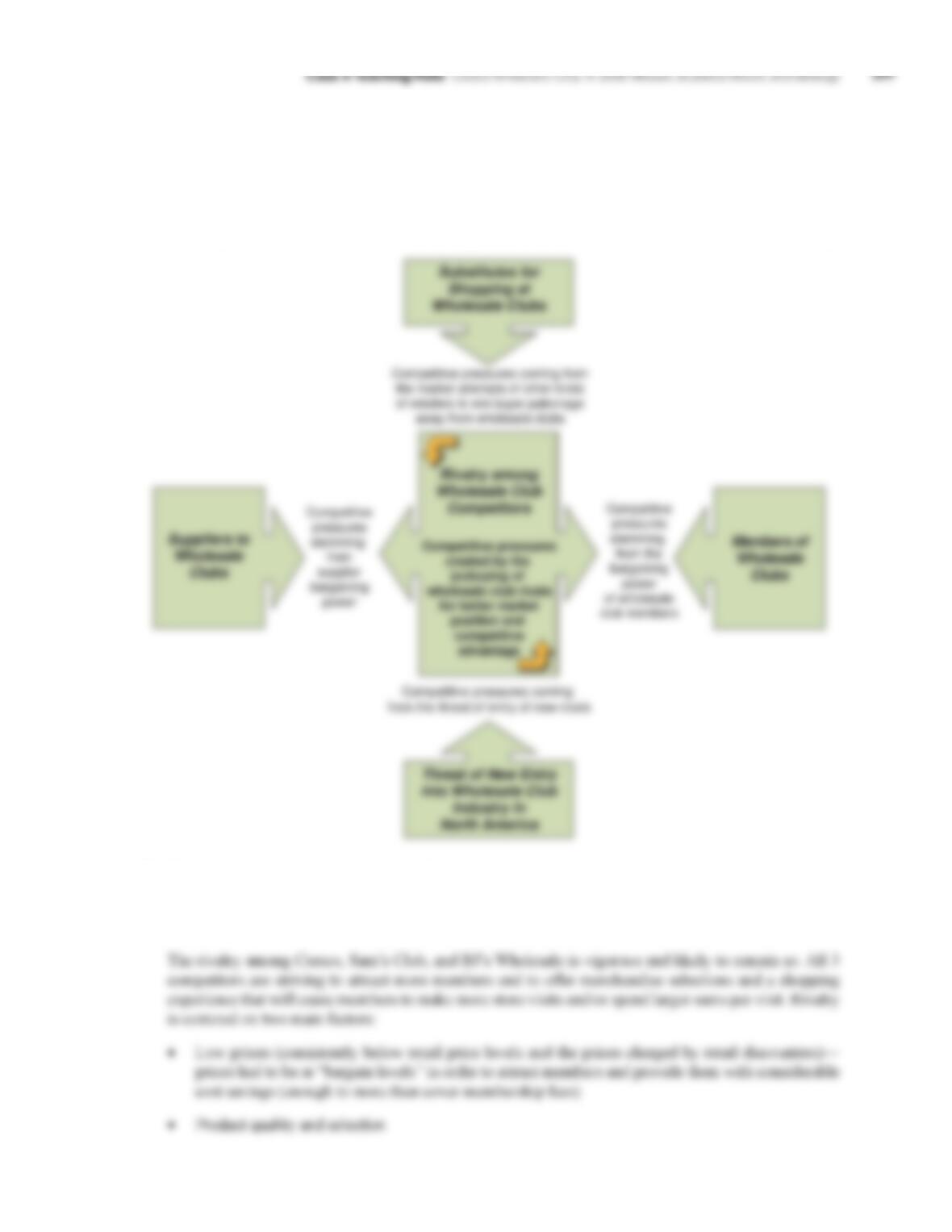
Below is a representative five-forces model of competition for the North American wholesale club industry:
Competitive pressures coming
from the threat of entry of new rivals
Substitutes for
Shopping at
Wholesale Clubs
Competitive pressures coming from
the market attempts of other kinds
of retailers to win buyer patronage
away from wholesale clubs
Threat of New Entry
into Wholesale Club
Industry in
North America
Rivalry among wholesale club competitors—a strong to fierce competitive force
In assessing this competitive force, students should draw upon the information in Figure 3.4 in Chapter
3 (and the related text discussion).
Case 4 Teaching Note Costco Wholesale Corp. in 2018: Mission, Business Model, and Strategy
310
— Merchandise was generally of good to excellent quality and often included name brand products
supplemented with an assortment of private-label products
— Warehouse clubs stocked 3,500 to 4,500 items, a portion of which were ever-changing as
company purchasing personnel ran upon one-time buying opportunities.
To a much lesser extent, rivalry also revolved around attracting members/shoppers by means of
convenient store locations, a comparatively pleasant big-box shopping environment, and maybe even
satisfactory checkout speeds.
Class members should cite several factors (displayed in Figure 3.4 and Table 3.2 on p. 55 of Chapter 3)
as working to intensify rivalry among the three warehouse club competitors in North America:
Factors that might be cited as making rivalry weaker include:
• The differentiation that exists from club to club (as concerns shopping ambience, product selection,
merchandising, and convenient access to store locations)—this differentiation poses a barrier to
switching to the extent that some bargain-hunting shoppers prefer shopping at one club versus
another when there are multiple clubs to choose from in their shopping area, thus acting to weaken
rivalry.
But this one factor is not powerful enough to overcome the combination of factors acting to strengthen
rivalry.