
– 323 –
Competition in the Craft Beer
Industry in 2018
Overview
Locally produced or regional craft beers caused a seismic shift in the U.S. beer industry during the early
2010s with the gains of the small, regional newcomers coming at the expense of such well-known brands
as Budweiser, Miller, Coors, and Bud Light. Craft breweries, which by definition sold fewer than 6 million
barrels (bbls) per year, expanded rapidly with the deregulation of intrastate alcohol distribution and retail laws
and a change in consumer preferences toward unique and high-quality beers. While craft beer sales had increased
in 2017, overall industry sales had declined. Further, there did not seem to be a slowdown in the number of new
craft brewers entering the market. Industry competition was increasing as grain price fluctuations affected cost
structures and growing consolidation within the beer industry—led most notably by AB InBev’s acquisition of
several craft breweries, Grupo Modelo, and its acquisition of SABMiller—had created a battle for market share.
While the market for specialty beer was expected to gradually plateau by 2020, it appeared that the slowing
growth had arrived by 2017. Nevertheless, craft breweries and microbreweries were expected to expand in
number and in terms of market share as consumers sought out new pale ales, stouts, wheat beers, pilsners, and
lagers with regional or local flairs.
Suggestions for Using the Case
The case is an ideal follow-up to a course lead-off case such as Airbnb in 2018, Robin Hood, Mystic Monk
Coffee or Wil’s Grill. This case is intended to provide students the opportunity to explore competition in an
established, yet growing market as found in the craft beer industry. We recommend using the case immediately
following your coverage of Chapter 3, but may also be used to illustrate concepts found in Chapter 5. The case
is closely linked to the industry and competitive analysis concepts presented in Chapter 3 and includes ample
material to allow students to perform a Five Forces analysis, determine the strategically-relevant aspects of
the macro-environment, examine strategic positioning through the use of a strategic group map, and evaluate
industry key success factors.
case 5 teaching note
*
Case 5 Teaching Note Competition in the Craft Beer Industry in 2018
324
Videos for Use with the Competition in the Craft Beer Industry in 2018 Case. There are two videos
you can show (or let students view on their own) when having class discussion of the Competition in the Craft
Beer Industry in 2018 case:
In our experience, it is quite difficult to have an insightful and constructive class discussion of an assigned
case unless students have conscientiously made use of pertinent core concepts and analytical tools in preparing
To facilitate your use of assignment questions and making them available to students, we have posted a file of
the Assignment Questions contained in this teaching note in the instructor resources section of the Connect
Utilizing the Guide to Case Analysis. If this is your first assigned case, you may find it beneficial to have
Suggested Assignment Questions for an Oral Team Presentation or Written Case Analysis. The
case can be used effectively for a written assignment early in the term, but we advise against using the case for
group presentations scheduled just prior to finals since the issues are relatively easy to sort out and address. Our
recommended questions for written assignments are as follows:
1. AB InBev is considering you for an entry-level brand management position. You have been asked to prepare
an analysis of the U.S. craft beer industry as part of the selection process. Please prepare a 5-6 page report
2. As a new member of Boston Beer Company’s brand management department, you have been asked to pre-
Case 5 Teaching Note Competition in the Craft Beer Industry in 2018
325
Assignment Questions
1. What are the strategically relevant components of the U.S. and global craft beer industry macro-environment?
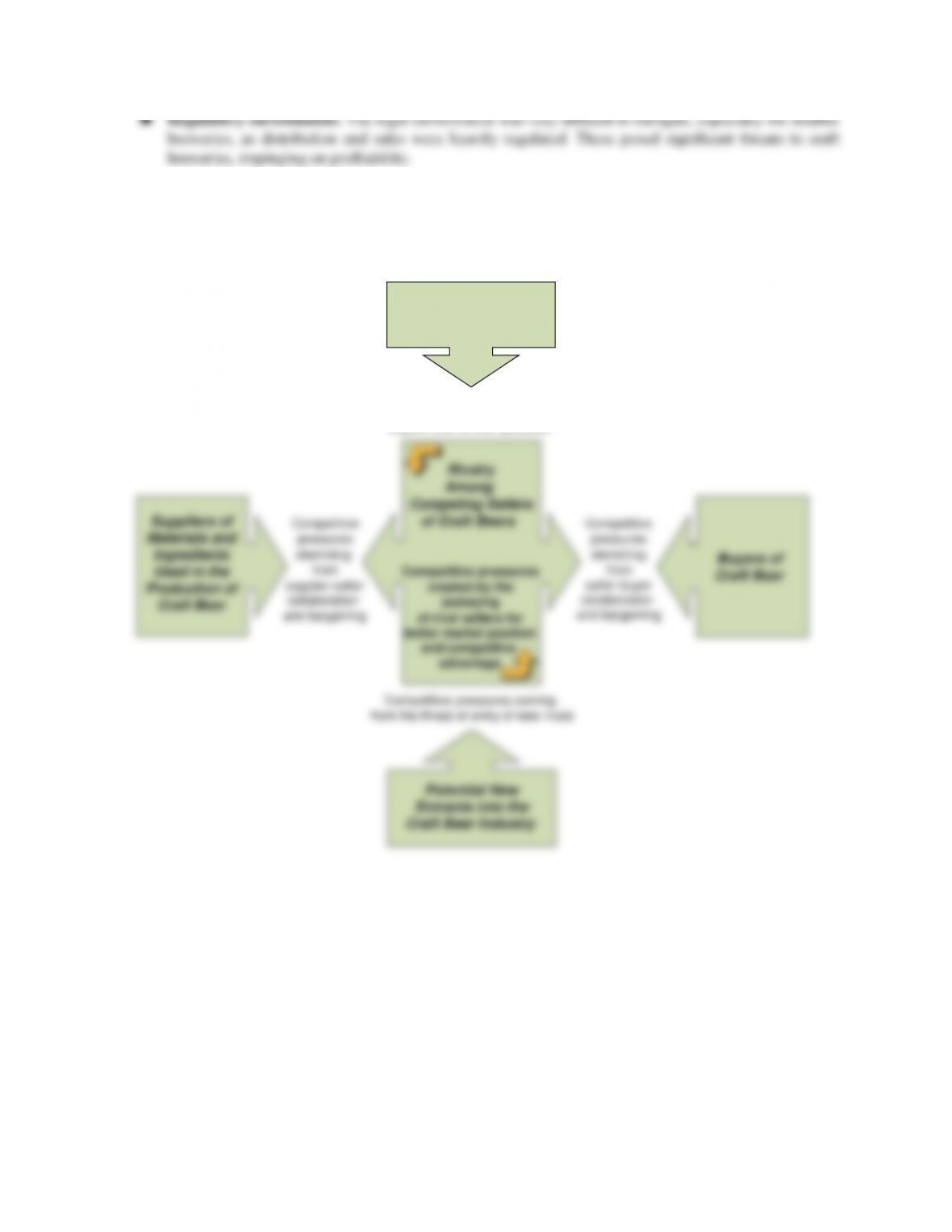
2. What is competition like in the craft beer industry? Which of the five competitive forces is strongest? Which
is weakest? What competitive forces seem to have the greatest effect on industry attractiveness and the
potential profitability of new entrants?
3. What does your strategic group map of the craft beer industry look like? Which strategic groups do you think
are in the best positions? The worst positions?
Teaching Outline and Analysis
1. What are the strategically relevant components of the U.S. and global craft beer industry
macro-environment?
Students should be able to identify the following from within the case:
Market size and growth. The total craft beer market was estimated to be around $6 billion. The total
economic impact of the beer market is estimated to be 2.0 percent of the total US GDP. In the case,
exhibit 1 lists the barrels produced in the US for the past 11 years, showing a steady decline, with only
a slight plateau between 2013 and 2016. Globally, while consumption may have slowed in developed
The case states there were nearly 6,000 US-based brewers in 2017, triple the number in 2012. Of these
breweries, 99 percent were identified as “craft” breweries, with distribution ranging from local to
national. By 2017, 3 out of 10 of the top US breweries were crafter brewers (exhibit 2). Exhibit 3 shows
the 10 largest global producers and their production from 2014 to 2016. Exhibit 4 lists the number of
craft brewers by US state, comparing 2015 to 2017, clearly showing the steady increase of craft brewers
entering the market.
Case 5 Teaching Note Competition in the Craft Beer Industry in 2018
326
2. What is competition like in the craft beer industry? Which of the five competitive forces is
strongest? Which is weakest? What competitive forces seem to have the greatest eect on
industry attractiveness and the potential profitability of new entrants?
Competitive pressures coming from the
market attempts of outsiders to win
buyers over to their products
Substitutes for
Craft Beer
Potential New
Entrants into the
Craft Beer Industry
The bargaining power and leverage of buyers—a strong competitive force
Students should recognize that due to the regulatory environment, the requirement to sell to distributors is
a significant competitive force faced by craft breweries. Students may discuss how the three-tier system
disadvantages small producers, while potentially benefiting larger producers as they have greater negotiating
power with distributors.
Case 5 Teaching Note Competition in the Craft Beer Industry in 2018
327
The bargaining power and leverage of suppliers—a moderate competitive force
Students should conclude that depending on the raw materials, bargaining power may be moderate or
low. Raw materials such as cans and aluminum have diminished due to demand, and may impact smaller
producers, who have relatively lower negotiating power when compared to global producers. Depending on
the hops and grain grower, they may possess moderate to high negotiating power if said raw material is a
specialty and is unique to both the beer produced and the area. Exhibit 5 lists the types of grain used in beer
production from 2010-2014.
3. What does your strategic group map of the craft beer industry look like? Which strategic
groups do you think are in the best positions? The worst positions?
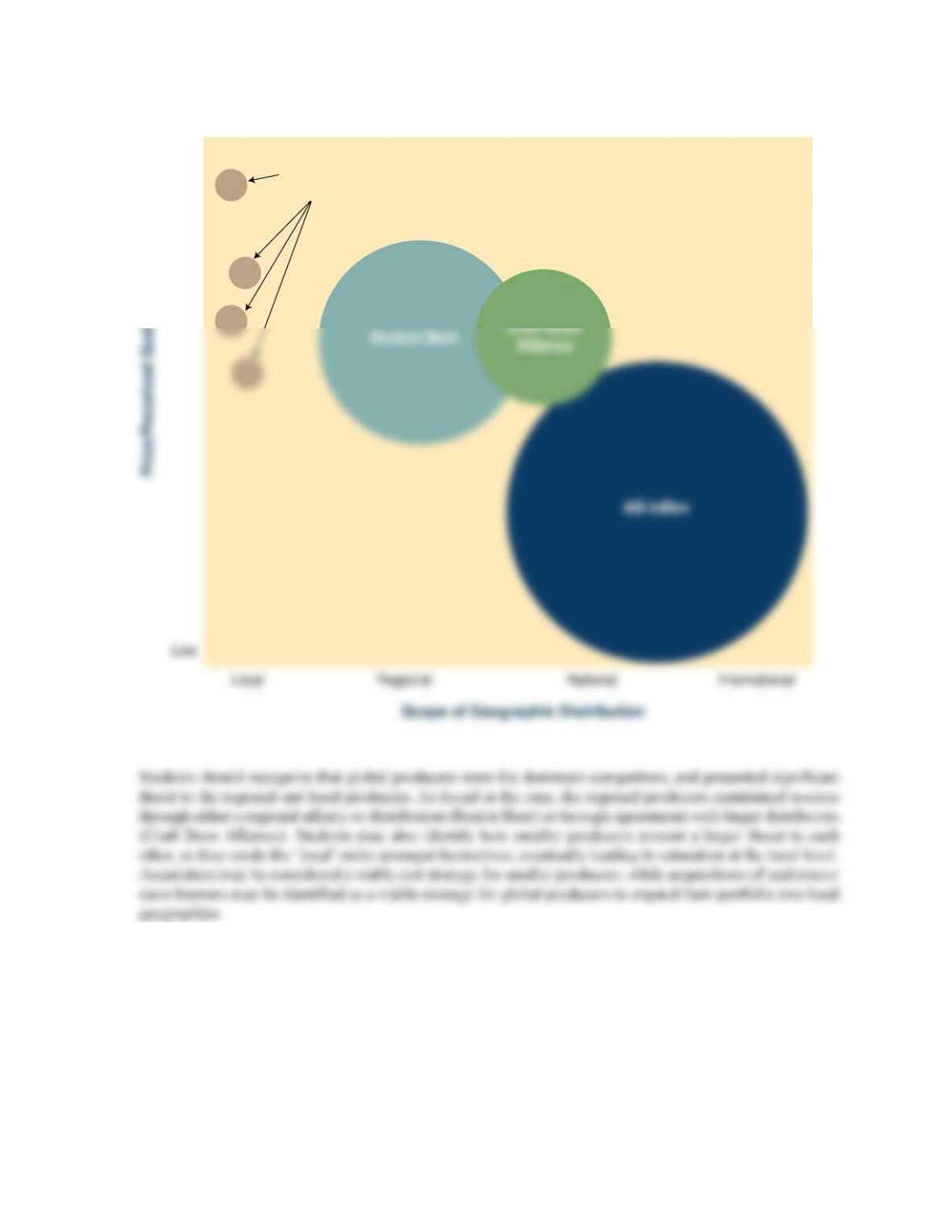
Students may use any grouping on the matrices, but the case provides the justification for a price/quality and
geographic distribution juxtaposition. In developing a strategic group map similar to what is shown in Figure
1 below, students should recognize that:
a) Nano- and micro- breweries are in a very narrow/local distribution. Local nano- and micro-breweries
generally occupied a high price/quality position, which could vary from above average price /quality to
exceptional price/quality.
Case 5 Teaching Note Competition in the Craft Beer Industry in 2018
328
FIGURE 1. Strategic Group Map of the Craft Beer Industry
Scope of Geographic Distribution
High
Craft Brew
Alliance
Boston Beer
Micro and
nano breweries
4. What key factors may determine the success of a start-up craft brewery?
Factors that are necessary for competitive success for a start-up or small, craft brewery:
Access to, and mitigation of distribution issues. Students may identify how smaller breweries are at a
disadvantage with distributors; yet distribution represents the key factor as small and large producers
compete for shelf and tap space. Especially at the local level, there is insufficient space to accommodate
the current producers, as well as the anticipated entry of future breweries.
Case 5 Teaching Note Competition in the Craft Beer Industry in 2018
329
5. What recommendations would you make to a craft brewery to improve its competitiveness
in the market while mitigating any current and future risks?
Students should note that strong distribution channels are mandatory for craft breweries to be competitive.
Thus, negotiation with distributors is a must. Further, students may identify how a push strategy; where
awareness by consumers and establishments may force distributors to carry a craft brewery; is also
necessary.
Students should identify how marketing efforts through social media can help drive awareness.
In addition, any and all events the brewery may host or may participate can help drive awareness.
6. Identify the strategic issues facing craft brewers in 2018. What eects may these issues
have on the industry?
Limited production and capital. Beer production for the vast majority of the craft breweries was
sufficient only for their local population. Many craft breweries started the same way as larger breweries:
home brewers or hobbyists decided to start brewing and sell their own beer. They often obtained startup
capital through personal savings or investments from friends and family. Due to their entrepreneurial
Case 5 Teaching Note Competition in the Craft Beer Industry in 2018
330
Epilogue