– 472 –
Amazon.com, Inc.: Driving Disruptive
Change in the U.S. Grocery Market
Overview
This case is about Amazon’s attempts to disrupt the U.S. grocery retail industry. Amazon had been chasing
the grocery market since 2007 with the launch of its online grocery delivery service, AmazonFresh. But
it had been unable to crack the market successfully. Finally, Amazon’s CEO, Jeff Bezos (Bezos), realized
that he could not win the grocery game by being online alone. In 2017, the e-tailer started experimenting with
physical grocery retail by launching the Amazon Go store (cashier-less convenience store) and AmazonFresh
Pick-Up services (grocery pickup). To further its brick-and-mortar ambitions and accelerate its growth in the
U.S. retail sector, Amazon acquired retail organic chain Whole Foods in June 2017. With this acquisition,
Amazon became a full force brick-and-mortar grocery retail operator, with more than 450 stores, most of them
in premium urban locations in the U.S.
Suggestions for Using the Case
This is a high-interest case because of both Amazon’s and Whole Foods Markets’ ubiquity and brand recognition,
and is one that will certainly trigger lively classroom discussion. Students should be very interested in discussing
the Amazon case, perhaps even in tandem with the Amazon case, particularly given the current dynamic changes
in industry leadership in both online and bricks-and-mortar retailing.
This case provides a unique opportunity for students to discuss Amazon’s attempts to strengthen its competitive
position via its sudden acquisition of Whole Foods Markets in June 2017, and is ideally paired with Chapter
6. Students should develop an appreciation of how and when companies need to deploy offensive or defensive
case 16 teaching note
*
Case 16 Teaching Note Amazon.com, Inc.: Driving Disruptive Change in the U.S. Grocery Market
473
strategic moves, as well as the impact of those moves in terms of changes in industry structure. Students can
tangentially consider the strategic risks and benefits to expanding a company’s horizontal scope via acquisitions.
This case is also of use in tandem with coverage of the diversification tests in Chapter 8 (industry attractiveness,
cost-of-entry, and better-off or “synergy” test). The case contains suffcient financial and operating and some
competitor information for students to evaluate. The case is meant to illustrate the following concepts and
frameworks and provide students with ample opportunities to use the tools of analysis:
Perform an analysis of the separate companies’ operating performance in the run-up to the acquisition,
and use the analysis of the addition of Whole Foods Markets to Amazon’s portfolio as a means
to determine the prospects for synergy between the two businesses (covered separately in Chapters 4
and 8)
The assignment questions and teaching outline presented below reflect our thinking and suggestions about
how to conduct the class discussion and what aspects to emphasize.
Video for Use with the Amazon.com, Inc.: Driving Disruptive Change in the U.S. Grocery
Market case. There is a 4:33-minute 2018 YouTube video entitled “Amazon Turns Groceries into Gold” that
you can show in class or have students view on their own. The video is located at https://www.youtube.com/
watch?v=CJzlXqrP0Eo
This case is suitable for both written and oral presentations, and because of its broad scope, works well as for a
midterm (or as a review for a final examination) writing exercise. Our recommended assignment questions are
as follows:
Case 16 Teaching Note Amazon.com, Inc.: Driving Disruptive Change in the U.S. Grocery Market
474
and a recommendation about potential new areas for diversification. Write an executive summary of
recommendations of no more than 2–3 pages, accompanied by supporting exhibits. These exhibits
may include an overview of Amazon’s strategy, an assessment of its resources and capabilities, and a
financial analysis.
Assignment Questions
1. What is competition like in the grocery retail industry? Which of the five competitive forces is strongest?
Which is or are weakest? What competitive forces seem to have the greatest effect on industry attractiveness
and the potential profitability of new entrants?
2. What does your strategic group map of the U.S. grocery retail industry look like? Is Whole Foods Market
suitably positioned? Why or why or why not?
3. What do you see as the key drivers of change in the U.S. grocery retail industry? Based on these drivers,
trace Amazon, Inc.’s evolution in the U.S. retail grocery industry. Is the Amazon Inc. / Whole Foods Market
combination potentially disruptive? Why or why not?

Case 16 Teaching Note Amazon.com, Inc.: Driving Disruptive Change in the U.S. Grocery Market
475
Teaching Outline and Analysis
1. What is competition like in the grocery retail industry? Which of the five competitive forces
is strongest? Which is or are weakest? What competitive forces seem to have the greatest
eect on industry attractiveness and the potential profitability of new entrants?
Students should be able to demonstrate their mastery of the material in Chapter 5, and come up with the
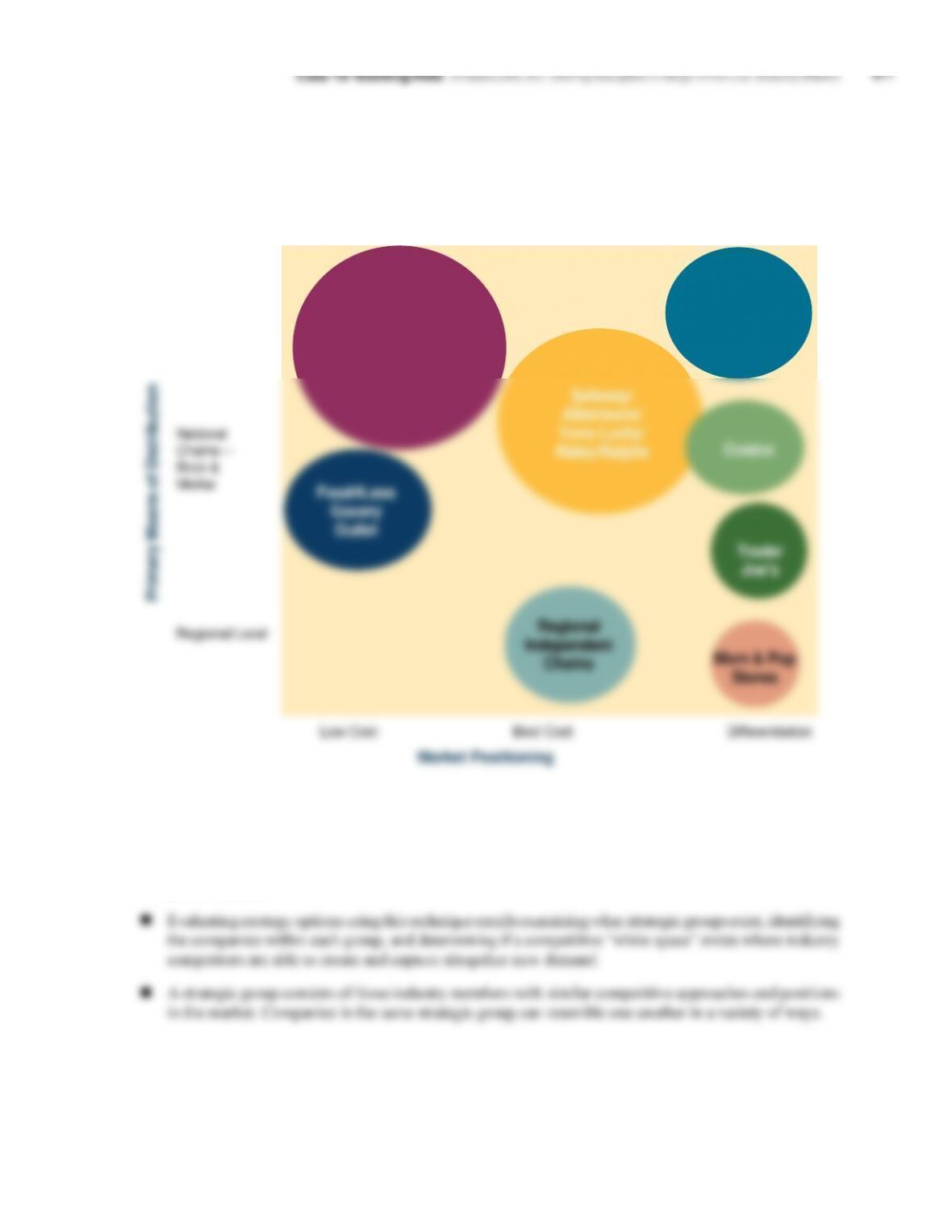
information used to create Figure 1, “Five Forces Model for the U.S. Supermarket Industry.”
FIGURE 1. The Five Forces Model for the U.S. Retail Grocery Industry
Threat
of New Entrants
Direct: Low
Indirect: High
Threat of Substitutes
Medium
The bargaining power and leverage of buyers—a strong competitive force.
Although not acting as one buyer, supermarket consumers have tremendous bargaining power as they are
not forced to shop at one or another supermarket, and base their patronage decisions primarily on location
Case 16 Teaching Note Amazon.com, Inc.: Driving Disruptive Change in the U.S. Grocery Market
476
The bargaining power and leverage of suppliers—a moderate competitive force.
Nearly all supermarkets are reliant on external manufacturers and food distributors for products to sell,
with the possible exception of those supermarkets that offer prepared convenience foods. As production
Threat of substitutes—a weak competitive force.
While growing and processing one’s own food or purchasing from farmers’ markets or patronizing
Threat of entry—a weak competitive force.
Owing to the high costs of starting a globally recognized supermarket brand and supply chain, threat of entry
may be analyzed as low. In the online retail age, investments in technology and customer acquisition are
quite likely to be capital intensive.
Rivalry among competing supermarkets—an intense competitive force.
Rivalry among supermarkets is strong and shows no sign of abating. This may be attributed to both the
established competitors in multiple communities and locations within those communities, and the even
***
Overall assessment of industry attractiveness—moderately attractive.
While substitution and entry threats remain weak, supplier power is moderate at least for the large national
chains and even stronger for regional or local supermarkets. Significantly, combined with pressure from
suppliers, the bargaining power of consumers and intense competitive rivalry severely curtail profitability
2. What does your strategic group map of the U.S. grocery retail industry look like? Is Whole
Foods Market suitably positioned? Why or why or why not?
Good coverage of the conceptual framework needed to answer this question is found in Chapter 3 of the text.
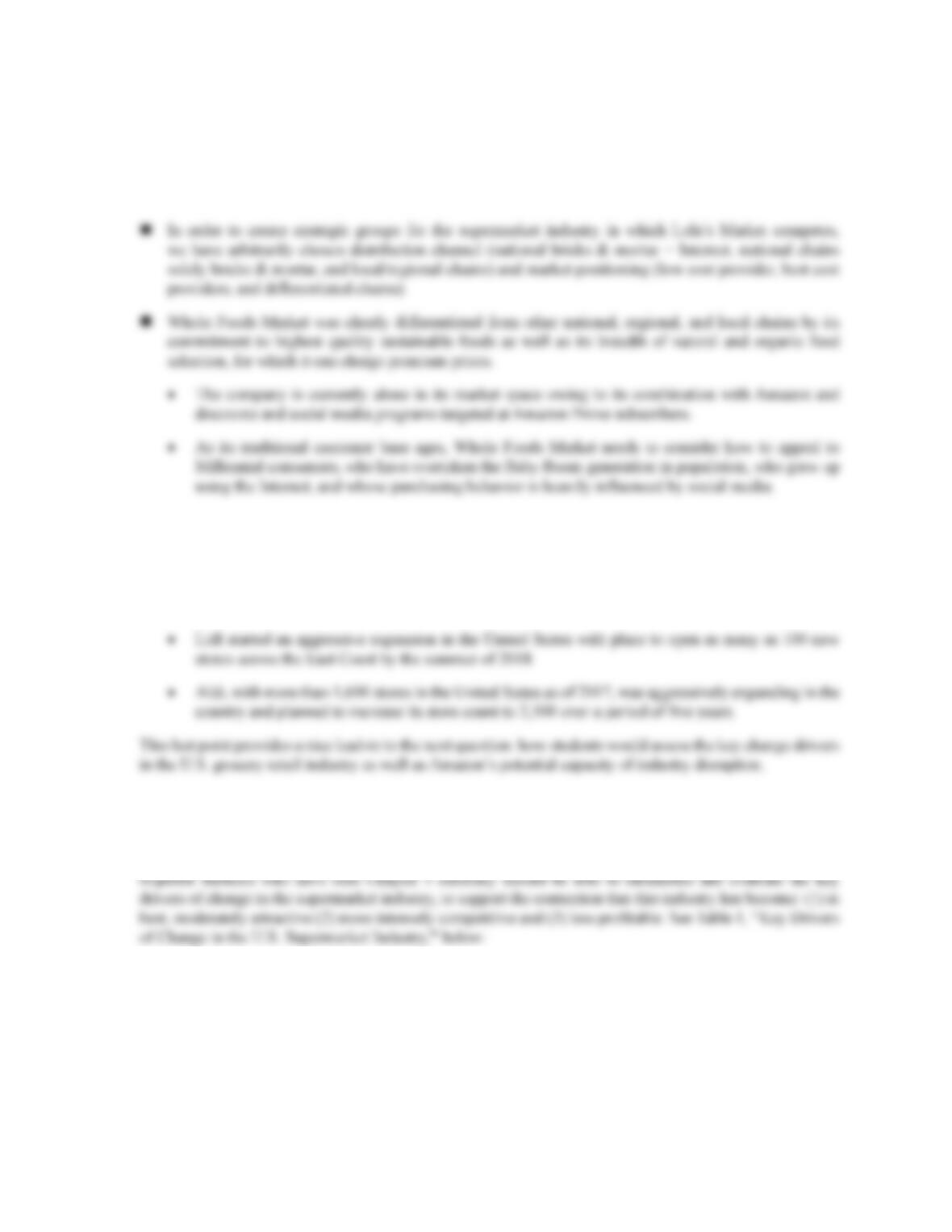
See suggested “U.S. Supermarket Industry Group Map” in Figure 2.
FIGURE 2. Strategic Group Map of the U.S. Grocery Retail Industry
Market Positioning
National chains
Brick & Mortar +
Internet
Walmart
Amazon
Whole Foods
Understanding which supermarket chains are strongly positioned and which are weakly positioned is an
integral part of analyzing this particular industry’s competitive structure.
The best technique for revealing the market positions of supermarket industry competitors is strategic
group mapping.
Case 16 Teaching Note Amazon.com, Inc.: Driving Disruptive Change in the U.S. Grocery Market
478
Other variables used in creating strategic group maps may include: price/quality range (high, medium,
low), geographic coverage (local, regional, national, global), product-line breadth (wide, narrow),
degree of service offered (no frills, limited, full), use of distribution channels (retail, wholesale, Internet,
multiple), degree of vertical integration (none, partial, full), and degree of diversification into other
industries (none, some, considerable).
As stated in the case, Amazon’s competitors were already taking steps to counter the e-tailer’s moves.
• WalMart announced that it would start offering its products on Google Express.
• German discount grocers Aldi and Lidl, who offered high quality products at low prices and a no-
frills store environment, were slowly making inroads into the U.S. grocery market.
3. What do you see as the key drivers of change in the U.S. grocery retail industry? Based
on these drivers, trace Amazon, Inc.’s evolution in the U.S. retail grocery industry. Is the
Amazon Inc. / Whole Foods Market combination potentially disruptive? Why or why not?
Case 16 Teaching Note Amazon.com, Inc.: Driving Disruptive Change in the U.S. Grocery Market
479
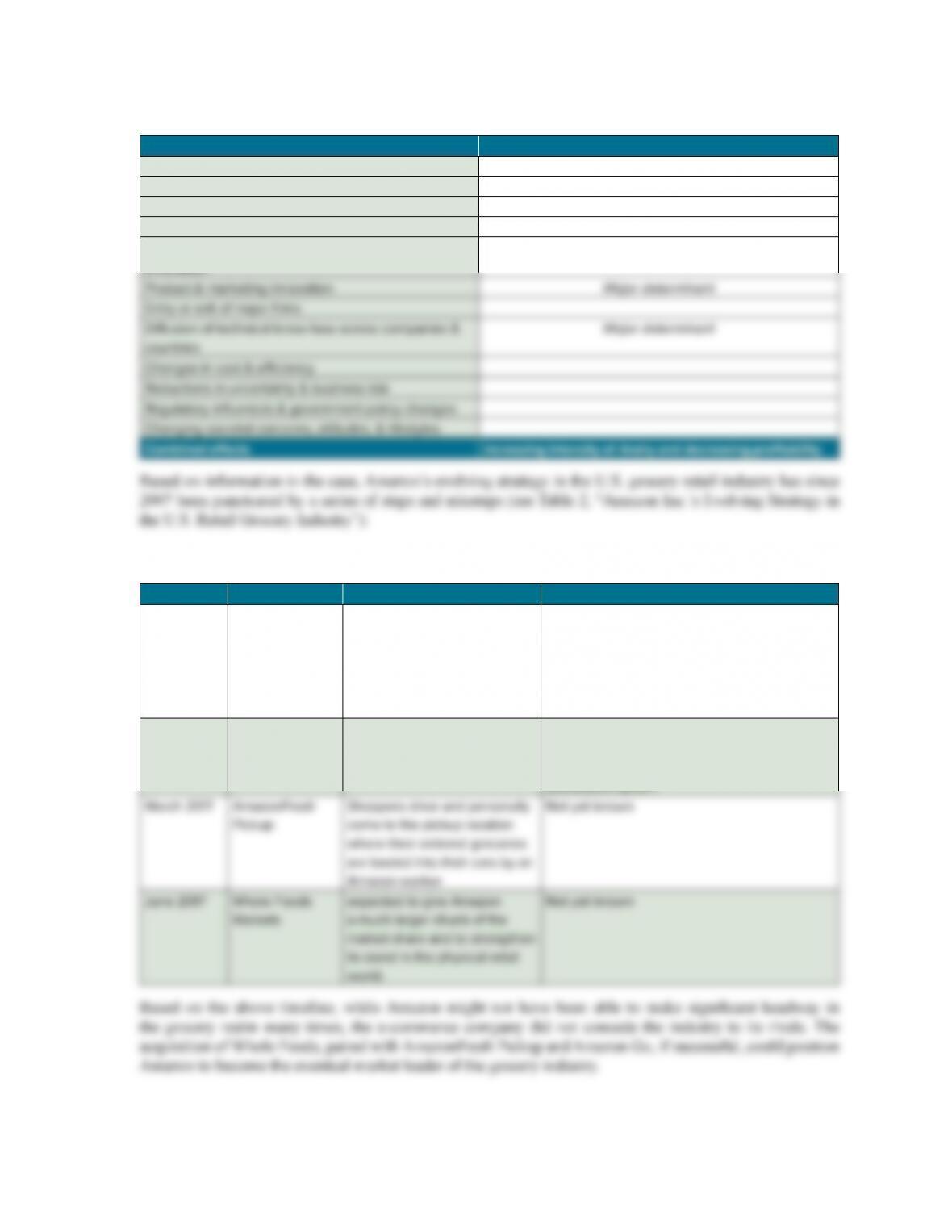
TABLE 1. Key Drivers of Change in the U.S. Supermarket Industry
Key drivers of industry change (from Table 3.3 in text) Impact of major factor on industry segment
Changes in the long-term industry growth rate
Increasing globalization
Emerging new Internet capabilities & applications Major determinant
Changes in who buys the product & how they use it Major determinant
Technological change & manufacturing process
innovation
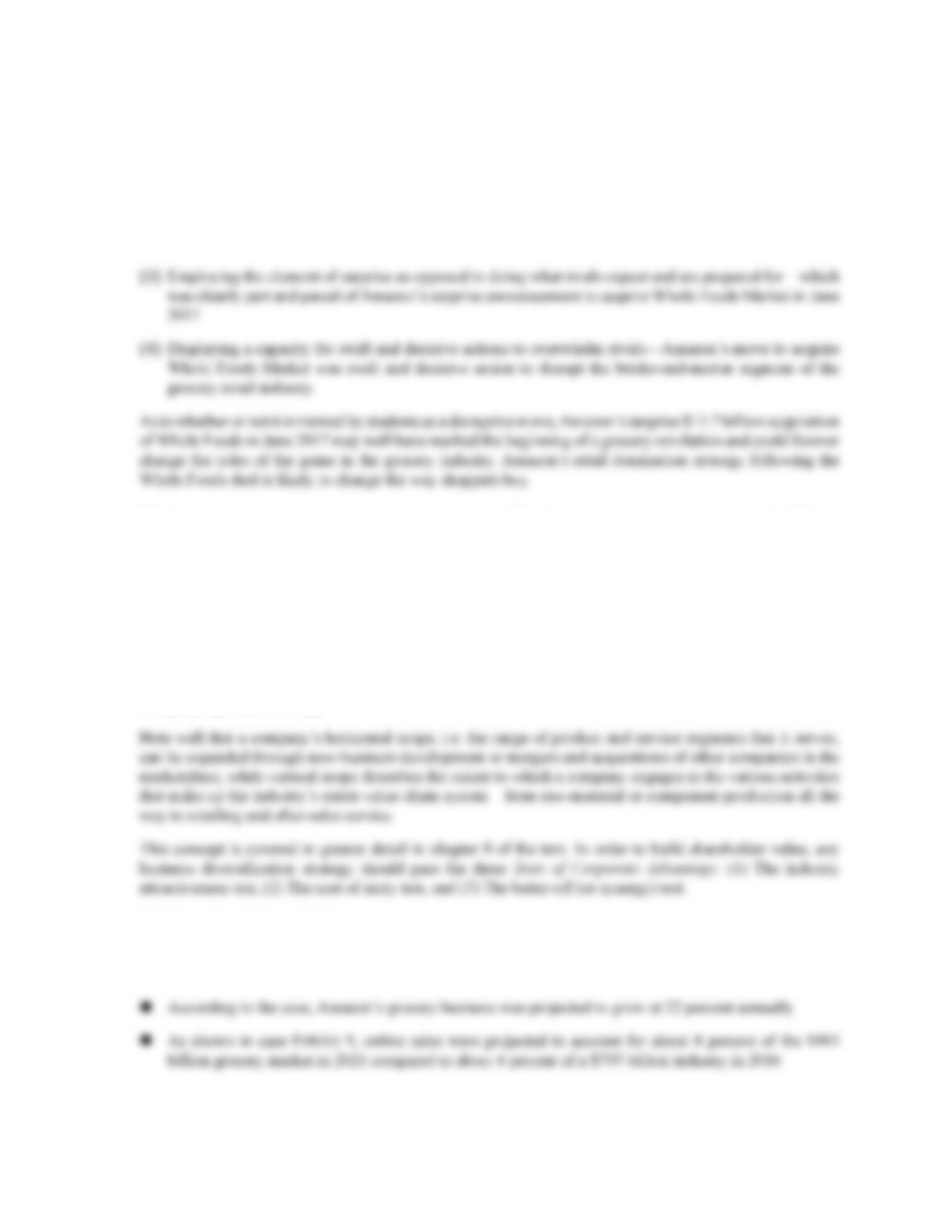
TABLE 2. Amazon Inc.’s Evolving Strategy in the U.S. Retail Grocery Industry
Date Entity Value Proposition Outcomes
August 2007 AmazonFresh Ease of shopping online &
doorstep delivery
Limited market availability, perishable products
customers’ desire for a personal experience,
reluctance to let someone else pick the items,
and the extra money they would have to pay
to make grocery home-delivery curtailed
expansion
December
2016
Amazon Go Enables consumers to grab
grocery on the go without
using a checkout
Based on Bezos’ realization that Amazon will
not succeed in the grocery industry without
establishing a physical presence and a strong
distribution system
Case 16 Teaching Note Amazon.com, Inc.: Driving Disruptive Change in the U.S. Grocery Market
480
As stated in Chapter 6, the best strategic offensives tend to incorporate several principles:
(1) Focusing relentlessly on building competitive advantage and then striving to convert it into a sustainable
advantage—which Amazon previously accomplished in the Internet retail and cloud computing
industries
(2) Applying resources where rivals are least able to defend themselves—in its execution of omnichannel
distribution and algorithm-based marketing intelligence
4. What key factors may determine the success of the Amazon, Inc. combination with Whole
Foods Market?
In answering this question, students should be reminded that Chapter 6 of the text stresses that the two best
reasons for investing company resources in vertical integration—Amazon’s acquisition of Whole Foods
is an example in this regard—are (1) to strengthen the firm’s competitive position and/or (2) to boost its
profitability.
Vertical integration has no real payoff unless it produces suffcient cost savings to justify the extra investment,
adds materially to a company’s technological and competitive strengths, and/or helps differentiate the
company’s product offering.
Industry attractiveness test
Based on the answer to Question 1, the U.S. grocery retail industry is already at least “moderately
attractive”
Case 16 Teaching Note Amazon.com, Inc.: Driving Disruptive Change in the U.S. Grocery Market
481
Cost-of-entry test
Amazon paid $13.7 billion to acquire Whole Foods Markets in June 2017
According to Cowen and Company, by 2021, and case Exhibit 9:
• Amazon should control about 33 percent (about $23.1 billion) of the $70 billion online grocery
Better-o (synergy) test
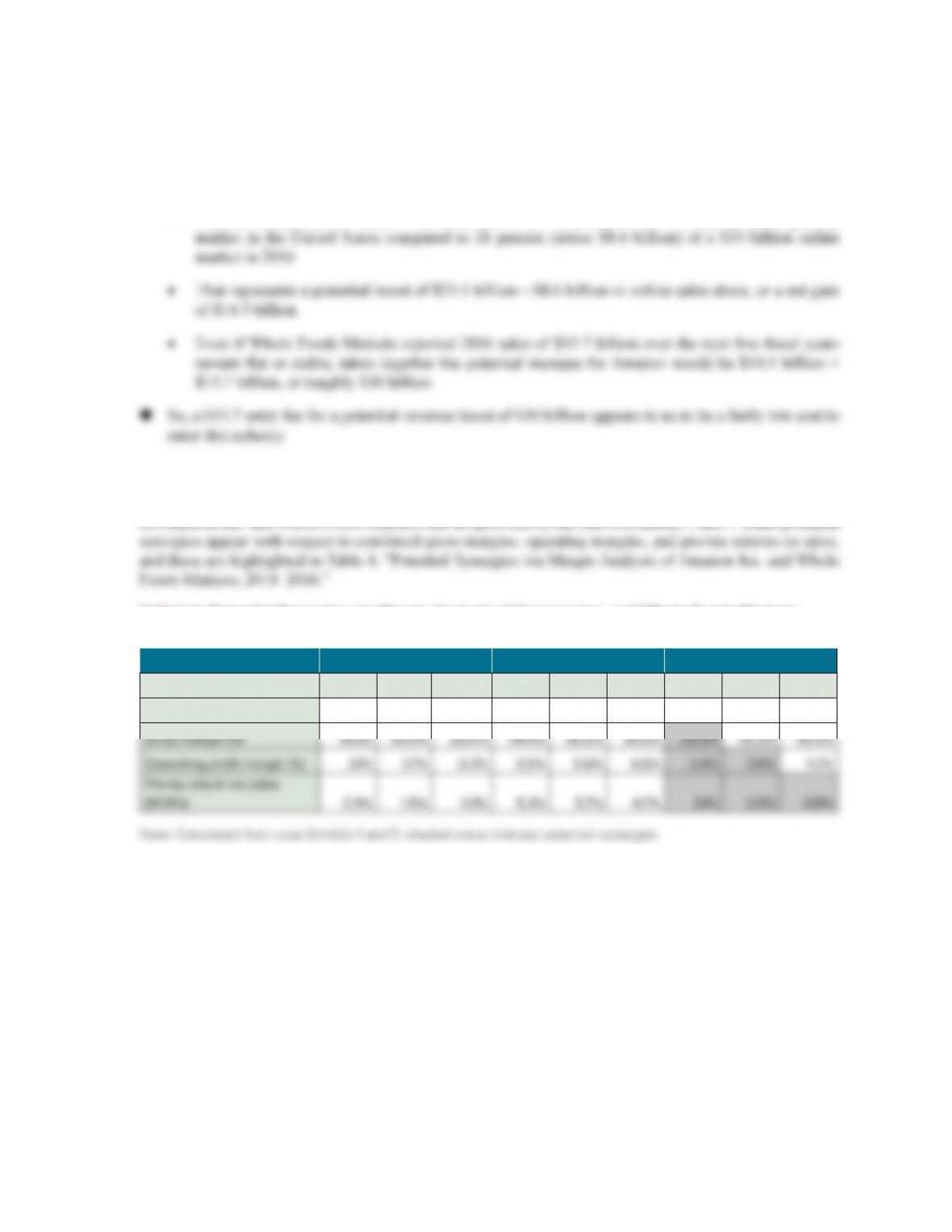
Advanced students will want to analyze the separate as well as potentially combined statements of operations
for Amazon Inc. and Whole Foods Markets that are provided in the case as Exhibits 1 and 5. Some potential
TABLE 4: Potential Synergies via Margin Analysis of Amazon Inc. and Whole Foods Markets,
2014–2016
AMAZ WFM COMBINED
Ratio comparisons 2016 2015 2014 2016 2015 2014 2016 2015 2014
COGS % of sales (%) 64.9% 67.0% 70.5% 65.6% 64.8% 64.5% 65.0% 66.7% 69.7%
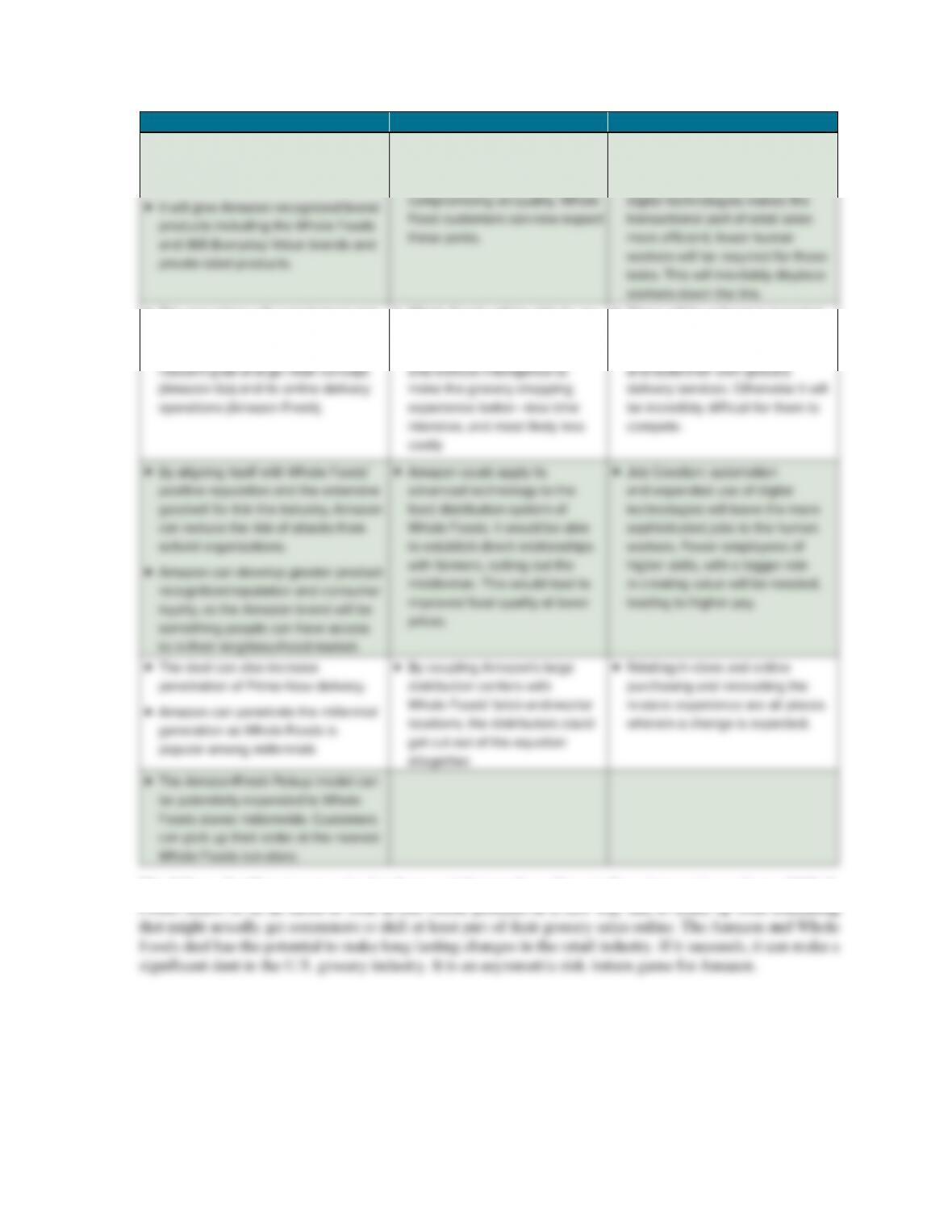
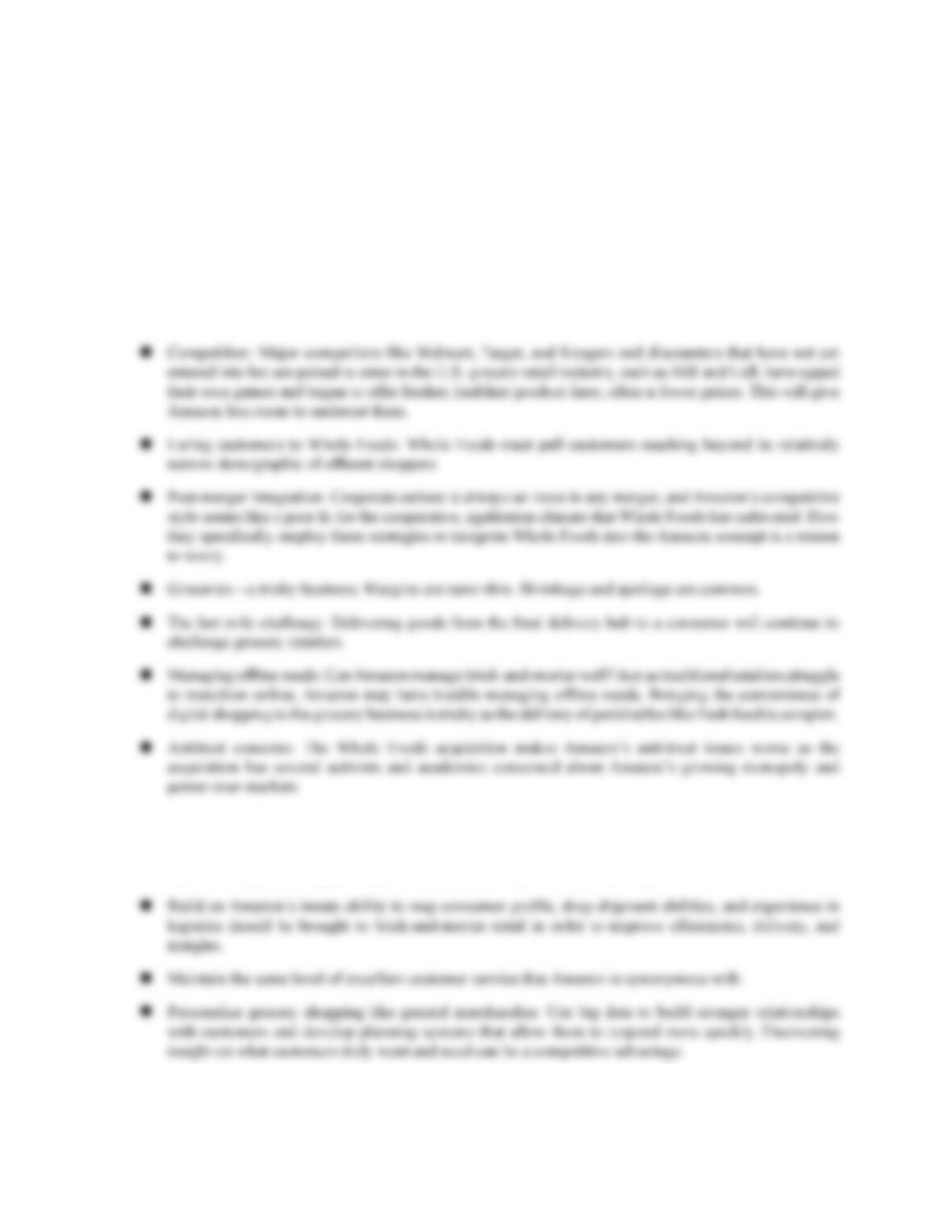
In addition, the Amazon-Whole Foods deal will have some serious implications for the future of the grocery
sector under the right set of conditions (see Table 5, “Amazon, Inc. and Whole Foods Markets’ Capacity to
Disrupt the U.S. Grocery Retail Industry”).

TABLE 5. Amazon, Inc. and Whole Foods Markets’ Capacity to Disrupt the U.S. Grocery Retail
Industry
Amazon Whole Foods Disruption of U.S. Grocery industry?
• The acquisition makes Amazon a
national grocery competitor overnight
via omnichannel marketing and
distribution.
• Under the umbrella of Amazon,
Whole Foods can lower prices
and undercut competitors.
• The acquisition may disrupt the
grocery retail space by shifting
the emphasis from conventional,
unhealthy products to sustainable,
struggled.
• The acquisition will bring instant
credibility to Amazon Fresh in the US
and help in expanding its customer
base.
• The analytics of Amazon will
enable Whole Foods to collect
data on their customers that
they have not had access
to. This will allow them to
understand customers better
and price smarter.
• It will escalate the pricing war in
the grocery sector.
• Competitors might feel the
pressure to lower prices to stay
competitive with Amazon.
get products to the store quickly and
oer more home delivery options for
the consumers.
Case 16 Teaching Note Amazon.com, Inc.: Driving Disruptive Change in the U.S. Grocery Market
483
Amazon Whole Foods Disruption of U.S. Grocery industry?
• The acquisition will lead to greater
product diversity. Whole Foods
handles roughly 30,000 SKUs.
• Amazon is about value,
focussing on low prices, speed,
and convenience without
• It could lead to job loss.
Amazon’s automated distribution
model and expanded use of
• The acquisition will complement and
leverage Amazon’s other initiatives
in the grocery industry including its
• Whole Foods will be able to use
Amazon’s incredible technology
skills, including big data mining
• There will be a threat to branded
food and consumer packaged
goods. Grocers need to innovate
The failure of online grocery sales has been a nightmare for online retailers. Amazon’s purchase of Whole
Foods seems to be an effort to look at this whole problem in a new way and to come up with something
Case 16 Teaching Note Amazon.com, Inc.: Driving Disruptive Change in the U.S. Grocery Market
484
6. What recommendations would you make to Je Bezos, CEO and founder of Amazon, Inc. to
improve Whole Foods Markets’ competitiveness in the market while mitigating any current
and future risks?
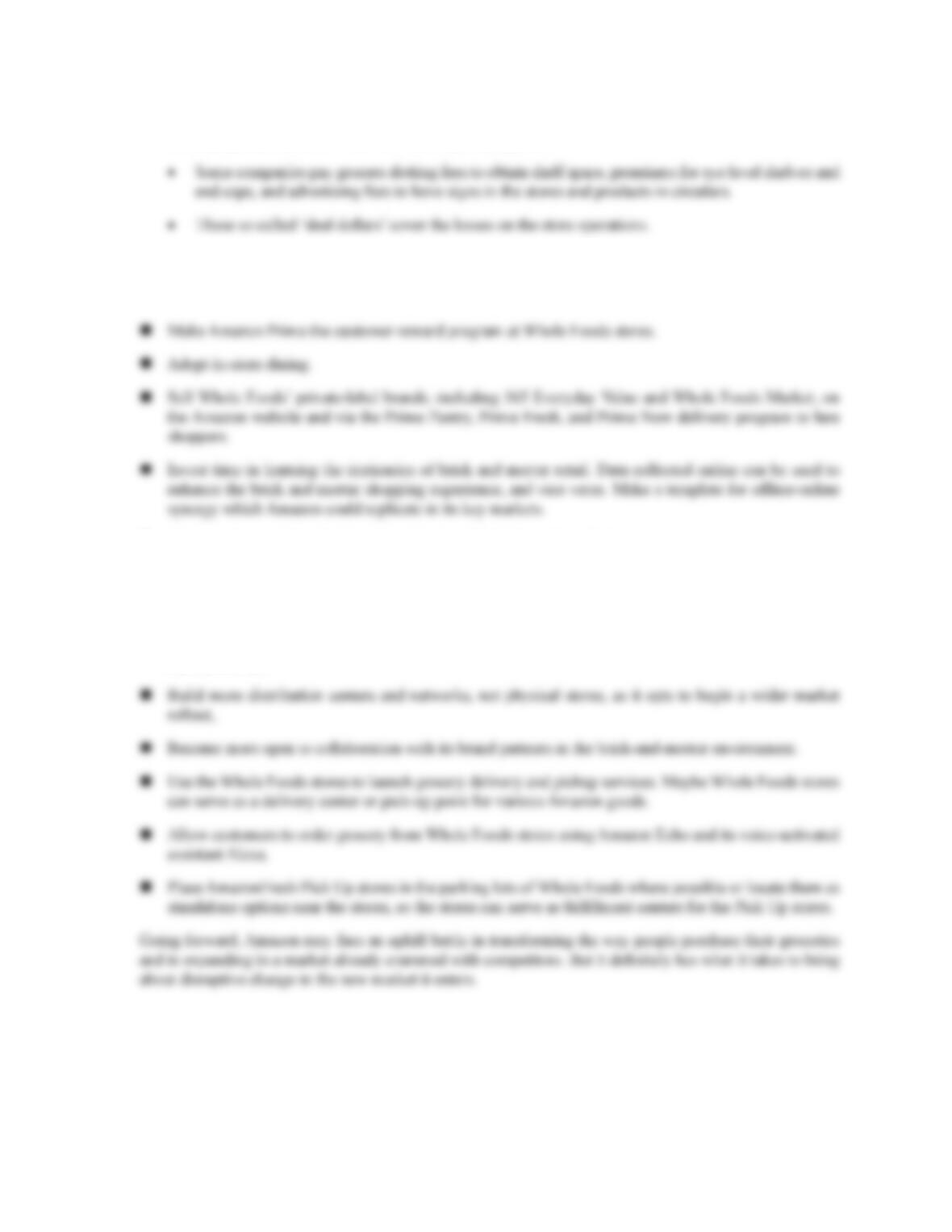
Bezos will face no shortage of challenges as he tries to consolidate Amazon’s presence in the highly
competitive grocery market, as follows:
Learning curve: Lack of experience in the bricks-and-mortar sector
Online Adoption: The majority of consumers have yet to jump on the digital grocery shopping
bandwagon. Shoppers prefer the physical experience of walking down the grocer’s aisles and selecting
their food quickly and first-hand.
We believe that the following should be among the top priorities for Jeff Bezos and his team:
Reduce prices at Whole Foods in order to move the brand away from its ‘Whole Paycheck’ image, woo
customers beyond its upper middle-class clientele and drive more business.
Case 16 Teaching Note Amazon.com, Inc.: Driving Disruptive Change in the U.S. Grocery Market
485
Use Whole Foods to increase its volume in all products and dramatically increase its deal dollar inflow—
something that Amazon missed as a ‘delivery only’ grocer.
Use the low-price position of Amazon to alter the Whole Foods brand concept to include a slew of
branded consumer goods previously avoided by Whole Foods. Optimize Whole Foods’ assortment to
the fullest extent, including Amazon private label products as well.
Integrate Amazon’s technology expertise into Whole Foods’ marketing.
Explore the checkout-free technology (Amazon Go) without major upfront investment.
Democratize the supplier base, giving smaller and local suppliers a channel to market.
Overhaul Whole Foods stores with the Amazon Go technology and improve upon the Whole Foods
business model.
Case 16 Teaching Note Amazon.com, Inc.: Driving Disruptive Change in the U.S. Grocery Market
486
Wrapping Up the Case
Here is a propitious moment to offer students some takeaways based on the material regarding related vs.
unrelated diversification, as covered in Chapters 6 and 8:
Struggling companies—like Whole Foods Markets—with good turnaround potential, that are
undervalued companies and can be acquired at a bargain price, and with bright growth prospects but
short on investment capital can become attractive acquisition targets for a company like Amazon
pursuing an unrelated diversification strategy
• Are the cost savings associated with economies of scope likely to give one or more individual
Amazon businesses a cost-based advantage over its rivals? How much competitive value will
come from the cross-business transfer of skills, technology, or intellectual capital or the sharing of
competitive assets?
• Will leveraging Amazon’s potent umbrella brand or corporate image strengthen the Whole Foods
Market and increase sales significantly?
Epilogue
Recent company updates can be found at Amazon’s corporate website: https://corporate.Amazon.com, as well as