– 487 –
Aliexpress: Can It Mount a Global
Challenge to Amazon?
Overview
The rapid advances in technology have apparently permanently altered social customs, and moved shopping
from the malls and other brick and mortar businesses, to the home and internet. Only 25 years ago, Jeff
Bezos founded the pioneer of electronic commerce and the biggest online merchandiser in the United
States, Amazon. According to the early Amazon logo, being the “Earth’s biggest bookstore” was their goal. From
1997 to 2001, Amazon had a successful transition from being an online bookstore to being the largest Internet
retailer in the world (by 2001), and the largest Internet retailer of tech products today. Amazon has positioned
itself as the world’s most customer-centric company, which has become the company culture and goal for their
long-term development.
One year after the founding of Amazon, Jack Ma, an English teacher in China, founded “Alibaba Group” in
his apartment in Hangzhou, China. It started in 1995 and failed because it was too early to introduce Internet
e-commerce to both Chinese consumers and the Chinese government. In 1999, he launched the company he
named Alibaba, which received an investment from Goldman Sachs for $5 million, and Softbank for $20 million.
In 2003, Alibaba launched Taobao, which had Business to Business (B2B), Business to Consumer (B2C), and
Consumer to Consumer (C2C) sales models via web portals.
By starting a business competition with eBay, Taobao improved the company’s visibility in the international
media. As a result, Taobao successfully replaced eBay in China’s Internet market, and finally made eBay
withdraw from China. AliExpress, the international version of Taobao, launched in 2010 targeting international
consumers in the United States as well as Australia and Russia. With the facilitating conditions of distance,
culture, and good terms of trading between China and Russia, AliExpress targeted Russia as a good market to
start expanding their business internationally. By the end of 2014, AliExpress was the number one online retailer
in Russia selling essentially Chinese products, and enjoying huge popularity among Russian online consumers
who appreciated its low prices and large assortment.
case 17 teaching note
*
Case 17 Teaching Note Aliexpress: Can It Mount a Global Challenge to Amazon?
488
Prime membership. AliExpress had 5.87 million app downloads and became the second leading shopping app in
the Google Play Store worldwide in April 2018. Amazon was fifth with 3.08 million downloads. AliExpress, as
a global retail marketplace, had approximately 60 million annual active buyers in the world in 12 months ending
March 31, 2017.
Suggestions for Using the Case
This new and timely case should generate considerable student interest and provoke a lively, interesting class
discussion about the global internet retail industry, and whether it was possible for AliExpress to mount a
serious competitive threat to Amazon, and if so, how? This is quite interesting, given the tremendous success of
both companies, using two different business models. Amazon has been primarily a North American business
(although it has a large global reach), while AliExpress has received about three fourths of its revenue from
China. Although Amazon’s revenues were 450 percent greater than that of AliExpress, the Chinese company had
a CAGR (compound annual growth rate) for revenue of 59.5 percent, which was twice that of Amazon. Students
will have differing interpretations of their financial analyses of the two companies as well as whether AliExpress
poses a threat to Amazon.
The AliExpress case is probably best assigned after you have covered Chapters 1–7, but it can be successfully
used after students have read just Chapters 3, 4, and 5. The topics covered in Chapters 5 and 6 are pertinent
to student identification and assessment of AliExpress and Amazon’s strategies and competitive approaches.
Amazon and AliExpress both operate in foreign markets, and thus the material in Chapter 7 regarding competing
in foreign markets comes into play as well.
Case 17 Teaching Note Aliexpress: Can It Mount a Global Challenge to Amazon?
489
In our experience, it is quite difficult to have an insightful and constructive class discussion of an assigned
case unless students have conscientiously made use of pertinent core concepts and analytical tools in preparing
substantive answers to a set of well-conceived study questions before they come to class. In our classes, we
expect students to bring their notes to the study questions to use/refer to in responding to the questions that
To facilitate your use of assignment questions and making them available to students, we have posted a file of
the Assignment Questions contained in the instructor resources section of the Connect Library for the 22nd
Edition
Utilizing the Guide to Case Analysis. If this is your first assigned case, you may find it beneficial to
have class members read the Guide to Case Analysis located in the instructor resources section of the Connect
Library. The content of this Guide is particularly helpful to students if your course is their first experience with
cases and they are unsure about the mechanics of how to prepare a case for class discussion, oral presentation,
or written analysis.
Suggested Assignment Questions for an Oral Team Presentation or Written Case Analysis. We
believe the “AliExpress: Can it Mount a Global Challenge to Amazon?” case is quite well-suited for written
assignments and/or oral team presentations. Our suggested assignment questions are as follows:
■ Jeff Bezos, founder and CEO of Amazon has employed you as a consultant to assess the company’s
overall situation and recommend a set of actions to improve the company’s future prospects, and its
relative competitiveness vis-a vis AliExpress. Please prepare a report to Mr. Bezos that includes: (1) a
comparison of the business models of both companies and an assessment of which is best suited to the
internet sales market, (2) an evaluation of relative financial strength of both companies, (3) an assessment
Case 17 Teaching Note Aliexpress: Can It Mount a Global Challenge to Amazon?
490
Assignment Questions
1. Identify the strategically relevant factors in the macro-environment of the online retailing industry. Prepare
a PESTEL analysis. Which of the factors appear the most likely to have the greatest effect on the online
retailing industry? Do the collective forces appear conducive to good industry profitability?
2. What are the keys to success in the online retailing industry? Does Amazon or AliExpress have an advantage?
3. Compare the business strategies of Amazon and AliExpress. Does either company have a strategy that will
likely lead to competitive advantage? Is the strategy of either a winner?
Teaching Outline and Analysis
1. Identify the strategically relevant factors in the macro-environment of the online retailing
industry. Prepare a PESTEL analysis. Which of the factors appear the most probable to
have the greatest eect on the online retailing industry? Do the collective forces appear
conducive to good industry profitability?
This is an excellent exercise for students to identify the macro-environmental factors that affect the online
retailing and to understand how they can influence the industry. Students typically have difficulty with
identifying the relevant factors and then struggle with linking the collective forces to industry profitability.
Amazon and Alibaba operate in a broad macro-environment comprised of six components: political factors,
economic conditions in the firms’ general environment (local country, regional, and worldwide), sociocultural
Case 17 Teaching Note Aliexpress: Can It Mount a Global Challenge to Amazon?
491
■Technological factors: the fast pace of technological change gave birth to high-speed internet technology,
which enabled the development of internet shopping and changed the consumer’s buying model.
Technological advances have created and will continue to improve internet sales and delivery abilities
and processes, and to provide privacy and security to internet shoppers.
■Environmental forces: increasing use of internet retail will reduce traffic of people driving to malls
and other brick and mortar stores. Automobile emissions should decline as one delivery truck can take
2. What are the keys to success in the online retailing industry? Does Amazon or AliExpress
have an advantage?
Students will be able to identify many of the key success factors in online retailing, but will have differing
opinions about which company has an advantage.
The keys to success for the online retailing industry are the several competitive factors that have the greatest
impact on the online retailers’ ability to survive and prosper in the market. Key success factors include
product attributes, elements of a particular strategy, operational approaches, resources and competitive
Case 17 Teaching Note Aliexpress: Can It Mount a Global Challenge to Amazon?
492
Key success factors for the online retailing industry are:
■Wide selection of low price merchandise—customers want to be able to do all their shopping at one
online retailer. Amazon’s early goal was to be Earth’s biggest bookstore, and over time moved to their
strategic intent to offer consumers everything from A to Z in the online store. The case indicated that low
prices were key for successful online retailing.
A review of the above factors clearly indicates that key factors in on-line purchasers’ choice of an online
retailer are, a wide selection of low priced merchandise, the cost and speed of shipping, and the entire
customer experience (customer care). Additionally, because of the low margins and high infrastructure costs,
having a large customer base is key to internet retailer success. These key success factors point to things
Case 17 Teaching Note Aliexpress: Can It Mount a Global Challenge to Amazon?
493
3. Compare the business strategy of Amazon and Alibaba/AliExpress. Does either company
have a strategy that will likely lead to competitive advantage? Is the strategy of either a
winner?
Students have little troubles identifying the business strategies of Amazon and AliBaba/AliExpress, but
spirited discussion will emerge over which will lead to competitive advantage and which is the best.
Amazon’s business strategy differed significantly from that of Alibaba. Amazon adopted a self-employed
approach and participated in every step of the sale. The most well-known Amazon business model was
Case 17 Teaching Note Aliexpress: Can It Mount a Global Challenge to Amazon?
494
Competitive Advantage: Both company’s strategy has provided competitive advantage in their primary
markets, however as the competition moves more globally, Amazon’s strategy appears to have the greatest
potential to provide advantage. Amazon was able to provide more control and quality: Alibaba/AiiExpress’
Winner Strategy: Both strategies have been winners for the companies as they have historically been
competing, primarily in different markets. Both companies’ strategies fit their company situation (which are
Case 17 Teaching Note Aliexpress: Can It Mount a Global Challenge to Amazon?
495
4. What does an analysis of Amazon and Alibaba’s most recent three year financial data
suggest about the relative competitiveness of the two companies? Which appears to have
the greatest “staying power” to engage in a long term competitive battle?
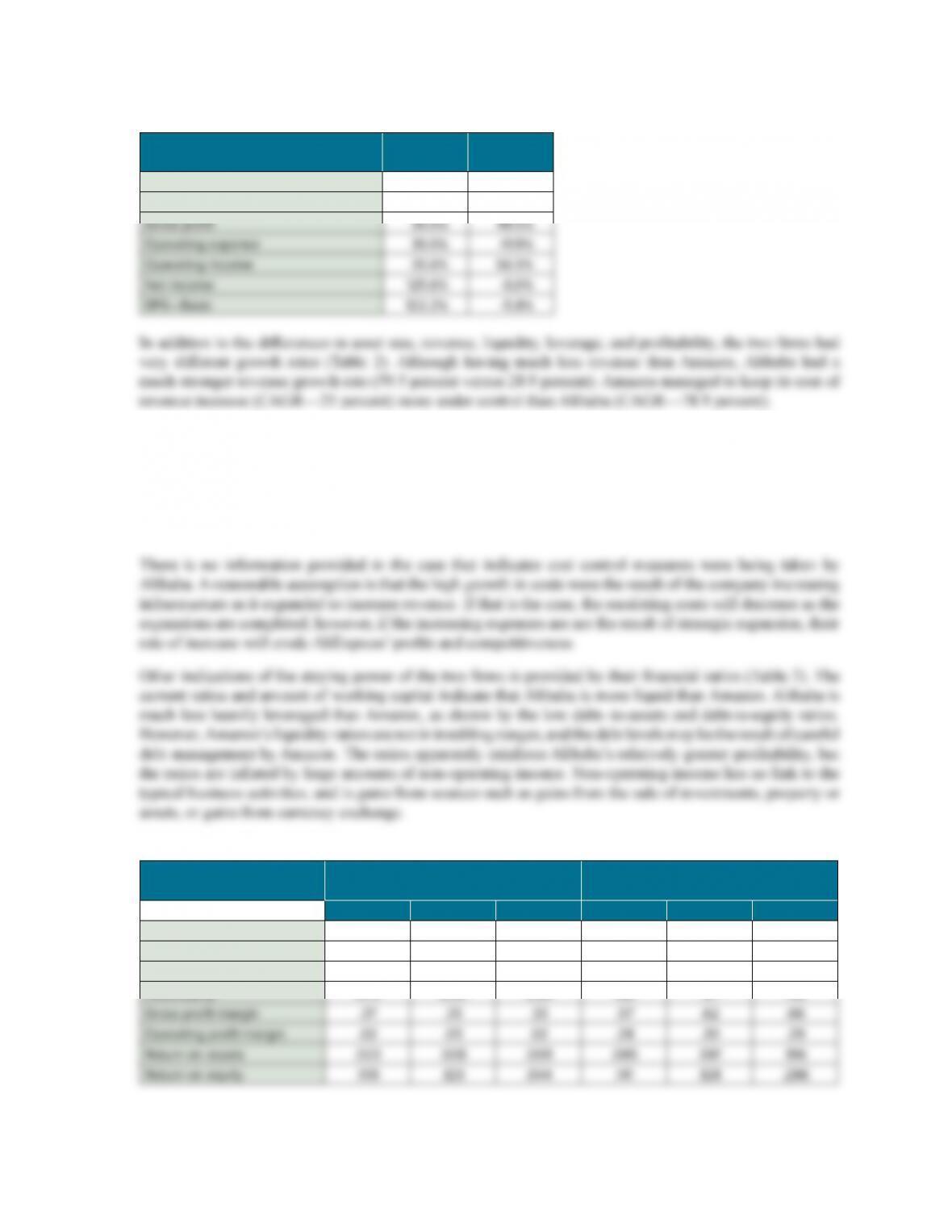
TABLE 1. Common Size Statement of Operations
Amazon
Fiscal Years Ending Dec. 31
Alibaba
Fiscal Years Ending March 31
2017 2016 2015 2018 2017 2016
Revenue 100% 100% 100% 100% 100% 100%
Cost of revenue 63% 65% 67% 43% 38% 34%
Gross Profit 37% 35% 33% 57% 62% 66%
Operating Expense 35% 32% 31% 30% 32% 37%
Case 17 Teaching Note Aliexpress: Can It Mount a Global Challenge to Amazon?
496
TABLE 2. Compound Annual Growth Rates (CAGR)
Amazon
2015–2017
Alibaba
2016–2018
Revenue 28.9% 59.5%
Cost of revenue 25.0% 78.9%
It is important to note that Alibaba’s cost of revenue growth rate (78.9 percent CAGR) is much greater
than its revenue growth rate (59.5 percent CAGR) which will eventually result in negative gross profit if
not corrected. Also, Alibaba’s operating costs are growing almost as fast as revenues, and combined with
the increasing cost of revenue, will soon lead to negative net income. These escalating costs resulted in a
negative growth rate (CAGR) for net income (-6.0 percent) and EPS (-5.8 percent) over fiscal years 2019–
2018.
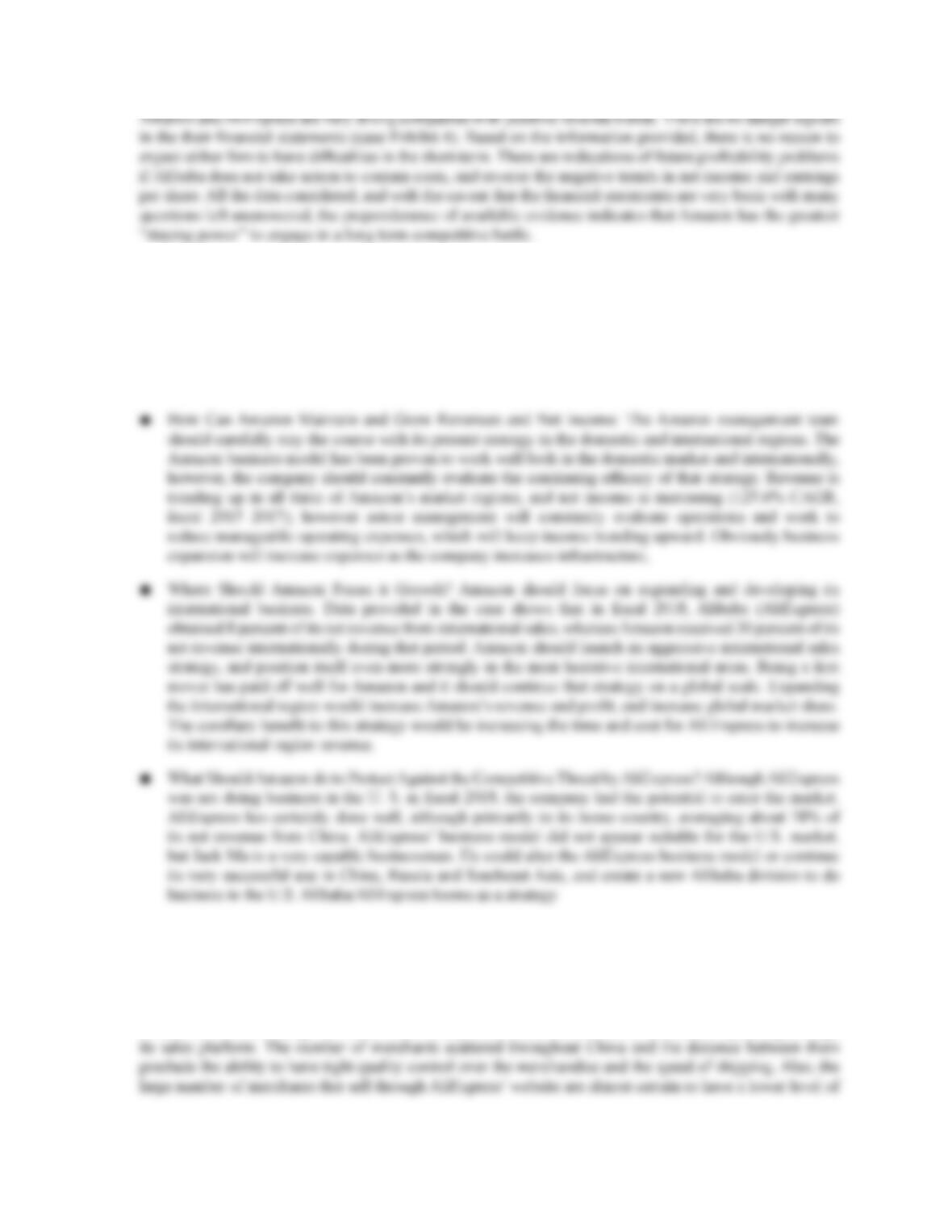
TABLE 3. Key Financial Ratios
Amazon
Fiscal Years Ending 12-31
Alibaba
Fiscal Years Ending 3-31
2017 2016 2015 2018 2017 2016
Current ratio 1.04 1.05 1.05 1.89 1.95 2.58
Working capital (millions) $2,314 $1,965 $1,894 $19,298 $12,893 $12,721
Debt/assets .79 .77 .79 .39 .36 .31
Debt/equity 3.74 3.32 3.84 .68 .57 .46
Case 17 Teaching Note Aliexpress: Can It Mount a Global Challenge to Amazon?
497
5. What strategic issues confront Amazon?
Amazon should pinpoint precisely what actions the company needs to take to improve its financial
performance and increase market share, and get a clear picture of the strategic and competitive challenges
that face the company. The top management team should also consider its competitiveness vis-à-vis Alibaba/
AliExpress, and take measures to seize international region market share and defend against that company
entering the domestic market.
6. What recommendations would you make to Amazon to confront the dangers posed by
Alexpress in the on-line retailing industry?
Amazon should focus on the keys to success in the industry. Because Amazon owns many of its products, it
can control price, quality, shipping (time and price), and set the standards for customer care. Amazon should
be able to do these things far better than AliExpress, which has numerous merchants operating through
Case 17 Teaching Note Aliexpress: Can It Mount a Global Challenge to Amazon?
498
Epilogue
There was nothing new to report about the performance of AliExpress at the time this note went to press.