Airbnb in 2018
Overview
Airbnb was founded in 2008 when Brian Chesky and a friend decided to rent their apartment to guests for
a local convention. To accommodate the guests, they used air mattresses and referred to it as the “Air
Bed & Breakfast.” It was that weekend when the idea– and the potential viability– of a peer-to-peer
room-sharing business model was born. By 2018 Airbnb had seen immense growth and success in its 10-year
existence. The room-sharing company had expanded to over 190 countries with more than 4 million listed
properties, and had an estimated valuation of $31 billion. Airbnb seemed poised to revolutionize the hotel and
tourism industry through its business model that allowed hosts to offer spare rooms or entire homes to potential
guests, in a peer-reviewed digital marketplace.
This case is meant to introduce students to the sharing economy. Students can compare and contrast Airbnb’s
business model with traditional models employed by bed and breakfast and hotel chain operators. Instructors
should note that technology and the legal environment can lead to opportunities, as well as challenges for an
upstart like Airbnb. The case opens and closes with quotes from CEO and co-founder Chesky, to juxtapose for
students how rapid advances in technology can lead to changes in competitive strategies for business, yet, how
the legal environment can both lag behind, and obstruct such strategies.
Suggestions for Using the Case
Students should find Airbnb in 2018 an interesting case because of their own experiences with smartphones and
companies such as Lyft, Uber or Airbnb. We recommend using the case immediately following your coverage
of Chapter 1. As this case specifically addresses the sharing economy, it lends itself well to discussions of smart–
phones, technology and their impact on competitive positions for both new and incumbent competitors. It may
also lead to discussion of disruptive innovation.
case 2 teaching note
*
Case 2 Teaching Note Airbnb in 2018
280
The assignment questions and teaching outline presented below reflect our thinking and suggestions about
how to conduct the class discussion and what aspects to emphasize.
To facilitate your use of study questions and to make them available to students, we have posted a file of the
assignment questions contained in this teaching note for the Airbnb in 2018 case in the instructor resources
section of the Connect Library. (We should also point out that there is a set of study questions posted in the
student section of the OLC for each of the 32 cases included in the 22nd Edition.)
Videos for Use with the Airbnb in 2016 Case. There are two videos that you may consider having
students view prior to class discussion of the case (or you may choose to open the class discussion with
one of the two videos). Both videos are posted at YouTube and can be access through the following links:
Because the case is relatively short, it is well suited for use as a leadoff case on the first day of class, or for
an in-class written case, or a final exam case. Our recommended questions for written assignments are as
follows:
1. Marriott management has asked you to assess the threat of Airbnb. Please prepare a 5-6 page report that
includes a description of both Marriott’s and Airbnb’s business models, with an emphasis on an evaluation
Assignment Questions
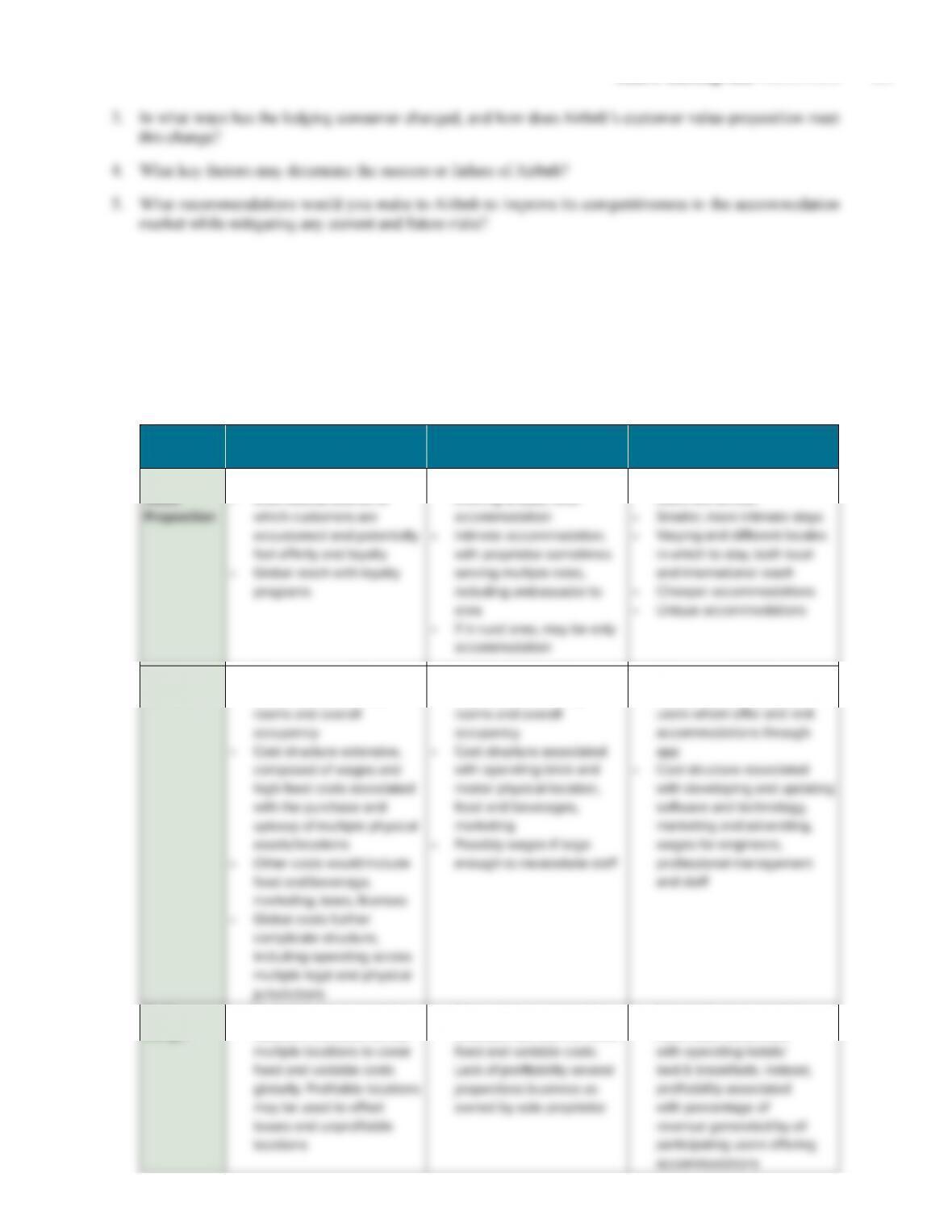
1. How would you illustrate and compare the business models for Airbnb, large hotel chains such as Marriott
and Hilton, and bed & breakfast operators? Use the example chart in the textbook for business models as a
guide (Concepts & Connections 1.1)
2. What are the general strengths and weaknesses of a) large, hotel chains such as Marriott and Hilton, b) bed
& breakfasts, and c) Airbnb? Explain how you would compare and contrast those businesses.
Case 2 Teaching Note Airbnb in 2018
281
Teaching Outline and Analysis
1. How would you illustrate and compare the business models for large hotels chains such as
Marriott and Hilton, bed & breakfast operators, and Airbnb? Use the example chart in the
textbook for business models as a guide (Concepts & Connections 1.1)
Students should be able to identify the following:
Chain
Hotels / Motels
Bed & Breakfast
(single proprietor) Airbnb
Customer
Value
• Familiar brands
• International brands to
• One location,
offering unique, local
• Use of technology to which
users are familiar
Profit
Formula
• Revenue generation
dependent on renting
• Revenue generation
dependent on renting
• Revenue generation
transaction fee charged to
Profit
Margin
• Dependent on generating
suffcient revenues across
• Dependent on generating
revenues suffcient to cover
• Not contingent upon the
fixed costs associated
Case 2 Teaching Note Airbnb in 2018
282
Students should be reminded that, as stated in Chapter 1 of the text:
n The appeal of a strategy or business model that yields a sustainable competitive advantage is that it
offers the potential for an enduring edge over rivals.
• However, Chesky as CEO must be willing and ready to modify the strategy in response to the
unexpected moves of competitors, shifting buyer needs and preferences, emerging market
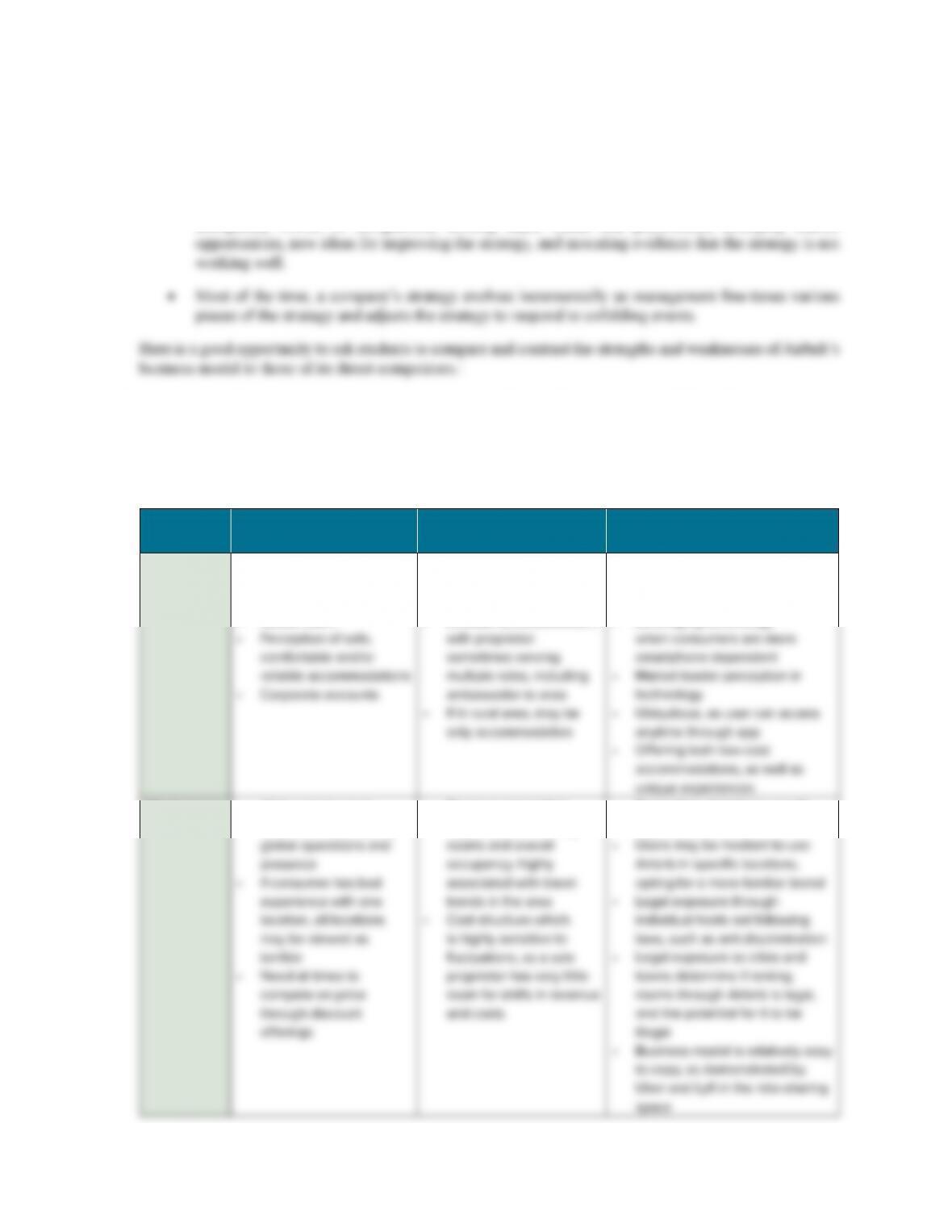
2. What are the general strengths and weaknesses of large hotel chains such as Marriott and
Hilton, bed & breakfasts, and Airbnb? Explain how you would compare and contrast those
businesses.
Students should be able to identify the following:
Large Hotel Chains
Bed & Breakfast
(single proprietor) Airbnb
Strengths • Familiar, International
brands
• Brand loyalty
• Global reach
• One location,
offering unique, local
accommodation
• Intimate accommodation,
• No fixed costs associated with
operating hotels, thus greatly
reduced cost structure
• Leveraging technology
Weaknesses • High cost structure,
further exacerbated by
• Revenue generation
dependent on renting
• Perception of at times unsafe
experiences
Case 2 Teaching Note Airbnb in 2018
283
Here is a good opportunity to recap Chapter 1 and also preview some concepts covered Chapter 2:
n In choosing among opportunities and addressing the hows of strategy, strategists must embrace the
risks of uncertainty and the discomfort that naturally accompanies such risks.
3. In what ways has the lodging consumer changed and how does Airbnb’s customer value-
proposition meet this change?
Students should be able to identify the following changes in the profile of lodging customers:
n Desire for unique experiences, not focused on ownership. should be able to discuss their experiences
as consumers of the sharing economy (not only with Airbnb, but also Uber, Lyft, and other similar
companies).
n Desire to access experiences immediately through smartphone technology. Students should note that
a company like Airbnb could only exist since the advent of Internet and smartphone technologies.
n Familiarity with apps and fluency with life/smartphone integration. Consumers — especially the
Millennial age group (i.e. those consumers born between the early 1980s and the early years of the 21st
century)— are less technology-averse, use smartphones and apps, and are more willing to experiment
and embrace the “experience economy” than previous generations, and this trend should continue to
occur.
4. What key factors may determine the success of Airbnb?
Factors that are necessary for competitive success for Airbnb:
n Mitigation of legal threat. Any regulation that inhibits or prevents Airbnb users/hosts from offering
their rooms on Airbnb represents a significant barrier. Students should observe that:
• Both domestic and international legislation did not account for, and had yet to catch up to, more
n Use of smartphone and other technology for differentiation. Due to its business model, Airbnb was
already differentiated from traditional competitors. In addition, continuing innovations based on current
and emergent technologies were essential to maintaining current users, while expanding into new users.
Students should also recognize that user experience with the app, including ease of use, was an essential
component of its competitive advantage. Students should be reminded that:
• Most large hotel and motel chains as well as consolidators such as Priceline, HotelTonight, Hotel.
com, and VRBO (Vacation Rental by Owner) also offered mobile apps that provided booking and
n Expansion of Users and Accommodations. Overall expansion of users who offer accommodations and
those who use Airbnb to book accommodations was critical to its success. Students should observe that:
• While continued growth will be necessary to ensure profitability, it is not clear that Airbnb can
n Brand image. Image was also a critical factor in helping consumers choose which accommodation to
patronize. Included within this image was reliability, quality of stay and safety. Students should observe
that:
Case 2 Teaching Note Airbnb in 2018
285
n Financial health. Rapid growth businesses require capital. A 2016 cash infusion of $850 million in
Airbnb and a pre-IPO valuation of about $31 billion (see exhibit 4), the fact that the company only
recently reached break-even signals the need for permanent capital to continue to scale its business
model. Students should observe that:
• It is unclear whether or not the $31 billion valuation is realistic or due to a “tech bubble.” A severe
5. What recommendations would you make to Airbnb to improve its competitiveness in
accommodation market while mitigating any current and future risks?
n Continue to lobby and advocate for friendly legislation, while proactively supporting legal compliance,
such as it began in 2018 with collecting taxes automatically through its platform.
n Attract and enroll single-proprietor establishments, and devise methods to provide added value for such
businesses, e.g. in utilizing Airbnb as a platform for marketing and offering accommodations.
n Pursue the business and international traveler segments (exhibit 2), as it is an essential component of the
market,
• Business travelers and extended stay guests present opportunities for increased user base and
Case 2 Teaching Note Airbnb in 2018
286
n Make continued investments in technology to maintain its differentiation/focus generic strategy.
• These investments will not only be in smartphone and computer interfaces, but also in emergent
n Find ways to mitigate competition between larger hotels and Airbnb. This can reduce legislative and
competitive risk, while potentially expanding user base and revenues.
• For example, students might suggest that Airbnb create a user interface that refers customers seeking
Instructors can wrap-up the discussion by asking students if they strongly feel that CEO Chesky could well
suffer from an “If it ain’t broke don’t fix it” mentality. That is, will Airbnb continue “business as usual,” and
if its revenue and bookings growth rates continue on their current declining trajectories, will the company
likely make slower progress towards its goal of achieving a competitive advantage and superior returns, as
reflected in an IPO or possible sale to a rival technology or lodging firm?
Chesky and his team may also be betting on rather slim odds that:
Epilogue
There was nothing new to report at the time this teaching note went to press, although similar news articles