Nucor Corporation in 2018
Overview
Despite the headwinds of a 15.5 percent increase in foreign steel imports and mounting evidence that many
of Nucor’s foreign steel competitors received subsidies from their governments—in direct violation of
prevailing trade regulations—to support their low-ball pricing in the U.S. steel markets, Nucor’s sales
and profitability improved in 2017 over 2016. During 2017, Nucor Corp., already the largest manufacturer
of steel and steel products in North America and the 13th largest steel company in the world based on tons
shipped, launched a series of strategic initiatives to further expand its production capacity and improve its cost
competitiveness against rival products of steel products. Not only was Nucor Corp. regarded as a low-cost
producer, but it also had a sterling reputation for being a global first-mover in implementing cost-effective steel-
making production methods and practices throughout its operations.
Heading into 2018, Nucor had 25 steel mills with the capability to produce a diverse assortment of steel shapes
(steel bars, sheet steel, steel plate, and structural steel) and additional finished steel manufacturing facilities that
made steel joists, steel decking, cold finish bars, steel buildings, steel mesh, steel grating, steel fasteners, and
fabricated steel reinforcing products. The company’s lineup of product offerings was the broadest of any steel
producer serving steel users in North America. Nucor had 2017 revenues of $20.3 billion and net profits of $1.38
billion, the company’s best performance since its 2008 pre-recession peak of $23.7 billion in revenues and $1.8
:
case 27 teaching note
Contending with the Challenges of
Low-Cost Foreign Imports and Launching
Initiatives to Grow Sales and Market Share
Case 27 Teaching Note Nucor Corporation in 2018
608
• Nucor has an exceptionally lean organizational structure, and it is an adept practitioner of decentralized
decision-making.
However, the case is an excellent fit with the material covered in Chapters 3-7. Nucor is a fascinating success
story and one of the world’s most adept manufacturers in crafting and executing a low-cost leadership strategy.
The case details how Nucor has been a first-mover in capitalizing on cutting edge technological innovation in
Conducting the Class Discussion. If you elect to use the Nucor case as a follow-on to Chapters 10-12, we
suggest pressing the class to identify all the different ways the company has sought to implement and execute
its low-cost strategy successfully. Students should be pressed to identify and explain in some detail the principal
Videos for Use with the Nucor Case. There are three videos available for use with the Nucor case:
A 6:08-minute 2018 video titled “Trump’s Tariffs Will Level the Playing Field: Nucor CEO” that is
Case 27 Teaching Note Nucor Corporation in 2018
609
The Connect-based Exercise for the Nucor Case. We developed an exercise for Nucor for inclusion in
the publisher’s Connect™ Management web-based assignment and assessment platform because:
This particular Connect-based exercise focuses on the following five questions:
1. Nucor is regarded as an accomplished low-cost provider, but what specific actions has Nucor taken to
drive costs out of its business and achieve low-costs vis-à-vis many other steel producers?
2. What does a SWOT analysis reveal about the attractiveness of Nucor’s situation and future prospects as
of 2018? Which, if any, of Nucor’s resource strengths and capabilities qualify as a core competence?
1. Have class members complete the Connect-based exercise for the Nucor case in the event you have
adopted the Connect software for your course.
OR
Case 27 Teaching Note Nucor Corporation in 2018
610
To facilitate your use of assignment questions and making them available to students, we have posted a file of
the Assignment Questions contained in this teaching note in the instructor resources section of the Connect
Library. (You should be aware that there is a set of assignment questions posted in the Connect Library for
each of the cases included in the 22nd edition.) In all instances, these assignment questions correspond to the
assignment questions in the teaching note for the case.
In our experience, it is quite difficult to have an insightful and constructive class discussion of an assigned case
unless students have conscientiously have made use of pertinent core concepts and analytical tools in preparing
substantive answers to a set of well-conceived study questions before they come to class. In our classes, we
Utilizing the Guide to Case Analysis. Should this be your first assigned case, you may find it beneficial
to have class members read the Guide to Case Analysis that follows Case 32. The content of this Guide is
particularly helpful to students if your course is their first experience with cases and they are unsure about the
mechanics of how to prepare a case for class discussion, oral presentation, or written analysis.
Suggested Assignment Questions for an Oral Team Presentation or Written Case Analysis.
The Nucor case merits very strong consideration for a written case assignment or oral team presentation. Our
suggested assignment questions, in the event you opt to use the case for a written assignment or an oral team
presentation, are as follows:
1. John Ferriola, aware of your emerging expertise in strategic analysis, has employed you as an intern to
assist him in evaluating Nucor’s situation and future prospects. Mr. Ferriola has asked you to provide
him with a 4-6 page report detailing (1) the strength of competitive forces in the steel industry as
2. John Ferriola, impressed with your knowledge of strategic analysis, has employed you to assist him
and Nucor’s senior executive team in evaluating the company’s growth prospects and determining the
wisdom of pursuing a rapid growth strategy via both additional acquisitions and new plant construction.
Case 27 Teaching Note Nucor Corporation in 2018
611
Assignment Questions
1. What are the primary competitive forces impacting U.S. steel producers in general and the producers like
Nucor that make new steel products via recycling scrap steel in particular? Please do a five-forces analysis
to support your answer.
2. What driving forces do you see at work in this industry as of 2018? Are they likely to impact the industry’s
competitive structure favorably or unfavorably?
3. How attractive are the prospects for future profitability of U.S. steelmakers, given the tariffs recently
imposed on foreign steel imports by the Trump Administration? Should Nucor consider expanding in this
type of industry environment? Why or why not?
4. What type of strategy has Nucor followed? Which of the five generic strategies discussed in Chapter 5
is Nucor employing? Is there any reason to believe that Nucor has achieved a sustainable competitive
advantage over many of its steel industry rivals in North America? If so, what type of competitive advantage
does Nucor enjoy?
Case 27 Teaching Note Nucor Corporation in 2018
612
Teaching Outline and Analysis
1. What are the primary competitive forces impacting U.S. steel producers in general and the
producers like Nucor that make new steel products via recycling scrap steel in particular?
What does a five-forces analysis reveal about competition in the U.S. steel industry?
It is worth spending 5-10 minutes of class time establishing just why competitive conditions in the steel
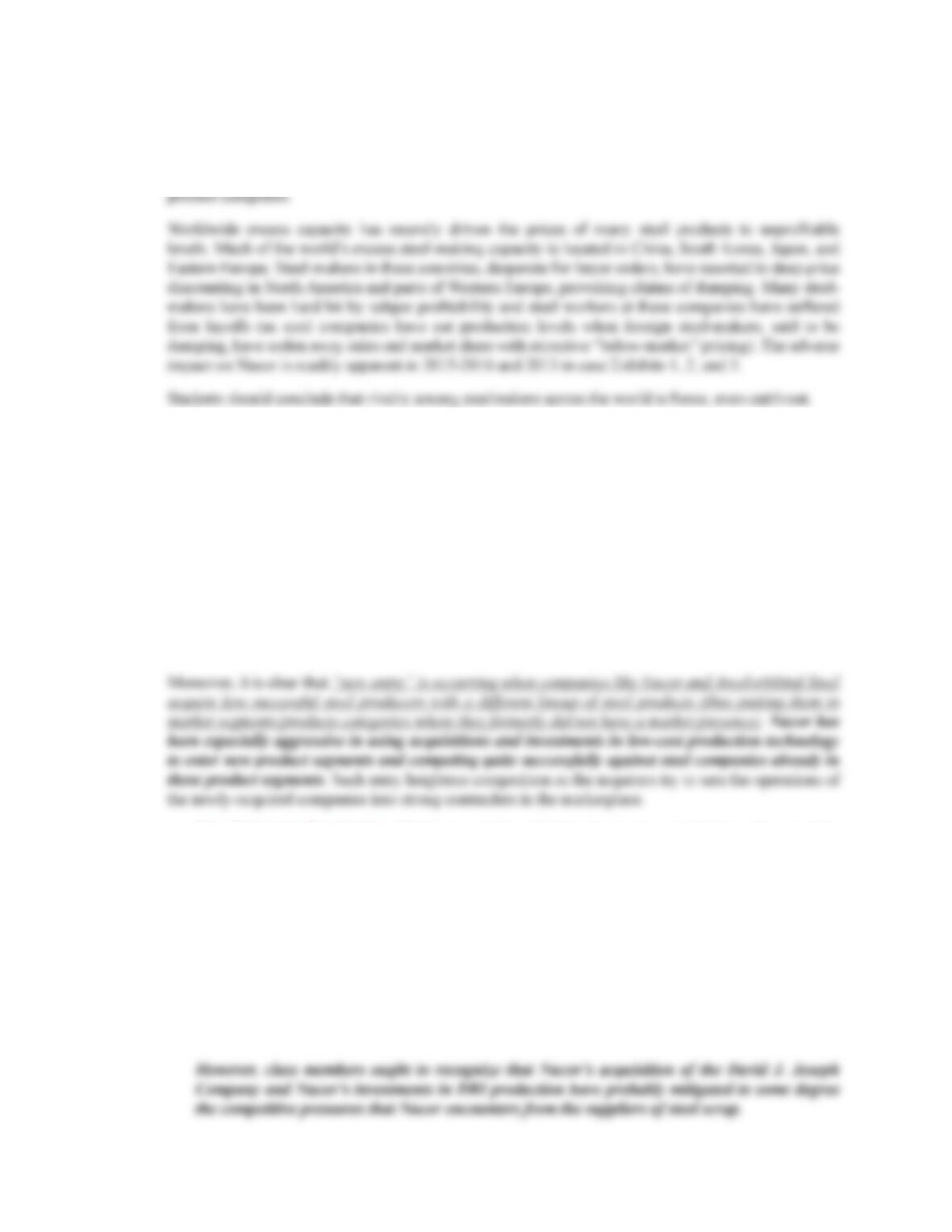
industry are currently very tough. A five forces model for the steel industry is depicted below.
Competitive pressures coming from the
market attempts of outsiders to win
Substitutes for
Steel
Potential New
Entrants into the
Steel Industry
Rivalry among Steel Producers—a fierce competitive force
Rivalry revolves heavily around price competition because most steel products are commodities.
Producing steel of satisfactory quality is something most producers have mastered. In a commodity
market like steel where it is hard to tell the steel products of one steel-maker from those of another,
buyers shop for the lowest/best price. However, meeting customers’ delivery schedule requirements
can also be a competitively relevant consideration for buyers when it comes to selecting whose steel to
purchase—this is particularly true when rival sellers are charging identical or very similar prices and
when supplies of particular steel products are constrained or when the buyer needs quick delivery.
Case 27 Teaching Note Nucor Corporation in 2018
613
Another competitive factor of significance is that producers like Nucor are figuring out how to use low-
cost scrap steel recycling technology to make a wider and wider range of steel products. They are using
their newly-developed technological capabilities to enter product segments that used to be the province
of the integrated producers, thus precipitating a fierce battle for market share in the newly-entered
Competition from Substitutes—a moderately strong competitive force
Aluminum, plastics/fiberglass, carbon fiber and perhaps other materials can be used in place of steel in
some products.
The Threat of Entry—a moderately strong competitive force
While it is quite unlikely that new start-up firms will enter the steel industry, it is clear from information
in the case that existing steel producers anxious to operate their plants at or very near full capacity will
seek out customers by offering very low prices to customers in geographic markets where they do not
currently have a presence. The geographic entry of many foreign steel producers into new geographic
markets accounts for why some low-cost foreign producers are thought to be “dumping” their products
in the U.S. and other countries.
Key Point to Emphasize Here: A number of Nucor’s recent acquisitions, for example,
represent entry of a potent and competitively successful steel company into either new product
categories or new geographic areas where its presence heretofore may have been fairly minimal.
Bargaining Power of Suppliers—a moderate competitive force in the case of scrap steel suppliers and
union labor (in the case of unionized steel companies) but a weak competitive force otherwise
There’s little in the case to indicate that suppliers (other than the suppliers of scrap steel) are a major
competitive factor. However, the price of scrap steel is a key input for mini-mills with electric arc
furnaces and rising scrap prices can put them at a competitive disadvantage. But scrap steel prices
appear to be a function of overall market demand-market supply conditions rather than a function of the
power of individual suppliers of scrap steel.
Case 27 Teaching Note Nucor Corporation in 2018
614
The power of unions could be a factor in affecting labor costs for steel producers having unionized labor
forces, putting such producers at a cost disadvantage vis-à-vis firms with nonunion labor.
Bargaining Power of Customers—a moderate to weak competitive force when demand is strong and
in short supply but a potent competitive force when demand is weak and steel suppliers are anxious to
win a customer’s business (as has been the case in much of the world market and certainly the market
in North America since 2008).
2. What driving forces do you see at work in this industry? Are they likely to impact the
industry’s competitive intensity and profitability favorably or unfavorably?
Class members should be expected to identify the following as being driving forces:
The oldest driving force whose influence is now waning is technological innovation in steel-making
via electric arc furnace technology, thin-slab casting, and direct casting of carbon steel (Nucor’s Castrip
technology) that has allowed companies (like Nucor) to enter product segments formerly dominated
Case 27 Teaching Note Nucor Corporation in 2018
615
3. How attractive are the prospects for the future profitability of U.S. steelmakers? Should
Nucor consider expanding in this type of industry environment? Why or why not?
The point of this line of questioning is to get students to recognize that all U.S. steelmakers are not necessarily
in the same boat, despite the tough market environment and the grim profit outlook industrywide. A low-cost
4. What type of strategy has Nucor followed? Which of the five generic strategies discussed
in Chapter 5 is Nucor employing? Is there any reason to believe that Nucor has achieved a
sustainable competitive advantage over many of its steel industry rivals? If so, what type of
competitive advantage does Nucor enjoy?
Very clearly, Nucor is pursuing a low-cost provider strategy. Such a competitive approach often is the best
and most competitively powerful strategy in a commodity product industry, and it is a strategy that has
plainly served Nucor exceptionally well over the past 40+ years.
Case 27 Teaching Note Nucor Corporation in 2018
616
5. What are the specific policies and operating practices that Nucor has employed to implement
and execute its low-cost provider strategy?
The class will undoubtedly have no trouble identifying Nucor’s low-cost provider strategy, but they may
not have as strong a grip on all the things that Nucor has done to achieve its low-cost status. It is one thing
for a company to aspire to low-cost leadership and profess its pursuit of a low-cost producer strategy; it is
quite another thing to display the managerial creativity and skills to do the kinds of things needed to become
a low-cost leader.
Some of the key operating practices, policies, and approaches that Nucor has employed in pursuit of its low-
cost leadership status include:
Case 27 Teaching Note Nucor Corporation in 2018
617
6. What specific factors account for why Nucor has been so successful over the past several
decades? Do these factors have more to do with great strategy, great strategy execution, or
great leadership?
Students ought to single out several factors that account for Nucor’s growth and market success over the
years:
1. The company’s aggressive pursuit of cost-saving efficiencies and the achievement of low costs per ton
produced in comparison with the costs of many rival steel-makers.