
Chapter 21
International Cash Management
Lecture Outline
Multinational Working Capital Management
Subsidiary Expenses
Subsidiary Revenue
Subsidiary Dividend Payments
Subsidiary Liquidity Management
Centralized Cash Management
Accommodating Cash Shortages
Techniques to Optimize Cash Flows
Accelerating Cash Inflows
Complications in Optimizing Cash Flow
Company-Related Characteristics
Government Restrictions
Characteristics of Banking Systems
Investing Excess Cash
Determining the Effective Yield
Implications of Interest Rate Parity

International Cash Management ❖ 2
Chapter Theme
This chapter emphasizes the decisions involved in the management of cash by an MNC. The additional
opportunities and risks of cash management for an MNC versus a domestic firm should be stressed.
There are actually three key components of the chapter. The first is distinguishing between subsidiary
control over excess cash versus centralized control. An argument is made in favor of centralized control.
Topics to Stimulate Class Discussion
1. Should international cash management be conducted at the subsidiary level or at the centralized
level? Elaborate.
2. What is the use of netting to an MNC?
3. How can a firm deal with blocked funds?
4. Assume that as a treasurer of a U.S. corporation, you believe that the British pound’s forward rate is
an accurate forecast of the pound’s future spot rate. What does this imply about your decision of
whether to invest cash in the U.S. or in the U.K.?
POINT/COUNTER-POINT:
Should Interest Rate Parity Prevent MNCs From Investing in Foreign
Currencies?
POINT: Yes. Currencies with high interest rates have large forward discounts according to interest rate
parity. To the extent that the forward rate is a reasonable forecast of the future spot rate, investing in a
foreign country is not feasible.
COUNTER-POINT: No. Even if interest rate parity holds, MNCs should still consider investing in a
foreign currency. The key is their expectations of the future spot rate. If their expectations of the future
spot rate are higher than the forward rate, the MNC would benefit from investing in a foreign currency.
WHO IS CORRECT? Use the Internet to learn more about this issue. Which argument do you support?
Offer your own opinion on this issue.
Answers to End of Chapter Questions

1. International Cash Management. Discuss the general functions involved in international cash
management. Explain how the MNC’s optimization of cash flow can distort the profits of each
subsidiary.
ANSWER: The general functions of international cash management are optimizing cash flows and
2. Netting. Explain the benefits of netting. How can a centralized cash management system be
beneficial to the MNC?
ANSWER: Netting is a centralized compilation of inter-subsidiary cash flows. It is designed to
reduce currency conversion costs and processing costs associated with payments between
3. Leading and Lagging. How can an MNC implement leading and lagging techniques to help
subsidiaries in need of funds?
4. International Fisher Effect. If a U.S. firm believes that the international Fisher effect holds, what
are the implications regarding a strategy of continually attempting to generate high returns from
investing in currencies with high interest rates?
5. Investing Strategy. Tallahassee Co. has $2 million in excess cash that it has invested in Mexico at an
annual interest rate of 60 percent. The U.S. interest rate is 9 percent. By how much would the
Mexican peso have to depreciate to cause such a strategy to backfire?
1 + 9%
1 + 60% –1 = – 31.875%

International Cash Management ❖ 4
6. Investing Strategy. Why would a U.S. firm consider investing short-term funds in euros even when
it does not have any future cash outflows in euros?
7. Covered Interest Arbitrage. Evansville, Inc. has $2 million in cash available for 90 days. It is
considering the use of covered interest arbitrage, since the euro’s 90-day interest rate is higher than
the U.S. interest rate. What will determine whether this strategy is feasible?
8. Effective Yield. Fort Collins, Inc. has $1 million in cash available for 30 days. It can earn 1% on a
30-day investment in the U.S. Alternatively, if it converts the dollars to Mexican pesos, it can earn 1
1/2% on a Mexican deposit. The spot rate of the Mexican peso is $.12. The spot rate 30 days from
now is expected to be $.10. Should Ft. Collins invest its cash in the U.S. or in Mexico? Substantiate
your answer.
9. Effective Yield. Rollins, Inc., has $3 million in cash available for 180 days. It can earn 7% on a U.S.
Treasury bill or 9% on a British Treasury bill. The British investment does require conversion of
dollars to British pounds. Assume that interest rate parity holds and that Rollins believes the 180-day
forward rate is a reliable predictor of the spot rate to be realized 180 days from now. Would the
British investment provide an effective yield that is below, above, or equal to the yield on the U.S.
investment? Explain your answer.
10. Effective Yield. Repeat question 9, but this time assume that Rollins, Inc., expects the 180-day
forward rate of the pound to substantially overestimate the spot rate to be realized in 180 days.

11. Effective Yield. Repeat question 9, but this time assume that Rollins, Inc., expects the 180-day
forward rate of the pound to substantially underestimate the spot rate to be realized in 180 days.
12. Effective Yield. Assume that the one-year U.S. interest rate is 10% and the one-year Canadian
interest rate is 13%. If a U.S. firm invests its funds in Canada, by what percentage will the Canadian
dollar have to depreciate to make its effective yield the same as the U.S. interest rate from the U.S.
firm’s perspective?
13. Investing in a Currency Portfolio. Why would a firm consider investing in a portfolio of foreign
currencies instead of just a single foreign currency?
14. Interest Rate Parity. Dallas Co. has determined that the interest rate on euros is 16 percent while the
U.S. interest rate is 11 percent for one-year Treasury bills. The one-year forward rate of the euro has
a discount of 7 percent. Does interest rate parity exist? Can Dallas achieve a higher effective yield
by using covered interest arbitrage than by investing in U.S. Treasury bills? Explain.
ANSWER: If interest rate parity (IRP) existed, the forward rate of the euro should have a discount
reflecting the interest rate differential:
15. Diversified Investments. Hofstra, Inc., has no European business and has cash invested in six
European countries, each of which uses the euro as its local currency. Are Hofstra’s short-term
investments well diversified and subject to a low degree of exchange rate risk? Explain.

16. Investing Strategy. Should McNeese Co. consider investing funds in Latin America countries where
it may expand facilities? The interest rates are high and the proceeds from the investment could be
used to help support the investment. When would this strategy backfire?
17. Impact of September 11. Palos Co. commonly invests some of its excess dollars in foreign
government short-term securities in order to earn a higher short-term interest rate on its cash.
Describe how the potential return and risk of this strategy may have changed after the September 11,
2001 terrorist attack on the U.S.
Advanced Questions
18. Investing in a Portfolio. Pittsburgh Co. plans to invest its excess cash in Mexican pesos for one
year. The one-year Mexican interest rate is 19%. The probability of the peso’s percentage change in
value during the next year is shown below:
Possible Rate of Change
What is the expected value of the effective yield based on this information? Given that the U.S.
interest rate for one year is 7%, what is the probability that a one-year investment in pesos will
generate a lower effective yield than could be generated if Pittsburgh Co. simply invested
domestically?

International Cash Management ❖ 7
ANSWER:
Effective Yield if this
Possible Rate of Rate of Change in the
Change in Peso Probability Peso Does Occur
–15% 20% (1.19) [1 + (–15%)] – 1 = 1.15%
19. Effective Yield of Portfolio. Ithaca Co. considers placing 30% of its excess funds in a one-year
Singapore dollar deposit and the remaining 70% of its funds in a one-year Canadian dollar deposit.
The Singapore one-year interest rate is 15%, while the Canadian one-year interest rate is 13%. The
possible percentage changes in the two currencies for the next year are forecasted as follows:
Possible % Change in Probability of that
the Spot Rate Over Change in the Spot
Currency the Investment Horizon Rate Occurring
Singapore dollar –2% 20%
Singapore dollar 1% 60%
Singapore dollar 3% 20%
Canadian dollar 1% 50%
Canadian dollar 4% 40%
Canadian dollar 6% 10%
Given this information, determine the possible effective yields of the portfolio and the probability
associated with each possible portfolio yield. Given a one-year U.S. interest rate of 8%, what is the
probability that the portfolio’s effective yield will be lower than the yield achieved from investing in
the U.S.? (See Appendix 21.)
ANSWER:
Possible % Change Effective Yield Based on the
in the Singapore Dollar % Change in the Singapore Dollar

International Cash Management ❖ 8
Possible % Change in Effective Yield Based on the
the Canadian Dollar % Change in the Canadian Dollar
Possible Joint
Effective Yield Computation of Computation of Effective
S$ C$ Joint Probability Yield of Portfolio
12.7% 14.13% (20%)(50%) = 10% .3(12.7%) + .7(14.13%) = 13.701%
Solution to Continuing Case Problem: Blades, Inc.
1. There is a tradeoff between the higher interest rates in Thailand and the delayed conversion of baht
into dollars. Explain what this means.
2. If the net baht received from the Thailand subsidiary are invested in Thailand, how will U.S.
operations be affected?
ANSWER: If the cash flows generated in Thailand are invested in Thailand, then Blades will have to
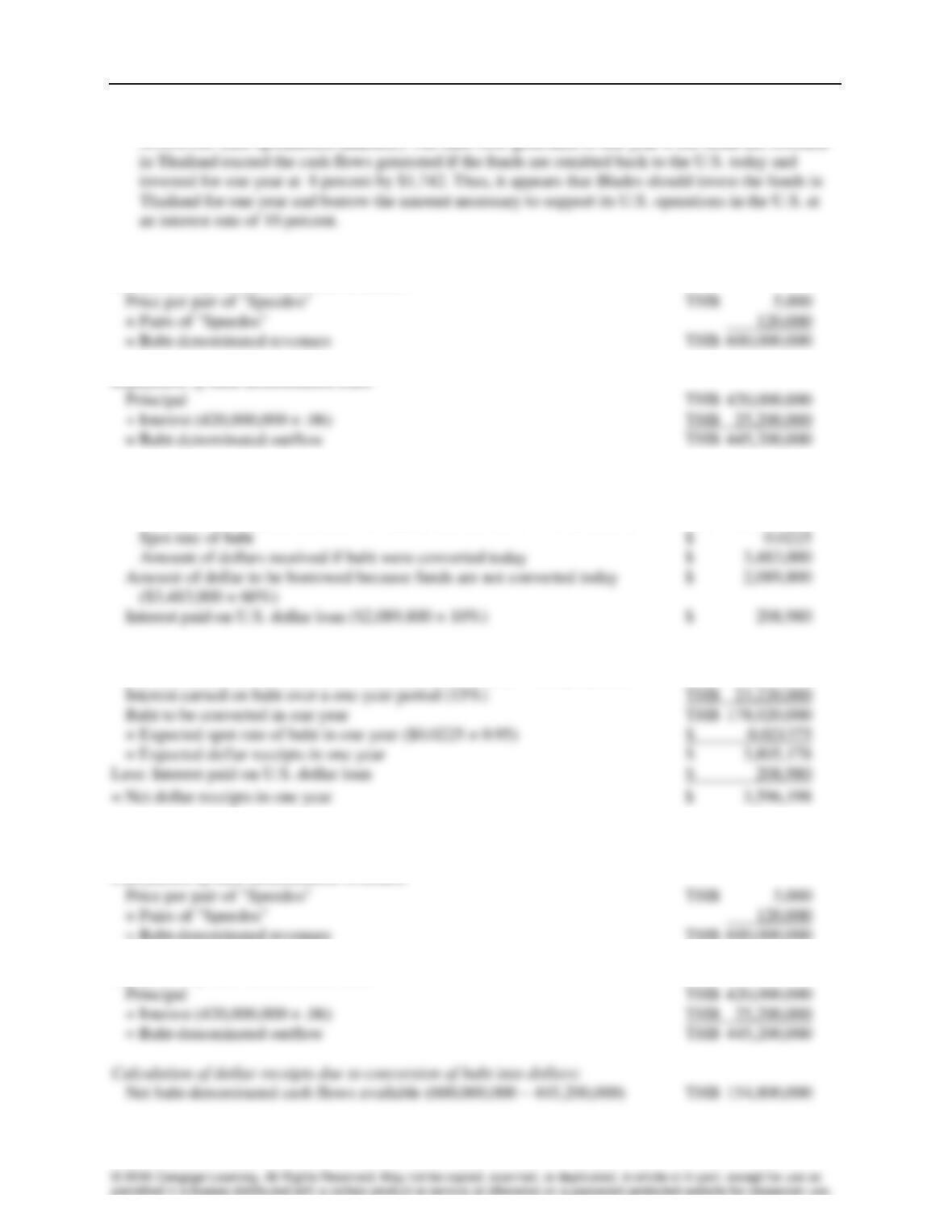
3. Construct a spreadsheet that compares the cash flows resulting from two plans. Under the first plan,
net baht-denominated cash flows (received today) will be invested in Thailand at 15 percent for a
one-year period, after which the baht will be converted to dollars. Under the second plan, net baht-
denominated cash flows are converted to dollars immediately and 60 percent of the funds will be used
to support U.S. operations, while 40 percent are invested in the U.S. for one year at 8 percent. Which
plan is superior given the expectation of the baht’s value in one year?
International Cash Management ❖ 9
Plan 1—Invest Funds in Thailand
Calculation of baht-denominated revenues:
Price per pair of “Speedos”
THB 5,000
× Pairs of “Speedos”
120,000
= Baht-denominated revenues
THB 600,000,000
Repayment of baht-denominated loan:
Principal
THB 420,000,000
+ Interest (420,000,000 × .06)
THB 25,200,000
= Baht-denominated outflow
THB 445,200,000
Calculation of interest on U.S. dollar loan needed to support U.S. operations:
Dollar receipts if baht were remitted now:
Net baht-denominated cash flows available (600,000,000 – 445,200,000)
THB 154,800,000
Spot rate of baht
$ 0.0225
Amount of dollars received if baht were converted today
$ 3,483,000
($3,483,000 × 60%)
Interest paid on U.S. dollar loan ($2,089,800 × 10%)
$ 208,980
Calculation of dollar receipts due to conversion of baht into dollars in one year:
Net baht-denominated cash flows available (600,000,000 – 445,200,000)
THB 154,800,000
Interest earned on baht over a one-year period (15%)
THB 23,220,000
Baht to be converted in one year
THB 178,020,000
× Expected spot rate of baht in one year ($0.0225 × 0.95)
$ 0.021375
= Expected dollar receipts in one year
$ 3,805,178
= Net dollar receipts in one year
$ 3,596,198
Plan 2—Convert Funds Immediately
Calculation of baht-denominated revenues:
× Pairs of “Speedos”
120,000
= Baht-denominated revenues
THB 600,000,000
Repayment of baht-denominated loan:
Principal
THB 420,000,000
+ Interest (420,000,000 × .06)
THB 25,200,000
= Baht-denominated outflow
THB 445,200,000
Net baht-denominated cash flows available (600,000,000 – 445,200,000)
THB 154,800,000

International Cash Management ❖ 10
× Spot rate of baht now
$ 0.0225
= Dollar receipts now
$ 3,483,000
Interest earned on dollar investment in the U.S. ($1,393,200 × 8%)
$ 111,456
Plan 1
$ 3,596,198
Plan 2
3,594,456
Solution to Supplemental Case: Islander Corporation
a. By using a spreadsheet format, the percentage changes in exchange rates can be easily computed for
each scenario. Using these percentage changes along with the interest rates, the effective yield can be
computed for each currency under each scenario. The effective yields are provided below for each
scenario, along with the expected value of the effective yield (using the probabilities assigned to each
scenario):
Somewhat Expected Value
Strong $ Stable $ Weak $ of Effective
Currency Scenario Scenario Scenario Financing Rate
Australian dollar –0.56% 14.51% 28.07% 14.05%
British pound 4.56 14.48 21.10 13.49
Canadian dollar 9.71 9.71 17.45 12.03
Japanese yen –1.00 11.60 29.60 13.22
U.S. dollar 9.00 9.00 9.00 9.00
Based on the expected values of effective yields for the currencies, the optimal composition of each
portfolio is disclosed in the following table:
Percentage of Funds Invested in:
Type of Portfolio
A$
BP
C$
JY
US$
Risk neutral
100
0
0
0
0
Balanced
25
25
25
25
0
Ultra-conservative
0
0
0
0
100
The effective yields for each portfolio can be determined on the spreadsheet by creating a compute
statement that sums weighted effective yields based on the weights assigned above. These yields are
disclosed below:
Portfolio’s Effective
Yield Under a: Expected Value
Strong $ Stable $ Weak $ of Effective
Portfolio Scenario Scenario Scenario Financing Rate

International Cash Management ❖ 11
Risk neutral –0.56% 14.15% 28.07% 14.05%
Small Business Dilemma
Cash Management at the Sports Exports Company
1. If Logan invests the excess cash in U.S. Treasury bills, would this reduce the firm’s exposure to
exchange rate risk?
2. Logan decided to use the excess cash to pay off the British loan. However, a friend advised him to
invest the cash in British Treasury bills, stating that “the loan provides an offset to the pound
receivables, so you would be better off investing in British Treasury bills than paying off the loan.”
Is his friend correct? What should Logan do?
Part 5—Integrative Problem
Short-Term Asset and Liability Management
Kent Company is a large U.S. firm with no international business. It has two branches within the U.S., an
eastern branch and a western branch. Each branch presently makes investing or financing decisions
independently, as if it was a separate entity. The East branch has excess cash of $15 million to invest for
the next year. It can invest its funds in Treasury bills denominated in dollars or any of four foreign
currencies. The only restriction enforced by the parent is that a maximum of $5 million can be invested
or financed in any single foreign currency.
The western branch needs to borrow $15 million over one year to support its U.S. operations. It can
borrow funds in any of these same currencies (although any foreign funds borrowed need to be converted
to dollars to finance the U.S. operations). The only restriction enforced by the parent is that a maximum
equivalent of $5 million can be borrowed in any single currency.
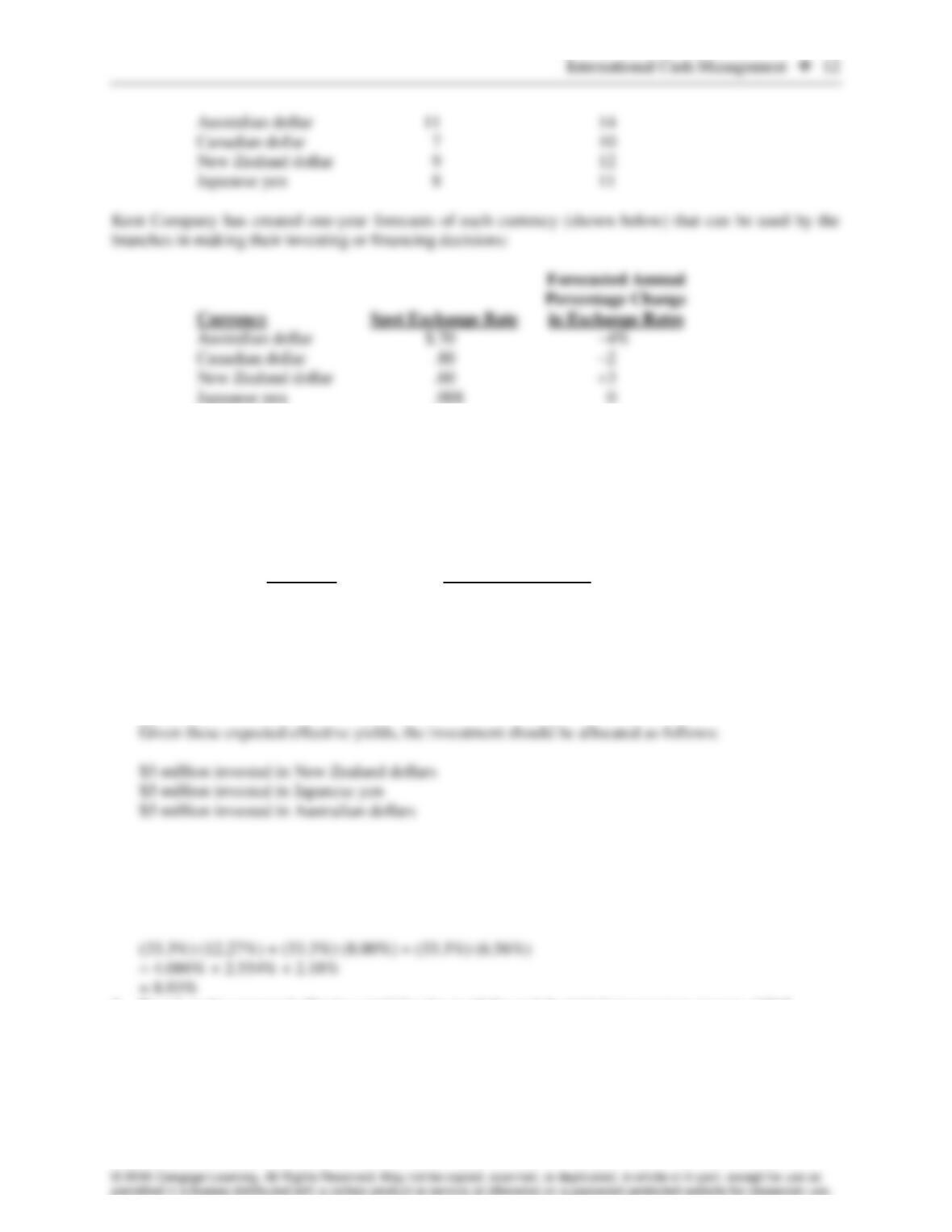
A large bank serving the international money market has offered Kent Company the following terms:
Currency
Annual Interest
Rate on Deposits
Annual Interest Rate
Charged on Loans
U.S. dollar
6%
9%
1. Determine the investment portfolio composition for Kent’s eastern branch that would maximize the
expected effective yield, while satisfying the restriction imposed by the parent.
When accounting for the interest rate and forecasted exchange rates, the expected effective yields are
listed below:
Currency
Expected Effective
Yield on Investment
U.S. dollar
6.00%
Australian dollar
6.56
Canadian dollar
4.86
New Zealand dollar
12.27
Japanese yen
8.00
ANSWER:
2. What is the expected effective yield of the investment portfolio?
ANSWER: Based on 33.3% allocated to each of three currencies (NZ$, JY, A$), the portfolio’s
expected effective yield is:
3. Based on the expected effective yield for the portfolio and the initial investment amount of $15
million, determine the annual interest to be earned on the portfolio.
ANSWER: The expected interest earned is the portfolio’s expected effective yield times the initial
investment, or:
Australian dollar
11
14
Canadian dollar
7
10
New Zealand dollar
9
12
Japanese yen
8
11
Australian dollar
$.70
–4%
Canadian dollar
.80
–2
New Zealand dollar
.60
+3
Japanese yen
.008
0

4. Determine the financing portfolio composition for Kent’s western branch that would minimize the
expected effective financing rate, while satisfying the restriction imposed by the parent.
When accounting for the interest rate and forecasted exchange rate, the expected effective financing
rates are listed below:
Currency
Expected Effective
Financing Rate
U.S. dollar
9.00%
Australian dollar
9.44
Canadian dollar
7.80
New Zealand dollar
15.36
Japanese yen
11.00
ANSWER:
Given these expected financing rates, the financing should be allocated as follows:
5. What is the expected effective financing rate of the total amount of funds borrowed?
ANSWER: Based on 33.3% financed with each of three currencies (C$, U.S.$, A$), the expected
financing rate for the entire portfolio of funds borrowed is:
6. Based on the expected effective financing rate for the portfolio and the total amount of $15 million
borrowed, determine the expected loan repayment amount beyond the principal borrowed.
ANSWER: The expected loan repayment amount beyond the principal borrowed is the portfolio’s
7. When the expected interest received by the eastern branch and paid by the western branch of Kent
Company are consolidated, what is the net amount of interest received?
ANSWER:
Net = Interest received – Interest paid

8. If the eastern branch and western branch worked together, the eastern branch could loan its $15
million to the western branch. Nevertheless, one could argue that the branches could not have taken
advantage of interest rate differentials or expected exchange rate effects among currencies. Given the
data provided in this example, would you have recommended that the two branches make their short–
term investment and financing decisions independently, or should the eastern branch lend its excess
cash to the western branch? Explain.
ANSWER: If one branch lends to another, the interest received by one branch will be exactly equal
Discussion in the Board Room
This exercise is intended to apply many of the key concepts to broad issues that are discussed by
managers who make financial decisions. It does not replace the more detailed questions and problems at
the end of the chapter. Instead, it focuses on broad financial issues to facilitate class discussion and
simulate a board room discussion. It serves as a running case in which broad concepts from every chapter
are applied to the same business throughout the school term. The exercise not only enables you to apply
concepts to the real world, but also develops your intuitive and communication skills.
There are several alternative ways in which this exercise is used in a course.
2. Use it to encourage online discussion for courses taught online.
4. Use it as a comprehensive case discussion near the end of the semester, as a means of reviewing the
key concepts that were described throughout the course.
5. Use it for presentations, in which individuals or teams present their views on the questions that were
assigned to them.
This exercise has been placed on the course web site so that students can download it, and insert their
answers after the questions. By the end of the course, the students will have applied all the major concepts
of the text to a single firm. The focus on a single firm will allow students to recognize how some of their
decisions about concepts covered in the earlier chapters interact with decisions to be made in later
chapters.
BACKGROUND
One of the best methods of learning broad concepts in this text is to put yourself in the place of an MNC
manager or board member, and apply the concepts to make financial decisions. Board members do not

International Cash Management ❖ 15
normally make the decisions that are discussed here, but must have the conceptual skills to monitor the
policies that are implemented by the MNC’s managers. Thus, they must frequently ask themselves what
they would do if they were making the managerial decisions or setting corporate polices.
Consider the following business that you could easily create: a business that teaches individuals in a non-
U.S. country to speak English. While this business is very basic, it still requires the same type of
decisions faced by large MNCs. Assume that you initially establish this business in Mexico.
Details of Your Business. You live in the U.S. You invested $60,000 to establish a business of a
language school called EE (Escuela de Engles) in Mexico City, Mexico. You hire local individuals in
Mexico who can speak English and train others how to speak English. You have a small subsidiary in
Mexico, which has an office and an attached classroom that you lease. Clients can come to your
subsidiary for a 1-month structured course in English, taught by your employees. You advertise in the
local newspapers to promote the teaching services offered by your business.
You also serve some individuals from Mexico who have taken English classes and want to come to the
U.S. for a one-week intense course in which they can improve and practice their English and practice it.
All revenue and expenses associated with your business are denominated in Mexican pesos. Most of the
profits from the business in Mexico are sent to you by your subsidiary at the end of each month. While
your expenses are somewhat stable, your revenue varies with the number of clients who sign up for the
English-speaking courses in Mexico.
You only need to know this background so that you can answer the related questions that are asked about
your business throughout the term. Answer each question as if you were serving on the board of your
business or as a manager of the business. The questions in the early chapters force you to assess the
firm’s opportunities and exposure, while the later chapters force you to offer your input on potential
strategies that your business may pursue.
Chapter 1
a. Discuss the corporate control of your business. Explain why your business in Mexico is exposed
to agency problems.
b. How would you attempt to monitor the ongoing operations of the business?
c. Explain how you might be able to use a compensation plan that limits the potential agency
problems?
d. Assume that you have been approached by a competitor in Mexico to engage in a joint venture.
The competitor would offer the classroom facilities (so that you would not need to rent classroom
facilities), while your employees would provide the teaching. You would split the profits with this
business. Discuss how your potential return and your risk would change if you pursue the joint
venture.
e. Explain the conditions that would cause your business to be adversely affected by exchange rate
movements.
f. Explain how your business could be adversely affected by political risk.