
Hitt 13e Case Teaching Notes
Case 2: Baidu’s Business Model and Its Evolution
Case Synopsis
After a little more than a decade of exponential growth and increasing revenues, China’s
Internet search giant Baidu suddenly found itself struggling in 2016. Co-founded by Robin Li
Yanhong, chairman and CEO, and his friend Eric Xu in 2000, Baidu was China’s first home-grown
search engine. Much like Google in the United States—one of its early rivals until Google exited
Driven by its success in meeting the unique needs of the Chinese market, Baidu also began to
expand internationally and to continue to localize its services for the people of such countries
as Brazil, India, Egypt, Thailand, Vietnam, and Indonesia. Through a partnership with France
Telecom, it entered the African market. Baidu’s Li has even suggested long-term plans to enter
the U.S. and European markets.

from one of connecting people to information to one of connecting people to services, and Li
promises solid long-term growth with the two segments supporting this goal.
Learning Objectives
• Discuss the relationship between customers and business-level strategies in terms of
who, what, and how. (Chapter 4)
• Describe business models and explain their relationship with business-level strategies.
(Chapter 4)
• Identify three basic benefits firms gain by successfully implementing an international
strategy. (Chapter 8)
• Explore the determinants of national advantage as the basis for international business–
level strategies. (Chapter 8)
• Describe the three international corporate-level strategies. (Chapter 8)
Strategic Issues and Suggested Discussion Questions & Answers
1. How and why have Baidu’s business model and customers changed over time?
When Robin Li Yanhong and Eric Xu co-founded Baidu in 2000, their intention was to create
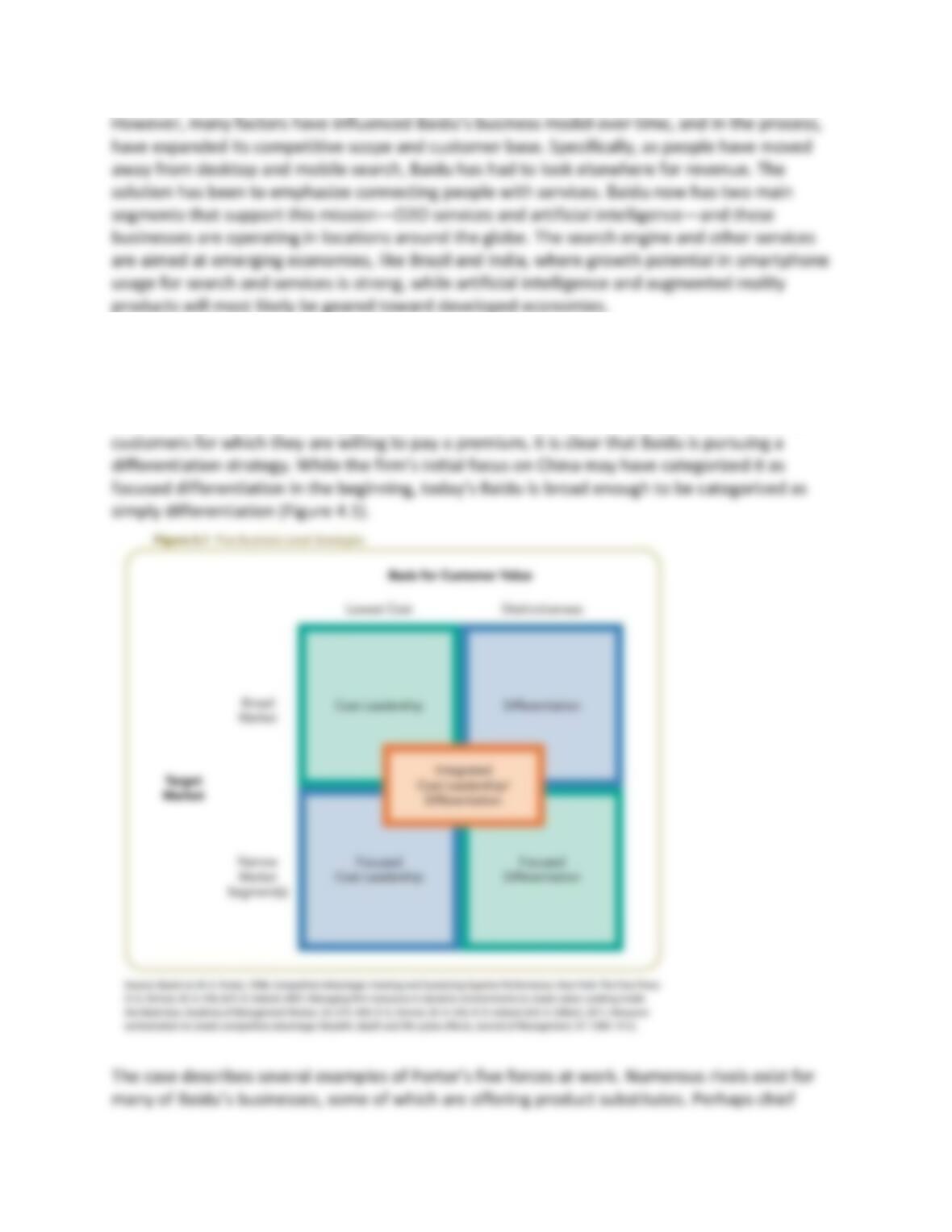
2. Which business-level strategy is Baidu using? Provide at least two examples of how
Porter’s five forces are affecting the firm and its strategy.
With an emphasis on providing products and services that are different and create value for
3. Baidu has diversified through both the creation and acquisition of new businesses.
Choose three examples from the case, and identify the value-creating, value-neutral,
or value-reducing reason behind the creation or acquisition of each of the examples.
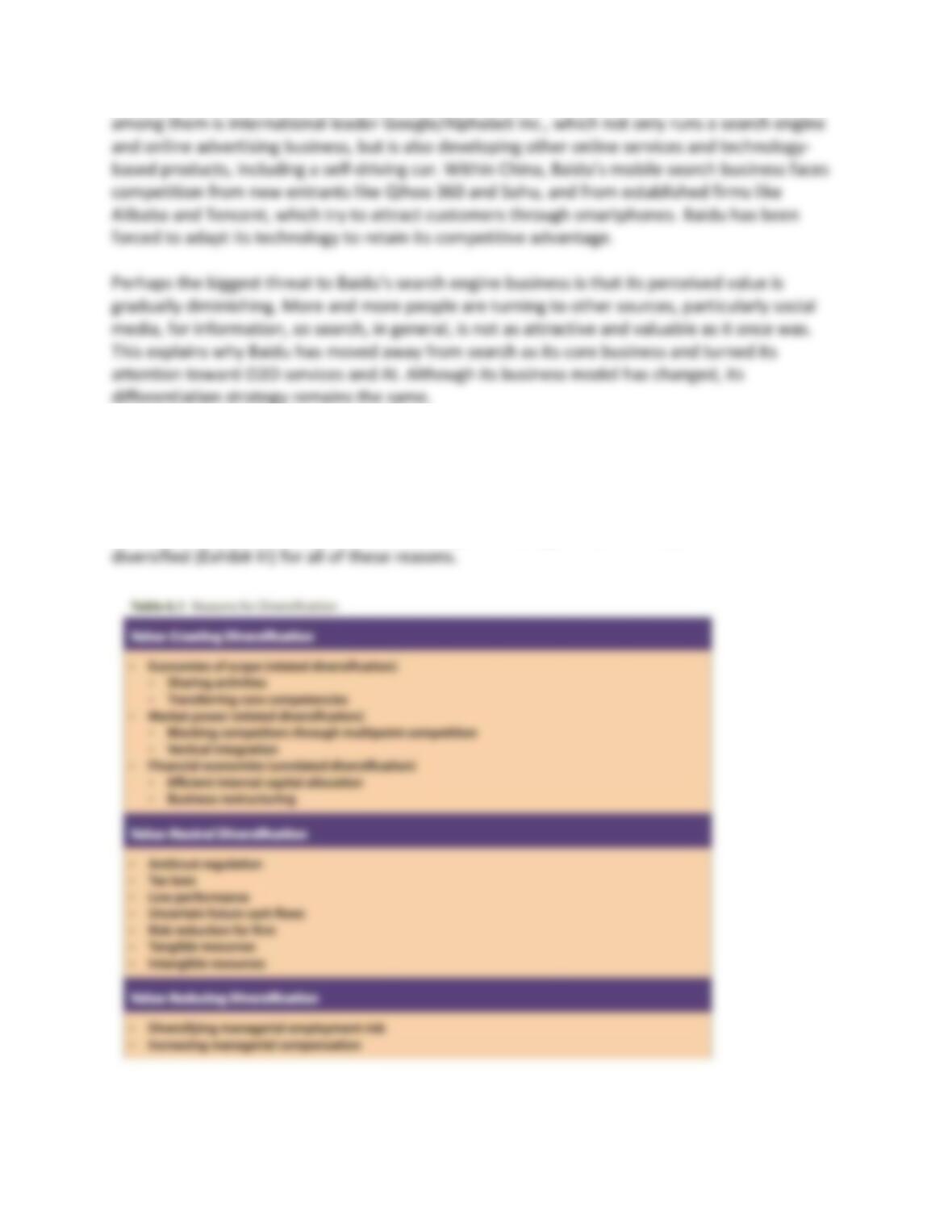
The reasons for diversification fall into three general categories (Table 6.1), and Baidu has

4. What has been the most powerful incentive for Baidu’s international expansion, and
what benefits is the firm enjoying from its global growth?
In a fairly short amount of time, Baidu’s top leadership recognized that it was getting close to
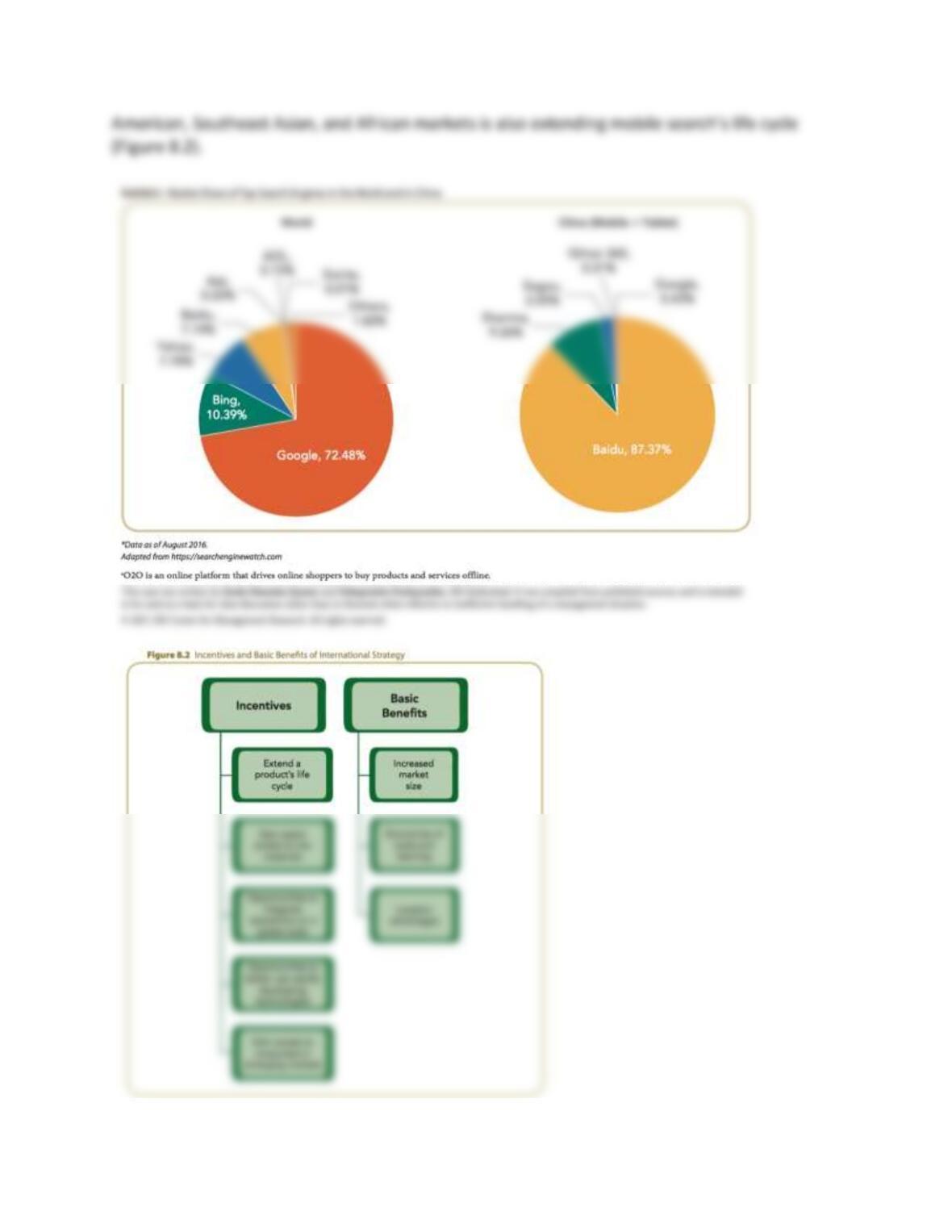
Thanks to Baidu’s international expansion efforts into some of the largest known markets
(India, Brazil, Southeast Asia), the firm has definitely increased its market size. In some ways,
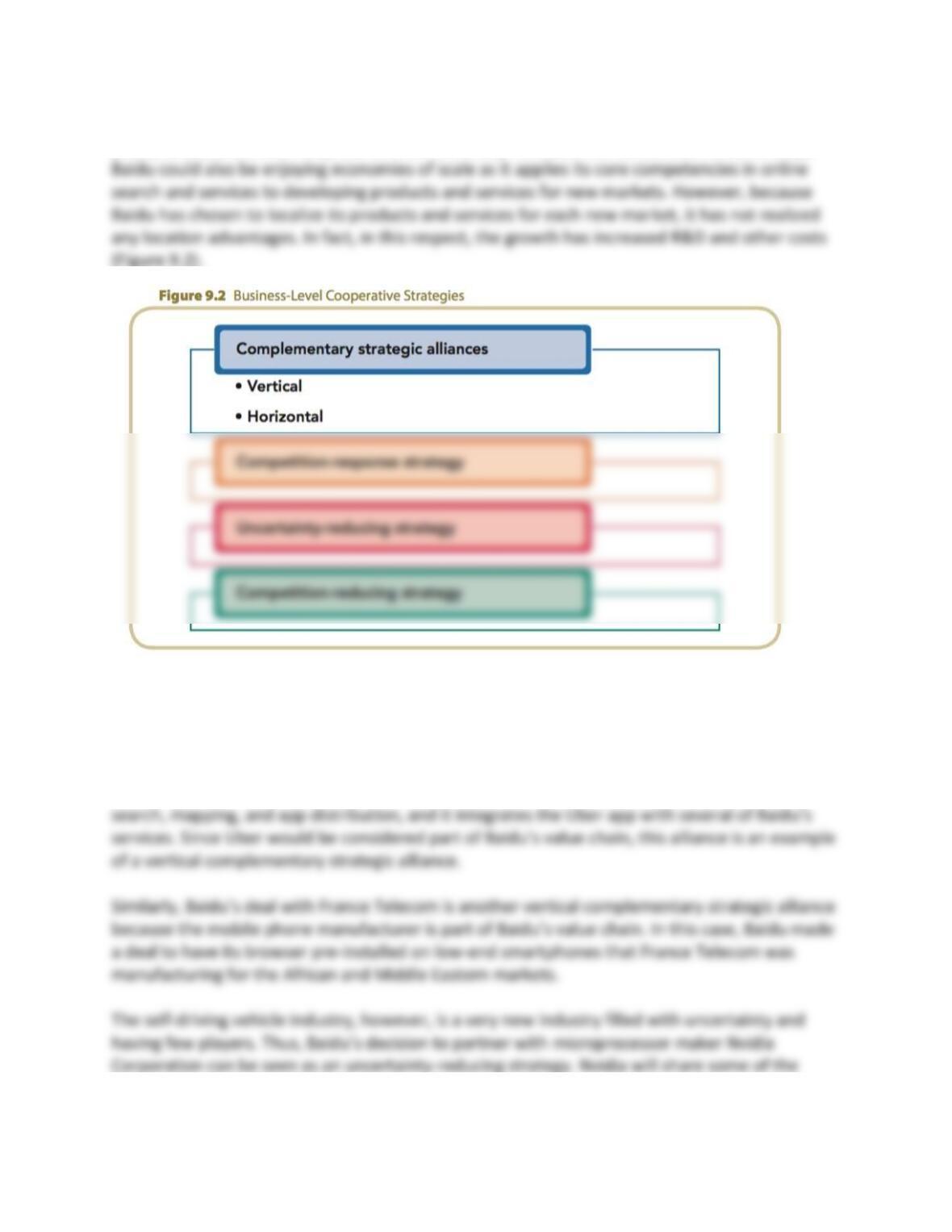
5. Choose one of the examples of Baidu’s cross-border strategic alliances described in
the case, and explain which type of business-level cooperative strategy it exemplifies.
On its own home turf, Baidu has made a cross-border strategic alliance with U.S.-based Uber by
investing an undisclosed amount of money. This move leverages Baidu’s strengths in mobile

weight of the R&D costs with Baidu in developing a computer platform for self-driving cars in
the Chinese market.
6. Would you characterize Robin Li Yanhong, chairman and CEO of Baidu, as an
entrepreneur? Explain your answer.
Baidu’s CEO and co-founder Robin Li Yanhong exhibits many of the qualities that characterize
an entrepreneur. Based on his experience with other search engines, as well as his personal
background as a Chinese national, he recognized an entrepreneurial opportunity to create a
Additional Resources
Reuters’s company profile gives in–depth background on Baidu’s current financials, leadership,
valuation, news, and more:
Hugh Sergeant, head of UK Equities at River & Mercantile, offered his perspective on Baidu in
April 2019: