Instructor’s Manual
2-1
CHAPTER TWO
Product Costing: Manufacturing Processes,
Cost Terminology, and Cost Flows
This chapter focuses on product costing. In particular, it focuses on
Key Concepts
• Production processes require the combination of raw materials, labor,
and other items such as electricity and supplies to create finished
goods.
Learning Objectives
LO1— Describe basic production processes used by manufacturing companies.
LO2— Identify the key characteristics and benefits of lean production and JIT
manufacturing.
Instructor’s Manual
LO5— Evaluate the impact of product costs and period costs on a company’s
income statement and balance sheet.
Lecture Outline
A. Introduction
1. Manufacturing companies purchase raw materials from other
companies and transform those raw materials into a finished
product.
B. The Production Process (LO1)
1. The production process transforms raw material into finished
products. This transformation typically requires labor and the
incurring of other costs, such as the cost of utilities, the
Instructor’s Manual
2-3
2. Manufacturing in a Traditional Environment
o In traditional manufacturing system, it was normal to
accumulate raw materials inventory and finished-goods
inventory to serve as buffers in case of unexpected
demand for products or unexpected problems in
o The traditional manufacturing system “pushes” the
products through the system.
C. Lean Production and Manufacturing in a JIT Environment (LO2)
One of the big changes affecting companies in the past 20 to 25 years has
been the adoption of lean production systems and just-in-time (JIT)
manufacturing.
1. Lean production is focused on eliminating waste associated with
Key Concept
Production processes require the combination of raw materials, labor, and
Instructor’s Manual
2. JIT (just-in-time) systems secure raw material and provide finished
product when needed or just in time for production or sale. JIT
systems “pull” the product through the system as opposed to
pushing it through. JIT systems:
o reduce waste and scrap.
D. Product Costs in a Manufacturing Company (LO3)
Manufacturing companies must know how much their products cost. It is
useful to distinguish between direct costs (directly attached to the finished
Key Concept
Lean production and JIT provide many benefits, including improved
production quality and reduced processing time.
Instructor’s Manual
2-5
1. Manufacturing costs: typically consist of three components: direct
materials, direct labor, and manufacturing overhead.
o Direct Materials: Materials that can be directly and
conveniently traced to a particular product or other cost
2. Nonmanufacturing Costs: consist of those costs which are incurred
outside the plant or factory and typically are categorized as selling
and administrative costs. They are called period costs and are
expensed on the income statement in the period incurred.
Key Concept
Manufacturing costs are incurred in the production facility, whereas
Instructor’s Manual
E. Flow of costs in manufacturing, merchandising, and service companies
(LO4)
1. Cost Flows in a Manufacturing Company—Traditional Environment
with Inventory
o To accurately determine the cost of manufactured
products, a company must trace or allocate manufacturing
o At the point of sale, the cost of producing the product (the
cost of goods sold) must be matched with the sales price to
compute a profit or loss on the sale (called gross margin,
or gross profit).
o When materials are not all used in production, goods are
o Manufacturing costs include the costs of direct materials,
direct labor, and manufacturing overhead. These costs are
also called product costs because they attach to the
product as it goes through the production process.
Instructor’s Manual
2-7
2. The Cost-of-Goods-Sold Model for a Traditional Manufacturing
Company with Inventory
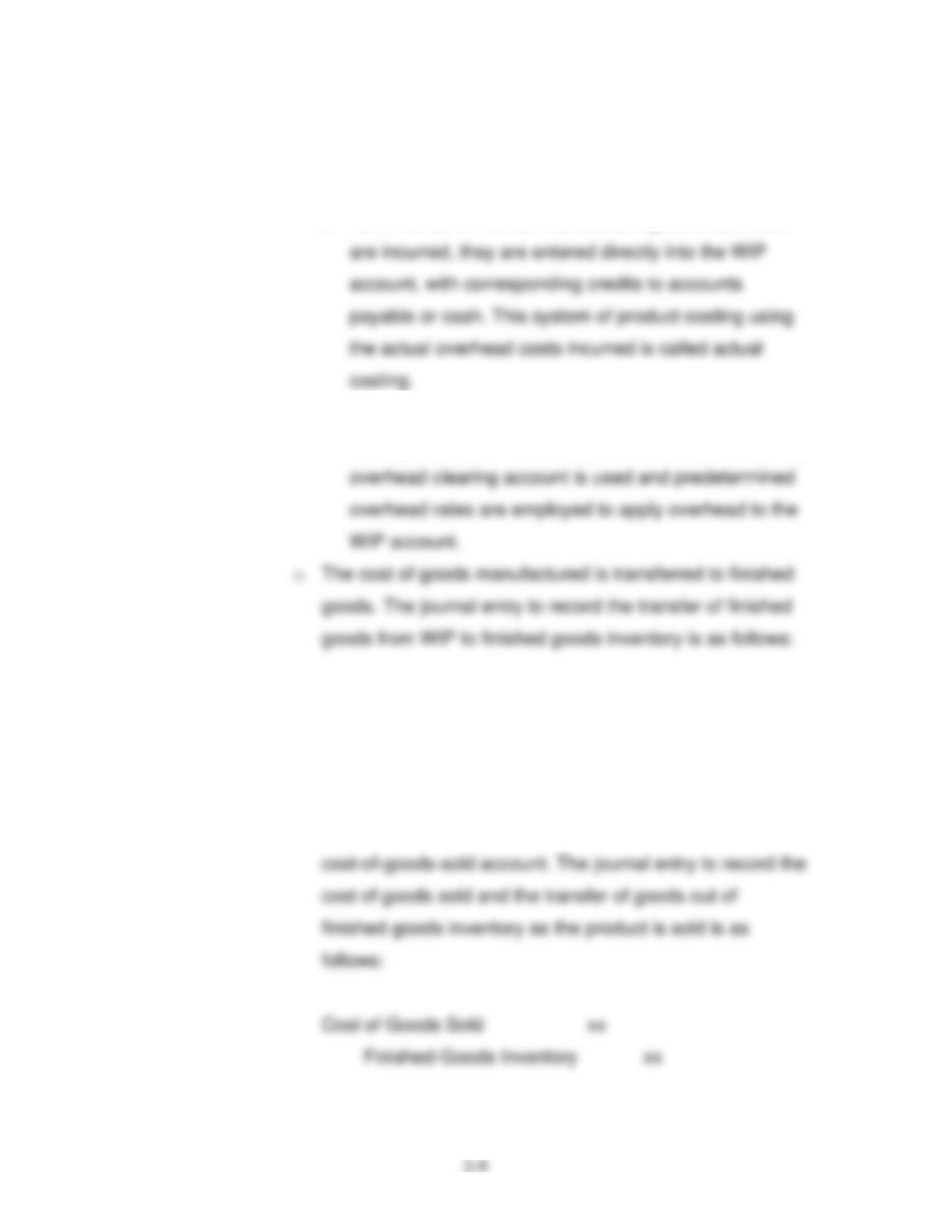
o First, raw materials are purchased from suppliers. The
o When the raw materials are moved to the factory, the raw
material costs move with the material to a work in process
o As direct labor costs are incurred, the cost of the workers is
added to the raw material cost in the WIP inventory
account. The journal entry to record the incurrence of direct
labor costs is as follows:
Instructor’s Manual
Work in Process Inventory xx
Accounts Payable (or Cash) xx
a. Note that as the actual manufacturing overhead costs
b. Most companies, however, utilize a system of product
costing called normal costing, in which a manufacturing
Finished-Goods Inventory xx
Work in Process Inventory xx
o When the finished goods are sold, the accumulated costs
in the finished-goods inventory account are moved to the
Instructor’s Manual
2-9
3. Cost Flows in a Manufacturing Company – JIT Environment
o In a JIT environment, the physical flow of goods is
streamlined by the use of manufacturing cells that largely
eliminate inventories of raw materials, WIP, and finished
4. Merchandising Companies and the Cost of Products
o The product cost of a wholesaler or retailer is simply the
purchase price of the merchandise the wholesaler or
retailer sells.
Instructor’s Manual
2-10
5. Service Companies and the Cost of Service
o Service providers must calculate the costs associated with
the revenue earned by the company from selling its
services.
o Although service companies typically have little need for
raw materials accounts and finished-goods inventory
accounts, work in process (WIP) accounts are commonly
used on projects that were incomplete at the end of a
particular period.
F. Product Costs and Period Costs (LO5)
1. Until the sale of the product, the costs of manufacturing are
included in one of three inventory accounts: raw materials, work in
2. Nonmanufacturing costs, or period costs, are expensed
immediately on the income statement in the period in which they
are incurred.
Instructor’s Manual
inventory owned by a company is provided in financial statements
and is included in the company’s annual report.
End-of-Chapter Material
Brief exercises, exercises, problems, and cases based on different learning
objectives have been provided at the end of the chapter. These-end-of chapter
Key Concept
Product costs attach to the product and are expensed only when the