Chapter 02 – Values, Attitudes, Emotions, and Culture: The Manager as a Person
2-15
Sex of children is an important variable in the birth-order equation. “If there are three daughters and a
last–born son, the son may possess the characteristics of the firstborn, rather than the baby,” Leman says.
Maniacci says: “In my practice, I’ve found the greater the sex differentiation between the parents, the less
children of the opposite sex compete with each other. That impacts birth-order roles.
mold personality. Experts generally agree interpreting birth order can be complicated and only presents
part of the picture.
But Leman says, “As a psychologist, I have not found a more practical tool for understanding human
dynamics than birth order.”
Lecture Enhancer 2.3
THE BIG THRILL PERSONALITY
Another facet of personality is one’s tolerance for risk taking. Some individuals have a kind of
psychological urge to reach beyond the status quo and seek out novelty, change, and excitement.
Psychologist Frank Farley, of the University of Wisconsin, has spent twenty years examining what he
calls the Type T (thrill-seeking) personality. According to Farley’s theory, Big T types are high-profile
Chapter 02 – Values, Attitudes, Emotions, and Culture: The Manager as a Person
2-16
Whether male or female, risk-taking individuals tend to be what Farley calls “transmutative thinkers,”
adept at shifting from one cognitive process to another, and from the abstract to the concrete and vice
Notes for Topics for Discussion and Action
DISCUSSION
1. Discuss why managers who have different types of personalities can be equally effective and
successful.
2. Can managers be too satisfied with their job? Can they be too committed to their organizations? Why
or why not?
MANAGEMENT IN ACTION
Chapter 02 – Values, Attitudes, Emotions, and Culture: The Manager as a Person
3. Assume that you are a manager of a restaurant. Describe what it is like to work for you when you are
in a negative mood.
4. Why might managers be disadvantaged by low levels of emotional intelligence?
ACTION
5. Interview a manager in a local organization. Ask the manger to describe situations in which he or she
is especially likely to act in accordance with his or her values. Ask the manager to describe situations in
which he or she is less likely to act in accordance with his or her values.
6. Watch a popular television show and as you watch it, try to determine the emotional intelligence levels
of the characters the actors in the show portrays. Rank the characters from highest to lowest in terms of
emotional intelligence. As you watched the show, what factors influenced your assessments of emotional
intelligence levels?
2-18
7. Go to an upscale clothing store in your neighborhood and go to a clothing store that is definitely not
upscale. Observe the behavior of employees in each store as well as the store’s environment. In what
ways are the organizational cultures in each store similar? In what ways are they different?
Diagnosing Culture
1. What values are emphasized in this culture?
2. What norms do members of this organization follow?
3. Who seems to have played an important role in creating the culture?
4. In what ways is the organizational culture communicated to organizational members?
Notes for Managing Ethically
BUILDING MANAGEMENT SKILLS
MANAGING ETHICALLY
Chapter 02 – Values, Attitudes, Emotions, and Culture: The Manager as a Person
2-19
1. Either individually or in a group, think about the ethical implications of using personality and interest
inventories to screen potential employees. How might this practice be unfair to potential applicants? How
might organizational members who are in charge of hiring misuse it?
2. Because of measurement error and validity problems, some relatively trustworthy people may “fail” an
honesty test given by an employer. What are the ethical implications of trustworthy people “failing”
honesty tests, and what obligations do you think employers should have when relying on honesty tests for
screening?
1. Develop a list of options and potential courses of action to address the heightened competition and
decline in profitability that your company has been experiencing.
(Note to instructors: student answers will vary based on their experiences.)
2. Choose your preferred course of action and justify why you will take this route.
3. Describe how you will communicate your decision to employees.
SMALL GROUP BREAKOUT EXERCISE
Chapter 02 – Values, Attitudes, Emotions, and Culture: The Manager as a Person
2-20
Since “rumors are rampant”, it is important to communicate with everyone in a clear and timely manner.
4. If your preferred option involves a layoff, justify why. If it doesn’t involve a layoff, explain why.
Layoffs could be justified if the slowdown of work is so severe that the company cannot keep its workers
occupied or is facing a financial crisis, such as bankruptcy. In this case, the only way to save the company
and protect the majority of stakeholders could be through downsizing.
In this situation it is best to take a collaborative approach toward conflict resolution. A
collaborative approach encourages the disputing parties to solve the problem together. The
position of both parties should be treated as equally important (though not necessarily the case),
and equal emphasis should be placed on the quality of the outcome and the fairness of the
decision making process. The intent is to find solutions that are satisfactory to both parties rather
than find fault or assign blame. The first step of the vice president for human resources should be
to bring the disputing parties together for the purpose of focusing upon a shared goal, such as
improved work climate, improved quality of work, improved work relationships, etc. The
establishment of common goals will provide a context for the continuance of discussions
BE THE MANAGER

Chapter 02 – Values, Attitudes, Emotions, and Culture: The Manager as a Person
2-21
Case Synopsis: Wipe Off That Smile: An Amazon Veteran is Launching a Shopping Site
That Is Part Costco, Part Mall, and All Anti-Amazon
Jet.com is the brainchild of Marc Lore. Through this company, he wants to reinvent the wholesale
shopping club. Customers will find just about everything, including clothes, books, and electronics. After
a 90–day free trial period, Jet customers will be asked to pay $49.99 a year for access to what Lore claims
will be prices that are 10 percent to 15 percent lower than anywhere else online.
Lore spent a little less than two-and-a-half years inside Amazon. After leaving the company, he came up
with the idea to bring the membership-based shopping club model online. With Jet.com, customers will
be able to make multiple online purchases from a range of sellers and combine the merchandise in one
• Whistle blowing: Code Red or Red Ink?
BLOOMBERG BUSINESSWEEK CASE IN THE NEWS
SUPPLEMENTAL FEATURES
MANAGER’S HOT SEAT (MHS)
Chapter 02 – Values, Attitudes, Emotions, and Culture: The Manager as a Person
2-22
These Instructor’s PowerPoint slides can be used to supplement the lecture material.
INSTRUCTOR’S POWERPOINT
SLIDE 1
Chapter Title
INSTRUCTOR’S POWERPOINT
SLIDE 2
Learning Objectives
INSTRUCTOR’S POWERPOINT
SLIDE 3
Personality Traits
INSTRUCTOR’S POWERPOINT
SLIDE 4
Managers and Traits
INSTRUCTOR’S POWERPOINT
SLIDE 5
Figure 2.1 – Big Five Personality
Traits
INSTRUCTOR’S POWERPOINT
SLIDE 6
Extraversion
INSTRUCTOR’S POWERPOINT SLIDES
Chapter 02 – Values, Attitudes, Emotions, and Culture: The Manager as a Person
2-23
INSTRUCTOR’S POWERPOINT
SLIDE 7
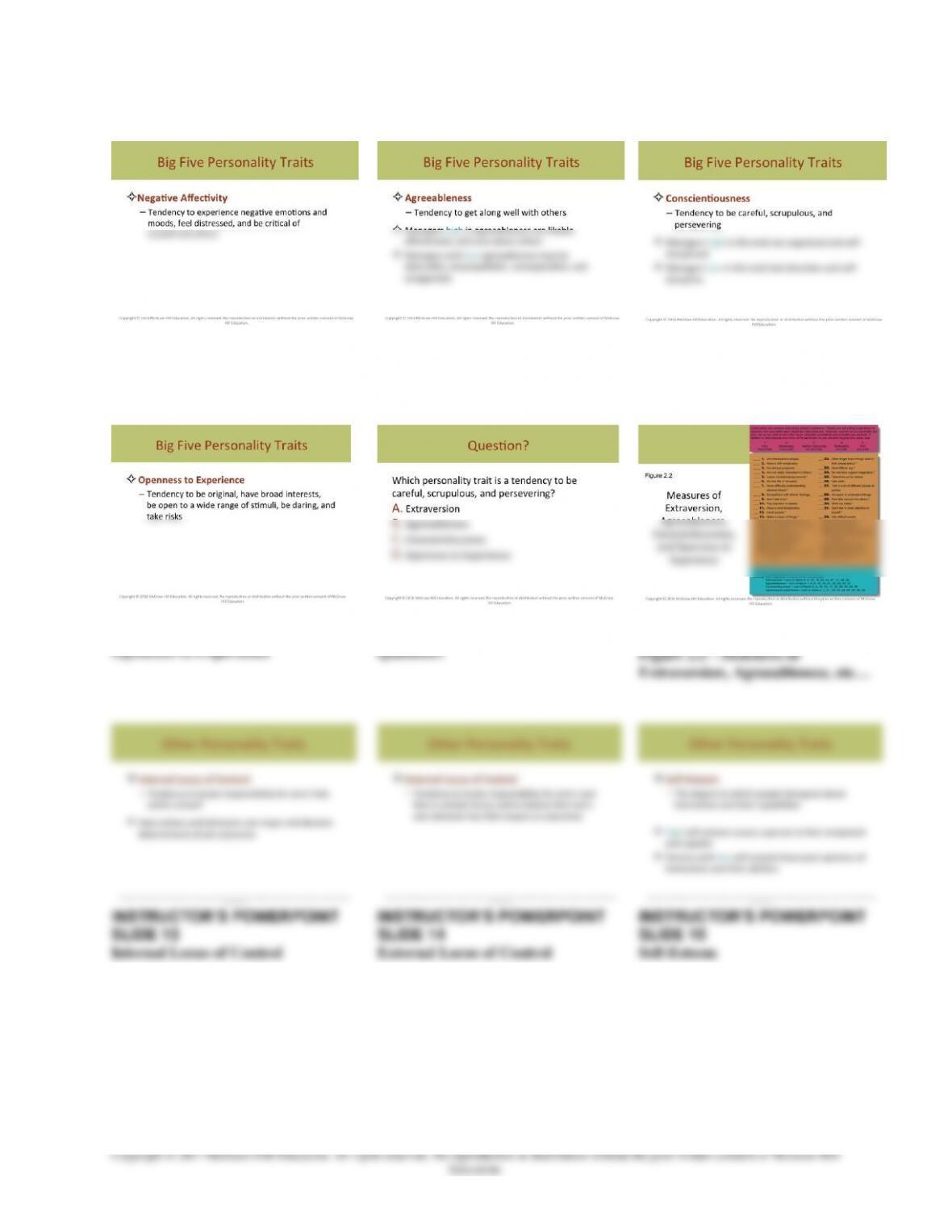
Negative Affectivity
INSTRUCTOR’S POWERPOINT
SLIDE 8
Agreeableness
INSTRUCTOR’S POWERPOINT
SLIDE 9
Conscientiousness
INSTRUCTOR’S POWERPOINT
SLIDE 10
Openness to Experience
INSTRUCTOR’S POWERPOINT
SLIDE 11
Question?
INSTRUCTOR’S POWERPOINT
SLIDE 12
Figure 2.2 – Measures of
Extraversion, Agreeableness, etc…
INSTRUCTOR’S POWERPOINT
SLIDE 13
Internal Locus of Control
INSTRUCTOR’S POWERPOINT
SLIDE 14
External Locus of Control
INSTRUCTOR’S POWERPOINT
SLIDE 15
Self-Esteem
Chapter 02 – Values, Attitudes, Emotions, and Culture: The Manager as a Person
INSTRUCTOR’S POWERPOINT
SLIDE 16
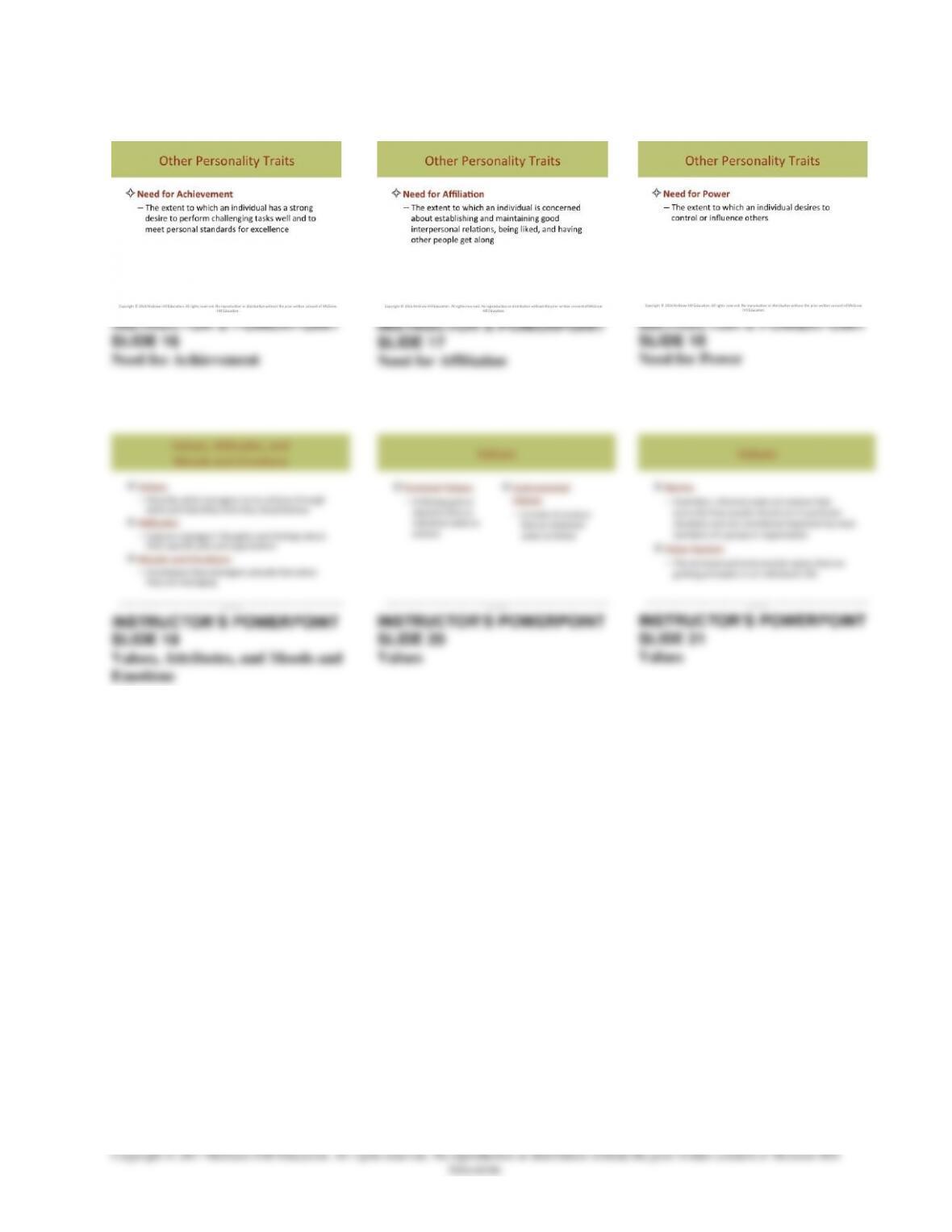
Need for Achievement
INSTRUCTOR’S POWERPOINT
SLIDE 17
Need for Affiliation
INSTRUCTOR’S POWERPOINT
SLIDE 18
Need for Power
INSTRUCTOR’S POWERPOINT
SLIDE 19
Values, Attributes, and Moods and
Emotions
INSTRUCTOR’S POWERPOINT
SLIDE 20
Values
INSTRUCTOR’S POWERPOINT
SLIDE 21
Values
Chapter 02 – Values, Attitudes, Emotions, and Culture: The Manager as a Person
2-25
INSTRUCTOR’S POWERPOINT
SLIDE 22
Terminal and Instrumental Values
INSTRUCTOR’S POWERPOINT
SLIDE 23
Figure 2.3 – Sample Items from
Two Measures of Job Satisfaction
INSTRUCTOR’S POWERPOINT
SLIDE 24
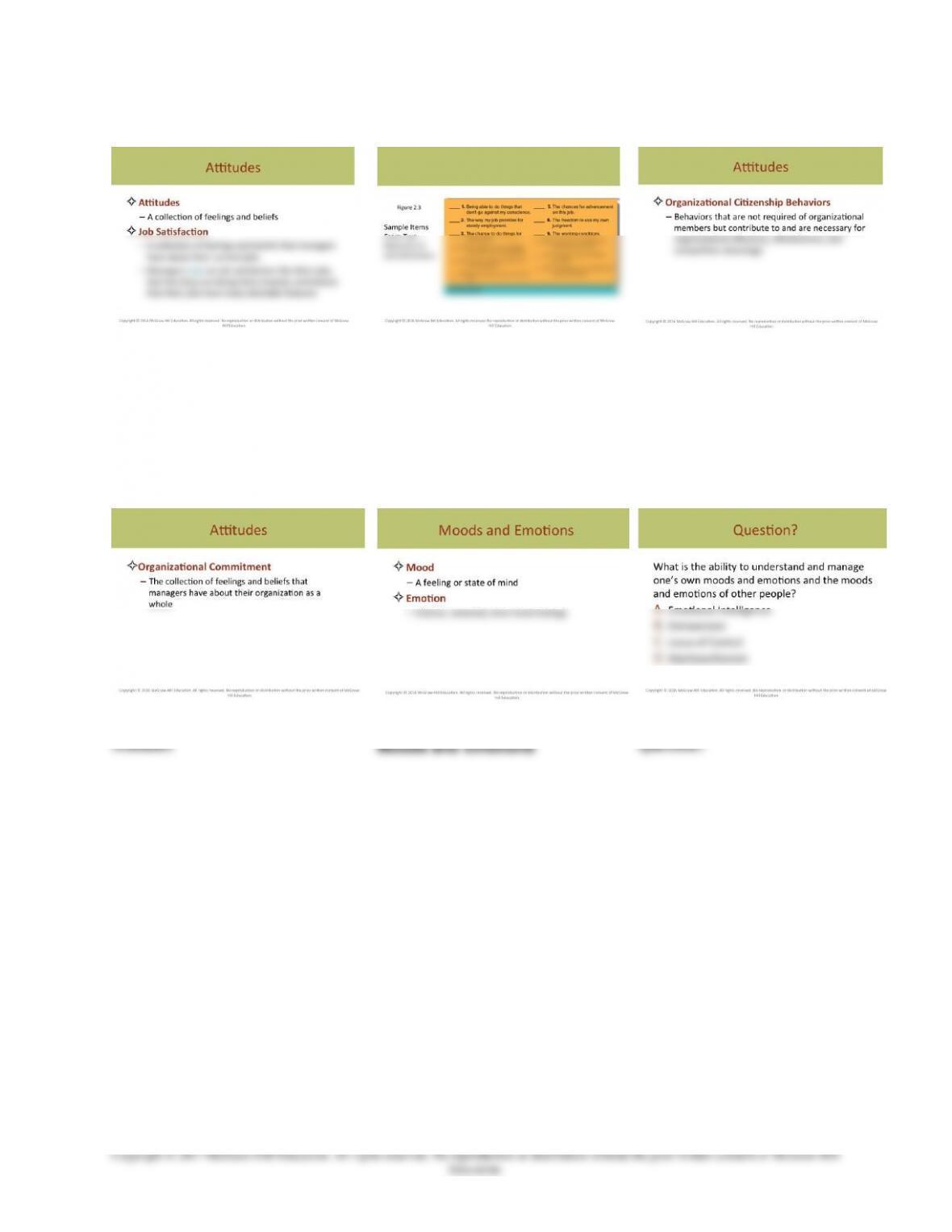
Attitudes
INSTRUCTOR’S POWERPOINT
SLIDE 25
Attitudes
INSTRUCTOR’S POWERPOINT
SLIDE 26
Moods and Emotions
INSTRUCTOR’S POWERPOINT
SLIDE 27
Question?
Chapter 02 – Values, Attitudes, Emotions, and Culture: The Manager as a Person
2-26
INSTRUCTOR’S POWERPOINT
SLIDE 28
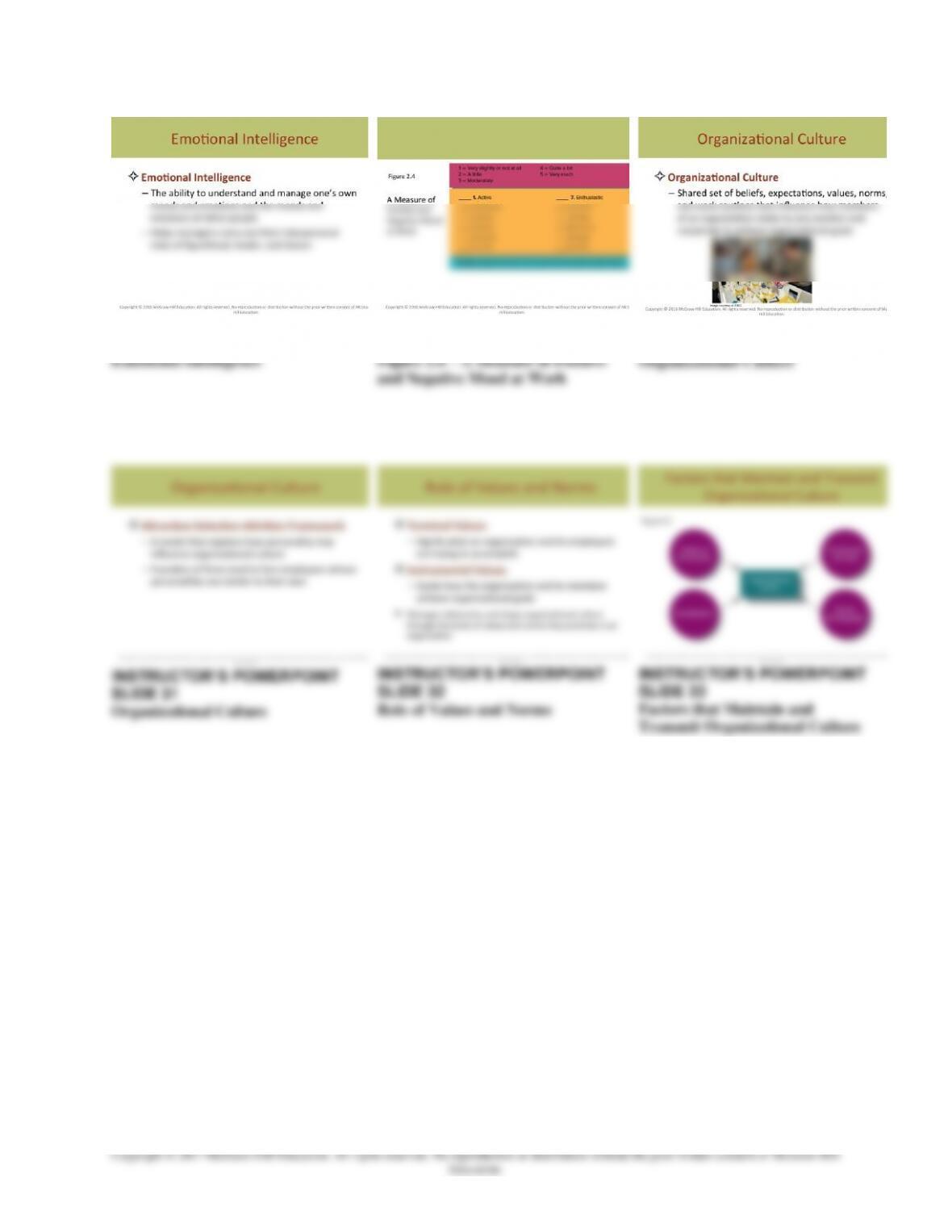
Emotional Intelligence
INSTRUCTOR’S POWERPOINT
SLIDE 29
Figure 2.4 – A Measure of Positive
and Negative Mood at Work
INSTRUCTOR’S POWERPOINT
SLIDE 30
Organizational Culture
INSTRUCTOR’S POWERPOINT
SLIDE 31
Organizational Culture
INSTRUCTOR’S POWERPOINT
SLIDE 32
Role of Values and Norms
INSTRUCTOR’S POWERPOINT
SLIDE 33
Factors that Maintain and
Transmit Organizational Culture
Chapter 02 – Values, Attitudes, Emotions, and Culture: The Manager as a Person
2-27
INSTRUCTOR’S POWERPOINT
SLIDE 34
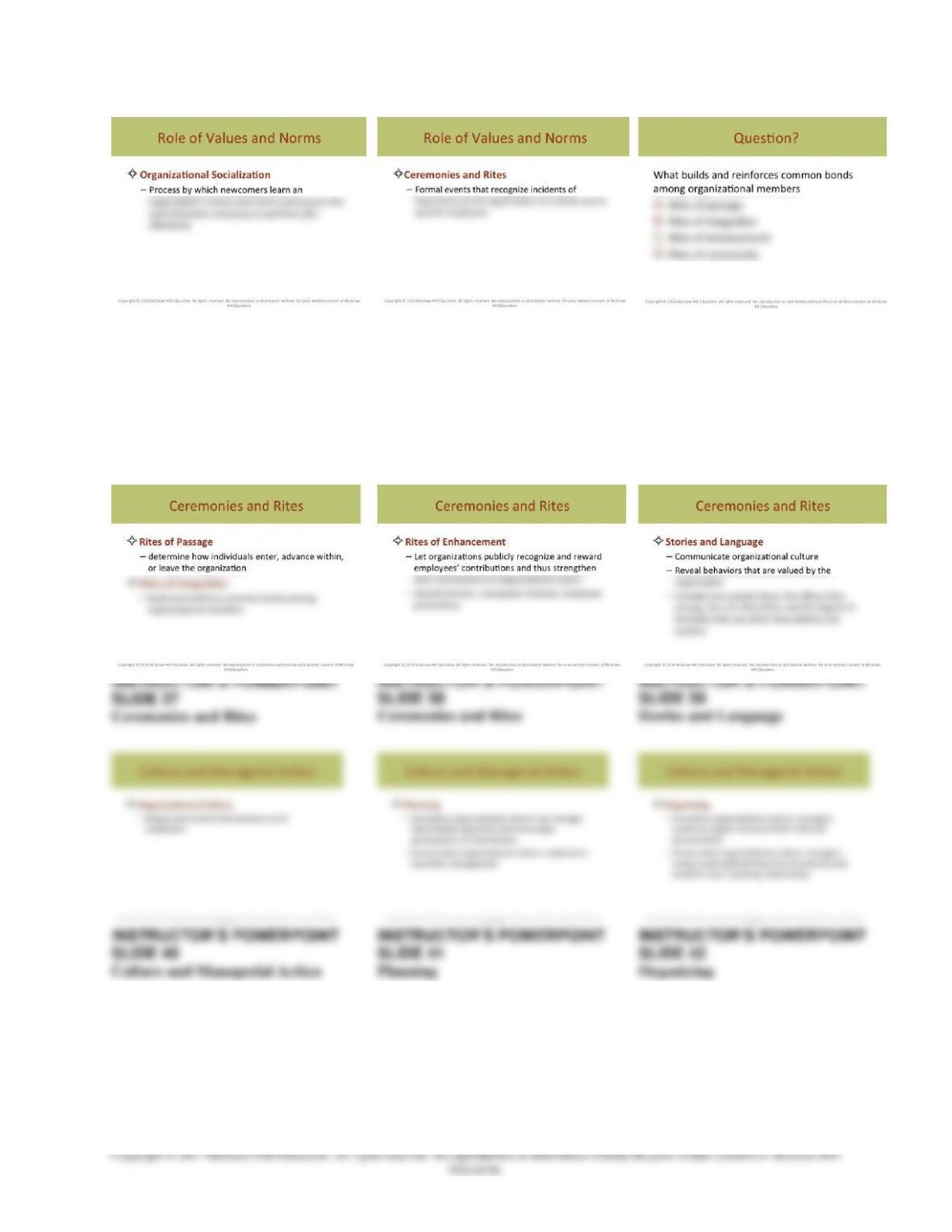
Role of Values and Norms
INSTRUCTOR’S POWERPOINT
SLIDE 35
Role of Values and Norms
INSTRUCTOR’S POWERPOINT
SLIDE 36
Question?
INSTRUCTOR’S POWERPOINT
SLIDE 37
Ceremonies and Rites
INSTRUCTOR’S POWERPOINT
SLIDE 38
Ceremonies and Rites
INSTRUCTOR’S POWERPOINT
SLIDE 39
Stories and Language
INSTRUCTOR’S POWERPOINT
SLIDE 40
Culture and Managerial Action
INSTRUCTOR’S POWERPOINT
SLIDE 41
Planning
INSTRUCTOR’S POWERPOINT
SLIDE 42
Organizing

Chapter 02 – Values, Attitudes, Emotions, and Culture: The Manager as a Person
INSTRUCTOR’S POWERPOINT
SLIDE 43
Leading
INSTRUCTOR’S POWERPOINT
SLIDE 44
Controlling
INSTRUCTOR’S POWERPOINT
SLIDE 45
Organizational Culture
INSTRUCTOR’S POWERPOINT
SLIDE 46
Topics for Discussion
INSTRUCTOR’S POWERPOINT
SLIDE 47
Topics for Discussion
INSTRUCTOR’S POWERPOINT
SLIDE 48
Topics for Discussion
INSTRUCTOR’S POWERPOINT
SLIDE 49
Topics for Discussion