
2-1
Management Information Systems, 13E, Global Edition
Laudon & Laudon
Lecture Files by Barbara J. Ellestad
Chapter 2 Global E-Business and Collaboration
What would happen if you walked into work one day and the management told the
employees they could do anything, anything at all, that they wanted to do that day. If
Jimmy from production decided he wanted to work in sales and marketing he could. If
Sally, who normally works in accounting, wanted to spend the day in shipping she could
do that too. No one would have to follow any rules or any set procedures. They could
accomplish the work any way they choose.
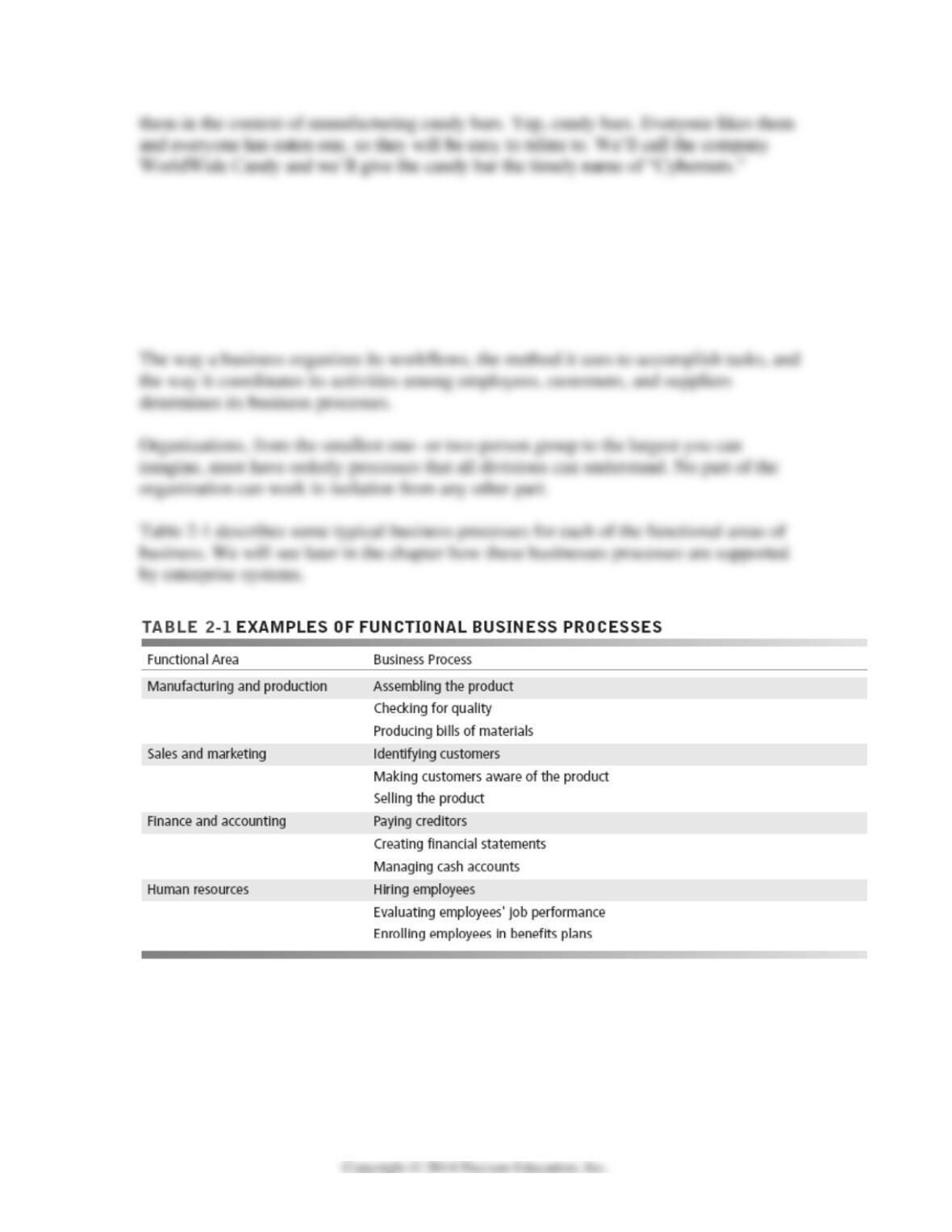
2.1 Business Processes and Information Systems
As we discussed in Chapter 1, the “digital firm” means more than just plunking down
computers that have all the latest bells and whistles on every desk. The digital firm must
connect each functional area and each management level to one another. Data input to the
system in manufacturing must be made available to sales, accounting, and shipping.
2-2
Business Processes
You can imagine from the above scenario how quickly chaos would reign in the
organization without established business processes that integrate functions throughout
an organization. Processes that deliver the best product for the lowest cost in the most
efficient manner are imperative to success.
How Information Technology Improves Business Processes
Some processes that may have contributed to an organization’s success have now
outgrown their usefulness. Information systems can help an organization recognize
processes that may need to be changed. An information system could be used to automate

2-3
Information systems enhance business processes in two ways:
• Increasing the efficiency of existing processes by automating them.
• Enabling entirely new processes that are capable of transforming the business by
changing the flow of information.
Bottom Line: Business processes help an organization organize, coordinate, and
focus its workflow to produce products or services. The success or failure of a
business may depend on how well its business processes are designed and
coordinated. Information systems can automate many steps in business processes
and even change the flow of information.
2.2 Types of Information Systems
There is no one single information system that will satisfy all of the needs of an
organization. At first glance it can be difficult to comprehend all the different systems in
a business, and even more difficult to understand how they relate to one another.
Systems for Different Management Groups
You’ll see at the end of this discussion the integral role each type of system plays—from
determining which kind of candy bar to make (strategic level systems); to how many
Transaction Processing Systems
The operational level of an organization includes various units such as the order

2-4
People using transaction processing systems usually need information to help them
answer routine questions such as: “How many Cybernuts candy bars did we produce
yesterday?” or “How much sugar do we have on hand for today’s production run?”
Although there’s more to making the Cybernuts bar than just running the assembly line, a
TPS will record the sales and marketing transactions as well. The system will record not
just the number of dollars used in the marketing program, but also how many stores are
actually stocking the candy bar and where the product is located inside the stores.
Interactive Session: Technology: Schiphol International Hub (page 78 of the
textbook) discusses the improvements that Schiphol International Airport made to
their baggage handling systems, and how much money and time they saved by
improving their information systems that move baggage throughout a passenger’s
flight.

2-5
Bottom Line: The transaction processing system records the data from everyday
operations throughout every division or department in the organization. Each
division/department is tied together through the TPS to provide useful information
to management levels throughout the company.
Systems for Business Intelligence
Think about the functions of managers that you may have learned about in other classes:
directing, controlling, communicating, planning, and decision making. Each manager
Management information systems (MIS) are designed to produce information on a
periodic basis instead of on a daily recurring basis like those using a transaction
processing system. Managers also require information on an exception basis. That is, they
need to know if production is higher or lower than the targeted rate or if they are over or
under their budgets. They also need to know about trends instead of straight numbers.
The questions they may ask of the system would be: “How far behind in production are
we for this quarter?” or “How many more workers would we need if we increased
production by 10,000 candy bars per quarter?” or “If we do adopt the new Cybernuts
recipe, what positions are open for the 25 excess workers and what skills do they possess
that the company can use elsewhere?”

2-6
Bottom Line: A management information system is used by managers throughout
the organization to help them in directing, planning, coordinating, communicating,
and decision making. The MIS will help answer structured questions on a periodic
basis.
Decision-support systems (DSS) also serve the management level of an organization,
but in a somewhat different way from an MIS. An MIS uses internal data to supply useful
information. A DSS uses internal data but also combines it with external data to help
You’ll notice we describe decisions at this level as semistructured. Not all decisions
required for an organization to function smoothly are cut-and-dried. There are a lot of
gray areas in successfully managing an organization and the larger the company, the
more diverse the decision-making process becomes.
As a company is affected not only by what goes on solely within the company, but also
by external forces not under its control, decision-support systems can help upper-level
management. What happens to the pricing structure and availability of the raw materials
Bottom line: Decision-support systems are used for complex “what–if” questions
that require internal and external data. Decisions at this management level are
mostly semistructured so the information system must respond to the unique
requirements of the executives.

2-7
Executive support systems (ESS) are used at the very upper echelons of management.
At the strategic level, the typical decision is very unstructured. Often there is no specific
question, but rather a series of undefined situations executives may face. There are no
easy, definable answers. These executives require summarized, historical information
gleaned from all other levels of the organization, coupled with large amounts of external
data gathered from many sources.
Senior executives often access information through the use of a portal. Basically, a portal
is a Web interface designed to present integrated personalized business content from a
variety of sources.
Interactive Session: Management: Piloting Procter & Gamble from Decision
Cockpits (see page 84 of the text) describes how one of the largest consumer goods
companies in the world is using information technology to focus on immediate
business decisions using the most accurate data available at precisely the moment
it’s needed.
Bottom Line: An executive support system helps managers make strategic decisions
affecting the entire company. The decisions use internal and external data to give
executives the information they need to determine the proper course of action in
unstructured situations.
Systems for Linking the Enterprise
It’s not unusual to find an organization with three or more different information systems

2-8
Enterprise Applications
No business can afford disjointed information systems that don’t work together to
produce a coherent picture of the entire organization. All the functions of a business must
The following sections are an overview of four major enterprise applications: enterprise,
supply chain management, customer relationship management, and knowledge
management systems. We’ll also study each of these systems in depth in future chapters.
Enterprise systems (also known as enterprise resource planning (ERP) systems) are
used to bridge the communication gap between all departments and all users of
information within a company. If the WorldWide Candy Company production
department enters information about its processes, the data are available to accounting,
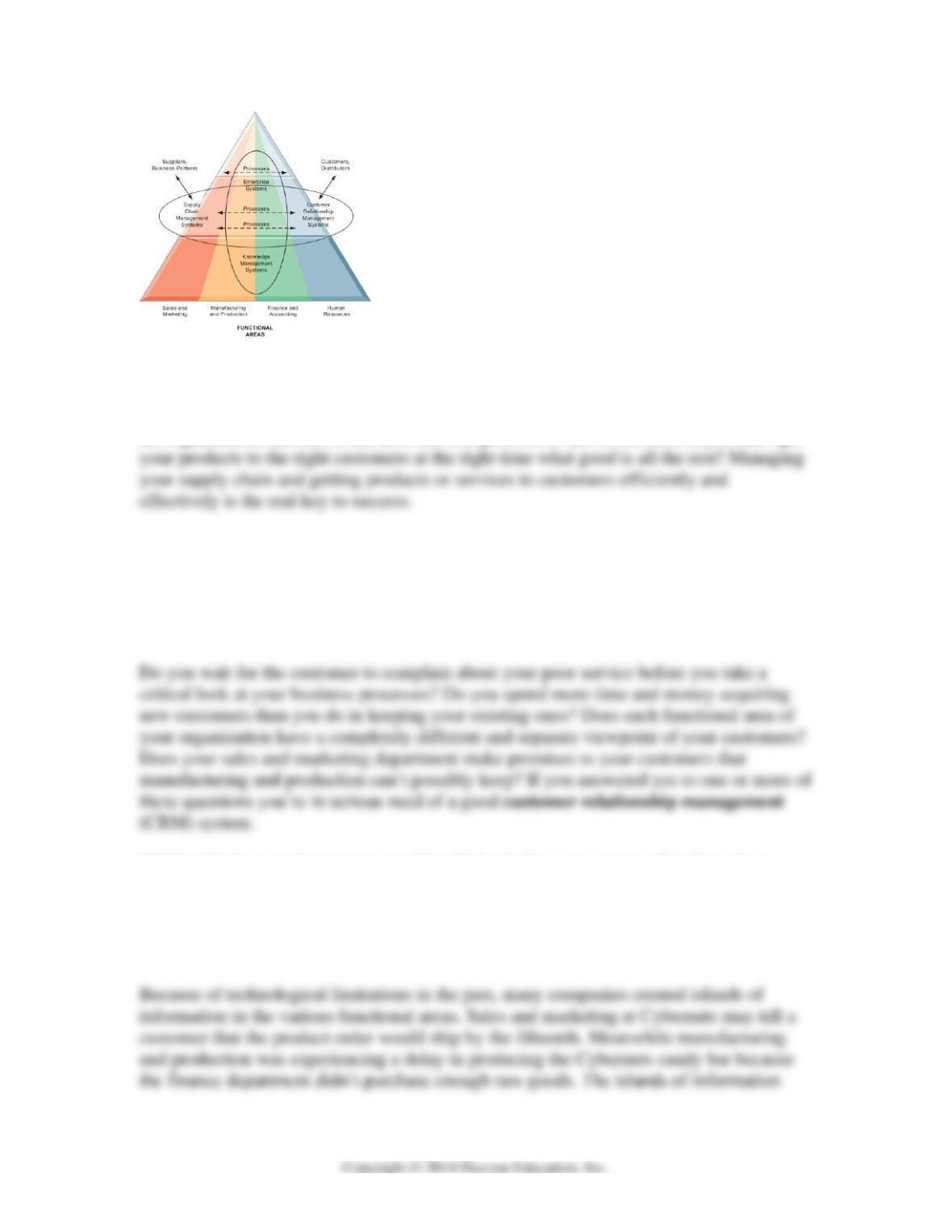
2-9
Figure 2.6: Enterprise Application Architecture
Even if you properly manage your processes, wring out excess costs from every corner of
the organization, and above all, have the best products at the lowest cost, if you can’t get
Supply chain management systems offer new opportunities for companies to integrate
data and information with their suppliers and customers and ultimately, lower costs for
everyone. When WorldWide Candy installed their supply chain management system, a
form of interorganizational systems, they created a cohesive network for buying raw
materials, creating the candy bars, and getting the packaged goods to retail outlets.
CRM technology isn’t just a nice looking Web site for customers to click through or
more reports dumped on managers’ desks that they don’t have time to review. CRM
systems involve business processes in all the functional areas and every management
level of a firm. The ideal CRM system provides end-to-end customer care from receipt of
order through product delivery.

2-10
prevented each functional area from knowing the situations in other areas. CRM systems
help solve some of these disjointed snafus.
Knowledge workers are those who promote the creation of new knowledge and integrate
it into the organization. Research scientists may discover new methods of mixing sugar
and cocoa beans and dairy products to make a better chocolate. Maybe a team of
engineers will develop a new method of packaging the Cybernuts bar to make it easier to
open. The legal knowledge workers may spend their time determining the copyright
protections that could be afforded to the Cybernuts product name.
Intranets and Extranets
Enterprise applications are often costly to implement. Companies that don’t have the
E-Business, E-Commerce, and E-Government
The Internet, extranets, and intranets offer new opportunities to do business in
cyberspace. The amount of electronic commerce and electronic business conducted

2-11
The electronic delivery of government services via the Internet has been fairly successful.
Citizens have easy access to forms necessary in many e-government programs such as
tax payments. Rather than waste time standing in line for vehicle registration and
licenses, people can complete these kinds of tasks on the Internet. Perhaps most
importantly, e-government has opened the lines of communications between citizens and
elected officials and made information access easier and timelier.
Bottom Line: Integrating functions and business processes cut costs and allow
systems development that involves the whole firm or industry. Customer resource
management and supply chain management give a company the added advantages
of end-to-end customer care. Enterprise systems have many challenges but the
benefits, when executed properly, are enormous. Knowledge management systems
allow an organization to fully integrate their newly acquired knowledge into the
current systems.
2.3 Systems for Collaboration and Social Business
Globalization now allows companies to work around the clock, around the world. It’s not
What Is Collaboration?
Let’s first determine exactly what the term collaboration means to businesses and to you:
• Working with others to achieve shared and explicit goals

2-12
Collaboration and teamwork are central to the success of many businesses. Here are six
reasons why businesses promote collaboration and teamwork:
• Changing nature of work—traditionally work was organized into silos. Now,
What Is Social Business?
Collaboration among employees, suppliers, and customers is becoming an important tool
in increasing a company’s competitive advantage. Social networking platforms like
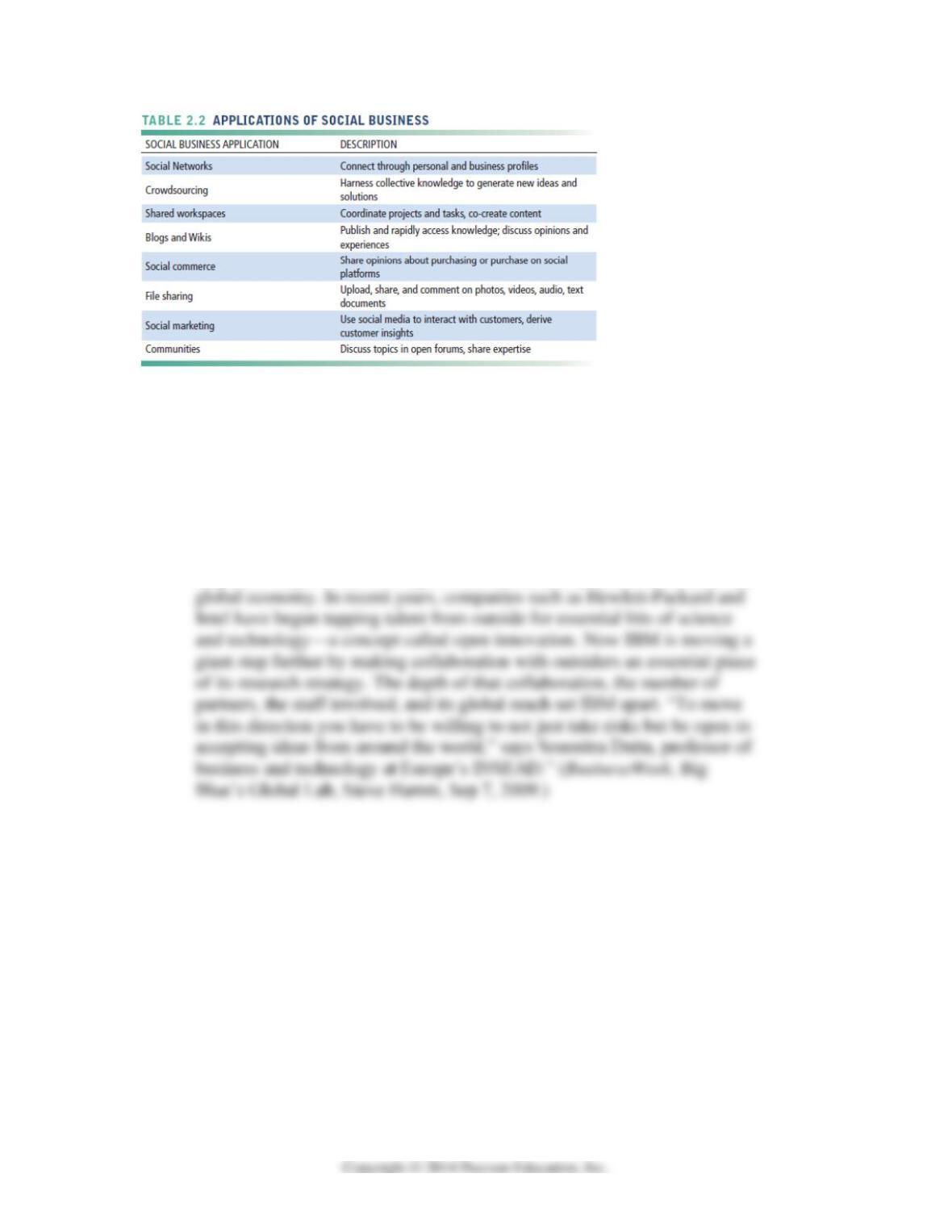
2-13
Business Benefits of Collaboration and Social Business
Many major corporations are embracing collaboration and teamwork not just within their
own company, but with people outside the organizations.
“IBM is prowling the world to set up what it calls ‘collaboratories’ which
match up its researchers with experts from governments, universities, and
companies. IBM is trying to convince countries and companies that it can
help them improve their ability to innovate at an important moment for the
Table 2-3 emphasizes the benefits of collaboration and social business: increased
productivity, increased quality of work, more and better innovation, improved customer
service, and increased profitability, sales, and sales growth. Figure 2-7 highlights the
necessity of having the appropriate organizations structure and culture, along with the
right technology.
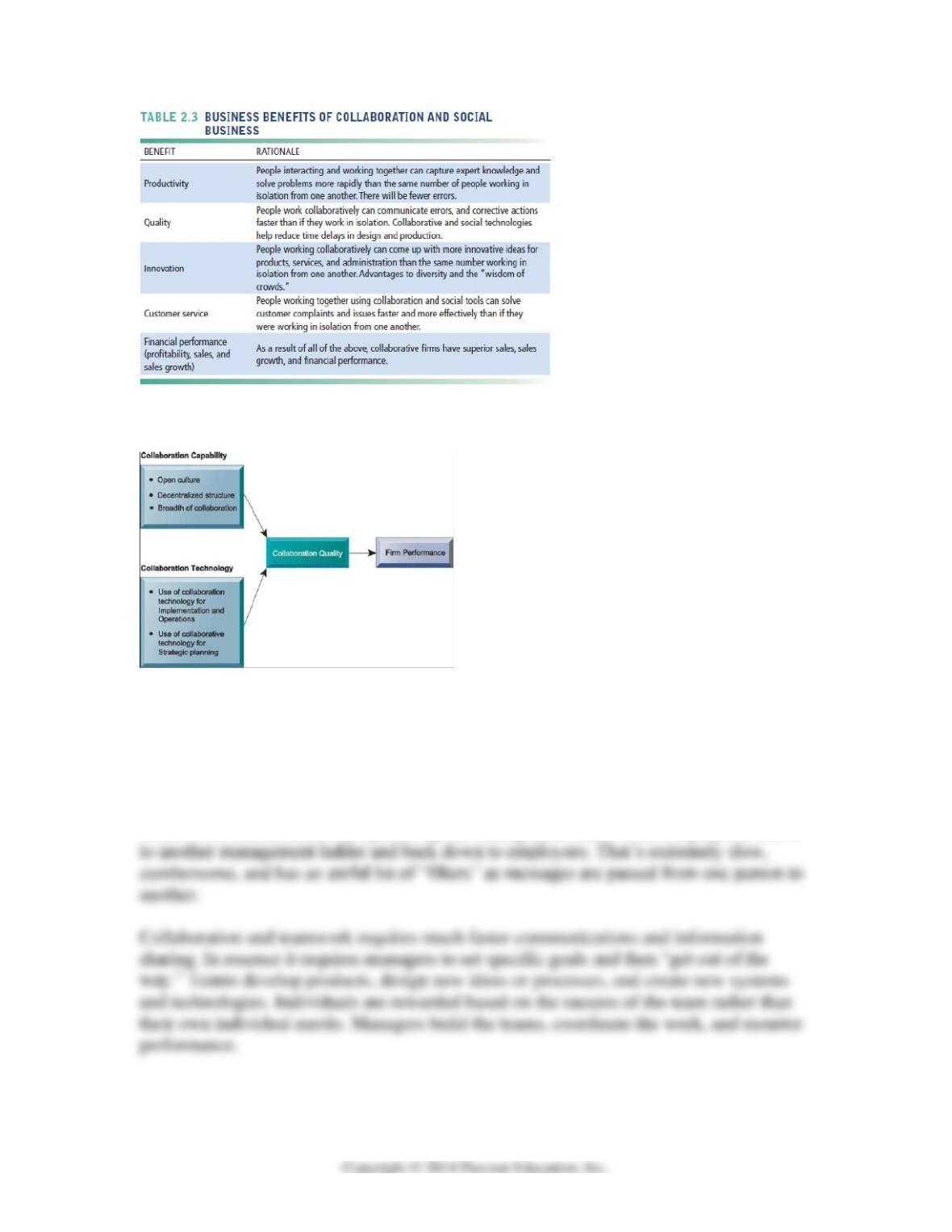
2-14
Figure 2-7 Requirements for Collaboration
Building a Collaborative Culture and Business Processes
Trying to mesh a typical hierarchical management structure with a true collaborative
environment simply won’t hack it for one major reason. In a hierarchical organization
structure, communications are passed up the management ladder from employees, across

2-15
Tools and Technologies for Collaboration and Social Business
Many new systems for interacting with other employees, managers, vendors, and
customers have been developed. You probably use some of them without realizing how
essential they’ve become in creating an environment that supports a collaborative culture.
• E-mail and instant messaging: billions of messages flow everyday between
employees, managers, suppliers, and customers.
Even though social networking sites first began as a way to share information, photos,
and messages with friends and family members, businesses soon realized how valuable
these technologies were as a business tool. When you think about it, it makes sense to go
where your customers are. If they aren’t watching traditional television that much
anymore, why spend your marketing dollars in an area where you stand to gain very little
benefit?
• Wikis: gaining in popularity as a way to share knowledge and ideas among
collaborators. They are much easier to use and manage than more sophisticated
Collaboration and Social business Platforms: Let’s assume you are part of a team
working on a new candy product for WorldWide Candy Corporation. You work in
Atlanta, Georgia, while your teammates work in New York City, Seattle, and Dallas.

2-16
Virtual Meeting Systems: With a virtual meeting system you can hold strategy sessions
Google Apps and Google sites: While your WorldWide Candy team is collaborating on
the new candy bar, you’ll find it necessary to share word documents, spreadsheets,
Microsoft SharePoint: WorldWide Candy already uses Microsoft servers and
networking products, along with the Microsoft Office suite of Word, Excel, Outlook, and
PowerPoint. Your team can use all of these as a base for collaboration by developing a
Lotus Notes: A third Internet-based collaboration environment your team could use is
IBM’s Lotus Notes. It provides all the basic collaboration tools as Google Apps/Google
Sites and SharePoint do but with a few added features. It has social networking
Enterprise Social Networking Tools: These tools, like Jive and Yammer, help connect
an organization’s members through profiles, updates, and notifications but are restricted
to internal corporate uses. Some include user profiles, communities, email, instant
messaging, Web meetings, calendars, personal dashboards, and file-sharing.
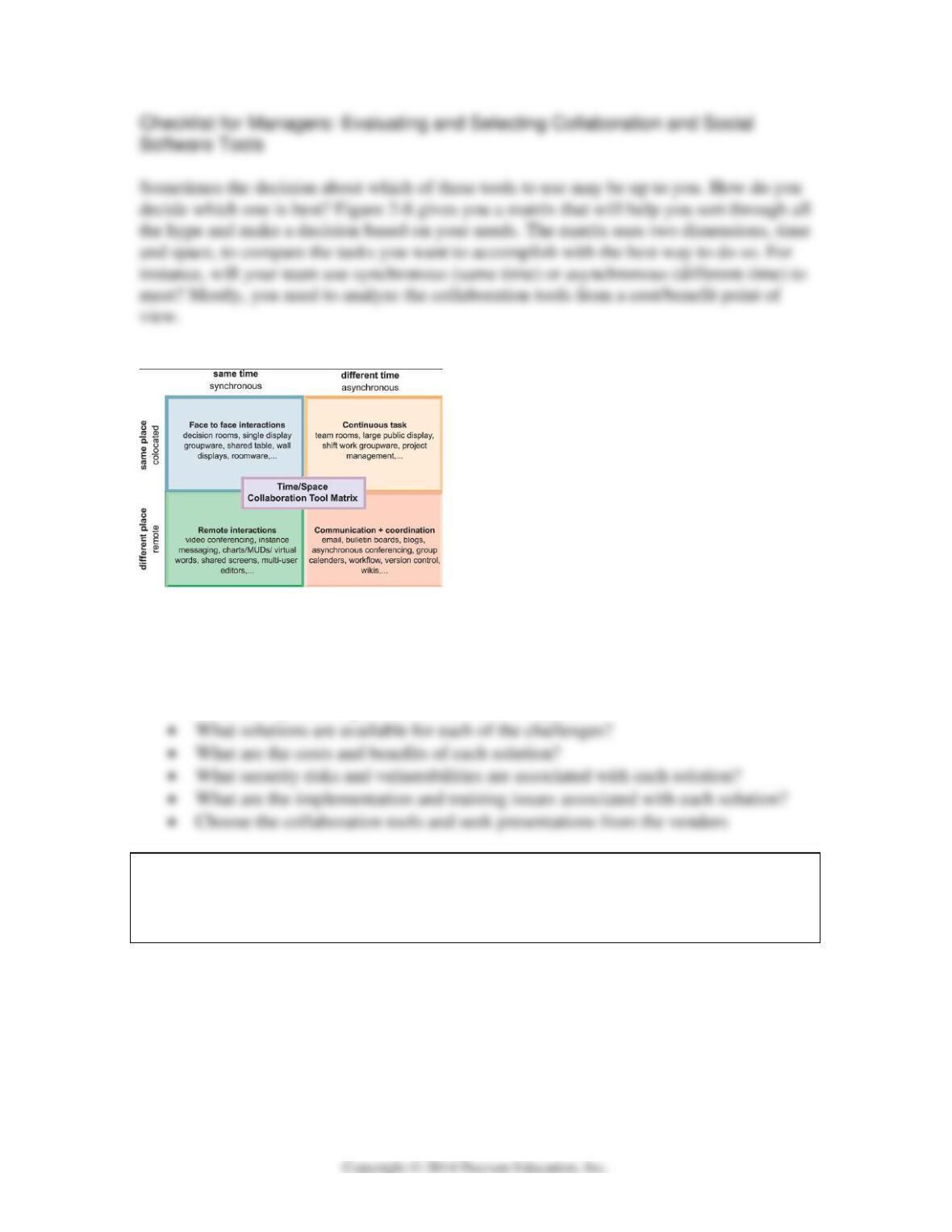
2-17
Figure 2-8 The Time/Space Collaboration Tool Matrix
You can also use these six steps to help you select the best product for the task at hand:
• What are my challenges in terms of time and space?
Bottom Line: Collaboration and teamwork is the name of the game in today’s
corporate world. There are many different tools and technologies that help enable
collaboration. The firm must have a collaborative culture that encourages
employees to work together as a team to ensure success.
2.4 The Information Systems Function in Business
Many people focus on the job losses caused by technological advances and changes. On
the other hand, many new jobs have been created because of technology. Information

2-18
The Information Systems Department
Programmers have taken on more important positions within organizations. They must
understand not only the technical side of computing, but they must also know business
processes so they can adapt the technology to the needs of their company. Systems
Chief Privacy Officer protects an organization’s data from misuse and abuse and makes
sure the company complies with data privacy laws. Another new position that of Chief
Knowledge Officer, has been created in larger corporations to deal with effectively using
knowledge management systems.
Organizing the Information Systems Function
Deciding how to organize the Information Systems function within a business is not as
easy as deciding how to organize other functional areas. After all, sales and marketing
Larger companies and organizations develop an IT governance that helps decide the best
way to organize the IT department for the benefit of all. Some of the issues to be decided
upon are:
• Strategy and policies for using IT

2-19
Bottom Line: The IS department is an integral part of any successful business.
Discussion Questions:
1. How can a transaction processing system help an organization’s management
information system and decision-support system?
2. Which of the four major types of information systems do you think is the most
valuable to an organization?
Answers to Discussion Questions:
1. A transaction processing system gathers data about the day-to-day operations of the
2. Opinions will vary about which type of information system is the most valuable.
Answers should include information about why the student thinks the one they have
3. Benefits of an enterprise system include a consolidated view of the organization,
unified platforms, more efficient operations, and customer-driven business processes.

2-20
4. Business firms, especially large firms, had in the past a reputation for being
“command and control” organizations where the top leaders thought up all the really
important matters, and then ordered lower level employees to execute senior
5. The tools and technologies for collaboration and social business include email, social
networking, wikis, and virtual worlds. Social networking sites give corporations
another way for users to share ideas and collaborate with each other. Businesses can