
Chapter 02 – Management Theory: Essential Background for the Successful Manager
2-1
2
Chapter
Management Theory:
Essential Background for the Successful Manager
Major Questions the Student Should Be Able to Answer 2
Mapping the Class: Chapter Outline 3
Overview of the Chapter 4
Classroom Outline 6
CHAPTER CONTENTS
Chapter 02 – Management Theory: Essential Background for the Successful Manager
2-2
2.1 Evolving Viewpoints: How We Got to Today’s Management
Outlook
MAJOR QUESTION: What’s the payoff in studying different management perspectives,
both yesterday’s and today’s?
2.4 Quantitative Viewpoint: Management Science and Operations
Research
MAJOR QUESTION: If the manager’s job is to solve problems, how might the two
quantitative approaches help?
2.5 Systems Viewpoint
MAJOR QUESTION: How can the exceptional manager be helped by the systems
viewpoint?
MAJOR QUESTIONS THE STUDENT SHOULD BE ABLE TO ANSWER
Chapter 02 – Management Theory: Essential Background for the Successful Manager
2-3
2.1 Evolving Viewpoints: How We Got to Today’s Management
Outlook
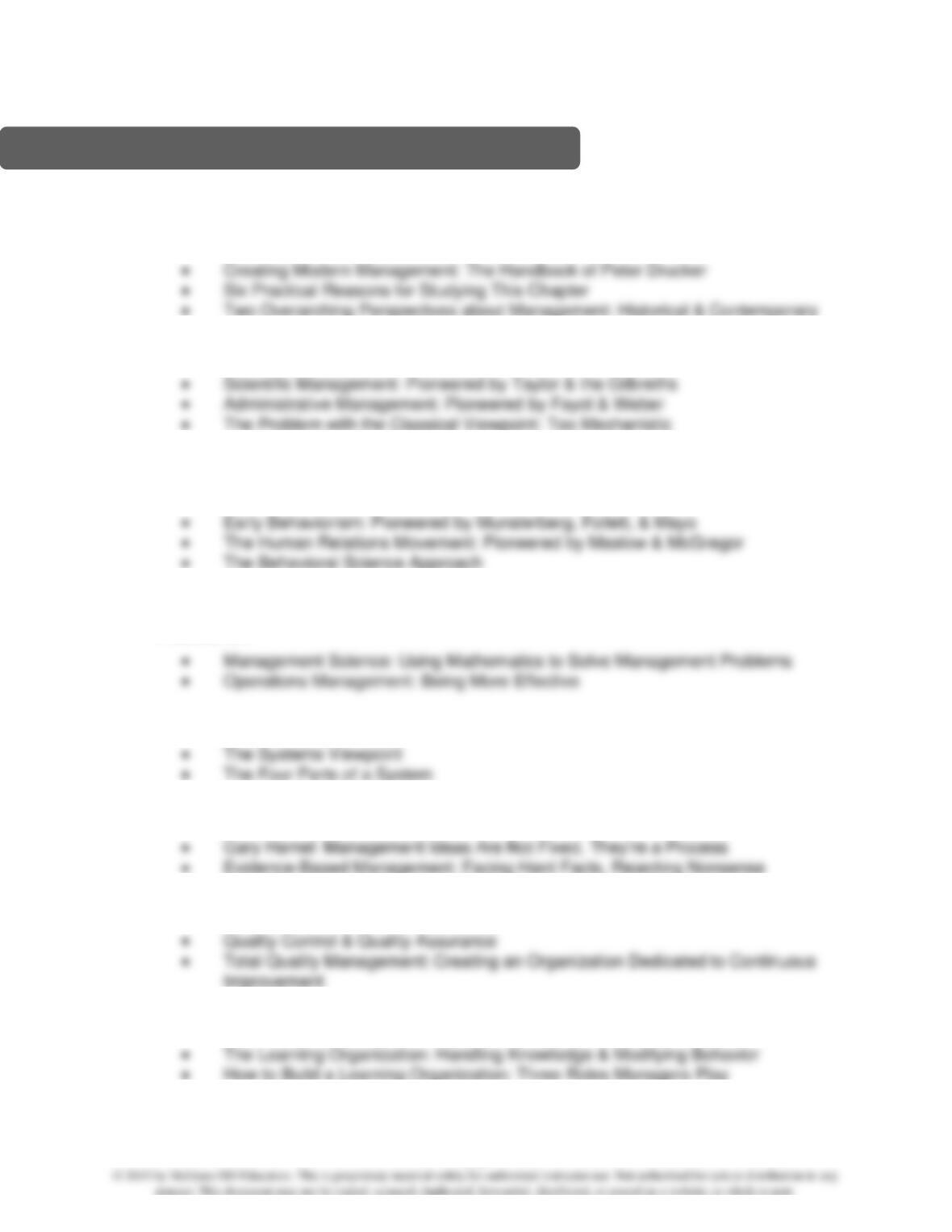
2.2 Classical Viewpoint: Scientific and Administrative Management
2.3 Behavioral Viewpoint: Behaviorism, Human Relations, and
Behavioral Science
2.4 Quantitative Viewpoint: Management Science and Operations
Research
2.5 Systems Viewpoint
2.6 Contingency Viewpoint
2.7 Quality-Management Viewpoint
2.8 The Learning Organization in an Era of Accelerated Change
MAPPING THE CLASS: CHAPTER OUTLINE
Chapter 02 – Management Theory: Essential Background for the Successful Manager
2-4
2.1 Evolving Viewpoints: How We Got to Today’s Management
Outlook
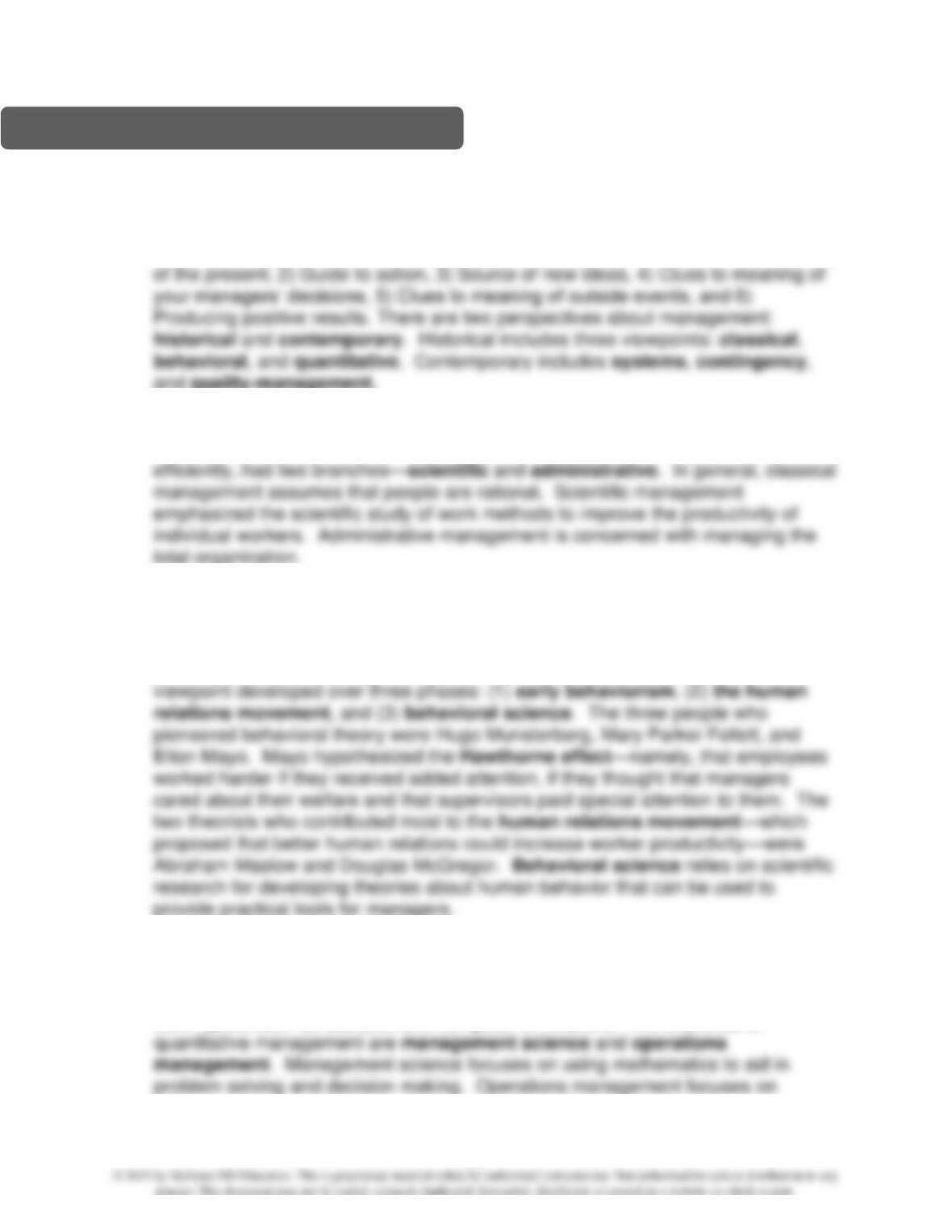
There are six good reasons for studying theoretical perspectives: 1) Understanding
2.2 Classical Viewpoint: Scientific and Administrative Management
The classical viewpoint, which emphasized finding ways to manage work more
2.3 Behavioral Viewpoint: Behaviorism, Human Relations, and
Behavioral Science
The behavioral viewpoint emphasized the importance of understanding human
behavior and of motivating employees toward achievement. The behavioral
2.4 Quantitative Viewpoint: Management Science and Operations
Research
Quantitative management is the application to management of quantitative
techniques, such as statistics and computer simulations. Two branches of
OVERVIEW OF THE CHAPTER
Chapter 02 – Management Theory: Essential Background for the Successful Manager
2-5
2.5 Systems Viewpoint
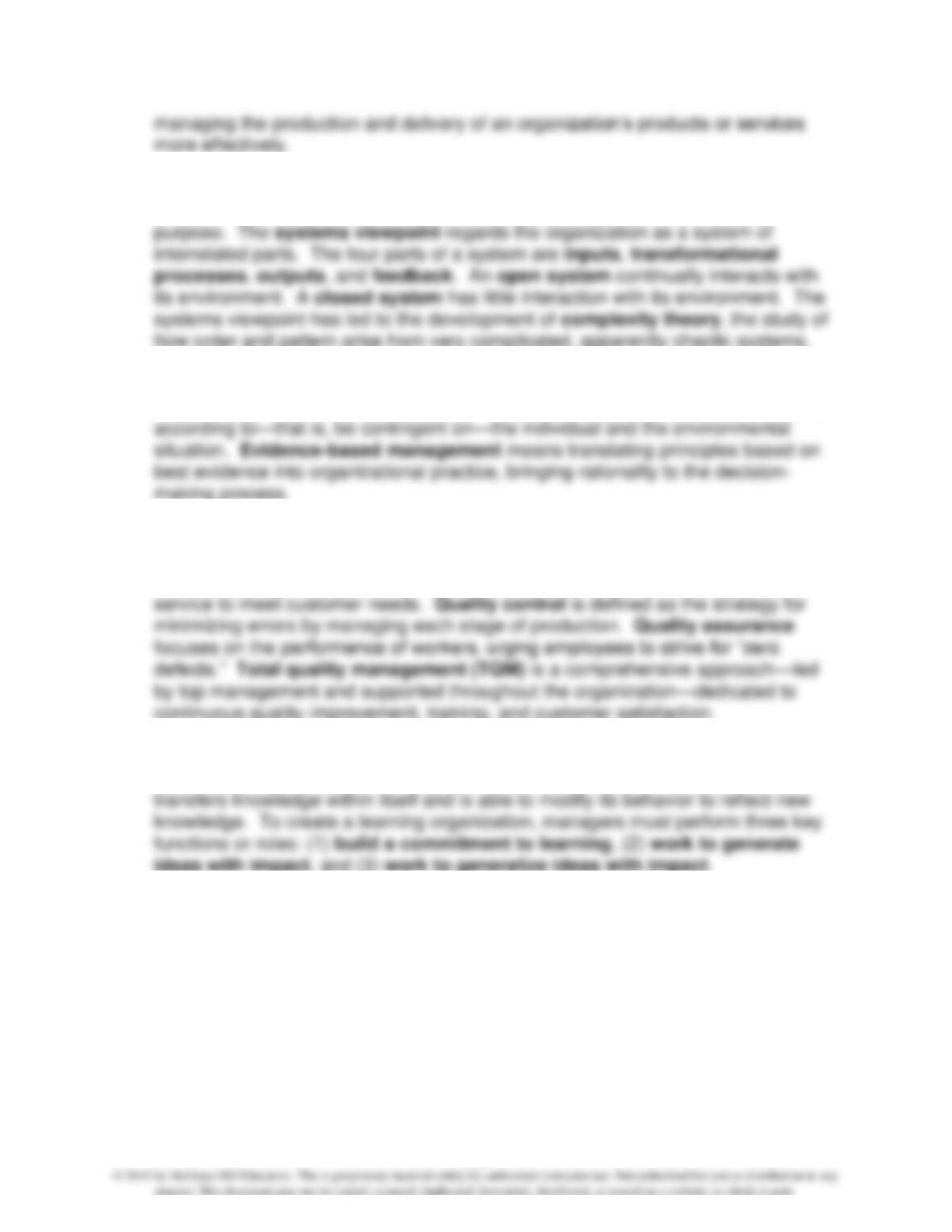
A system is a set of interrelated parts that operate together to achieve a common
2.6 Contingency Viewpoint
The contingency viewpoint emphasizes that a manager’s approach should vary
2.7 Quality-Management Viewpoint
The quality-management viewpoint includes quality control, quality assurance,
and total quality management. Quality refers to the total ability of a product or
2.8 The Learning Organization in an Era of Accelerated Change
A learning organization is an organization that actively creates, acquires, and

Chapter 02 – Management Theory: Essential Background for the Successful Manager
2-6
The Manager’s Toolbox: Mind-sets: How Do You Go about Learning?
Possible Topics for Discussion:
• Which type of mind-set are you? What can a person begin to do to move from a
fixed mind-set to a growth mind-set?
Section 2.1describes two principal theoretical perspectives—the historical and the
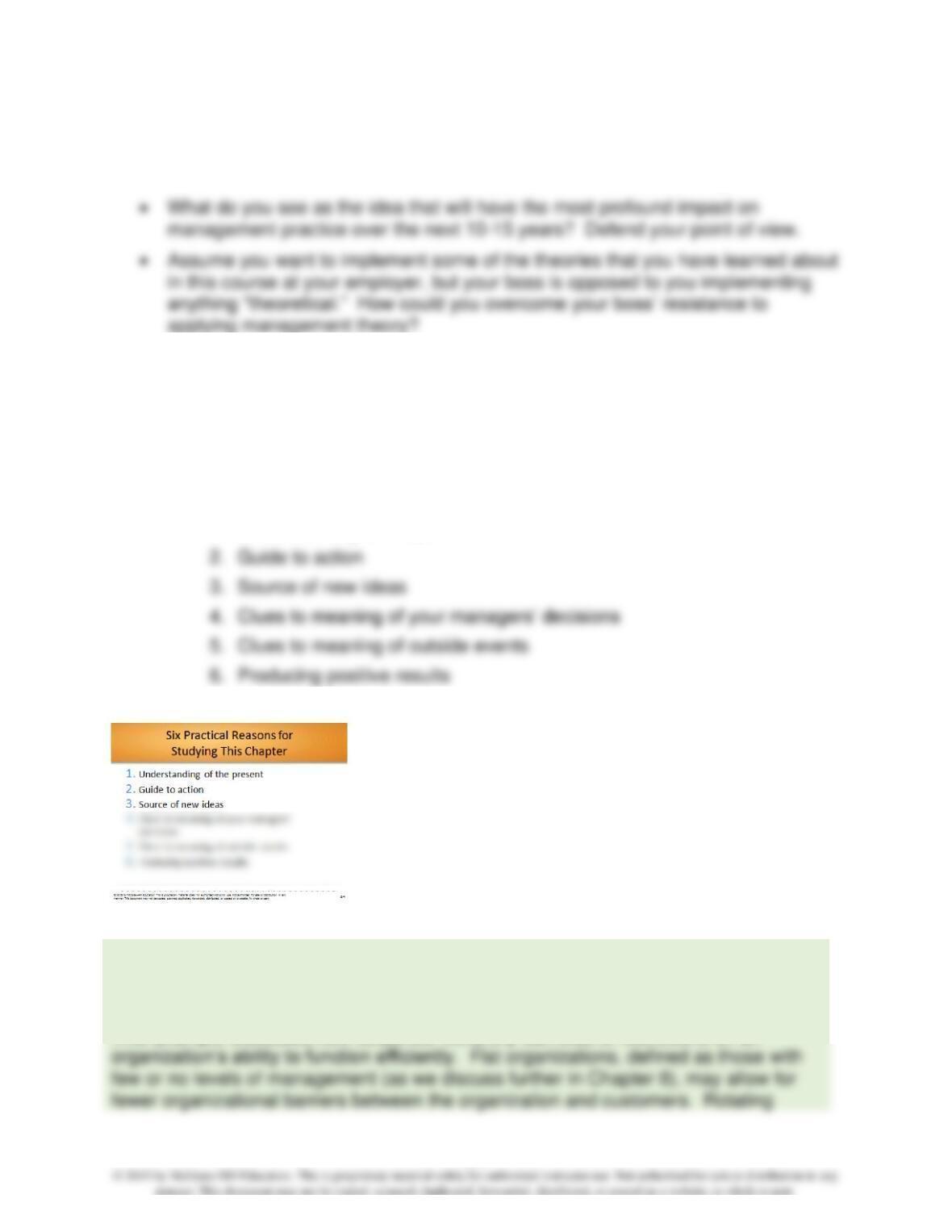
contemporary. There are six reasons for studying theoretical perspectives: 1)
understanding of the present, 2) guide to action, 3) source of new ideas, 4) clues to
CLASSROOM OUTLINE
2.1 Evolving Viewpoints: How We Got to Today’s
Management Outlook (pp. 42-44)
What’s the payoff in studying different management perspectives, both
yesterday’s and today’s?
Chapter 02 – Management Theory: Essential Background for the Successful Manager
2-7
Possible Topics for Discussion:
• There is an old adage that “Those who fail to learn from history are doomed to
repeat it.” How can that sentiment be applied to the study of management?
Major Idea Outline:
1) Evolving Viewpoints: How We Got to Today’s Management Outlook
A. Managers will benefit from learning management theory, including historical
and contemporary theories.
B. Peter Drucker was the creator and inventor of modern management.
C. Six Practical Reasons for Studying This Chapter
1. Understanding of the present
Interactive Classroom Material:
EXAMPLE: Pages from a Game Company’s Employee Guide in Flatness Lies
Greatness: (p. 43)
This Example discusses how corporate hierarchy can lead to restrictions on an
Chapter 02 – Management Theory: Essential Background for the Successful Manager
2-8
leaders, who change based on each project, may also assist in “flattening” the
organization.
YOUR CALL
Why do you think, then, that many organizations resist using flat structures?
Do you think studying management theory could help you answer this
question?
Many organizations may resist using flat organizations because of the need to
have multiple layers of oversight and control over daily activities. There is a belief
Additional Activities:
One way to build on this Example is to have the students read Valve’s “Handbook for
D. Two Overarching Perspectives about Management
1. The historical perspective includes three viewpoints – classical,
behavioral, and quantitative.
Chapter 02 – Management Theory: Essential Background for the Successful Manager
2-9
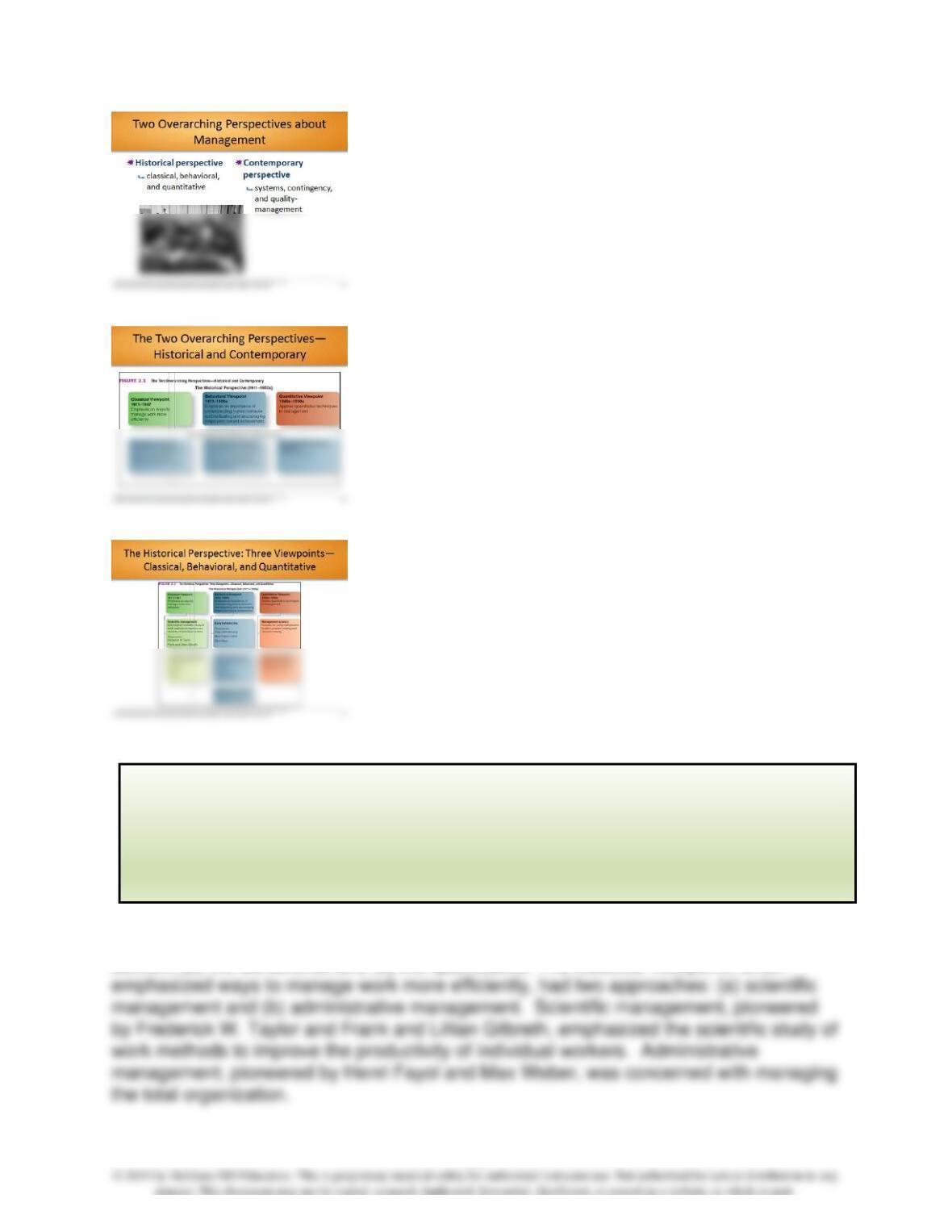
The three historical management viewpoints include (1) the classical, described in this
section; (2) the behavioral; and (3) the quantitative. The classical viewpoint, which
2.2 Classical Viewpoint: Scientific & Administrative
Management (pp. 45-48)
If the name of the game is to manage work more efficiently, what can the
classical viewpoint teach me?
Chapter 02 – Management Theory: Essential Background for the Successful Manager
Possible Topics for Discussion:
• Do you believe that simply paying workers more money is an effective way to
overcome the limitations of jobs developed based on the principles of scientific
management? Defend your point of view.
Major Idea Outline:
A. An early classical pioneer, Frank Gilbreth, coined the term “therblig,” physical
motions you perform from time to time.
1. By identifying the therbligs in a job, Frank and Lillian Gilbreth were able to
eliminate motions while reducing fatigue.
B. Scientific Management: Pioneered by Taylor and the Gilbreths
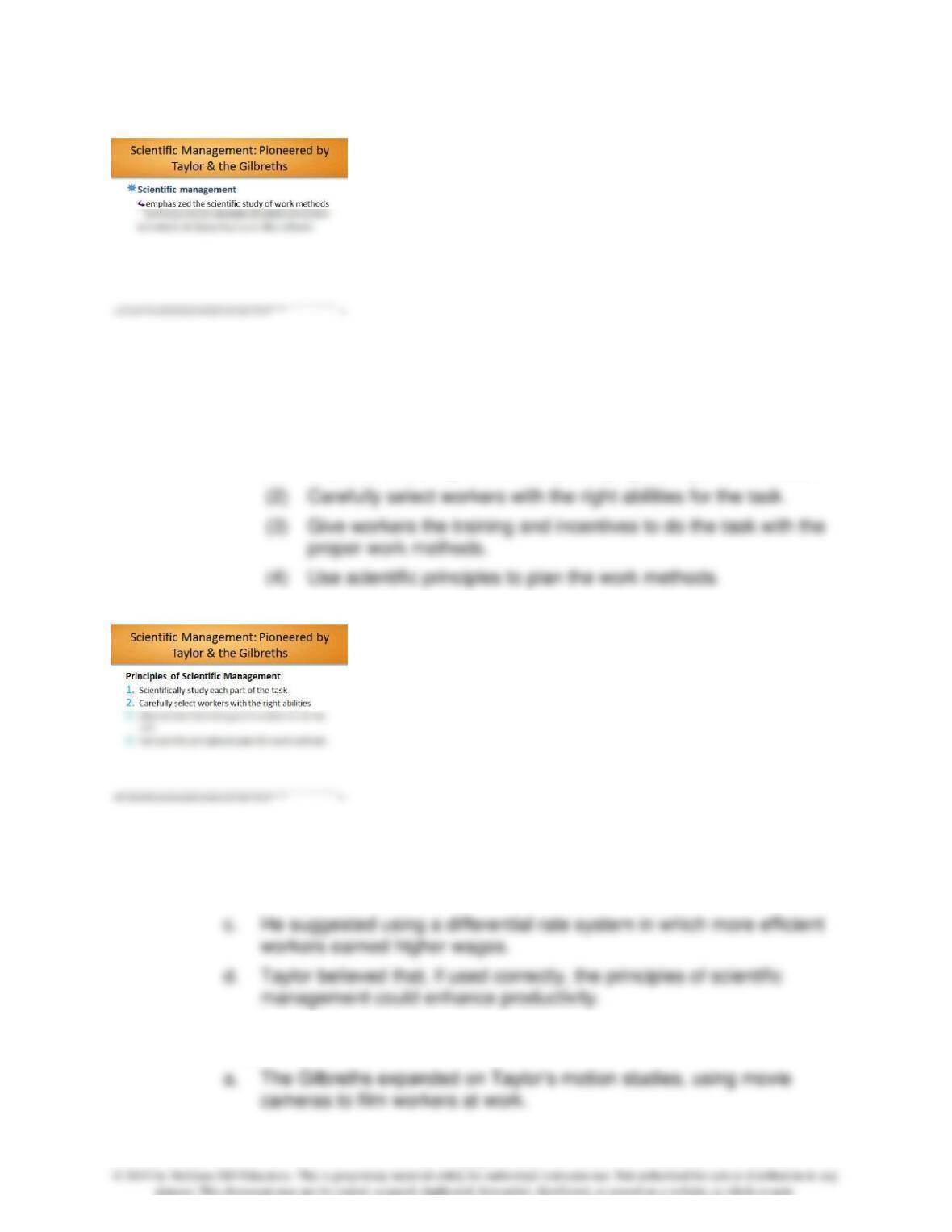
1. Scientific management emphasized the scientific study of work methods
in order to improve the productivity of individual workers.
Chapter 02 – Management Theory: Essential Background for the Successful Manager
2-11
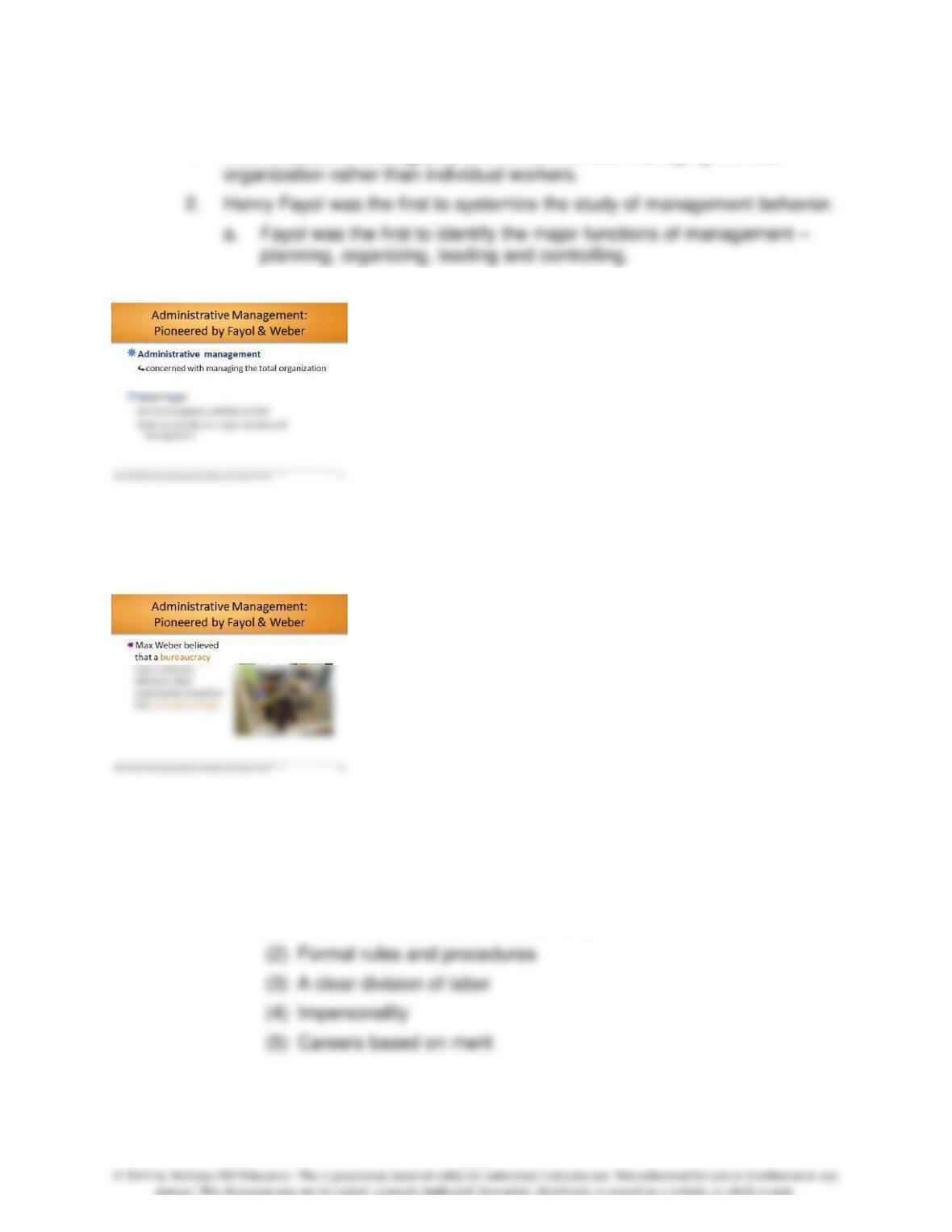
2. Frederick Taylor and the four principles of scientific management.
a. Taylor believed that managers could eliminate soldiering, deliberately
working at less than full capacity, by applying four principles of
science.
(1) Evaluate a task by scientifically studying each part of the task.
b. Taylor used motion studies, in which he broke down each worker’s job
into basic physical units, and then trained workers to use the best
possible methods.
3. Frank and Lillian Gilbreth were a husband-and-wife team of industrial
engineers.
Chapter 02 – Management Theory: Essential Background for the Successful Manager
2-12
C. Administrative Management: Pioneered by Fayol & Weber
1. Administrative management is concerned with managing the total
3. German sociologist Max Weber described a bureaucracy as a rational,
efficient, ideal organization based on principles of logic.
a. Weber’s work occurred in late 19th century Germany when many
people were in positions of authority because of their social status.
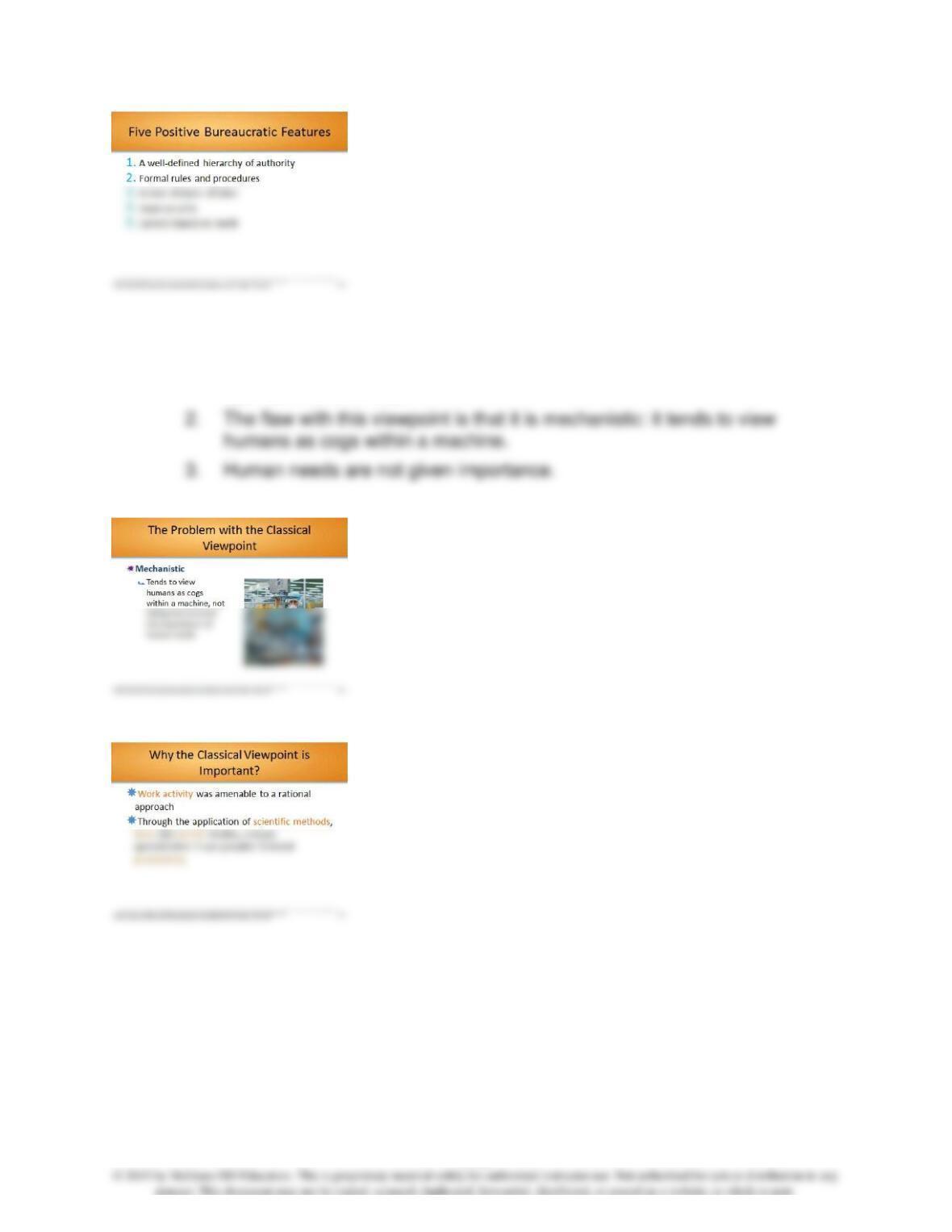
b. A better-performing organization should have five positive
bureaucratic features:
(1) A well-defined hierarchy of authority
Chapter 02 – Management Theory: Essential Background for the Successful Manager
2-13
D. The Problem with the Classical Viewpoint: Too Mechanistic
1. The essence of the classical viewpoint was that work activity could be
approached rationally.
Chapter 02 – Management Theory: Essential Background for the Successful Manager
2-14
The behavioral viewpoint emphasized the importance of understanding human behavior
and of motivating employees toward achievement. This viewpoint developed over three
phases: (1) Early behaviorism was pioneered by Hugo Munsterberg, Mary Parker
Possible Topics for Discussion:
• Explain how the behavioral viewpoint discussed in Section 2.3 is different from
the classical viewpoint you learned about in Section 2.2.
Major Idea Outline:
(Correct answer is C)
2.3 Behavioral Viewpoint: Behaviorism, Human Relations, &
Behavioral Science (pp. 49-52)
To understand how people are motivated to achieve, what can I learn
from the behavioral viewpoint?
Chapter 02 – Management Theory: Essential Background for the Successful Manager
A. The behavioral viewpoint emphasized the importance of understanding
human behavior and of motivating employees toward achievement.
B. The behavioral viewpoint developed over three phases: early behaviorism, the
human relations movement, and behavioral science.
B. Early Behaviorism: Pioneered by Munsterberg, Follett & Mayo
1. Hugo Munsterberg and the first application of psychology to industry
a. Called “the father of industrial psychology,” Munsterberg suggested
that psychologists could contribute to industry in three ways:
(1) Study jobs and determine which people are best suited to specific
jobs.
Chapter 02 – Management Theory: Essential Background for the Successful Manager
2-16
2. Mary Parker Follett was a Massachusetts social worker and social
philosopher who believed in power sharing among employees and
managers
a. Instead of following the usual hierarchical arrangement, Follett thought
organizations should become more democratic.
(1) Organizations should be operated as “communities.”
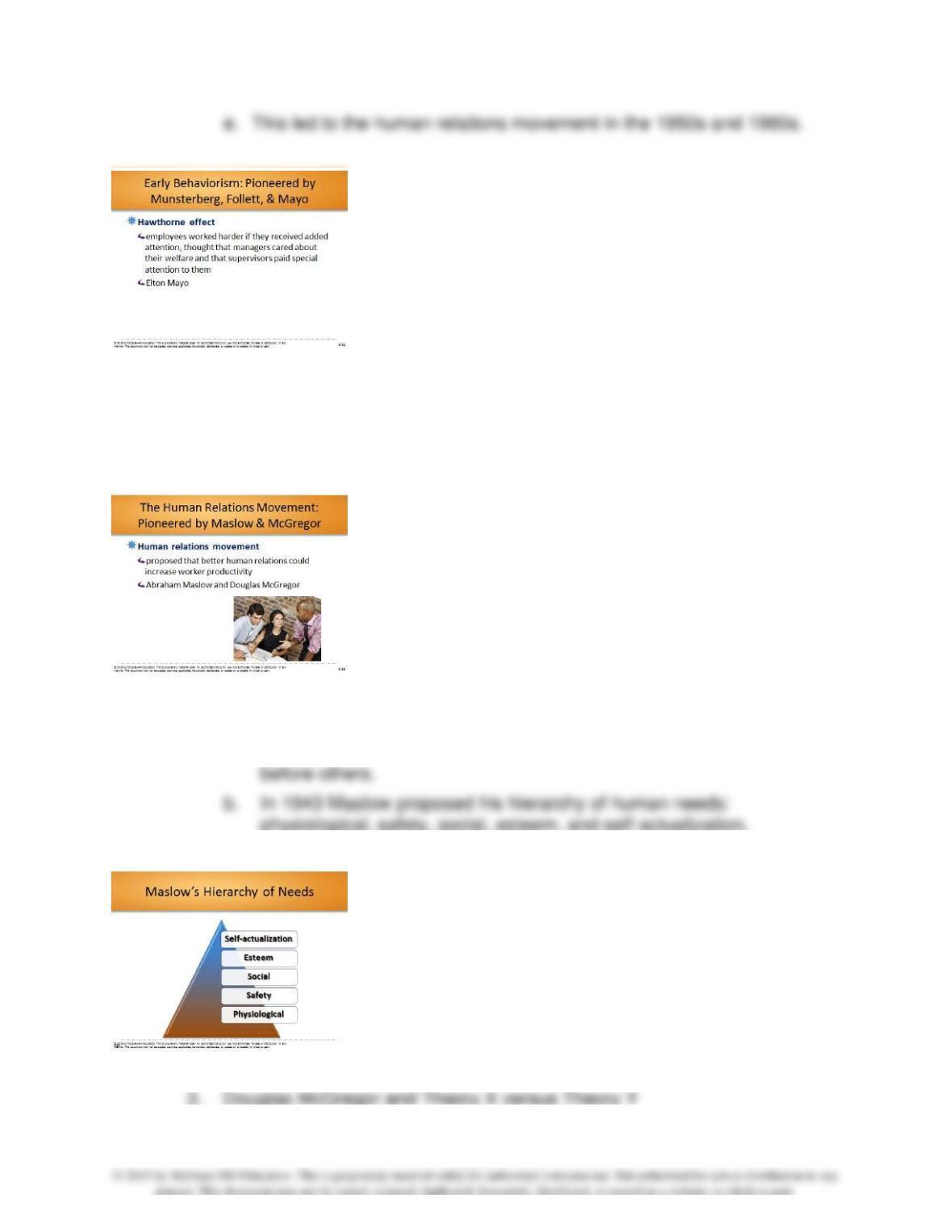
3. Elton Mayo and the supposed “Hawthorne effect”
a. Conducted by Elton Mayo at Western Electric’s Hawthorne plant, the
Hawthorne studies began with an investigation into whether workplace
lighting level affected worker productivity.
Chapter 02 – Management Theory: Essential Background for the Successful Manager
2-17
C. The Human Relations Movement: Pioneered by Maslow and McGregor
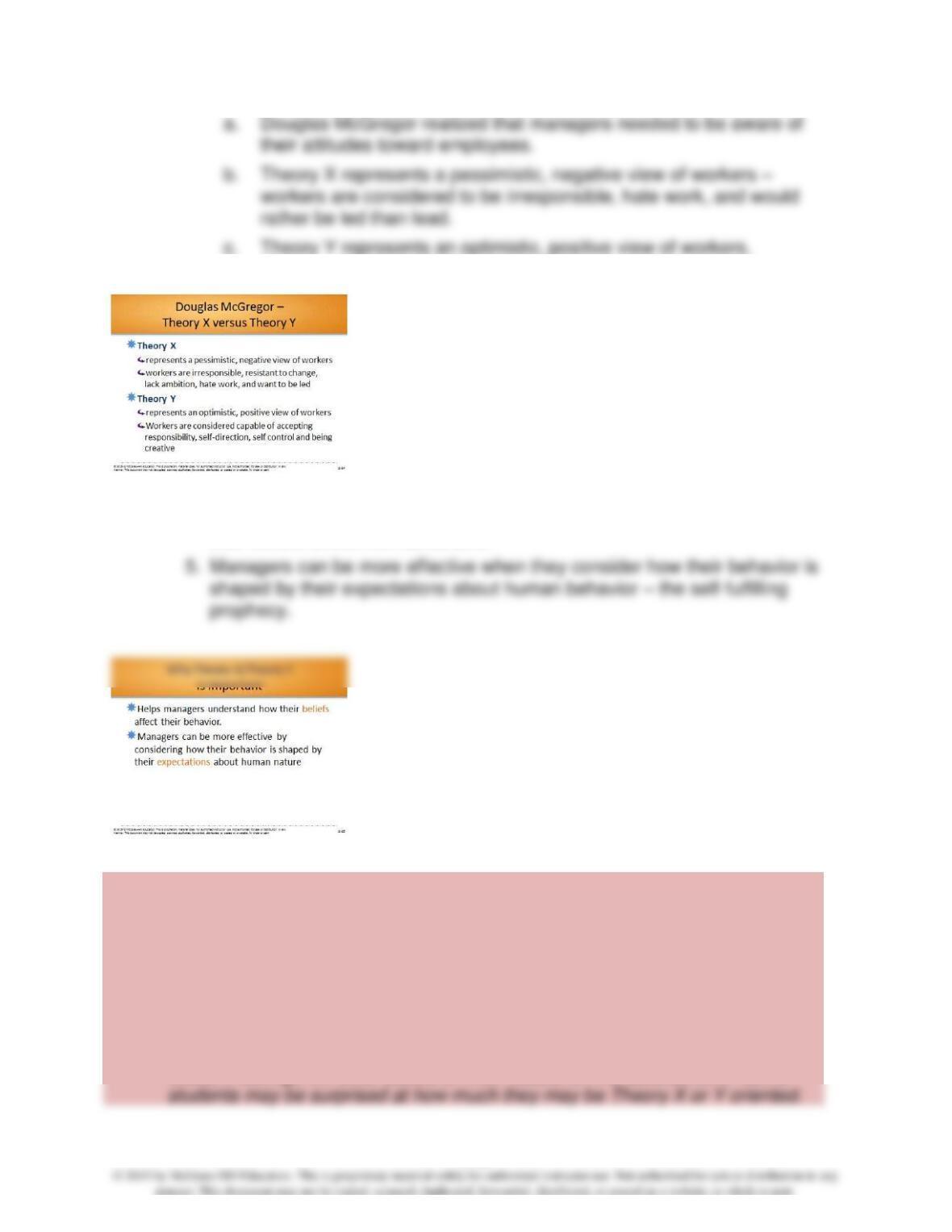
1. The human relations movement proposed that better human relations
could increase worker productivity.
2. Abraham Maslow and the hierarchy of needs
a. Abraham Maslow believed that some human needs must be satisfied
Chapter 02 – Management Theory: Essential Background for the Successful Manager
2-18
4. Theory X/Theory Y is important because it helps managers understand how
their beliefs affect their behaviors.
SELF-ASSESSMENT 2.1 (p. 51)
What Is Your Orientation toward Theory X/Theory Y?
Go to connect.mheducation.com and take Self-Assessment 2.1.
Student Questions:
1. To what extent do you think your results are an accurate reflection of your
beliefs about others? Are you surprised by the results?
Student feelings will differ based on their results on the assessment. Some
Chapter 02 – Management Theory: Essential Background for the Successful Manager
2-19
2. As a leader of a student or work-related project team, how might your results
affect your approach toward leading others? Explain.
Student responses will differ based on their assessment results. Those with a
3. If an employee doesn’t seem to show ambition, can that be changed?
Discuss.
Student responses will depend on their orientation toward Theories X or Y.
Those with a Theory X orientation may believe that employee ambitions, or
Additional Activities:
You can also consult the Connect Instructors Manual for the post-assessment activity
and corresponding PowerPoint slides used for this Self-Assessment in Connect. In
this activity, students should be assigned to groups based on their Self-Assessment
D. The Behavioral Science Approach
2. Behavioral science relies on scientific research for developing theories
Chapter 02 – Management Theory: Essential Background for the Successful Manager
2-20
Interactive Classroom Material:
EXAMPLE: Application of Behavioral Science Approach: The Open-Plan
Office—Productivity Enhancer or Productivity Killer? (p. 52)
In today’s offices, many managers and employees are in an open floorplan using
YOUR CALL
Is there a case to be made for intermingling employees with different
personalities and different skills to foster the potential for stimulating
breakthrough ideas? What kind of fellow workers in an open office would you
like to be seated with and why?
This Example demonstrates the importance of a proper office layout. There may
be a case to be made for intermingling employees with different personalities and
skill sets. This could lead to “out–of–the-box” thinking based on conversations and
Additional Activities:
One way to build on this Example is to have the students read the HR Magazine
article “Beyond the Open Office.” This article from April 2015 summarizes the current
thinking and research results on open offices. Consider using the following