
CHAPTER 2
STRATEGY AND HUMAN RESOURCES PLANNING
CHAPTER OUTLINE
2.1 Strategic Planning and Human Resources Planning
2.1a Strategic Planning and HR Planning: Linking the Processes
2.2 Step One: Mission, Vision, and Values
2.2a Developing a Mission Statement
2.3 Step Two: External Analysis
2.3b The Competitive Environment
2.3c HR’s External Analysis
2.4 Step Three: Internal Analysis
2.4b Sustaining a Competitive Advantage Through People
2.4c Types of Talent and Their Composition in the Workforce
2.4d Corporate Culture
2.4f Assessing a Firm’s Human Capital Readiness: Gap Analysis
2.5 Step Four: Formulating a Strategy
2.5a Corporate Strategy
2.5b Business Strategy
2.5c HR Strategy
2.6a HR’s Role in Strategy Execution
2.7a Evaluating a Firm’s Strategic Alignment
LEARNING OUTCOMES
After studying this chapter, students should be able to:
1. Explain how human resources planning and a firm’s mission, vision, and values are
integrally linked to its strategy.
3. Understand why it is important for an organization to do an internal resource analysis.
5. Understand what is required for a firm to successfully execute a strategy and assess its
effectiveness.
6. Describe how firms evaluate their strategies and HR execution.
2 Part 1: Human Resources Management in Perspective
GENERATING INTEREST
Consider using a case study from the end of the chapter to generate interest and launch
the discussion of this chapter. Guidance for the case studies is located at the end of the
chapter in this guide.
DEALING WITH TROUBLE SPOTS
The goal of human resources planning can be described as having the right number of
people with the right skills in the right place at the right time. Three factors that
contribute to the challenging nature of this goal are employee turnover, absenteeism, and
LECTURE OUTLINE
Discussion Starter #1: Amazon.com has tested technology to deliver small packages to people’s
houses via drones.
ANSWER: Amazon.com’s new drone delivery will have a massive effect on its competitive
environment.
2.2b HR’s Role in Establishing and Reinforcing a Firm’s Mission, Vision, and Values
2.3 Step Two: External Analysis Figure 2.2
Figure 2.3
2.3a The Business Environment
A firm’s business environment (sometimes called the remote environment) is the
factors in the external environment that a firm cannot directly control but that can
2.3b The Competitive Environment
The competitive environment consists of a firm’s specific industry, including the
industry’s customers, rival firms, new entrants, substitutes, and suppliers. The
more power each of these forces has, the less profitable (and therefore attractive)
the industry will be. The following five factors affect the competitive
environment:
• customers (create value customers want)
• rival firms (know the competition)
Teaching Tip: Use Figure 2.2 to discuss the five forces framework. Ask students to identify a local
business and identify how the five forces are affecting it.
Stakeholders are key people and groups that have an interest in a firm’s activities
and that can either affect them or be affected by them. A firm has primary
stakeholders with a direct stake in the firm and secondary stakeholders who can
affect or be affected by the company.
Chapter 2: Strategy and Human Resources Planning 5
Teaching Tip: Use Figure 2.3 to discuss the difference between primary and secondary stakeholders.
What happens if primary stakeholders don’t want to be involved or secondary stakeholders want to
be too involved?
2.3c HR’s External Analysis
Firms evaluate themselves against other firms. Benchmarking is the process of
Sources of information include the following:
• published documents (U.S. Department of Labor)
• hiring and recruiting metrics
• informal media (blogs, press releases, etc.)
Teaching Tip: Use Figure 2.4 to discuss the information that can be collected and how it is used.
Discussion Starter #2: What external forces influence a firm’s strategy?
EOC Discussion Question #2: What external forces influence a firm’s strategy?
2.4 Step Three: Internal Analysis Figure 2.5
Figure 2.6
2.4a Core Capabilities
Core capabilities are integrated knowledge sets within an organization that
distinguish it from its competitors and deliver value to customers. Value creation
2.4b Sustaining a Competitive Advantage Through People
Organizations can achieve a sustained competitive advantage through resources—
people—if they meet the following criteria:
• The resources must be valuable.
• The resources must be rare.
EOC Discussion Question #3: What criteria must be met if firms are to achieve a competitive
advantage through their employees?
2.4c Types of Talent and Their Composition in the Workforce
Managers make personnel decisions based on skill groups that can be classified
according to the degree to which they create strategic value and are unique to the
organization. The following segments are represented in Figure 2.5:
• Strategic knowledge workers (unique skills linked to the company’s
strategy that are difficult to replace—sales and finance in Figure 2.5)
• Core employees (valuable skills that are not unique—customer service and
Teaching Tip: Use Figure 2.5 to discuss the types of workers and examples of each type. Ask students
the job tasks that might be unique, valuable but not unique, and generally available.
2.4d Corporate Culture
Cultural audits are audits of the culture and quality of work life in an
organization. They can help firms decide upon the strategic investments and
maneuvers to which their cultures lend themselves.
To conduct a cultural audit, a firm asks its employees how they feel about several
issues. The most widely used cultural audit questionnaire is the Organizational
Cultural Assessment Instrument (OCAI). It helps identify four distinct types of
corporate culture shown in Figure 2.6:
• “Clan” culture (closely knit, concerned for one another and their
© 2019 Cengage. May not be scanned, copied or duplicated, or posted to a publicly accessible website, in whole or in part.
2.4e Forecasting
Managers focus on forecasting at least three key elements: (a) forecasting the
demand for labor, (b) forecasting the supply of labor, and (c) balancing supply
and demand considerations. Figure 2.7 will be useful to initiate a classroom
discussion on forecasting.
Teaching Tip: Use Figure 2.7 to discuss the techniques and considerations involved when forecasting
supply and demand. Ask students to evaluate local supply and demand for different jobs.
Forecasting a Firm’s Demand for Employees
The two approaches to HR forecasting are quantitative and qualitative.
• Quantitative approaches involve the use of statistical or mathematical
techniques. Trend analysis is a quantitative approach to forecasting labor
Forecasting the Supply of Employees
An organization must determine whether sufficient numbers and types of
employees are available to staff the openings it anticipates having.
Teaching Tip: Use Figure 2.8 to discuss the Markov analysis method. Ask students to suggest the
advantages and disadvantages of using only Markov analysis. For example, it is based on actual data,
but it doesn’t consider management’s experience to evaluate the data.
Several methods are available, including the following tools:
• Staffing Tables and Markov Analyses—These tools focus on the number
of employees. A staffing table is a table that shows a firm’s jobs, along
8 Part 1: Human Resources Management in Perspective
• Skill Inventories and Management Inventories— These tools focus on the
types of employees. Skills inventories are files of personnel education,
experience, interests, skills, and so on that allow managers to quickly
match job openings with employee backgrounds.
• Replacement Charts and Succession Planning—Replacement charts are
listings of current jobholders and people who are potential
EOC Discussion Question #1: Identify the three key elements of the human resources planning
model and discuss the relationships among them.
2.4f Assessing a Firm’s Human Capital Readiness: Gap Analysis
Human capital readiness is the process of evaluating the availability of critical
talent in a company and comparing it to the firm’s supply.
Teaching Tip: Use Figure 2.10 to discuss the assessment of human capital readiness and how it is
used. The example demonstrates the information considered when assessing readiness.
2.5 Step Four: Formulating a Strategy Figure 2.11
2.5a Corporate Strategy
A firm’s corporate strategy includes the markets in which it will compete, against
whom, and how. A concentration strategy focuses on a portion of the industry.
Growth and Diversification

Chapter 2: Strategy and Human Resources Planning 9
Mergers and Acquisitions
Merging companies often streamline their costs by eliminating duplicate functions.
Failures can be caused by cultural inconsistencies and conflicts among the
managers of each firm.
Strategic Alliances and Joint Ventures
Sometimes, firms pursue cooperative strategies such as a strategic alliance or joint
venture. HR assesses culture compatibility, identifies potential problems, helps
the companies work together, and designs performance assessment and mutual
incentives for the alliance.
2.5b Business Strategy
Business strategy is more focused than corporate strategy on how the company
will compete against rival firms to create value for customers.
Low-Cost Strategy: Compete on Productivity and Efficiency
A low-cost strategy means keeping costs low enough so that a company can offer
an attractive price to customers relative to its competitors. This strategy focuses
on efficiency, productivity, and minimizing waste. HR planning is involved in
several ways:
• Increase productivity.
2.5c HR Strategy
HR strategy must work with corporate and business strategies. The firm must
focus on its workers and how they mesh. HR managers should analyze the
subcultures in the company and ensure that they work together with the right
corporate strategies to succeed.
Discussion Starter #3: Explain the difference between a firm’s corporate strategy and business
strategy. Why do firms need to look at both aspects?
10 Part 1: Human Resources Management in Perspective
EOC Discussion Question #4: Explain the difference between a firm’s corporate strategy and
business strategy. Why do firms need to look at both aspects?
2.6 Step Five: Executing a Firm’s Strategy Figure 2.12
Strategy execution, not the strategy itself, determines a firm’s success. The “4As” are
required for successful strategy execution:
• Alignment (shared performance expectations and accountability)
• Agility (proactive in the face of change)
2.6a HR’s Role in Strategy Execution
Managers translate strategic priorities into functional areas of the organization.
Remaining Agile
HR agility is achieved in two ways:
Reconciling Supply and Demand
Demand for a firm’s products is based on business forecasts. Supply
considerations involve filling employee vacancies to meet the forecasted demand
for products. Organizations can hire, outsource, and lay off employees or adjust
work hours in a variety of ways.
EOC Discussion Question #5: Why is it often difficult for a firm to match its strategy to HR
deliverables?
2.7 Step Six: Evaluation Figure 2.13
2.7a Evaluating a Firm’s Strategic Alignment
HR and the requirements of an organization’s strategy must be aligned. Fit can be
vertical or horizontal.
Chapter 2: Strategy and Human Resources Planning 11
Vertical Fit/Alignment
Vertical fit (or vertical alignment) focuses on the alignment of the business’s
Horizontal Fit/Alignment
HR practices should be aligned with one another internally to establish a
configuration that is mutually reinforcing. All of HR’s practices need to focus on
the same objectives.
Teaching Tip: Use Figure 2.13 to discuss horizontal alignment. Ask students which elements might
need to be adjusted.
Strategic Alignment and the Balanced Scorecard
A balanced scorecard ((BSC) is a measurement framework that helps managers
translate strategic goals into operational objectives. The model uses four related
fields:
• Financial
Teaching Tip: Use Figure 2.14 to discuss balanced scorecards. Ask students how the fields are
related.
Video Highlight #2: Section 2.7a: Evaluating a Firm’s Strategic Alignment
VIDEO: Communicating Strategy with the Balanced Scorecard (3:23)
EOC Discussion Question #6: What steps does the firm need to take to execute its strategy and
measure the results?
12 Part 1: Human Resources Management in Perspective
ANSWERS TO END-OF-CHAPTER DISCUSSION QUESTIONS
1. Managers focus on (at least) three key elements: (1) forecasting the demand for labor, (2)
forecasting the supply of labor, and (3) balancing supply and demand considerations.
3. The human capital must be valuable, rare, difficult to imitate, and organized in a way that
4. While we think about corporate strategy as domain selection, business strategy is viewed
in terms of domain navigation. It is more focused on how the company will compete
5. Strategy alone does not differentiate high- from low-performing firms. The true
6. HR managers first gauge demand based on forecasted trends in business activity using
both quantitative and qualitative methods. The Monthly Labor Review and Occupational
Outlook Handbook, published by the Bureau of Labor Statistics (BLS) of the U.S.
Department of Labor, as well as local chambers of commerce and individual state
Chapter 2: Strategy and Human Resources Planning 13
HRM EXPERIENCE
Customizing HR for Different Types of Human Capital
To understand the different roles that employees play in an organization’s strategy, divide
into groups of three and ask each student to role-play the three employees described.
Each student should include the strategic importance of the employee. How would the
absence of a position affect the organization?
NOTES FOR END-OF-CHAPTER CASE STUDIES
Case Study 1: How a Strategy Change Led to Nike’s Formation
1. Management is ultimately responsible for formulating strategy, but they use input from
employees. Therefore, students could argue that both are responsible.
Case Study 2: Domino’s Tries to Get Its Strategic Recipe Right
1. Domino’s was able to offer a different value proposition than anyone else was offering as
2. Yes, Domino’s approach is working as the turnover has dropped and customer
satisfaction has increased. This is because Domino’s invested in training and retaining
FLIP TIPS
Group Activity
To understand the important relationship between HR functions and competitive
advantage, divide into groups of three and answer the following questions:
• Why are HR functions important?
• What do you understand from the term competitive advantage?
• What is the relationship between HR functions and competitive advantage?
14 Part 1: Human Resources Management in Perspective
• How can HR functions be used to gain competitive advantage in a market? Cite
examples.
APPENDIX
CALCULATING EMPLOYEE TURNOVER
AND ABSENTEEISM
This appendix shows students how to measure employee turnover and absenteeism to
manage their impact on the firm.
A.1 Employee Turnover Rates
Employee turnover is the movement of employees out of an organization.
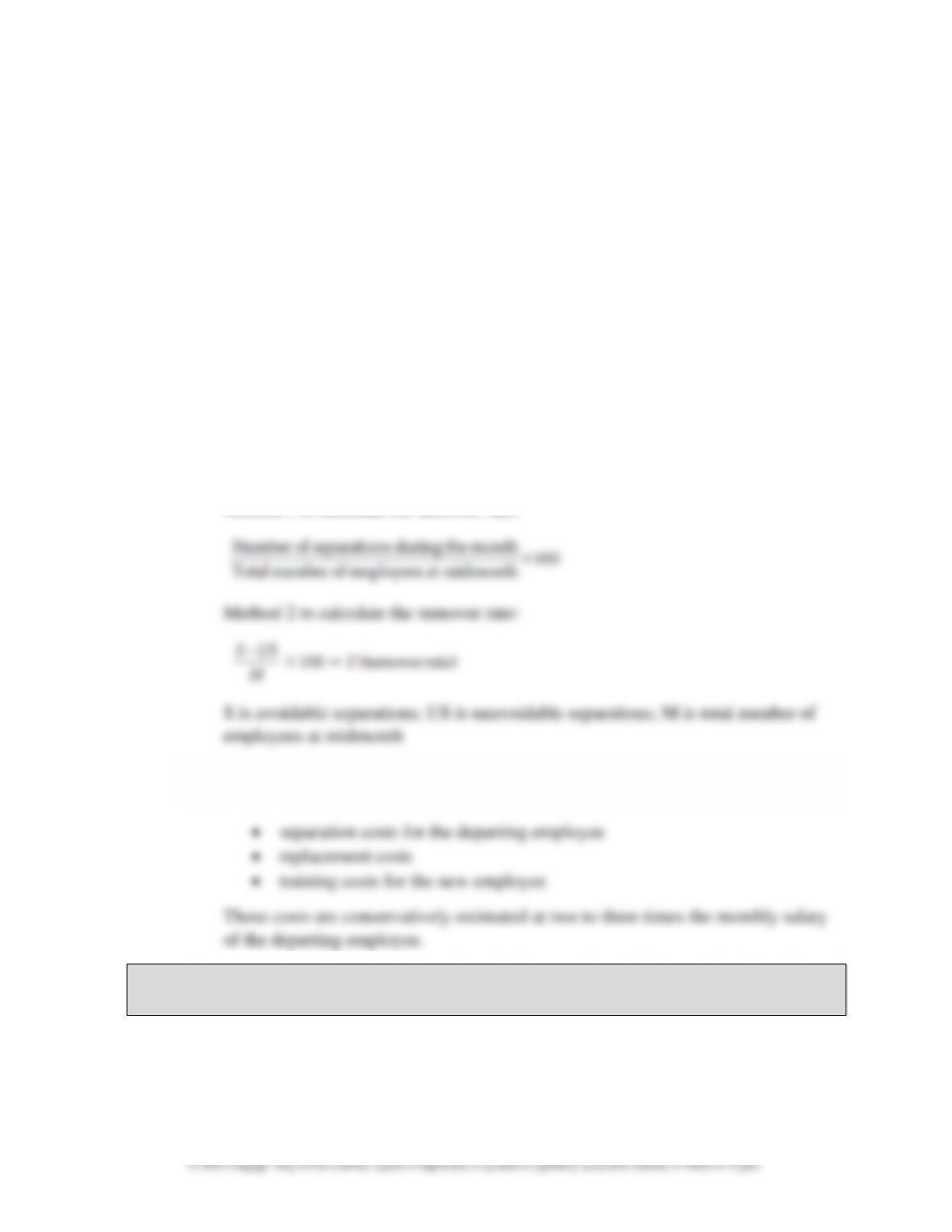
A.1a Computing the Turnover Rate
Method 1 to calculate the turnover rate:
A.1b Determining the Costs of Turnover
The costs of turnover can generally be broken down into three categories:
Teaching Tip: Introduce the notion of “unavoidable separations.” Is there ever a case in which firms
might want to induce turnover? Ask students to suggest examples.
A.2 Employee Absenteeism Rates
The absenteeism rate is how frequently employees are absent from their work.
Absenteeism causes direct costs. Indirect costs may underlie excessive absenteeism.
Chapter 2: Strategy and Human Resources Planning 15
A.2a Computing Absenteeism Rates
“Absence” does not have a universally accepted definition or a standard formula
A.2b Comparing Absenteeism Data
A.2c Costs of Absenteeism
A.2d Absenteeism and HR Planning
HR managers should study their firm’s absenteeism statistics to determine
Teaching Tip: Show students how to calculate absenteeism rates based on the U.S. Department of
Labor’s formula shown in this section in the appendix. Then show them a copy of the absenteeism