1
Chapter 2: Human Resource Strategy and Planning
Chapter 2: Human Resource Strategy
and Planning
Table of Contents
Chapter Summary
1
Learning Objectives
1
Lecture Outline
2
Critical Thinking Challenges
13
Case: Happy and Healthy Transformation at Walgreens
15
Supplemental Cases
15
Extra Teaching Video
19
Chapter Summary
Chapter 2 examines strategic planning for an organization and the role of the Human Resources
(HR) department in its strategic plans. First, the chapter describes the strategic planning process,
including the formulation of effective strategies. Next, it explains how HR’s strategies fit into the
organization’s strategic plans and the contributions HR can make. Human resource planning
determines and plans for the availability of employees and external workers needed to meet the
organization’s strategies. Some strategic challenges are presented: managing a talent surplus,
Learning Objectives
After students have read this chapter, they should be able to accomplish the following objectives:
• Summarize the organization’s strategic planning process.
• Outline how HR’s strategies are merged with organizational strategies and give two
examples.
2
Chapter 2: Human Resource Strategy and Planning
© 2020 Cengage Learning®. May not be scanned, copied or duplicated, or posted to a publicly accessible website, in whole or in part.
The chapter opens with a feature describing the current trends in HR strategy and planning.
Trends include the rising importance of strategic planning, emerging strategic issues, challenging
issues in globalization, new approaches needed in strategic planning, and the role that HR plays
in facilitating mergers and acquisitions.
Lecture Outline
HR Headline: HR Planning in the “Air Capital of the World”
Wichita, Kansas, is known as the “air capital of the world.” As recently as 2008, over 69,000
people worked in aviation-related jobs. However, the city has since experienced a 25 percent
reduction in aircraft manufacturing jobs. In an effort to rejuvenate the aircraft industry, private
and public organizations have banded together to make the city more attractive to skilled
workers.
• A strategy is a plan an organization follows for how to compete successfully, survive, and
grow.
o The plan may be formal or informal.
2-1. Organizational Strategic Planning
• Strategic planning is the process of defining organizational strategy, or direction, and
allocating resources toward its achievement.
Teaching Tip: Use Figure 2-1 to help students understand the strategic planning process. Ask
students to suggest actions HR can perform during each stage.
2-1a. Strategy Formulation
• An organizational mission is the core reason for the existence of the organization and
2-1b. Managing in Turbulent Conditions
• VUCA is an acronym that stands for volatile, uncertain, complex, and ambiguous.
o Leaders operating in such conditions must be more adaptable and agile than in the
2-1c. Triple Bottom Line
2-2. Human Resources and Strategy
• The HR department must demonstrate that it helps the organization.
• Strategic HR management refers to the appropriate use of HR management practices
HR Perspective: Genentech Maps Its Human Resources Possibilities
Genentech, the founder of the biotechnology industry, merged with Roche. This prompted
the HR leadership to assess the company and the industry, which led to the creation of a
“map of possibilities” for the organization. The map comprised two main segments—key
disruptors and themes for HR. Analyzing the information under these segments led to the
identification of three “super-themes.” Addressing these themes will help HR in managing
talent to ensure the goals of the organization are met. It will also ensure that employees are
in an environment that enables them to do their best work.
1. What are the pros and cons of conducting such an extensive research process before
laying out plans for managing talent in the future?
Students’ answers may vary. Advantages include (1) having a thorough
understanding of the industry and trends that may influence the industry and its
demands in the future, (2) determining where the organization stands in terms of its
current talent pool and its ability to cater to future demands of the industry, and (3)
creating strategies that will enable the organization to cater to upcoming demands.
However, while conducting an extensive research process, it is possible that the
4
Chapter 2: Human Resource Strategy and Planning
How can they continue to monitor external and internal conditions that might affect
the workforce?
Students’ answers may vary. Such assessments can be conducted on a regular basis,
such as at the end of a quarter, or whenever a trend is identified that may require a
different plan of action. With regard to monitoring external and internal conditions,
the identification and observation of factors that may influence these conditions
may help HR in coming up with solutions that may address future demands or
challenges.
2-2a. Human Resource Contributions to Strategy
• HR leaders included in an organization’s strategic planning should know about the
2-2b. Human Resources Strategies for Global Competitiveness
• Globalization refers to the phenomenon of organizations operating across borders.
HR Competencies & Applications: Latin American Firms Face Staffing Problems
Key Competencies: Global & Cultural Effectiveness (Behavioral Competency) and
Organization (Technical Competency)
A survey of large Latin American firms showed that many have expanded into international
markets through mergers and acquisitions. They face problems in cultural differences and
staffing.
1. How would you focus HR leaders on the development of positive strategies for
expansion? What HR issues do you think deserve the most attention?
Answers will vary. Students should consider the role of cultural differences in many
of the issues faced after a merger or an acquisition that involves a firm in a different
country. Differences such as communication styles and attitudes toward
management can cause problems.
© 2020 Cengage Learning®. May not be scanned, copied or duplicated, or posted to a publicly accessible website, in whole or in part.
2-4b. Geographic and Competitive Evaluations
2-4c. Changing Workforce Considerations
2-5. Planning for Internal Workforce Availability
• HR must compare the needs of the organization with the existing labor supply and the
potential labor supply available outside the organization.
HR Highlight: Barriers to Workforce Planning
For most organizations, the workforce is the most important resource in achieving its goals.
While leaders might recognize and acknowledge this reality, too often the planning process for
human resources falls short. Fortunately, the use of big data in the HR domain and predictive
analytics are two emerging trends that may help to combat this reluctance to conduct workforce
planning.
1. How might HR professionals work to overcome issues related to managers’ need for
control and focus on the short term?
Students’ answers may vary. Meeting with managers and identifying and analyzing some
pain points associated with their everyday tasks may help in understanding the causes of
the need for control. HR professionals can also help managers understand the benefits of
keeping long-term goals in mind while performing everyday tasks.
2. What steps might HR staff take to improve the quality and availability of data regarding
human resources in the organization?
2-5a. Current and Future Jobs Audit
7
© 2020 Cengage Learning®. May not be scanned, copied or duplicated, or posted to a publicly accessible website, in whole or in part.
2-5b. Employee and Organizational Capabilities Inventory
• HR planners should conduct a detailed audit of current employees and their capabilities.
2-6. Forecasting HR Supply and Demand
• Forecasting refers to the use of information from the past and present to predict future
conditions.
2-6a. Forecasting Methods and Periods
• Forecasting methods may be either qualitative or quantitative, as shown in Figure 2-7.
2-6b. Forecasting the Demand (Need) for Human Resources
2-6c. Forecasting the Supply (Availability) of Human Resources
• Forecasting availability considers both external and internal supplies.
2-7. Workforce Imbalances
8
© 2020 Cengage Learning®. May not be scanned, copied or duplicated, or posted to a publicly accessible website, in whole or in part.
2-7a. Managing a Talent Surplus
• A talent surplus can be handled in different ways: reduction in work hours or
compensation, attrition and hiring freezes, voluntary separation programs, and
Teaching Tip: Ask students to describe scenarios in which each method would be most useful.
2-7b. Legal Considerations for Workforce Reductions
• HR’s role during workforce adjustments is to ensure that the organization does not
violate any laws governing workforce reductions.
2-7c. Managing a Talent Shortage
• Several methods can be used to handle a talent shortage: using overtime, outsourcing,
making alternate work arrangements, bringing back recent retirees, increasing
contingent workers, and reducing turnover.
9
Chapter 2: Human Resource Strategy and Planning
© 2020 Cengage Learning®. May not be scanned, copied or duplicated, or posted to a publicly accessible website, in whole or in part.
maintain a talented workforce.
Discussion Starter: Use Figure 2-10 to discuss why this order is most commonly used.
2-8. Human Resources Planning in Mergers and Acquisitions
• A merger or acquisition generates growth by combining two existing companies and
2-8a. Before the Deal
2-8b. During Integration
• During the first 60 days after the acquisition, HR provides administrative and
2-8c. Post Integration
2-9. Measuring Effectiveness of Human Resources and Human Capital
• Effectiveness is the ability of a program, project, or task to produce a specific desired
effect or result that can be measured.
• Efficiency is the degree to which operations are carried out in an economical manner.
Discussion Starter: Ask students why it is important to measure effectiveness.
• The benefits of HR practices are not always immediately visible, which is what makes
measuring HR’s impact such a challenge.
10
Chapter 2: Human Resource Strategy and Planning
© 2020 Cengage Learning®. May not be scanned, copied or duplicated, or posted to a publicly accessible website, in whole or in part.
o However, successful efforts can usually be made to assess HR practices.
• HR managers should understand financial and operational measures that drive the
business and relate decisions to key performance indicators (KPIs).
• Metrics, benchmarking, balanced scorecards, and audits can help firms track HR
performance.
2-9a. HR Metrics and Analytics
• HR metrics are specific measures of HR practices.
• A metric can be developed using costs, quantity, quality, timeliness, and performance
Teaching Tip: Use Figure 2-12 to highlight metrics that can be used in different areas. Ask
students to suggest additional data that can be used as metrics.
HR Competencies & Applications: Talking Numbers with Organization Leaders
Key Competencies: Business Acumen (Behavioral Competency), Critical Evaluation
(Behavioral Competency), Strategy (Technical Competency), and Organization/Technology
& Data (Technical Competency)
CEOs are interested in knowing how HR practices impact key organization performance
indicators. The CEO and other leaders are focused on the strategic goals of the organization rather
than measures of activity. If HR professionals don’t provide relevant metrics to leaders, there is
little chance of gaining a seat at the strategic planning table or demonstrating the value of
effective HR practices. The following strategic metrics will get the attention of the CEO and
demonstrate the value of investing in human capital:
• Revenue per employee
• Quality of hire improvement
• Performance turnover in key jobs
• Revenue lost due to position vacancies
• HR program contribution to productivity improvements
• Percentage of HR strategic goals that were met.
1. What data would be necessary to track and report on each of the metrics listed? What
11
Chapter 2: Human Resource Strategy and Planning
• Revenue per employee: Data may be sourced from the financial department. A
report on the revenue earned by the organization for a certain period of time
versus the strength of the organization for the same period will provide this
information.
• Quality of hire improvement: This information may be available from the
managers to whom new recruits report. Managers may maintain profiles on the
quality and productivity of employees who work under them.
• Performance turnover in key jobs: This information may be available from project
managers.
• Revenue lost due to position vacancies: This information can be sourced from the
HR department and the sales department. An example of such information may be
a report on the contracts lost due to a lack of skilled employees or inadequate
manpower.
• HR program contribution to productivity improvements: The HR department may
possess this information. Each program that is initiated will need to have a
benchmark to assess its outcome.
• Percentage of HR strategic goals that were met: The HR department may possess
this information. This information can be available in reports that contain the
strategic goals set by the department, the milestones for each goal, and the status
of each milestone, along with any associated learnings and improvements
2. What resources would you recommend to HR professionals who are not skilled in
creating these sophisticated metrics?
Students’ answers may vary. The Society of Human Resource Management may have
resources that HR professionals can use to create HR metrics.
2-9b. Human Resources and Benchmarking
12
Chapter 2: Human Resource Strategy and Planning
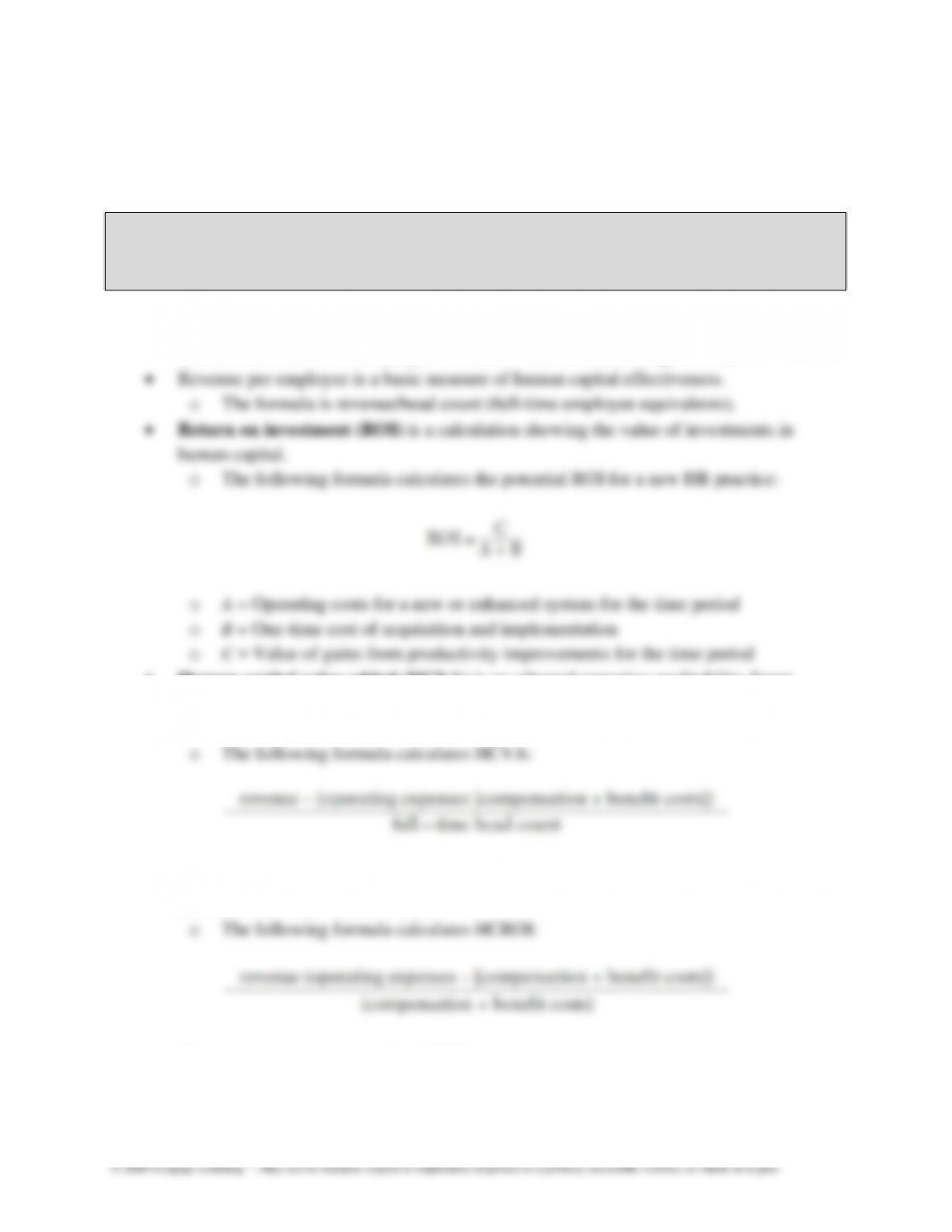
• Human capital often provides both the biggest value and the biggest cost to
organizations.
Teaching Tip: Remind students that, as stated in Chapter 1, human capital is the collective value
of the capabilities, knowledge, skills, life experiences, and motivation of an organizational
workforce.
• The total cost of workforce (TCOW) is a comprehensive measure that takes into
account the full cost for all people who contribute work to the organization.
• Human capital value added (HCVA) is an adjusted operating profitability figure
calculated by subtracting all operating expenses except labor expenses from revenue and
dividing by the total full-time head count.
• Human capital return on investment (HCROI) directly shows the amount of profit
derived from investments in labor.
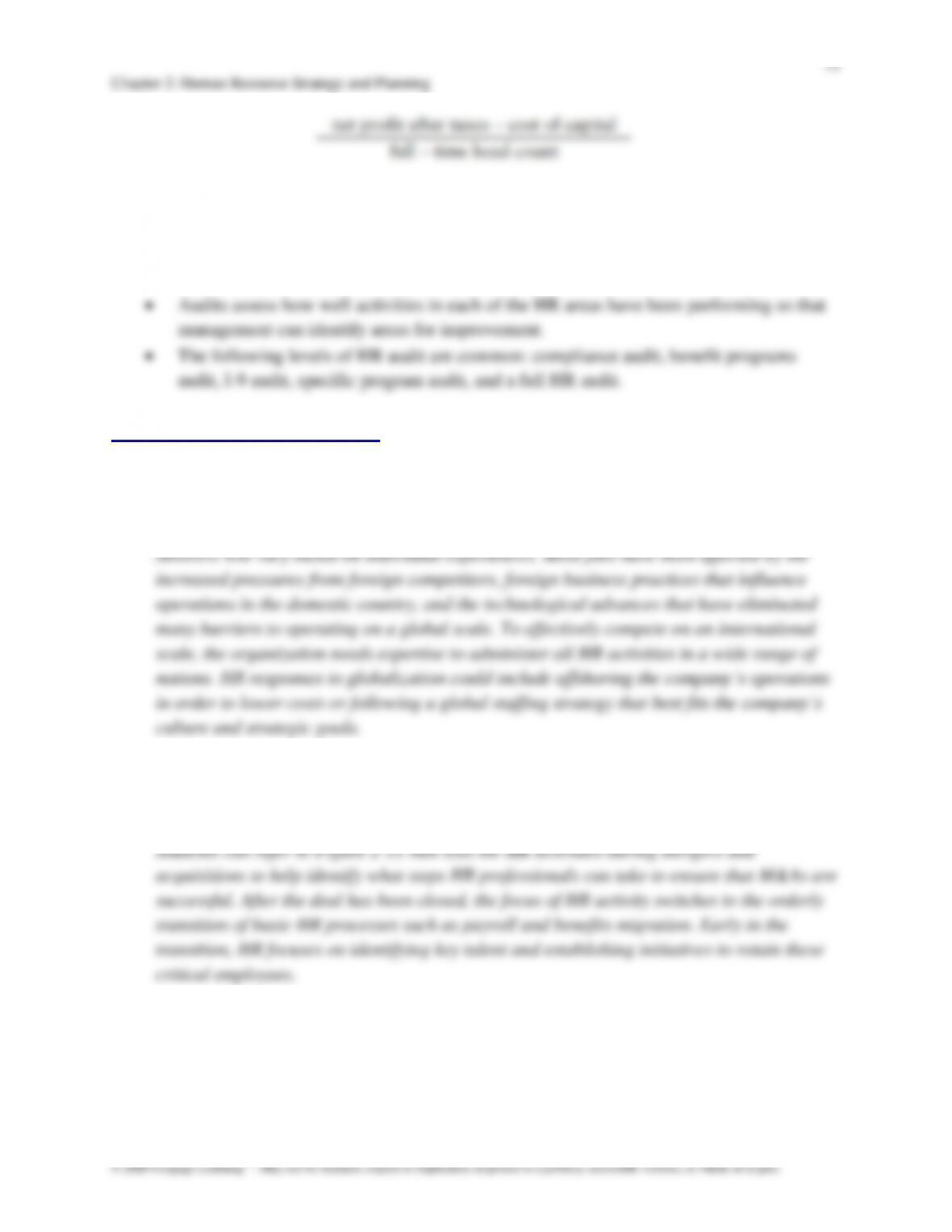
• Human economic value added (HEVA) is the wealth created per employee.
o The following formula calculates HEVA:
© 2020 Cengage Learning®. May not be scanned, copied or duplicated, or posted to a publicly accessible website, in whole or in part.
2-9e. Human Resources Audit
• An HR audit is a formal research effort to assess the current state of an organization’s
HR practices.
Critical Thinking Challenges
1. Discuss how globalization has changed jobs in an organization where you have worked.
What are some HR responses to those changes?
2. What steps can HR professionals take to ensure that mergers and acquisitions are
successful? How can HR help during the integration process?
3. How can an organization maintain its image while dealing with a talent surplus? If layoffs
are necessary, what would you recommend managers do to ensure that survivors remain
committed and productive?
14
© 2020 Cengage Learning®. May not be scanned, copied or duplicated, or posted to a publicly accessible website, in whole or in part.
4. As the HR manager for a multinational corporation, you want to identify HR competencies
that are critical for global companies. Visit the website for the World Federation of People
Management Association (www.wfpma.com) to research the topic and to identify
differences in the body of knowledge in different parts of the world.
5. As the HR Director of a U.S.-based company that is looking at global opportunities in
China, you have been asked by the company president to prepare an outline for an HR
strategic plan as part of the company’s expansion process. You need to develop an HR
strategic plan that will integrate the goals, objectives, and strategies of the HR department
with those of the company. The plan also needs to support the objectives of other
A. What is the process to use for identifying the components of the HR strategic
planning process?
Most students will probably refer to the Strategic Planning Process shown in Figure
B. What other company strategic objectives must the HR strategic plan integrate and
support?

15
Chapter 2: Human Resource Strategy and Planning
© 2020 Cengage Learning®. May not be scanned, copied or duplicated, or posted to a publicly accessible website, in whole or in part.
be others related to globalization, mergers/acquisitions, technology changes, etc.
Case: Happy and Healthy Talent Transformation at Walgreens
Walgreens is responding to rapid advancements in technology and shifting customer shopping
preferences by introducing changes in its core business model and transitioning to a customer-
driven supply chain approach.
1. What are other ways that Walgreens can improve its image as a leader in supply chain
considering it is competing with companies like Amazon? How can Walgreens
differentiate itself to become attractive to hard-to-find supply chain experts?
2. What additional development would be important to retain supply chain interns and
professionals who join the Walgreens team?
Supplemental Cases
HR’s Performance Consulting at Ingersoll Rand
This case illustrates how HR staff linked employee performance and development to strategic
1. Why do HR personnel need to think more strategically in companies? Why might such an
approach enable HR to be taken more seriously by other managers?
© 2020 Cengage Learning®. May not be scanned, copied or duplicated, or posted to a publicly accessible website, in whole or in part.
1. How does this case illustrate the lack of HR planning?
2. What approaches could be used to recruit mechanics?
Answers will vary. Because the objective of strategic planning is to anticipate future
events and conditions, managers should evaluate and revise the strategic plan on a
Comments
The situation described in Boomtown is very typical in several parts of the western United
States. Unfortunately, there are no easy solutions that Milt can adopt. He might try recruiting
Xerox
This case highlights the challenges of employee retention during stressful and unpredictable
times when Xerox was undergoing a significant shift in its strategic focus. (For the case, visit
© 2020 Cengage Learning®. May not be scanned, copied or duplicated, or posted to a publicly accessible website, in whole or in part.
2. How can HR professionals develop the needed skills to analyze and interpret metrics?
What resources could an HR professional consult to begin building expertise in this area?
Extra Teaching Video
On the Job Video: Ocean House—HR Business Strategy
This short video will help reinforce key points and may prompt additional discussion from the
class.
Suggested Discussion Questions
1. How does the Ocean House ensure that they have a good strategy every year and that they
don’t slip from their five-star rating?
2. What strategy does the Ocean House use to make sure they get the best employees for their
clientele?
© 2020 Cengage Learning®. May not be scanned, copied or duplicated, or posted to a publicly accessible website, in whole or in part.
3. How does the Ocean House use performance reviews and feedback to help develop their
strategies for customer service?