9
PRODUCTION PLANNING SYSTEM
CHAPTER 2
ANSWERS TO PROBLEMS
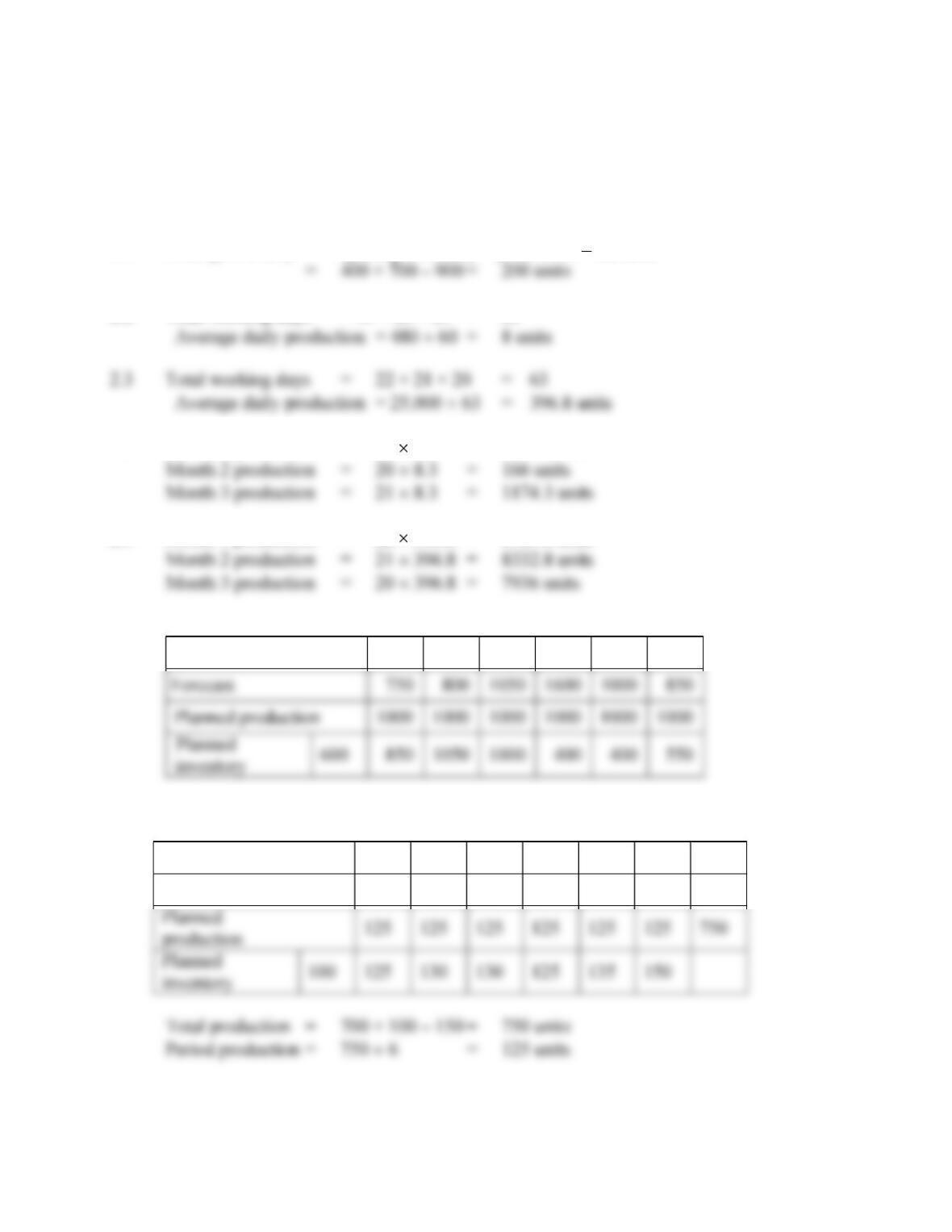
2.1 Ending inventory = opening inventory + production demand
2.2 Total working days = 19 + 20 + 21 = 60
2.4 Month 1 production = 19 8.3 = 157.7 units
2.5 Month 1 production = 22 396.8 = 8729.6 units
2.6
Per Period
1 2 3 4 5 6
2.7
Period 1 2 3 4 5 6 Total
Forecast demand 100 120 125 130 115 110 700
10
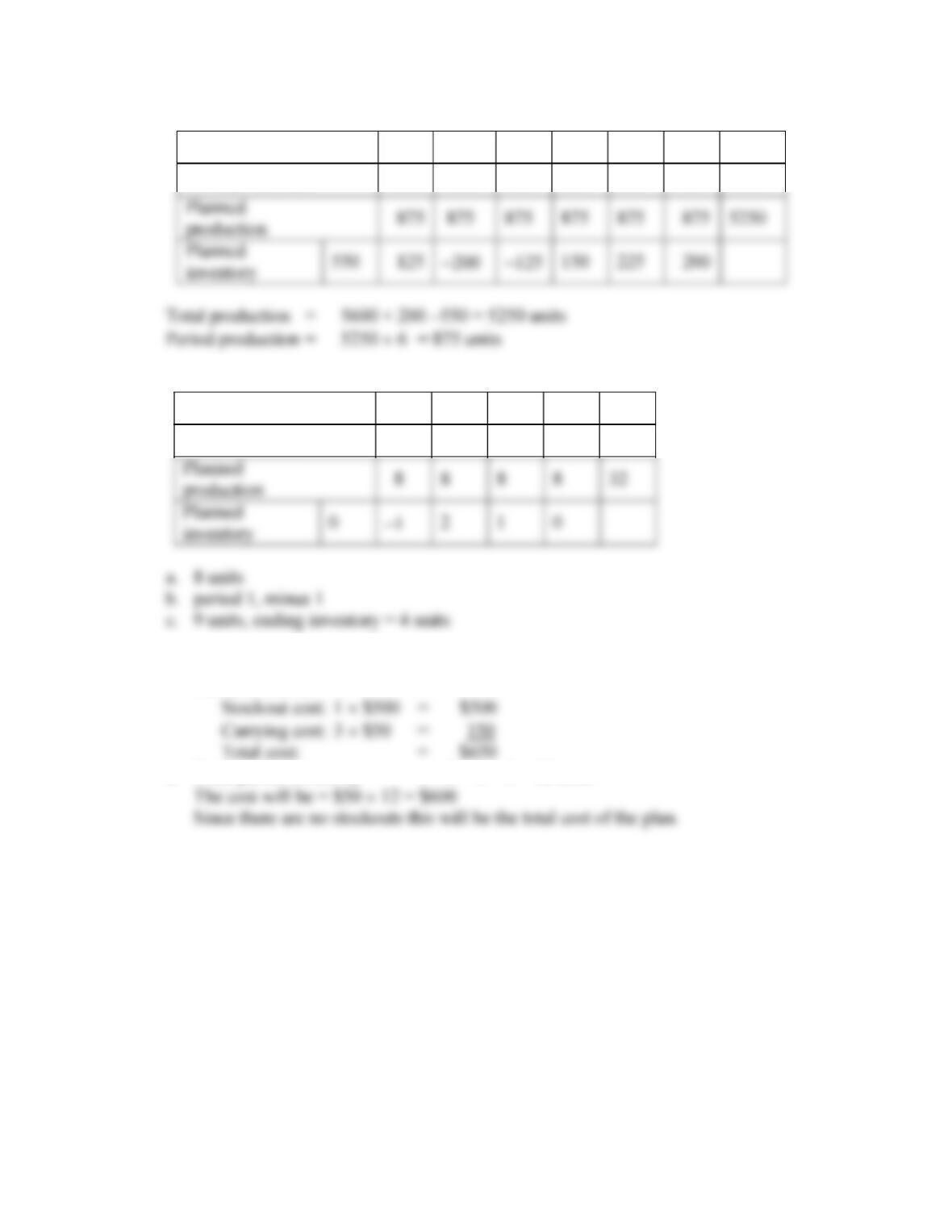
2.8
Period 1 2 3 4 5 6 Total
Forecast demand 1300
1200 800 600 800 900 5600
2.9
Period 1 2 3 4 Total
Forecast demand 9 5 9 9 32
2.10 a. There is a stockout of 1 unit in period one.
The cost will be:
c. Total period inventory = 0 + 5 + 3 + 4 = 12 units
11
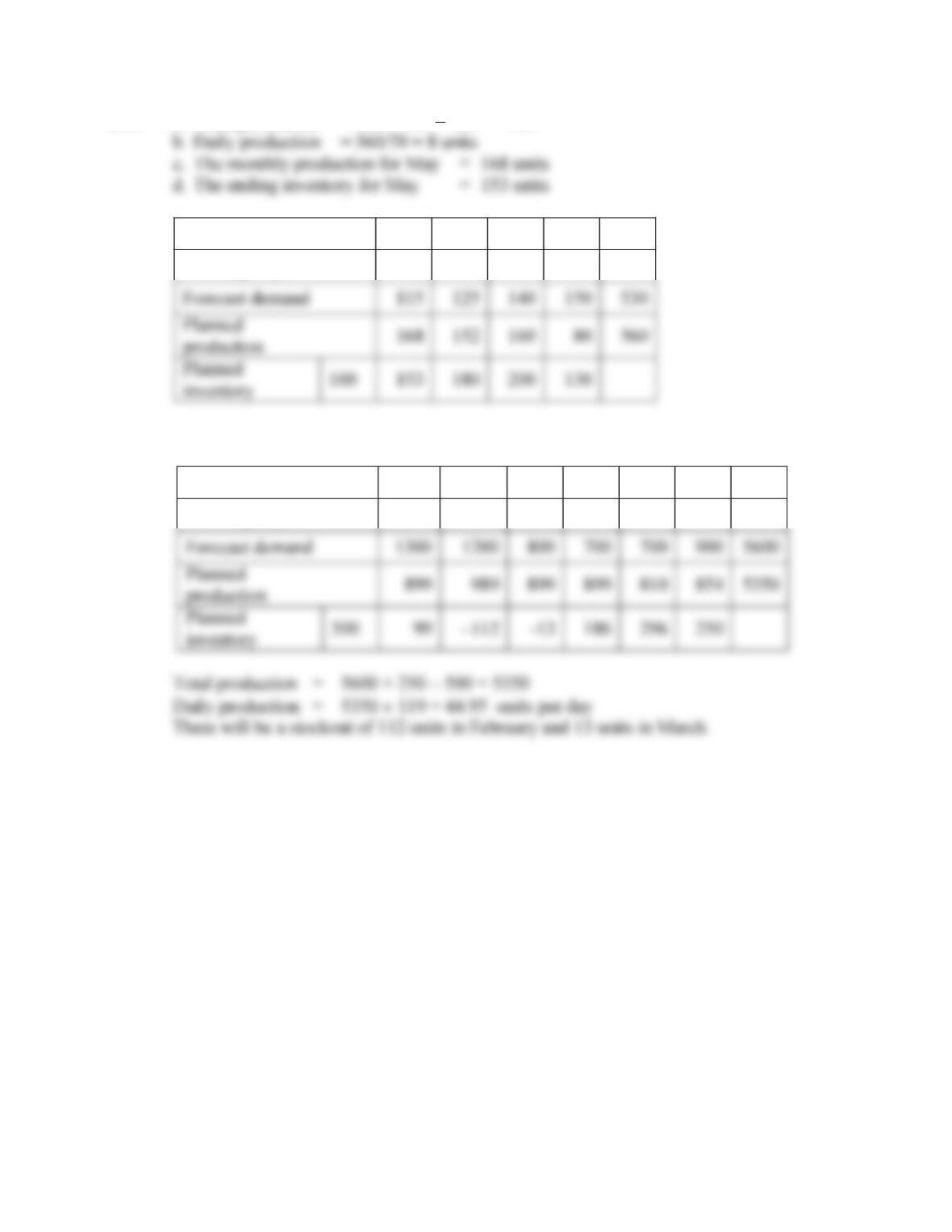
2.11 a. Total production = 530 + 130 100 = 560
Month May Jun Jul Aug Total
Working days 21
19
20
10
70
2.12
Month Jan Feb Mar Apr May Jun Total
Working days 20
22
20
20
18
19
119
12
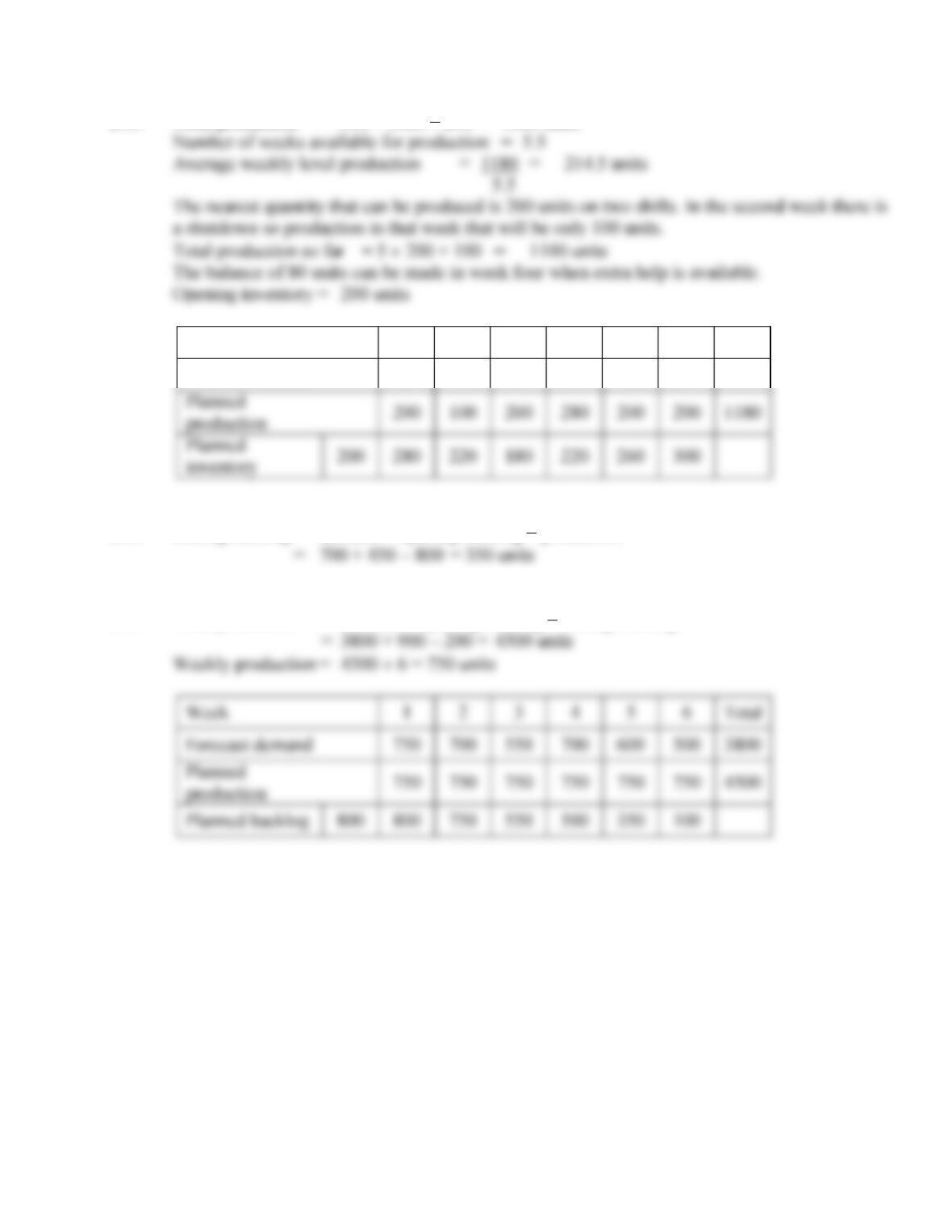
2.13 Total production = 300 + 1080 200 = 1180 units
Week 1 2 3 4 5 6 Total
Forecast demand 120 160 240 240 160 160 1080
2.14 Ending backlog = demand + opening backlog production
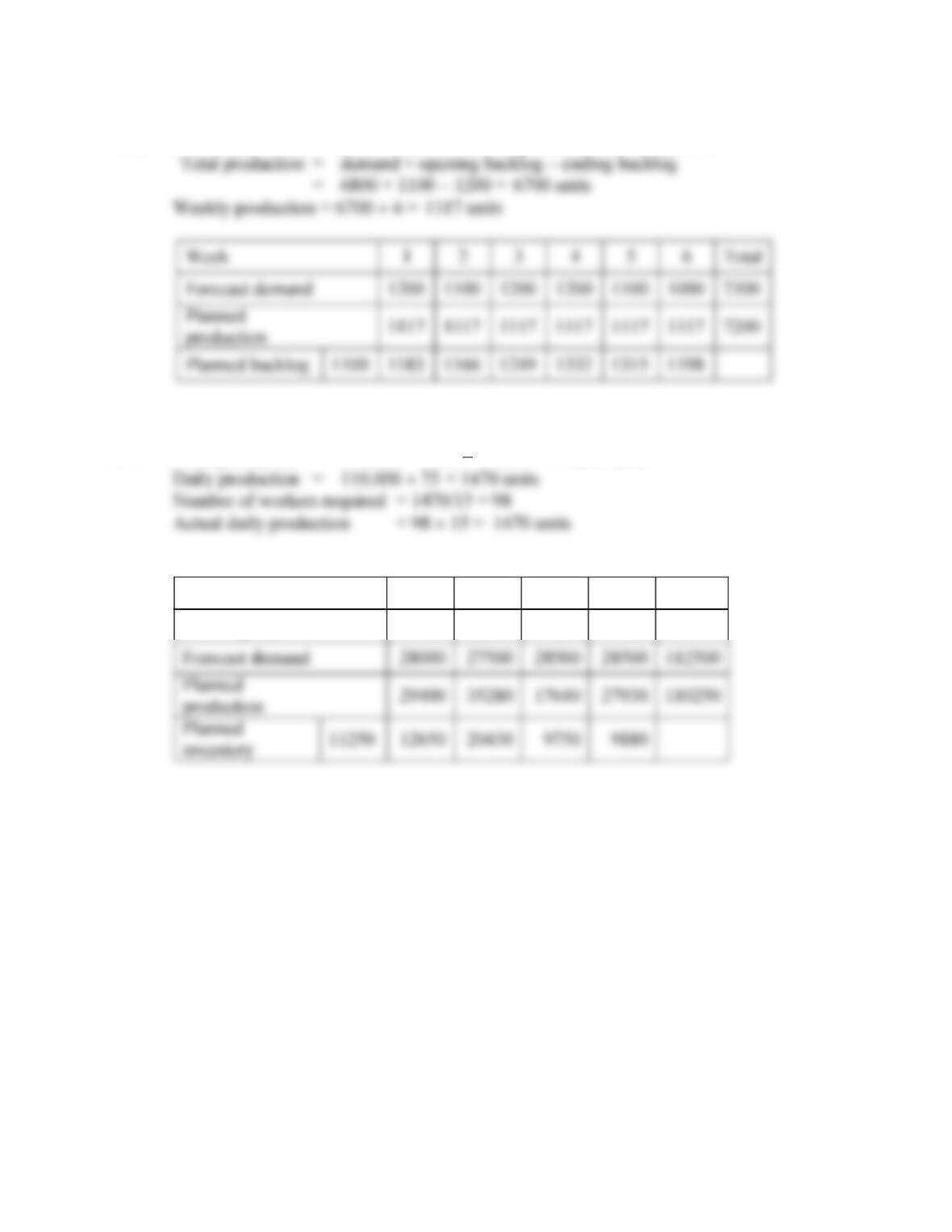
2.15 Total production = demand + opening backlog ending backlog
13
2.16 Desired ending backlog = 1200
Note: All weekly production amounts determined using standard rounding rules.
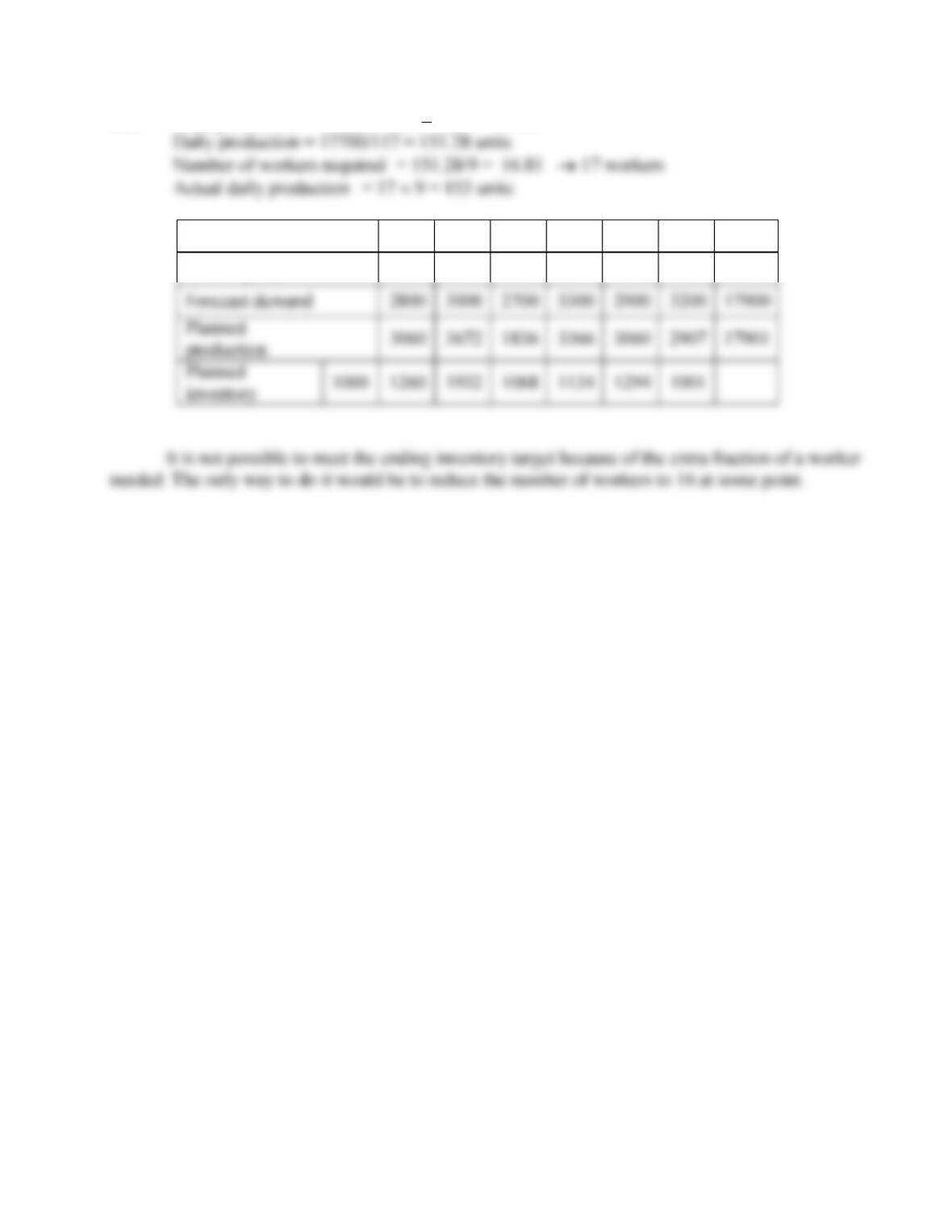
2.17 Total production = 112,500 + 9000 11,250 = 110,250 units
Month 1 2 3 4 Total
Working days 20
24
12
19
75
14
2.18 Total production = 17900 + 800 1000 = 17700
Month 1 2 3 4 5 6 Total
Working days 20
24
12
22
20
19
117
15
MULTIPLE CHOICE QUESTIONS
1. The ability of manufacturing to produce goods and services is called:
a. scheduling
b. production planning
c. capacity
d. routing
e. none of the above
2. Priority in production planning relates to:
a. routing
b. how much of what is needed and when
c. capacity
d. an objective of the firm
e. none of the above
3. Which of the following is an input to the production plan?
a. strategic business plan
b. financial plan
c. market plan
d. engineering plan
e. all of the above are inputs
4. Which of the following plans has the longest planning horizon and the least level of detail?
a. strategic business plan
b. production plan
c. master production schedule
d. all of the above have the same level of detail
e. none of the above
5. In terms of INCREASING level of detail, which is the best sequence of activities?
I. Material requirements planning.
II. Master production scheduling.
III. Production planning.
a. I, II and III
b. I, III, and II
c. II, III, and I
d. II, I, and III
e. III, II, and I
16
6. Over the time span of the production plan, which of the following can usually be varied to change
capacity?
a. work force
b. inventories
c. plant and equipment
d. all of the above
e. a and b above
7. Which of the following is a characteristic of a production plan?
a. time horizons are five years
b. the production plan is for individual items
c. the only objective is to have an efficient plant
d. all of the above are characteristics of a production plan
e. none of the above is characteristic of a production plan
8. Determining the need for labor, machines, physical resources to meet the production objectives of
the firm is called:
a. production control
b. production planning
c. capacity planning
d. all of the above
e. none of the above
9. The function of setting the limits or levels of manufacturing operations based on the market plan
and resource availability is called:
a. production planning
b. production activity level
c. capacity planning
d. all of the above
e. none of the above
10. A statement of a schedule of requirements for individual end items is called:
a. a master production schedule
b. a material requirements plan
c. a production plan
d. a capacity plan
e. none of the above
11. Which of the following statements is most appropriate regarding production planning?
a. a high level of detail is not needed
b. a translation must be made from product demand to capacity demand
c. product groups based on similarity of manufacturing process should be used in planning
d. all of the above are true
e. none of the above is true
12. Which of the following statements is best about sales and operations planning?
a. it provides an means of updating the material requirements plan
b. it includes only the marketing and production plans
c. it is usually updated on a monthly basis
d. it has no effect on inventory levels
17
13. Which of the following are characteristics of an MRPII system?
I. It incorporates the plans of marketing, production and finance.
II. It is a fully integrated planning and control system.
III. It has feedback from the bottom up.
a. I only
b. II only
c. III only
d. I, II and III
14. For the purposes of production planning, product groups should be established on the basis of:
a. market segments
b. similarity of manufacturing process
c. the availability of materials
d. the availability of machinery
e. all of the above
15. Which of the following is a basic strategy in developing a production plan?
a. hybrid strategy
b. production leveling
c. chase strategy
d. a and b above
e. b and c above
16. A production planning strategy which turns away extra demand is called:
a. production leveling
b. demand matching
c. hybrid strategy
d. all of the above
e. none of the above
17. Which basic production planning strategy will build inventory and avoid the costs of excess
capacity?
a. demand matching (chase)
b. production leveling
c. subcontracting
d. all the above
e. none of the above
18. Which basic production planning strategy avoids hiring and layoff costs and the costs of excess
capacity?
a. demand matching
b. operation smoothing
c. subcontracting
d. all the above
e. none of the above
19. If the opening inventory is 100 units, the sales are 500 units and the ending inventory is 200 units,
then manufacturing must produce:
a. 300 units
18
b. 400 units
c. 500 units
d. 600 units
e. none of the above
20. Over a 10-week period the cumulative sales are forecast at 10,000 units, the opening inventory is
200 units and the closing inventory is to be 100 units. What should be the weekly planned
production for level production?
a. 990
b. 1000
c. 1010
d. 1030
e. none of the above
21. Firms will generally make-to-stock when:
a. demand is unpredictable
b. there are many product options
c. delivery lead times are long
d. all of the above
e. none of the above
22. Firms will generally make-to-order when:
a. products are produced to customer specifications
b. there are many product options
c. product is expensive to make and store
d. all of the above
e. none of the above
23. Which of the following information is needed to develop a make-to-stock production plan?
I. Forecast by time period for the production plan.
II. Opening inventory.
III. Opening backlog of customer orders.
IV. Desired ending inventory.
a. I, II and III
b. I, II and IV
c. 1, III and IV
d. II, III and IV
e. none of the above
24. If the old backlog was 200 units, the forecast for the next period is 500 units, and production for the
next period is 600 units, what will be the backlog at the end of the next period?
a. 100 units
b. 200 units
c. 300 units
d. 700 units
e. 800 units
19
25. Which of the following is concerned with long-term planning of manufacturing activity?
a. Sales and operations planning
b. Master production scheduling
c. MRP
d. Production activity control
e. Master planning
26. Which of the following is NOT a rule of Sales and Operations Planning?
a. Product Groups need not be decided
b. Planning units of measure need to be decided
c. A planning horizon must include new product development time
d. Performance review periods to be compared should be decided
27. Which of the following is a complete closed loop planning system that develops plans for all
materials and operations?
a. Capacity requirements planning
b. Enterprise resource planning
c. Supply chain management
d. Material requirements planning
28. Which of the following represents the major reason for developing the production plan as part of
Sales and Operations Planning?
a. To decide how to best produce exactly what is in the sales plan
b. To plan for resources required to produce to the agreed plan
c. To plan a schedule for the production of individual products
d. To plan the acquisition of new manufacturing facilities
29. Which of the following is true?
I The strategic plan is stated in product terms
II The strategic business plan is stated in financial terms
III The strategic business plan is developed from the strategic plan
a. I and II only
b. I and III only
c. II and III only
d. I, II, and III
e. None are correct
30. Which following best represents the concept of sustainability?
a. The ability to make long production runs
b. The ability to train labor effectively
c. The ability to maintain the supplier base
d. The ability to continue operation in the long term
31. When a company establishes a program to recycle or reuse products discarded or returned from
customers it is typically called which of the following?
a. Product return contract
b. Reverse supply chain

20
c. Customer servicing
d. Resupply planning
32. Which of the following is most true about Sales and Operations Planning
a. It usually is produced only once a year
b. It usually includes only sales and manufacturing people
c. It is typically done in financial terms
d. It usually includes all functions at the executive level
Answers.