Total Quality in Organizations 18
integrated their QMS with enterprise resource planning (ERP), less than 30% with
manufacturing execution systems (MES), and only about 25% with supply chain management
(SCM).
ANSWERS TO DISCUSSION QUESTIONS
1. Compare the Deming Chain Reaction (Figure 2.1) with Figure 1.3, which suggests the
relationships between quality and profitability. Discuss the similarities and differences.
Which do you think is the better model, if you had to choose one to present to a senior
manager? Can you suggest a different model that captures both?
When one compares the Deming Chain Reaction (Figure 2.1) with Figure 1.3, which suggests
the relationships between quality and profitability one can see that Deming’s model emphasizes
quality of conformance on the right-hand side of the quality and profitability model (Figure 1.3).
Although “the market” is mentioned in Deming’s model, quality of design is not explicitly
treated. Lower prices in his model also imply cost reductions which are passed on to customers,
as opposed to higher prices in Figure 1.3. The case could be made for using either model in a
2. Discuss the interrelationships among Deming’s 14 Points. How do they support each
other? Why must they be viewed as a whole rather than separately?
Deming’s 14 points are interrelated as part of a complete system. They support each other as part
of a complete system for managing. For example, Point #1 requires that managers publish a
statement of the aims and purposes of the organization. Point #9 states that management must
optimize the efforts of teams, groups, and staff areas toward meeting the aims and purposes of
the organization. Deming felt that a company – the whole company – must commit to quality as a
total effort, as published in their aims and purposes. This means that all 14 points must be
adopted as a package. You can’t embrace the quality philosophy in one area of work and ignore it
Total Quality in Organizations 19
3. The following themes form the basis for Deming’s philosophy. Classify the 14 Points into
these categories and discuss the commonalties within each category.
Deming’s 14 points may be put into the six categories listed, but it should be realized that some
of his 14 points apply to more than one category.
a. Organizational purpose and mission: Points 1, 7, 9, and 14. These relate the need to
develop a mission statement (aims and purposes), publish the statement, develop
leadership to carry out the purpose, focus the efforts of everyone on the mission, and
act to ensure that the transformation happens.
b. Quantitative goals: Points 3, 4, 8, 10, 11.a. & 11.b. These points may not be chosen
by everyone, but several have “hidden agendas” that relate to quantitative goals.
Inspection (point 3) is frequently used to develop quantitative goals and to “catch”
problems (and the people who supposedly caused them) after they have occurred.
Price tags (point 3), rather than overall quality levels, are the quantitative goal used to
measure the efficiency, rather than effectiveness of the purchasing function. Fear
(point 8) has been heightened, as workers are exhorted (point 10) to “do better” and
Total Quality in Organizations 20
4. A team of quality professionals has suggested a revised version of Deming’s 14 Points
“for the twenty–first century,” as given in Table 2.4. Contrast these with Deming’ s version
in Table 2.1. What do you think of the revision? Can organizations today use them
effectively to improve
quality?
In the year 2000, Deming proposed a new version of the 14 Points versus the original 14 Points.
This version showed more of a systems emphasis than the original. For a number of points,
Deming shortened and simplified them, perhaps to eliminate the obvious duplications, and
perhaps to make them easier to remember.
The team of quality professionals who suggested the revised version of Deming’s 14
Points “for the 21st century,” as given in Table 2.4 seemed to take a more “process” view, while
attempting to retain some of the concepts of Deming’s systems view. It is not easy to compare
these points with Deming’s version in Table 2.1, because they do not match, point for point.
Deming constantly questioned the mind-set of managers, and challenged them to “adopt a
new philosophy.” Deming was not afraid to suggest that management actions or inactions were
at the heart of quality problems, and that behavioral goals needed to be set. The new 21st century
version of the 14 points seem to recognize that there are process problems that management can
correct, but the critical tone that Deming took, and the management behaviors that he advocated,
are avoided by the 21st century version.
21st Century Version
1. Increase value through products and services that delight customers.
2. Connect customer requirements to key process variables.
3. Prevent, where possible; inspect where necessary; implement process management.
4. Pick the vital few suppliers based on total cost and fit with the organization.
5. Improve processes now; find those that will need it later; sustain gains over time.
6. Build training into jobs so employees can improve their performance.
Deming’s Version (Abbreviated)
1. Create a Vision and Demonstrate Commitment. Originally, in Deming’s earlier
version, commitment to aims and purposes of the organization by senior leaders was
something that might or might not be made clear to employees throughout the
Total Quality in Organizations 21
organization. In the newer version, Deming urged that it be “published” to all
employees.
2. Learn the New Philosophy. Again, the older version suggested that it was primarily
the job of management to adopt the new philosophy and provide leadership for
change. The new version emphasizes the need for communication of values,
expectations, customer focus, and learning as a key area for everyone.
3. Understand Inspection. In the old version, it appeared that Deming wanted to end
inspection (although a closer reading showed that he did not advocate ending all
inspection). The newer version suggests the need to develop appropriate measurement
Total Quality in Organizations 22
5. Suggest ways that management can recognize the existence of fear in an organization.
What strategies might managers use to deal with and eliminate fear?
Fear can become apparent in many ways in organizations. Workers will tend to do only what
they are told to do. They will be afraid to “stick their necks out.” Managers will be the last to
hear of a quality or production problem, because there is a tendency to “shoot the messenger,”
6. Discuss how Deming’s 14 Points can apply to an academic environment. How can
learning and classroom performance be improved by applying Deming’ s philosophy?
Deming’s philosophy can be applied to an academic environment, but only with concerted efforts
on the part of faculty, administrators, and students. Professors obviously serve in a key role in
transforming the classroom to a total quality environment. Unless they “adopt the new
philosophy,” change will never come about. Many classes operate on a “control” model and the
7. In a videotape made in 1993, Deming related a story of an executive who spent an entire
day flying from city to city, changing planes several times, because her company’ s travel
department received a cheaper fare than if she had taken a direct flight. How does this
example violate the concepts of Profound Knowledge and the 14 Points, and what should
the company do about it?
Deming’s classic example of the woman on the airplane is an illustration of sub-optimization —
optimizing goals of a sub-unit of an organization while undermining the goals of the larger
Total Quality in Organizations 23
organization. It shows that the people in the Travel Department did not understand the concept of
the system in which they worked. Thus, the components of any system must work together if the
system is to be effective. As pointed out in the answer to question 5, suboptimization results in
losses to everybody in the system. The Travel Department wins, the traveler’s department loses,
etc. Management must have an aim, a purpose toward which the system continually strives and
must understand the interrelationships among the systems’ components and among the people
8. Melissa Clare works for a software company as a technical support representative. Her
duties include answering the telephone, providing information to customers, and
troubleshooting technical problems. Her supervisor told her to be courteous and not to
rush callers. However, the supervisor also told her that she must answer an average of 15
calls per hour so that the department’s account manager can meet his or her budget.
Melissa comes home each day frustrated because the computer is slow in delivering
information that she needs and sometimes provides the wrong information, causing her to
search for the information in complex manuals. When she is pressed for time, she often
cuts the call off prematurely or provides only the minimal information necessary. What
might Deming say about this situation? Explain which of the 14 Points might be violated.
Drawing upon Deming’ s principles, outline a plan to improve this situation.
Melissa’s job is to satisfy customers who are trying to obtain information or make reservations,
while she simultaneously attempts to satisfy her internal customers, the supervisor and the
account manager. Using Deming’s principles, her supervisor (and the supervisor’s customer, the
account manager) need to “adopt the new philosophy” of quality, to remove the barriers in the
Total Quality in Organizations 24
9. What implications might Deming’s Profound Knowledge have for Wall Street traders
whose buying and selling behavior reacts somewhat wildly to daily news and government
economic reports?
Understanding of Deming’s Profound Knowledge concept might have a profound impact if
applied diligently to transactions on stock exchanges around the world. Theory of knowledge is
the branch of philosophy concerned with the nature and scope of knowledge, its presuppositions
and basis, and its general reliability of claims to knowledge. In Deming’s system, this involves
10. Think of a system with which you are familiar, such as your college, fraternity, or a
student organization. What is the purpose of that system? What would it mean to optimize
that system?
See Review Question 3, above, for a discussion of how optimization relates to Profound
Knowledge from which to begin discussion. Answers will vary, depending on the organization
chosen. Optimization requires recognizing the fact that there are interactions among the parts of
11. Whose philosophy — Deming, Juran, or Crosby — resonates most with your thinking
and experience? Explain why.
Answers will vary, depending on the experiences of the student. See the answer to Review
questions 4, 8 and 11 for a frame of reference for this discussion.
12. Review the Quality Profiles presented at the beginning of this chapter. List specific
practices cited in these examples and how they support the quality management principles
in Table 2.2.
Texas Nameplate

Total Quality in Organizations 25
Quality practices include leadership’s changing the organizational structure from a traditional
top-down approach to a bottom-up approach, continuous learning, empowering teams and
production workers, process design to meet company goals and team-set standards, and
conducting customer and employee surveys. Implied practices included fair compensation and
recognition and career development.
Medrad, Inc.
Quality practices are distributed decision making, creating a culture for high performance,
creating agility, customer listening methods, complaint process, and corrective actions.
13. Think of your experiences in a job that you have held. How might the principles and
practices of quality management listed in Tables 2.2 and 2.3 be applied to improve this
organization?
Answers will vary, depending on the experiences of the student. See the answer to Review
questions 14 and 15 for a frame of reference for this discussion.
14. List some examples of variation that you observe in your daily life. Would they be
classified as common or special causes? How might they be reduced?
Common causes of variation occur as a natural part of any process and are difficult to change
without making a major change in the system of which they are a part. Special causes of
variation arise from sources outside the system and can generally be traced back to a specific
change that has occurred and needs correction. For example, a process may be stable and running
15. One of our former students who sews as a hobby observed that it’ s often difficult to
control thread tension (tightness versus slackness of the stitch) as the tension normally
exhibits variation. She learned from experience that if she adjusts the tension every time a
stitch comes out too tight or loose, it generally makes matters worse. However, other times,
the stitching is clearly bad and requires an adjustment. Explain how her observations
relate to statistical thinking. Can you think of other situations in your life that illustrate
these concepts?
In this chapter, statistical thinking is defined as a philosophy of learning and action based on
these principles:
1. All work occurs in a system of interconnected processes.
Total Quality in Organizations 26
2. Variation exists in all processes.
3. Understanding and reducing variation are keys to success.
The student has learned to see her sewing work in the context of a system of interconnected
processes (material, thread, machine characteristics, and her own work in the system). Like the
Deming funnel experiments, she has also observed that making adjustments in the process when
SUGGESTIONS FOR PROJECTS, ETC.
1. Study the annual reports of some major companies issued over a period of several years.
Do you see evidence of implementation of the quality principles and practices discussed in
Tables 2.2 and 2.3?
We have a similar question and case (Deere, Inc.) in Chapter 1. If students have answered these,
it would be easy to identify specific principles and practices evident in the company’s activities.
2. Design a questionnaire or survey instrument to determine the degree to which an
organization is “Demingized.” Explain how you developed the questions.
Students should use principles from the 14 Points and Profound Knowledge to design the
questionnaire.
3. Interview a quality professional at a local company about their quality management
system. Consider questions such as: Do they have a quality manual? Is their QMS
integrated with other enterprise business systems?
Students should identify the components of the system to learn how quality is implemented in
4. Interview some managers at a local company that is pursuing or has pursued ISO 9000
registration. Report on the reasons for achieving registration, the perceived benefits, and
the problems the company encountered during the process.
This exercise is designed to expose students to the use of ISO 9000 in organizations. Students
Total Quality in Organizations 27
5. Search the Internet to find information about current registration trends for ISO 9000.
How widespread is ISO 9000 in the United States as compared to Europe and other global
regions?
The International Organization for Standardization (IOS) website www.iso.org is an interesting
ANSWERS TO CASE QUESTIONS
I. The Disciplinary Citation
Discussion Questions
1. What is your opinion of the manager’s approach? How does it compare with the Deming
philosophy?
This case study shows Deming’s Red Bead Experiment in action. Drivers are being blamed for
2. How might the analysis of these data help the manager to understand the variation in the
system? (Plot the data to obtain some insight.) How can the data help the manager to
improve the performance of this system?
Note that this part of the case solution uses techniques which are not discussed until later
chapters. Students, of course should not be expected to take any more than an intuitive approach
to the analysis. A run chart (see the Excel file C02 Disciplinary Citation Case in the instructor
materials for Chapter 2) would appear to be a way to begin to understand the process and to
determine if it is in control or not. Most students would already know how to at least plot the
data on a line chart in Excel. Based on the data, we have:
Center Line (average) for the chart = 280/40 = 7.0 mistakes
The data show that 15 drivers have exceeded the average. Also, 6 drivers had “no
defects”. A Pareto chart (also shown in the Excel file) also shows that only 5 drivers have 15 or
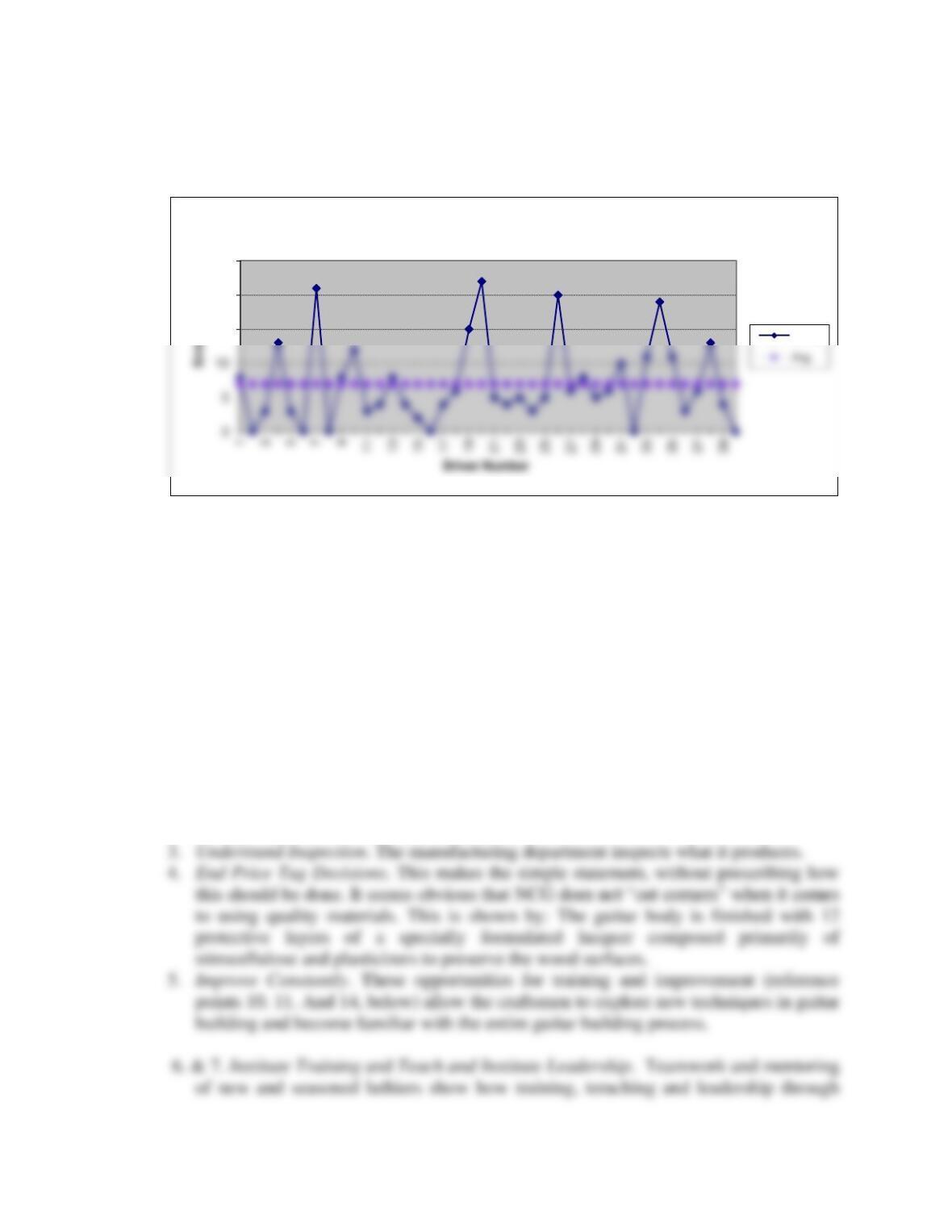
Total Quality in Organizations 28
II. Nashville Custom Guitars
Based on this descriptive tour of NCG, can you identify how the operations and quality
practices reflect Deming’ s 14 Points?
Based on the narrative tour of The Nashville Custom Guitars, it is easy to identify how the
operations and quality practices reflect Deming’s 14 points. Almost every point can be matched
with a specific practice followed by NCG.
1. Create a Vision and Demonstrate Commitment. This principle is exemplified in the
small staff of 14 craftsmen, known as luthiers, who apply care and attention to detail
while hand-crafting the major components of each instrument. Also, the company
recruits only those who desire to work in a team environment and have a passion for
guitar making. The following Deming principles can be applied to NCG.
2. Learn the New Philosophy. Experienced luthiers, who are empowered to make their
own quality decisions, staff each station.
15
20
25
Package Errors by Driver
Errors
Total Quality in Organizations 29
mentoring is “ built in” to the process. The guitar does not move to the next station
until the luthier and another more senior luthier are satisfied with the quality of the
work.
8. Drive Out Fear and Innovate. Although modern computer numerical controlled
(CNC) equipment is used to manufacture minor parts of the guitar, the secret of
NCG’s success lies in the small staff of 14 craftsmen.
9. Optimize the Efforts of Teams and Staff. The shop floor is divided into six
workstations at which the guitars are progressively assembled as they move from
station to station.
Note that there are several guitar companies that have provided detailed descriptions of their
handcrafted and semi-automated manufacturing processes for guitars via YouTube videos on the
Internet. Some of these include:
III. Walker Auto Sales and Service
Drawing upon the principles of quality management and the unique nature of services
addressed in Chapter 1, describe some of the issues that Darren must consider in achieving
his vision. Develop a list of action plans that he might consider.
Issues that Darren is encountering or may encounter include:
Total Quality in Organizations 30
• Customer needs and performance standards are often difficult to identify and measure
in services, primarily because the customers define what they are and each customer
is different.
• The production of services usually requires a higher degree of customization, so
employees must tailor their services to individual customers
• The output of many service systems is intangible, so service quality can only be
assessed against customers’ subjective, nebulous expectations and past experiences.
(What is a “good” sales experience?)
• Services are produced and consumed simultaneously, and many services must be
performed at the convenience of the customer. Attention must be paid to training and
Action plans that Darren might consider developing must tailor the systems to the needs of
various types of customers. He must ensure that he develops appropriate infrastructure, practices
and tools to support his vision. These might include:
a. Customer relationship management
b. Leadership and strategic planning
c. Human resources management
d. Process management
e. Information and knowledge management
For example, car buyers have different needs from those who are coming in for shop service to
their cars. For car buyers to be able to obtain a wide range of vehicles and options to evaluate,
have access to available salespeople, enjoy a prompt greeting, and feel comfortable and un–
pressured in reaching a buying decision, Darren must plan on exercising leadership and strategic
Total Quality in Organizations 31
IV. The Quarterly Sales Report
How can Hagler improve his approach by applying principles of statistical thinking? Use
any analyses of the data that you feel are appropriate, such as construction of Excel charts
or computing summary statistics to fully explain your thinking and help him.
Obviously, Hagler has got to look beyond the quarterly sales reports to find out what is really
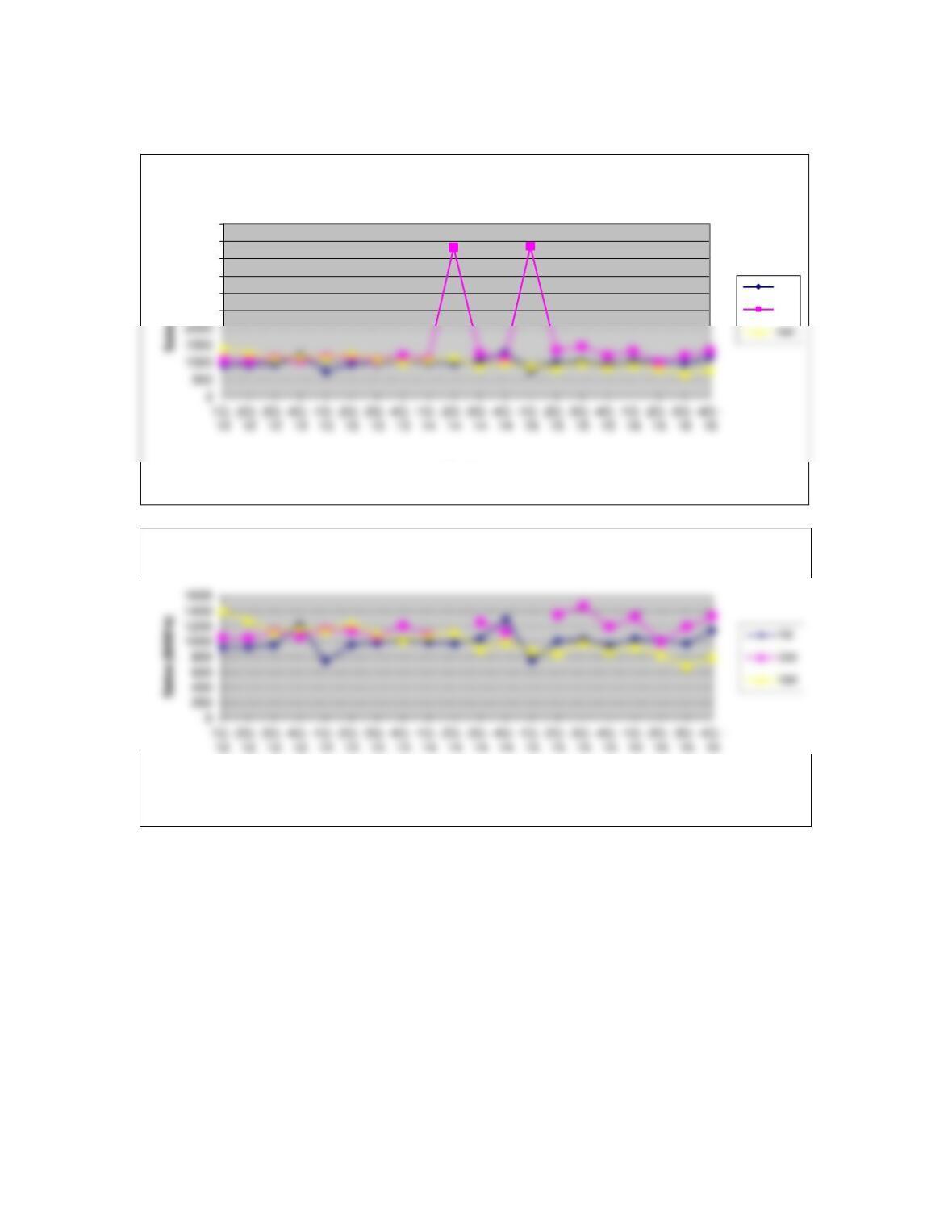
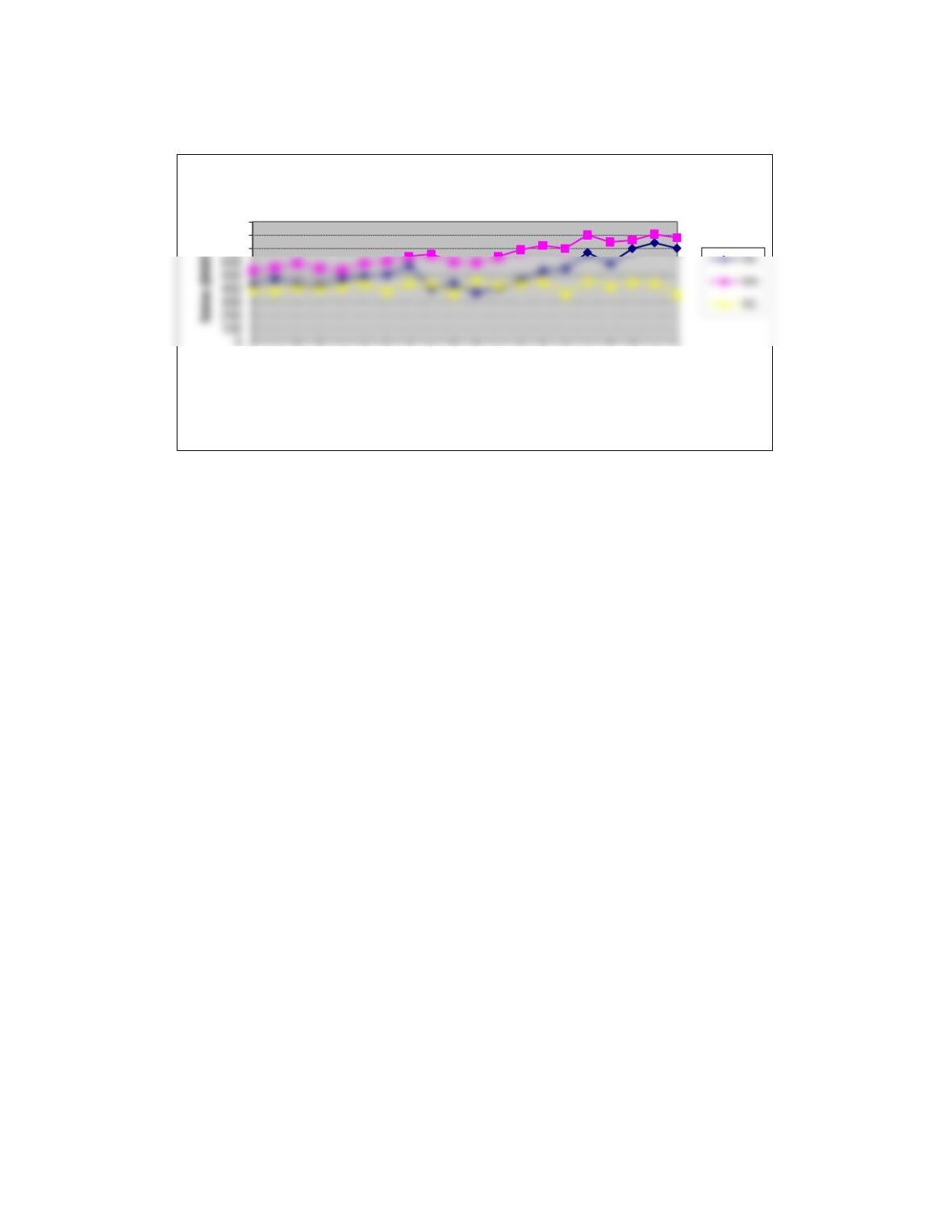
going on in his regions. Two simple run charts (see the Excel file C02 Quarterly Sales Case in
the instructor materials) that plot the entire 5 years of data, divided into large regions and small
regions, are very revealing. He might start with those charts to see what the general trend has
been.
The Northeast, Southwest, and Northwest regions show basically flat sales for the 5-year
period. The Southwest region had a strange jump in sales in the second quarter of 2014 and again
in the first quarter of 2015, possibly due to inventory reduction sales. Otherwise, the three
Total Quality in Organizations 32
2500
3000
3500
4000
4500
5000
Quarters
Large Regions’ Quarterly Data
NE
SW
Quarters
Large Regions’ Quarterly Data – Without Sales Jump
Total Quality in Organizations 33
0
700
800
900
1Q
–
12
2Q
–
12
3Q
–
12
4Q
–
12
1Q
–
13
2Q
–
13
3Q
–
13
4Q
–
13
1Q
–
14
2Q
–
14
3Q
–
14
4Q
–
14
1Q
–
15
2Q
–
15
3Q
–
15
4Q
–
15
1Q
–
16
2Q
–
16
3Q
–
16
4Q
–
16
Quarters
Small Regions’ Quarterly Sales