Page 1 of 13
Chapter 2: Quality Theory
Chapter Outline
• Quality Theory
▪ What is Theory?
▪ Leading Contributors to Quality Theory
• W. Edward Deming
• Joseph M. Duran
• Kaoru Ishikawa
• Armand Feigenbaum
• Philip Crosby
• Genichi Taguchi
• The Rest of the Pack
▪ Viewing Quality from a Contingency Perspective
▪ Resolving the Differences in Quality Approaches: An Integrative Approach
Overview
When the author discusses theory, he is not being philosophical; rather he
discusses the major “players” and their contributions to the subject. On page 26, the point
is made that “there is not a unified theory explaining quality improvement.” The author
Page 2 of 13
Discussion Questions
1. Define theory. Why are theories important for managing quality in the supply
chain?
The author states that in order for a theory to be complete, it has to answer these
questions:
• What?
• How?
• Why?
• Who?
• Where?
• When?
How does practice relate to theory? You might also ask how this relates to the classic
definition of theory that we have studied in other disciplines.
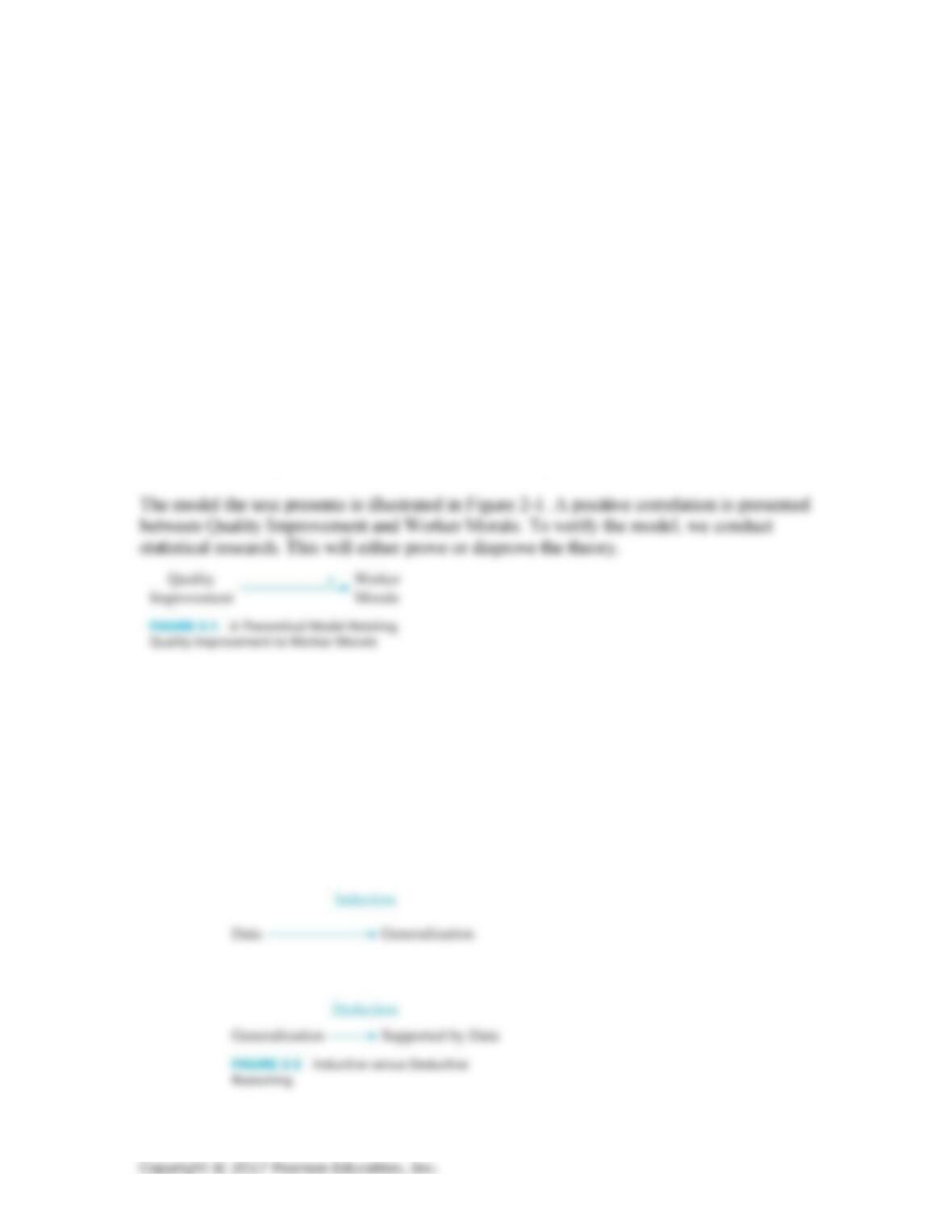
2. Describe the differences between induction and deduction. If you developed a
theory based solely on your experiences of quality practices in business
organizations, would you be basing your theory on induction or deduction? Why?
On page 25, the text discusses a Morale Check at a Chicago-based company just after the
Cubs won the World Series. Morale is found to be positive. Students must decide: is this
inductive or deductive? What are examples of inductive and deductive theory from the
class’s perspective. If one looks at the classic theories – Evolution, Relatively, Theory X,
Y, and Z – are they individually inductive or deductive?
3. Do you believe that the development of a unified theory of quality management is
possible? What is a unified theory?
On page 26, “A Closer Look at Quality – The Product That is Quality” looks at the
different approaches to quality. As you discuss the key players, this might be a good
question to keep going on the side.
4. Why do managers need to be cautious about purchasing material (e.g., courses,
workbooks, videos, and so on) on quality management from trainers and
consultants? How would you go about selecting this type of material?
In the quoted article, The Product That is Quality, the statement is made that, “Within
each approach, corporate managers are confronted by a numbing maze of acronyms and
buzzwords. There is TQC, TQM, fishbone diagramming, cause and effect, poka yoke, big
5. Briefly describe the contributions W. Edwards Deming made to the field of
quality management. Why do you believe he is the most influential quality expert?
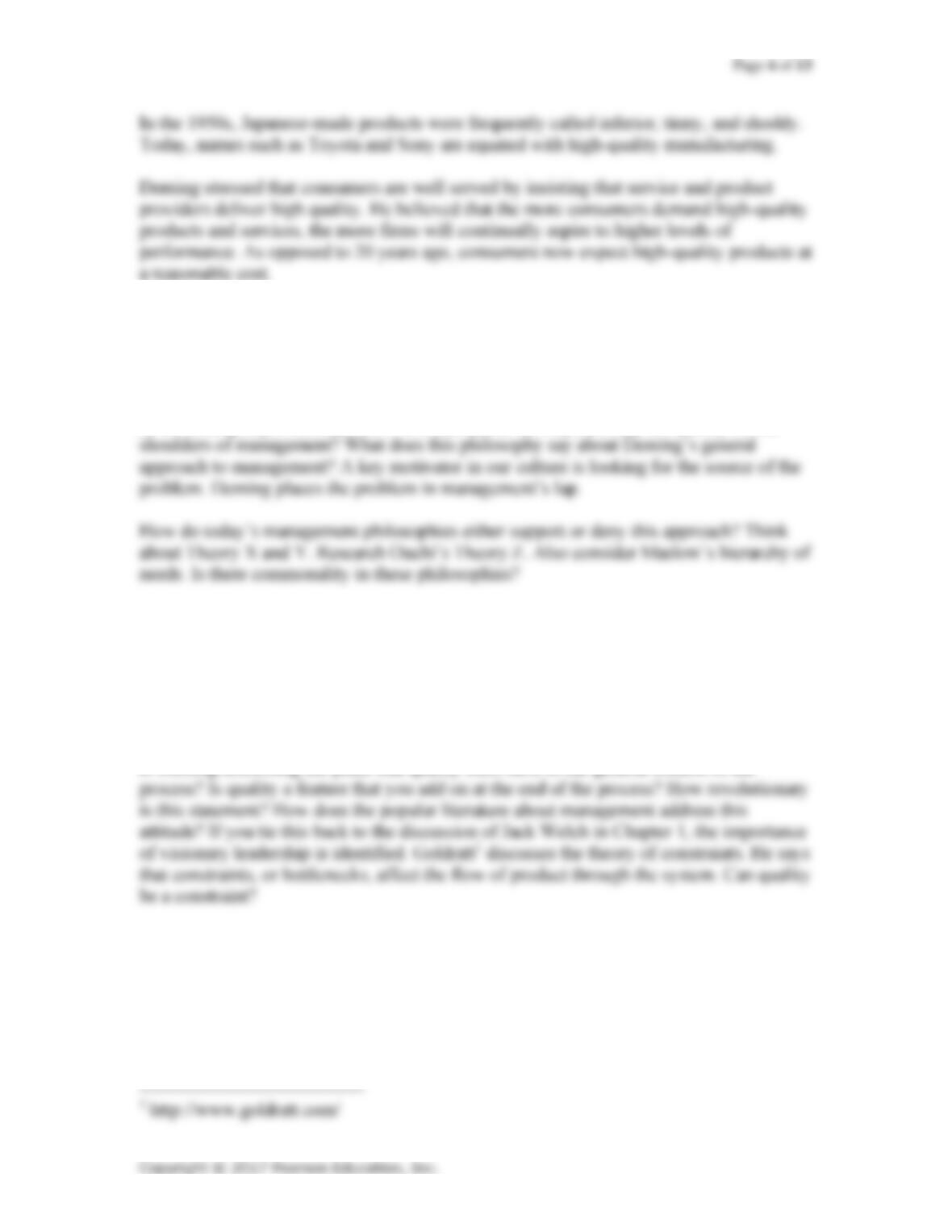
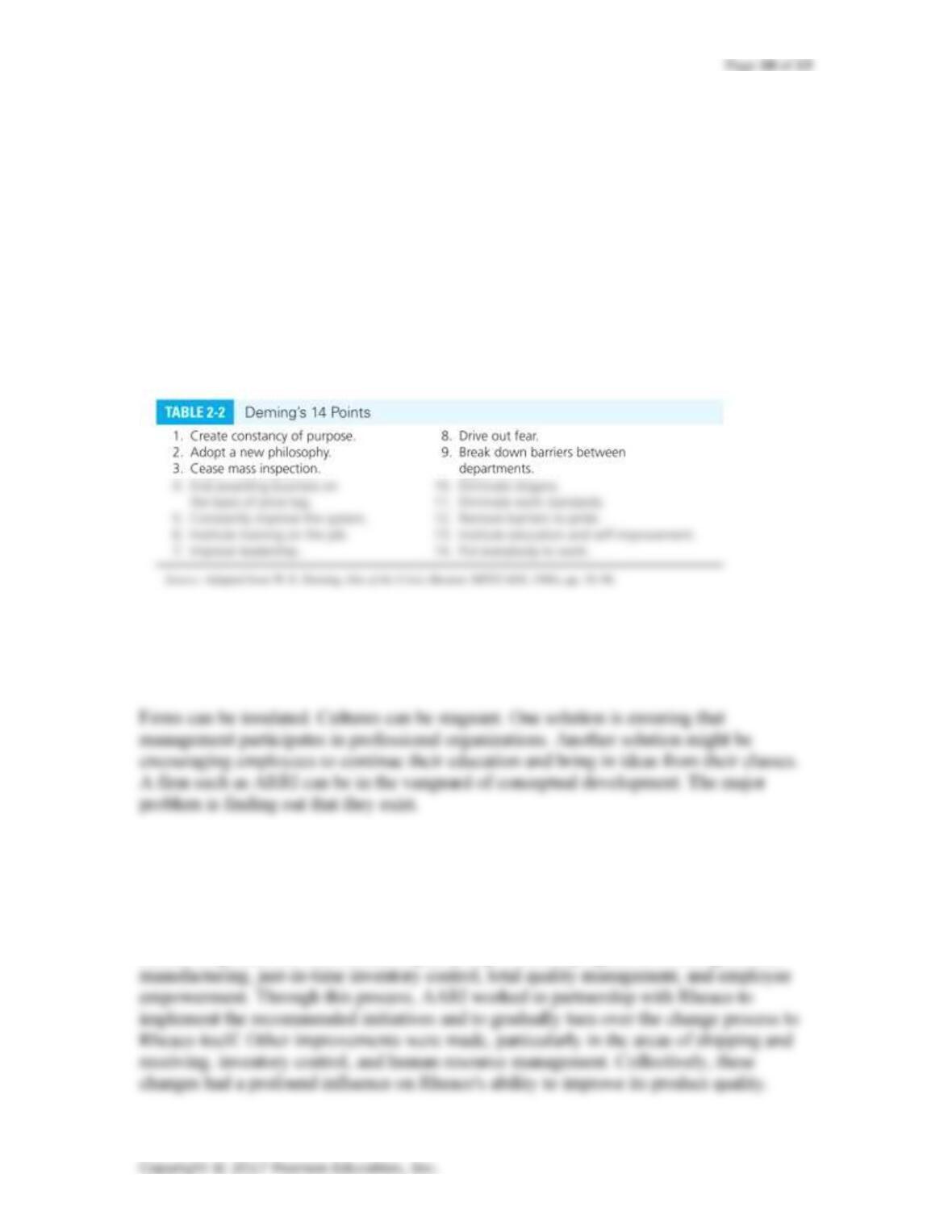
Deming outlined 14 points for management:
6. Deming believed poor quality was not the fault of workers but resulted from poor
management of the system for quality improvement. Do you agree with Deming’s
stand on this issue? Why or why not?
Answers here will vary. Some things to consider: Deming raises the topic of “continual,
never-ending improvement.” How does this place the responsibility for quality on the
7. Deming was not an advocate of mass inspection as a means of ensuring product
quality. Please explain Deming’s beliefs in this area.
Taken out of context, the statement is curious. However, from page 29, we read:
“Eliminate the need for inspection on a mass basis by building quality into the product in
the first place.”
Is Deming discussing the place that quality must have in the general context of the
8. Select one of Deming’s 14 points for management and describe how this point
could have resulted in quality improvements in a business or volunteer organization
with which you have been involved.
Every successful manager can point to failures in his or her past. The difference between
a successful manager and an unsuccessful manager is how he or she reacts to those
9. Briefly describe the contributions that Joseph M. Juran made to the field of
quality management. What do you believe was Juran’s most significant
contribution?
10. Is the concept of scientific management compatible with employee
empowerment? Why or why not?
11. Does the phrase “quality is the responsibility of the quality department” reflect a
healthy perspective of quality management? Please explain your answer.
This revolves around the question, “Whose job is quality?” By centralizing quality,
Taylor removed it from the day-to-day operation of the company. As the topic of quality
is removed from the production floor, what is management’s response going to be? If we
look back at Juran, is this now a control or a breakthrough function? Why?
12. Briefly describe the Japanese quality revolution following World War II. What
can modern day managers learn from studying the history of this era?
After the war, the industrial leaders in Japan turned their attention toward improving the
quality of Japanese manufactured goods. The quality revolution in Japan was initiated
through the following steps:
• They sent teams abroad to learn how foreign countries achieved quality.
13. What was Joseph Juran’s primary contribution to quality thinking in America?
Discuss Juran’s three-step process to improving quality.
Juran’s three-step process was:
• Planning
14. Hothouse quality refers to those quality programs that receive a lot of hoopla and
no follow-through. Provide several examples of management practices that can lead
to hothouse quality. How can hothouse quality be avoided?
Management practices that are focused on achieving short-term objectives and/or
immediate results are susceptible to hothouse quality. Hothouse quality programs often
15. Compare and contrast Deming’s, Juran’s, and Crosby’s perspectives of quality
management. What are the major similarities and differences between their
perspectives?
Deming addressed the entire process and focused primarily on the assertion that poor
quality is not the fault of the worker, but is the fault of the system. Deming also strongly
opposed the creation of quality inspection departments. He felt that quality should not be
the responsibility of the quality inspection departments. It should be built into the
product.
Juran’s work focuses on the idea that organizational quality problems are largely the
result of insufficient and ineffective planning for quality. In addition, Juran fleshed out
16. Describe Taguchi’s perspective of ideal quality. Does this perspective have
practical applications? If you were a manager, would you consider using the
Taguchi method? Why?
Table 2-4 on page 37 provides an overview of the Taguchi method.
Page 8 of 13
Taguchi accomplishes these steps by emphasizing a three-fold approach to quality:
• The definition of quality
17. Why do you think that reengineering programs have such a high failure rate?
Can you think of ways to improve the success rate of reengineering programs?
Reengineering bypasses the analysis and design steps and tries to piggyback on the past
successes of others. Reengineering programs have experienced a high failure rate
18. Describe how the contingency perspective helps us understand why a single
approach to quality management may never emerge.
The text states that firms that are successful in quality do not adopt a blanket “Deming
19. How can a philosophy of quality improvement help a firm in its overall efforts of
improving the quality of its products and services?
The one common element of all these approaches is that quality cannot be an adjunct to
the process. Quality must be an integral part of the development. For this to happen, a
20. Do you believe that CEOs and business managers should be skeptical about the
quality movement, or should they embrace the quality movement and try to involve
their firms in as many quality initiatives as possible? Please explain your answer.
The key to this question may be the phrase “as many quality initiatives as possible.” Any
Case 2-1: Rheaco, Inc.: Making a Quality Turnabout byAsking for Advice
Discussion Questions:
1. Many companies fail in their efforts to improve quality without ever having asked
for advice. In your opinion, what are some of the reasons that inhibit firms from
asking for timely advice? If you were a manager at Rheaco, would you have sought
out an agency like the ARRI?
Many companies get into “fire fighting mode.” They are so busy solving immediate
problems that no one has time to dig into the cause of the problems.
Many of Deming’s 14 points speak to this problem:
Adopting a new philosophy (point 2), driving out fear (point 8), and remove barriers to
pride (point 12), all seem to be based on point 7, improve leadership. The problem is that
sometimes leadership does not realize that they are the roadblocks.
2. Discuss ARRI’s recommendations to Rheaco. How did these recommendations
help Rheaco improve its product quality?
First, AARI helped Rheaco develop an Enterprise Excellence Plan, which acted as a
roadmap for Rheaco’s improvement efforts. Consistent with this effort, AARI helped
Rheaco implement several standard quality improvement programs, including cellular
Page 11 of 13
3. ARRI’s initial evaluation of Rheaco indicated that Rheaco’s employees, despite
the company’s difficulties, had an overall positive attitude. Do you believe that this
factor contributed to ARRI’s ability to provide Rheaco advice? Why or why not?
Most students will say that the attitude of Rheaco’s employees was a significant factor in
AARI’s ability to provide Rheaco advice. As discussed in Chapter 1, it is impossible to
implement quality without the commitment and action of employees. Because Rheaco’s
Case 2-2: Has Disney Developed a Theory of Quality Guest Services
Management?
Discussion Questions:
1. Is Disney’s level of emphasis on anticipating the behavior of its guests
appropriate, or does the company expend too much effort in this area? Explain your
answer.
Before Disneyland, carnivals had a reputation as being seedy and unscrupulous. Walt
Disney saw the need for a family-friendly wholesome theme park. In fact, Disneyland
2. Is it appropriate to think in terms of developing a “theory” of how guests will
behave in a theme park or any other setting? If so, why?
On page 26 the text discusses this topic thusly:
Page 13 of 13
3. Think about the last time that you visited a theme park. Were your expectations
met? Did you have a sense that the operator of the park attempts to “anticipate” the
behavior of the guests? If so, provide some specific examples.
This question can best be answered on a personal basis. What experiences did the class