Chapter 2: History of Management
23
Chapter 2: History of Management
Pedagogy Map
This chapter begins with the learning outcome summaries and terms covered in the chapter, followed by a
set of lesson plans for you to use to deliver the content in Chapter 2.
• Lesson Plan for Lecture (for large sections)
• Lesson Plan for Group Work (for smaller classes)
• Assignments with Teaching Tips and Solutions
What Would You Do Case Assignment – ISG Steelton – Frederick Taylor’s Experiments
Self-Assessment – Dealing with Conflict
Management Decision – Tough Love?
Highlighted Assignments
Key Points
What Would You Do?
Frederick Taylor’s original research is made more accessible
by casting college students with summer jobs at the steel mil,
in the role of the workers Taylor used in his pig-iron studies.
Self-Assessment
Students can use the assessment to gain a better
understanding of how they deal with conflict.
Management Decision
A manager faces the decision of how to discipline
employees.
Management Team Decision
As a management team, students must decide how to resolve
a conflict between a company and employees.
Practice Being a Manager
Students do observational activities to see management
theories in practice in modern work environments.
Develop Your Career Potential
Students begin scanning the press to get a sense of where
management is going.
Reel to Real Video Assignment – Biz
and their organized crime connections during the 1970s.
Supplemental Resources
Where to Find Them
Course Pre-Assessment
IRCD
Course Post-Assessment
IRCD
Chapter 2: History of Management
24
Learning Outcomes
1 The Origins of Management
Management as a field of study is just 125 years old, but management ideas and practices have actually
been used since 6000 B.C.E. From ancient Sumer to sixteenth-century Europe, there are historical
2 Scientific Management
Scientific management recommended studying and testing different work methods to identify the best,
most efficient ways to complete a job. According to Frederick W. Taylor, the father of scientific
management, managers should follow four scientific management principles. First, study each element of
3 Bureaucratic and Administrative Management
Today, we associate bureaucracy with inefficiency and red tape. Yet, according to German sociologist
Max Weber, bureaucracy—that is, running organizations on the basis of knowledge, fairness, and logical
rules and procedures—would accomplish organizational goals much more efficiently than monarchies
4 Human Relations Management
Unlike most people who view conflict as bad, Mary Parker Follett believed that it should be embraced
and not avoided, and that, of the three ways of dealing with conflict (domination, compromise, and
integration), the latter was the best because it focuses on developing creative methods for meeting
conflicting parties’ needs.
Elton Mayo is best known for his role in the Hawthorne Studies at the Western Electric Company. In
the first stage of the Hawthorne Studies, production went up because the increased attention paid to the
5 Operations, Information, Systems, and Contingency Management
Operations management uses a quantitative or mathematical approach to find ways to increase
productivity, improve quality, and manage or reduce costly inventories. The manufacture of standardized,
interchangeable parts, the graphical and computerized design of parts, and the accidental discovery of
just-in-time management were some of the most important historical events in operations management.
Throughout history, organizations have pushed for and quickly adopted new information technologies
that reduce the cost or increase the speed with which they can acquire, store, retrieve, or communicate
information. Historically, some of the most important technologies that have revolutionized information
management were the creation of paper and the printing press in the fourteenth and fifteenth centuries, the
Terms
bureaucracy
closed systems
contingency approach
Gantt Chart
integrative conflict resolution
system
time study
Lesson Plan for Lecture
Pre-Class Prep for You:
Pre-Class Prep for Your Students:
• Prepare syllabus.
• Bring PPT slides.
• Buy book.
Warm Up
Begin Chapter 2 by leading students through this series of questions:
• “How long have there been managers?” (since the late 1800s)
Content
Delivery
Lecture slides: Make note of where you stop so you can pick up at the next class
meeting. Slides have teaching notes on them to help you as you lecture.
Topics
PowerPoint Slides
Activities
In the Beginning
1 The Origins of
Management
1.1 Management
1: History of
Management
2: What Would You Do?
3: In the Beginning
Chapter 2: History of Management
27
The Evolution of
Management
2 Scientific
6: The Evolution of
Management
7: Scientific
Ask the class to give specific
examples of each of these
types (using titles).
3 Bureaucratic and
Administrative
Management
3.1 Max Weber
3.2 Henri Fayol
13: The Aim of
Bureaucracy
14: Administrative
Management: Henri
Fayol
4 Human Relations
Management
4.1 Mary Parker
Follett
15: Human Relations
Management
16: Constructive Conflict
and Coordination: Mary
Parker Follett
5 Operations,
Information,
Systems, and
Contingency
Management
5.1 Operations
21: Operations,
Information, Systems,
Contingency
22: Operations
Management Tools
23: Operations
Chapter 2: History of Management
28
Special
Items
Spark a quick discussion by asking students to respond to the following statement:
“Efficiency is exploitation: The studies and techniques developed by Taylor and
Gilbreth simply enabled employers to get more work out of their employees.”
Make sure students back up their answers.
Conclusion
and
Assignments:
1. Tell students to be ready at the next class meeting to discuss or answer questions
Lesson Plan for Group Work
Pre-Class Prep for You:
Pre-Class Prep for Your Students:
• Set up the classroom so that small groups
of 4-5 students can sit together.
• Bring book.
Warm Up
Begin Chapter 2 by leading students through this series of questions:
(If a blackboard is available, begin to write their ideas on it so that a cumulative
definition can be derived.)
Content
Delivery
Lecture on The Origins of Management (Section 1)
Break for the following group activity:
“Scientific Management”
Divide the class into small groups, and give students roughly 5 minutes to review the
What Would You Do? case that opens the chapter. Have students come to an
Chapter 2: History of Management
29
“Gantt Charts”
Put the class back into small groups. Give each group a blank Gantt chart, and have
them create the chart using a one of the projects below. Make sure ALL groups use
the same project so that you can compare ideas across groups after the work is
complete.
• Planning a campus fundraiser for the end of the semester
Special
Items
Spark a quick discussion by asking students to respond to the following statement:
“Efficiency is exploitation: The studies and techniques developed by Taylor and
Gilbreth simply enabled employers to get more work out of their employees.”
Make sure students back up their answers.
Conclusion
Possible Assignments:
cover to present last.
3. If you have finished covering Chapter 2, assign students to review Chapter 2 and
read the next chapter on your syllabus.
Remind students about any upcoming events
Additional Activity
Out-of-Class Project: “Peer Review.” Each group of 4-5 students should work through the Management
Team Decision at the end of the chapter. The case deals with developing peer review systems for conflict
management and gives the example of a convenient-store employee who foils a robbery, breaking a
Have groups share their work with the class.
Chapter 2: History of Management
30
Assignment Teaching Tips and Solutions
Case Assignment – What Would You Do?
What Really Happened? Solution
ISG – STEELTON
In the opening case, you learned that six college students had summer jobs working for a supervisor at
International Steel Group in Steelton, Pennsylvania. Their task, over the next two weeks, was to load
thousands of 92-pound pieces of metal onto nearby railroad cars for shipping. Unfortunately, since the
metal pieces were stacked individually and not on pallets, it wouldn’t be possible to use a forklift to load
That general scenario is actually based on one of the most famous cases in the history of
management, the pig iron experiments, which were conducted by Frederick W. Taylor, the father of
scientific management, at Bethlehem Steel in Bethlehem, Pennsylvania, in 1899. Bethlehem Steel had
10,000 long tons (a long ton is 2,240 pounds) of pig iron on hand. Each pig was 32 inches long,
approximately 4 inches high and 4 inches wide, and weighed, on average, about 92 pounds. After the
price of a long ton of pig iron rose from $11 to $13.50 per ton, the company sold all 10,000 long tons of
pig iron and used work crews to load it onto rail cars for shipping. And, like our college students in the
So, without more workers (there’s a hiring freeze) and without forklifts, it all has to be loaded by hand by
these six workers in two weeks. But how do you do that? What would motivate them to work much, much
harder than they have been all summer? After all, they’ve gotten used to the leisurely pace and job
assignments.
One of Taylor’s strongest beliefs was that it was management’s responsibility to pay workers fairly for
their work, or as Taylor would put it “a fair day’s pay for a fair day’s work.” In essence, in an age of labor
Chapter 2: History of Management
31
So, what kind of incentives did Taylor provide the laborers who were loading pig iron onto the rail
cars? Taylor increased worker’s pay by 61 percent, from $1.15 a day to approximately $1.85 a day,
contingent on loading 47.5 tons of pig iron. While that may not sound like much today, imagine if you
were offered a 61% increase in pay. For example, since the average business college graduate earns a
starting salary of about $40,000 a year, imagine being offered a $24,000 increase in pay. Would that
increase motivate you? How much harder would you be willing to work for a 61% increase in pay?
Here’s what Taylor wrote regarding the motivating power of money for Henry Knolle (called “Schmidt”
in Taylor’s book), who was one of the pig iron handlers: “We found that upon wages of $1.15 a day he
had succeeded in buying a small plot of ground, and that he was engaged in putting up the walls of a little
house for himself in the morning before starting to work and at night after leaving. He also had the
reputation of being exceedingly ‘close,’ that is, of placing a very high value on a dollar. As one man
In the long run, was Taylor right about the motivating power of money? Yes and no. Yes, in that
numerous studies over the last 100+ years show that when financial rewards are clearly tied to
performance, they significantly increase individual performance. Do financial rewards work all of the
time? No. But, as you’ll learn in Chapter 13 on motivation, linking financial rewards to individual
performance increases performance 68% of the time in general and 84% of the time in manufacturing
settings, such as at Bethlehem Steel. So, how was Taylor wrong about the motivating power of money?
And while motivation might help, motivation will only get so much done. After all, short of illegal
steroids, nothing is going to work once muscle fatigue kicks in from carrying those 92-pound parts up a
ramp all day long. So, what can you change about the way the work is done to deal with the physical
fatigue that can’t be avoided from this kind of work?
Chapter 2: History of Management
32
Another of Taylor’s controversial proposals was to give rest breaks to workers doing physical labor. We
take morning, lunch, and afternoon breaks for granted, but in Taylor’s day, factory workers were expected
However, Taylor understood that especially with physical labor, rest was necessary. (Today we know
that rest breaks are needed for all kinds of work.) Taylor wrote: “When a laborer is carrying a piece of pig
iron weighing 92 pounds in his hands, it tires him about as much to stand still under the load as it does to
walk with it, since his arm muscles are under the same severe tension whether he is moving or not.” He
further said: “It will also be clear that in all work of this kind it is necessary for the arms of the workman
Here’s Taylor’s explanation of how rest breaks were actually used with the pig iron loaders: “Schmidt
[the laborer, Henry Knolle] started to work, and all day long, and at regular intervals, was told by the man
[one of Taylor’s associates] who stood over him with a watch, ‘Now pick up a pig and walk. Now sit
down and rest. Now walk—now rest,’ etc. He worked when he was told to work, and rested when he was
Some academicians are critical of Taylor with respect to the short-term effects of rest breaks, pointing
out that the pig iron laborers could only work at most for two or three consecutive days at these high
levels (i.e., four times the normal workload) before having to take two or three days off to recover from
the cumulative physical fatigue of this difficult job. However, under Taylor’s plan the workers weren’t
penalized or exploited because of this. During the two or three days “off” from the high load/high
payment plan, they simply moved a smaller number of pig irons under the regular pay plan under which
they were able to load on those days.
In the end, what can we take away from Taylor’s pig iron experiments? This excerpt from a 1915
speech he made to the Cleveland Advertising Club can help us put them into the proper perspective:
Chapter 2: History of Management
33
Most people think scientific management is chiefly handling pig-iron. I do not know why (laughter). I do
not know how they have gotten that impression, but a large part of the community has that impression.
The reason I chose pig-iron for the first illustration [of scientific management] is that if you can prove to
any one that the strength, the effort of those four principles when applied to such rudimentary work as
that, the presumption is that it can be applied to something better. The only way to prove it is to start at
the bottom and show these four principles all along the line.
Basically, Taylor’s pig iron experiments were intended as a demonstration of the power of his four
principles of scientific management, shown below.
First: Develop a science for each element of a man’s work which replaces the old rule-of-thumb
method.
Second: Scientifically select and then train, teach, and develop the workman, whereas in the past he
chose his own work and trained himself as best he could.
In short, if those principles could work extremely well in basic jobs, such as heavy manual labor, then
what results might they produce with even more complex tasks and jobs? Taylor summarizes what we
should learn as follows.
It is no single element, but rather this whole combination, that constitutes scientific management,
which may be summarized as:
• Science, not rule of thumb.
Sources: J. Gillespie and H. Wolle, “Report on the Establishment of Piecework in Connection with the Loading of
Pig Iron, at the Works of the Bethlehem Iron Co., South Bethlehem, PA,” 17 June 1899, Taylor Collection, Stevens
Institute of Technology, Hoboken, N.J., Files 32A and 32J; J. Hough and M. White, “Using Stories to Create
Change: The Object Lesson of Frederick Taylor’s ’Pig–Tale,’ ” Journal of Management 27 (2001): 585–601; E.
Locke, “The Ideas of Frederick W. Taylor: An Evaluation,” Academy of Management Review 7 (1982): 14–24; A.
D. Stajkovic and F. Luthans, “A Meta-Analysis of the Effects of Organizational Behavior Modification on Task
Self-Assessment
DEALING WITH CONFLICT
Chapter 2: History of Management
34
This assessment is meant to give your students a more detailed perspective on how they each handle
conflict. The inventory tool will measure tendencies in five areas: yielding, compromising, forcing,
problem-solving, and avoiding. The research supporting this assessment can be found in C. K. W de
Dreu, A. Evers, B. Beersma, E. S. Kluwer, and A. Nauta, “A Theory-Based Measure of Conflict Strategies in
the Workplace,” Journal of Organizational Behavior 22 (2001) 645-668.
In-Class Use
Have students open their books to page 72 of the text and give them 5 to 7 minutes to complete the
Scoring
If you completed the inventory, you have generated five scores:
• (A) corresponds to a tendency to yield to the other party during a conflict.
Higher scores for each subscale indicate that you have a greater tendency to want to use that means of
conflict resolution. Likewise, looking at all subscales, your highest score of the five represents your
primary method of responding to conflict, while the next highest score is your secondary method for
responding to conflict.
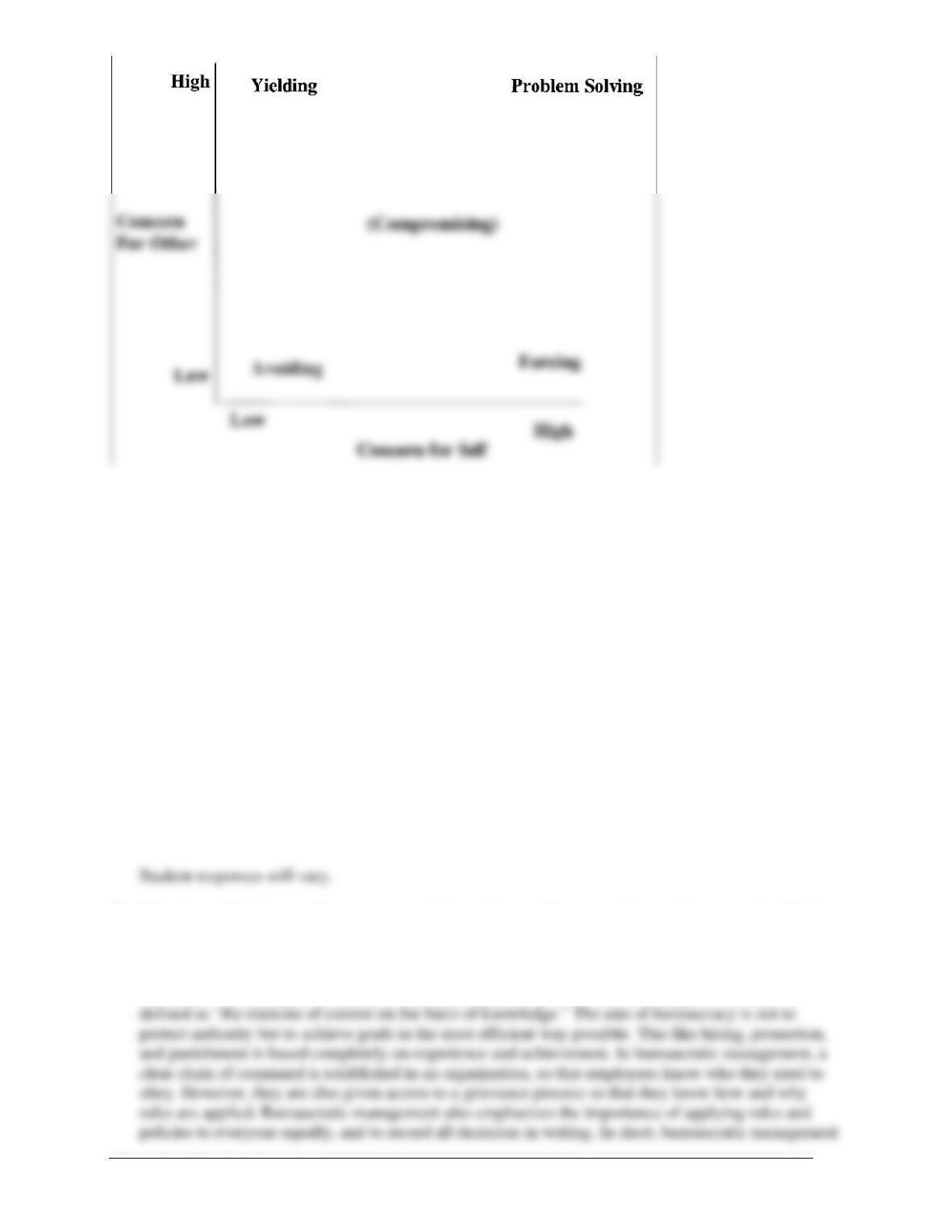
De Dreu’s study talks about these five strategies in terms of Dual Concern Theory. That is,
concern for others and concern for self. In the diagram on the next page, high concern for self and low
concern for the other leads to a forcing style, characterized by imposing one’s own will on the other party.
According to de Dreu’s research, “Forcing involves threats and bluffs, persuasive arguments and
positional commitments.” In contrast, yielding connotes a high concern for the other and a low concern
evidence of compromise as a separate and valid strategy for conflict resolution.
Chapter 2: History of Management
35
Management Decision
TOUGH LOVE?
Purpose
The purpose of this case is for student groups to analyze a conflict between management and employees,
and to find a solution that will satisfy both parties.
Setting It Up
You can introduce this case by, first, asking students “Is there a way for a company to cut jobs and costs
without angering employees?” Then, ask students “What is the best way that employees can convince a
company not to cut jobs?”
Questions
1. How would you resolve the situation described in this scenario?
2. What is an effective way for a manager to balance the need for supporting employee morale with the
need for establishing discipline and authority?
The text discusses a number of managerial theories that have relevance for balancing managerial
authority with employee morale. One concept to consider is bureaucratic management, which is
Chapter 2: History of Management
36
is a way to apply rules in the workplace, and communicate that it’s done so on the basis of what
employees do, rather than personal feelings of manager.
Mary Parker Follett’s work on constructive conflict might also provide an answer for how a manager
can approach employee discipline. Follett wrote that in a conflict, it may be easy for a manager to
exercise domination by telling the employee what to do, or for both parties to compromise by giving
Students’ responses should also refer to the work of Chester Barnard on the acceptance of authority.
Barnard maintained that it is more effective to induce workers’ willing cooperation through
incentives, clearly formulated organizational objectives, and effective communication. Barnard
argued that managers can gain others’ cooperation by completing three executive functions: securing
essential services from individuals, formulating an organization’s purpose and objectives, and
Management Team Decision
RESOLVING CONFLICTS
Purpose
Every manager must make decisions on a daily basis. Sometimes it’s large-scale decisions like creating a
new strategic plan to increase sales. At other times, it’s smaller-scale decisions like smoking policies, or
Setting It Up
You can introduce this case to students by asking them to imagine a very formal workplace, one in which
employees are given a dress code. What would be the pros and cons of such a workplace? Next, ask
students to imagine a very informal workplace, with no dress code, or titles, or hierarchy. What would be
the pros and cons of such a workplace?
Questions
1. How could you help steer negotiations between labor and management so that the conflict
between them is healthy and productive? Is that even possible?
Rather than one side looking for domination, or for both parties to lose something by