Chapter 02 – Management Theory: Essential Background for the Successful Manager
2-21
discussion questions:
Provide recommendations for your employer (or a previous one) on how it could
best implement the “hybrid approach” to office layout that seeks a balance
between closed and open systems.
Article Citation:
Ward, D. (2015). Beyond the open office. HR Magazine, 60(3), 30-35.
ProQuest Document ID: 1670108474
For instructors interested in learning more about the academic research on office
layout, you may consider reading the Journal of Organizational Behavior article
Section 2.4 describes quantitative viewpoints, which emphasize the application to
2.4 Quantitative Viewpoints: Management Science &
Operations Management (pp. 53–54)
If the manager’s job is to solve problems, how might the two quantitative
approaches help?
Chapter 02 – Management Theory: Essential Background for the Successful Manager
2-22
Article Citation:
Possible Topics for Discussion:
• Provide examples of how your employer (or a previous one) has used
management science and/or operations management to improve its operations.
• How can managers best combine the insights from the behavioral viewpoint
principles of the quantitative viewpoints to achieve its strategic turnaround.
Major Idea Outline:
A. Historical Perspective
1. In World War II the Royal Air Force planners used mathematics and
statistics to effectively allocate limited resources.
2. Americans used the British model to form operations research (OR) teams
Chapter 02 – Management Theory: Essential Background for the Successful Manager
2-23
(Correct answer is D)
B. Management Science: Using Mathematics to Solve Management Problems
1. Management science focuses on using mathematics to aid in problem
Interactive Classroom Material:
EXAMPLE: Management Science: “Find Me More Music I Like!” (p. 54)
This Example discusses the Music Genome Project and Pandora, which essentially
applies management science to music selection. The company reported in 2014 that
it had 75 million active listeners.
YOUR CALL
Do you think there’s any room left for experienced human decision makers who
don’t rely on numbers? Do you think reliance on the automated
recommendation process cheats consumers out of “pleasant surprises” and
new discoveries?
There is plenty of room left for human decision makers, such as disc jockeys, to
make decisions. For example Apple just released a radio subscription service that
Chapter 02 – Management Theory: Essential Background for the Successful Manager
2-24
Additional Activities:
One way to build on this Example is to have the students watch an interview with the
CFO of Pandora, Mike Herring, in which he reacts to Apple’s announcement about
the introduction of its radio subscription service. In the 2-minute video, the CFO
discusses the strengths of Pandora which will allow the firm to maintain a competitive
advantage over Apple. Consider using the following discussion questions:
If you are a regular user of Pandora or Netflix, evaluate the extent to which either
firm has you pegged. In other words, do the firms accurately predict what music
Video Link:
C. Operations Management: Being More Effective
1. The techniques of operations management are used when a warehouse
store decides when to reorder supplies.
Chapter 02 – Management Theory: Essential Background for the Successful Manager
Interactive Classroom Material:
EXAMPLE: Operations Management: Using “the Toyota Way” to Benefit
Hospital Patients (p. 54)
This Example discusses “the Toyota Way” systematic approach to producing
vehicles, and how this can be applied to hospitals. This includes hospital
management coming up with plans to make specific, small changes that can have a
major impact. This includes ways to reduce wait times, and even wheeling patients
around the facility.
YOUR CALL
Which is the focus of lean management?
Both effectiveness and efficiency are the focus of lean management. Proper
operations management would lead to more efficient practices and better
Additional Activities:
One way to build on this Example is to have the students watch the video “Toyota
Corolla: A Day in the Life at the Toyota Corolla Factory in Blue Springs, Mississippi.”
In this 3-minute video, a manager at Toyota’s plant in Blue Springs, Mississippi
discusses the Toyota way of doing things. Consider using the following discussion
questions:
2-26
Section 2.5 discusses the contemporary management viewpoint of systems. The
systems viewpoint sees organizations as a system, either open or closed, with inputs,
outputs, transformation processes, and feedback. The systems viewpoint has led to the
development of complexity theory, the study of how order and pattern arise from very
complicated, apparently chaotic systems.
Possible Topics for Discussion:
• Use systems theory to identify the most important parts of the system that is your
university or academic institution. Specifically, describe important inputs,
transformational processes, outputs and feedback important to your school’s
success.
Major Idea Outline:
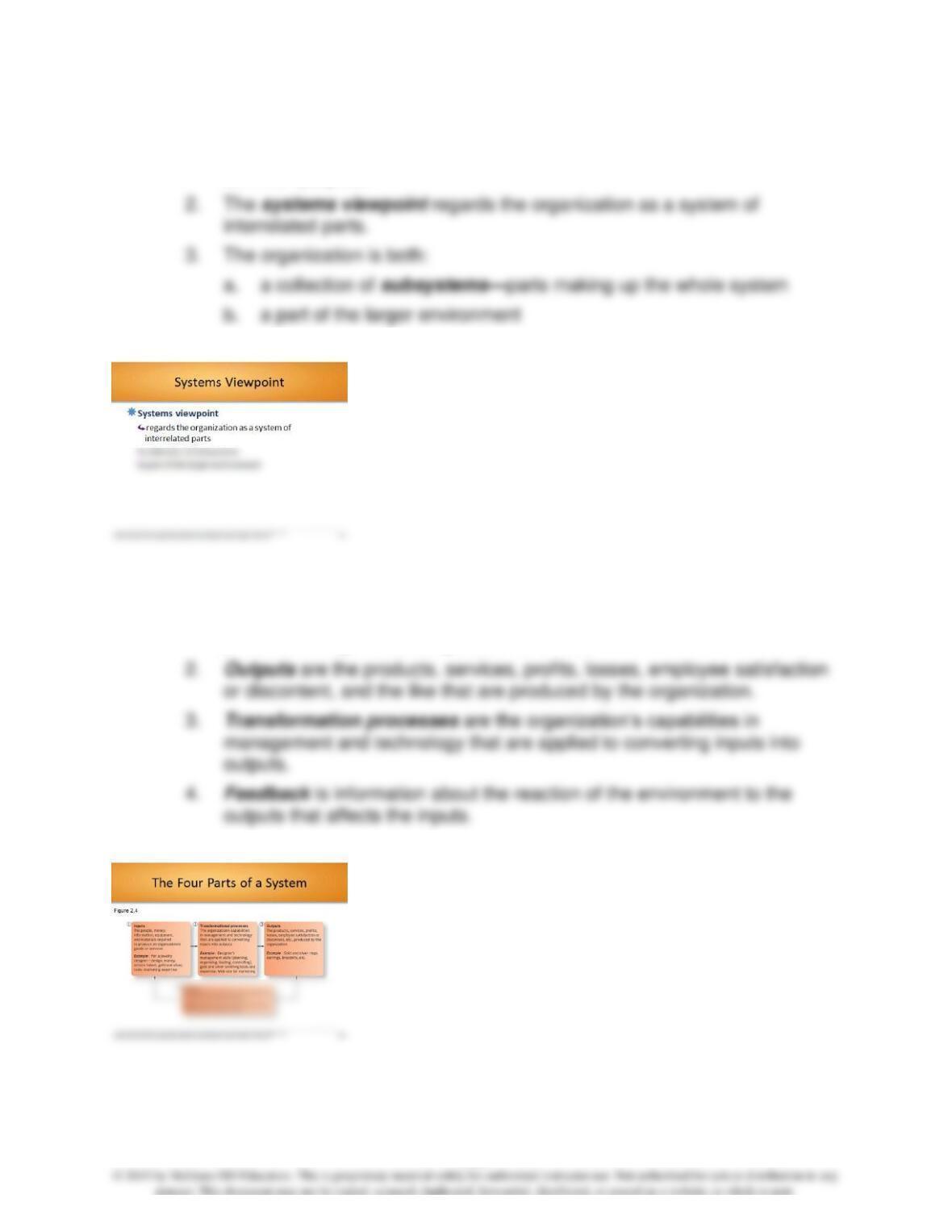
A. In addition to the historical perspective on management, there are three
contemporary perspectives: systems, contingency, and quality management.
2.5 Systems Viewpoint (pp. 55-57)
How can the exceptional manager be helped by the systems viewpoint?
Chapter 02 – Management Theory: Essential Background for the Successful Manager
2-27
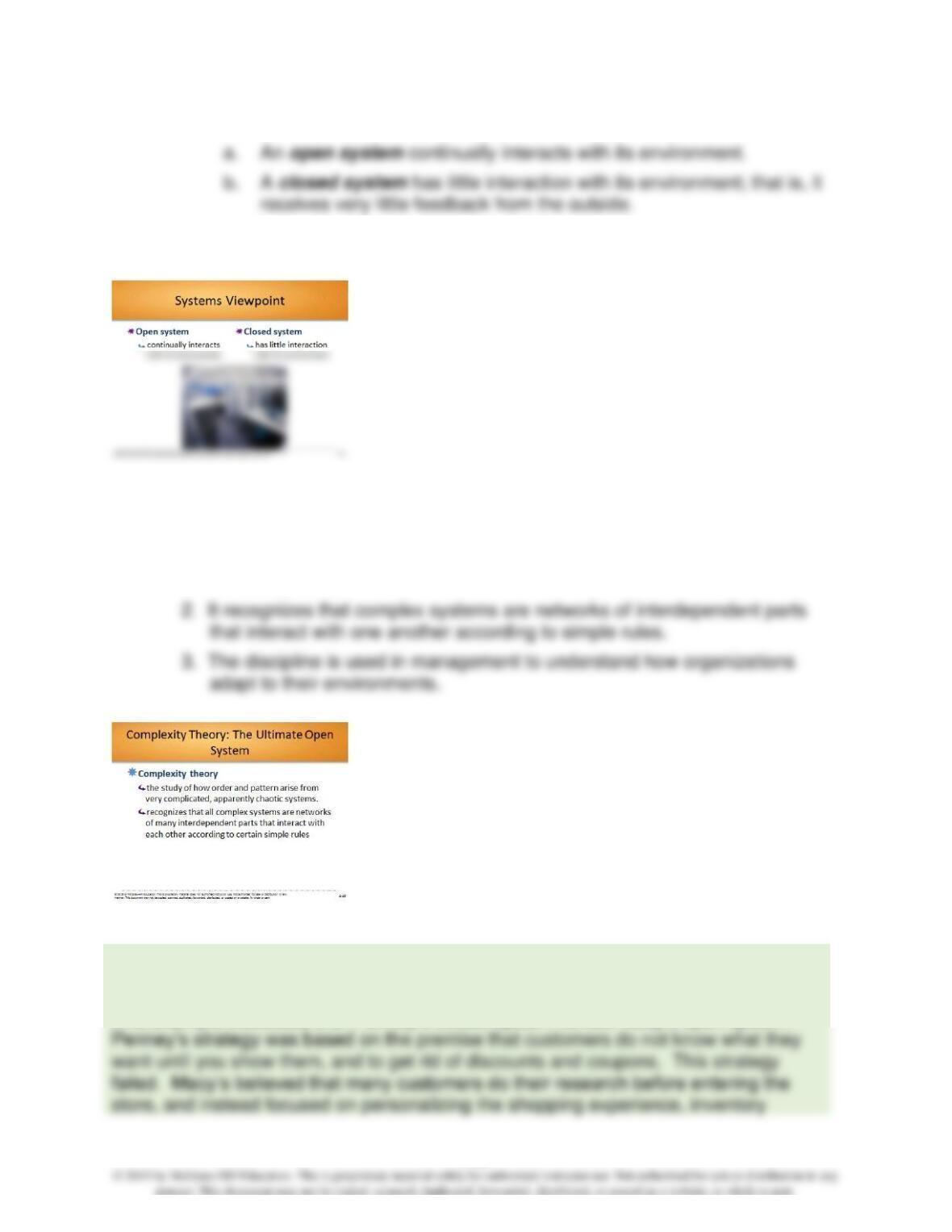
B. The Systems Viewpoint
1. A system is a set of interrelated parts that operate together to achieve a
common purpose.
C. The Four Parts of a System
1. Inputs are the people, money, information, and materials required to
produce an organization’s goods or services.
D. Open and Closed Systems
Chapter 02 – Management Theory: Essential Background for the Successful Manager
2-28
1. Nearly all systems are open systems rather than closed systems.
2. Any organization that ignores feedback from the environment risks failure.
E. Complexity Theory: The Ultimate Open System
1. The systems viewpoint has led to the development of complexity theory,
the study of how order and pattern arise from very complicated, apparently
chaotic systems.
Interactive Classroom Material:
EXAMPLE: Closed versus Open Systems: Penney’s versus Macy’s (p. 57)
This example discusses J.C. Penney’s closed system versus Macy’s open system.

Chapter 02 – Management Theory: Essential Background for the Successful Manager
2-29
management and integrated sales, which includes shipping products directly to
customers.
YOUR CALL
Besides the retrenching of RadioShack and Staples, can you think of other
retail businesses that need a makeover—that should do more to become open
systems? What should they do?
There are different businesses that may want to consider more open systems.
Furniture retailers such as Marlo’s and IKEA should consider a more personalized,
Additional Activities:
One way to build on this Example is to have the students watch the CBS News video
“Are Shopping Malls Vanishing?” This 4-minute video further elaborates on the need
for retailers to adopt more of an open system mentality in today’s retail environment.
Consider using the following discussion questions:
Critique the state of retailing in your community. How many shopping malls have
closed or been re-purposed to another function (e.g., are now a church)?
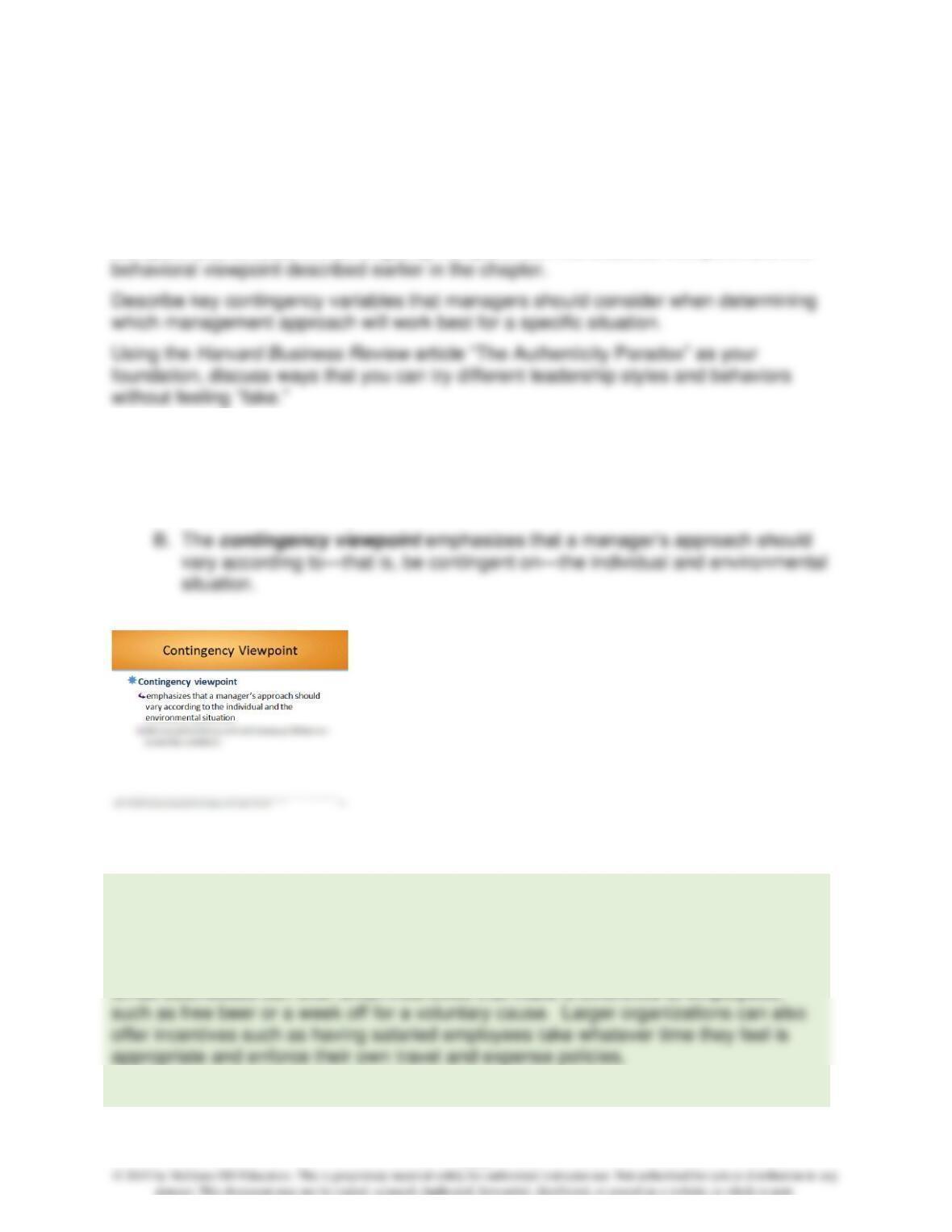
Section 2.6 describes the contingency viewpoint, which emphasizes that a manager’s
approach should vary according to the individual and environmental situation.
2.6 Contingency Viewpoint (pp. 58-60)
In the end, is there one best way to manage in all situations?
Chapter 02 – Management Theory: Essential Background for the Successful Manager
2-30
Article Citation:
Ibarra, H. (2015). The authenticity paradox. Harvard Business Review, 93(1), 52–59.
Product #: R1501C-PDF-ENG
Possible Topics for Discussion:
Compare and contrast the contingency viewpoint with the classical viewpoint and the
Major Idea Outline:
Contingency Viewpoint
A. The classical viewpoints assumed that their approaches were “the one best
way” to manage organizations.
Interactive Classroom Material:
EXAMPLE: The Contingency Viewpoint: What Are the Best Kinds of Benefits?
(p. 58)
This Example discusses other forms of compensation than money, such as benefits.
Small businesses can offer small incentives that make a difference to employees,
YOUR CALL
Chapter 02 – Management Theory: Essential Background for the Successful Manager
Considering these findings and applying a contingency approach to stimulating
productivity at work, what different kinds of incentives or benefits would you
offer for hourly shift workers, salaried middle managers, and work-at-home
employees?
Students’ responses will differ on the approaches, but some ideas may include
providing hourly shift workers with a good environment to work for a sense of
Additional Activities:
One way to build on this Example is to have the students read the Fortune article “L.L.
Bean Gives Workers an Outdoor Adventure While on the Job.” The article and
corresponding web video on the Fortune website describe some of the unique
benefits offered by the outdoor goods retailer. Consider using the following
discussion questions:
Assume that your employer (or a previous one) offered you additional days of paid
C. According to Gary Hamel of the Management Innovation Lab, management
ideas are not fixed, they are a process.
D. Hamel suggests that management should be innovative and this process
begins by identifying core beliefs people have about the organization.
Chapter 02 – Management Theory: Essential Background for the Successful Manager
2-32
3. How does this belief serve the interests of its adherents? Are there
F. Evidence-Based Management
1. Means translating principles based on best evidence into organizational
practice, bringing rationality to the decision-making process.
Interactive Classroom Material:
PRACTICAL ACTION: Evidence-Based Management: An Attitude of Wisdom (p.
60)
Management is both an art and a science. Many top executives have no formal
training, just a good mix of intuition, judgment and experience, like an artist.
YOUR CALL
Do you think managers are often driven by fads, by what they’ve read in the
latest book or heard in the latest management seminar? Have you ever heard
of a manager taking an experimental approach, as in trying out a new idea with
an open mind to see what happens? How could you profit by taking an
evidence-based approach to the ideas we discussed in this chapter?
Managers may embrace new ways of working with employees, but many are also
content with proven ways that they conduct their affairs, especially the ways that
Chapter 02 – Management Theory: Essential Background for the Successful Manager
2-33
Additional Activities:
One way that you could build on this Practical Action is to have the students watch
the CBS News video “Zappos Does Away with Bosses, and Not Everyone Likes It.”
This two-minute video describes how many employees have left the online retailer
Zappos, in response to the firm adopting a “holacracy,” which is a management style
that relies of self-management and self-organization. The video could be used as an
illustration of how new trends in management should be subject to evidence-based
Section 2.7 describes the quality-management viewpoint. This viewpoint consists of
quality control, quality assurance, and the movement of total quality management
(TQM), dedicated to continuous quality improvement, training, and customer
satisfaction.
2.7 Quality-Management Viewpoint (pp. 61-62)
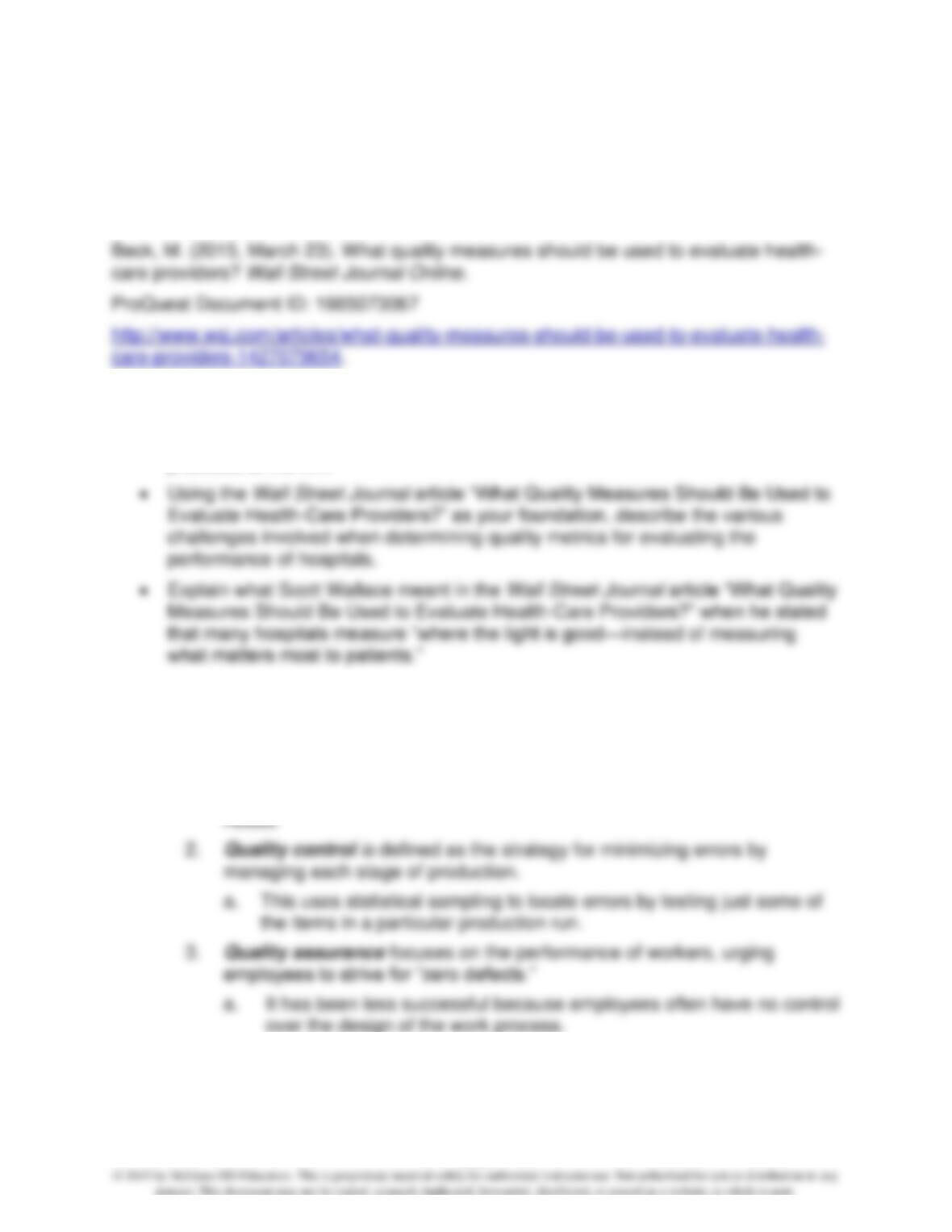
Can the quality-management viewpoint offer guidelines for true
managerial success?
Chapter 02 – Management Theory: Essential Background for the Successful Manager
2-34
insurance companies, the government, and patients don’t always have the same
definition of quality. This issue was explored by the Wall Street Journal in the Special
Report “What Quality Measures Should Be Used to Evaluate Health-Care Providers?,”
which can be assigned for reading by the students.
Article Citation:
Possible Topics for Discussion:
• Describe the quality control measures or TQM approaches used by your
employer (or a previous one) and discuss how they impact management
practices at the firm.
Major Idea Outline:
A. The quality-management viewpoint includes quality control, quality
assurance, and total quality management.
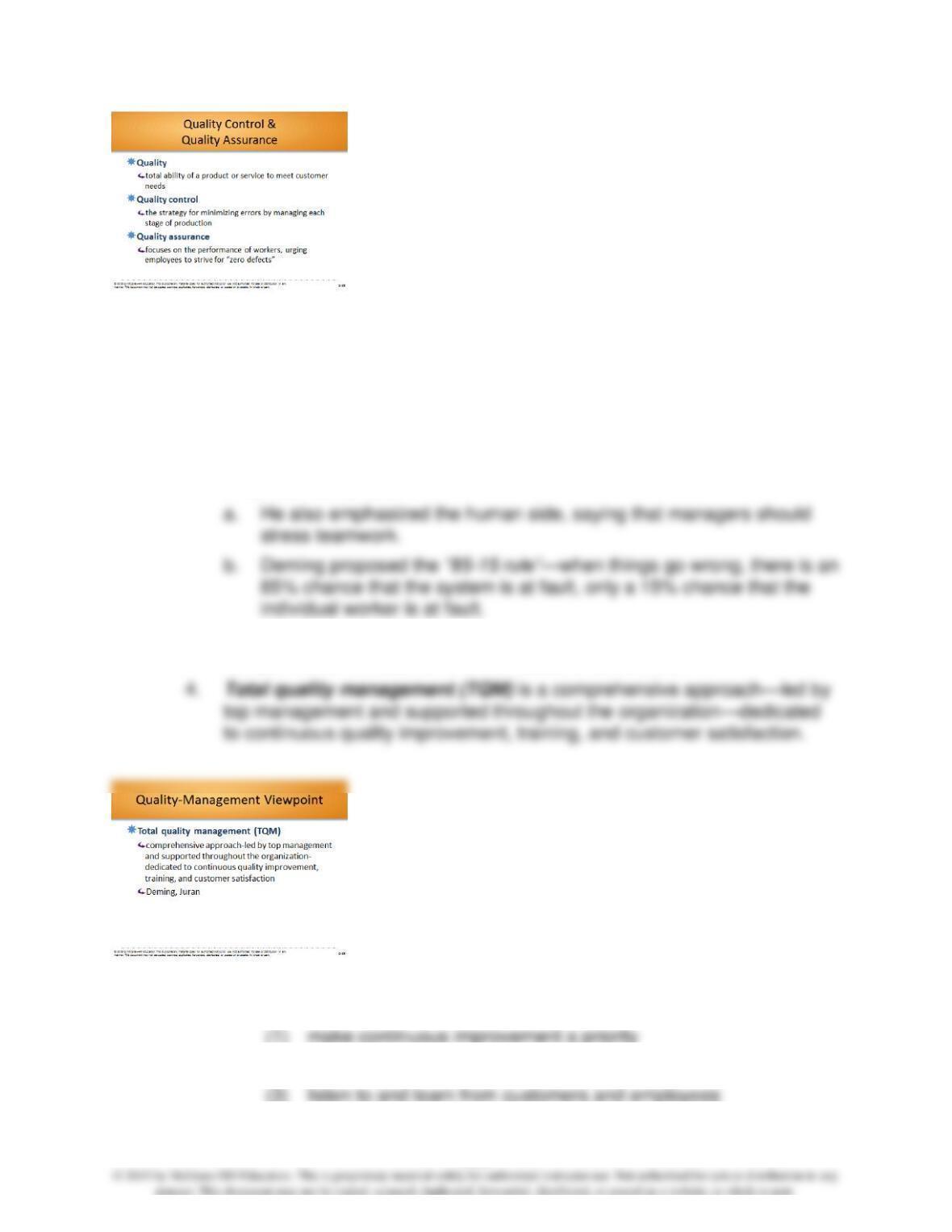
B. Quality Control and Quality Assurance
1. Quality refers to the total ability of a product or service to meet customer
Chapter 02 – Management Theory: Essential Background for the Successful Manager
2-35
C. Total Quality Management: Creating an Organization Dedicated to Continuous
Improvement
1. The inferior quality of Japanese products began to improve with the arrival
of two Americans.
2. W. Edwards Deming believed that quality stemmed from “constancy of
purpose” along with statistical measurement and reduction of variations in
the production process.
3. Joseph M. Juran defined quality as “fitness for use” and suggested that
companies concentrate on the real needs of customers.
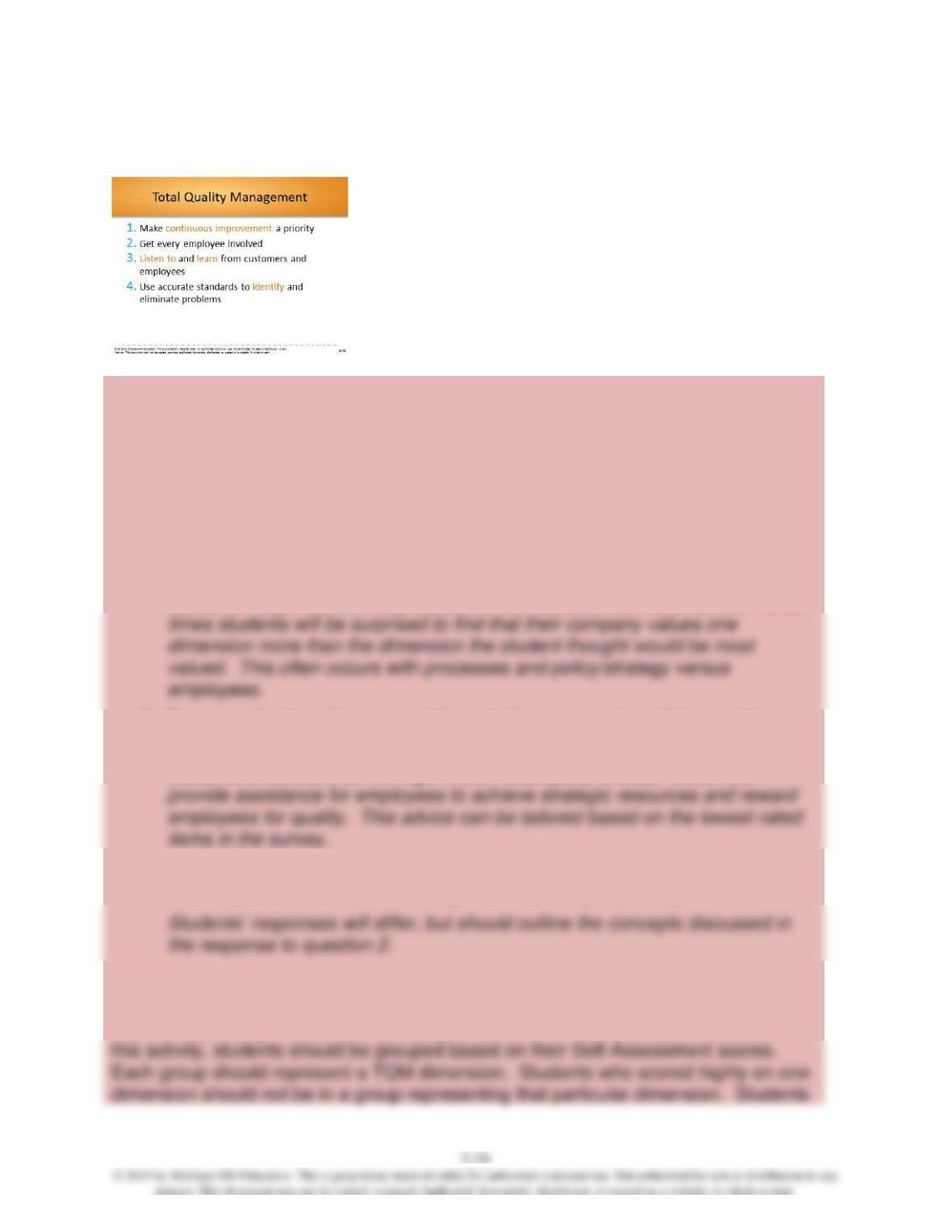
a. TQM has four components:
(2) get every employee involved
Chapter 02 – Management Theory: Essential Background for the Successful Manager
(4) use accurate standards to identify and eliminate problems
SELF-ASSESSMENT 2.2 (p. 62)
To What Extent Is Your Organization Committed to Total Quality
Management?
Go to connect.mheducation.com and take Self-Assessment 2.2.
Student Questions:
1. Which of the five dimensions is most and least important to the organization?
Are you surprised by this conclusion? Explain.
Students’ responses will vary based on the results of their assessment. Often
2. Based on the three lowest-rated items in the survey, what advice would you
give to senior leaders in the company?
Students should advise the organization to properly allocate resources,
3. Considering all of the questions in the survey, which three do you think are
most important in terms of fostering TQM in a company? Why?
Additional Activities:
You can also consult the Connect Instructors Manual for the post-assessment activity
and corresponding PowerPoint slides used for this Self-Assessment in Connect. In