

College Mathematics: Learning Worksheets Chapter 2
52
College Mathematics: Learning Worksheets Chapter 2
53
Name ________________________________ Date ______________ Class ____________
Goal: To describe and solve functions that are exponential in nature
In Problems 1–8, describe in words the transformations that can be used to obtain the graph
of g(x) from the graph of f(x).
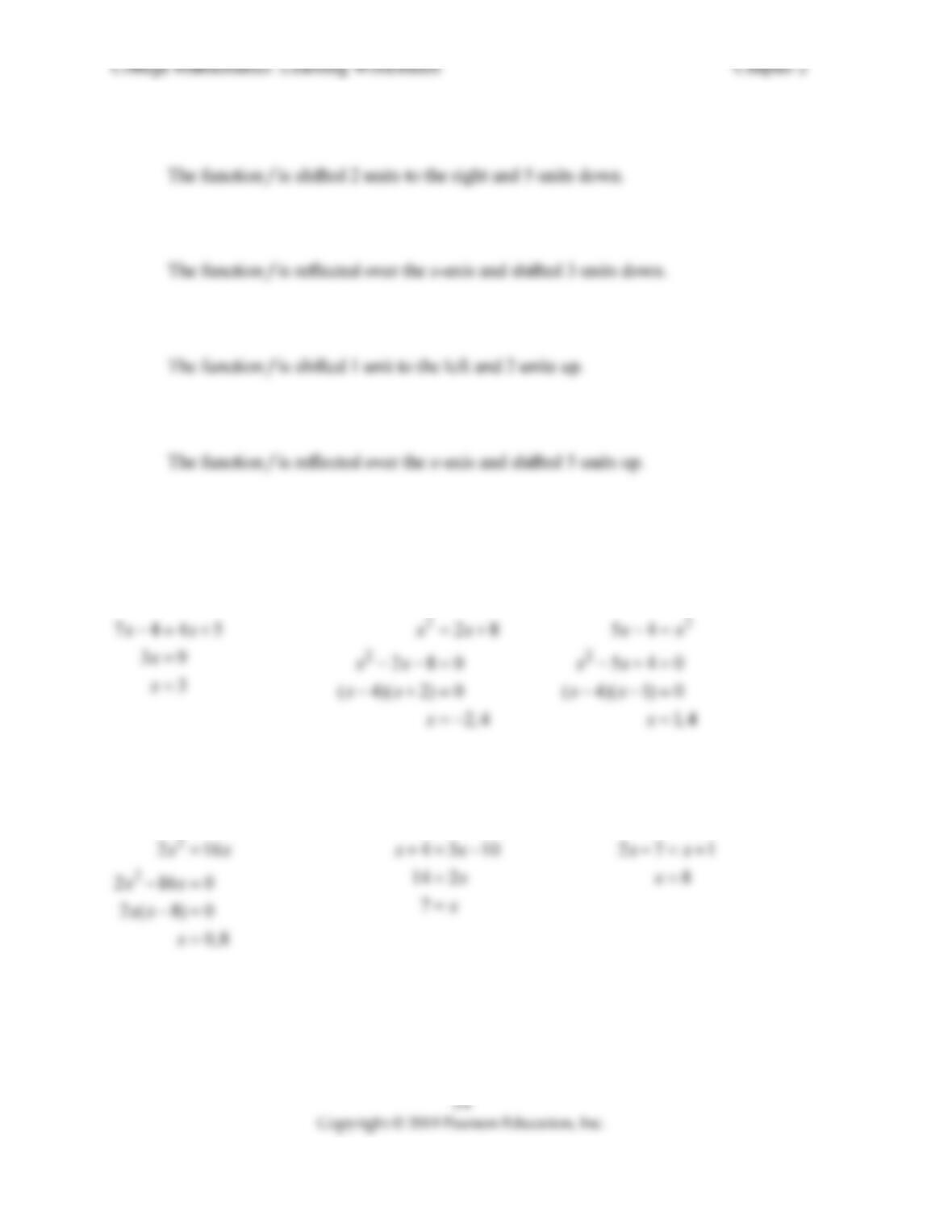
1. 5
() 4 3; ()=4
x
x
gx fx
+
=−
2. () 3 7; () 3
x
x
gx f x=− − =
3. 4
() 2 6; () 2
x
x
gx f x
4. 4
() 5 5; () 5
x
x
gx f x
−
=− + =
Section 2-5 Exponential Functions
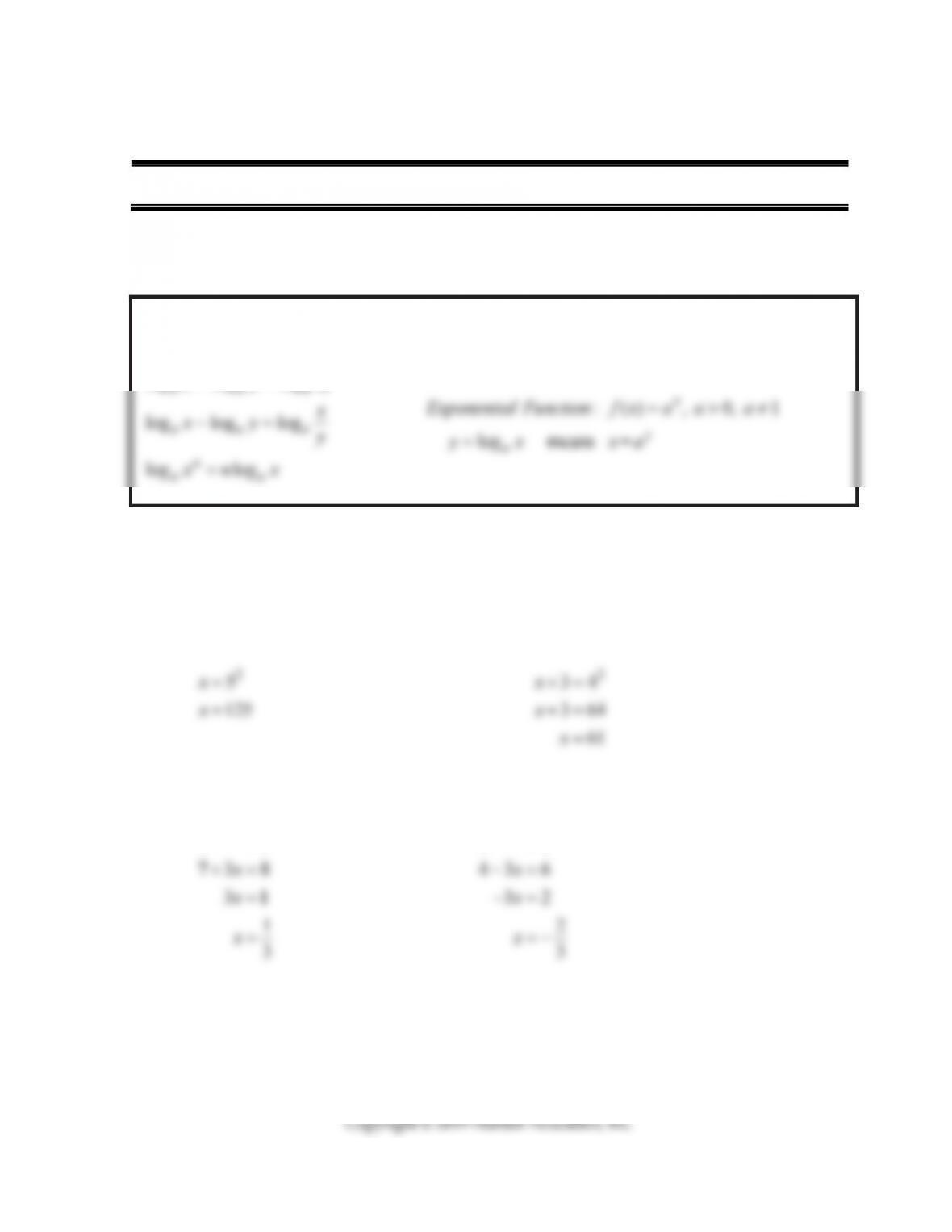
Rules for Exponents:
mn mn
aa a
Product Rule 01, 0aa Zero Exponent Rule
mmn
n
aa
a
Quotient Rule
n
mmn
aa Power Rule
5. 2
() 10 5; ()=10
x
x
gx fx
6. () 10 3; () 10
x
x
gx f x
7. 1
() 2; ()
x
x
gx e f x e
8. () 5; ()
x
x
gx e f x e
In Problems 9–20, solve each equation for x.
9. 74 45
10 10
x
x−+
= 10. 228
10 10
x
x
11. 2
54
66
x
x
12. 2
216
88
x
x
= 13. 33
( 4) (3 10)xx+=− 14. 55
(2 7) ( 1)xx

College Mathematics: Learning Worksheets Chapter 2
55
15. 23
()
x
ee= 16. 2
5
()
x
x
ee= 17. 215
()
x
xx
ee
18. 2
43
33 3
x
x
19. 212 32
222
xx
20. 2
2
999
x
x
2
43
x
x
2
12 32
xx
2
12
x
x
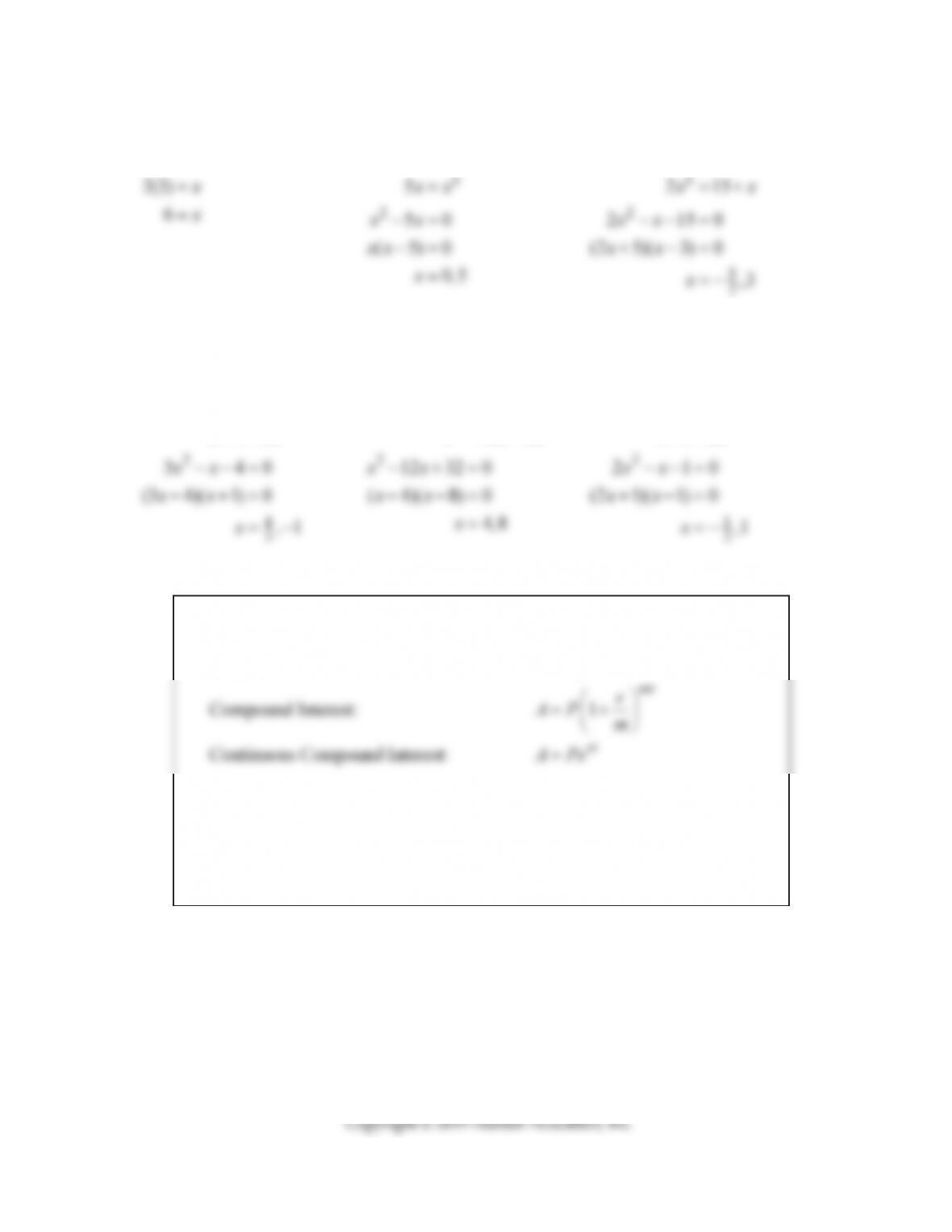
Interest Formulas
Simple Interest: (1 )AP rt
where P is the amount invested (principal), r (expressed as a decimal) is the
annual interest rate, t is time invested (in years), m is the number of times
a year the interest is compounded, and A is the amount of money in the
account after t years (future value).
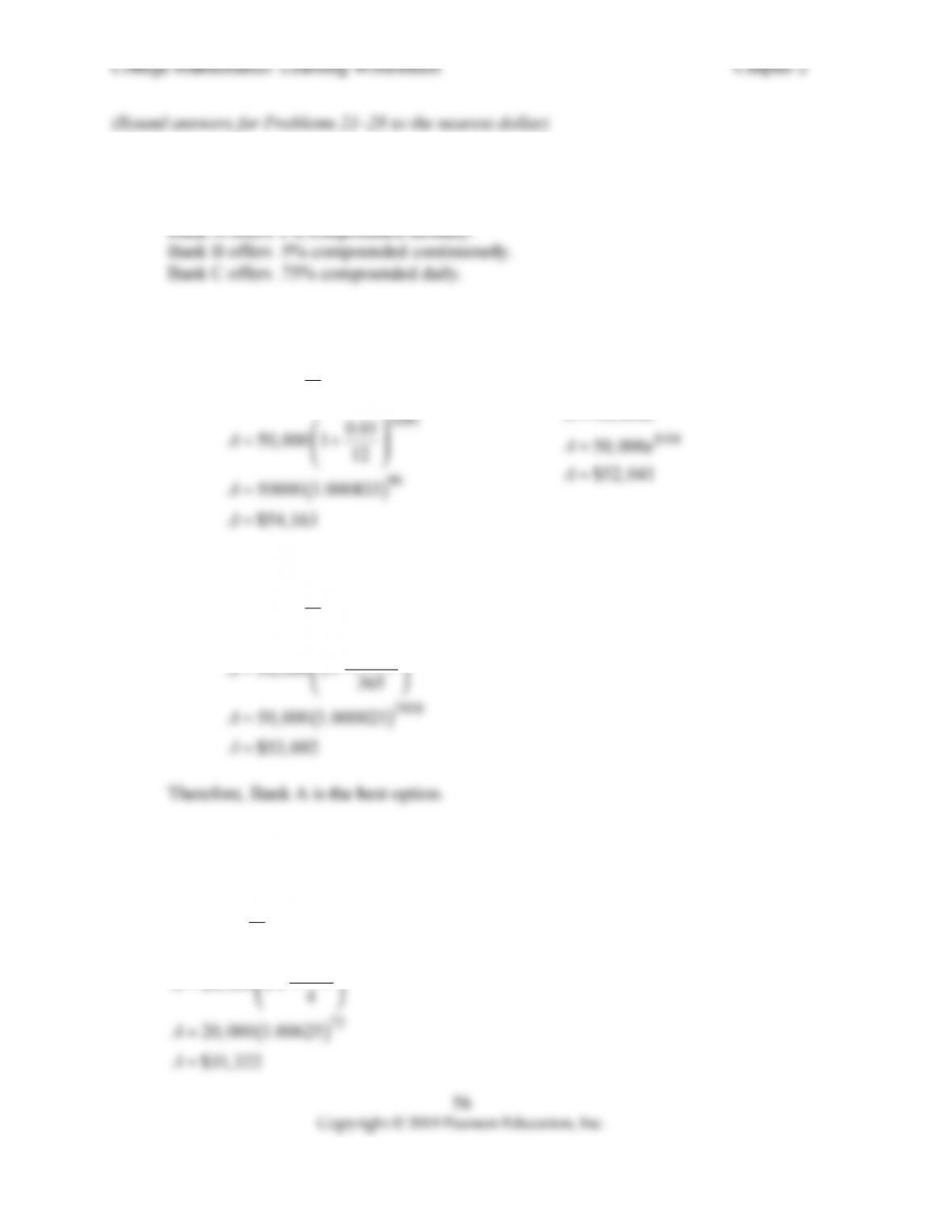
21. Fred inherited $50,000 from his uncle. He decides to invest his money for 8 years in
order to have the greatest down payment when he buys a house. He can choose from 3
different banks.
Which bank offers the best plan so Fred can earn the most money from his investment?
Bank A:
1
mt
r
AP m
⎛⎞
=+
⎜⎟
⎝⎠
Bank B:
(0.005)(8)
50,000
rt
APe
Ae
=
=
Bank C:
365(8)
1
0.0075
mt
r
AP m
⎛⎞
=+
⎜⎟
⎝⎠
⎛⎞
22. The day your first child is born, you invest $20,000 in an account that pays 2.5%
interest compounded quarterly. How much will be in the account when the child is 18 years
old and ready to start to college?
4(18)
1
0.025
20,000 1 4
mt
r
AP m
A
⎛⎞
=+
⎜⎟
⎝⎠
⎛⎞
=+

57
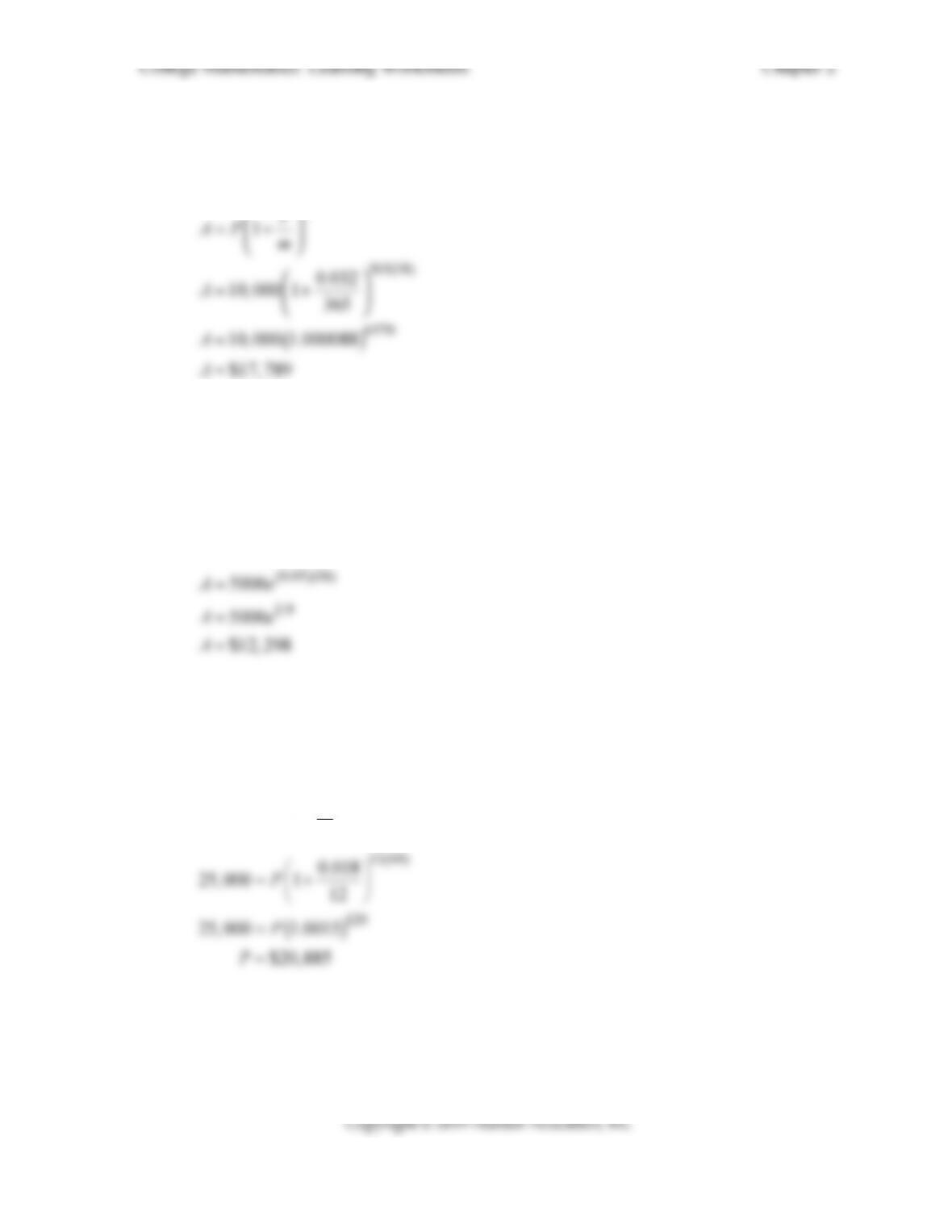
23. When your second child is born, you are able to invest only $10,000 but the account
pays 3.2% interest compounded daily. How much will be in the account when this child is
18 years old and ready to start to college?
mt
24. When your third child comes along, money is even tighter and you are able to invest
only $5000, but you are able to find a bank that will let you invest the money at 5%
compounded continuously. How much will be in the account when this third child is 18
years old and ready to start to college?
rt
APe
=
25. Joe Vader plans to start his own business in ten years. How much money would he need
to invest today in order to have $25,000 in ten years if Joe’s bank offers a 10-year CD that
pays 1.8% interest compounded monthly.
1
mt
r
AP m
58
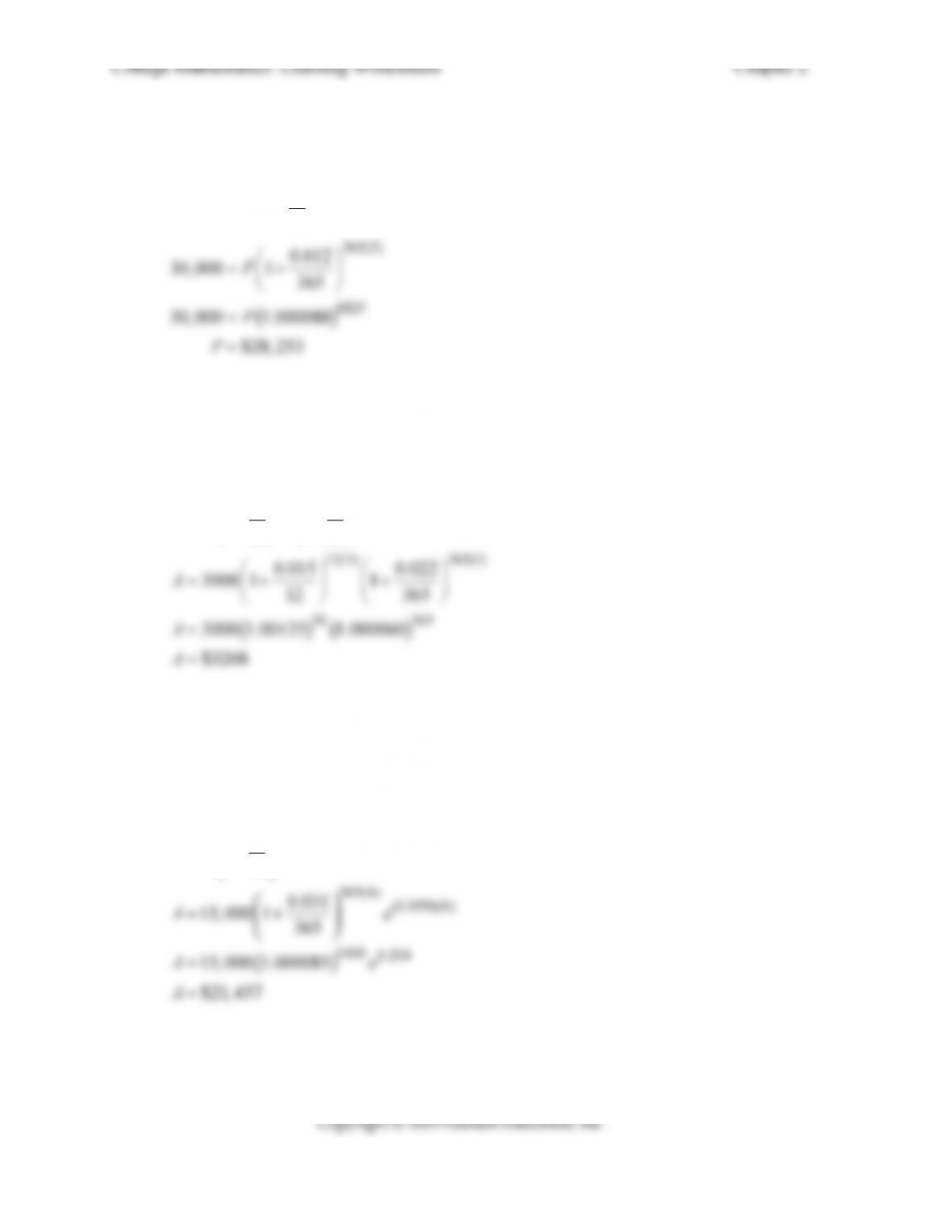
26. Bill and Sue plan to buy a home in 5 years. How much would they need to invest today
at 1.2% compounded daily in order to have $30,000 in five years?
1
mt
r
AP m
27. Suppose you invest $3000 in a four-year certificate of deposit (CD) that pays 1.5%
interest compounded monthly the first 3 years and 2.2% compounded daily the last year.
What is the value of the CD at the end of the four years?
11
mt mt
rr
AP mm
28. Suppose you invest $15,000 in a 10-year certificate of deposit (CD) that pays 3.1%
interest compounded daily the first 4 years and 3.9% compounded continuously the last six
years. What is the value of the CD at the end of the 10 years?
1
mt
rt
r
AP e
m
⎛⎞
=+
⎜⎟
⎝⎠
College Mathematics: Learning Worksheets Chapter 2
59
Name ________________________________ Date ______________ Class ____________
Goal: To solve problems that are logarithmic in nature
In Problems 1–20, find the value of x. (Evaluate to four decimal places if necessary.)
1. 5
log 3x= 2.
4
log ( 3) 3x+=
3. 8
3
log 3 7 3
x
4.
6
2
log 2 4 3
x
73 8
33
x
43 6
22
x
Section 2-6 Logarithmic Functions
Properties of Logarithms
log log log
x
yxy
x
College Mathematics: Learning Worksheets Chapter 2
5. ln( 5) 8x+= 6. log ( 20) 2
xx+=
8
5
ex
=+
2
20
xx
=+
7. 22
log (4 3) log (6 5)xx+= − 8. 33
log (8 5 ) log (2 13)xx
4365
x
x
x
+= −
85 2 13
xx
9. ln ln 8 5x+= 10. ln ln 2 0x−=
x
x
x
x
11. log( 1) log 4 3x 12. ln( 1) ln 6 2x
1
4
1
3
4
log 3
10
x
x
1
6
1
2
6
ln 2
x
x
e
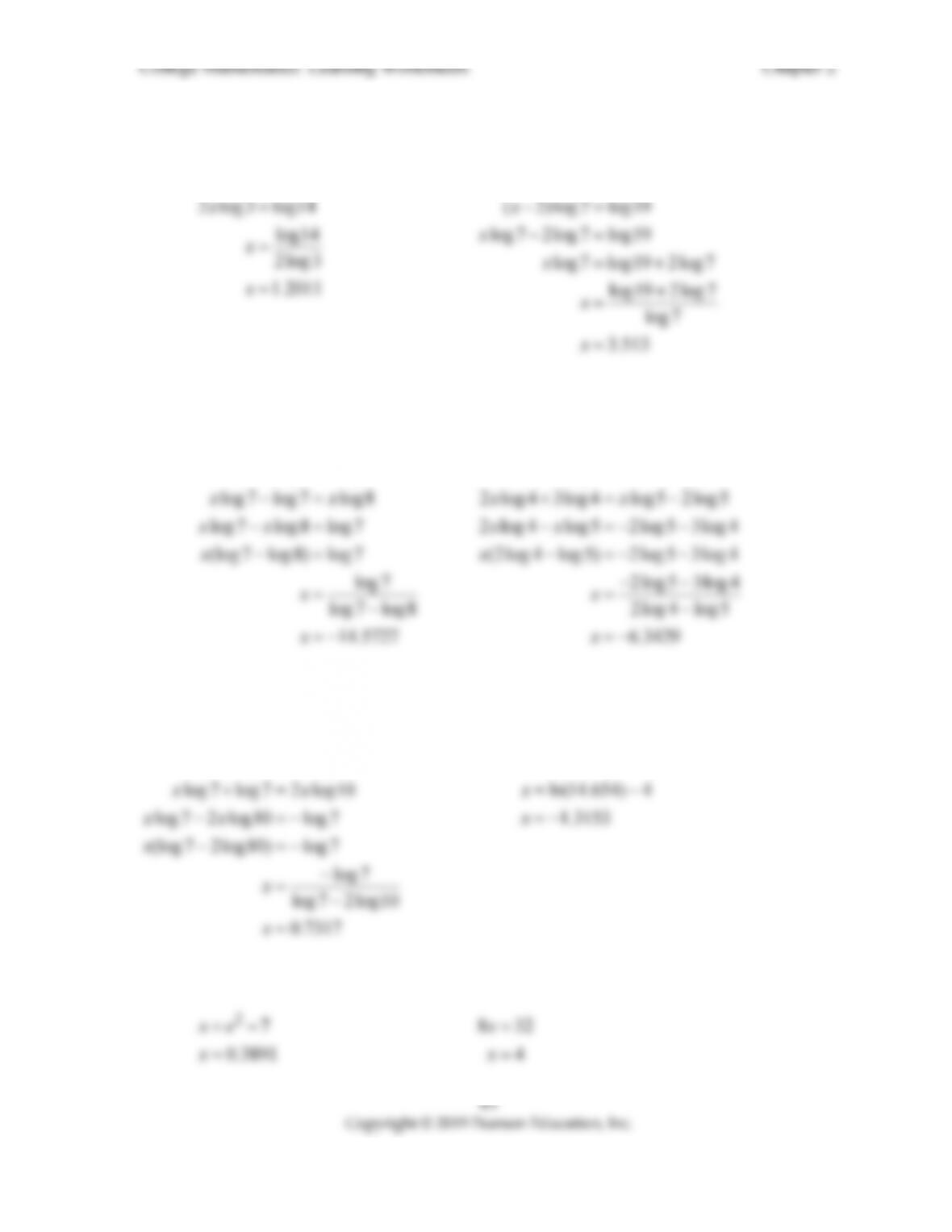

13. 2
314
x= 14.
2
719
x−=
2
log 3 log14
x
=
2
log 7 log19
x
−=
15. 1
78
x
x 16.
23 2
45
x
x
1
log 7 log 8
( 1) log 7 log 8
xx
xx
23 2
log 4 log 5
(2 3)log 4 ( 2)log5
xx
xx
17. 12
710
x
x 18.
414.654
x
e
12
log 7 log10
(1)log72log10
xx
xx
4
ln ln(14.654)
4 ln(14.654)
x
e
x
19. 2
7
x
e+= 20.
832x
ee=

21. You want to accumulate $30,000 by your son’s eighteenth birthday. How much do you
need to invest on the day he is born in an account that will pay 1.9% interest compounded
quarterly? (Round your answer to the nearest dollar.)
4(18)
1
0.019
mt
r
AP m
⎛⎞
=+
⎜⎟
⎝⎠
⎛⎞
22. Using the information in Problem 21, how much would you need to invest if you waited
until he is 10 years old to start the fund?
4(8)
1
0.019
mt
r
AP m
⎛⎞
=+
⎜⎟
⎝⎠
⎛⎞
23. A bond that sells for $1000 today can be redeemed for $1200 in 10 years. If interest is
compounded quarterly, what is the annual interest rate for this investment? (Round your
answer to two decimal places when written as a percentage.)
4(10)
1
mt
r
AP m
r
63
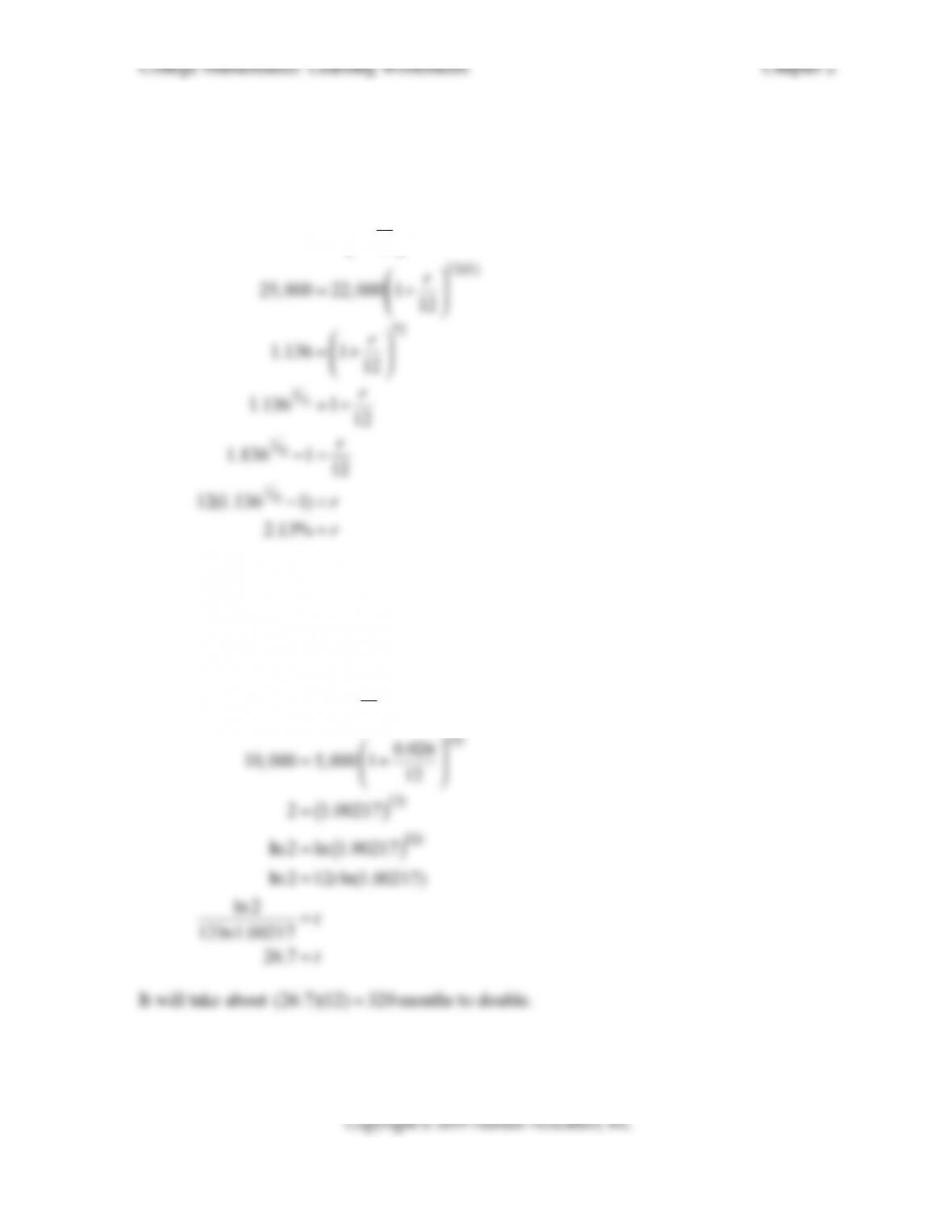
24. A bond that sells for $22,000 today can be redeemed for $25,000 in 4 years. If interest
is compounded monthly, what is the annual interest rate for this investment? (Round your
answer to two decimal places when written as a percentage.)
1
mt
r
AP m
⎛⎞
=+
⎜⎟
⎝⎠
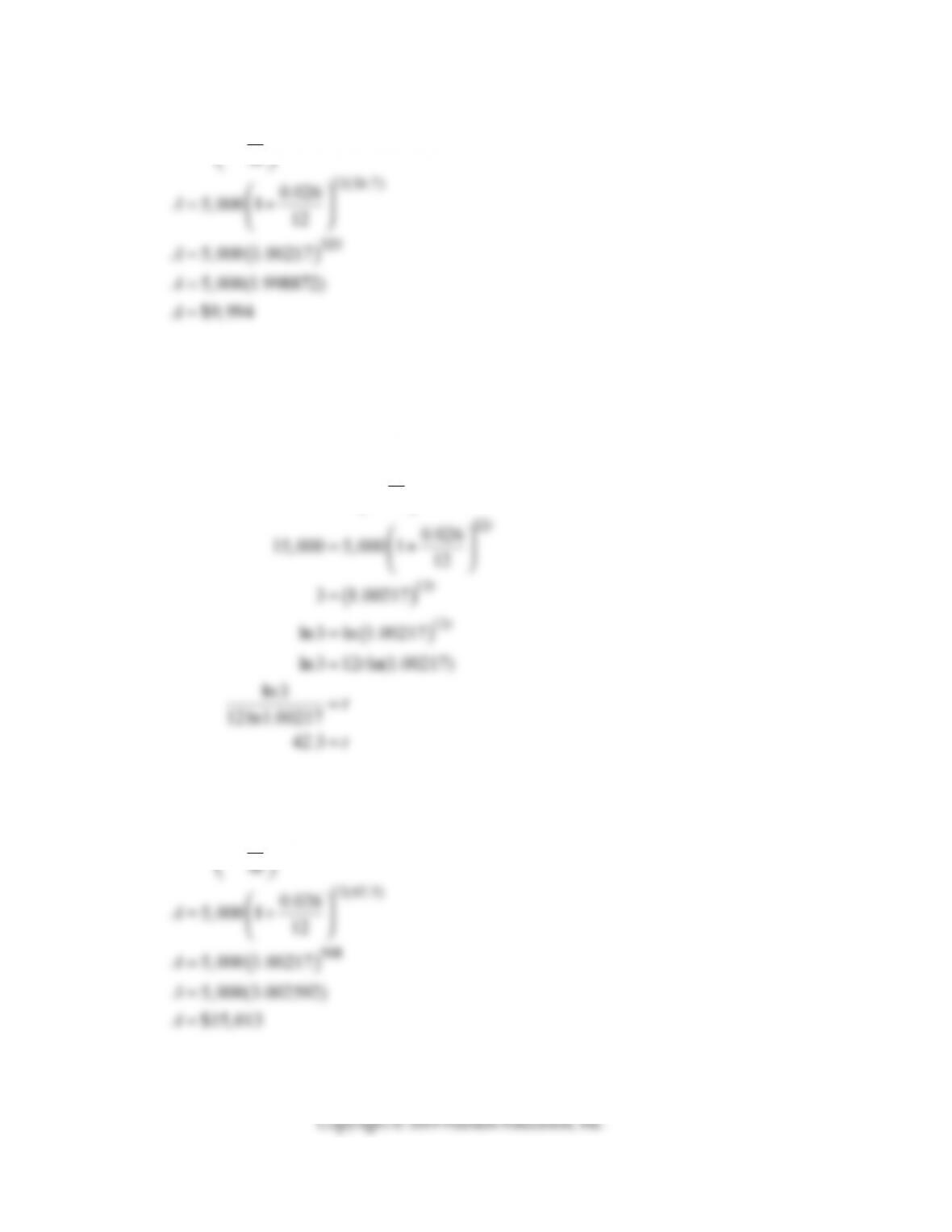
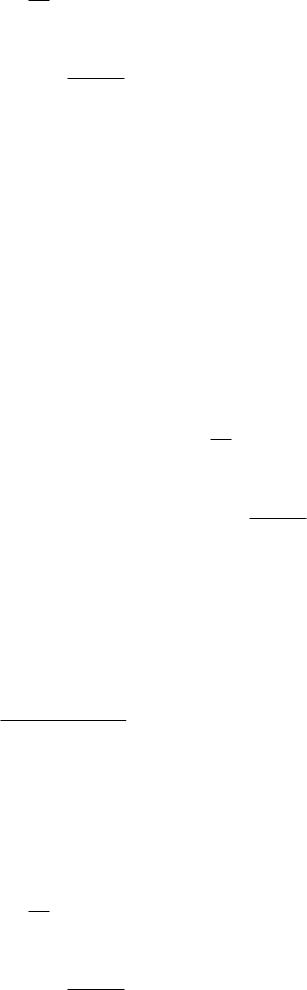
25. What is the minimum number of months required for an investment of $5,000 to grow to
at least $10,000 (double in value) if the investment earns 2.6% annual interest rate
compounded monthly? What would be the actual value of the investment after that many
months?
1
mt
r
AP m
⎛⎞
=+
⎜⎟
⎝⎠
College Mathematics: Learning Worksheets Chapter 2
64
1
mt
r
AP m
⎛⎞
=+
⎜⎟
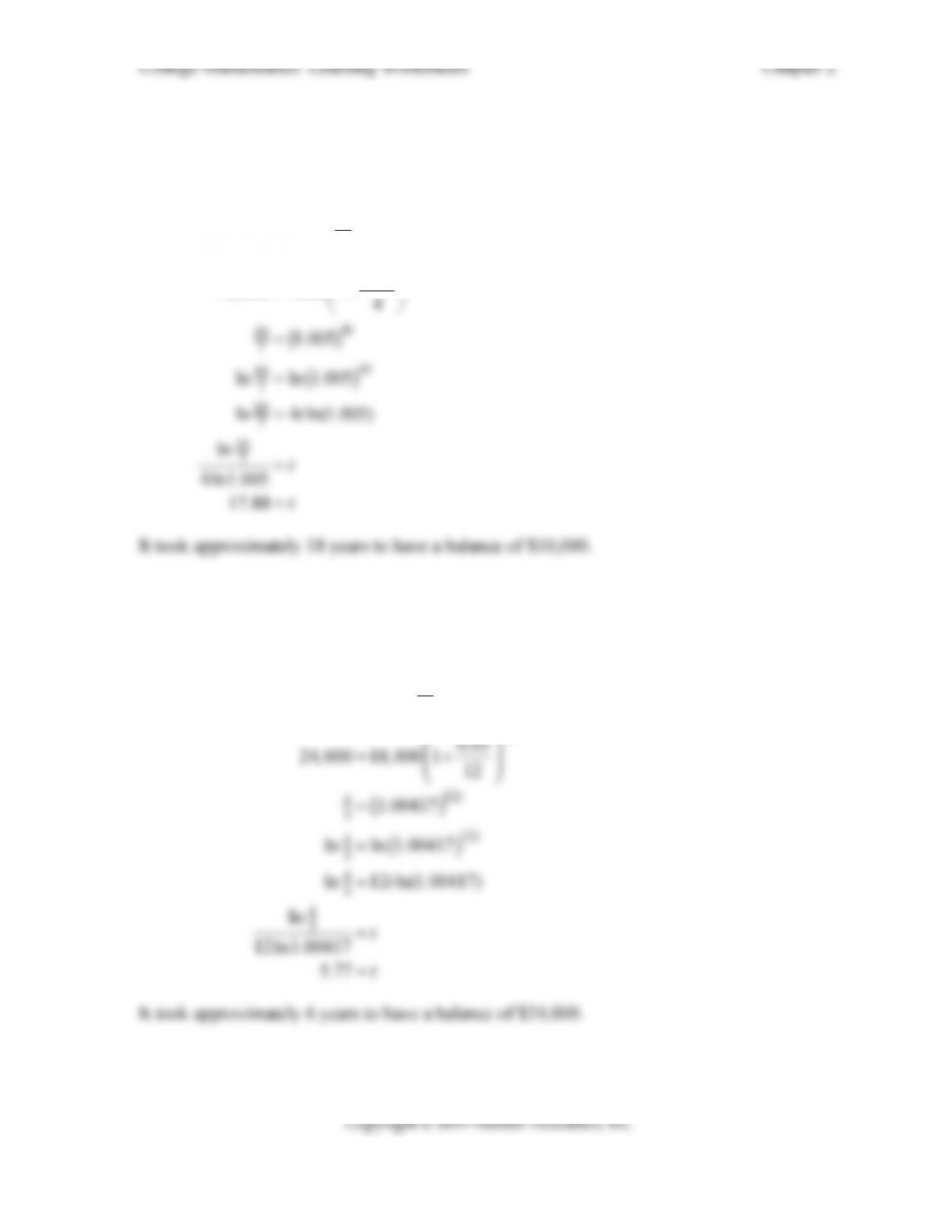
26. What is the minimum number of months required for an investment of $5,000 to grow to
at least $15,000 (triple in value) if the investment earns 2.6% annual interest rate
compounded monthly? What would be the actual value of the investment after that many
months?
1
mt
r
AP m
⎛⎞
=+
⎜⎟
⎝⎠
It will take about (42.3)(12) 508=months to triple.
1
mt
r
AP m
⎛⎞
=+
⎜⎟
65
27. Some years ago, Ms. Martinez invested $7000 at 2% compounded quarterly. The
account now contains $10,000. How long ago did she start the account? (Round your
answer up to the next year.)
4
1
0.02
10,000 7000 1 4
mt
t
r
AP m
28. Some years ago, Mr. Tang invested $18,000 at 5% compounded monthly. The account
now contains $24,000. How long ago did he start the account? (Round your answer up to the
next year.)
12
1
mt
t
r
AP m
⎛⎞
=+
⎜⎟
⎝⎠

66
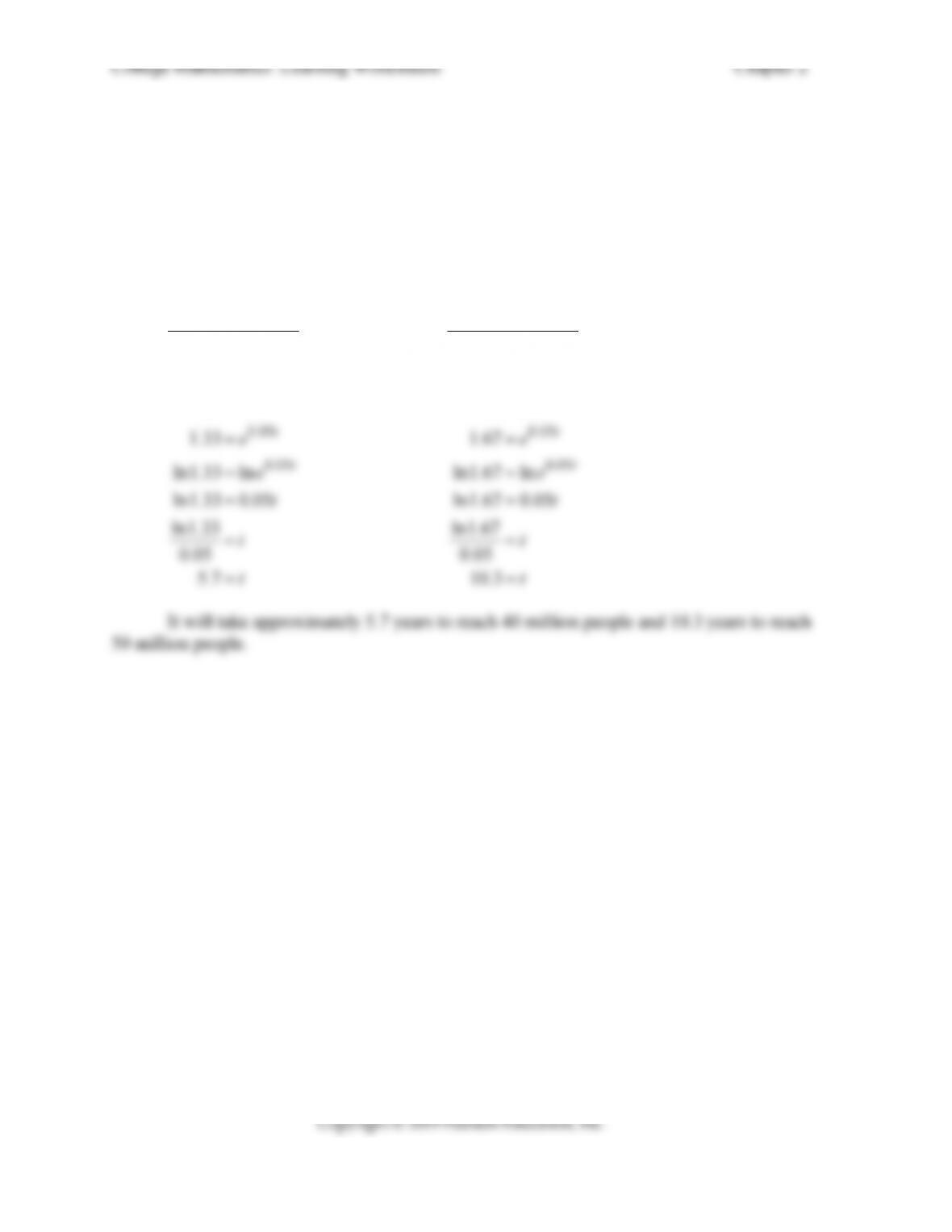
29. In a certain country, the number of people above the poverty level is currently 30
million and growing at a rate of 5% annually. Assuming that the population is growing
continuously, the population, P (in millions), t years from now, is determined by the formula:
0.05
30 t
Pe=
In how many years will there be 40 million people above the poverty level? 50 million?
(Round your answers to nearest tenth of a year.)
40 million people 50 million people
0.05
0.05
30
40 30
t
t
Pe
e
=
=
0.05
0.05
30
50 30
t
t
Pe
e
=
=
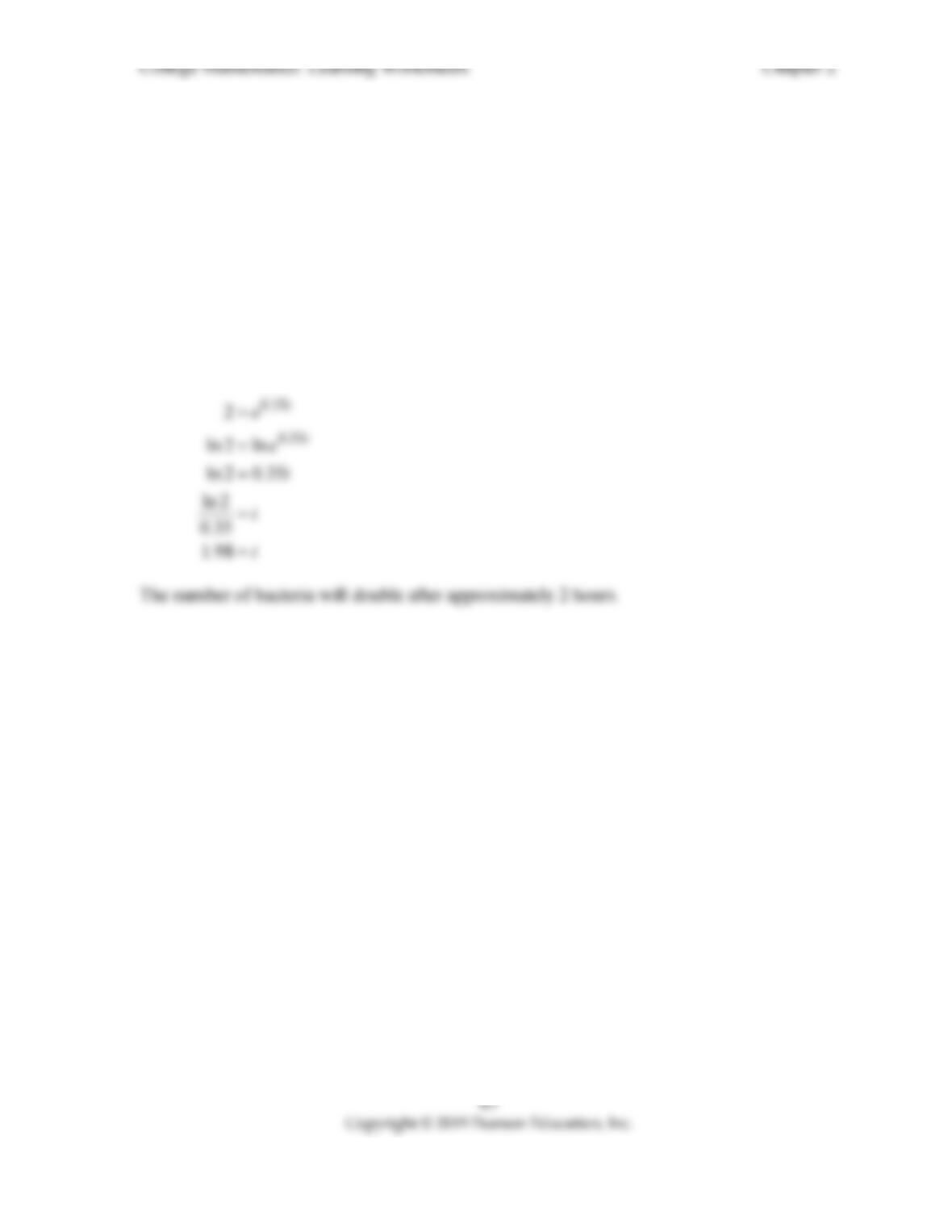

30. The number of bacteria present in a culture at time t is given by the formula
0.35
20 t
Ne, where t is in hours. How many bacteria are present initially (that is when
t = 0)? How many are present after 24 hours? How many hours does it take for the bacteria
population to double? (Round your answers to nearest whole number.)
Initially, there are 0.35(0) 0
20 20 20Ne ebacteria present.
After 24 hours there will be 0.35(24) 8.4
20 20 20(4447.066748) 88,941Ne e bacteria
present.
0.35
0.35
20
40 20
t
t
Ne
e


College Mathematics: Learning Worksheets Chapter 2
68