Solutions for Web Chapter 19: Questions and Problems
WEB CHAPTER 19
ANALYSIS OF FINANCIAL STATEMENTS
Answers to Questions
1. The kind of decisions that require the analysis of financial statements include whether to
lend money to a firm, whether to invest in the preferred or the common stock of a firm,
2. Analysts employ financial ratios simply because numbers in isolation are typically of
little value. For example, a net income of $100,000 has little meaning unless analysts
3. A major problem with comparing a firm to its industry is that you may not feel
comfortable with the measure of central tendency for the industry. Specifically, you may
feel that the average value is not a very useful measure because of the wide dispersion of
4. In general, jewellery stores have very high profit margins but low asset turnover. It could
take them months to sell a 1-carat diamond ring, but once it is sold, the profit could be
5. Business risk is measured by the relative variability (i.e., the coefficient of variation) of
operating earnings for a firm over time. In turn, the variability of operating earnings is a
Solutions for Web Chapter 19: Questions and Problems
6. The steel company would be expected to have greater business risk. As discussed in
Question #5, sales variability and operating leverage are the two components of business
7. When examining a firm’s financial structure, we would also be concerned with its
business risk. Since financial risk is the additional uncertainty of returns faced by equity
8. The total debt/total asset ratio is a balance sheet ratio that indicates the stock of debt as
compared to the stock of equity. While the total debt/total asset ratio is a common
measure of financial risk, many analysts prefer to employ the fixed charge coverage ratio,
9. Growth analysis is important to common shareholders because the future value of the
firm is heavily dependent on future growth in earnings and dividends. The present value
of a firm with a growing dividends payment is:
Solutions for Web Chapter 19: Questions and Problems
10. The rate of growth of any economic unit depends on the amount of resources retained and
reinvested in the entity and the rate of return earned on the resources retained. The more
reinvested, the greater the potential for growth. In general:
11. Assuming the risk of the firm is not abnormally high, a 24% ROE is quite high and
probably exceeds the return that the equity investor could earn on the funds. Therefore,
12. Growth, as predicted by the sustainable growth rate (retention ratio × ROE) has two
13. External market liquidity is the ability to buy or sell an asset quickly with little change in
price (from prior transaction), assuming no new information has been obtained. The two
14. Some internal corporate variables such as the total market value of outstanding securities
and the number of security owners are good indicators of market liquidity. If the firm has
a fairly large number of shareholders, it would be very likely that, at any point in time,
Solutions for Web Chapter 19: Questions and Problems
– 148 –
15. Student exercise, so answers will depend upon what limitations the student chooses to
discuss. Some possibilities are:
• Flexibility in choosing which GAAP to use and how to apply them
Solutions for Web Chapter 19: Questions and Problems
– 149 –
WEB CHAPTER 19
Answers to Problems
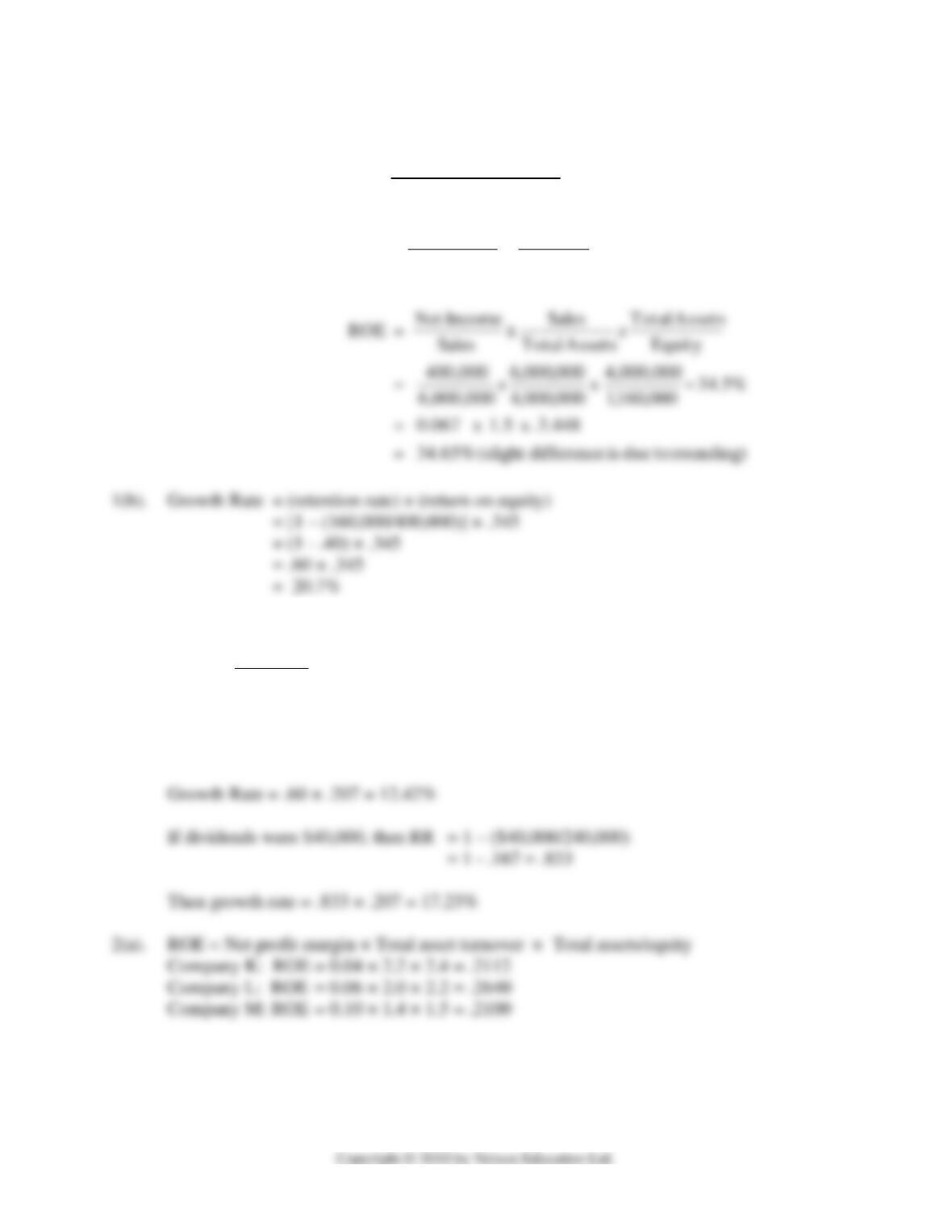
1(a).
1(c). 0.04 × $6,000,000 = $240,000 (profit margin × sales)
1(d). Using the ROE of 20.7 in part c) and a net income of $240,000, we have
:components 3 theusingor %5.34
000,160,1
000,400
Equity
IncomeNet
Equity Totalon Return
===
20.7% 3.45 x 1.5 x 0.04 ROE
20.7%
1,160,000
240,000
ROE
==
==
Solutions for Web Chapter 19: Questions and Problems
– 150 –
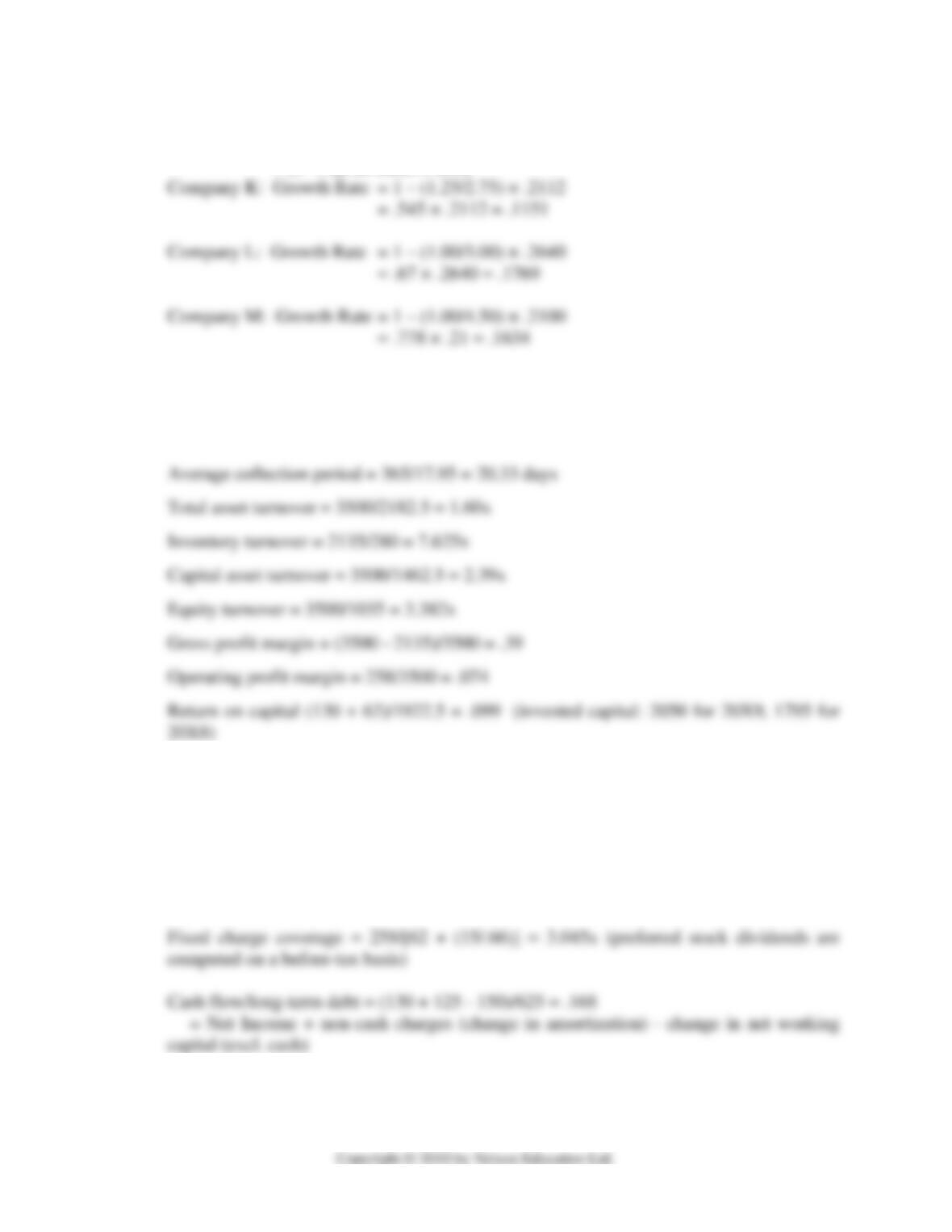
2(b). Growth Rate = Retention Rate × ROE
= (1 – Payout Rate) × ROE
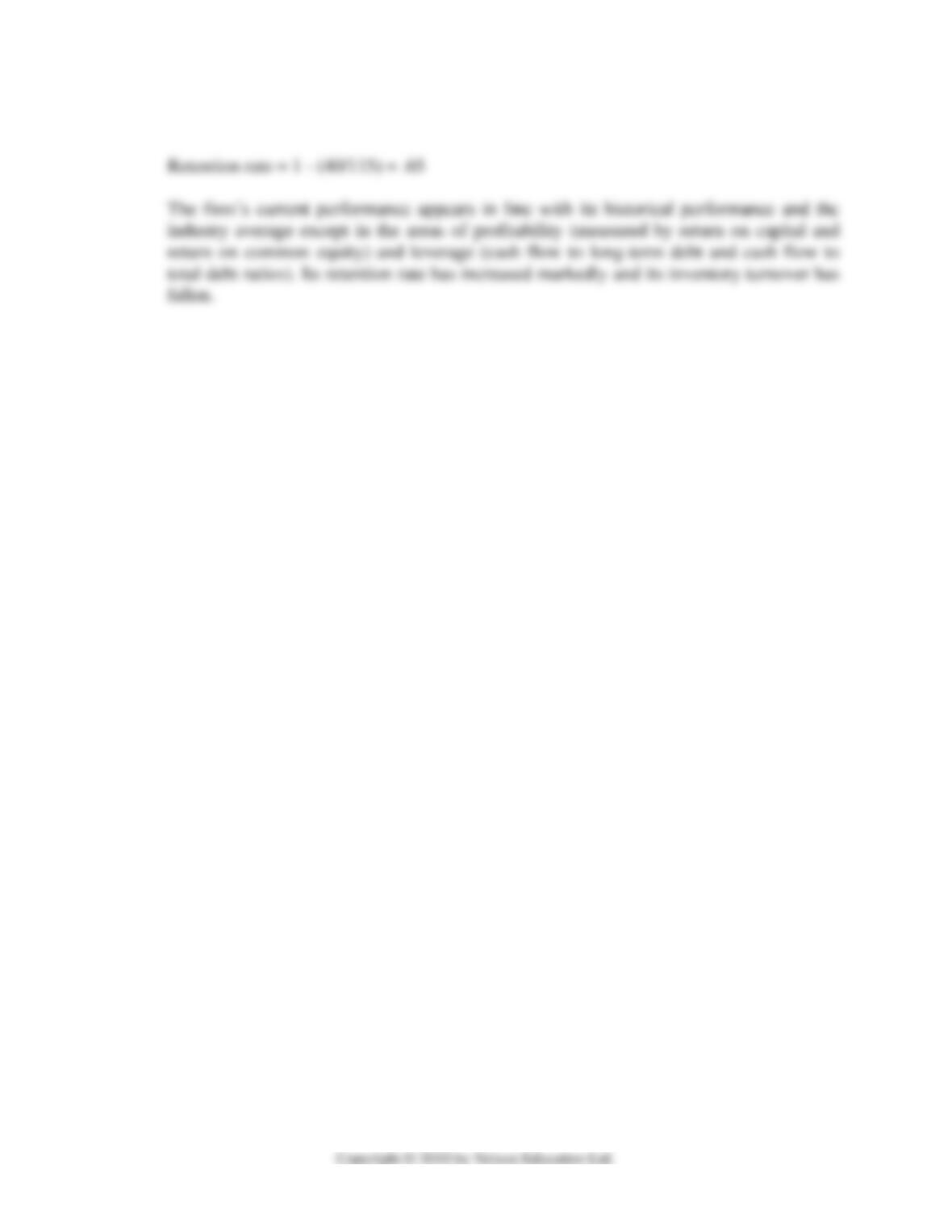
3. Current ratio = 650/350 = 1.857
Quick ratio = 320/350 = 0.914
Receivables turnover = 3500/195 = 17.95x
Return on equity = 130/1185 = .109
Return on common equity = 115/1035 = .110
Debt/equity ratio = 725/1225 = .59
Debt/total capital ratio = 725/1850 = .372
Interest coverage = 258/62 = 4.16x
Solutions for Web Chapter 19: Questions and Problems
– 151 –
Cash flow/total debt = (130 + 125 – 150)/975 = .108